







Abstract
By focusing on the pharmaceutical or pharma industry in Khyber Pakhtunkhwa, Pakistan, this study empirically assesses the effects of macro-environmental risks on organizational self-development. The pharma industry in that area suffers from electricity shortages, parliamentarian transience, and terrorism and counterterrorism acts. Through a survey instrument, data were collected from pharma supervisory personnel and analysed via the PLS-SEM technique. The results confirm the adverse effects of macro-environmental risks on organizational self-development. Ergo, the article urges local parliamentarians to encourage egalitarianism, to mitigate terrorism and counterterrorism acts, and to enable the provision of electricity as well as organizational securities that can sequester the disadvantageous effects of macro-environmental risks. The study offers directions for future research and recommendations for policy-making that can help business professionals with their self-development capabilities.




Introduction
Organizations operate within specific environments, each with its challenges, opportunities, and risks [1]. Environmental circumstances that is, those are not controllable by a firm’s management, such as internationalization, technology advancement, socio-cultural changes, government policies, and parliamentarian transience have significant effects on organizational self-development [2]. Firms’ managers should be able to identify and deal with such problems in the macro-environment from legislators, competitors, and customers [3].
Dynamic processes underlie internationalization and can be both opportunities and threats for an organization [4, 5]. For example, technological advancement in transportation and communication facilitates organizations’ ability to target international markets efficiently, but entrance into an international market also comes with many challenges. Having sophisticated technological capabilities helps businesses mitigate the effect of the external environment, concentrate on market changes, adopt new technologies accordingly, and align organizational strategies to deal with new challenges [6].
A few economic experts have studied environmental risks and explored these risks negative relation with organizational self-development (e.g., [7]), and game-theorists have analysed terrorism and its effects on the economy [8]. Furthermore, [9] studied the nature of the fundamental relation between energy and economy and found that energy is a vital source of economic growth and production.
Firms can reduce environmental risks through self-governance and self-organization initiatives. Self-governance can restore the balance of power when organizations formulate their own economic and social well-being and future planning, while self-organization encourages the organization to make decisions for their regulation. Through self-organization, intrapreneurs decide on an appropriate approach to decision-making. The constitution of Pakistan permits people in tribal areas to be self-determinant and to govern themselves to provide services to their communities. The regulations established by local communities are more effective because the local communities have complete information about their resources and norms that should be considered in designing rules and regulations [10]. Organizations can increase their performance by developing themselves, as the best development for organizations and humans is self-development [11]. Organizations with self-governance and self-organization are free of government control, thereby reducing the effect of the macro-environmental risks to a significant extent.
Since inception, Pakistan has faced challenges like security threats and parliamentarian transience, so destabilization of the domestic peace, the economy, and the country’s structure have resulted. Pakistan’s physical infrastructure and security conditions have been severely damaged by “Talibanization and military operations against militants, particularly in Khyber-Pakhtoonkhwa and federal administration tribal areas (FATA)”. The energy crisis has also been a severe problem that has affected the nation’s overall development. The country’s authenticity and reliability have declined because of the increasing energy crisis. These macro-environmental features have led to the destabilization of the industry.
While Pakistan’s external environment contains several macro-environmental risks, we address parliamentarian transience, terrorism and counter-terrorism acts, and electricity shortage as macro-environmental risks that affect organizational self-development. This study is the first of its kind, particularly in the context of Pakistan.
Furthermore, emphasizing limitation of the paper, this study covered only three macro-environmental risks, so future researchers could expand the study by focusing on other kinds of macro-environmental risk.
The rest of the article organized as follows. Section 2 consists of a comprehensive examination of the literature, covering the concepts of macro-environmental risk and organizational self-development. Section 3 describes the paper’s methodology, while Section 4 addresses the evaluation and assessment of the measurement model, and Section 5 concludes.
Literature review
Macro-environmental risks
The external environment is consist of macro-environmental risks that surround business organizations [12]. Macro-environmental risks can be divided on the basis of industry size and the industry’s current condition, such as economic situation. It usually takes a long time to fully interpret the economic environment and identify the opportunities it affords an organization, such as the opportunities that result from economic growth. A country system is a skeleton of rules and laws within which an organization works that give the organization direction for smooth, efficient, and effective functioning. Policymakers must grasp the limits of the lawful skeleton before making decisions.
Doing business without taking risks is difficult, so an organization must have a logical approach to dealing with the identification, analysis, and mitigation of risks. A company with the ability to innovate and manage risk can improve its chances of survival in its competitive market. Management must cultivate the ability to minimize risk or the impact of risks [13].
Hypothesis 1
There is a negative relation between organizational self-development and electricity shortage.
Electricity shortage is a hurdle for economic growth, domestic development, and profitability in Pakistan, and it raises the poverty level and reduces foreign direct investment. Electricity shortages hurt all sectors of the country. [14] found a loss of industrial output caused by electricity shortages or load. Electricity shortages have paralyzed the industrial, agricultural, and commercial sector and adversely influenced everyday life [15, 16]. Energy is one of the primary sources of industrial development and a fundamental need for production and economic growth [17]. Sufficient energy production is imperative for economic, environmental, and social development and is considered the backbone of sustainable economic growth [18, 19]. Economic development and quality of life improve with a continuous supply of electricity [20]. However, access to electric power becomes limited when it comes at a high cost, and the system is decentralized [21]. When the electricity crisis worsens because of poor governmental policies, the country’s economic development is negatively affected. These conditions in the country discourage private investment and lead to the failure of industrialization and organizational self-development.
Hypothesis 2
Organizational self-development and parliamentarian transience are negatively related.
Parliamentarian transience countries lose the confidence of their communities because of insincere leadership and government authorities. Nations with parliamentarian instability lose their ability to promote innovative systems, to sustain foreigner investors, and to encourage new investors. The government must be safe from public disturbance and illegal events to attract investors and sustain an industrialized environment that promotes organizational self-development through improvement in technologies and products. Researchers are willing to evaluate the effects of parliamentarian transience on the entrance of multinational companies and how to mitigate or reduce this affects through joint ventures with authorities [22]. Empirical studies have stated that parliamentarian transience has a negative relation with organizational self-development, and control of governments by illegal authorities hurt business. In the past decade, several issues have led to parliamentarian transience, such as student uprisings in China, militancy, and martial-law in Pakistan, activism in India, the disintegration of Yugoslavia, war in Bosnia-Herzegovina, religious, racial, and ethnic conflict in Haiti, student uprisings in Rwanda, and the ongoing Arab-Israeli conflict. Many countries are facing parliamentarian transience that arises from illegal behaviors of state authorities that discourage investors. The uncertainties of government and securities is a serious issue for economic growth and self-development [23]. Parliamentarian transience indicates a government’s inability to survive. According to a worldwide survey conducted on parliamentarian risk in 2011 by MIGA-EIU, 15–25 percent of organizations withdraw their investments from unstable countries and industries. Pakistan’s government and authorities are unable to provide a safe environment for international and national investors, as investors have experienced electricity shortages, militancy, corruption, and economic instability in Pakistan. Because of these hurdles, foreign and domestic investors’ perceptions of Pakistan is negative, and even the private sector industries are switching to other countries. Foreigner investors are avoiding long-term investment in Pakistan because of parliamentarian transience.
Hypothesis 3
Organizational self-development and terrorist and counter-terrorist acts are negatively related.
Terrorism and counter-terrorism acts threaten national and international business activities directly and indirectly and become more complex and dangerous with the passage of time. Business centers become more attractive targets for terrorism, so terrorism is a threat to organizational self-development. After the 9/11 attacks on the World Trade Center, research focused on Al-Qaida and religious militancy, the definition of terrorist and counter-terrorist acts, and how to address them [24]. The term terrorism comes from the 1790 French revolution but now has changed to refer to violence against civilians to creates uncertainty [25]. To investigate the effect of terrorism and counter-terrorism acts on organizational self-development, we developed hypothesis 3. Terrorism is planned violence or threats of violence to create fear in citizen and governments [26]. Management of the risk of terrorism and counter-terrorism acts is crucial for business [27]. Terrorists draw support from various sources, sometimes including governments. Terrorists are social, non-state actors who influence politics through violence. In 2003, 164 people in Pakistan were killed by terrorists, a number that increased to 3,500 in 2010. Thus, Pakistan may eventually be abolished by these acts of militancy. Pakistan’s army has initiated a variety of operations against terrorists and fighting in tribal areas and is a coalition partner with the United States in a war against the Taliban and Al-Qaida [28]. Terrorism and counter-terrorism acts have an adverse effect on the country’s economic growth, as the GDP rate is sensitive to acts of terrorism and counter-terrorism. GDP loss leads to parliamentarian transience [29], as the national economy is severely affected by erratic economic policies, and terrorism, bomb blasts, militancy, army enrollments, and parliamentarian transience. After 9/11, Pakistan’s image declined, with even local investors moving to more regularized markets [30]. Terrorist incidents causes inflation, effects trade and reduces industrial performance.
Organizational self-development
Most of the literature on growth and development is quantitative, defining development in terms of an increase in amounts, such as increases in entries into new markets and new products. The indicators used to measure development in empirical studies have included asset size, output quantity, profits, market share, sales, and a number of employees. Organizational performance has been measured using growth in sales, employment and asset value, profit, output, level of production, and market share. An organization that grows in these ways provides more job opportunities [31], plays a significant role in the economic growth of a country and promotes innovation. According to [32], organizational self-development is a behavioral science, so organizational targets need a highly egalitarian and humanistic approach. People and collaboration are the bases of organizational self-development, so many interventions and elements are required, including team-building, training, monitoring, diagnostics, strategic thinking, performance management, and talent management. The strategic management perspective, the stochastic model, the industry economic perspective, and the stage model are four theories of organizational effectiveness. The industry economic perspective theory addresses how to increase an organization’s production, while the stochastic model explains the components that affect an organization performance [33]. There are deterministic approaches to determine the internal and external elements that influence organizational self-development. Motivation theory indicates why an individual is motivated to improve performance, while the theory of planned behavior explains the relationship between an organization’s intended and actual development [34].
Research methodology
The Pakistan Pharmaceutical Association reports that there are 265 pharmaceutical companies with 755 manager-level employees in Khyber-Pakhtoonkhwa. For empirical analysis, the data were collected through a self-administered questionnaire through a simple random sampling technique. Respondents were asked for their perceptions on issues using a five-point Likert scale from strongly agree to strongly disagree. A sample item for OSD, ES, PT, and TI (α= 0.820, α= 0.900, α= 0.845, and 0.888 respectively) is the relation between macro-environmental risks and organization performance. Manager-level employees were the unit of analysis, and Structural Equation Modeling (PLS-SEM) was used to test the collected data. Partial Least Squares (PLS) is a favorable alternative to covariance-based SEM, especially in cases of small sample sizes [35]. The present study adopted the PLS-SEM statistical approach proposed by [36] to evaluate a two-stage performance. The PLS-SEM approach was considered suitable for this study, as this study focuses on predictions, the selected research model has a complex structure, and the study’s sample size is relatively small.
Evaluation and assessment of the measurement model
The estimated results shown in Table 1 indicate that the measurement model used in this study has the essential requirements. First, all the reflective items are significant, and all of the loadings items are above 0.50. The study adopted an item-trimming procedure because of some weak items or weak loadings, but they were retained to support the content validity of the scale. Second, as [35, 36] suggested, we used composite reliability to establish internal consistency and assess the composite reliability of the constructs. The estimated results are shown in Table 1 confirm the construct reliability, as their values of composite reliability exceed 0.70. Third, the average variance extracted (AVE) of all latent variables is higher than 0.50, so they meet the requirement of convergent validity.
The Measurement model
The Measurement model
Note: The items were removed from the final version of the construct and not used in the structural model; All loadings are significant at 0.001 level (2-tailed); rho_A = rho indictors; VIF = Variance Inflation Factor.
Finally, discriminant validity shows the extended construct that is distinct from other constructs by empirical standards. This study follows three criteria to estimate discriminant validity: (i) The Fornell-Larker criterion is met because the square root of each AVE is higher than the correlations (Table 2). (ii) Cross-loadings are another approach to estimate discriminant validity. The outer loadings of all items are higher than their loadings on other constructs. (iii) The study also upholds the HTMT criteria because all values are under the threshold of 0.90 (Table 3).
Measurement model. Discriminant validity
Notes: ES = Electricity Shortage; OSD = Organizational Development; PT = Parliamentarian Transience; TCA = Terrorism and counter-terrorism acts.
Cross Loadings
For evaluation of the structural model, this study relies on [35]. First, the study performs the collinearity assessment using variance inflation factors (VIF). Then the structural path coefficients are investigated through application of a bootstrapping procedure. Next, the coefficient of determinants (R2) is determined to explain the model’s predictive accuracy and endogenous construct. Finally, the effect size (f2) is estimated, and Q2 is evaluated to find the predictive relevance of the model.
That the VIF values are less than 5 confirms that collinearity is not an issue among the predictor constructs in the model. The resampling bootstrap method with 5000 selected samples is applied; the bootstrapping procedure offers standard errors and confidence intervals to find the statistical significance of the variable.
The study also determined the f2 effect size. The f2 values of electricity shortage (ES) (0.07), organizational self-development (OSD) (0.1), and parliamentarian transience (PT) (0.17) are small, medium, and large respectively. Finally, the blindfolding procedure is used to assess the Q2 value. The estimated results in Fig. 1 reveal that all Q2 values are considerably higher than zero. These results support the model’s predictive relevance of the endogenous latent factors. The calculated results’ t-value and p-value (t = 3.635, P = 0.000 for ES-OSD), (t = 7.639, P = 0.000 for PT-OSD), (t = 1.950, P = 0.051 for Terr and counter-terrorism acts-OSD) reveal that all three construct hypotheses are supported and accepted.
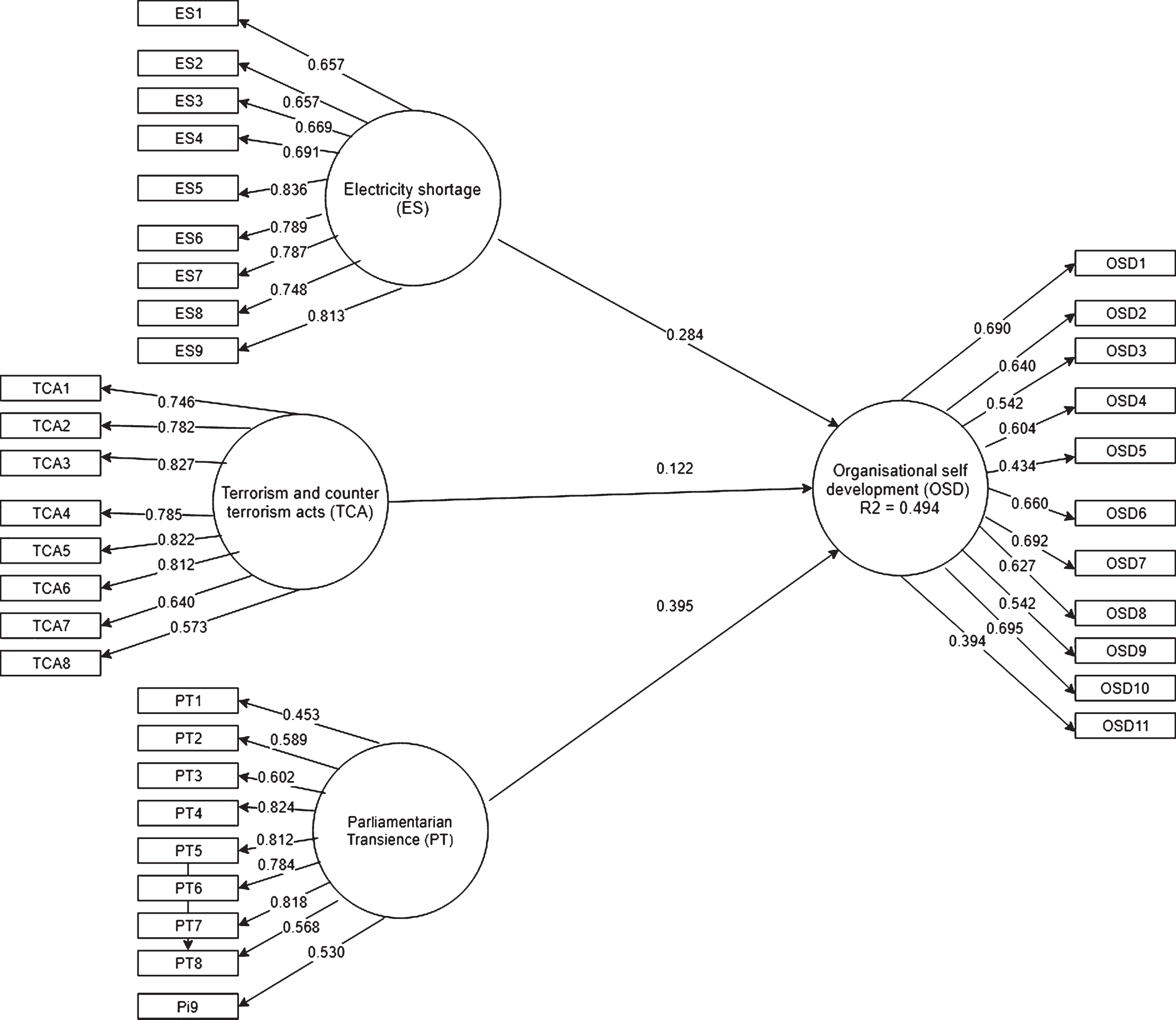
Results of Structural Model.
Pakistan’s economy has suffered declining economic conditions because of the war against extremism. Facing domestic inflation, slow economic growth and significant deflation of the currency against the major currencies. We have discussed three critical issues in Pakistan: the electricity shortage, parliamentarian transience, and terrorism and counter-terrorism acts. The estimated results show that macro-environmental risks have a negative effect on organizational self-development. Electricity shortage is a primary source of the self-development. The results of our analysis show a negative relation between electricity shortage and organizational self-development (t = 3.635, P = 0.000), which supports hypothesis 1. This finding aligns with [37], who found that electricity shortage negatively affects organizational performance. The result is also in line with [38], who focused on the relation between organizational performance and environmental risks and found that macro-environmental risks not only affect citizens’ social lives but also have a negative impact on organizations’ activities. According to resource dependency theory, the organization’s environment is a source of organizational self-development.
The international management literature has shown that most private enterprises focus on the effects of parliamentarian transience. The estimated results are reported in Table 4 (t = 7.639, P = 0.000), which shows that parliamentarian transience negatively influences organizational self-development. Multinational firms and investors look to make their businesses safe from the adverse outcomes of parliamentarian hazards. The organization seems into the state institutional profile before investment like (parliamentarian transience and regulatory authorities) [39]. When we talk about the relation between parliamentarian transience and organizational performance, we are using the evidence that validates hypothesis HII, which indicates that there is a negative relation between parliamentarian transience and organizational self-development. This finding is supported by [40] and is in line with [41], who revealed that parliamentarian transience has adverse effects on organization self-development.
Results of structural model path coefficients
Results of structural model path coefficients
BCCI = Bias Corrected Confidence Interval (based on n = 5000 subsamples).
Terrorist attacks significantly reduce the birth of new businesses, as entrepreneurs move away from affected areas. A similar situation can be observed in areas with the high crime rates. The results of the study show that organizational self-development has a negative and significant relation with terrorism and counter-terrorism acts (t = 1.950, P = 0.051). This finding is in line with [42], and similar findings are shown in [43], who argued that an organization with high costs to overcome the fear of terrorist attacks are unable to change their behavior. The present study suggests that policymakers should concern themselves with the consequences of losing business activities because of violence.
Therefore, the companies that can hide and manage macro-environmental risks should be able to deal with threats and grasp opportunities. Organizations’ adaptation to the environment is the most important predictor of sustained organizational performance.
This study quantifies the effect of terrorism and counter-terrorism acts, parliamentarian transience, and electricity shortages on organizational self-development. The results show that macro-environmental risks have an adverse and significant effect on organizational self-development. Daily terrorist attacks, electricity shortages and parliamentarian transience create hurdles for organizational self-development. The study’s findings reveal that electricity shortages negatively affect organizational productivity, innovation, and profitability, so organizations must mitigate these external risks.
To attract foreign investors, the government must provide a sound rationale for tariffs and develop the competitive energy market. The government should manage the energy crisis issue properly for encouraging organizations to adjust employees’ working hours. A government should also work to provide a continuous and adequate supply of energy to industrial areas to encourage industrialization. Parliamentarian transience negatively affects organizational performance, so a smooth parliamentarian environment is essential to the development of industries and to attract investors. Government authorities should encourage egalitarian environments, clear policies, and a regular tax system to indicate the country’s stability and provide opportunities for self-governance to promote organizational performance. Through self-governance organizations may able to install technologies that help to mitigate the problem of electricity shortages. The state should also promote activities that can help to stabilize the government. At present, terrorism and counter-terrorism acts are serious issues in Pakistan that have led to the economic situation in Pakistan worsening day by day. To mitigate terrorism and counter-terrorism acts, the government, the military, and religious leaders should contribute to making the country an acceptable place for foreign investors. Self-governance and self-organization increase organizational efficiency. The government must ensure the security of the organization and their employees, which would help to limit macro-environmental risks and sustain investors.
Limitation of the study
This study covered only three macro-environmental risks, so future researchers could expand the study by focusing on other kinds of macro-environmental risk.