







Abstract
This Study investigates the role that agricultural cooperatives play in advancing entrepreneurship for increased food security and income, in the rural areas of developing countries. It examines cooperative member self-efficacy, entrepreneurship skills and attitudes, through self-evaluation of cooperative viability. Ergo, this article uncovers the challenges, local solutions and sources of resilience in the agricultural cooperatives of developing countries. Collected through a survey, primary and secondary data were analyzed using SPSS 23, and content analysis was performed on qualitative data. The results reveal a high self-efficacy for cooperative members and a high motivation for market development and profitability. Agricultural cooperatives lag behind in information and communication techniques (ICT), and have a limited capability to resolve challenges, yet they achieve income higher than the national average income per head per year. Despite its limitations, the study urges cooperatives to reject economic growth models that damage the environment and promote short-term economic growth against environmental susstainability. Future research directions and policymaking recommendations pertain to the need for innovation, self-coordination, and openning up and sharing to accompany economic, social, cultural and political self-development, in ways that respect, protect and adapt to nature, through resource conservation, restoration and protection.


Introduction
Background and significance
The food price crisis of 2008 increased global awareness of the challenge of how to feed the world by 2050 given the need to increase food availability by 60% to meet the rising demand for food due to population growth and other influences. As a result, Agriculture has received additional attention from global and national policy makers. Food insecurity is a problem that has beset many developing countries. In order to ensure food availability, accessibility and its proper utilization at all levels of society is a task of all governments. Agriculture remains a critical sector of these countries’ economies and the need to invest and expand its output in line with growing food demands cannot be ignored.
Malawi is among the poorest countries of the world. The country ranked position 153 of 182 countries of the world in 2010 and slipped to position 173 in 2013, with a life expectancy of 54 years at birth, while noting that more than half the countries below it were either recovering from conflict or other state failures [1]. Whilst 20years after independence in 1964 the country was able to produce all its food requirements, it can no longer produce or commercially purchase the food it needs today. Malawi’s risky food security situation is closely linked to its economic development challenges, while the effects of slow economic growth and macroeconomic problems on livelihoods and food security are directly linked to poverty. The Malawi fourth integrated household survey [2], reported 53% of the population living below the poverty line (subsisting on less than US$1.90 per day) and 40% of GDP deriving from Agriculture despite the fact that 85.1% of the economically active population was employed in it. Agriculture provides 90% of total foreign exchange earnings. Agriculture provides 60–70% of inputs to the manufacturing sector which dominates the commercial and distribution industry [3]. The performance in the agricultural and rural economy is a critical component of food security and overall economic growth for the country. Malawi’s agriculture sector however, is faced with many challenges: low agriculture technology adoption; transportation problems; poor quality seeds; poor adoption of technologies; postharvest losses; scarce financial resources; climate change; weak uptake of improved farm inputs; weak links to markets; small land holdings for cultivation; unavailability of credit facilities and inefficient market systems and outlets; over-reliance on rain fed agriculture production; weak agriculture extension services; declining soil fertility; an increasing population; rising prices of farm inputs; prolonged dry spells and droughts and floods. The performance of Malawi’s Agriculture has been quite unsatisfactory, marked by low rates of growth and extending of inescapable rural poverty and food insecurity [4], rendering the country to high vulnerability to shocks that have given rise to acute food insecurity with increasing frequency over the recent years. Commercialization of resource-poor smallholder farmers is closely linked to higher productivity, greater specialization and higher incomes. These outcomes contribute significantly to improvements in household food security, poverty reduction, agriculture development, and economy-wide growth [5]. However, with imperfect markets and high transaction costs many resource-poor smallholder farmers do not ably exploit the potential gains from commercialization [5].
Deliberate policies and strategies are needed to address these problems and increase smallholder participation in markets to ensure that they realize the benefits of market participation. Rural producer organizations (RPOs) have re-emerged as one mechanism that governments, development agencies and scholars are showing renewed interest in to promote inclusive and equitable growth and poverty reduction [6]. This has brought expectations that by leveraging collective action, RPOs can help smallholders aggregate their output, achieve scale economies in marketing and bargain for better terms of trade in the marketplace, serve as means of reaching the rural poor people and provide partnership for inclusive State programs and other non-governmental projects to improve rural welfare and livelihoods [7].
Research problem
The performance and sustainability of RPOs in developing countries is contentious. Some reports indicate that to date, no African country has achieved a sustained and large scale increase in staple crop yields as a result of RPOs and many cooperative development programs have failed to achieve their purposes or have even been counter-productive. However, there is an increasing number of emerging RPOs and a renewed interest in them by both governments and their development partners. High quality and rigorous evaluative studies exist, but are relatively more scarce than in other areas and especially do not cover the complexities and expansiveness of approaches to improve agriculture from production to consumption across numerous and diverse pathways. There are still many gaps in evidence around this diversity of approaches, their potential for impact and their cost-effectiveness. The renewed interest that has arisen in cooperatives and other RPOs in recent years demand an examination.
Purpose of study
This article investigates the circumstances that motivate members in cooperatives, assesses the members’ self- efficacy and entrepreneurial knowledge and skills for attainment of higher incomes and food security through empirical research in rural areas of a developing country, Malawi. RPOs are chosen because of their enabling capacity for self-employment and income potential. The study evaluates the effectiveness of the cooperative organization in instilling an entrepreneurial culture and attitudes among its members in rural areas. The findings add to knowledge and understanding of sustainable agriculture and rural transformation and its potential contributions to farmers’ livelihoods and food security in developing country contexts for rural transformation and growth. This will enable decision makers to ground their decisions related to policies and investments on evidence to ensure that their organizations promote the best possible development practices known to the sector. The study will further build on and contribute to the body of knowledge on food security to improve the design and management of interventions in the agriculture, economic growth and nutrition sectors. The findings contribute to the agricultural sector debate among policy makers and stakeholders for its evolving role in agriculture and economy at grassroots.
Study intentions
The specific intentions of this study were to highlight circumstances influencing farmers’ motivation in producer cooperatives in developing countries; to assess the effectiveness of agricultural cooperatives in promoting entrepreneurial knowledge, skills and attitudes and income generation for food security; and to investigate sources of resilience in cooperatives operating in rural areas in a developing country context.
The underlying hypotheses in the study were, first, that there are no circumstances motivating farmers in agriculture cooperatives in developing countries. Second, agricultural cooperatives do not improve rural entrepreneurship knowledge, skills, attitudes and incomes of their members. Third, cooperatives in developing countries cannot withstand disruptions due to natural disasters and other shocks.
Study limitation
This study was conducted in a developing country (Malawi) where, as observed elsewhere, “agricultural cooperatives in developing countries are forced to form themselves and to function under inhumane, top-down imposition of the aye- unnatural and faulty, bureaucratically-hierarchized authority and power sham, a delusion of organization that subjugates and enslaves people, in lieu of a pragmatically ecological decision-making structure of collegial control and responsibility” [8]. In worldwide response, pioneering business enterprises and other societal organizations in many industries are transforming themselves into truly ecological decision-making structures of collegial control and responsibility [8].
Concept and principles of a cooperative
Different definitions of what is a cooperative exist [9]. These vary from source but most agree that a conventional cooperative is one that provides service at a cost; is democratically controlled by its member-patrons; and limits returns on equity capital. It is also a special type of business organization serving those who are at the same time owners and users of its services. A cooperative “is a voluntary closed organization in which the decision-control and risk-bearing functions repose in the membership, and decision management reposes in the agent (board and manager), who represent the principal’s interest”. Working individually or as institutions, cooperatives are associations of people who work together to achieve certain commercial aspirations for mutual benefit of users (member-patrons). From these definitions, three common characteristics of a cooperative are cooperation in an economic activity; conducted for the need of its members and is owned and controlled by these members. It is emphasized that “a cooperative is an organization formed by a group of people who meet voluntarily to fulfil mutual economic and social needs through running a democratically controlled enterprise such that the benefits achieved through cooperation are greater than the benefits achieved individually” [10].
Overview of cooperative movement in Malawi
Cooperatives in Malawi date back to the colonial era and were introduced by the British based on their experiences in Asia. The motivation was to incorporate the natives into the cash economy, boost production and export of cash crops and encourage them to pay taxes [11], through the enactment of the Cooperatives Ordinance and Rules of 1946. The very first cooperatives to register under these rules were the Chintheche Meat Trading Cooperative Society in Nkhata Bay in the North of the Country and Lingadzi and Mbadzi Mutual Cooperative Limited in Lilongwe, Central Malawi. However, many of the early cooperatives did not succeed due to low levels of education among the general membership, poor agriculture extension services, lack of business and people management skills, government interference and a general lack of financial literacy necessary for efficient operation of the cooperatives. Paradoxically, the number of new cooperatives kept rising, reaching 48000 members in 181 cooperatives at independence in 1964 although of these, only 132 were active [11]. After independence in 1964, the cooperatives were coerced to suit government priorities and the political and directives of the State at the exclusion of the general membership [12]. Later, Cooperatives came to be viewed as a political threat to the government and political party establishment, eventually leading to their dissolution and subsequent closure of the Cooperative College at Mpemba (1962–1966) which had been established to meet education and training needs of cooperatives as government switched focus away from smallholder farmers to the estate subsector favoring large private investors and government controlled companies to lead growth in agriculture [11]. The Malawi Development Corporation (MDC) and Agricultural Development and Marketing Corporation (ADMARC) were tasked to lead this shift away from smallholder agriculture as tool for growth. Similar as in other countries in Africa, particularly Mali and Tanzania [13]. However, in the 1970 s, Savings and Credit Cooperatives were encouraged and continued providing personal and business loans to low income individuals with little or no collateral and putting them under one umbrella body called the Malawi Union of Savings and Credit cooperatives in 1980 to coordinate and promote their development. Thus, the post-independence era did not develop the cooperative movement, instead it turned it into a socio-control instrument by co-opting the leaders into the political structures and work with the then only and ruling Malawi Congress party [14]. After the fall of autocratic government in 1994, the new multi-party government recognized the need for local initiatives and participation for self- reliance. The Ordinance Act of 1946 was transformed and enacted into the Cooperative Development Policy in 1997 aspiring to enable cooperatives to become efficient business institutions for mobilizing people, as well as financial and material resources [15] and providing greater autonomy for cooperatives by reducing the powers of the Registrar of Cooperatives in the Ministry of Trade and Industry. Supportive subsequent legislation followed to anchor cooperatives, including the 1997 Competition Policy, the 1998 Local Government Act, and the 1998 Decentralization Policy and the 1998 Integrated Trade and Industry Policy. The Cooperatives were then incorporated into the Malawi Growth and Development Strategy Paper in 2002 followed by the development of the Cooperative Societies Regulations. By 2012 there were 681 registered cooperatives in the country, 382 of them in agriculture [16].
Methodology
The study was conducted in Malawi in Sub-Saharan Africa and focused on people whose livelihoods derive from farming on landholdings in the cooperatives. Both male-headed and female-headed households were randomly selected. A total of 315 households were surveyed, comprising 162 households (51.4%) in Zomba district in the southern region and 153 households (48.6%) in Dedza district in central region. The two districts were chosen to ensure variability among research subjects as the districts have different poverty levels. Malawi has 52.4 % of the population living below the poverty line. Of these, 10.2%, 38.1%, 40.4% are from the rural north, center and south of the country respectively and remaining 11.3% are from the urban areas. This means that half of the poor people in the country live in rural south in the country, one in every three poor people comes from rural areas of central region while one in ten poor people comes from the northern region [17]. And going by poverty headcount and percentage distribution by Malawi’s poor and ultra-poor people by district, Zomba district has 70% rural people as poor and Dedza has 54.6% of rural people as poor. We selected Domasi rice cooperative in Zomba and Bwanje valley rice cooperative in Dedza for the study to assess the impact of these cooperatives on their members’ livelihood and entrepreneurial knowledge and skills for income generation and implications on their households’ food security. A structured questionnaire and checklists were used to collect data. The questionnaire sought information on socio-demographics, economic livelihoods, entrepreneurship knowledge and skills and agronomic issues. It also sought information on cooperatives’ problems, solutions and sources of their resilience. This information was captured on checklists for focus group discussions and prime informants. Focus group discussions comprised members of cooperative management, extension officers and members of the cooperatives. Employed managers of the cooperatives were prime informants. Enumerators were used to collect data after training them in data collection using structured questionnaires and semi-structured interviews in households and focus group discussions. Enumerators were engaged in pretesting and evaluation of the flow of questions in questionnaires and checklists. All data were entered and analyzed with aid of SPSS 23 and Excel computer packages for quantitative descriptive and inferential statistics. Content/thematic analysis was applied on qualitative data. Cronbach alpha coefficient [18] was calculated to determine internal reliability and consistency of the intruments.
The conception of the study was that through the cooperative organisation members will realise transformation that will significantly increase their incomes, food availability and accessibility and improve their nutritional status through the various services provided by the cooperative organisation. The cooperative is expected to sustainably increase agriculture production and productivity, strengthen market systems and institutions while enhancing coordination and capacity of actors in the sector. The cooperative is expected to organise smallholder farmers and commercialise them by linking with input and output markets through vertical coordination mechanisms such as contract farming, public-private-partnerships and establishing value addition and rural agro-processing centres. Food security is assumed to be reached through increased production which enhances availability, accessibility and diversity and also higher incomes enabling the members to purchase in case of the commodities not being available in their area. This is shown in the viewgraph in Fig. 1.
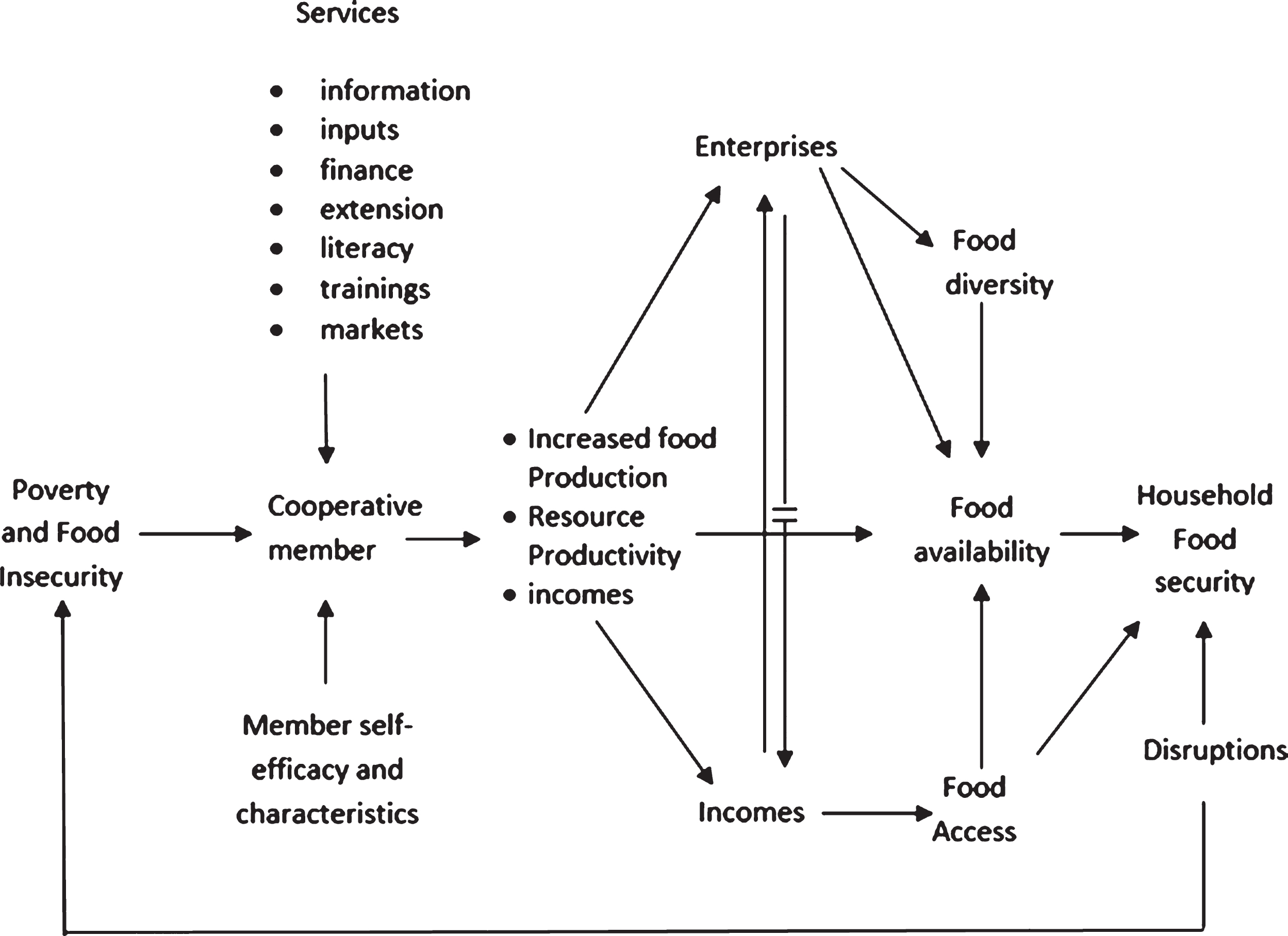
The Conceptual Framework.
Demographic characteristics and profile of respondents
A total of 315 respondents comprising 58.1% females and 41.9% males were interviewed. Of all respondents, 61.3% were household heads with an age range of 16–83years and a mean of 43years old. The majority (90%) of the members were in the productive age group and are household decision makers. 59% of members have attended some primary school whilst 22.5% have not attended any formal school and 10% have reached secondary level education. This means the education level is barely minimum for the majority of the members. This has serious implications on the extension services and adoption of new societal human systems and practices, with multiple causal and mutual interdependencies among its hardware, brainware and support network or net components [8, 19] bearing in mind that transformation will require new skills and higher levels of self-efficacy. It has implications on counselling services for reproductive and other public health practices in the cooperatives, in addition to farm management practices decisions. Most of the respondents have lived in the area for a long time with a mean stay of 37years. Thus, the members have been together enough to be able to establish social anchorage networks that are tied and trusted and can work in the cooperative with greater cohesion [20]. They share religion with 74%, 25% and 1% being christian, muslim and traditional worshipers respectively. In the past five years, 32.7% of households have experienced 1 to 7 deaths of household members of which 23.8% are deaths of children under the age of five. This has serious implications for various activities in the cooperatives and households concerned and extension and health workers. Ninety Percent of households visited have a mean of 5 people per household and mostly (97%) derive their livelihood from farming on average plot sizes of 0.4 ha of land per household in the cooperative whilst the remainder comprises members who initially came to work either as civil servants or working in the rice companies nearby and eventually settled in the area.
Self-efficacy scores of cooperative members
Members of the cooperatives were engaged in self-efficacy tests. This is an individual’s judgement of themselves regarding their own capability to organise and execute courses of action required to attain designated types of job in the cooperative using Bengali’s item-summated rating scale with 5-point rating categories to assess self efficacy [21]. The Bengali scale assesses to what extent the farmer member of a cooperative has belief in self recognition, interest to know new ways of doing things, their ability to compete, whether they consider participation in certain activities in the cooperative as a challenge, whether they are proactive, whether they like imitating new skills and abilities and also whether they understand their social requirements. The 5-point rating categories are 1- to a greater extent; 2- great extent; 3-neither agree nor disagree; 4-less extent; and 5- least extent. A high score indicates high self efficacy of the individual while a low score indicates low self-efficacy level for the participant. The instrument was then tested for reliability using Cronbach’s alpha coefficient. The value of the Cronbach alpha ranges from 0 to 1 and is used to describe the reliability of items used to measure a phenomenon. Our alpha value was 0.657 and Cronbach’s Alpha Based on Standardized items was 0.698. Alpha value of 0.70 is an acceptable reliability coefficient. A higher value indicates a more reliable generated scale [22]. Our Cronbach’s Alpha of 0.657 as well as Cronbach’s Alpha Based on Standardized items of 0.698 are close to the cut-off point and are strong. Hence our scale to measure self-efficacy in this study was a good fit and had an acceptable reliability coefficient and appropriate for the study.
The results revealed that up to 35 percent of members in the cooperative have self-awareness to a greater extent whilst up to 84 percent of members have self-awareness in great extent. This implies that they feel they can undertake activities and take up responsibility in the cooperative. 92 percent of members interviewed expressed huge interest to know new ways of doing things in the cooperative and in life generally. More than half (56%) of the surveyed members consider participation in certain activities in the cooperative as a challenge, but are ready to learn. This may be attributed to their low level of education and introduction of technologies that are too advanced for their quick uptake and use of new farming methods and varieties that require well designed training and extension programs. Up to 80% of the members are proactive in the cooperative, meaning that they have the determination to pursue and attain the intention the cooperative organization seeks to avail for their communities. 87.6% of cooperative members think they have capacity to learn and imitate new technologies and put them into use in their day to day lives.
Circumstances motivating members in the cooperative
Motivation of members in the cooperative is an important element for survival of the cooperative and also recipe for its success [23]. “Member motivation is a sort of glue that allows membership and business volume to be maintained......” Cooperative performance mainly depends on the capacity to build and maintain trust, commitment and confidence among the cooperative members [24]. Member motivation can be determined by different circumstances. In this study our results are summarized in the Table 1.
Circumstances motivating members in cooperatives
Circumstances motivating members in cooperatives
a = 0.05.
Balancing work and family responsibilities is not always easy for cooperative members and remains a challenge for them to meet the competing needs of both family and work. The need to reduce stress and have a healthy family life, healthy relationships at work and a sense of satisfaction about themselves are all important. This is exacerbated by women’s changing roles in modern society and therefore their membership in a cooperative may have a built-in potential for conflict with family roles. A balance of work and family responsibilities is expected to minimize this conflict. Our findings in the cooperatives surveyed indicated that so far there is minimal conflict of this kind and on average, time spent with family is adequate and reported at 3.66 out of 5 on our measurement scale. The cooperative organization has therefore no real disturbance on family and work responsibilities as shown in Table 2.
Work-family balance in households of members in cooperatives
Work-family balance in households of members in cooperatives
Mean scores out of possible 5 (representing 100%).
Mean scores out of possible 5 (representing 100%), see Table 3.
Cooperatives’ members’ entrepreneurial skills and attitudes
Cooperatives’ members’ entrepreneurial skills and attitudes
Mean scores out of possible 5 (representing 100%). Source: Author field survey.
Mean scores out of possible 5 (representing 100%), see Table 4.
Cooperative members’ self-evaluation of cooperatives’ viability
Cooperative members’ self-evaluation of cooperatives’ viability
Mean scores out of possible 5 (representing 100%). Source: Author field survey.
Lastly, we investigated the challenges, local solutions and what the members of the cooperatives think are the influences keeping their cooperatives going on. We used a qualitative approach by engaging in interviews, review of policy reports and previous studies and oral conversations through which we accessed what is important to members and how they think about their cooperative. The policy reports provided the frame for our work and the previous research reports enlightened this study on what is the same and what is different and why. We ensured confidentiality. Focus group discussions and prime informant interviews were also conducted.
Content (thematic) analysis of data was performed. The study was triangulated through interviews, focus group discussions and prime informant interviews and corroborated through comparing the results. Differences provided an important source of our data. The findings of the analysis were then given back to the participants through focus groups to assess how far they considered them to reflect the issues from their perspective. The results highlighted major problems in the cooperative to be in the areas of leadership, access to inputs and markets, climate change and environment degradation, and infrastructure. Declining yields, lack of government support and general membership problems to do with group dynamics were also reported. The findings revealed that leaders have challenges to do with trasparency in their decisions, favouritism, power struggles, corruption and allegations of financial mismanagement. This highligts the problem that we listed in our limitations section of the study that “This study was conducted in a developing country (Malawi) where, as observed earlier, “agricultural cooperatives in developing countries are forced to form themselves and to function under inhumane, top-down imposition of the aye- unnatural and faulty, bureaucratically-hierarchized authority and power sham, a delusion of organization that subjugates and enslaves people, in lieu of a pragmatically ecological decision-making structure of collegial control and responsibility” [8]. In worldwide response, pioneering business enterprises and other societal organizations in many industries are transforming themselves into truly ecological decision-making structures of collegial control and responsibility [8]. The members complained of markets not being readily available and offering low prices although they are faced with high inputs costs and have no access to credit. Unpredictable weather has led to droughts and sometimes flooding, making it difficult to have two harvests in a year. The infrustructure problems relate to inadquate and impassable roads in the cooperatives, transportation problems for both people and produce, and expensive processing and packaging equipment. Group dynanmics problems related to absenteeism from meetings by some members, communication problems and reported cases of thefts in other members’ plots.
The problems above are usually resolved using unreliable collective local wisdom and unscientific methods. Leadership problems are resolved through regular meetings and elections, proper record keeping and asking for leadership trainings from government department of extension services. Access to markets is still a challenge although members rely on cooperative leaders to find markets or take a personal initiative. Access to inputs is approached with informal savings, bulk buying and sometimes selling livestock (which is taken as a form of savings as they cannot access banking services which are far away). It also is dealt with by borrowing although at exploitative rates as they have to pay back at 300% of borrowed amount leading to defaults and hopelessness. Climate change problems have led to members diversifying their entreprises by openning up other businesses rather than farming alone, planting early maturing varieties, organic farming and tree planting, and there is outstanding need for construction of water reservoirs. The problem of infrastructure is huge and far reaching and members alone are helpless to deal with it comprehensively. They often rely on expensive public transport, hiring equipment from local exploitative vendors and do most of the work manually. Issues of land degradation need urgent attention in soil improvements to reverse the situation of declining yields.
Lastly, cooperative members are optimistic about their cooperatives to remain as going concerns. They attribute this resilience to their own cooperation, commitment, unity and communication among members. They assert that with proper checks on leadership, production of quality products, use of new varieties and methods and availability of markets and infrastructure improvements, their cooperatives will last. They claim that there are many other silent benefits from the cooperatives and it is their main source of livelihood and that the skills and knowledge gained are not only useful in the cooperative business, but also in their daily lives in their households. The availability of water and good soils were mentioned to be indispensable assets to protect.
Conclusions
Rural producer cooperatives provide a good platform to promote employment and work that leads to poverty reduction which remains persistently high in developing countries. They are more inclusive, pro-poor and employment intensive and have potential to bring about food security and create further growth through investment diversification. The majority members of cooperatives are in the productive age group (16–62yrs old) with minimum level of education requiring continuous retooling through extension services for real transformation and higher levels of efficacy to be achieved. The high infant mortality rate has serious implications for various activities in the cooperatives and the households concerned, as well as for agriculture extension, education and health services. The high self efficacy scores of the majority cooperative members imply that they are trainable. Cooperatives provide good motivation for their members through economic profitability, improving quality of their products, market development, avoiding technical barriers to trade and their very nature of inclusivity. Cooperatives also avail their members an opportunity to diversify their enterprises and empower them with better entrepreneurial skills and attitudes. Members have a good view of their cooperatives’ survival prospects despite the challenges faced. Members have a good view of the impact of the cooperatives on their families overall, giving them less burden on work-family balance. The use of ICT media and other technologies is still very low in the cooperatives in developing countries, meaning access to information and technologies useful for their business growth is still wanting. Farming remains the major source of income and is supplimented by owning other small businesses or self employment like bricklaying and carpentry. Although there is great talk about remittances from migrant workers abroad to developing countries, we did not find evidence in the cooperatives visited to be enjoying such remittances and investing it in the producer cooperatives. Since average/mean annual incomes for cooperative members are higher than the national average as well as by area of residence figures per head as given by the national statistics office of Malawi (NSO), we also conclude that producer cooperatives not only make the food available for their members but also empowers them to buy in case it is not available in their area and also to utilize the food they get appropriately. With respect to the study limitation, in worlwide response, pioneering business enterprises and other societal organizations in many industries are transforming themselves into truly ecological decision-making structures of collegial control and responsibility.
Recommendations
Increase investment in producer cooperatives to ensure growth in rural incomes through entrepreneurship knowledge and skills to achieve income and food secure communities, through a comprehensive climate change response plan and practising conservation agriculture and utilizing climate resilient methods of production and storage. Activities of value chain development through agribusiness and processing, mechanization and adoption of resilient varieties should be enhanced in all producer cooperatives in order to meet the increasing demand for food as a result of increasing urbanization and population growth in developing countries. This also calls for cold chain development and linkages with supermarkets. Engage young people (not underage children) in the cooperatives for their own employment, as they are better placed to embrace new technologies that can expand the value chains. These can easily adopt use of various ICT media in their business dealings. Young people may be encouraged to venture in eco-farming and eco-tourism activities as this may also ttarct them to remain in the rural areas. The brain drain to town centres may also be curbed by creating vitality in rural areas through women’s start-up labs for venture capital and incubation clubs. Introduce e-commerce platforms in the rural markets and have an agriculture bank for financial support. The producer cooperatives should preserve their lands by practising smart agriculture, water harvesting and increasing productivity per unit area by planting high value crops and staples. Governments should intensify their efforts to train people in cooperative organisation management and constantly monitor and evaluate their progress to ensure sustainability of food production for communities. The governments should further improve education environment in rural areas through introduction of public libraries. Governments should engage earnestly various stakeholders in the agriculture value chains in order to pursue a common purpose in the sector. Cooperatives should reject a development model that damages and even destroys the environment and reject practices that boost short-term economic growth at the cost of the environment. There is need for innovation, greater coordination, openning up and sharing to accompany economic, social, cultural and political progress in a way that respects, protects and adapts to nature through resource conservation, restoration and protection. This research concertrated on members of cooperatives that are active only. Future research should include failed cooperatives and investigating causes for such failures and modelling future cooperatives to detect, resolve and guard against potential failures to safeguard future cooperatives.