







Abstract
BACKGROUND:
Previous research has shown different ways how managers can influence job satisfaction of employees, mostly in form of external factors. We found that there is little research regarding organizational values and their influence on job satisfaction of employees.
OBJECTIVE:
The objective of this research was therefore to identify if there is a statistically significant influence on job satisfaction from organizational values.
METHODS:
The article is based on a quantitative approach where we have performed a survey among employees in a selected sector. In the questionnaire we asked respondents to evaluate what kind of organizational values the organization they work for does promote, later we asked respondents to evaluate what influences their job satisfaction, and in the final part we have collected demographical data.
RESULTS:
The results show a weak, but still detectable, positive correlation between organizational values and job satisfaction of employees with regard to work itself. Additionally, we have found a positive correlation between organizational value innovation and satisfaction with working conditions.
CONCLUSIONS:
There is an influence of organizational values on job satisfaction of employees with regard to job satisfaction with work itself. This indicated that employees feel the influence of promoted organizational values and that it does influence their job satisfaction.



Introduction
Researching how organizational values influence job satisfaction, is based primarily on the premises that organizational values are similar to values in other communities that have their own value systems [1]. Research on individual values present what is important for individuals [2], and this guides how individuals behave and make their choices [3]. Values represent individual motivations [4], and happiness is proven to be of great importance for personal satisfaction [5]. There is therefore no doubt that individuals’ values are a foundation for their personal satisfaction. There seems to be a substantial gap in research between organizational values and job satisfaction [6], since most of the research has been dealing with the question of relationship between individual values and job satisfaction or the influence of job satisfaction on other attributes of organizational performance [7] that are clearly seen. Influences of organizational culture or climate on job satisfaction have been deeply studied before [8–11] but there is still a gap in research of the influence of organizational values on job satisfaction of employees.
Based on this, this article aims to examine whether there is an influence from organizational values on job satisfaction for employees. The article will firstly examine theories related to organizational values, and job satisfaction. Secondly, it will analyze the results of a survey on the influence of organizational values on job satisfaction of employees.
This paper takes as its starting point a modernist scientific ontology [12], in which the authors of this paper take a neutral objective stance to the data, and investigates the research questions with the help of three hypotheses. The introduction, literature review and conclusion are written in third person tense, whereas the methodology, results and discussion are written in first person tense to emphasize the decisions taken in the research.
Between individual values and organizational values
In order to understand how organizational values are formed, and how they work, one needs to understand what an individual’s values are, how they are formed, and how they function. When it comes to individuals’ values there are several studies from the 1960 s and 1970 s that lay a foundation for current research. For example, that individuals’ values are still seen as beliefs, upon which individuals perform their tasks on the basis of their preferences [13], more modern view says that values are broad motivational constructs that express what is important to people [14]. Individuals’ values can be interpreted as relatively permanent frames of perception [15] that influence the nature of individuals’ behavior. In this sense, values are seen as types of beliefs, that are centrally located in individuals’ system of beliefs and they represent individuals’ attitudes towards how someone should or should not behave [16]. There are a lot of different factors influencing how individuals’ values are shaped. Classic research shows that it starts in childhood, and is related to social status, family, upbringing, education [13, 18], modern research however stresses the importance of motivational continuum [19], ethical behavior [20] and in case of service sector, which this article is examining, also consumer orientation [21], and all of this is seen very clearly in the cultural capital of an individual [22].
When talking about organizational values, it need to be stated that, just as any human community has its own set of values, the same is true for any organization [1]. It has been well established that organizational values influence organizational culture [23], organizational structure and strategy [24], organizational identity [25, 26] and that is how goals and the means of reaching them are established. Organizational values are shaped primarily by the philosophy of work that an organization is pursuing, exemplified in the culture of the organization [27]. It could be argued that organizational values are embedded within organizational culture [28], since it is this very organizational culture that shapes how people act, work, make decisions and communicate within the organization. Certain authors [29] agree that values of top management have a great influence, but they do not agree that these can be enforced unconditionally. However, some authors [30] argue that organizational practices, originally established by founders, and later modified by succeeding managers, are based on values not necessarily shared by organization members.
Regardless of how the evolvement of organizational values is described, it is most commonly shared that the values that top managers sanction through verbal or written statements and formal documents, are often presumed to represent organizational values [31]. Another view is that organizational values present something that is positive for an organization, they are desired and worth the effort, organizational values are beliefs within the organizations that are shared by employees [32]. Research in travel and leisure industries show that it is important that there is a positive relation between individuals’ values and organizational values [33, 34] and the effects of this relation are presented in the following subchapter.
Individual –organizational values fit theories
There are five prominent theories that, in one way or the other, examine how personal values fit organizational values. The first one is in the field of interactional theory [35]; which investigates a fit between personal values and environmental values ‘personality-environment fit theory’. The second is [36] a theory of fit between a person and the person’s vocation ‘personal-vocational fit’. The third is a theory which discusses the fit between a person and a group ‘personality-group fit’ [37, 38]. But, for the purpose of this article, the focus will be on two theories that fits the interest of the topic the most: Firstly a theory that focused on fit between a person and a job ‘personality-job fit theory’ [39], and secondly a theory which focused on a fit between a person and an organization ‘personality-organizational fit’ [40]. These final two theories are our foci for this article, since it will be examine the relationship between organizational values and job satisfaction.
There are articles that takes into account some of above mentioned theories, for example, Posner et al. [41], who illustrated that the higher level of fit between organizational and personal values is clearly shown in individuals’ positive approach to work, as employees are more satisfied when they are performing their tasks. Furthermore, Enz and Schwenk [42] confirmed this organizational personal fit, and added that such fit has an impact on increased efficiency of an organization as a whole, or on certain workgroups within an organization. The latter finding given that, in larger organizations, smaller workgroups can have their own values [42]. Based on this, it can be recognized that organizations would benefit from establishing and maintaining friendly and psychologically supportive work environments which would allow employees to develop their self-confidence, motivation, and relationship with their managers [43]. This will increase their perceived value congruence and a fit better with the organization, which, in turn, results in increased level of job satisfaction and decreased level of turnover intentions [44].
Organizational values in tourism sector
The tourism sector, as a part of the service sector, is highly dependent on the performance of employees. Since employees are in direct contact with customers, their experiences are in many ways dependent on the employees. These same employees, as individuals, have their own values, but as a part of an organization they also share organizational values. A very comprehensive list of organizational values [45] can show as many as 200 organizational values that can be found within any organization. Within hospitality research [46] a much shorter list identifies the following eight as most important ones: team/people-orientation, innovation, fair compensation, attention to detail, valuing customers, employee development, honesty and ethics and results orientation. There are also several studies that have explored organizational values of different hospitality industries, within hotel industry one of the researches Martinez et al. [47] exhibited, for example, organizational values such as: responsibility, sustainability, people focus, innovation. Another example [48] shows the following organizational values: valuing customers/service, quality, results orientation, team orientation, honesty and people orientation, innovation, employee development, fair compensation. While there are also very general examples [49] of organizational values within hospitality: consideration, cooperation, courtesy, forgiveness, adaptability, creativity, development, initiative, cautiousness, economy, formality, obedience, orderliness,
Based on this knowledge about relations between organizational values and satisfaction of employees, this article seek to explain further the extent organizational values influence job satisfaction of employees in travel and leisure industries. For the purpose of this article, a definition of organizational values, based on a communicative constitution of organizations [50] will be proposed: Organizational values are defined as ‘relatively permanent beliefs, established by founders of the organizations, but shaped by decisions that are perceived as desired, expected and welcome, by all the individuals within the organization’.
Job satisfaction
The second part of this literature review focuses on another widely researched topic; job satisfaction. Job satisfaction of employees has been suggested as one of the most important responsibilities of organizations [51], and that is why understanding it is of even greater importance.
Job satisfaction is seen as individual perception [52] of experiences with a company as a whole, part of the company, company procedures, and fellow employees [53]. However, it is not always related to current feelings of an individual, but also past experiences, and future possibilities [54]. Job satisfaction can also be defined as a ‘pleasurable or positive emotional state resulting from the appraisal of one’s job or job experiences’ [55]. Job satisfaction can also be seen as employees’ feelings while they are performing their tasks at their workplace [56]. Examining job satisfaction is not a simple matter of a person being satisfied or not, but rather a more holistic state. This debate goes back to the work, that demonstrated the factors that influence satisfaction and dissatisfaction [57], and further explained different levels of satisfaction. Suggestions were made as well that job satisfaction consists of three levels [58]; The lowest level is named casual satisfaction, where individuals are not really satisfied, neither dissatisfied. The intermediate level is called stable satisfaction where individuals are generally satisfied, but due to the lack of encouragement and motivation, they cannot reach the highest level of satisfaction. The highest level is named progressive satisfaction, where individuals are highly motivated and encouraged to improve their job satisfaction [58]. Others [59] have described job satisfaction simply as the overall evaluation of the employee’s job.
This article will not examine the intensity of job satisfaction, but focus more on the factors that influence job satisfaction. Research [57] suggests several factors that influence job satisfaction, and so has other research [60]. While early research focused on individual factors, later research suggests that groups of factors is a preferable mode of investigation [61]. In the first group, there are factors related to organizational behavior, such as: Management systems, decision-making procedures, system of promotions and rewards. In the second group there are factors related to job specifics, such as: Autonomy at work, use of specific knowledge and information feedback. In the final group, there are factors related to individuals’ characteristics, such as: Self-esteem, stress management and ability of critical thinking [61]. An interesting current feature is how job satisfaction within the sharing economy is influenced in contrast to standard employment. Research indicate that job satisfaction within the sharing economy [62] has a possibility of developing the sector positively. Job satisfaction can also be seen within the broader context of issues which affect individuals’ experience of work, or their quality of working life [63, 64] as well as their compensation [65] and career [66]. It was found that satisfaction with work itself is one of the factors of job satisfaction [67]. Another factor influencing job satisfaction is working conditions [68, 69] and a further factor of satisfaction is linked to the possibility of career development [70]. Thus this article follows the definition that “job satisfaction, is an emotional state of individuals, affected by their experience of work, their quality of working life, and other characteristics related to how their work is being managed” [71].
Methodology
For the purpose of this article, we are using data that was gathered in a wider survey. The data in this chapter, as well as in Results and the subchapter named Formatting merged variables, is presented for explanatory purposes so that readers are able to understand the survey that was conducted fully.
Research question and hypothesis
The aim of the research was to answer the research question: is there a statistically significant influence of organizational values on employee job satisfaction?
In order to answer this research question, the following research hypotheses were set up based on theory studied above:
H1: There is a statistically significant influence of organizational values on employees’ job satisfaction, with regard to satisfaction with work itself.
H2: There is statistically significant influence of organizational values on employees’ job satisfaction, with regard to satisfaction of career development possibilities.
H3: There is statistically significant influence of organizational values on employees’ job satisfaction, with regard to satisfaction of career development possibilities.
Instrument
The research was done using a questionnaire with a pencil-and-paper survey. The whole population of one central European nation’s employees in the selected industries (Travel and Leisure) represents 9,117 people. Consent was given from several organizations within the sector to carry out the survey, these organizations employ 2,762 people, and 1,100 questionnaires were distributed on a random sample. Out of 1,100 questionnaires, 388 were returned, which represents 35.27% of all questionnaires sent out, or 4.26% of the entire population in the selected sector.
The questionnaire comprised 50 questions relating to (1) Organizational values (20 questions), questions were created based on own research within the country of research and two preexisting theoretical basis [46, 72], (2) Job satisfaction (25 questions), questioner was adopted from existing research [73] and (3) Respondent’s demographic details.
Sample and validity
The sample which has been used for the purpose of this paper contained 133 (34.3%) male respondents and 213 (54.9%) female respondents, and 42 (10.8%) people who did not respond to the question regarding gender. The average age of respondents was calculated at 38.17 years of age. The sample contained 34 (8.8%) respondents with elementary school level of education or less, 83 (21.4%) respondents with vocational high school level of education, 121 (31.4%) respondents with high school level of education, 80 (20.6%) respondents with a college degree, 35 (9.0%) respondents with a university degree or more and 35 (9.0%) respondents who decided not to disclose their level of education.
We evaluated the validity of the sample within the selected sector. The chi-square test (χ2) of significance was employed on the following demographic information of respondents: Gender, education and age. For the variable sex, chi-square was 0.598 and significance level at p = 0.434, for the variable education, the chi-square test was 9.296 with significance level at p = 0.054, the final variable age provided a value of 13.971, and the level of significance was at p = 0.052.
The value of chi-square (χ2) distribution at significance 0.05 or 5% are for variables with single degree of freedom (variable gender) 3.8415, for variables with four degrees of freedom (variable education) 9.4877 and for variables with seven degrees of freedom (variable age) 14.0671 [74]. Based on the findings, we can conclude that the research sample could be generalized to the whole population [74].
Results
First, we tested the validity of the questionnaire using Cronbach’s alpha test, calculating the coefficients for each set of variables. We have performed this test on variables that measured organizational values first; the value was 0.859, indicating great reliability of measurement. Secondly, we performed this test on variables that measured job satisfaction; the value was 0.954, thus indicating an equally great reliability of measurement. According to Cronbach’s [75] research, values indicate great reliability of measurement. With regard to the composition and characteristics of the sample, we determine that it is representative.
Formatting merged variables
The structure of the questionnaire used in the survey demanded some variables to be merged and not used individually. Values of some variables that were formed intentionally in negative form statements were transformed through the statements before creating composite variables, and were not changed into positive form.
Before actually conducting the factor analysis of variables related to organizational values we have performed Kaiser-Meyer-Olkin (KMO) measure of sampling adequacy and Bartlett’s test of sphericity, results show KMO value of 0,931 and significance of 0,000 for Bartlett’s test of sphericity, thus proving that sample is appropriate for factor analysis to be conducted. After this initial step, we have conducted a factor analysis on the first set of 20 variables that measured organizational values. Out of 20 variables 12 of them have positioned themselves in 6 different factors with suitable weights, and the other 8 are either not positioned in any of the factors, or have had minimum weight in two or more factors, which is why we have removed them. Results are shown in Table 1.
Factor analysis of variables that measured organizational values
Factor analysis of variables that measured organizational values
We have named the factors determined in Table 3 in the following order; the first factor represents quality, so we merged the variables in the first factor into a new variable named OVQ –Organizational Value Quality. The variables in the second factor represent innovativeness, merged into a new variable named OVI –Organizational Value Innovation. The variables in the third factor represent ethical conduct, merged into a new variable named OVE –Organizational Value Ethics. The variables in the fourth factor represent employees, merged into a new variable named OVEm –Organizational Value Employees. The variables in the fifth factor represent customers, merged into a new variable named OVC –Organizational Value Customers. Finally, the variables in the sixth factor represent responsibility, therefore merged into a new variable named OVR –Organizational Value Responsibility.
Before actually conducting the factor analysis of variables related to job satisfaction we have performed Kaiser-Meyer-Olkin (KMO) measure of sampling adequacy and Bartlett’s test of sphericity, results show KMO value of 0,961 and significance of 0,000 for Bartlett’s test of sphericity, thus proving that sample is appropriate for factor analysis to be conducted. After this step, we conducted a factor analysis on the set of 25 variables that measured job satisfaction. All 25 variables have positioned themselves in one of the three factors. Results are shown in Table 2.
Factor analysis of variables that measured job satisfaction
We have named the factors determined in Table 2 in the following order: The first factor represents the dimension of job satisfaction with work itself, so we merged the variables in the first factor into a new variable named SWI –Satisfaction with Work Itself. The variables in the second factor represent the dimension of job satisfaction with working conditions, merged into a new variable named SWC –Satisfaction with Work Conditions. The final, third factor, represents elements of job satisfaction with possibilities for career development, merged into a new variable named SPCD –Satisfaction with Possibilities for Career Development. With the help of factor analysis, we were able to explain 56.23% of variability of competencies with these 25 variables in 3 factors.
The first analysis we did was Persons’ correlation analysis, so we could see which of the merged variables correlate among each other, and results are shown in Table 3.
Correlation between individual merged variables
Correlation between individual merged variables
*Correlation is significant at the 0.05 level (2-tailed). **Correlation is significant at the 0.01 level (2-tailed).
Table 3 shows some correlations among merged variables; the correlations are relatively weak, though some are still statistically significant. SWI correlates statistically significantly with all six organizational values. SWC correlates statistically significantly only with OVI. In the following step, we conducted a linear regression analysis among pairs that correlate statistically significantly, though relative low values indicate that the explained portion of dependent variables (job satisfaction) from independent variables (organizational values) is going to be relatively low.
Linear regression analysis has shown statistically significant influence between independent variables (organizational values) and dependent variables (job satisfaction) only in some pairs, and results are shown in Table 4.
Linear regression analysis among individual pairs of merged variables
Linear regression analysis among individual pairs of merged variables
In the first six pairs we have selected the dependent variable SWI, and independent variables of all six organizational values. There is a statistically significant influence with all six pairs; the highest value is with independent variable OVEm where we can explain 9,6 % of dependent variable SWI, the lowest value is with independent variable OVQ, where we can explain only 1,7 % of dependent variable SWI.
In pair seven, we have selected the dependent variable SWC and independent variables OVI and OVC. With independent variable OVI, we can explain 3,5% of dependent variable SWC. Linear regression only explains part of the relations between dependent and independent variables. To see all six values’ influence on the dependent variable SWI, we have further created a hierarchical regression analysis.
In the following section, we have conducted a hierarchical regression analysis, where the influence between independent variables towards dependent variable was analyzed. For the dependent variable we have selected variable SWI –Satisfaction with Work Itself, and independent variables were entered in the following order, determined by the strength of correlation analysis done before: OVQ –Quality; OVI –Innovation; OVEm –Employees; OVE –Ethics; OVR –Responsibility and, finally; OVC –Customers. Results of analyses are shown in Tables 5 and 6.
Results of hierarchical regression analysis
Results of hierarchical regression analysis
aPredictions: (Constant), Organizational Value Quality. bPredictions: (Constant), Organizational Value Quality, Organizational Value Innovation. cPredictions: (Constant), Organizational Value Quality, Organizational Value Innovation, Organizational Value Employees. dPredictions: (Constant), Organizational Value Quality, Organizational Value Innovation, Organizational Value Employees, Organizational Value Ethics. ePredictions: (Constant), Organizational Value Quality, Organizational Value Innovation, Organizational Value Employees, Organizational Value Ethics, Organizational Value Responsibility. fPredictions: (Constant), Organizational Value Quality, Organizational Value Innovation, Organizational Value Employees, Organizational Value Ethics, Organizational Value Responsibility, Organizational Value Customers.
Results of hierarchical regression analysis II
aPredictions: (Constant), Organizational Value Quality. bPredictions: (Constant), Organizational Value Quality, Organizational Value Innovation. cPredictions: (Constant), Organizational Value Quality, Organizational Value Innovation, Organizational Value Employees. dPredictions: (Constant), Organizational Value Quality, Organizational Value Innovation, Organizational Value Employees, Organizational Value Ethics. ePredictions: (Constant), Organizational Value Quality, Organizational Value Innovation, Organizational Value Employees, Organizational Value Ethics, Organizational Value Responsibility. fPredictions: (Constant), Organizational Value Quality, Organizational Value Innovation, Organizational Value Employees, Organizational Value Ethics, Organizational Value Responsibility, Organizational Value Customers. gDependent variable: Satisfaction with Work Itself.
We can see from Tables 5 and 6 that, with the first variable, OVQ, we can explain 2.4% (ΔR2 = 0.024) of variability of SWI. When we added the second variable, OVI, we were able to explain an additional 0.9% (ΔR2 = 0.009) of variability of SWI. When we added the third variable, OVEm, we were able to explain an additional 2.0% (ΔR2 = 0.020) of variability of SWI. Adding to that the fourth variable, OVE, we were able to explain an additional 1.7% (ΔR2 = 0.017) of variability of SWI. Adding on the fifth variable, OVR, we were able to explain an additional 1.8% (ΔR2 = 0.018) of variability of SWI, and, finally when we added the sixth variable, OVC, we were able to explain an additional 2.3% (ΔR2 = 0.023) of variability of SWI. Altogether, we were able to explain 11.1% (ΔR2 = 0.111) of variability of SWI, and this is also shown in Fig. 1.
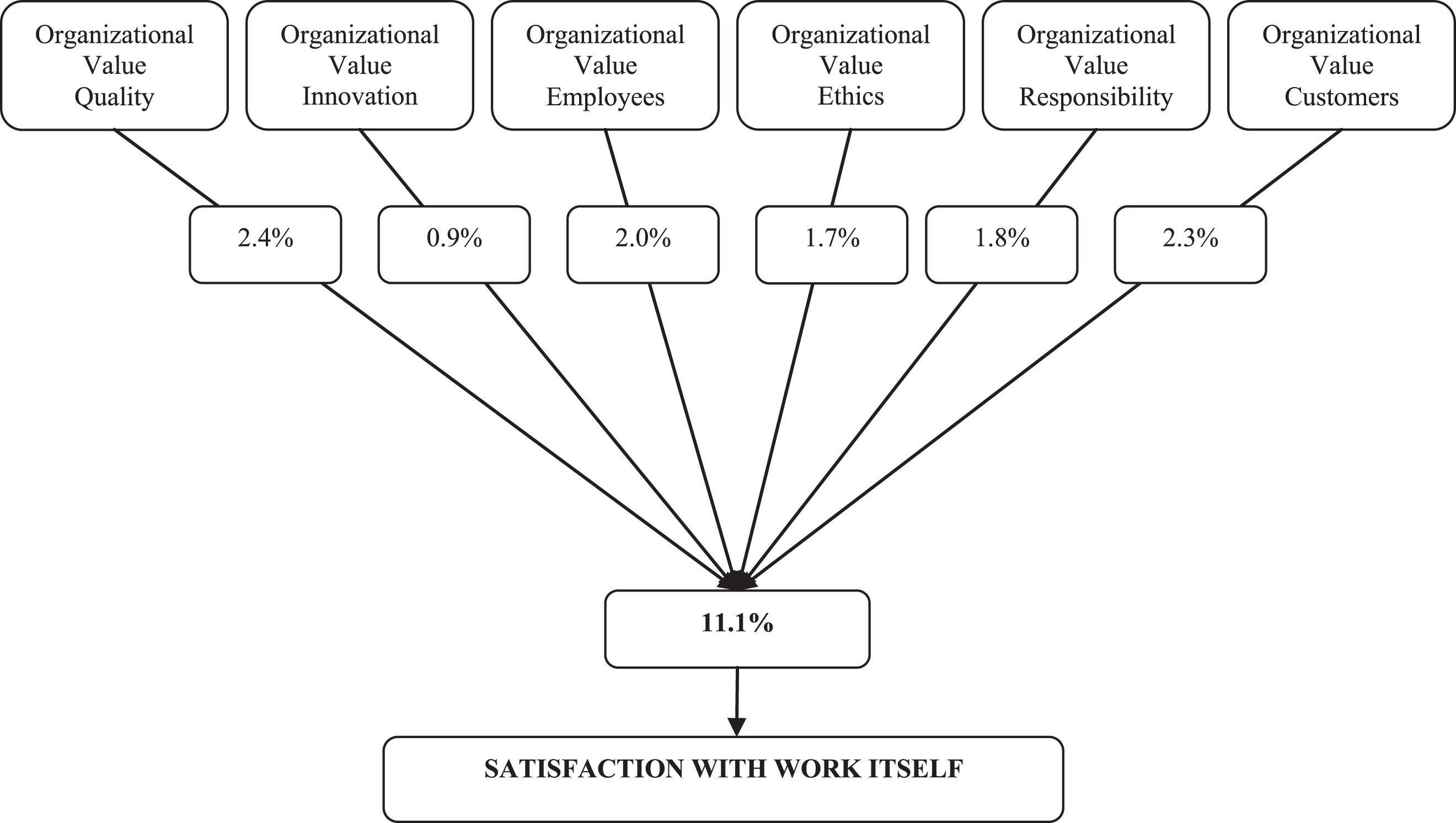
Results of hierarchical regression analysis.
Through this study, we have established eight findings that also correspond with practical implications. Firstly, not all the organizational values correlate with certain aspects of job satisfaction (see Table 3). Secondly, through the analysis, we have found out that OVQ correlates with SWI (r = 0.132 correlation is significant at the 0.05 level (2-tailed)), adding to that the results of linear regression of the first pair, we see that the independent variable OVQ explains 1.7% of variability of the dependent variable SWI. Thirdly, we have shown that respondents who more frequently indicated that OVI is important, also indicated more often that SWI, is important to them (r = 0.173 correlation is significant at the 0.05 level (2-tailed)). Adding to that the results of linear regression of the first pair, we see that the independent variable OVI explains 2.7% of variability of the dependent variable SWI. Fourthly, we have shown that respondents emphasizing OVR as important, also answered more often that SWI is important to them (r = 0.229 Correlation is significant at the 0.01 level (2-tailed)). Adding to that the results of linear regression of the first pair, we see that the independent variable OVR explains 3.4% of variability of the dependent variable SWI. The fifth finding, shows that respondents who answered more often that OVE is important, also answered more often that SWI is important to them (r = 0.200 correlation is significant at the 0.01 level (2-tailed)). Adding to that the results of linear regression of the first pair, we see that the independent variable OVE explains 3.7% of variability of the dependent variable SWI. Sixth, we have shown that respondents who said more often that OVC is important, also say more often that SWI is important to them (r = 0.310 correlation is significant at the 0.01 level (2-tailed)). Adding to that the results of linear regression of the first pair, we see that the independent variable OVC explains 5.0% of variability of the dependent variable SWI. Seventh, we have shown that respondents who emphasized that OVEm is important, also indicate more often that SWI is important to them (r = 0.192 correlation is significant at the 0.01 level (2-tailed)). Adding to that the results of linear regression of the first pair, we see that the independent variable OVEm explains 9.6% of variability of the dependent variable SWI. Finally, after researching the first set of organizational values and SWI, we have continued on to the SWC. Respondents who said more often that OVI is important, also say more often that SWC is important to them (r = 0.195 correlation is significant at the 0.01 level (2-tailed)). Adding to that the results of linear regression of the first pair, we see that the independent variable OVI explains 3.5% of variability of the dependent variable SWC.
Based on the findings we made, we can retain hypothesis H1: There is statistically significant influence of organizational values on job satisfaction of employees with regard to Satisfaction with Work Itself. We have seen that there is a statistically significant influence of all six different, identified organizational values on job satisfaction with regard to work itself. With hierarchical regression analysis, we have further proven that we can explain up to 11.1% of job satisfaction with regard to work itself with organizational values.
Further, we have to reject hypothesis H2: There is statistically significant influence of organizational values on job satisfaction of employees with regard to satisfaction with conditions of work. We have found out that only with Organizational Value Innovation is there a statistically significant influence of organizational values when it comes to Satisfaction with Working Conditions.
Finally, we have to reject hypothesis H3: There is statistically significant influence of organizational values on job satisfaction of employees with regard to satisfaction with possibilities for career development, since we found no influence between organizational values and possibilities for career development.
Theoretical and practical implications
The first finding that not all organizational values correlate with certain aspects of job satisfaction is somewhat expected, but the Pearson correlational analysis was never intended to prove that everything correlates; it was intended to forecast where the correlations are found, so that we can, in further steps, analyze how strong influences of various organizational values are on job satisfaction.
Our second finding, that organizational value quality correlates with satisfaction with work itself proves that in the world where quality is important for the long-term growth, it is not surprising that employees value quality. Especially so when creating a product, or conducting a service, that is perceived by them to represent quality, which they experience heighten levels of job satisfaction with work itself. This supports the idea [76], that various patterns of behavior of employees, among them quality of work, influence job satisfaction. Our third finding indicated that people who perceive organizational value quality as important also see satisfaction with work itself as important. It has been established that innovation is the driving force of progress, thus, in the companies where organizational conditions are facilitating innovation, it can be expected that innovation will be seen in the work of employees [77]. This, in turn, puts innovation into the culture of the organization, and the culture of the organization influences job satisfaction of employees directly [78]. Our fourth finding indicated that people who perceive organizational value responsibility as important also see satisfaction with work itself as important. Responsible behavior of organizations is becoming more and more important through the concepts of Corporate Social Responsibility. Our results supports the previous conclusion [79], that has established that if employees perceive the organization that they work for as an organization that promotes responsibility, they will in turn perceive higher levels of job satisfaction. Our fifth finding indicated that people who perceive organizational value ethics as important also see satisfaction with work itself as important. Ethical conduct that is promoted by managers has a direct impact on job satisfaction of employees [80]. In this sense, we can say that perceptions of a positive ethical climate that indicates ethical conduct being a value of the organization is associated positively with job satisfaction of employees [81]. This supports our results that job satisfaction might be increased indirectly through the development of individual/managerial ethics, in other words, ethics codes and training signify that the company is institutionalizing an ethical culture by improving individual moral development [79]. Our sixth finding indicated that people who perceive organizational value customers as important, also see satisfaction with work itself as important. This finding correlates with the finding that customer orientation is an essential part of organizational culture [10] and, through it, influences job satisfaction of employees directly. Our seventh finding indicated that people who perceive organizational value employees as important, also see satisfaction with work itself as important. Putting a value on employees is important for every organization; through time we have seen studies that relate that to organizational commitment [82], and although they did not relate organizational commitment to job satisfaction of employees directly, this commitment shows the fit of a person within the organization, being the so called P-O fit (personal organizational fit) or P-J fit (personal job fit). Later studies, [83], have shown that valuing employees and helping them with achieving the fit will increase their job satisfaction, which again supports our findings.
Our final eight finding indicated that people who perceive organizational value innovation as important also perceive as important satisfaction with working conditions. As indicated before, innovation is the key for progress; through the organizational culture [84] we can foster an innovative working environment. We can also expect that an innovative working environment will cause a substantial increase in creativity [85], and creativity further influences job satisfaction positively [86].
Our findings have theoretical as well as practical implications. In terms of theoretical implications we have re-confirmed the work of several authors mentioned above, adding the knowledge that the main influence of organizational values goes towards the general satisfaction with work itself, partially also towards satisfaction with working conditions. Practical implications are much clearer, managers need to promote organizational values within the organization thus making them foundations for nurturing job satisfaction. This approach to deal with job satisfaction enables managers to build on satisfaction from the core, since organizational values present the core of any organization.
Conclusions
The article examined the influence of organizational values on job satisfaction of employees within the selected sector. A theoretical framework was created that supports the main research question; is there a statistically significant influence of organizational values on employee job satisfaction? For each of the six identified Organizational Values (Quality, Innovation, Responsibility, Ethics, Customers and Employees), it was shown that there is a direct correlation to the variable of Satisfaction with Work Itself. The results shows also that there is a direct correlation between Organizational Value Innovation and variable Satisfaction with Work Conditions. Using linear regression analysis, it was confirmed that each organizational value explains a certain percentage of each variable in job satisfaction. The findings show directly that there is a statistically significant influence of Organizational Values. A hierarchical regression analysis explained up to 11.1% of job satisfaction with regard to work itself, with Organizational Values showing to have an influence on job satisfaction of employees. This correlates with the Managing by values theory [87], that stresses the importance of values in all aspects of managing. The main idea behind the Managing by values theory is to limit the amount of formal control by enhancing the trust among employees and their supervisors. There are also other researchers [88] who have proven that shared values, alongside communication and opportunistic behavior, can influence trust positively.
Initiating the research, the presumption was that Organizational Values influence job satisfaction as a whole. However, the research has proven that Organizational Values influence the part of job satisfaction that is related to work itself, while only Organizational Value Innovation plays a role in the part of job satisfaction that is related to working conditions. There is no statistically significant correlation between Organizational Values and job satisfaction related to career development that could be proven. The novelty of this article is mainly in the finding that not the whole of job satisfaction is influenced by Organizational Values, but rather only a part of it. With this knowledge, it can now be proposed that managers on all levels should focus their energy on working with Organizational Values leading to positive influences on job satisfaction of employees. This knowledge is important for organizations in general, and especially for organizations in travel and leisure industries, which has an significant impact on the local, national and global economies [89].
There are some limitations in this article that needs to be highlighted. The research was conducted in a single sector. To limit the influence of that the sample was carefully selected, and ensured that it is representative of the entire population. The research was also limited to a single country. However we have selected a big enough sample so that it is representative. Other precautionary measures have been implemented to restrict influences of limitations to a minimum. For further research, it is proposed that the intensity of expression of Organizational Values would be measured, and that this influence on job satisfaction would be investigated.
Conflict of interest
None to report.