






Abstract
BACKGROUND:
Aircraft maintenance and repair are critical tasks in the aviation industry for improved aircraft service and safety. Many articles and reports describe personnel factor and skill issues contribute to many aircraft incidents. Aircraft maintenance personnel needs to level up their skill set to match with task requirements in the setting of Industry Revolution 4.0.
OBJECTIVE:
The aim of this paper is to investigate document set that describe human errors and skill mismatch as a human factor in aircraft incidents and problems. It also discusses on the findings and management of the aircraft maintenance skill issues.
METHODS:
The study uses a document analytics tool to assess a set of online articles that discuss aircraft maintenance incidents and skill mismatch issues. The experiment is divided into four (4) modules: (i) collection of online articles and reports, (ii) document pre-processing, (iii) text analytics, and (iv) visualisation.
RESULTS:
The experiment’s results show that the majority of documents discuss aircraft maintenance, skill mismatch, and training gaps.
CONCLUSION:
We can conclude that the document dataset primarily discusses aircraft maintenance and skill set issues using the document analytics. Consequently, the management of aircraft maintenance workforce skill set issues by having initiatives for upskilling and reskilling. Furthermore, firms should foster a culture of continuous learning and develop a mindset among their employees that allows them to adapt to new technologies and information in aircraft maintenance.




Introduction
The convergence of artificial intelligence and engineering automation is driving the growth of Industry Revolution 4.0. (IR4.0). As a result of the surplus in specific groups of employees and specialists, the workforce requires the replacement of appropriately skilled workers. Some work tasks can be replaced by machines to reduce production costs. Many skills are acquired through formal education (TVET, colleges, and universities), but they can also be acquired through other means [1]. The changes in the IR4.0 labour force setting have necessitated the acquisition of new skills and competencies in order to keep up with the progression of current innovations [2]. The current situation revealed that many work domains have become extremely demanding, and as a result, current employees’ skill sets are insufficient to support a significant change in the entire field of work. As a result, more efforts should be made to instil critical work skills in recent graduates and even current employees, so that they are in sync with the needs of the business. Ultimately, this costs them the opportunity to fill labor-force gaps and accelerates the rate of graduate unemployment. Graduates should be exposed to appropriate skill sets in order to guarantee their work and remain employed in a constantly changing industry and innovation climate.
The aviation industry is being shaped by IR4.0 to adopt modern technology in its aircrafts and human resources [3]. In the production of aircrafts and related equipment, the aviation industry is moving forward with the use of technology such as artificial intelligence, machine learning, automation, sensors, and remote monitoring. Because maintaining modern aircrafts is a complex task, it is critical to ensure that engineers and technicians have a broad skill set and the best competencies. Some of the necessary skill sets that individuals must acquire include critical thinking and innovation, active learning and learning strategies, creativity and initiative, analytical thinking and analysis, system analysis and evaluation, and so on. According to the Malaysian Aerospace Industry Blueprint 2030 [4], some education and training programmes are not being developed satisfactorily, and there is a skills mismatch between academia and industry. Graduates from academies do not meet workforce requirements for the right talent. Skill mismatch among aircraft maintenance technicians has recently emerged as a common talent management issue in the aviation industry [5]. The purpose of this paper is to investigate a set of documents pertaining to human factors and skills issues aircraft maintenance using a text mining technique.
The paper is organized as follows: Section 2 discusses background and related work on impact of IR4.0 on aviation, aviation maintenance and skill sets issues and incidents, document mining or document analytics processes. Section 3 elaborates the methodology of the proposed framework of the document analytics. Followed by Section 4 presents the findings and management of the skill issues. Finally, Section 5 concludes with a summary and future research directions.
Background and related work
Level of aviation maintenance tasks
Aircraft maintenance technicians work in a number of highly specialized fields, such as aircraft construction and engine maintenance, as well as system maintenance, such as instruments, navigation and communication components. These technical crews are in charge of making sure that aircraft fly safely and efficiently. These experts maintain, service, repair, and maintain aircraft parts and systems in order to ensure the aircraft’s complete reliability and safety. Aircraft maintenance is also a fast-paced industry. In the future, aircraft maintenance will continue to evolve [6]. This is due to the introduction of new aircraft designs and materials, as well as the interaction of complex advanced technologies such as mission control computers, fly-by-wire systems with scheduled maintenance systems such as hydraulics, flight controls, and propellers or blades systems, microsensor networks interconnected, intelligent and intuitive presentation of data in remote operations [65].
In general, aircraft maintenance technicians perform a variety of maintenance tasks, which are supported by three-tiered maintenance plans as follows: 1st level maintenance (Organizational level): This on-site maintenance check includes inspection, repair, and part replacement. 2nd level maintenance (Intermediate level): This inspection, repair, and replacement of parts is done on-site and is more extensive than the first level of maintenance. The components must meet the deterioration or thorough characteristic requirements, which indicates that the likelihood of failure mode increases with time. There must be other effective measures in place to prevent the parts from failing on a regular basis replacement. 3rd level maintenance (Depoh level): This inspection is carried out by well trained professionals in specialised or original equipment manufacturer facilities. It requires more intense repair, replacement parts and overhaul.
All aviation system maintenance can be classified as corrective, preventative, or surveillance, as well as scheduled, unscheduled, or condition maintenance.
Aviation maintenance and skillsets issues and incidents
Aircraft maintenance refers to the repair and service activities performed to keep the aircraft operational and reliable. Maintenance activities encompassing component or aircraft engine repair, inspection and problem-solving [7–9]. Aircraft maintenance is a critical task in ensuring flight safety throughout the aircraft’s life cycle [10–12]. Despite the fact that aircraft maintenance is considered a high-risk job task in aviation due to its critical impact on aviation safety, it still plays a significant role in aircraft accidents and incidents [13–16]. A couple of studies [17, 18] emphasised the importance of developing a culture of recognising, reporting, and learning from past maintenance errors in order to improve maintenance quality and aircraft safety. Furthermore, Periyar Selvam et al. [19] reported that maintenance costs account for approximately 10% to 20% of total aircraft operating costs.
Rashid et al. [20] and Saleh et al. [21] conducted a study to investigate safety issues related to maintenance. Analysis of human factors in both studies shows that most of the factors influencing the maintenance event are related to improper component inspection and installation procedures, along with temporary factors that are profoundly come from the organizational and management levels.
According to a study conducted by [22], based on International Civil Aviation Organization (ICAO) official reports, approximately 0.9 percent of aircraft incidents involved maintenance. It also stated that maintenance accidents were 20% more likely to result in one or more deaths than all official ICAO accidents (14.7 percent). Nonetheless, it was discovered that the number of accidents caused by maintenance errors per year decreased over the study period, and the statistic rate decreased from 5% per year to 2% per year. The findings revealed that aircraft with maintenance contributions were typically between the ages of 10 and 20 years, with aircraft over 18 years old being more likely to result in fleet loss and aircraft over 34 years old being more likely to result in death. Several studies [13, 24] discovered that the primary causes of technical failures were inadequate repair procedures, irresponsibility, and incorrect installations, which could be caused by workforce skill sets.
Geibel et al. [24] presented the study’s findings by looking into the issues that cause errors in air service maintenance. According to the paper, the top five categories of maintenance errors are maintenance technician qualifications, maintenance inspections, spare parts installation, contract maintenance problems, and log documentation. This investigation included 1,000 NASA US incident reports for aircraft maintenance issues discovered between July 1997 and August 2006. According to the study, more than 53% of the negative results analysed in data collected from their aviation safety system. The main contributor factors were skill-based errors such as slipping errors, impairment, and perception, followed by routine violations (15%) and errors in making results (9%).
Reynolds et al. [25] conducted a study to investigate the effects of training on human factors for maintenance work forces in the European Union (EU) and the United States in order to reduce maintenance incidents (US). Data comparisons on vocational training prior to the implementation of human factor training from 1991 to 1998 and after the implementation of vocational training from 2000 to 2006 were compiled for the study. According to the study, after the introduction of trained human factors, aircraft mechanical accidents in the EU decreased from 33% to 22%, while mechanical accidents increased in the US. Ng and Li [26] conducted another study that provided a theoretical support concept to aid in the analysis of aircraft maintenance incidents. The study looked into the root cause of 109 aircraft maintenance incidents using data from several airlines. According to the findings, more than 60% of aircraft maintenance activities can be based on Rasmussen SRC framework regulations, while nearly 50% of accidents can be supported by standard aircraft types. Technical personnel’s errors or work factors
Schmidt et al. [27] and Illankoon et al. [14] described the Human Factor Analysis and Classification System (HFACS) for analysing maintenance accidents in military aviation in their research. According to [27], the influence of human factors on aviation maintenance accidents is the circumstances of managers, maintenance, and latent work, which can influence employee performance. This conclusion was made after analysing data from 470 maintenance-related accidents obtained from the Naval Security Center Information Management System between 1990 and 1997. Later research [14] reported their study on data from a fleet of fighter jets to look for maintenance irregularities reported over 38 months in January 2013, taxonomy to locate and identify hidden causes. Similarly, work attention, memory errors, work process deficiencies, and documentation are identified as important causal workforce factors in the study. This study also revealed how IR4.0 interventions can aid in the reduction of maintenance disorders while capturing hidden causal factors.
Many of the previous works discussed critical issues concerning human factor and skill mismatch errors in aircraft maintenance. This paper describes a survey of document analytics using document mining on additional published articles related to these issues by evaluating the gist content of related topics in a document dataset. As a result, it is expected that this analysis will identify human factors error, particularly skills mismatch among aircraft maintenance technicians in the discussions, as a common talent management issue in the aircraft maintenance field.
Impact of IR4.0 on aircraft maintenance
Evidently, the first industrial revolution saw a significant increase in the level of industrialization, with the transition from manual and animal power to steam power [28, 29] highlighted that the second industrial revolution was entirely driven by mass production, electricity, assembly lines, industrial chemistry and metallurgy automobiles, aircraft, radio, and the massive start of construction works and the development of more powerful engines. In the third industrial revolution, massive computers and the information and communication technology (ICT) revolution were introduced into production automation of processes, ushering in the digital age [30].
IR4.0 brings in Industry 4.0 by preparing the manufacturing sector to embrace digital transformation through the incorporation of sensing devices in virtually all manufacturing parts, products, and equipment [63]. Organizations must evaluate the impact of Industry 4.0 technology to sustainability and economy benefits [68–70]. The implementation of a ubiquitous system promotes the ability to analyse digital data and physical equipment, allowing every global industrial sector to advance much more quickly [31]. This implied Industry 4.0 is part of an interconnected world that has been altered by the ICT revolution for example the technologies merger such as cyber-physical systems (CPS), the Internet of things (IoT), Big Data and cloud manufacturing [32, 33]. [61, 66] also formalized interpretation Artificial intelligence (AI), Big Data, IoT, the Internet of services (IoS), CPS, and smart manufacturing are all listed as critical components of IR4.0. As a result, this gyration is the culmination of all previous revolutions’ inventions. According to the literature, this revolution will convert and have an irreversible impact on the built environment industry as profoundly and irreversibly as each of its three predecessors, and more rapidly as any of them. As a result, in order to handle advanced aircraft systems and manage data analytics for predictive maintenance [67], such as deep data and probably more performance analytics, aircraft maintenance technicians are anticipated to obtain more 21st-century skills [53].
In the aviation industry, one example of IR4.0 adaptation is the development of predictive maintenance systems. Predictive maintenance includes the role of sensors and IoT in maintaining and monitoring aircraft components to be replaced before visible defects emerge [64]. This approach teaches a valuable lesson in how typical aircraft maintenance work practises can be translated by the smart factory [34]. Similarly, in the manufacturing industry, components of smart factories are introduced as part of engineering science integrations. The distributed manufacturing branches or alliances are linked by leveraging technological advances such as big data analytics and remote monitoring to assist factories in increasing productivity, creating a safe environment, and maintaining safe operations [34]. Today’s technical advancements in the aviation sector have impacted aircraft maintenance professionals, making it necessary for them to become compatible with more sophisticated aircraft systems. In order for maintenance technicians to attain this compliance, technician training in organisations and institutions that provide maintenance training must be tailored to today’s circumstances [51]. Maintenance-related delays may be avoided significantly by having well-trained and experienced aeroplane technicians with experience in specialised equipment. Graduates of educational institutions did not have enough training to keep up with the evolving technologies in the aviation maintenance environment [52].
Document mining
Document mining is one of techniques in Data Mining (DM) [35, 36]. It aims to discover knowledge in a stack of documents that may have comparable discussions and arguments by determining term frequencies and term connections in the documents. DM is famously known as a process of extracting nontrivial, useful and meaningful insights in databases or Knowledge Discovery in Databases (KDD). KDD has an iterative multi-stage of 5 main processes as illustrated in Fig. 1. The stages are: Selection – raw data is carefully selected for mining process. Preprocessing – the selected data is preprocessed in acceptable data format and data types. Transformation – the cleaned data is transformed into suitable data ranges and data aggregations. Data Mining – the main process of knowledge discovery in terms of patterns and rules. Interpretation – patterns and rules are interpreted into knowledge and information for users, stakeholders and decision markers.
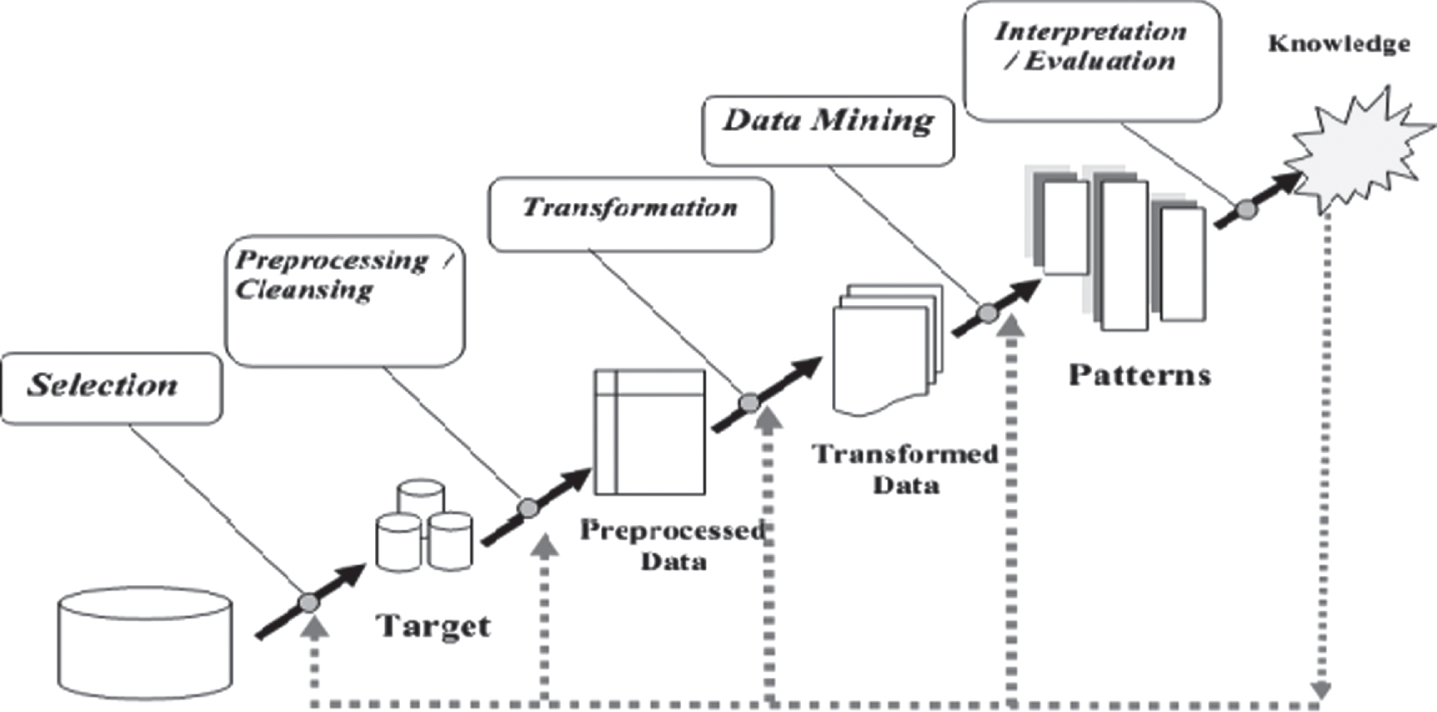
KDD stages [37].
Basically, document analytics adapt the KDD processes. A document is regularly treated as an individual information item and an assortment of it is considered as a document dataset. A proper document collection is importance for formal and informal reader to access information as knowledge and information sharing [38]. ICT allows many documents to be collected as data files which have been created or converted into digital papers such as articles, contracts, reports and news. Thus, for faster information sharing, document mining can be applied to process digital documents. Document mining consists of several techniques of information extraction, natural language processing (NLP), information retrieval and text mining. The key use of document mining is to explicitly identify the term association and similarity in a document dataset [39, 40].
Text mining (TM) is one of data mining methods for extracting insights using text data. TM literally a text analytics technique that incorporates NLP and DM techniques to convert the free (unstructured) text in documents and databases into standardized and structured data patterns. NLP is used during the preprocessing stage to clean, convert, and standardize text data (text terms) formatting.
In TM, cleaned terms undergo a ranking process using Term Frequency-Inverse Document Frequency (TF-IDF) to assign term count and term weighting for each term that appears within set of documents or corpus. Thus, it produces a list of terms ranking based on TF-IDF. Then, Term Document Matrix (TDM), a two– dimensional matrix or table, is constructed with rows represent terms and columns contain document ids in a corpus. The purpose of generating TDM is to record calculated terms’ frequency counts of terms across documents in a corpus [41].
Figure 2 shows a general process of building TDM from a corpus using TF-IDF equation. TDM contains list term entries of (i,j) that represents the frequency count of the text term i which appears in document j. The range of a term’s frequency count is in between 0 and n. Hence, rows in TDM records the terms similarities between one document to another document in the same corpus.
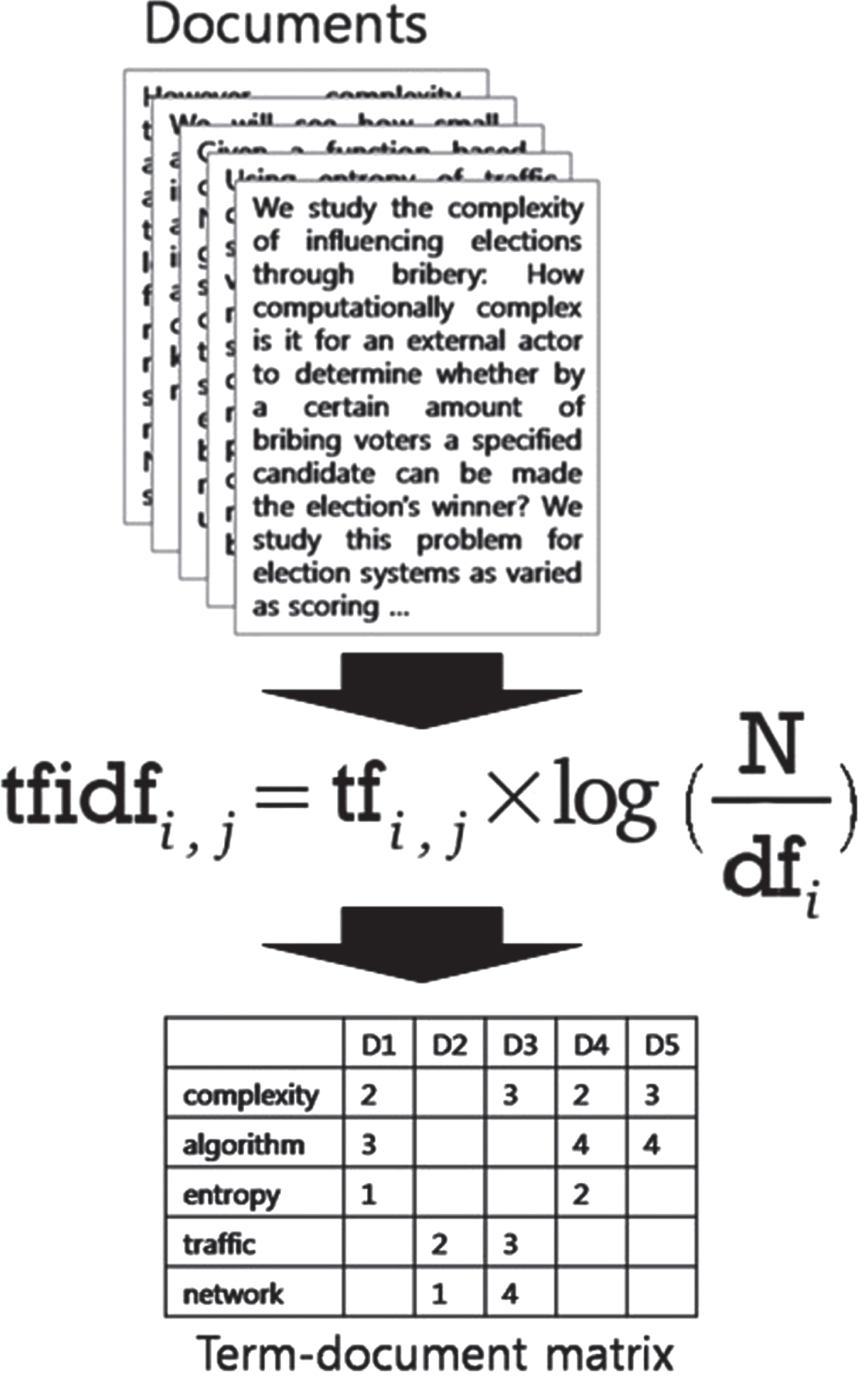
Term document matrix generation.
TF-IDF is a most important method to compute term’s frequency counts and weights across documents in a corpus that frequently utilized in information retrieval and TM. It is supposed to measure how significant a term is to a document in a corpus. Therefore, TF is the term frequency for the terms appear in a document while IDF is applied to measure how significant of a term for the collection of documents or corpus [41, 42]. Each term has its corresponding TF and IDF score and TF*IDF weight of each term using equation shown in Equation 1:
tfi,j is total of frequencies of i in j. df
i
is the quantity of documents have i. N represents the total amount of documents in a corpus.
The wi,j value of a term increases correspondingly to the number terms appear in the documents. It is used to examine how significant the term is all through documents in a corpus.
Document mining may appear technical to non-data science experts, but there are many practical text or document analytics tools on the market, such as SAS, WordStat, Voyant Tools, RapidMiner, and many more. Some of these are cleverly packaged, powerful, and ready for non-technical users to use in developing their own text or document analytics tasks.
In this experiment, we use a document analytics tool to assess a set of online articles that discuss aircraft maintenance and skill mismatch issues. We integrate NLP and TF-IDF as an absolutely combination method.
In this study, there are several integrated processes in this proposed document analysis framework. Figure 3 illustrates the framework, Aircraft Maintenance Document Analytics Framework (AMDAF) which consists of four (4) stages which are (i) Aircraft maintenance online articles and report collections (ii) Document Data Pre-Processing (iii) Text analytics and (iv) Visualizations. The aim of this analysis to point out the key keywords exist in the document set or referred as corpus.
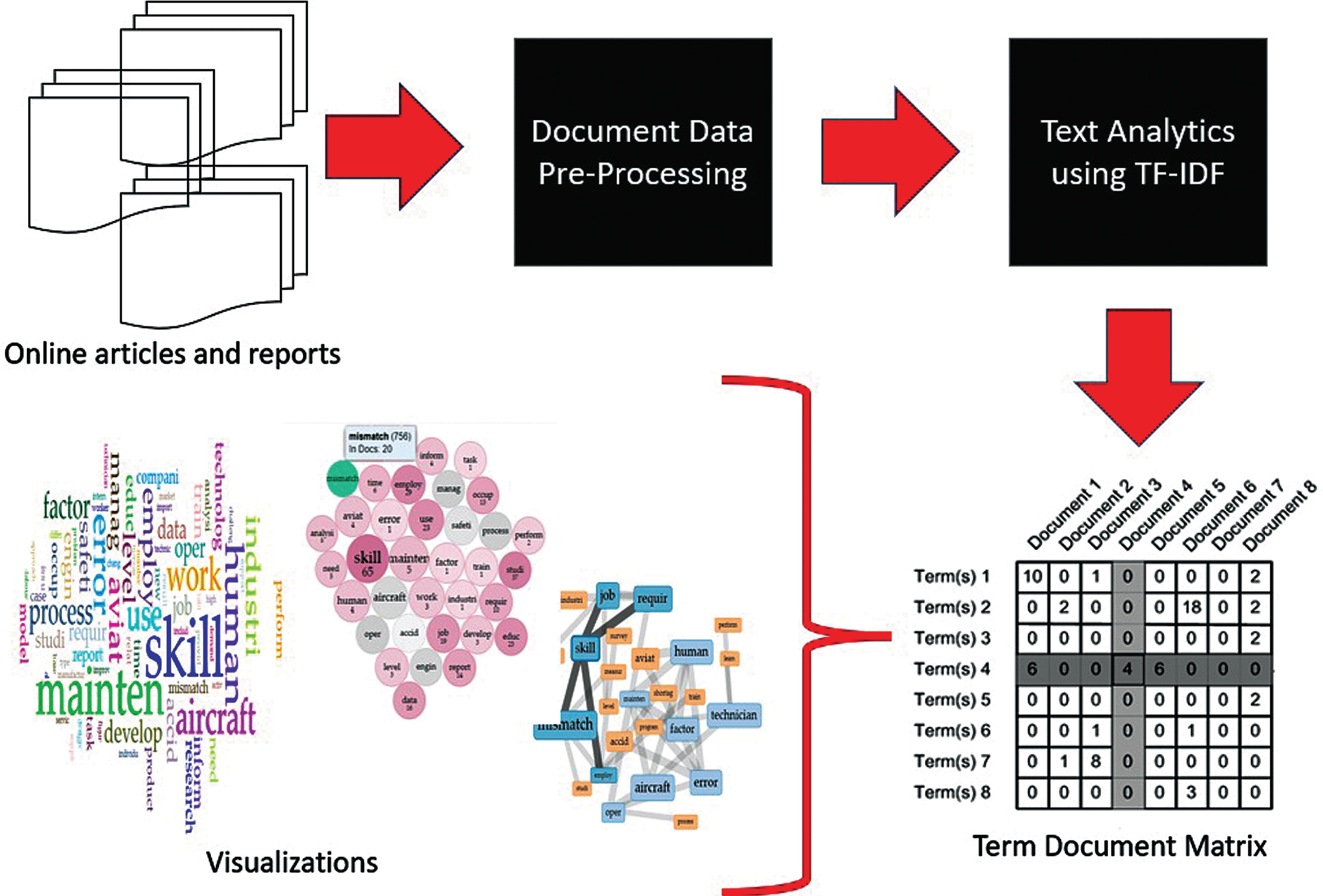
Aircraft maintenance document analytics framework.
Initially, AMDAF collects online documents that specifically describe and discuss on aircraft maintenance errors and incidents, engineers and technicians’ skill and competency, and training for MRO personnel. These online articles and reports are collected randomly; however, the scope of document content descriptions is carefully selected. The format of the documents is in text (.txt) file. Then, these files undertake a document pre-processing module. The module is developed using R language. The module works based on (NLP) concept in which two (2) main processes involve (i) removes stop words and (ii) stems terms to become root word. Document pre-processing is a vital process in document analytics as it is a conventional procedure applied in cleaning original documents to decrease noise, unstructured and inconsistent data.
The next module processes significant terms extraction for building the TDM. The process of ranking and extracting these keywords is based on TF-IDF technique using Voyant [43]. Text analysis is performed following their important values and word occurrences. In this stage, the framework applies the TF-IDF method to rank and count terms. The mining process produces a TDM. The TDM is then becomes the data input for term pattern visualization using the Voyant application, an open-source web-based application that reads and analyses texts in various formats. It supports scholarly text analytics of texts or corpus, predominantly by analyst, students and also the public.
Lastly, in the final stage, the discovered term patterns are represented in three (3) types of visualization graphics, such as word cloud, word trends, word links and terms berry. From here, we are able to distinguish the gist of document contents between the different studies conducted under aircraft maintenance, repair and overhaul, technician skills, human errors and aircraft incidents.
In this section, the results of the experiment are presented and discussed. There are visualizations presented to demonstrate term frequency and term relationships of the analysed corpus. The document analytics results are presented in a number of visualizations such as word cloud, word trends, word links and terms berry. Each visualization highlights the significant terms that describe gist contents of documents.
The corpus contains 43 documents that comprise of (i) 20 Web of Science indexed journals, (ii) 3 Scopus indexed journals and (iii) 20 technical reports and white papers. Among selected journals come from Maintenance and Reliability (Web of Science), Human Factors: The Journal of the Human Factors and Ergonomics Society (Sage Journals), International Journal of Industrial Ergonomics (Scopus), Aerospace and other indexed journals. These articles review and describe topics of the aircraft maintenance, repair and overhaul, technician skills, human errors and aircraft incidents. The document dataset was published between year 2010– 2020.
Part of cleaned data files
Part of cleaned data files
In the second stage of AMDAF, all 43 documents undergone the document preprocessing module to remove the stop words and stemming process. During document pre-processing, all documents are merged as a corpus. After that, all text in the documents is converted into lowercase format and symbols and numbers are removed. Next process is the removal of all numbers, symbols, stop words like ‘a’. ‘an’, ‘the’, and white space from the corpus. This process is to improve the quality of the corpus as meaningless terms are pruned. Lastly, the essential process is stemming. Stemming is a process in which terms are trimmed into its root term, for example, term “running”, and “runner” are trimmed as its root word “run”. The stemming process is required so as terms with same root words is referred to same distinct term. Table 1 contains parts of cleaned contents in the first 5 documents.
Next, the third stage of AMDAF uses TF-IDF equation on the cleaned corpus to generate TDM. Table 2 shows part of TDM’s rows and columns that record documents and term frequencies. These frequency counts are used to determine terms and documents relationships.
Part of term document matrix
Term trends.
As shown in Fig. 4, it is the summary sheet that listed information corpus and term details that include document length, vocabulary density, average words, most frequent words, and distinctive words. This corpus has 43 documents with 278,807 total words and 13,045 unique terms. Document length describes the longest and shortest documents in the corpus. The top 5 longest documents are file7 with 32757 terms; then followed by file27 with 30792 terms, file29 with 21910 terms, file14 with 21425 terms and file3 with 12706 terms. On the other hand, the shortest documents are file24 with 353 terms; then followed by file26 with 581 terms, file21 with 589 terms, file16 with 658 terms and file20 with 794 terms.
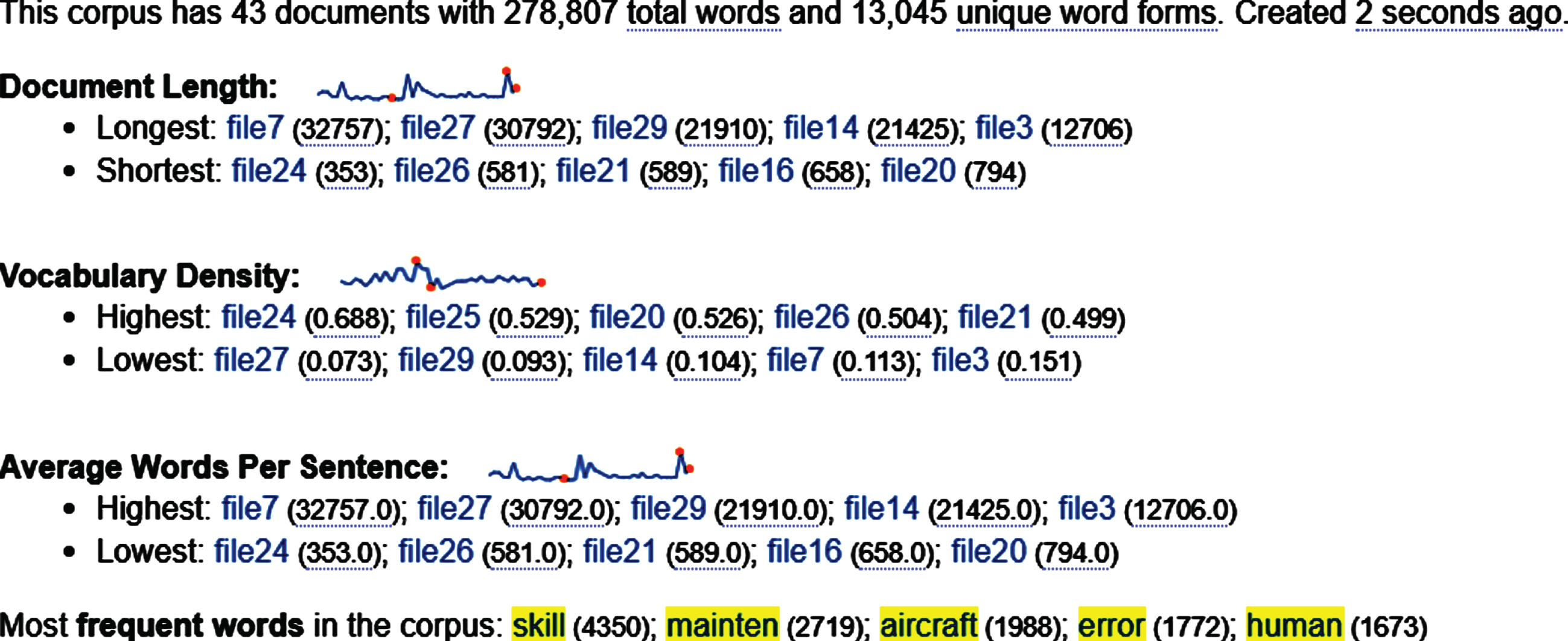
Summary on terms statistics.
It also shows the most frequent terms in the corpus are ‘skill’, ‘mainten’, ‘aircraft’, ‘error’ and ‘human’. These terms are shown in other visualization statistics to show term significance and relationship in the document contents.
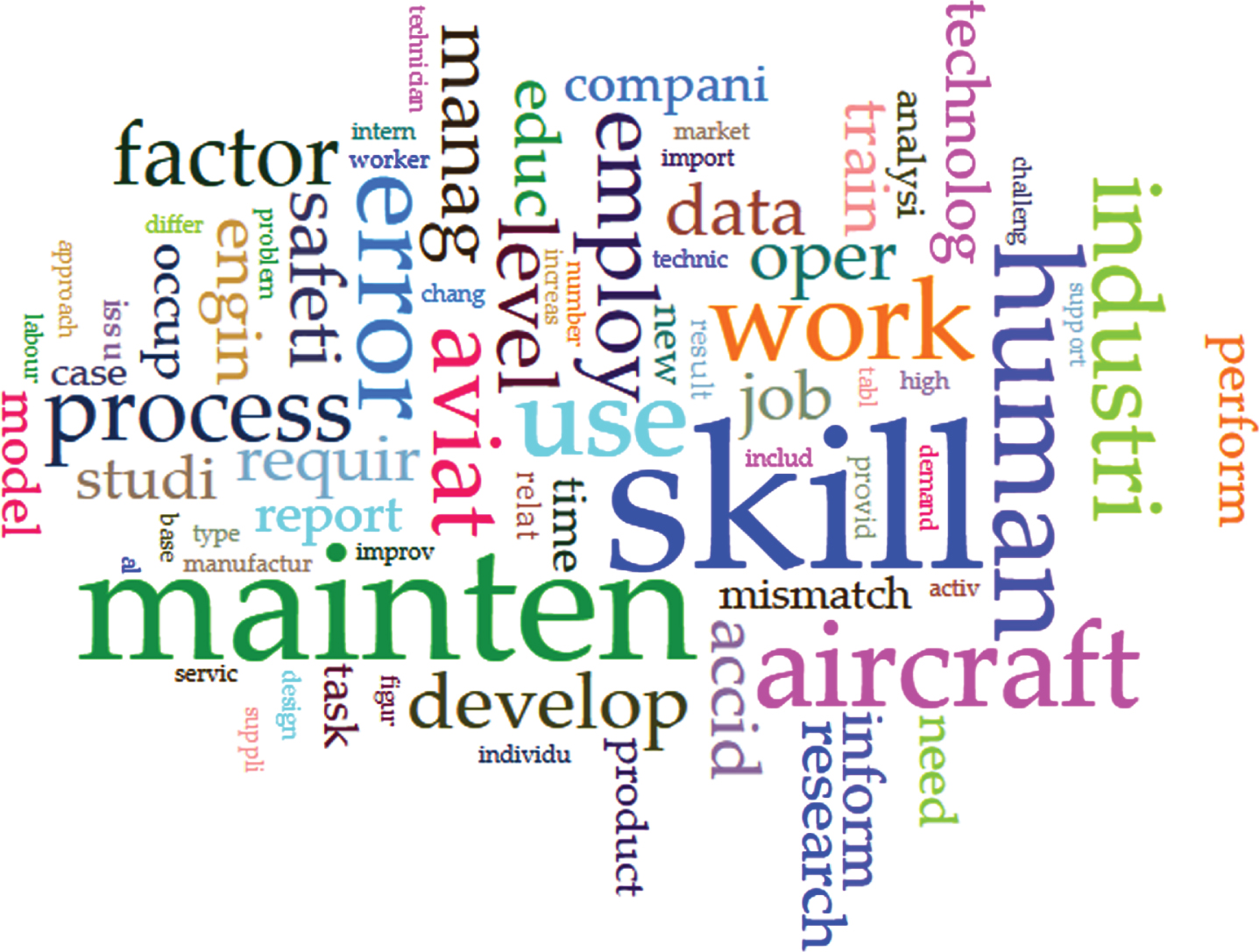
Figure 5 illustrates a word cloud, a graphical representation of word frequency in the corpus. The bigger the words appear in the word cloud means the higher the frequency of the terms. The word cloud shows bigger words for ‘skill’ (4350 frequencies) means it appears 4350 times in relative to the 43 lengthy datasets, then followed by ‘mainten’ (2719 frequencies), ‘aircraft’ (1968 frequencies), ‘error’ (1772 frequencies), and ‘human’ (1673 frequencies). Among 13,045 unique terms, the terms that appear in the word cloud are among high term counts. The terms like ‘employ’ (1191 frequencies), ‘technolog’ (939 frequencies), ‘mismatch’ (756 frequencies), ‘industri’ (1494 frequencies), ‘educ’ (942 frequencies), ‘safeti’ (1167 frequencies), ‘aviat’ (1436 frequencies), ‘factor’ (1359), ‘train’ (1058 frequencies) and ‘accid’ (1046 frequencies). From the word cloud visual, we can deduce that the corpus has document contents related to aircraft maintenance, human factor, accidents and errors, skill mismatch, aviation industry and education and training.
Word cloud.
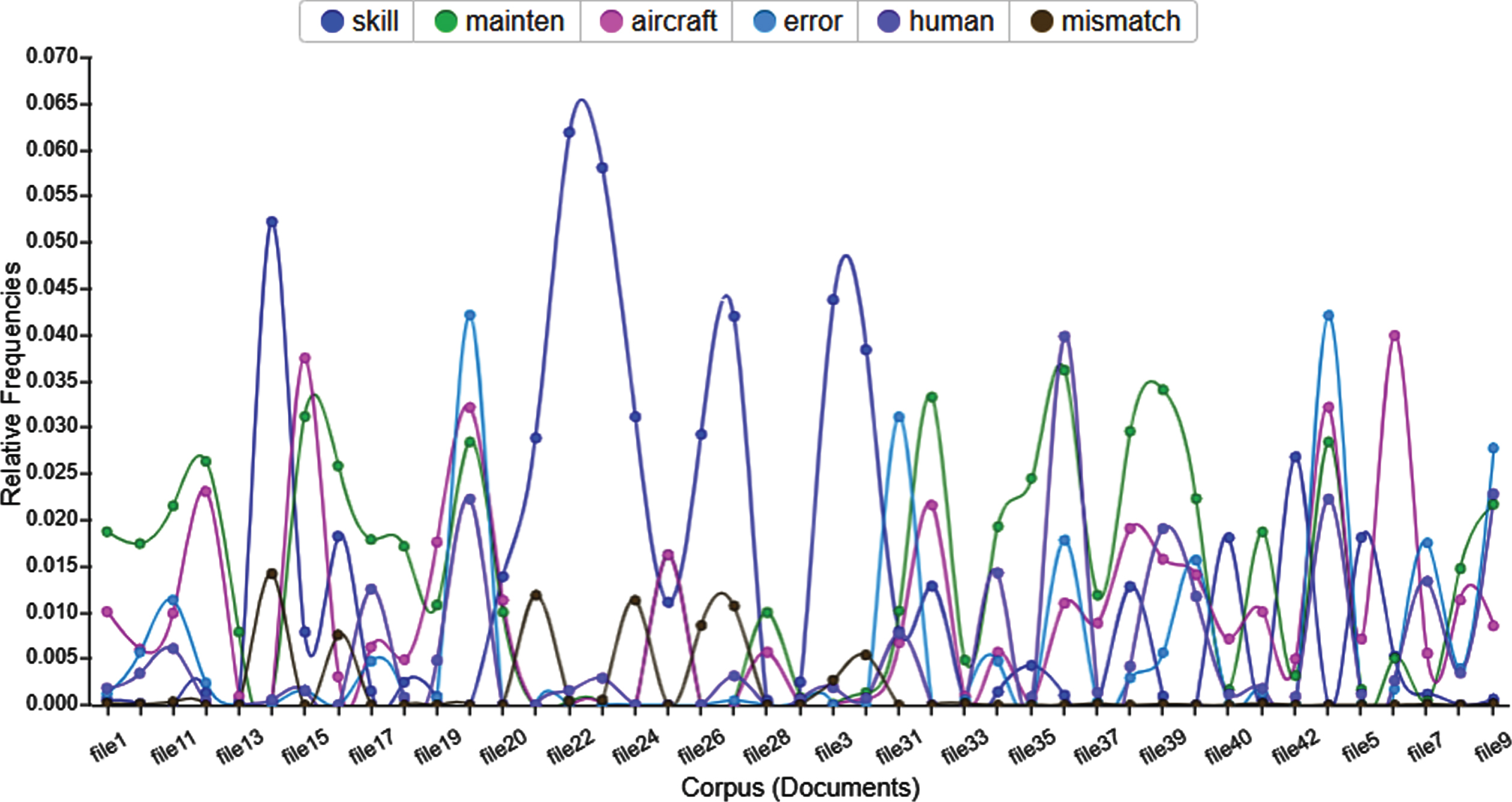
Moreover, Fig. 6 illustrates the term trend graph describing the relative frequencies versus corpus (the 43 document collections). In the graph, we can identify the term ‘skill’ was predominant in most of the documents with high frequencies, particularly in document 22 and 23. The rest of the top frequencies’ terms also appeared in most of the corpus. With term trends, we are able to anticipate the overall content of the 43 documents. Additionally, the term significance and similarity of documents are mainly focus on ‘skill’, ‘mainten’, ‘aircraft’, ‘error’, ‘human’ and ‘mismatch’. We can also presume that these documents have similar themes even though they are randomly selected in the earlier stage of the analysis.
Furthermore, Fig. 7 visualizes the link analysis of the frequent terms that existed in the 43 documents in this text analytics. Through term link, terms are associated to how they are written or described in the documents. Therefore, the generated term links support details correlated to term representation in a word cloud. The term links reveal the descriptive terms related to the main keywords. For example, the term ‘skill’ linked to ‘mismatch’, ‘technician’ and ‘requir’ described that many of the documents described the technician may/are having mismatch skills required for their MRO job tasks. The thicker links between two (2) terms indicates a stronger relationship between these terms.
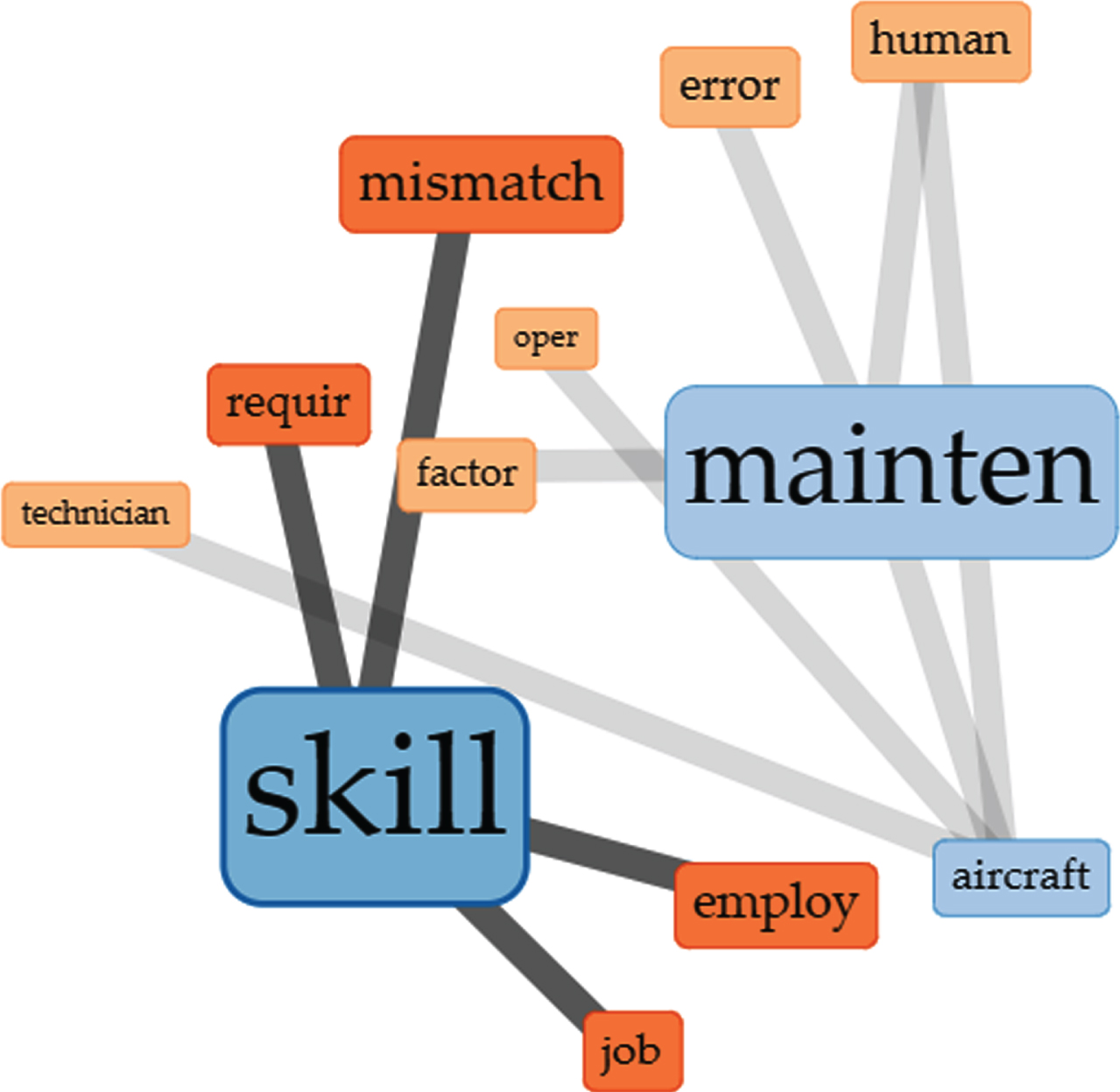
Term links.
Using the term link, we can zoom in to look at what other terms are connected to the main keywords. Figure 8 demonstrates the sub term link which indicates link analysis of more related terms associated to the frequent terms in the 43 documents. In this figure, we are to see a bigger picture on how the similarity of topics in these documents. Many documents discussed on skills mismatch and shortage and aircraft maintenance. The term ‘technician’ is directly connected to ‘learn’, ‘program’, ‘aircraft’. The links between ‘human’, ‘error’, ‘mainten’, and ‘accid’ highlight one of important issues that need more attention by the allied parties. All in all, the main keywords and terms like ‘skill’, ‘aircraft’, ‘technician’, ‘error’, ‘human’ ‘mismatch’, ‘measur’ and ‘train’ are correlated in the link analysis.
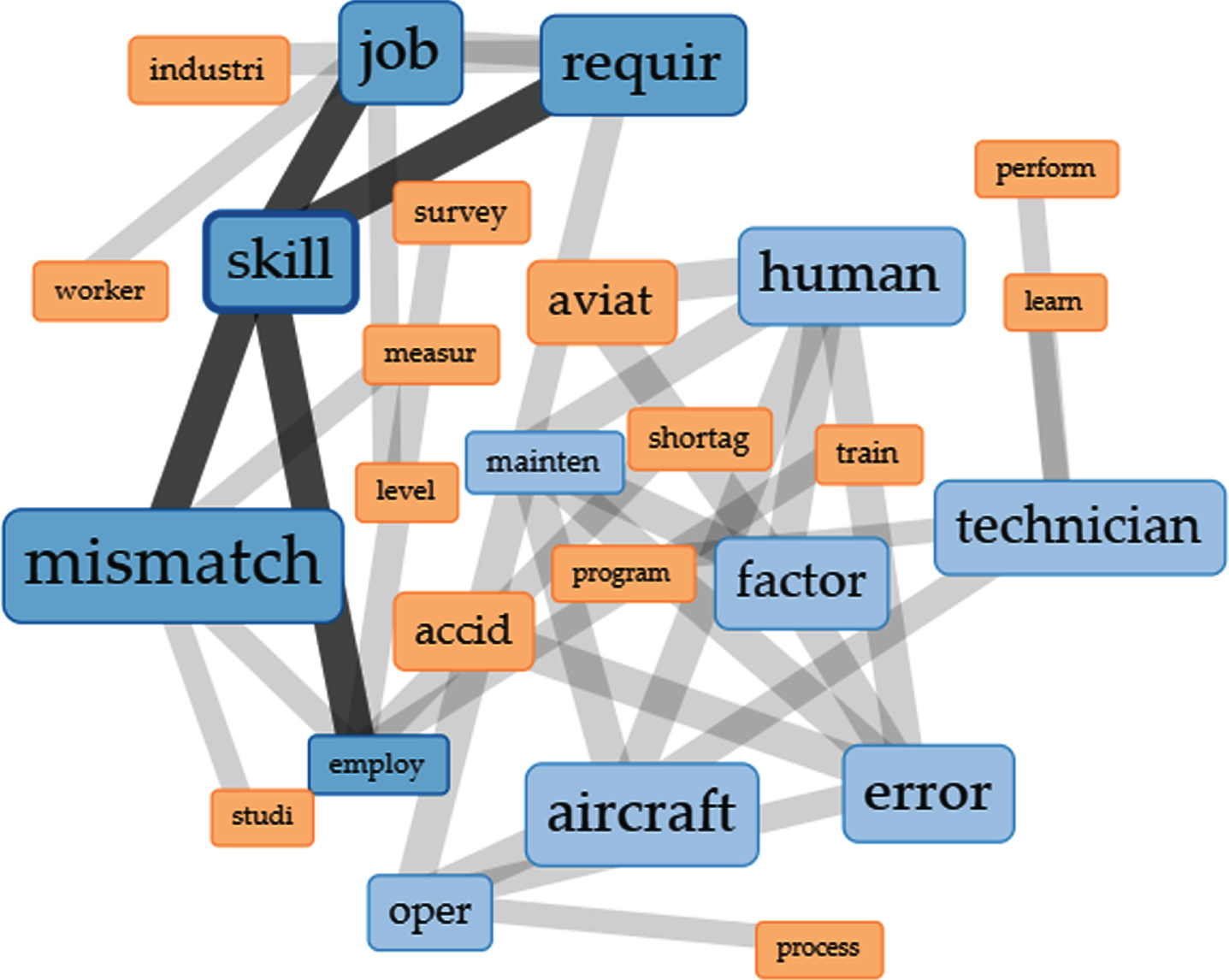
Sub term links.
Figure 9 portrays a TermsBerry visualization. The TermsBerry is aimed to combine the high frequency terms with same terms co-occur. This way it is an extension of showing how far the terms appear in proximity with one another. It is also similarly used as word cloud visualization but even more effective with the added statistic on terms and corpus coverage information. In this figure, we highlight the term ‘mismatch’, has 756 frequencies and appeared in 20 documents, is related closely to terms ‘skill’, ‘educ’, ‘employ’, ‘use’ and ‘studi’ (high statistics).
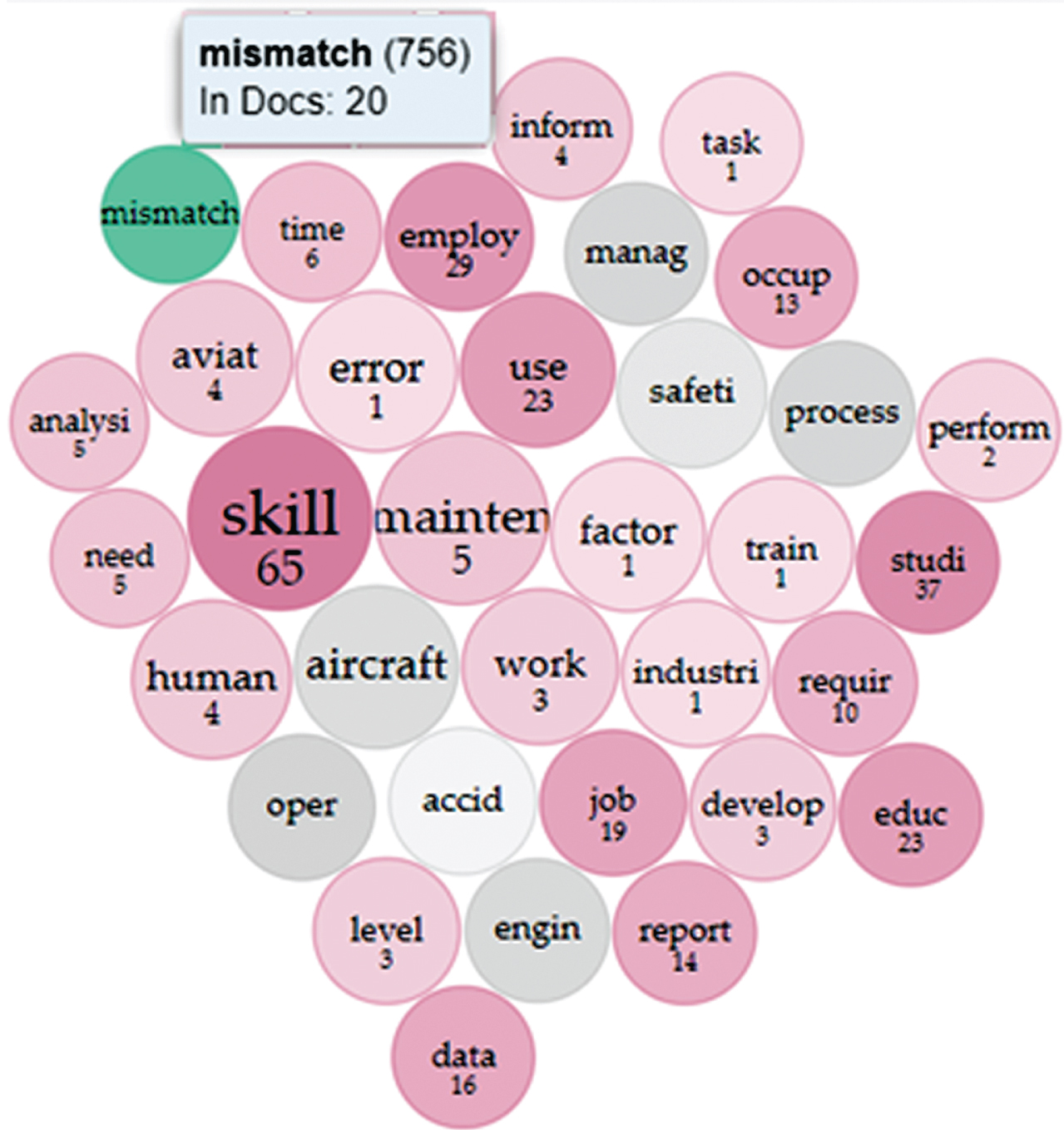
TermsBerry visualization.
Overall, from the visualizations, we could infer that the document dataset mainly discusses on a theme of aircraft maintenance and skillset issues. Aircraft maintenance is considered as a complex problem solving [44], thus, it is crucial to overcome issues of skills shortage and mismatch among the aircraft maintenance technicians.
Human resource management approaches such as placing individuals in certain roles without the necessary skills or education might hurt a company’s competitiveness yet declaring so does not create an image that can help the company especially in aircraft maintenance. [45] conducted a study on Air Asia aircraft maintenance technicians agreed that skill mismatch affects their work performance. 50% of the respondents (technicians) agree that some of the tasks assigned are mismatched between their capabilities because of limitation of knowledge and skills with the new difficult and unfamiliar task with limited time given. [46] also studied that majority aircraft incidents in Nigeria between 2006 and 2019 are affected by maintenance factors with the highest contribution to these accidents are “operator and regulatory oversight”, “inadequate inspection” and “failure to follow procedures”. These are in line with the Figs. 7 and 8 which illustrate ‘employ’, ‘job’, ‘requir’, ‘skill’ and ‘mismatch’. [47] examined the skills mismatch dimension, which looked at the gap between education and the employment, including between employee skills and company demands. The first type of mismatch is termed educational mismatch, and it refers to situations in which individual’s education is inconsistent with the requirements of the job. The second educational mismatch is undereducation, which occurs when an employee’s education falls short of what the organisation requires.
Work-based learning, or in-house specialised training that targets the specific needs of the employer, is frequently used to overcome the skills mismatch [48, 49]. Furthermore, tailored training is considered as a way to meet the many “levels” of skill requirements that businesses require. The gap between the needs of the aviation workforce and the skills of the technician prospect can be bridged through tailored training. Airport Region Council in Belgium oversees a project on re-designing of work processes and conducting a work-based learning for mismatch capability aviation worker [50]. This is consistent with the findings in Fig. 9 that depicts terms ‘skill’, ‘educ’, ‘employ’, ‘use’ and ‘studi’ extracted from the document set.
In recent years, the aviation industry has experienced a growing interest for reskilling and upskilling [6]. The aircraft maintenance workforce will endure skill development programmes, as outlined and proposed below: Personnel upskilling [2, 62]: Management will be expected to upskill its employees, either domestically or through external training institutions. A first-line technician, for example, will be required to manually fit a part using a robot or other IoT devices. He or she should learn to use the new tools effectively. Internationally, the growth of skills for the continuous maintenance knowledge base falls behind that of manufacturing technologies and systems. Personnel reskilling [55, 56]: IR 4.0 is expected to result in some job displacement. A significant number of jobs will be lost. In addition, a number of new jobs will be created. Management will need to invest in reskilling its employees in order to prepare for this anticipated transformation. Constant Learning [6, 57]: Technological advancements may become obsolete rapidly. To quickly respond to the changes brought about by technological advancements, continuous professional development approaches would be required. Mindset shift [58–60]: Because they will have to adjust to a lot of changes, technicians will reject and fight the implementation of contemporary technologies. To guarantee a smooth transition to advanced maintenance operations, management should anticipate the need for technician mentality changes.
Conclusion
Because aircraft maintenance and servicing are vital tasks in the aviation industry, they should be improved. According to reports and news, many aircraft incidents occur due to a variety of factors, including faulty equipment, hazardous weather conditions, including turbulence, and human error. In this paper, we conduct an experiment on a collection of online articles and reports concerning aircraft incidents and skill mismatch issues in the aircraft maintenance fields. The impact of IR4.0 on aviation, aviation maintenance and skill set issues and incidents, document mining, TDM, and the TF-IDF technique are also discussed in this paper. It introduces the AMDAF and presents the results of document analytics using the proposed framework. We can conclude that the document dataset primarily discusses aircraft maintenance and skill set issues. Because aircraft maintenance is regarded as a complex problem to solve, it is critical to address issues of skill mismatch among aircraft maintenance technicians. Not only will the aviation industry face difficulty in finding trained technicians, but it will also face a variety of other issues connected to its current workforce and skill development projects such as upskilling and reskilling the aircraft maintenance workforce. Furthermore, the organizations should promote a constant learning environment and create a mindset of its personnel for adapting the new technologies and knowledge in aircraft maintenance.
In the future, the research will expand on the need for a competency-based skill assessment and training mapping model for aircraft maintenance technicians to address IR 4.0 and skill mismatch issues in aircraft maintenance.
Footnotes
Acknowledgments
The authors have no acknowledgments.
Author contributions
CONCEPTION: T. Nanthakumaran Thulasy, Puteri NE Nohuddin, Noorlizawati Abd Rahim and Astuty Amrin
METHODOLOGY: T. Nanthakumaran Thulasy and Puteri NE Nohuddin
DATA COLLECTION: T. Nanthakumaran Thulasy
INTERPRETATION OR ANALYSIS OF DATA: T. Nanthakumaran Thulasy and Puteri NE Nohuddin
PREPARATION OF THE MANUSCRIPT: T. Nanthakumaran Thulasy, Puteri NE Nohuddin, Noorlizawati Abd Rahim and Astuty Amrin
REVISION FOR IMPORTANT INTELLECTUAL CONTENT: T. Nanthakumaran Thulasy, Puteri NE Nohuddin, Noorlizawati Abd Rahim and Astuty Amrin
SUPERVISION: Cross supervision, all authors