





Abstract
This paper tackles the job shop scheduling problem with fuzzy sets modelling uncertain durations and flexible due dates. The objective is to achieve high-service level by maximising due-date satisfaction, considering two different overall satisfaction measures as objective functions. We show how these functions model different attitudes in the framework of fuzzy multicriteria decision making and we define a measure of solution robustness based on an existing a-posteriori semantics of fuzzy schedules to further assess the quality of the obtained solutions. As solving method, we improve a memetic algorithm from the literature by incorporating a new heuristic mechanism to guide the search through plateaus of the fitness landscape. We assess the performance of the resulting algorithm with an extensive experimental study, including a parametric analysis, and a study of the algorithm’s components and synergy between them. We provide results on a set of existing and new benchmark instances for fuzzy job shop with flexible due dates that show the competitiveness of our method.
Introduction
Scheduling is a decision-making process that tackles the allocation of resources to tasks over given time periods with the goal of optimising one or more objectives. This kind of problems is pervasive in a growing number of domains, including engineering, management science or distributed and parallel computing, to mention but a few [2, 63, 86]. Within scheduling, one of the most relevant problems is the job shop, a combinatorial optimisation problem where pre-defined sequences of tasks are organised into jobs, so each job must visit several resources or machines in a predetermined route. Different processing restrictions and constraints (e.g. job release or due dates or machine setup times) as well as different objective functions (many of them dependent on the completion times of the jobs) yield different variants of the problem. It has many practical applications (e.g. wafer fabs in the semiconductor industry often function as job shops). It also poses a challenge to the research community due to its complexity [63].
The most common objective in the literature is to find a schedule with minimum makespan (which is the time when the last job is finished), but due-date fulfilment has also occupied researchers and is receiving increasing attention in recent years [63, 40]. Indeed, on-time fulfilment appears to be of prime importance in modern pull-oriented supply chain systems and keeping job due dates is a prerequisite for serving customers within the promised delivery time and avoiding out-of-stocks costs. Hence, the use of due-date satisfaction measures in production scheduling helps the companies to increase their logistic service and create competitive advantage.
Classical objectives related to due-date satisfaction are total weighted tardiness or maximum lateness, which are typically associated with customer satisfaction and service level in make-to-order environments. These approaches fail however to account for the case – often encountered in practice – where due-date constraints are flexible, for instance, if preferences of customers are incorporated [7]. Traditional approaches also assume that scheduling problems are static and certain: all activities and their durations are precisely known in advance and do not change as the solution is being executed. Still, in many real-world applications design variables are subject to perturbations or changes, causing optimal solutions to the original problem to be of little or no use in practice [35, 6].
With the goal of narrowing the gap between theory and applications, some researchers have started to take into consideration uncertainty and flexibility. To this end, fuzzy sets provide an interesting framework since they allow both for tackling uncertainty and accounting for preferences, as well as addressing solution robustness [22, 38].
Whether in its more classical form or taking into account uncertainty or flexibility, many scheduling problems, including the job shop, belong to the class of hard combinatorial optimisation problems. For this reason, researchers often resort to metaheuristic search methods to solve them. In particular, hybrid metaheuristic approaches such as memetic algorithms have proved very successful in tackling complex problems of combinatorial nature [16, 49, 71, 84].
In the following, the fuzzy job shop scheduling problem, or FJSP in short, is addressed. This is a job shop problem with uncertain durations and flexible due dates modelled as fuzzy numbers and fuzzy thresholds. The goal is to maximise the overall due-date satisfaction, which translates into two different objective functions depending on how this “overall” satisfaction is defined. The proposal builds upon the contribution presented at IWINAC’2017 Conference [61], where a hybrid algorithm for the FJSP was introduced. This preliminary work is enhanced in several ways. First, we reformulate the objective functions modelling overall due-date satisfaction in the context of multicriteria aggregation and decision making, shedding more light into their meaning and the different requirements they model. Second, we introduce the concept of solution robustness and we define new measures of robustness and surrogate robustness regarding due-date satisfaction are given, which will allow to assess the quality of the fuzzy schedule at the moment of its practical use. Third, we improve the hybrid algorithm in two different ways. We consider a more varied set of genetic operators and we follow a robust design method in the experiments to select the most competitive configuration, ensuring an adequate balance between intensification and exploration. Also, based on the original reformulation of the objective functions, we propose a novel heuristic technique to improve the algorithm by effectively guiding the search across plateaus in the objective space for one of the objective functions. Finally, the experimental evaluation is greatly extended with a parametric analysis, separate assessment of each component of the hybrid algorithm and the synergy between them, convergence analysis and solution robustness evaluation. Experiments are run on more challenging job shop instances by incorporating due dates to them and show that the enhanced algorithm not only outperforms the state-of-the-art, but also provides robust solutions and is more capable of navigating plateaus in the fitness landscape. As a result, we provide a new benchmark together with competitive results for due-date satisfaction which should serve as future reference for researchers working in this area.
Related work
A considerable effort has been made to extend classical scheduling models and algorithms in order to capture and deal with complex constraints and features present in real-life environments. Notable examples of this are scheduling problems considering resource setup times [5], presence of human operators [48], flexibility in machines [19] or features typical of construction projects such as precedence relationships, multiple crew-strategies, and time-cost trade-off [70].
The most frequent objectives related to due-date satisfaction in deterministic problems are maximum lateness and total weighted tardiness (cf. [63, 14] and references therein). For the latter, exact and heuristic search methods exist in the literature [72, 62] and the state-of-the-art is formed by different metaheuristics incorporating local search: the Genetic Local Search from [28] which combines a genetic algorithm with an iterated local search, the Hybrid Shifting Bottleneck with Tabu Search approach proposed in [17], the Hybrid Genetic Algorithm with Tabu Search from [31], and the Extended GRASP algorithm presented in [14].
Many of these successful methods belong to the class of memetic algorithms, whose structure is characterized by an evolutionary framework incorporating local search components [49, 50]. Indeed, memetic algorithms have proved successful in solving complex combinatorial optimisation problems, such as job shop scheduling problem, thanks to the synergy obtained from combining the global search diversification of the evolutionary framework with the intensification provided by the local search components. Examples of successful applications of evolutionary algorithms to scheduling and related complex optimisation problems abound. Among recent contributions, we find genetic algorithms for solving a multiobjective elevator scheduling problem [3] and a time-constrained project scheduling problem [41]. Distributed embodied evolution is used to obtain solutions in real-time to distributed engineering problems with collectively non-separable spaces such as the dynamic fleet size and mix vehicle routing problem with time windows [64] and a quantum inspired evolutionary algorithm is applied to real-world optimisation problems in [81]. Evolutionary strategies have also proved effective in solving complex multiobjetive optimisation problem [66, 78].
In a complementary approach to modelling real-world characteristics, fuzzy sets were first incorporated to scheduling in the turn of the 1980s [18]. Since then, fuzzy sets have been widely used in scheduling: using fuzzy priority rules or fuzzy decision making with linguistic qualifiers [65], modelling soft constraints and uncertain durations [22, 46] or even as a means of improving solution robustness, a much-desired property in real-life applications [38, 77]. In particular, fuzzy sets have been used to model gradual satisfaction of flexible due dates since the 1990s, sometimes in combination with uncertain processing times [23, 68, 33].
In [47] we find one of the first attempts of using fuzzy sets to model uncertain times in a job shop problem, while [23] also uses fuzzy sets to model flexible constraints. After these seminal papers, many contributions for different variants of fuzzy job shop have appeared in the literature, as can be seen in the recent reviews on fuzzy job shop [1], fuzzy shop scheduling [9] and benchmarks for fuzzy job shop [59]. The simulated annealing algorithm from [30] and the genetic algorithm from [69] constitute two landmarks in the application of metaheuristic search to FJSP. Currently, some of the most competitive methods for fuzzy makespan minimisation in job shop problems are the genetic algorithm from [44] and the memetic algorithm from [59].
For problems combining fuzzy durations and fuzzy due dates, the term agreement index was coined in [69] to refer to the degree to which a job’s fuzzy completion time satisfies the flexible due-date, and a genetic algorithm was proposed to maximise the minimum agreement index across all jobs. Maximising the minimum agreement index is also the objective of a random-key genetic algorithm in [44], a scatter search method in [27], a hybrid discrete imperialist competition algorithm in [79] and a memetic algorithm in [61]. This memetic algorithm is also applied to maximise the average minimum index, which is also the objective of the co-evolutive method from [82], here for a fuzzy job shop with multi-process routes, and of the multiobjective genetic algorithm from [29], which also attempts to minimise the number of tardy jobs. Maximisation of average or minimum agreement index is also one of the objectives of several multiobjective approaches together with makespan minimisation: based on fuzzy decision making using genetic algorithms [68, 33], based on lexicographical goal programming also with a genetic algorithm [32] or Pareto-front approximation using a genetic algorithm [54], Pareto archive particle swarm optimisation [43] or a memetic algorithm for multi-process routes [76]. For a classical benchmark from [68], the most competitive methods are the random-key genetic algorithm from [44] and the memetic algorithm from [61], while [32] reports minimum and average agreement index values for another set of instances. In fact, these methods obtain almost full due-date satisfaction, suggesting there is no room for improvement in this area. However, in [61] new results on harder instances make it clear that the problem of due-date satisfaction is far from being solved.
The remainder of the paper is organised as follows. Section 2 gives the necessary background on the fuzzy job shop problem under consideration. Section 3 provides a new insight into the two objective functions usually considered in the literature by situating them in the more general framework of fuzzy multicriteria aggregation and decision making and develops the concept of solution robustness regarding due dates and measures thereof. Then, Section 4 enhances the hybrid algorithm from [61], combining a genetic algorithm with local search, to solve the problem. Different genetic operators are considered and, based on the framework of fuzzy multicriteria aggregation, a new heuristic strategy to guide the search through plateaus in the fitness landscape is proposed for the case of the most demanding objective function. Finally, Section 5 presents a thorough experimental evaluation of the proposed method, introducing a new more challenging benchmark based on existing instances for makespan minimisation, and Section 6 presents the main conclusions and proposals for future work.
The fuzzy job shop problem
The classical job shop scheduling problem, also denoted JSP, consists of a set of jobs
for
for every pair of tasks
Each job
In real-life applications, it is difficult, if not impossible, to foresee in advance the exact time it will take to process a task. It is reasonable however to have some knowledge (albeit uncertain) about the duration, possibly based on previous experience. The crudest representation of such uncertain knowledge would be a human-originated confidence interval and, if some values appear to be more plausible than others, then a natural extension is a fuzzy interval or fuzzy number. The simplest model is a triangular fuzzy number or TFN, denoted
Triangular fuzzy numbers (or, more generally, fuzzy intervals) are widely used in scheduling as a model for uncertain processing times [1, 22, 59].
The job shop essentially requires two operations on fuzzy numbers, the sum and the maximum. These are usually defined by extending the corresponding operations on real numbers. The resulting addition is pretty straightforward, so for any pair of TFNs
Unfortunately, computing the extended maximum is not that simple and the set of TFNs is not even closed under this operation. Hence, it is common in the fuzzy scheduling literature to approximate the maximum of two TFNs as
Besides its extended use, several arguments can be given in favour of this approximation [59].
Fuzzy sets can also be used to model flexible due dates. Consider the case where there is a preferred delivery date
This expresses a flexible threshold “less than”, representing the satisfaction level
When the job’s completion time is no longer a real number
where
To determine a solution for a fuzzy JSP, it is necessary to establish partial task processing orders on all machines. A schedule
The resulting schedule
Once a schedule
The overall value of due-date satisfaction for the schedule
The resulting job shop problem, with fuzzy processing times and fuzzy due dates, and where the objective is to maximise the aggregated agreement index
Aggregated due-date satisfaction
Both
From the viewpoint of multifactorial evaluation, the flexible due dates
Under these requirements, if it is possible to find a schedule that fully satisfies individual job due dates then at least one of these maximal schedules has full membership in
In general, when an overall decision must be made, three fundamental attitudes in front of several goals
In some cases,
where
Both
where
Depending on the weight values, OWAs can range from conjunctive attitude to the disjunctive one.
In summary, both
A fuzzy schedule does not provide exact starting times for each task. Instead, it gives a fuzzy interval of possible values for each starting time, provided that tasks are executed in the order determined by the schedule. In fact, it is impossible to predict what the exact time-schedule will be, because it depends on the realisation of the task’s durations, which is not known yet. This idea is the basis for a semantics for fuzzy schedules from [33] by which solutions to the fuzzy job shop should be understood as a-priori solutions, also called baseline or predictive schedules in the literature [35]. These solutions are found when the duration of tasks is not exactly known and the set of all possible scenarios must be taken into account. Only after tasks are executed according to the ordering provided by the fuzzy schedule is their real duration known and a real (executed) schedule is obtained, the a-posteriori solution with deterministic times. Clearly, it is desirable that a fuzzy solution yields reasonably good executed schedules at the moment of its practical use, in clear relation with the concept of schedule robustness.
Roughly speaking, a schedule is said to be robust if it minimises the effect of executional uncertainties on its primary performance measure [6]. This straightforward definition may, however, be subject to many different interpretations when it comes to specifying robustness measures [67].
For the problem at hand, uncertainties apply to task processing times, the performance measure is the overall due-date satisfaction and the effect of executional uncertainties is understood relative to all possible scenarios.
In the context of stochastic uncertainty, a robust predictive schedule is proposed as a predictive schedule such that the quality of the eventually executed one is close to the quality of the predictive schedule [12]. This yields a definition of
Given the above, in this work a definition of robustness measure is proposed which, although keeping in line with the spirit of
.
Let
That is, the error of the estimation made by the predictive schedule (i.e. the aggregated agreement index) regarding overall due-date satisfaction is bounded by
The rationale behind this definition is that a predictive schedule is robust if the quality of the eventually executed schedule is close to the quality of the predictive schedule in any of the possible scenarios for task durations. Obviously, since
It is worth noticing that the approach to robustness taken here is different from the better-known approach from combinatorial optimisation, based on min-max or min-max regret criteria, which aims at constructing solutions having the best possible performance in the worst case [4]. The study of such criteria is motivated by practical applications where an anticipation of the worst case is crucial and there already exist proposals to translate it to the fuzzy framework [38, 75]. However, the min-max approach may be deemed as too conservative in some cases where the worst case is not that critical and an overall acceptable performance, with a solution that behaves “well” or “not too bad” in all the scenarios, is preferred [37]. It is in these situations where an approach such as the one proposed here might be more adequate. Also, more classical approaches measure robustness as a deviation from the optimal solution on each possible case, thus assuming that such optimal solution can indeed be found. Unfortunately, this is a somewhat unrealistic assumption when dealing with complex problems such as job shop (even in its deterministic version). The approach adopted in this work takes the alternative stance of measuring deviations between the prediction and the real execution (be it optimal or not).
The above definition of
.
For a given fuzzy job shop problem instance and
A crucial factor in this method is the way in which task crisp durations are obtained. This is done by simulating crisp durations for tasks following a probability distribution that is consistent with the possibility distribution
The first approach consists in taking the uniform probability distribution that is bounded by the support of the TFN; the resulting simulation will be referred to as “Scenario I”. This transformation is motivated by several results from the literature (see [24, 8]) that justify the use of TFNs as fuzzy counterparts to uniform probability distributions and model-free approximations of probability distributions with bounded support.
The second method consists in taking the probability distribution obtained from each fuzzy duration after applying the pignistic transformation obtained by considering cuts as uniformly distributed probabilities [26]. This is the probability one would obtain from the membership function of a fuzzy duration applying a generalised version of the Insufficient Reason Principle by Laplace. This distribution is much more “focused” on the modal value, in the sense that it gives high probability to values close to the mode and very low probability to values at the extreme of the support interval. The simulation that results from this transformation will be referred to as “Scenario II”.
Memetic algorithms, a kind of hybrid algorithms combining genetic algorithms with local search methods, have proved to be very powerful in different optimisation problems [36, 49]. The reason is their ability to integrate the intensification provided by the local search with the diversification provided by the population-based algorithm. In particular, some state-of-the-art methods for different variants of fuzzy job shop are hybrids of this kind [55, 59]. This motivated the proposal in [61] of a memetic algorithm for
Genetic component
For the genetic component of the algorithm, solutions are codified into chromosomes as permutations with repetitions [13]. Each permutation represents a feasible task processing order by identifying each operation
The algorithm starts from a random population. It then iterates until maxIter consecutive iterations pass without any improvement in the best solution found so far. At each iteration a new generation is built from the previous one by applying the genetic operators of selection, recombination and replacement.
In the selection phase all chromosomes are randomly paired, and then each pair is mated to obtain two offspring by applying crossover and mutation with a certain probability. Two individuals are then selected from each pair of parents and their two offspring to pass onto the next generation using tournament. If the two selected individuals have the same fitness value, the replacement strategy may discard one of them and select the next best individual instead, as a mechanism to preserve diversity.
For recombination, several classical operators are considered: Job-Order Crossover (JOX) [53], Generalised Order Crossover (GOX) [13] and Generalised Partially-Mapped Crossover (GPMX) [15] and Order-Based Mutation (OBM), Insertion Mutation (IM) and Simple Inversion Mutation (SIM) [42]. In GOX and GPMX a substring is randomly chosen from the first parent and then the offspring is generated by initially copying the second parent in the offspring and then deleting the genes in the substring taking into account the positions where they occur. GOX then inserts the substring at the position where the first gene of the substring had occurred (before deletion) in the second parent. Alternatively, GPMX inserts the substring at the position where it occurred in the first parent. JOX is more job oriented; it starts by randomly choosing the jobs whose loci are to be preserved, which are then copied from the first parent onto the offspring preserving their loci and the offspring is completed with the remaining jobs preserving their relative order in the second parent. In all cases, a second offspring may be obtained by reversing the parents’ roles.
Regarding mutation operators, OBM (also known as Swap Mutation operator or Exchange Mutation operator) exchanges two positions of the chromosome at random, IM (also known as Position-Based Mutation) inserts a randomly chosen gene into another random position and SIM reverses a random substring in the chromosome.
Local search component
The local search component consists in a simple hill climbing procedure using one of the neighbourhood structures
[h!t] The Memetic AlgorithmA FJSP instance A schedule Generate random population
Apply mutation to
Apply mutation to
Evaluate
Apply Local Search to
Update genotype of
Apply Local Search to
Update genotype of
Heuristic tie-breaking for
The experimental results using
As highlighted in [74], a possible strategy to break the plateaus of a landscape and guide the search toward better regions consists in having a secondary criterion that allows to discriminate individuals that have the same value for the fitness function and is correlated with the main objective of the problem.
This approach is taken in [20] to avoid misleading the search to local optima in deceptive problems: a measure of the “potential” of individuals is proposed as an additional criterion for selecting them for reproduction. Similarly, in [11] a secondary measure of the “improvability” of individuals is used to break ties in tournament selection in order to solve bin packing problems, where equal integer fitness values often occur. A secondary fitness is also used to break ties in tournament selection in [45, 80] in the context of genetic programming to guide the search through fitness plateaus.
Building on these works, in the following it is proposed that the MA optimising
For any schedule
It is important to notice that the procedure does not assign a new fitness value, but instead uses a modified tournament replacement operator to consider additional criteria in order to break ties and guide the search. The rationale behind this strategy is that, when two solutions are equally bad with respect to the due date that is satisfied the least, the solution achieving more satisfaction in the second-worst due date might be preferred. If ties persist, i.e., solutions are still indistinguishable from the point of view of the next-to-last due-date satisfaction, then the schedule with better performance in the third-worst due date is preferred, and so on. Equivalently, if two schedules are equally bad regarding the least-satisfied due date (or
[h] Heuristic tie-breakingTwo solutions
Alternative strategies to handle plateaus and mostly flat fitness landscapes can be found in the literature. For instance, in [51, 52] we find two complex evolutionary algorithms that avoid getting trapped in a local optimum based on measuring the population diversity and, based on this, dinamically adjust the algorithm parameters and activate/deactivate the use of local search strategies to guide the search. For the experimental evaluation, we have adapted the Adaptive Multimeme Algorithm (AMmA) from [51] to our problem. We have plugged the genetic operators and the only local search from our memetic algorithm into AMmA while keeping the variable population size and crossover and mutation probabilities as well as the application of the local search dependent on the diversity of the population. We consider the two different diversity measures extending them so they are zero in the case where all the individuals in the population have null fitness (and the original expressions of diversity yield an indeterminate). This results in two different versions of AMmA adapted to our problem, denoted AMmA
Experimental evaluation
The memetic algorithm or the MA proposed in Section 4 builds on the memetic algorithm from [61], by enhancing it with a variety of genetic operators, allowing for different intensities in the hybridisation with local search and incorporating a heuristic mechanism to navigate through plateaus when the objective is to maximise
First, the preliminary version of the MA from [61] already compared favourably with the methods which, up to that moment, conformed the state of the art in the literature on fuzzy job shop with flexible due dates. Hence, no further comparison with these already outperformed methods is needed.
Second, among the FJSP instances most widely used in the literature up to now, (S6.1-3 and S10.1-3 from [68], S6.4 and S10.4 from [69] and Lei01 and Lei02 from [44]) only the two largest ones, Lei01 and Lei02, seem to offer enough room for improvement to continue serving as benchmarks. Additionally, instances La21, La24, La25, La27, La38, La40, ABZ7, ABZ8 and ABZ9, obtained from classical JSP instances by fuzzifying processing times and adding due dates as explained in [54] have proved hard to solve. Therefore, it seems reasonable to start the empirical evaluation of the MA on the eleven challenging instances.
Finally, the results obtained by the preliminary version of the MA suggest that the due dates generated for the fuzzified instances are, in general, very tight or strict, in the sense that they are difficult to satisfy. This is likely to be related to the method used to generate due-date values, based on a lower bound of the expected job’s completion time obtained by relaxing resource constraints. Depending on the ratio between the number of jobs and the number of machines, it may result in a loose lower bound and, in consequence, the due date turns out to be excessively strict or even impossible to satisfy. This, together with the conjunctive behaviour of
All results reported in the sequel correspond to a C++ implementation of the MA running on a PC with Xeon processor at 2.2 Ghz and 24 Gb RAM with Linux (SL 6.0.1).
Parametric and convergence analysis
In a first set of experiments, a parametric analysis is conducted to find the best configuration of operators and parameters for the MA. Specifically, the three crossover and mutation operators described in Section 4.1 are considered, together with typical values for crossover and mutation probability, and two different replacement strategies as follows:
Replacement strategy: Allow repeated individuals (AR) or not (NR). Crossover operator: JOX, GOX, GPMX. Crossover probability: 0.8, 0.9, 1.0. Mutation operator: IM, OBM, SIM. Mutation probability: 0.05, 0.10, 0.20.
Population size is taken to be 100, the local search probability
Perhaps two of the most extended approaches to parameter tuning are a sequential strategy or an experimental design approach, such as the Taguchi meth-od [74]. Arguments can be given in favour and against both of them. The sequential strategy consists in tuning one parameter at a time, starting from a base set-up and determining each optimal parameter value empirically. This method is widely used, but is heavily dependent on the order in which parameters are tuned. The Taguchi or robust design method sorts the parameters according to their relevance in the final performance of the algorithm and at the same time gives the “best” parameter configuration based on statistical principles but it is also subject to criticisms. These two methods are somehow complementary: the Taguchi method can provide the base set-up for the sequential strategy as well as an order for the sequential parameter tuning.
Delta values and set-up obtained after the parametric study
For the Taguchi method, given that there are four parameters with 3 different levels and another parameter with two levels, the orthogonal array L18 is used. The obtained “Delta values” in the second column of Table 1 indicate that the most relevant parameter for the algorithm is the crossover operator, followed by the replacement strategy, the mutation operator and finally the crossover and mutation probabilities. The “Base set-up” column shows the configuration that results from the Taguchi method. Starting from this configuration, parameters are then sequentially tuned in the order given by the Taguchi analysis, yielding the final configuration in the last column of the table.
Evolution of the MA with different local search pressure on instance La21.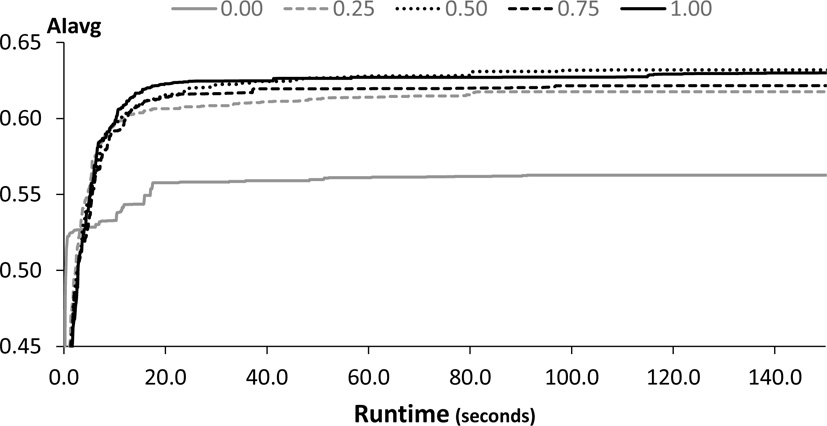
The performance of a memetic algorithm can also be affected by the local search, since this component may in some cases provide excessive intensification, negatively affecting the diversity in the population and leading to premature convergence. In order to fix a value for the probability
The main difference in convergence curves lies in having or not local search. For the cases where local search is applied, regardless of the probability, fitness values and convergence patterns are quite similar, with slightly better fitness values when local search is applied to every individual in the population (
Finally, in order to assess the behaviour of the MA with different population sizes, another convergence study is carried out by running the algorithm with varying population sizes of 100, 200 and 500 with a time limit of 300 seconds, which is more than twice the time it took to converge in the previous experiments. Figure 2 shows the average
Results obtained by the MA maximising
Evolution of the MA with different population sizes on instance La21.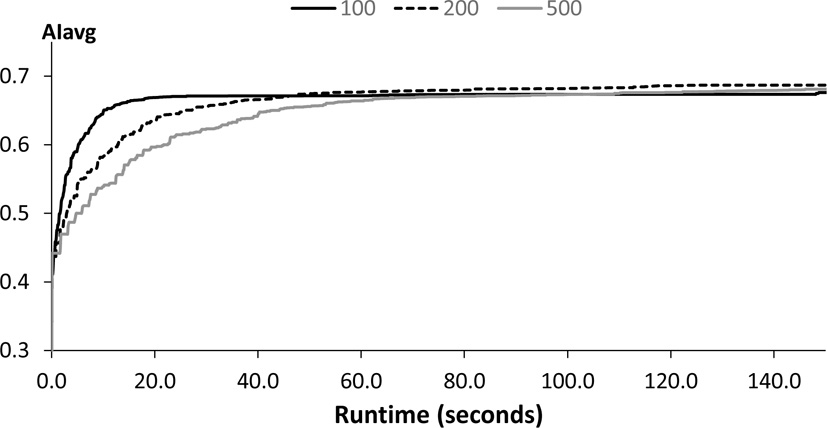
Once a configuration has been decided for the MA, its performance can be assessed on the same set of instances. A summary of the results is shown in Table 2, where each row corresponds to a problem instance. The second and third columns contain the best and average values of
Surrogate
-robustness for
Surrogate
It can be appreciated that the degree of overall due-date satisfaction varies significantly across the different instances, ranging from more than 0.82 on instances La38 and La40 to values in the vicinity of 0.5 on instances La27 and La29. This might be related to the method used in [54] to generate due-date values and with the shape of the instances as explained above. For instances La27 and La29, with twice as many jobs as tasks per job, due dates are very tight and there is little room to schedule tasks in every job in such a way that precedence and resource constraints hold and due dates are met. On the other hand, for “square” instances La38 and La40, with the same number of jobs and tasks per job, due dates turn out less strict and tasks can be scheduled so as to satisfy due dates to a large extent.
Further evaluation can be provided in terms of solution robustness. For each problem instance, the 30 runs of the MA provide a total of 30 solutions or predictive schedules. For each of these predictive schedules the surrogate
A final set of experiments is conducted to assess to what extent does each component of the MA contribute to its overall performance. It also allows to check if there is an expected synergy effect between the intensification provided by the local search (LS) and the diversification provided by the genetic algorithm (GA). To this end, the GA and LS are run independently. For a fairer comparison, LS is run as a multi-start local search with as many restarts as the average number of evaluations performed by the MA on each instance. Analogously, the GA is run with the same configuration as the MA except for the stopping criterion, which is changed to leaving GA run for as long as MA takes to converge. The comparison is shown in Fig. 3. The multi-start LS starting from random solutions obtains the worst results, not only in performance, but also in runtime which is 62% longer than for MA. GA, although performing much better than LS, is not as good as MA. Indeed, a synergy effect can be appreciated when combining both strategies, with MA obtaining much better results in the same running time than GA. This shows that MA benefits from the interaction between the exploration of GA and the intensification of LS.
Performance of the different components of MA with respect to 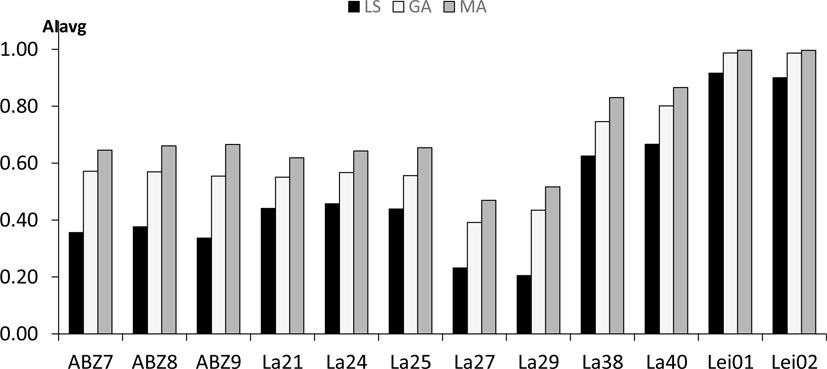
The review of existing benchmarks for fuzzy job shop in [59] concludes that most of the existing benchmark instances are not especially hard in terms of makespan minimisation and proposes a new more challenging benchmark based on the well-known Ta benchmark for the classical JSP from [73] containing 20 instances with as many tasks per job as the number of machines,
Table 4 reports the results obtained by MA on the 20 most challenging instances of this new benchmark when optimising
Results obtained by MA maximising
on the new benchmark instances Ta21-50
Results obtained by MA maximising
As was the case with the previous benchmark, the method used to generate due dates results in very tight due dates for those problem instances where the number of jobs is larger than the number of tasks in each job (Ta41-50), making it very difficult to achieve high levels of due date satisfaction. This explains the fact that for instances Ta21-30 the average overall due-date satisfaction degree is always between 0.74 and 0.83, while for instances Ta41-50 it is never greater than 0.51.
Additional assessment is provided by computing surrogate
Surrogate
Average 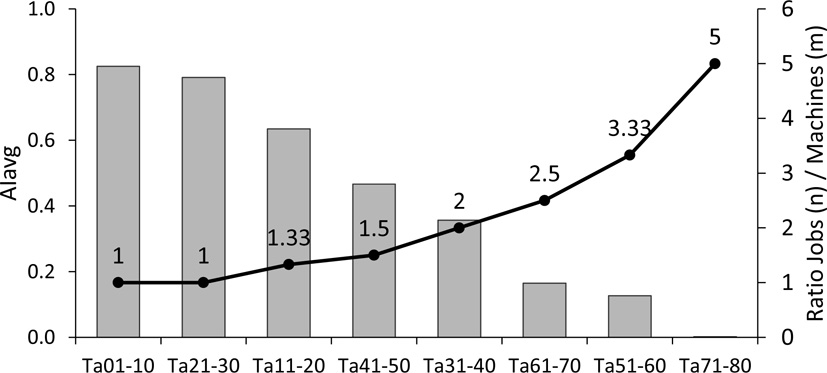
Figure 4 illustrates the relationship between the obtained results and the structure of the problem instances. It depicts the average
Average runtime depending on the instance size.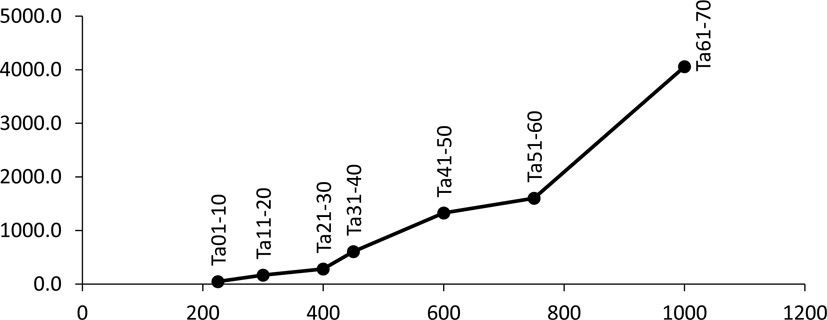
Finally, we obtain results of MA incorporating the tie-breaking heuristic to maximise
First, the challenging problem instances from [61] are considered. These instances can be classified into three groups. A first group of “easy” instances includes Lei01 and Lei02, where all three algorithms obtain very good solutions. Almost full due-date satisfaction is achieved on average and the best solution of MA for Lei02 is actually optimum. There is no significant difference between using MA or tbMA, nor between tbMA and any of AMmA
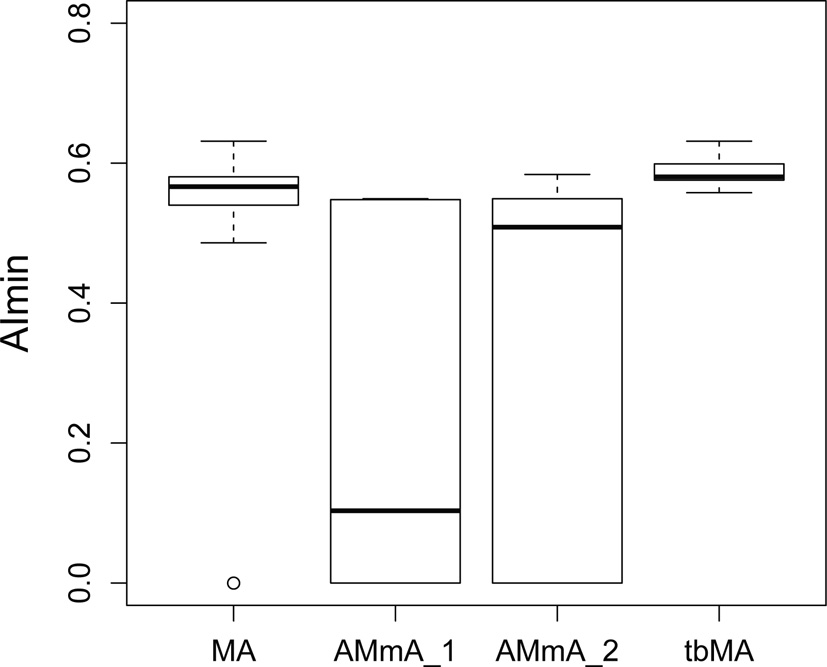
suggest that here due dates are not unreasonably tight but MA without the tie-breaking mechanism cannot find any solution with
A similar behaviour can be seen on the more challenging benchmark Ta. In the set of “rectangular” instances Ta41-50, with more jobs than tasks per job,
Results obtained by MA maximising
Besides Ta21-30, the new benchmark only has another set of square instances, Ta01-10. These are the only instances where some solution is found without null
Average and best 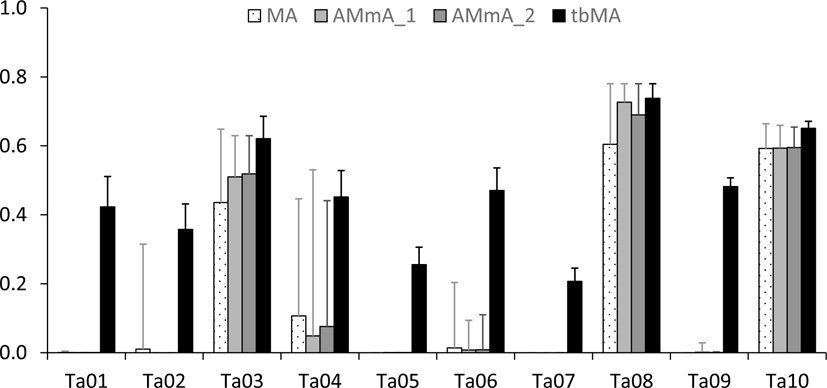
Out of completeness, we have conducted another set of statistical tests for pairwise comparisons for all four methods on Ta01-10. Again we have discarded normality and run Wilcoxon tests with significance level 0.05. These show that there are significant differences between MA and both AMmA
To better understand the difference in behaviour between the heuristic tie-breading method and the alternative strategy to escape plateaus from AMmA
The fuzzy job shop scheduling problem or FJSP, is a variant of the job shop problem with uncertain durations and flexible due dates modelled as fuzzy numbers and fuzzy thresholds. It is an interesting problem with the potential of narrowing the gap between scheduling theory and practical applications in different fields of engineering. Its complexity calls for the use of metaheuristic search techniques which provide good solutions in a reasonable time.
Here, the concept of solution robustness for FJSP has been introduced and a new measure of robustness has been defined. Additionally, the two most common objective functions from the literature have been placed in a more general framework of fuzzy multicriteria decision making, shedding more light into their different behaviours. This has later been used to devise a heuristic mechanism to guide the solving method through flat plateaus of null fitness. This solving method is based on a memetic algorithm from [61], combining a genetic algorithm with local search, which has been enhanced by considering a wider range of genetic operators, allowing for different intensities in the hybridisation of the genetic and local search components and by incorporating the heuristic tie-breaking mechanism. A thorough experimental evaluation has shown the potential of the memetic algorithm, which not only outperforms the state-of-the-art, but also provides robust solutions. A new more challenging benchmark has been proposed by incorporating flexible due dates to existing instances and results obtained with MA using both objective functions, hopefully providing a reference for future research on more powerful methods to solve this problem. The resulting test bed is available on the internet,2 in order to facilitate experiment reproducibility and encourage research competition.
Results obtained by MA maximising
on instances Ta01-Ta20 and Ta31-Ta40
Results obtained by MA maximising
As future work, it would be interesting to devise a method to generate due dates that takes into account the “shape” of the problem instances, so for those instances with a ratio
Tables 7 and 8 report detailed
Results obtained by MA maximising
Footnotes
Repository section at