






Abstract
Future 5G networks are envisioned to provide communication services in a very heterogeneous catalogue of applications. The concept of network slicing, a technology where network resources are packed and assigned to users in an isolated manner, contributes to overcome the relevant differences among all the applications scenarios. This paper proposes a new approach for the implementation and management of services and slices in future 5G systems with network slicing, based on lightweight algorithms and virtualization technologies, such as Docker or Kubernetes. The proposed solution consists of a microservice-oriented virtualization-based architecture, where Docker containers encapsulate virtual network functions configured as microservices. Kubernetes mechanisms take care of most management functions, so (in the proposed approach) only two functional components must be designed. In this paper, a possible implementation for one of these components (the specific service manager) is proposed, based on statistics and metrics generated by Kubernetes cAdvisor and simple mathematical operations. Results show an improvement in relevant network indicators such as availability and configuration time. Besides, the scalability of the proposed technology is evaluated by means of the calculation time it requires.
Keywords
Introduction
Future 5G networks are evolving from a scientific and theoretical paradigm to a real and commercial technology [1]. Both, the definition of new and innovative applications based on broadband mobile communications (such as Wireless Sensor Networks [2]); and the incredible number of devices and different wireless technologies operating within the same public frequency spectrum bands, are pushing to develop 5G systems as fast as possible.
In fact, during the last ten years, many different wireless technologies and devices have been deployed: from traditional mobile solutions such as Long-Term Evolution Advanced (LTE-A, or 4G+), to Low-Power Wide Area (LPWA) systems for Internet-of-Things (IoT) networks [3], Cyber-Physical Systems [4] and Industry 4.0 [5] (like LoRa or SigFox). Besides, users and companies are exhaustively using some wireless technologies (such as Bluetooth or ZigBee), even in scenarios where they cannot operate efficiently. Furthermore, the same application may employ different wireless technologies depending on the manufacturer, and sometimes complex infrastructures including several Radio Access Technologies (RATs) must be designed to compensate inefficiencies due to the misuse of these wireless solutions.
This chaotic scenario, where different scientific, commercial and politic interests meet, has reduced the global efficiency of wireless communications. In a context where the device density is continuously growing up, and applications are becoming fully pervasive, this is a critical issue to be addressed.
Although different discussions about the most adequate technology (among all the existing ones) to support future systems have been reported, relevant problems such as the spectrum saturation, interferences, scalability and global connectivity suggest the need of a new and totally innovative communication technologies to replace all the currently existing wireless solutions.
Next generation of mobile communications (i.e. 5G communications) have been envisioned to play that role. 5G technologies must fulfil three basic characteristics to be considered real next generation solutions [54]:
Massive Machine-Type Communications (mMTC): Thousands of billions of devices should be interconnected through the mobile network, at low cost and without creating congestion in the infrastructure. Enhanced Mobile BroadBand (eMBB): Data transmission rates between end-users must be equivalent to wired connections. UltraReliable Low Latency Communications (URLLC): Sub-millisecond latency communications must be supported, with error rates that are lower than 1 packet loss in 10
Most of these requirements must be addressed at very low-level. However, end-to-end communications must consider other high-level challenges. In particular, the technological challenge for 5G communications is to reorganize wireless solutions with a common vision, but respecting and tolerating the radical differences among the different applications and services they should support. For example, traditional mobile Internet access services may be sized considering the standard traffic profiled for a community of users accessing the web 2.0. However, this approach is not valid for a ubiquitous IoT service where a pervasive sensor network is periodically transferring information.
This situation, where homogenous network architectures cannot meet required characteristics from 5G networks in every application scenario, has naturally led to the notion of network slicing [6]. Being networks organized as a collection of slices, network resources and infrastructures are divided into different vertical dedicated networks (or slices) each one optimized to support a particular service. Resources are, then, packet and assigned in an isolated manner to a set of users, according to their requirements.
Most modern network architectures already consider virtualization technologies, such as Software Defined Networks (SDN) and Virtual Network Functions (VNF) [7], which enable a more efficient network management and, even, establishing programmable management solutions. These techniques, together with traditional technologies to create private networks over public infrastructures (such as circuit switching or virtual private networks) could be employed to support network slicing. However, various problems are associated with this approach.
First, these techniques require a high integration among different agents: the infrastructure owner, the communication service provider and, eventually, the final service provider. In the current economic situation, where specialization is a critical factor, this integration in the value chain is unlikely.
Second, slices are imagined to have a highly dynamic lifecycle (as can be deducted from the current mobile application or cloud computing markets). Actually, slices should be able to be created automatically and dynamically, according to user demands. Then, original resources could be required to be modified (sometimes exponentially) after only some days or even hours. And, finally, users could cancel the slice as fast as they desired to create it. This approach, similar to the one that nowadays is employed by cloud computing platforms, is incompatible with heavy configurations and traditional contracts usually employed with circuit switching and other similar solutions.
Third, all the referred solutions are focused on the creation of horizontal networks. No solution to relate the circuit switching with resources in servers (for example) is available. Nevertheless, as said, slices must be vertical, to guarantee an isolated use of resources (including from access networks to service management).
Finally, these traditional solutions are not compatible with the isolation characteristics required by slices in future 5G systems. In fact, all the cited technologies (circuit switching, virtual private network, etc.) create divisions which share common functional resources (for example routers), what is unacceptable in network slicing. For example, in future systems, some slices could be considered unsecure, or present a non-guaranteed availability level. To preserve the conditions of other services, these slices must be fully isolated one from each other.
In this context, we argue that all these problems could be addressed by creating architectures for future 5G systems with an exhaustive use of virtualization technologies; over which lightweight slicing and service implementation and management solutions are deployed.
Therefore, the objective of this paper is to describe a new approach for the implementation and management of future 5G systems with network slicing based on virtualization technologies, such as Docker [35] or Kubernetes (K8s) [36]. New and innovative service management solutions are described. In this proposal, physical infrastructures are managed by independent agents, which rent hardware capabilities and resources to communication service providers. These providers design and deploy (using virtualization technologies) functional components supporting different communication services. Slices are implemented using K8s [8], and functional components are deployed in different containers (e.g. Dockers [9]) which guarantee the availability, isolation and security of the different communication services. Moreover, agile, lightweight, programmable and autonomous management solutions associated to K8s fit perfectly the characteristics of the intra-slice and inter-slice management functions described in 5G standards.
The rest of the paper is organized as follows. Section 2 presents the relevant technologies for our solution (virtualization, 5G networks and network slicing). Section 3 describes the proposed virtualization-based architecture for future 5G networks. Section 4 presents the service management algorithms. Section 5 describes the experimental evaluation; Section 6 concludes the paper and Section 7 describes some future works.
In this section, the most relevant technologies associated to the proposed virtualization-based architecture and management solutions for services and slices in future 5G systems are described in a comprehensive manner. The first subsection is focused on network slicing, second subsection describes the state-of-the-art on virtualization solutions (with a special interest on Docker and K8s), and third subsection presents the most modern ideas about 5G systems.
Network slicing
This section presents an overview of the related research in the most relevant fields associated to network slicing. As systems implementing network slicing present a vertical design, research areas related to this topic cover all network levels: infrastructure, network functions and services.
In general, existing works about network slicing are introductory, so most common works on this topic are about pending challenges (in the three previously referred areas) and existing working groups in standardization institutions [14]. Initial descriptions and conceptual maps about the idea of network slicing [15, 16] may also be found.
Most advanced works on network slicing propose the new idea of Network Slicing as a Service (NSaaS), where a new business based on renting slices supported by a hardware platform is described [17]. The proposed solution in this paper also considers and develops this idea. On the other hand, first algorithms to manage and prioritize actions about a certain set of slices supported by the same infrastructure have been reported [18].
Next subsections analyse the state of the art on the three main topics related to network slicing identified before.
Infrastructure management
In order to maximize the flexible definition of future networks, 5G systems are usually described to be supported by general-purpose hardware infrastructures, commercialized following the Infrastructure-as-a-Service (IaaS) paradigm [10].
In fact, most authors agree IaaS paradigm (sometime also known as Hardware-as-a-Service) is the preferred solution to implement core networks in future mobile systems [11, 12]. Works on this topic address seven basic issues [13]: (i) multi-tenancy, (ii) resource management, (iii) network management, (iv) security, (v) data management, (vi) application programming interfaces and (vii) development tools.
However, only the three first topics have been deeply investigated. With respect to multi-tenancy, typical works propose new approaches to apply virtualization using this concept [19]. Energy saving and an efficient use of power resources are the most common topic in relation to resource management [20]. Network management must deal with the increasing number of instances to be controlled, so different instruments have been reported [21, 22].
Although most proposals about infrastructure management are about the core network, some authors also describe solutions to implement Access Networks with a very low latency (as required from 5G solutions) [23]. In particular, various mechanisms to create virtual Radio Access Network (RAN) instances on-the-fly [24, 25] have been reported.
As in all IaaS solutions, in 5G networks general-purpose hardware infrastructure is virtualized using different techniques, although most common approach is based on Linux containers and kernel-based virtual machines [26]. With this view, resource pools are defined and assigned to service providers to create their communication networks.
Software defined networks
NFV and SDN are two of the most popular and interesting research topics nowadays. Many review articles with specific details about these technologies may be found [27, 28].
While NFV is the concept of transferring network functions from dedicated hardware devices to software-based applications; SDN employ NFV to create programmable connections of virtual network functions (VNF).
Apart from generic proposals for network virtualization, and focusing on SDN for future 5G networks, the concept of vEPC (virtualized Evolved Packet Core) is the most developed. The basic idea is to build a virtual core network of interconnected VNF, whose structure, management and architecture is programmable and automatable [29, 31]. Moreover, orchestration mechanisms to coordinate virtual instances and support network slicing have been also reported [30]. These solutions, however, are usually only theoretical discussions which are not designed to fit the real 5G architectures, characteristics or requirements.
Solutions to create SDN for RAN are the next technological challenge to be addressed. Although some works about this topic may be found [32] (specifying new hypervisor, for example), techniques to create resource pools which include not only CPU processing resources and storage space but also antenna and frequency spectrum resources have not been reported so far.
Service management
Traditionally, deploying a communication service in mobile networks requires an elaborated and permanent configuration [33]. However, in 5G networks services will be very dynamic components, and will be deployed and cancelled following the users demand, almost at real-time.
The main problem that prevents the development of these solutions is the need of knowing the underlying infrastructure, interfaces and components (to provide valid automatic deployment algorithms). As nowadays this information is still being built, works on service management in future 5G networks are sparse [1].
Existing proposals are mostly focused on techniques to map service requirements into available network functions and components [34], so initial checks before service deployment may be done.
Our proposal is totally coherent with all these previous contributions and research, but expands the knowledge in the area by defining a technique and approach being able to address current problems in the three cited topics through a consistent and integrated technology.
Relevant virtualization technologies: Docker and K8s
In this section a general description about relevant virtualization technologies to be considered is provided. Basically, two main and commercial solutions are analysed: Docker [35] and K8s [36].
Containers: Docker
Containers are a virtualization instrument more agile and lightweight than traditional virtual machines. Containers virtualize at operating system level, contrary to hypervisor-based solutions that virtualize at hardware level [37].
Docker is a virtualization technology for Linux systems based on three basic previous solutions: LXC (Linux Containers) [38], Control Groups (cgroups) [39] and copy-on-write filesystems [40]. LXC employs kernel-level namespaces to isolate the containers from the host OS; cgroups establish a resource quota for each container; and copy-on-write filesystems (Docker employs the Advanced Multi-Layered Unification Filesystem or AuFS) transparently overlay the host’s filesystems and create a new proprietary copy of each file a container needs to modify.
In respect to the use of Docker for implementing future 5G networks, three particular functionalities (that are only available in Docker technology) must be considered. First, cgroups create a large catalogue of statistics and metrics, which enable managers to monitor the containers’ state. Second, the corresponding Docker daemon creates an API to invoke its functionalities locally or remotely (a characteristic very important when managing networks from control centers). And, third, Docker daemon is able to run containers from images stored in a remote repository.
Using these functionalities, applications (images or, in our case, network functions, see Section 3) may be developed in any environment, packed, published in the repository and, later, downloaded and run in the corresponding machine.
Besides, using the API and the monitoring capabilities of Docker, it is possible to create remote control mechanisms to detect malfunctions and reboot those applications that are not working properly. This reboot process fully meets the requirements of 5G networks. Specifically, sub-millisecond delays in communications can be easily supported by Docker. Previous works have reported more than one hundred connections may be managed using virtual networks implemented through Docker with sub-millisecond delays [56].
However, systems as complex as future 5G networks (which may include thousands of containers running is sparse geographical locations) cannot be easily managed by human managers, so automatic and engineered control and management solutions are required. K8s address this problem.
Managing containers: K8s
Future 5G networks are complex systems, where many different components must operate together to provide next generation communication services. Each one of these components may belong to a different tenant, and be developed following a different path (see Section 2.3). To enable this new manner of building mobile networks, components (i.e. virtual network functions, see Section 3) will be disaggregated and structured as small services, which are consumed among them to globally create the final communication service.
In our proposal, each component is packed in a Docker; which is an instrument very related to computer architecture. To abstract the communication service management from the computer architecture details, and, then, make easier the containers management from remote control centres and service providers, K8s technology is employed.
K8s [36] is a reliable technology to deploy, maintain and scale applications based on the coordination of several containers. An application or network based on K8s has four basic components:
K8s pods: Set of containers (Docker) that must run in the same machine, or node (it may be physical or virtual), and collaborate to execute a complex application. Dockers within a pod share some resource such as the IP address or the machine name. Pods abstract the service management from details about the underlying computing systems. Pods may be managed manually or automatically using controllers. Labels and selectors: K8s technology allows creating key-value pairs named “labels” for any element (pod, nodes, etc.) in the architecture. On the other hand, label selectors are queries to the label catalogue, which returns the objects meeting the defined conditions. This is the basic grouping solution in K8s. Controllers: Controllers are specific feedback control loops which are executed to move the entire system to a desired state. Some controllers are pre-defined in K8s technology. For example, “Replication Controller” creates a predefined number of copies of the same pod; or “Job Controller” is employed to run a pod until the program finishes and then it is destroyed. K8s services: A K8s service is a set of pods working together to provide a high-level service or application. Services are identified by means of label selectors. K8s provide each K8s service with a name and a fixed IP addressed which is stored in the DNS. Using a round-robin technique, communication traffic is divided among the pods composing the service. By default K8s service are consumed by applications in the node cluster, but it also may be offered publicly.
Components in K8s are weakly linked, so more containers and/or resources may be associated to a K8s service dynamically. These functionalities, as well as other control and management characteristics are executed in a master node which controls the other nodes in the cluster. Figure 1 presents the K8s architecture.
K8s architecture.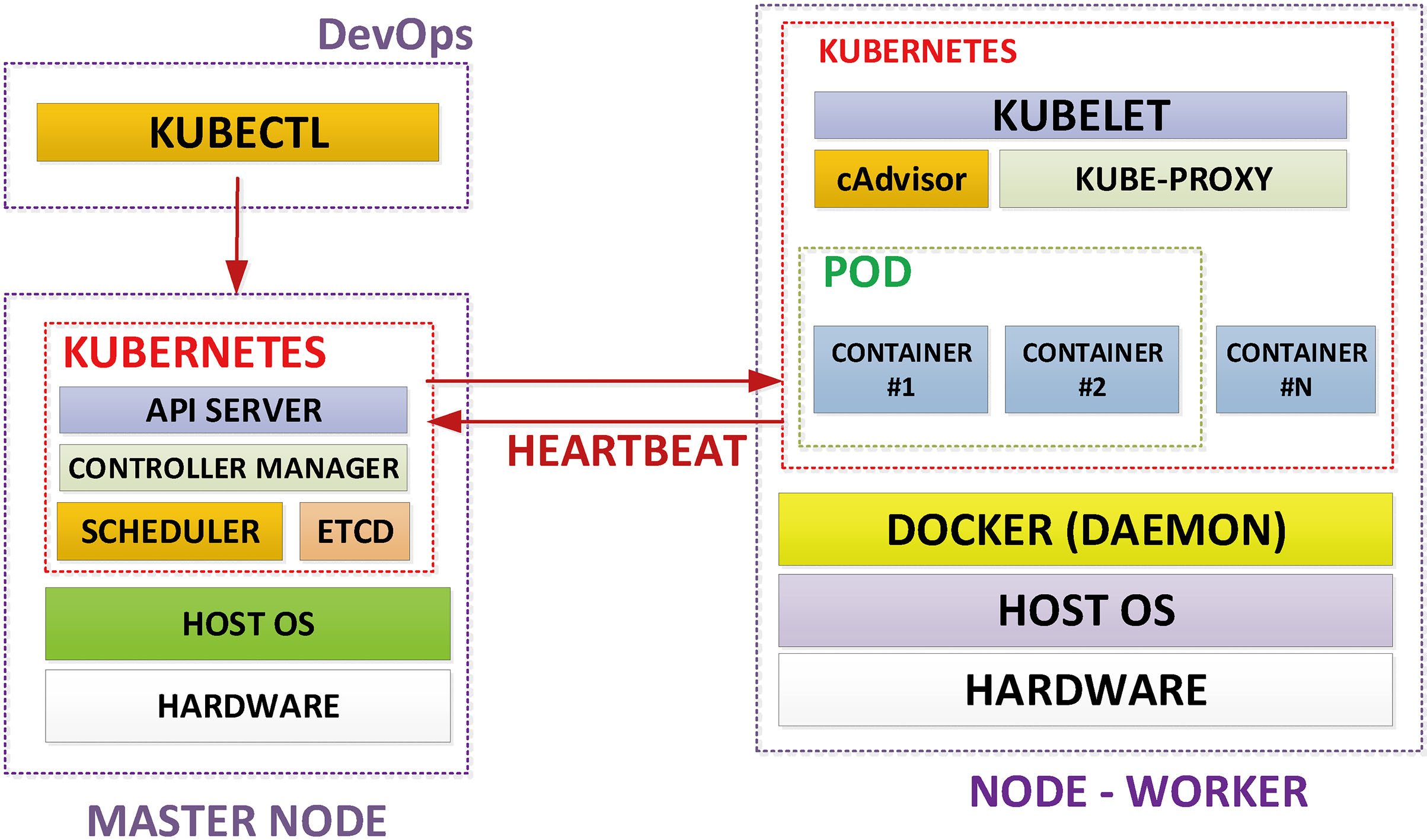
K8s follows a master-slave approach, with several K8s nodes or workers and a unique master node. Each worker executes a collection of containers grouped in pods. Besides the pods, each node must execute three control components:
Kubelet: It is the component controlling the container execution in each node. Kubelet monitor the state of K8s pods in the node and, if they are not in the desired state, regenerates them. Each few seconds, Kubelet communicates the node situation to the master node (a message known as heartbeat). If the node is not working properly, the replication controller executes new pod copies in healthy nodes. Kube-proxy: It is a particular implementation of a network proxy and traffic balancer. It routes datagrams among containers using the same IP address. cAdvisor: It is the component in charge of monitoring the resource and CPU usage in each node.
The main node receives orders from managers (DevOps, Development and operations team) through a specific line command interface named as Kubectl, and communicates with workers to dynamically and automatically decide how to implement these orders. With this view, communication services could be deployed, replicated, etc. regardless the computing platform. To reach this objective, the main node must implement four basic components:
etcd: It is a persistent repository where cluster, K8s service and pod configuration is stored. Scheduler: This component selects which node must execute a new non-scheduled pod. To perform this selection, the scheduler considers the current node situation (to ensure no node is congested), the Quality-of-Service limitations, etc. Basically, it matches the resource offer and demand. API server: This component provides an internal and external REST API to enable users, containers and other entities to interact with other components and configure new works and services. Controller manager: This component executes a process employed to run a particular controller when required. This controller employs the API server to interact with pods, nodes and other components.
Other solutions, such as Docker Swarm, have been reported to coordinate and manage containers. However, they present important limitations making K8s the most employed technology nowadays.
Although deploying K8s may be a costly procedure (more than one hundred seconds could be necessary) [57], this process is only performed before network operation and does not affect the characteristics of slices and services (especially the end-to-end delay).
Future 5G networks are being developed nowadays. Different scientific proposals may be found in relation to access networks, handovers, core networks, etc. However, in this paper, we are focusing on realistic network architectures; and, then, standards are our main reference. Future 5G technologies, as current 4G (Long-Term Evolution) networks, are managed by 3GPP standards. Nevertheless, at the time of writing, no full 5G specifications have yet been released. In December 2018 the first document about future 5G networks (known as 5G Systems – Phase 1) was released [55], but it is mainly focused on RAN and a very low-level description of Core Network (functional components, protocols, messages, etc.). Additional details about service layer will be required to be taken as input in our work. A much more advanced document (with additional, new and relevant details) will be released by the end of 2019; but (at the time of writing) no information about this future standard has been published.
Therefore, we are taking as main reference the white paper “View on 5G architecture” created by the 5G-PPP organization, released in January 2018 [41]. This white paper is considered an official input for future 5G network standardization.
Any case, this paper addresses a challenge that is in a higher level than physical architectures, so even if details of 5G change or new unexpected application domains arise, the basic challenges this work addresses will be still valid.
Future 5G networks are characterized by the unusual, variable and heterogeneous values they present in some relevant indicators: mobility, device density, latency, reliability, etc. The cause of this situation is the large catalogue of applications these networks are envisioned to cover; which are classified into six basic groups: (i) automation and tactile Internet, (ii) smart offices, (iii) dense urban, (iv) connected vehicles, (v) low bandwidth Internet of Things, and (vi) broadband everywhere (50Mbps+).
To provide more homogeneity and make this situation more practical, the idea of network slicing emerges [6]. Network slicing is a technique where network resources are packed and assigned in an isolated manner to a set of users, i.e. to one of the previously cited group of services, according to their particular needs and requirements. Different authors have proved to enable the automatic, efficient and dynamic creation and maintenance of slices, future 5G networks must be softwarized, i.e. they must be based on virtual network functions. In order to achieve this objective, the traditional monolithic architecture of mobile networks (see Fig. 2) is divided into three basic layers (physical infrastructure, network layer and service layer) and a set of transversal operations (security and management), where the global network has not a unique tenant, but is the result of the interconnection of several different networks and services belonging to different tenants. In this proposal, physical infrastructure is recovered by a specific and innovative OS named as “Network Operating System” (sometimes abbreviated as NOS, although some particular proposals may employ specific names for their solutions) [42], which enables the virtualization of infrastructure resources. Slices are, in this context, created by instancing a generic object and model (see Fig. 3).
Overall architecture for future 5G networks (a) reference architecture (b) comparison to 4G networks.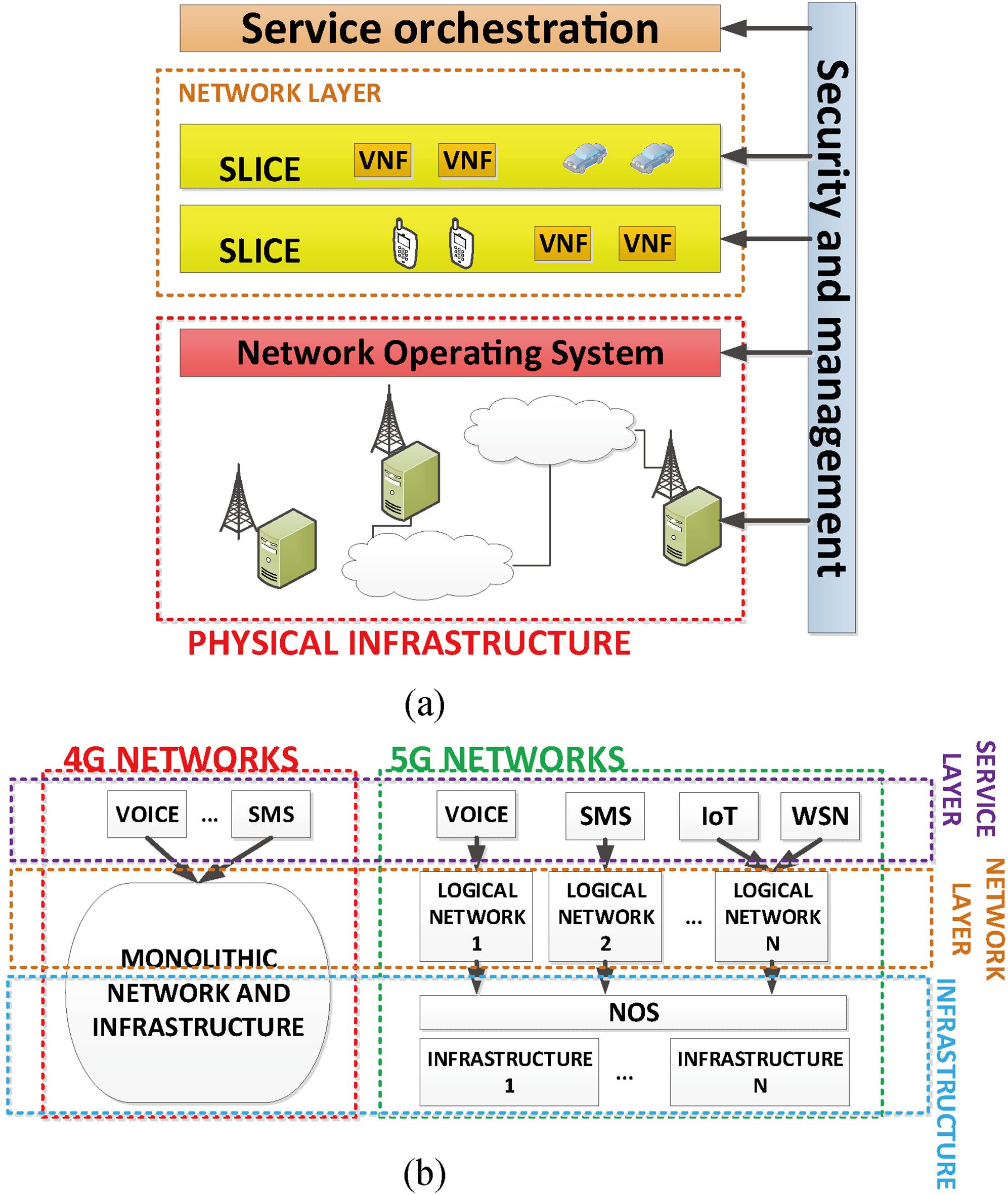
Slice creation in 5G networks.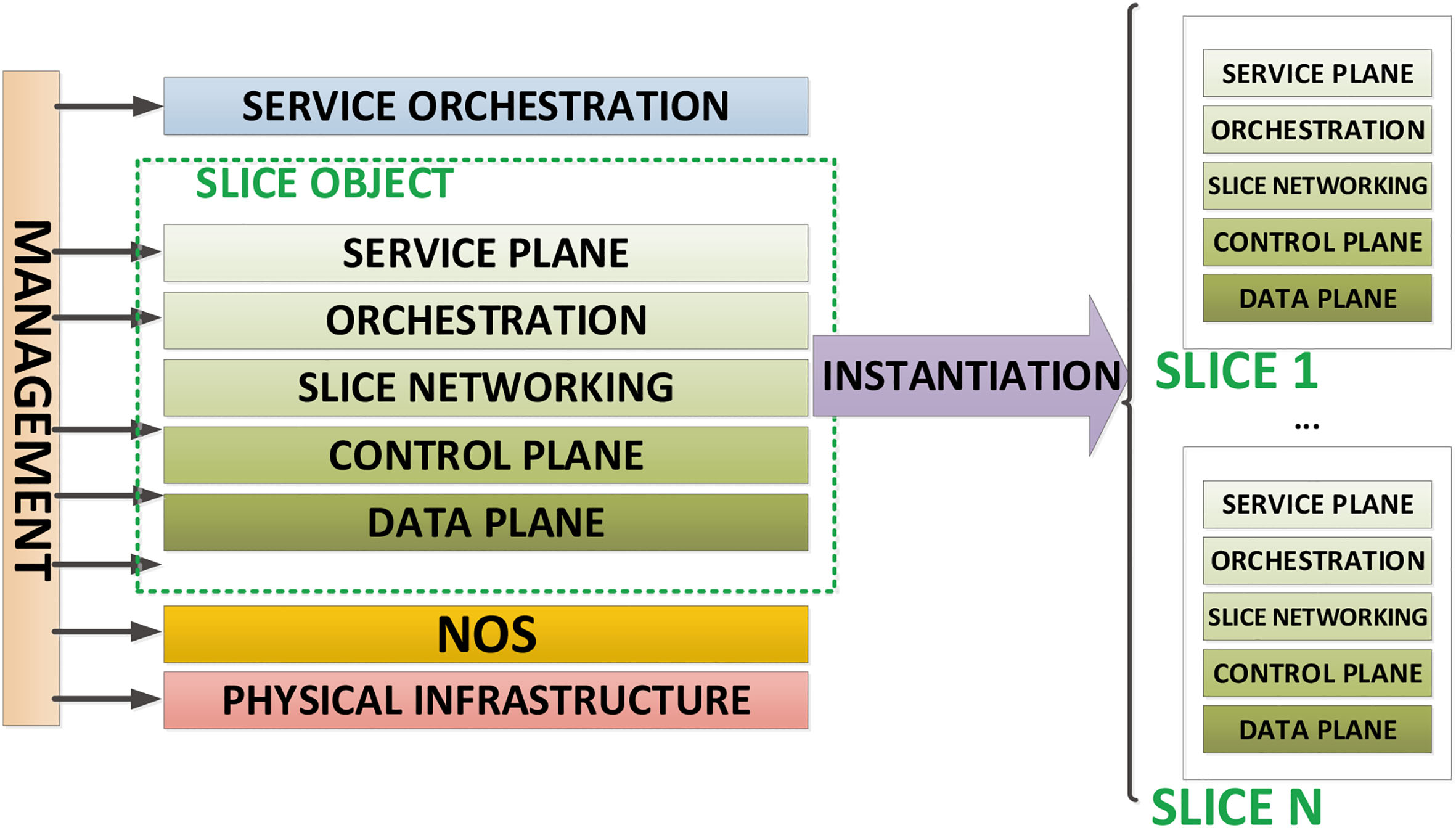
This object defines all functionalities inside the slice (control, data, service management, etc.). This domain is known as intra-slice domain. The intra-slice domain is in charge of orchestrating and managing all communication services and applications supported by the slice (see Fig. 4), as well as network functions supporting those services. These network functions may be dedicated or shared, depending on if they are consumed by one or several communication services.
Intra-slice architecture.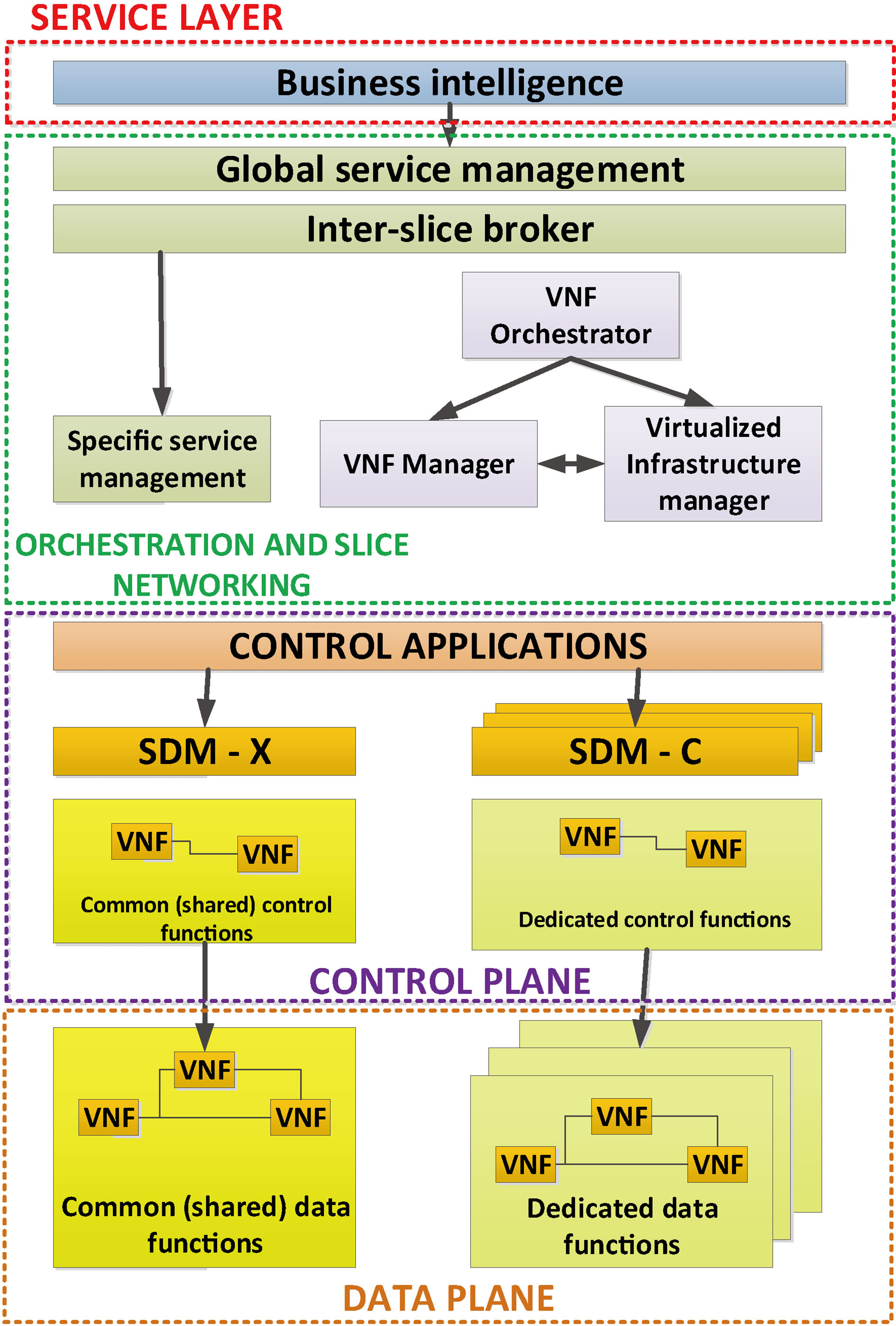
In the service plane, the service (business) intelligence is located. These functionalities may be operated by the service tenant if required. The orchestration layer includes a broker to communicate with the global service (slice) orchestrator, and elements to manage the communication services offered by the slice. On the other hand, slice networking functionalities include components to manage the underlying virtual network functions supporting the communication services in the slice, such as capabilities related to VNF Management and Orchestration (MANO) [43].
Finally, control and data planes include all VNF supporting the services in the slice. Control plane includes control applications and data planes data services. For each slice, there is a common group of network functions shared by several services in the slice, and a set of dedicated functions grouped in different sub-networks (each one associated with a specific communication service). Common functions are controlled through a Software Defined Manager named as SDM-X; and dedicated functions requires a different specific manager (SDM-C) for each sub-network.
Slices are end-to-end entities. The use of this technology, thus, enables the concurrent deployment of several logical, independent and self-contained networks sharing the same infrastructure. These networks are softwarized, abstract and isolated from the environment. Nevertheless, all these entities must be organized and, finally, orchestrated. Therefore, the intra-slice domain is complemented with an inter-slice domain in charge of these global management operations.
Inter-slice domain supports a global broker to coordinate the operations of all slices, and a particular slice (including dedicated virtual network functions) to implement global control applications (no data services are deployed within this domain). In general, the inter-slice domain contains the business logic and control policies configured and managed by the slice provider. Thus, although in the intra-slice domain capabilities to control the offered Quality-of-Service (QoS) and mobility in the specific applications and services supported by the slice are included; in the inter-slice domain global managers for all those characteristics are also considered. These global managers support policies valid for all slices: slice access control as service provider, the (maximum) allowed QoS, service and inter-slice mobility, etc.
Inter-slice and intra-slice management solutions are nowadays very sparse. This paper proposes a solution for 5G networks supported by virtualization techniques. The proposed management solution covers the intra-slice domain, and future works will address the inter-slice domain.
In order to implement complex architectures as 5G mobile networks, not only one virtualization technique must be employed, but a coordination of several solutions at different levels according to the characteristics and properties (with special interest on security and isolation) of the system to be deployed.
In particular, to implement 5G networks by the coordination of components which are created and operated in an isolated manner (see Section 2.3), we propose an architecture based on the concept of “microservices” [44].
Microservices is a modern variant of a service-oriented architecture (SOA) where applications (or complex services) are structured as a collection of loosely coupled services. These services may be developed and deployed in independent environments together with all their dependencies. As can be seen, this approach matches both, the requirements of 5G networks and the characteristics of container-based virtualization.
The next subsections describe the agents and businesses involved in 5G networks, and our proposed hybrid virtualization solution to implement 5G networks with network slicing (based on VM, Docker and K8s), following a microservice approach. Also, we discuss how our proposal matches the designed architectures for future 5G systems (see Section 2.3). We pay special attention to those management functionalities that must be present in these next-generation networks, and could be easily covered by the native mechanisms available in Docker and (overall) K8s.
Involved agents: Proposed virtualization scheme
Considering the information shown in Section 2.3, three different agents must be considered. These agents, also, define three basic business models based on future 5G networks. A fourth hypothetical market could appear, supported by the concept of network slicing. These agents and business models are:
Infrastructure owner: It may be understood as a traditional Platform as a Service (PaaS) or Infrastructure as a Service (IaaS) agent. Using a certain physical infrastructure this agent offers VM and resource packets for which it obtains a fee. This agent must deploy, maintain and manage both, the core and access network (router, antennas, etc.) and physical resources (spectrum). Communication service provider: Standard tele-communication operators may take this role. Basically, using the VM provided by the infrastructure owners, service providers must deploy the network functions and slices to support communication services (e.g. voice, data connection with a certain throughput and QoS, etc.). Final service provider: These providers are responsible of Over-The-Top (OTT) services. They rent communication services to telecommunication providers in order to deploy and support next-generation user services. Slice provider: This role is not certain to appear, as it depends on the future economic movements. In order to generate more specialized businesses, telecommunication operators may decide not to deploy and control network slicing technologies. This role, then, will be taken by a different economic agent who would rent VM to infrastructure owners and would create and maintain slices and inter-slice components. The key element in this discussion is the inter-slice domain: agent controlling network slicing must collaborate also in the maintenance of inter-slice functions.
Proposed virtualization scheme for future 5G networks.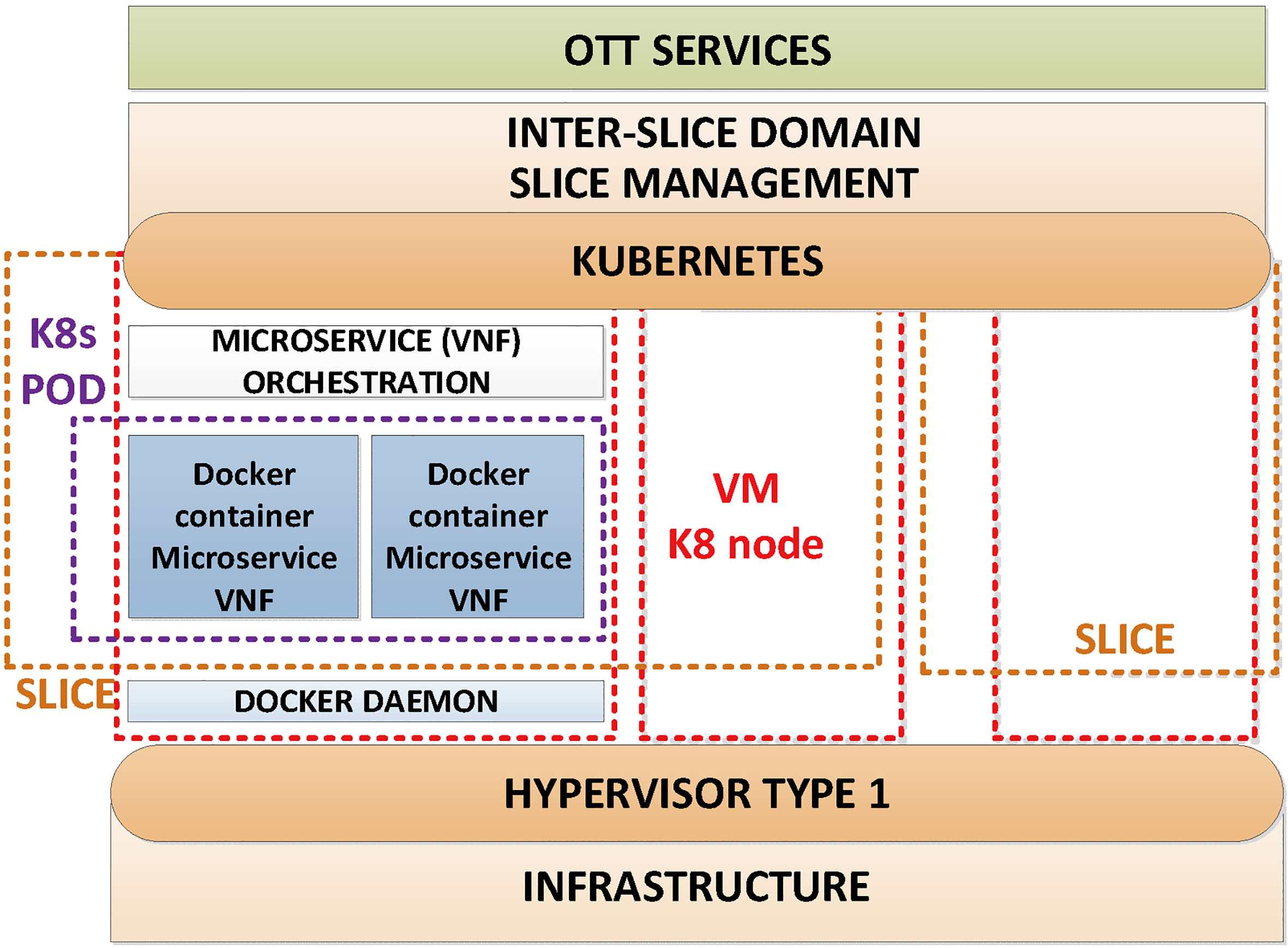
However, to enable the real existence of three independent markets, infrastructure must be isolated from network functions, slices and services. To reach this objective, a hybrid virtualization solution must be employed. In fact, this view matches with the design approach of K8s, where also three basic different layers are identified (pods, containers and nodes). Considering this relation, Fig. 5 shows the proposed virtualization scheme for future 5G networks.
The proposed scheme virtualizes the physical infrastructure using hypervisor-based type 1 virtualization. These operations are performed by infrastructure owners, whose business is renting VM to communication service providers and/or slice providers. The created VM (the K8s nodes) are assigned to slices. To ensure the maximum isolation level among slices, a VM may only support services of a unique slice. Inside each VM a collection of Docker containers implementing each one a virtual network function is deployed. Each one of these containers is configured as a microservice. To enable this operation, VM must be provided with Docker daemon.
Communication service providers are in charge of deploying these VNF to create the adequate (common and dedicated) logic network(s) for supporting all communication services for the target application scenario associated to the slice. Telecommunication operators must also collaborate in the maintenance of inter-slice functions if they take care of network slicing. As previously said, if a real slice market appears in the future, slices and inter-slice components would be managed and maintained by the slice providers.
Finally, OTT services are deployed in proprietary servers and hardware infrastructure whose connectivity is guaranteed by telecommunication operators. However, these services do not affect at all the network architecture.
Virtualization-based overall architecture implementation for future 5G networks.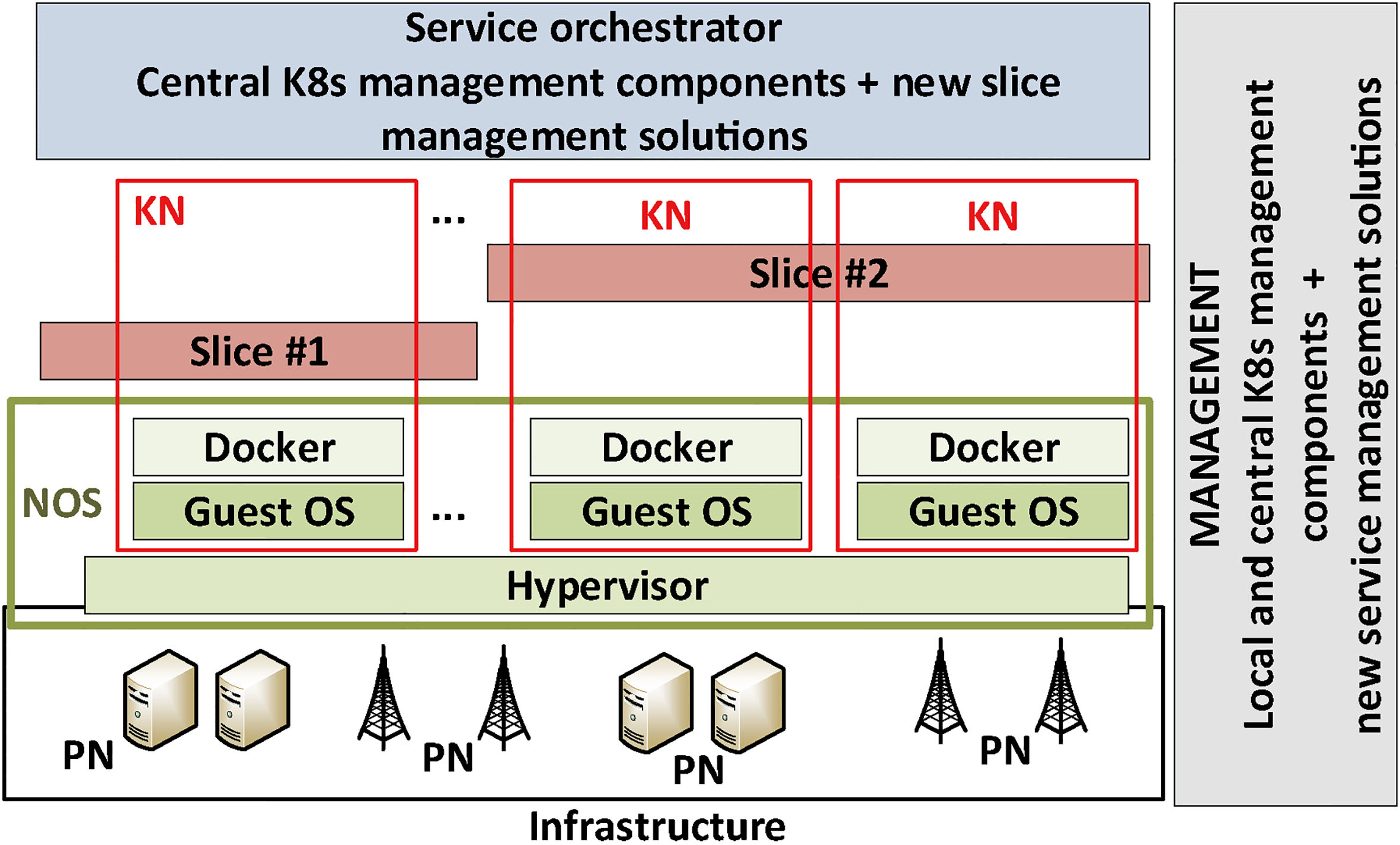
With the proposed virtualization scheme, the global architecture for 5G networks gets strongly simplified (see Fig. 6). This proposal, as can be seen, matches the proposed overall architecture for 5G networks in Fig. 2, the K8s architecture (Fig. 1) and the proposed virtualization scheme (see Fig. 5).
The described NOS can be implemented using the Docker daemon, a guest OS and the hypervisor type 1 employed to virtualize the physical nodes (PN). Among these components, only specific hypervisors should be developed. Both the Docker daemon and OS are well known and reliable solutions.
As said in Section 3.1, VM (or K8s nodes) are associated to a unique slice, but all Docker containers inside each node (configured as microservices executing VNF) are managed using two instrument types: the K8s local management functions and components and new and specific service management solutions.
K8s local management components include Kubelet, Kube-proxy and cAdvisor. These elements, as described in Section 2.2, can monitor, control, regenerate or report permanent problems about K8s pods executed in the K8s node they manage. These functions match (see Section 2.3) the capabilities associated to controllers SDM-X and SDM-C, to control applications and to VNF management components (orchestrator manager and infrastructure manager) in slices architecture (see Fig. 4). Communication services will be configured as K8s services, which enables a more efficient control.
Intra-slice management functions are, in that way, covered by trustworthy, mature, commercial and reliable technologies. Only one component must be developed (see Fig. 4): the specific service management (which is the second solution type to support communication service management). A possible first implementation for this element is described in Section 4.
Service orchestration layer groups all inter-domain management functions and components. In an equivalent manner as explained for the intra-slice domain, K8s global management components may take care of an important part of the inter-domain management functions. Specifically, all capabilities related to NFV (microservices or containers) management can be executed by the K8s scheduler, etcd, and controller manager (see Section 2.2.2). On the other hand, global slice management functions (global service manager, global QoS manager, global mobility manager, etc.) must be implemented. Specific solutions for each situation and scenario are required. Some solutions have been already proposed [18]. In future works some proposals will be investigated.
Proposed algorithm for efficient service management in future 5G networks
In this section, an enhanced service management solution for 5G networks implementing our proposed architecture is described. This technology is designed to operate over the interfaces and functionalities offered by K8s and Docker, covering those functions that these virtualization technologies cannot perform, as explained in Section 3.2.
Service management policies are implemented in the intra-slice domain (in the specific service manager, see Fig. 4). In the proposed architecture, communication services are K8s services, composed of, at least, two K8s pods: the common network functions and the dedicated network functions (one sub-network per communication service, as said in Section 2.2.3). Containers in these pods are configured as microservices. While K8s manage these elements from the virtualization point of view (as containers), in this section a management algorithm to control them as containerized microservices (including QoS considerations and other relevant communication indicators) is described. The objective is to automate operations usually performed manually by system managers in the K8s architecture, but that in 5G networks must be performed dynamically by software control elements.
In this section, an algorithm to manage the two main and most basic operations is proposed: the creation of pods (what microservices are put together in the same pod) and the deployment of redundant components (number of copies of each pod to be deployed). In both cases, algorithms try to optimize costs and the use of resources.
Mathematical model
In the proposed architecture, a slice is modelled as a microservice architecture. A microservice architecture
and
Both sets
Finally,
In that way, a microservice architecture may be understood as a directed or oriented graph
The graph
As can be seen, these functions allow transforming a technological system into a graph and vice versa, so (hereinafter) we are using indistinctly both notions.
Although this representation fully describes any network, in order to perform some advanced calculations and management operations it may not be adequate. Therefore, an expanded representation is proposed.
To create the expanded architecture representation, each microservice
Then, interconnections among microservices are replaced by interconnections among endpoints, which allow the interoperation among service providers and service consumers via a certain request type. Between two endpoints, then, as many interconnections as request types they may exchange have to be considered.
In an equivalent manner to which previously described, it is possible to define an oriented and labeled graph to mathematically describe this expanded architecture representation Eq. (6):
As in the previous case,
Moreover, vertices and edges in the
On the other hand, vertex are also labeled with four parameters
type is a label indicating if the endpoint may only receive requests from other endpoints in the architecture (backend endpoint) or it may also receive requests from external entities (frontend endpoint). Finally, error is the percentage of failed operations associated to the corresponding vertex or endpoint.
Figure 7 shows a graph representing a simple expanded microservice architecture. In this figure, the labels of edges (interconnections) are represented in colour red; and labels of vertices (microservices) are written in colour black. In order to improve the figure readability, not all labels are shown. In this case, requests associated to interconnections are REST (Representational State Transfer) requests (although other calls could be employed). Proposed values are just examples. The system shown in Fig. 7 does not represent any particular slice or coherent scenario; it is just a graphic representation of the data structure employed to work with slices, on which latter calculations will be based.
Example of a graph representing a microservice architecture.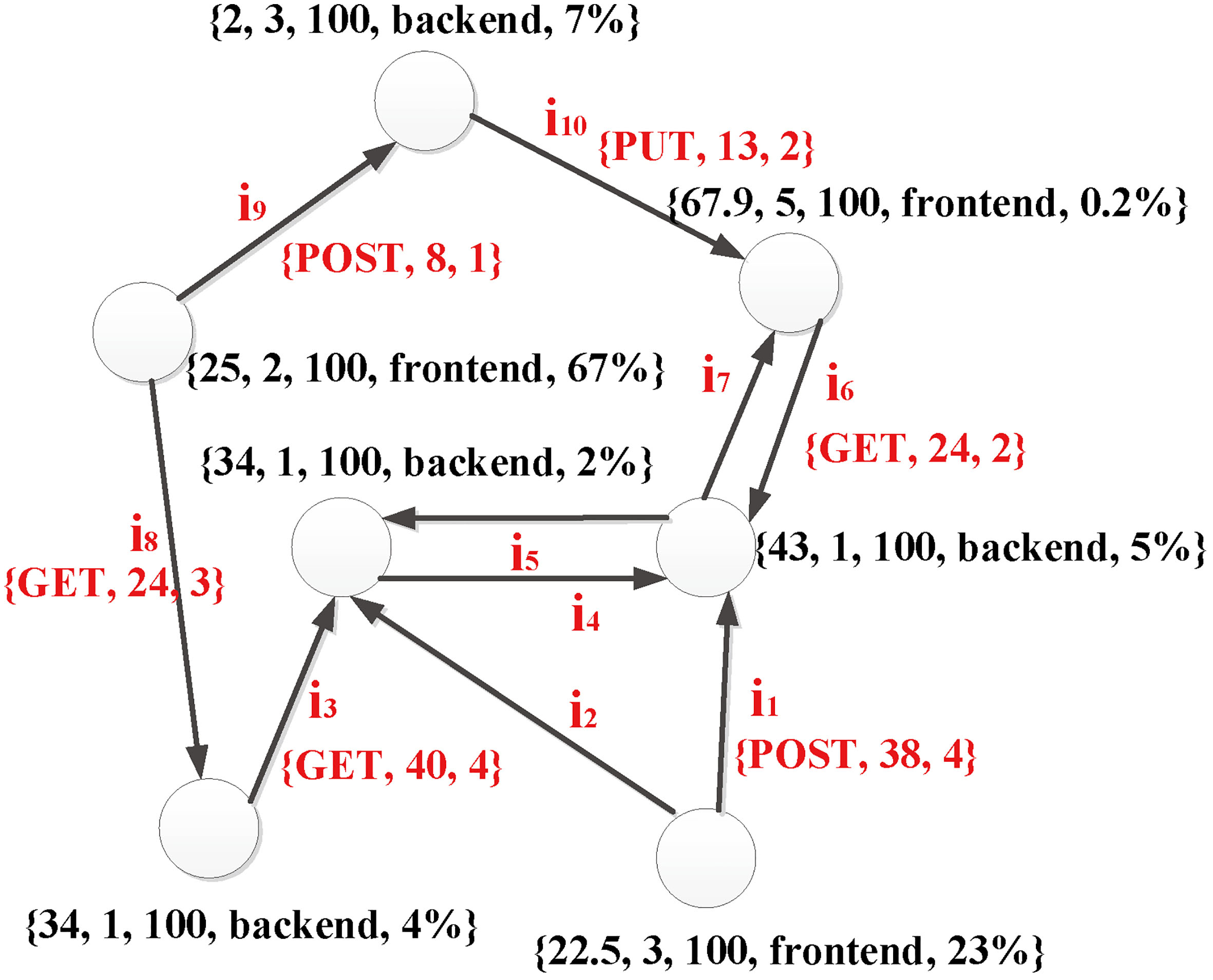
From this expanded graph
The basic purpose of this algorithm is to calculate the deployment cost of any additional redundant component
To calculate the cost
Three basic resources are consumed when a new pod is deployed: (i) computation resources, (ii) storage resources, and (iii) API resources. The consumption of these resources in the
This fact (among other factors), as we are seeing, is responsible of the existence of the cost
Apart from these variable consumptions
In conclusion, the total resource consumption
where
To obtain a real estimation of the resource consumption, this expression is combined with the previously proposed mathematical model. API resource consumption is included in the label of each edge in the expanded graph
On the other hand, computing and storage resource consumption (a combined and mean value) is included in the labels of vertices:
and the total consumption for the entire pod Eq. (13)
The number of requests to be supported by a pod is obtained from the call graphs and the expanded graph
In consequence, the total number of requests Eq. (14) to be managed by the pod is (hereinafter all calculations are referred to the hour with highest peak traffic):
Each pod, in general, would be designed to manage only a certain percentage of this amount Eq. (15). Being
As K8s balances traffic using a round robin technique, this percentage must be, at least, enough to accept the corresponding traffic load in Eq. (16):
Using these expressions, the resource consumption may be calculated dynamically in a very lightweight manner. It is very important to note that call graphs and other relevant parameters employed in the proposed mechanism, such as
System designers must only define parameters
To transform this consumption into the cost
This function, although it may take different expressions, follows in this paper an exponential law with a vertical asymptote in
Proposed cost function.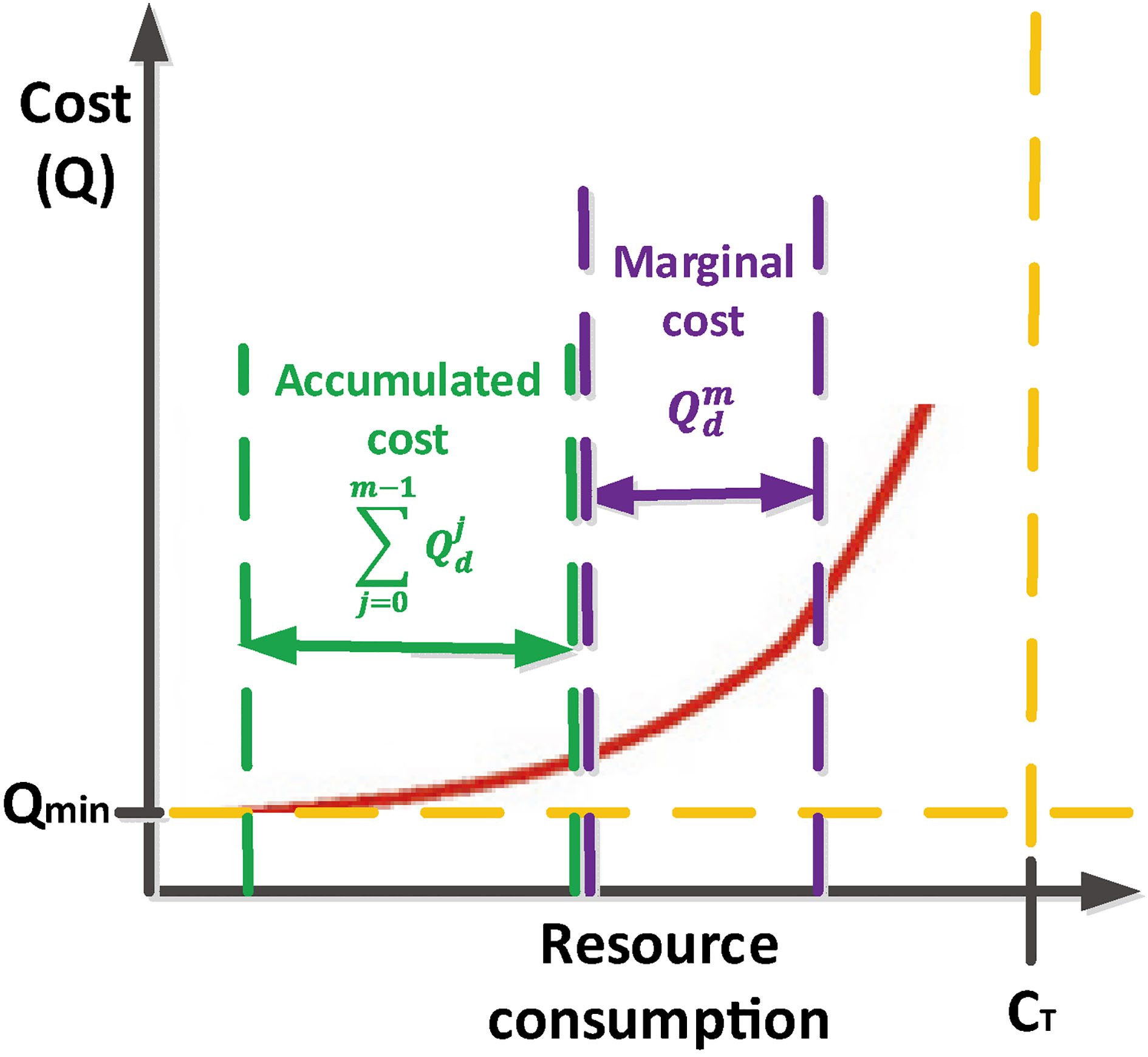
On the other hand, the cost
Among them, a maximum of
To these microservices, an arbitrary and finite number of users
But it may also occur because an internal error, a situation which is modelled by probability
In the same manner, we are considering the QoS is strongly affected when the resource consumption goes above a certain percentage, being
In these previous expressions,
In this expression,
Using the previous expression, and considering that microservices are independent (isolation is guaranteed by Docker technology), two global probabilities (for the entire pod) are obtained. The first one, the probability of failure is Eq. (4.2)
and the second one, the probability of QoS degradation in Eq. (4.2)
Finally, to obtain the probability of a global fail in the system, or a QoS reduction, all deployed pods must be considered. Being deployed
A global fail is produced only if all pods fail. A QoS reduction appears if all pod employs more than A QoS reduction also appears if
Therefore, and considering that pods are independent entities (being
Each one of these probabilities, now, is associated with a cost using the corresponding functions,
To calculate the final cost of not deploying a new pod copy, both partial costs must be combined. A weighted arithmetical average may be employed, employing the weighting factor
The optimum number of pod copies to be deployed is that which makes
Algorithm 1 summarizes the entire process. Basically, the proposed algorithm iterates along the list of deployed microservices and analyses all interconnections whose origin is each one of these microservices. Then, probability of a failure and the probability of QoS degradation are obtained for each microservice and, finally, for the entire system (aggregating all previous partial results). The same operation is performed for the resource consumption of each microservice and the whole system. Using these three variables, an optimization problem is defined and solved to obtain the optimum number of pod copies.
In comparison to the calculation of the number of pod copies to be deployed, the calculation of the containers to be included in each pod is much simpler.
Small pods are easier to allocate in physical nodes, but more resources are consumed in coordination tasks. The basic idea of this management algorithm is to find out a balance.
The total resource consumption
On the other hand, a set
A physical node
Then, a partition
The problem to be solved is to find a partition, or partitions, that could be fully allocated into the physical nodes. Mathematically:
In fact, as smaller pods are created, this task is easier. In general, the total amount
It is important to note that, it is only necessary to ensure that the previous statement is true, as the final and real allocation would be performed by K8s scheduler.
However, at least two pods must be created (a requirement of 5G architectures): one for the common network functions
being
With this approach, however, the trivial solution (one container in each pod) would be a valid solution. Small containers, nevertheless, require from K8s components a greater effort and the employment of more resources. Therefore, in this initial proposal, we are considering as the final solution, the partition where a lower number of pods is created. In advanced and future works, a global distance function to evaluate the dispersion of the 5G system may be created and employed to select the optimum partition.
In order to evaluate the behaviour and performance of the proposed algorithms and architecture, in this section we carry out a set of relevant experiments and provide and analyse the obtained results.
Experimental validation: materials and methods
Simulations were performed using the Network Simulator 3 (NS3) [50] simulator, which implemented a platform based on Terminal Access Point (TAP) [51] bridges and lightweight virtualization. The proposed simulation platform turns independent the physical infrastructure modelling and the definition of algorithms to be executed and evaluated. The infrastructure model is supported by NS3 simulator, where different libraries describing low-level protocols, mobile communications, wireless links, etc., are available. On the other hand, proposed algorithms are implemented using Linux paravirtualization techniques, as native C programming is the most adequate to implement the proposed solution.
Using the proposed simulation technique, NS3 scenarios recreate very similar conditions to real physical infrastructures, as well as applications, algorithms and functional components in these simulation scenarios may exchange data and operate as real deployed software does.
The simulation scenario is implemented through TAP bridges, which connect virtual Linux machines generated using LXC technologies and the Libvirt library with the NS3 simulator, and ghost nodes, the virtual entity that represents the virtual machine in the network simulator.
This approach, besides, is equivalent to the virtualiz-ation-based architecture described in this paper for future 5G networks; where physical infrastructure is virtualized and divided into VM where Docker software and K8s solutions are installed. Using TAP bridges, physical infrastructure is simulated, but VM are, in fact, created, and real containers, VNF and algorithms may be deployed.
Configuration time.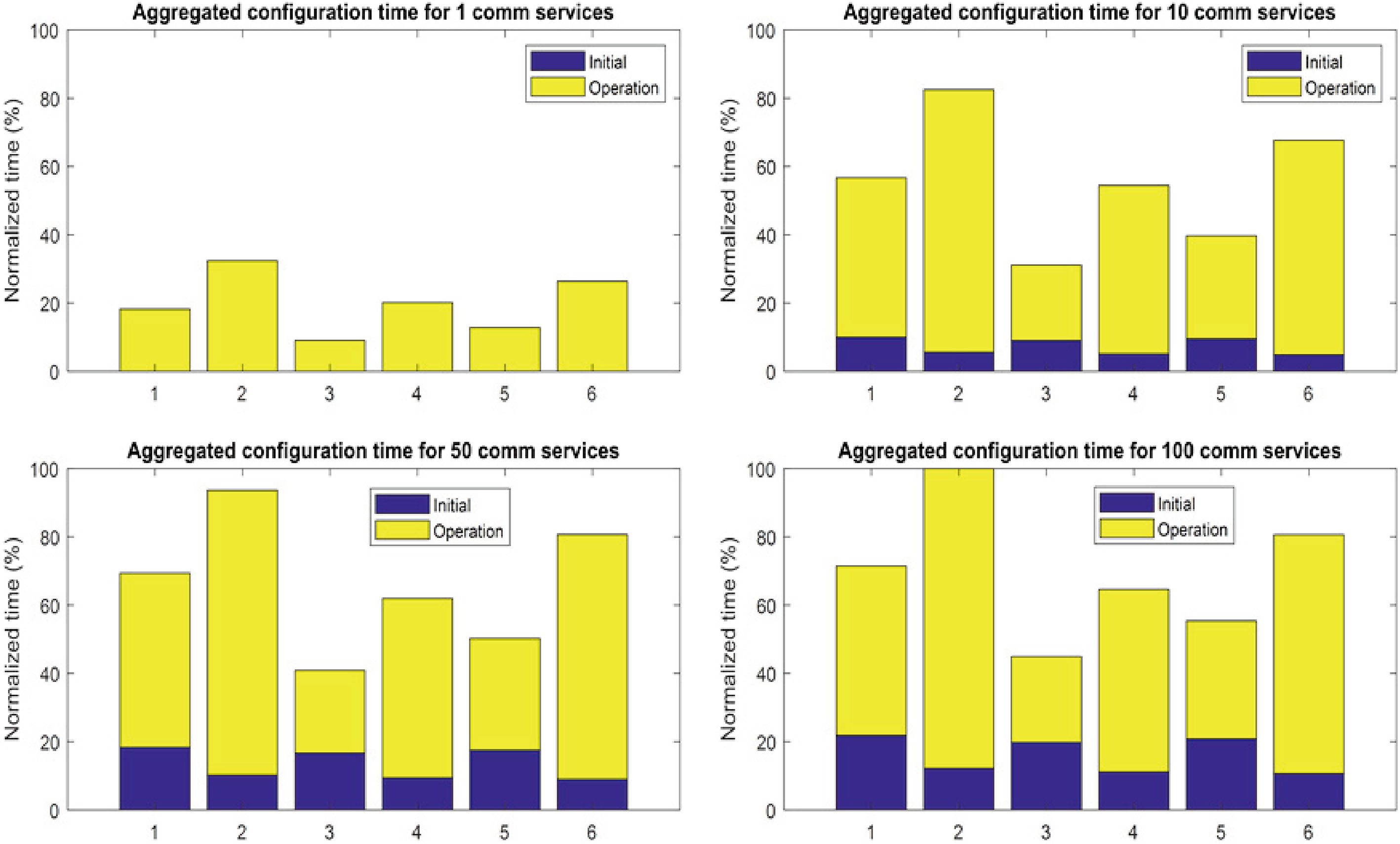
All parameters to create the infrastructure model are provided using a configuration script, where hardware devices, interfaces, protocols, communication links, etc., are described. Although this approach is more complex than the configuration of regular NS3 simulations, it represents in a closer manner the system to be evaluated. TAP bridges are configured as “ConfigureLocal”. In that way, TAP bridges are generated in a row, inheriting the configuration properties one from the other.
A small network function was simulated. The following elements were considered:
Twenty-four (24) physical nodes supporting both the core and the access networks. Nodes were considered to be general purpose servers, as they can be found in cloud computing systems. Ten cells in the mobile network, to provide communication services to users. Sixty (60) virtual machines were created, all of them implementing the Operating System Ubuntu 16.04, and the Docker software. The total amount of physical resources was divided into the VM in this way: two machines using 10% of resources each one (main nodes); eight machines using 3% of resources each one; fifty (50) machines using 1% of resources each one. Virtual Network Functions were implemented in PHP language using the existing algorithms in the NS3 libraries. K8s solution was implemented in all VM, acting one of the main nodes as K8s main node. Communication services to be provided were considered to be only broadband (50Mbps+) data connections.
The number of user devices in the system, as well as the number of services to be supported, was supposed variable.
Three different scenarios were considered:
Scenario #1, IoT deployments and Smart Cities: In these scenarios the device density is very high, so 250 user devices were contemplated in this scenario. Scenario #2, Residential areas: In this case, traditional users using smartphones and other similar devices have to be considered. The number of users is lower, so only fifty (50) user devices were included in the simulation. Scenario #3, Industrial applications: The device density in these scenarios is medium, so 120 user devices were considered to be consuming communication services in this case.
Temporal evolution of the accumulated configuration time.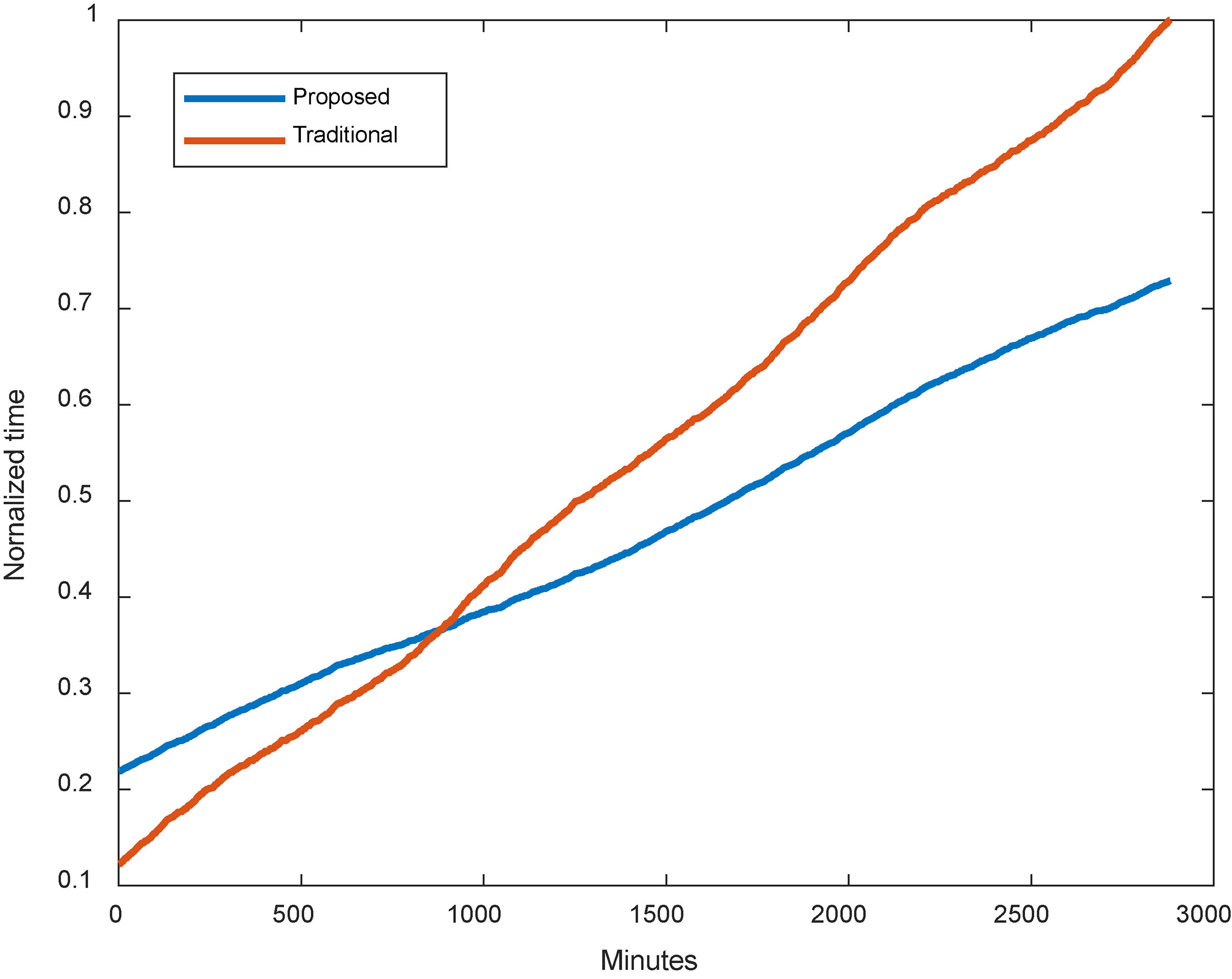
The total simulated time was two days (48 hours), for which an 18 hours simulation was required. Each simulation was repeated five times in order to compensate the possible random effects.
Using these simulation scenarios, two experiments were carried out.
In the first experiment, a simulation scenario is employed to evaluate how the proposed service management solution affects the performance of future 5G networks. Specifically, the most relevant key performance indicators in mobile networks, such as availability and configuration delay, are analysed. Obtained results are, later, compared to values generated by traditional mobile network architectures where virtualization technologies and K8s are not employed.
In the second experiment, the performance of the proposed solution was evaluated, calculating the response time of the proposed technology depending on the number of communication services to be managed.
Availability.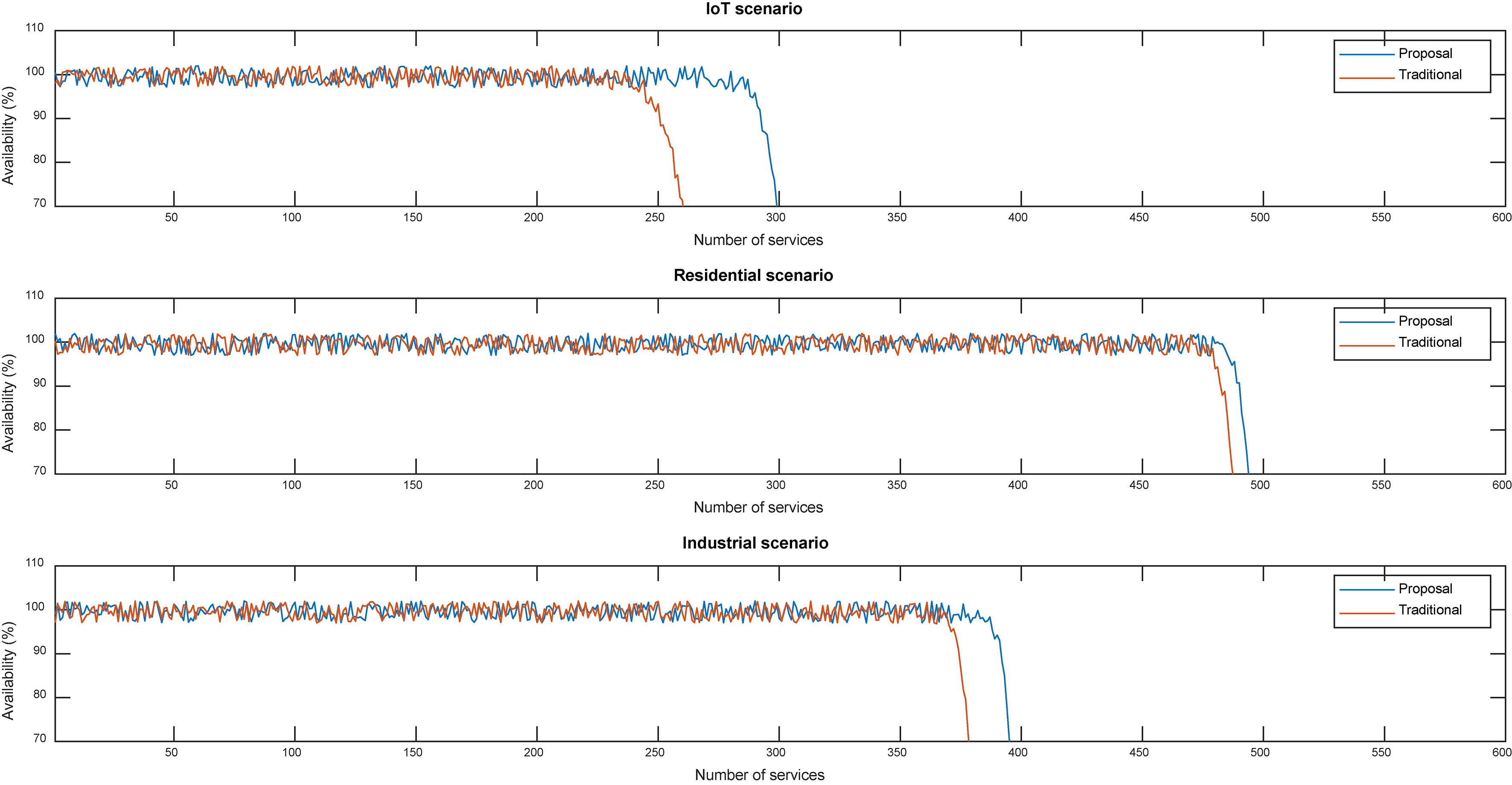
In respect to the configuration of the proposed service management solution, all weighting parameters were defined to follow a uniform distribution.
Figure 9 shows the accumulated configuration time, depending on the number of communication services being managed, and for the three different scenarios being evaluated. This configuration time is divided into two different amounts: the initial configuration time and the configuration time during operation. Initial configuration time (in blue colour) refers to the delay required to deploy all virtual instances, programs, dependencies, endpoints and, in general, software structures and components before being able to start the slice operations. Configuration time during operation (in yellow colour) refers to the aggregated delay along the whole considered operation period, required to manage all occurring network events, updates, new services to be offered, etc.
To facilitate the results analysis, time is normalized in Fig. 9; i.e. all expressed results are relative values (percentage) with respect to the greater time obtained in the whole experiment.
As can be seen, the highest configuration time is always obtained for IoT scenarios, because of the complexity of hardware infrastructures, and the great number of devices consuming communication services.
Another global important result that must be noted is the relation between configuration time in the traditional approach and in architectures implementing our proposal. As can be seen, the initial configuration time is slightly higher in the proposed solution (as many VM, containers, operating systems, etc. must be started). However, the aggregated configuration time required to maintain the system during the operation time is always much lower for our technologies, which makes that, globally, it presents better results.
As the number of communication services to be supported goes up, the initial configuration time also grows. When one hundred (100) services must be deployed, the initial configuration time represents around 20% of the total aggregated time. Besides, as can be seen, the evolution of this initial configuration time is logarithmic with the number of communication services. As can be seen, almost no variation is obtained when the number of services grows up from fifty to one hundred, and it decreases a 50% when the number of services is reduced in a magnitude order (an evolution pretty similar to a logarithmic function).
In conclusion, the proposed architecture and service management algorithm allows a faster and more efficient (in time) deployment and management of communication services in 5G networks.
Any case, and although the following analysis does not affect the previous results, additional configurations could be necessary in real scenarios in order to address Docker and K8s vulnerabilities and preserve the entire 5G networks security. Between 2016 and 2018 up to eight different vulnerabilities were discovered in K8s technologies. These vulnerabilities include methods to gain privileges and deny services. Docker technology presents a similar behaviour (nine vulnerabilities were discovered between 2016 and 2018), but in this case some of them were detected after successful attacks (typically Denial of Service attacks). Therefore, in real scenarios, configuration delays could be slightly different as additional mechanisms to preserve network security such as new software patches will be required.
Configuration time.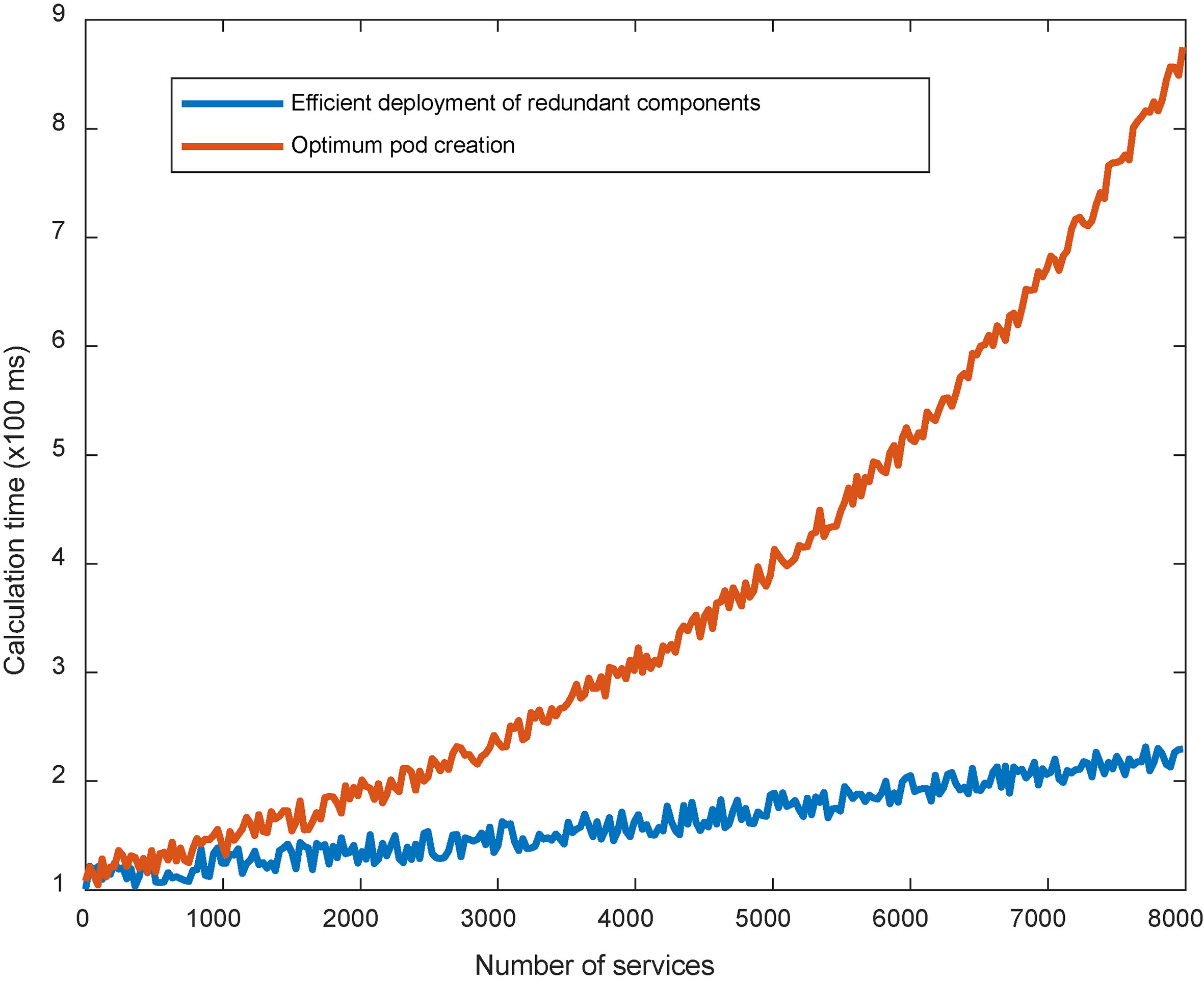
Figure 10 shows the temporal evolution of the accumulated configuration time in the worst case among the reviewed cases in Fig. 9 (IoT scenario with one hundred services to be managed). To facilitate the analysis of the results, the ordinate axis has been normalized (results have been proportionally scaled to range between zero and the unit). Besides, collected data have been processed to generate a smooth curve.
As can be seen, after only 900 minutes (15 hours approximately), the ordinary management tasks generate an accumulate configuration time equal for both, the proposed and traditional service management solutions. From this point, the proposed technology offers a clear advantage. In other words, for systems whose lifetime is going to be higher than 15 hours (typical situation in standard mobile networks), the proposed approach is (at long-term) much more efficient. However, if the deployed system is going to have a shorter lifetime (a very unusual situation), the required initial configuration time by the proposed approach makes traditional schemes more competitive.
5G service management is characterized by stringent delay requirements. Figure 10 shows the proposed mechanism is effective and met this objective. To reach this requirement the proposed technology employs the monitoring solutions included into K8s, which may deploy new instances and micro-services before the occurrence of fatal failures (thanks to prediction mechanisms and other similar instruments).
Figure 11 presents the results obtained from the availability analysis. In this work we are calculating the availability of the system as the ratio of (a) the total time the communication services (slices) are capable of being used during the considered operation interval to (b) the length of the interval.
As can be seen, for all scenarios, the proposed technology has a higher availability than traditional solutions, although for certain amounts of communication services both techniques offer similar results.
In general, both technologies present availability close to 100%, until the number of communication services goes above a certain limit. This limit is around 300 services for IoT scenarios, where the high device density makes more difficult to manage great amount of services. In this case, the proposed solution increases in 25% the results obtained from traditional techniques.
Both technologies are more similar for residential scenarios, where the limit is around 480 communication services for both solutions: traditional and the proposed technique.
Finally, for industrial scenarios, the proposed solution improves in a 5% the number of services being able to manage for a 100% availability (the limit is around 390 services). These results are coherent with previous discussions, where industrial scenarios have hybrid characteristics between residential and IoT scenarios.
In general, the proposed approach (where services are supported by K8s pods) increases availability when fails affect specific communication services or slices. Thus, regenerating the affected K8s pods is enough to maintain service availability. However, all services will become unavailable if the K8s master node fails and no additional protection policy has been applied. That is why in Figure 11, although availability increases, it does not reach 100% permanently. In order to protect the proposed scheme against fails in the K8s master node, several replicas of this virtual entity should be created.
Finally, Fig. 12 shows the calculation time required by both service management algorithms proposed in Section 4.
The algorithm employed to calculate the optimum number of pod copies to be deployed follows a linear evolution, using 200ms to process near 8000 communication services. This is coherent with the use of summations, where scalability is also linear. However, as can be seen, proposed solution to create the optimum pods has an exponential complexity. In fact, Bell’s number are also exponential, and the number of possible configurations to be reviewed present this distribution as the number of communication services (microservices) to be allocated goes up. Any case, for eight thousand communication services, less than one second is required to solve the mathematical problem.
It is important to note that this calculation time does not affect the end-to-end delay in communication services supported by slices. The mathematical problems to be solved by the proposed mechanism are addressed before network operation. Once systems are running, Docker and K8s instruments manage all virtual instances (VNF) building slices.
Emerging 5G networks are envisioned to provide communication services to a very large catalogue of applications: from traditional mobile phones, to future Cyber-Physical Systems and Industry 4.0 solutions. In general, these heterogeneous application scenarios present different Quality-of-Service requirements and a very dynamic lifecycle. In this context, traditional homogeneous network architectures are very inefficient and new mechanisms to provide communication services have been proposed. In particular, 5G networks will be based on network slicing technologies. Network slicing is a technique where network resources are packet and assigned in an isolated manner to a set of users according to their specific requirements. Standard solutions such as virtual private networks, virtual network functions or circuit switching could support and manage network slicing, and services, in future 5G systems; however, these techniques do not fit with the automatism, isolation and dynamism characteristics required by future applications.
Therefore, this paper proposes a new approach for the implementation and management of services and slices in future 5G systems with network slicing, based on lightweight algorithms and virtualization technologies, such as Docker or K8s. The proposed solution is totally compatible with new 5G standards, proposed by the corresponding international organizations. Using this approach, important indicators such as availability, security and the configuration time are improved. The benefits of the proposed solution are evaluated using a simulation scenario.
Results show an improvement in relevant network indicators such as availability and configuration time. Briefly, systems and networks with a lifetime above fifteen hours would take advantage of the proposed mechanism, obtaining a much more efficient service management. Besides, the scalability of the proposed technology is evaluated by means of the calculation time it requires. Results show the proposed mechanism grows linearly with the number of deployed services, while other solutions evolve exponentially.
Future works
Future works will address the design of other pending components such as inter-slice broker. Besides, in order to improve the solution efficiency, advanced mechanisms to represent services and their lifecycle will be considered. For example, visibility graphs [48, 49] could be employed to work with time series containing historical data about the services evolution. On the other hand, slices could be modelled as monoids of P systems [53] or spiking neural P systems with communication on request [58], what will enable the use of neural technologies to study the evolution of services.
Footnotes
Acknowledgments
The research leading to these results has received funding from the Ministry of Economy and Competitiveness through SEMOLA project (TEC2015-68284-R).