






Abstract
Continuous function optimization is ubiquitous in many branches of Science and Technology. Memetic algorithms are a particularly interesting approach to the optimization of continuous, non-linear, multimodal, ill-conditioned or noisy functions as these algorithms do not require derivatives and balance global exploratory search with local refinement. The Wang genetic algorithm promotes genetic diversity (exploratory capacities) by applying crossover only to parents with sufficient different chromosomes (genomes). In this work an improvement of the Wang algorithm is proposed that allows for an adaptive evaluation of the genomic difference between individuals in a way that is independent of the optimization problem and takes into account the stage of the evolutionary process. Moreover, the work proposes an original and relevant memetic algorithm combining the improved Wang genetic algorithm, for exploration purposes, with the covariance matrix adaptation evolutionary strategy (CMA-ES) for refinements. The proposed algorithm is empirically evaluated using 25 bench marking functions against five state-of-the-art memetic algorithms revealing superior performance which is a strong evidence on the relevance of proposed algorithm.
Keywords
Introduction
Memetic algorithms (MA) – otherwise known as cultural algorithms, Baldwinian or Lamarckian evolutionary algorithms, hybrid or genetic local search algorithms – are one trendy research topic in Evolutionary Computation and can be viewed as an extension of conventional genetic algorithms (GA) [26, 13, 12, 16]. The conventional GA operates on a population of individuals each one of which being a candidate solution to the considered optimization problem. Classically, each individual is composed by chromosomes (represented by a binary string) whose elements (bits) are called genes. Associated with each individual there is a figure of merit (fitness function) indicating how good this candidate solution is. The algorithm itself is an iterative stochastic procedure where in each generation, individuals are stochastically selected based on their fitness. Selected individuals (parents) will have a chance to crossover their genome among each other, thus propagating part of their genes to new individuals (offsprings). During this process sometimes mutation occurs, i.e., one gene flips its value with low probability. Offsprings can replace total or partially the old population. The whole process repeats until a given stop criterion is met.
Roughly speaking, a MA combines the global search (exploration) provided by an evolutionary process similar to the above mentioned one, with individual refinements, the so called local search (exploitation). Exploration promotes search in distinct regions of the search space, whereas exploitation searches around the neighborhood of a good solution aiming at producing better quality solutions.
This work focuses on memetic algorithms for real-valued (continuous) function optimization. Continuous function optimization is an ubiquitous problem in the many branches of Science and Technology, and becomes even more relevant when functions are non-linear, multimodal, ill-conditioned or noisy as most of the classic methods may not be effective. Evolutionary computation approaches are a particularly interesting to the optimization of such functions, as they use only information of the value of the function in a limited number of points and do not require the computation of derivatives. This is in clear contrast with conventional analytical methods that, depending on the function to optimize, may have their application quite limited. Evolutionary approaches in which real-valued solutions are directly coded as individuals of a population include the real-coded genetic algorithms [6], evolution strategies [2], evolutionary programming [17], particle swarm optimisation [14], and differential evolution [29]. For a recent comprehensive view of the available methods see [20]. Currently there is a large body of evidence suggesting that MAs not only converge to high-quality solutions, but also search vast solution spaces more efficiently than other evolutionary approaches [24].
This work proposes two main contributions:
It proposes an improvement of the Wang genetic algorithm [31, 32]. Wang algorithm promotes genetic diversity in the population by applying crossover only to parents with sufficient different chromosomes (genomes). This conditional application of variation operators replaces the classical probability based application of these operators. Our improvement allows for an adaptive evaluation of the genomic difference between individuals in a way that is independent of the optimization problem and takes into account the stage of the evolutionary process. Less crossover, more mutation in the beginning and more crossover, less mutation towards the end of the evolutionary process (see Section 4); The work also proposes an original and relevant memetic algorithm combining the improved Wang genetic algorithm, for exploration purposes, with the covariance matrix adaptation evolutionary strategy (CMA-ES) [10] for exploitation (Section 5). There are a variety of memetic algorithms for continuous function optimization – see Section 2 – but to the best of the authors’ knowledge this particular symbiosis is not being considered. Furthermore, the proposed algorithm is empirically evaluated using 25 bench marking functions [30] against five state-of-the-art memetic algorithms and has shown superior performance which is a strong evidence on the relevance of proposed algorithm.
The rest of the paper is organized as follows. Section 2 briefly reviews the related work on memetic algorithms for continuous function optimization. Section 3 presents the required background, formulating the studied problem and introducing both the Wang algorithm and the CMA-ES. Section 4 describes the proposed improvement to the Wang algorithm and Section 5 describes the proposed memetic algorithm. Section 6 summarizes the experimental setup used for empirical evaluation and includes a brief discussion of the obtained results. Section 7 presents the main conclusions of the work. Appendix A specifies CMA-ES and Appendix B summarizes the 25 functions used to evaluate the proposed algorithm.
Many different instances of memetic algorithms (MA) have been reported and applied across a wide variety of domains, see [28, 25] for recent reviews. This work focuses on memetic algorithms for continuous optimization. These have to deal with at least the following basic issues: adoption of a global and of a local searcher, and integration issues such as computational resources balancing between the global and local searchers or communication between them.
Work on memetic algorithms for continuous optimization have been developed around one or more of the above issues. Most of these work employs real-coded evolutionary algorithms. In general, generational real-valued genetic algorithm (GA) are used as global searcher due to their recognized exploratory capabilities. Much less works are employing steady-state GA, references [24, 22, 23] being some examples of such works.
In a typical MA an offspring undergoes local refinement with a given probability. Obviously, some local searchers are more suitable for some problems than others. Adaptive MAs use a set of predefined local searchers and select the one that seems more appropriated at each decision point. Algorithm UACOR-c [18] belongs to the family of MA with a pool of local searchers, including CMA-ES. UACOR-c employs ant colony optimization for global exploration of the search space.
The covariance matrix adaption evolutionary strategy (CMA-ES) is, by far, the most used local searcher for continuous optimization whenever a single local search mechanism is used. MA-LSCh-CMA [24] is an advanced memetic algorithms based on steady-state GA and CMA-ES. The algorithm employs the concept of local search chains. In a sense, this is similar to resume exploitation of an individual in the exact point where it was left in a previous local search occasion. IPOP-CMA-ES [1] and UACOR-c [18] are two other examples of memetic algorithms that resorts to CMA-ES. Pro-SaDE and Pro-DEGL [7] are two algorithms that resort to differential evolution (DE) instead of CMA-ES.
More recently, memetic differential evolution and its variants have been study in [19, 3], In this approach each new point generated by Differential Evolution is subject to refinement by local search. The work in [15] discusses and compares memetic algorithms in the context of both conventional and multi-agent based evolutionary algorithms.
Background
This section starts by formulating the type of problem we are aiming at solving and reviews the framework required for the proposed algorithms.
Problem formulation
The problem we are interested in can be formulated as follows. Let
Notice that this formulation is quite general. The only implicit requirement for
CMA-ES as local searcher
The covariance matrix adaptation evolution strategy (CMA-ES) [10] is a well-known, powerful, and state-of-the-art evolution strategy that will be adopted here as a local searcher in the proposed memetic algorithm. Endowing memetic algorithms with CMA-ES is not a novelty. For example, memetics algorithms such as IPOP-CMA-ES [1], MA-LSCh-CMA [24], or UACOR-c [18] also adopt CMA-ES as a local searcher. However, the proposed hybridization using CMA-ES is a novelty that, as it will be shown below, it is quite relevant.
Although well-known, CMA-ES is now summarized for completeness. The (
where
Given
In the canonical genetic algorithm (GA) crossover and mutation operators are applied with pre-defined probabilities, typically named
where
Should the selected parents failed the difference test, the mutation operator is applied to one of them and the mutated individual is viewed as a new offspring. The whole process is repeated until the number of offsprings equals a pre-defined population size. Algorithm 3.3 presents a specification of this process.
The Wang algorithm: a GA that prefers mating dissimilar genomes [31].InputInput OutputOutput Population size:
Output the fittest individual in the population Randomly initialize the population with
Clearly the user-defined threshold
While the former case is desirable in the initial generations of the algorithm the latter becomes more convenient in the final generations when there are individuals in the population representing values near the solution of the optimization problem. For dealing with this issue, in [31, 32]
Despite the above efforts, the problem of setting the initial
An improved Wang algorithm: mating dissimilar genomes with adaptive difference thresholds.InputInput OutputOutput Population
Output the fittest individual in the population
i = 0 M-1 (
Although simple to implement, the proposed improvement addresses some critical issues of the original Wang algorithm: 1) it sets automatically an otherwise user-defined, problem-dependent parameter the threshold
Moreover, Algorithm 4 is general enough to be used with binary, integer, permutations, or real-valued chromosomes. Once the chromosome representation is selected, appropriated definitions of difference degree, crossover, and mutation operators can be established. Next subsections describe the adopted operators for the real-valued case.
Defining the difference degree for real-valued chromosomes
Let
be a pair of real-valued parents with
where
In an attempt to identify those variation operators that promote population diversity, in this work three crossover operators (BLX-
BLX-
The BLX-
where
In this operator multiple parents are used to create offsprings
where
In this operator, the
where
Non-uniform mutation
Given an individual
where
where
The section presents the proposed memetic algorithm, i.e., Algorithm 5. The algorithm combines the proposed Algorithm 4 as a global searcher with CMA-ES to exploit the neighborhood of a globally evolved solution. Integration issues such as i) the computational cost balancing among the global and local searchers, ii) communication between local and global searchers, iii) local search chains, and iv) restarting, are addressed next.
The proposed memetic algorithm. See text for details.InputInput OutputOutput Global searcher (Algorithm 4) hyper-parameters Local seacher CMA-ES (Algorithm Appendix A) hyper-parameters Population size:
Uniformly initialize a population
termination condition not met
Apply global searcher Algorithm 4 over
// Communication from the local to the global searcher
(fittest individual in
Balancing between global and local search
The overall search cost of a memetic algorithm is related to the number of (fitness) function evaluation. The performance of the algorithm depends on how this search cost is balanced among its global and local searchers. Typically, a local/global search ratio
Communications between global and local search
In a memetic algorithm, a form of bidirectional communication between the two searchers is required. In Algorithm 5, global searcher (Algorithm 4) communicates with the local searcher (Algorithm Appendix A) as follows. The memetic algorithm 5 maintains a population
Basically, the communication between the local and the global searcher is carryout by integrating the current local population into the global one
Local search chains
Algorithm 5 adopts the local search chains as advocated in [24, 22, 23] that consists in the following. Every time the CMA-ES algorithm is applied to refine the fittest individual,
This is equivalent to resume the exploitation of
Random restarting
As in every evolutionary process, sometimes, stagnation occurs. Restarting is a common remedy for such cases. For such reasons, the proposed algorithm also includes a restarting mechanism. In the event of stagnation in the best solution, for say
Empirical evaluation
In this section an empirical evaluation of the proposed algorithms is provided. In a first moment, the sensitivity of Algorithm 4 to the three crossover operators of Section 4.2 is analyzed. Afterwards, the performance of Algorithm 5 is contrasted with state of the art memetic algorithms.
Experimental setup
The test suite used in the experimental evaluation consists of 25 benchmark functions that have been used as benchmark functions after the Special Session on Real Parameter Optimization of the 2005 IEEE Congress on Evolutionary Computation. There are five unimodal functions (F
For facilitating the performance comparison of the proposed memetic algorithm with other memetic algorithms available in the literature, the evaluation criteria postulated for the above mentioned Special Session are also adopted here [30]:
The population of an algorithm is uniformly initialized within the search space of the test function, except for F An algorithm is ran 25 times over each test function and the average of the error The maximum number of fitness evaluations, allowed for each algorithm run is Each run stops either when A run is termed successful if the algorithm achieves The success rate is defined as
In general, hyper-parameters are problem dependent. Below the used hyper-parameters are enumerated and a brief explanation on how their values were found is given:
For illustrating purposes, we show how we heuristically tuned
Example of the obtained results in preliminary experiments to set the local/global search ratio
Typically, crossover operators play a key role in the global search of memetic algorithms. For this reason, we also studied the performance of Algorithm 5 under the three different crossover presented in Section 4.2. This was done resorting to functions F
Evaluation of the influence of crossover operators BLX-
, UNDX, and PNX in Algorithm 5
Evaluation of the influence of crossover operators BLX-
Average error
Curiously enough, from Table 2 it is not obvious the difference of performance relative to these operators; all operators achieving similar results. As the crossover operators yield different offspring for the same parents, the results of Table 2 may indicate that, by preferring mating individuals with dissimilar genomes, the improved Wang Algorithm 4 is effective as a general searcher being insensitive to type of crossover operator used. This hypothesis is further analyzed bellow.
Convergence curves (log of the error vs. the number of the function evolutions) relative to each one of the 25 benchmark functions for 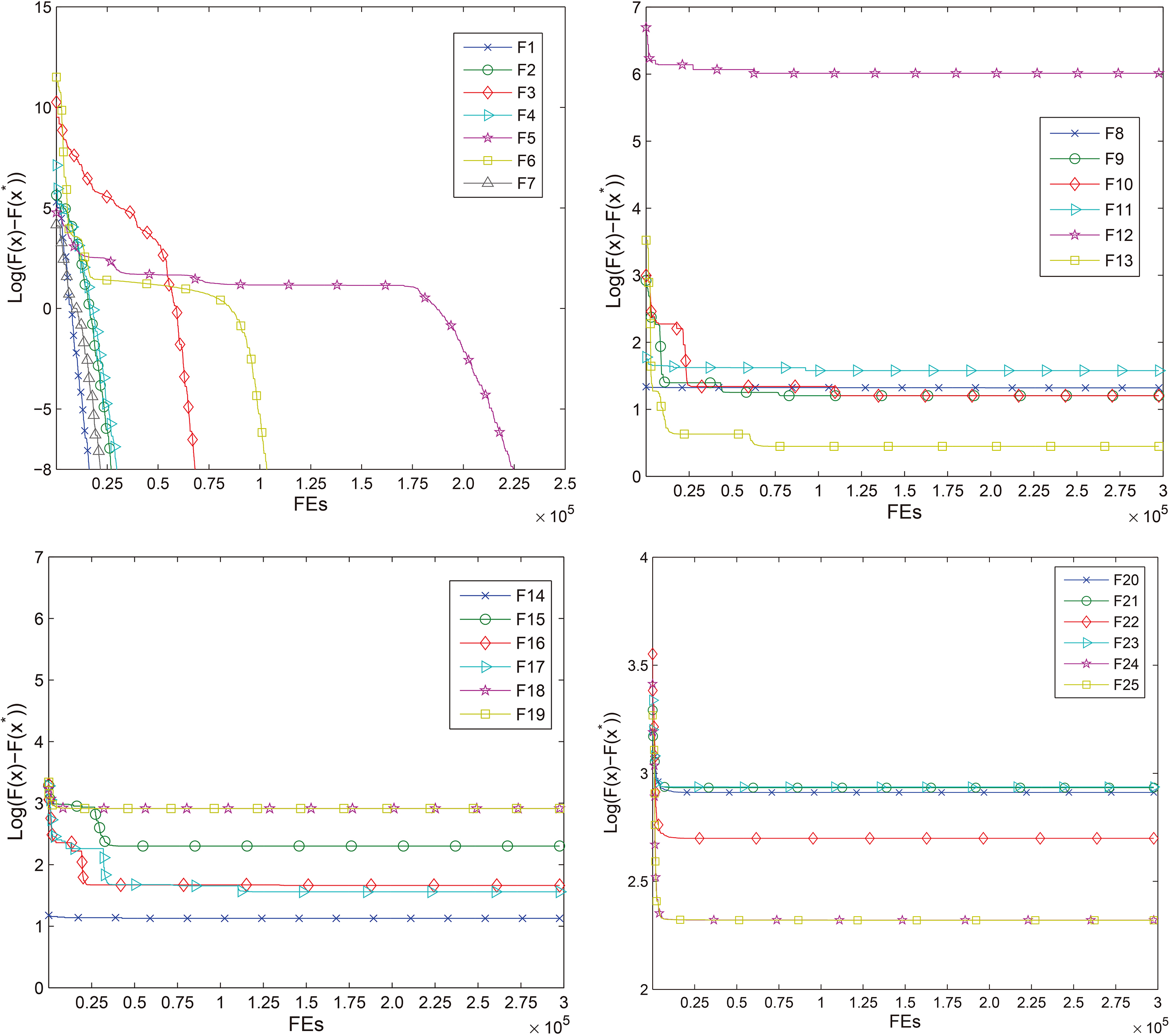
In this section the results of the performance comparison between the proposed memetic algorithm and five other state-of-the-art memetic algorithms are presented in two tables. Tables 3 and 4 show the average error over 25 runs off each benchmark function for
Convergence curves relative to each one of the 25 benchmark functions for 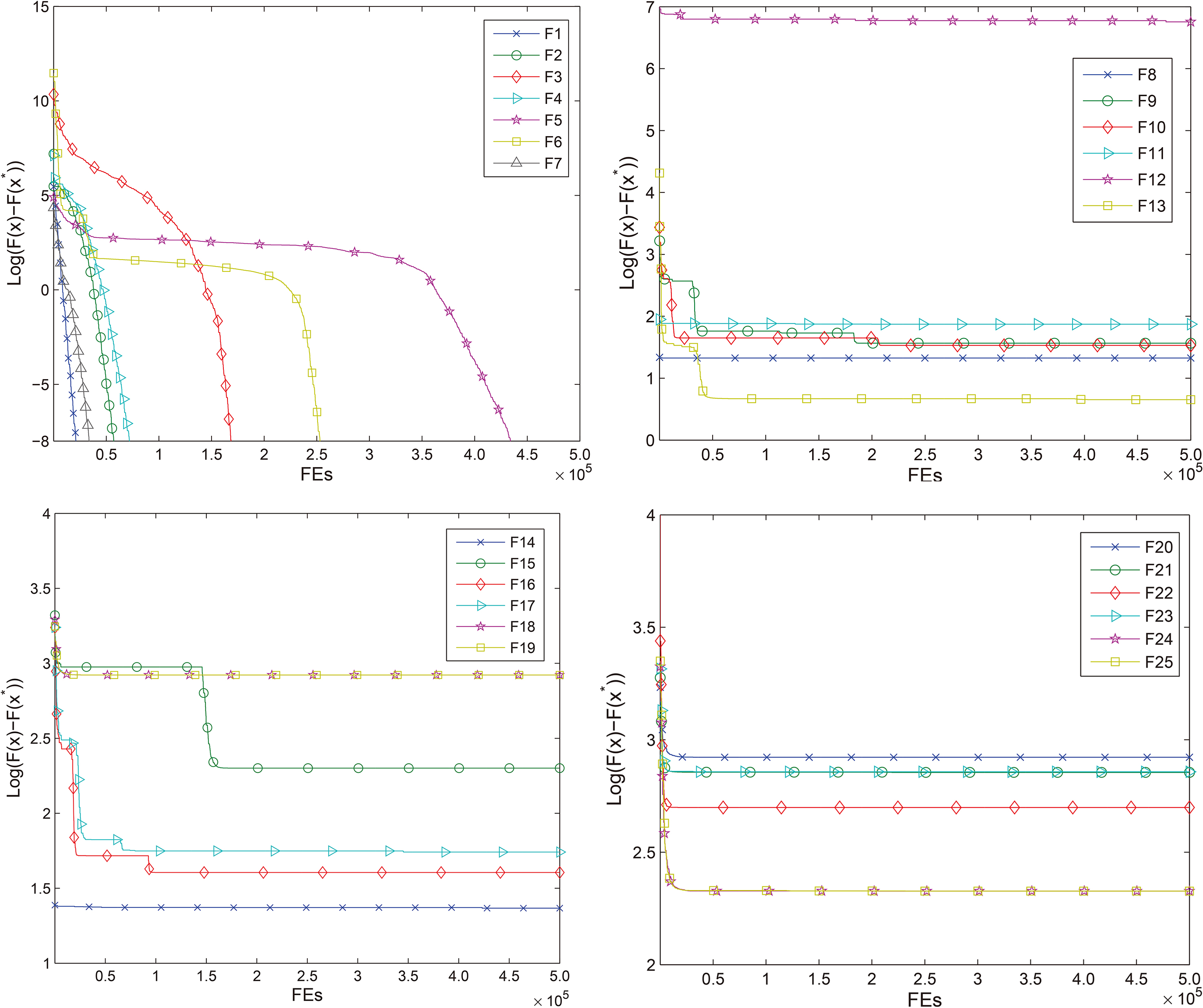
Average error
Tables 3 and 4 show that, under the conditions of the study, one can claim that the proposed Algorithm 5 outperforms all the others, independently of
Figures 1 and 2 show the convergence curves yielded by the proposed MA for
Also, it is worth noting that the proposed algorithm clearly outperformed IPOP-CMA-ES, independently of
Another interesting observation is that the proposed memetic algorithm achieved
Considering the average errors over all benchmark functions, Algorithm 5 performed significantly better than any of the others. It should be stressed that similarly to the proposed Algorithm 5, IPOP-CMA-ES, UACOR-c, and MA-LSCh-CMA all use CMA-ES as a local searcher. Consequently, the performance improvement observed for Algorithm 5 can only be due to synergy between the improved Wang algorithm and CMA-ES, as CMA-ES is common to all four mentioned algorithms.
Although the conditions of the competition are arguably questionable from the statistical test of hypotheses point of view, it is interesting to observe that the best classified algorithms performed well for both
Conclusions
This work proposes an adaptive extension of the Wang algorithm that promotes genetic diversity in a population by applying crossover only to parents with sufficient different chromosomes (genomes). This conditional application of variation operators replaces the classical probability based application of these operators. The proposed extension allows for an adaptive evaluation of the genomic difference between individuals in a way that is independent of the optimization problem and takes into account the stage of the evolutionary process. These features are deemed relevant in memetic algorithms where a global searcher is combined with a local searcher for addressing the exploration/exploitation trade-of of evolutionary computation. Consequently, this work also proposes an original and relevant memetic algorithm for continuous optimization combining the adaptive extension of Wang genetic algorithm, for exploration purposes, with the covariance matrix adaptation evolutionary strategy (CMA-ES) for exploitation.
The proposed memetic algorithm was empirically compared against five state-of-the-art memetic algorithms using a classical bench marking function set and has shown superior performance under strict competing comparing conditions. This can be viewed as a strong evidence on the relevance of the proposed algorithms.
Appendix B
This appendix summarizes the 25 functions used in Section 6 for empirical evaluation of the proposed algorithm. These have been used as benchmark functions after the Special Session on Real Parameter Optimization of the 2005 IEEE Congress on Evolutionary Computation. Functions are unimodal (F
In the following
Unimodal functions
Shifted Sphere Function
where Shifted Schwefel’s Problem 1.2
Shifted Rotated High Conditioned Elliptic Function
Shifted Schwefel’s Problem 1.2 with Noise in Fitness
Schwefel’s Problem 2.6 with Global Optimum on Bounds
where Basic Multimodal Functions
Shifted Rosenbrock’s Function
Shifted Rotated Griewank’s Function without Bounds
Shifted Rotated Ackley’s Function with Global Optimum on Bounds
Shifted Rastrigin’s Function
Shifted Rotated Rastrigin’s Function
where Shifted Rotated Weierstrass Function
where Schwefel’s Problem 2.13
where Expanded Functions
Shifted Expanded Griewank’s plus Rosenbrock’s Function (F
Shifted Rotated Expanded Scaffer’s F
with
Composition functions
Hybrid Composition Function: F F F
Rotated Hybrid Composition Function: F F F Rotated Hybrid Composition Function: F F F Rotated Hybrid Composition Function: F Rotated Hybrid Composition Function without bounds: F
Footnotes
Acknowledgments
This work was supported in part by the Scientific and Technological Research Program of Chongqing Municipal Education Commission (No. KJ1500607, KJ1400629), The National Natural Science Foundation of China (Grant No. 61402063, 61502063), the National Key Research and Development Program of China (2016YFE0132200), and CTBU Open Grant No. 1456027. J. V. de Oliveira acknowl-edges the support from FCT (the Portuguese Board of Science and Technology) grant number SFRH/ BSAB/128153/2016.
Appendix A
In this appendix CMA-ES is specified using the notation and terminology of [ ] where further implementation details and guidance can be found.
The covariance matrix adaption evolution strategy (CMA-ES) [] set
a stop criterion is met k = 1
// selection and recombination
// step-size control
// covariance matrix adaptation