






Abstract
Active learning is a typical approach for learning from both labeled and unlabeled examples aiming to build efficient and accurate predictive models at minimum expense under an expert’s guidance. Since there is a lack of labeled data in many scientific fields whilst, at the same time, the labeling cost of unlabeled data is typically high in terms of time and expenditure, active learning has grown rapidly over recent years with great success. This is reflected in various studies providing insights and analyzing several active learning methods, especially in the case of classification tasks, whereas, there is only a limited number of studies concerning the implementation of active learning methods for regression ones. Within this context, the present paper sets out to put forward a pool-based active learning regression algorithm employing the query by committee strategy to evaluate the informativeness of unlabeled examples. The experimental results on a plethora of benchmark datasets demonstrate the efficiency of the proposed method, since it prevails over the baseline active learning approach applying the random sampling strategy, as well as familiar supervised methods.
Keywords
Introduction
Nowadays, a vast range of data is stored in databases and data warehouses on a daily basis. Finding interesting patterns within digitally stored data is the main concern of Data Mining (DM) by means of Machine Learning (ML) algorithms to mine the hidden knowledge [1]. Applying one or more ML algorithms to a training example set results into the generation of a learning model with the ultimate purpose of predicting the labels or the target values of new examples. Several ML settings have been used for that purpose in order to solve a variety of problems depending on the existence of labeled and unlabeled examples.
Learning from labeled examples is the main objective of Supervised Learning aiming to predict the output for future data by training a function
Regarding the active learning approach, it is considered a fast growing and promising subfield of ML with emphasis on building efficient and accurate predictive models at minimum expense under an expert’s guidance [8]. Two main sub-branches of active learning are discernible, depending on the type of the predicted variable: active learning for classification problems and active learning for regression ones. While active learning has been broadly applied to both binary and multi-class classification problems in several scientific fields with quite satisfactory results, there are only a limited number of studies concerning the implementation of active learning methods for regression. This is reflected more clearly in various studies providing insights and analyzing several active learning classification methods, whereas, there are only a limited number of studies concerning the implementation of active learning methods for regression tasks.
In that connection, we make an effort towards developing a new active learning regression algorithm. The proposed algorithm depends on the pool-based sampling scenario for asking queries, employing at the same time the query by committee strategy to evaluate the informativeness of unlabeled examples, of which the most informative are labeled by a domain expert. The experimental results on a plethora of benchmark and artificially generated datasets demonstrate the efficiency of the proposed method, since it prevails over the baseline active learning approach employing the random sampling strategy, as well as familiar supervised methods.
The rest of this paper is structured as follows: The active learning framework is clearly delineated in Section 2 while defining the problem of active learning regression, while Section 3 reviews recent studies relating to several active learning methodologies for regression tasks. The proposed active learning regression algorithm is introduced and described in detail in Section 4, whilst the experiments carried out and their consequent results are presented and analyzed in Section 5. Finally, in Section 6 we comment on the results considering some thoughts for future work.
Active learning for regression problems
Active learning or Query learning is a typical example of learning from both labeled and unlabeled examples aiming to build highly effective predictive models by using the minimum number of labeled examples, while asking from a domain expert the labels from the most informative and uncertain to label unlabeled examples [8]. The focus of active learning is all about minimizing the querying process, regarding its total effort, along with the generalization error of the generated regression model [9]. The novelty of the active learning framework lies in the fact that the learning algorithm actively participates in knowledge acquisition having discretion in the matter of selecting the unlabeled data thereby reducing the labeling effort and cost [10]. To this end, several methods have been proposed for asking queries and a lot more for selecting the most informative examples for querying their labels from the expert (human or system).
Concerning the main scenarios in which active learners are able to pose queries, pool-based, stream-based and membership query synthesis are the most characteristic and predominantly used in classification tasks. The diversification of these scenarios lies in the different ways in which the unlabeled data are obtained. According to pool-based sampling, the most “valuable” unlabeled examples for label querying are selected from the entire pool
Regarding the query strategies applied for selecting the most informative instances from
The active learning framework.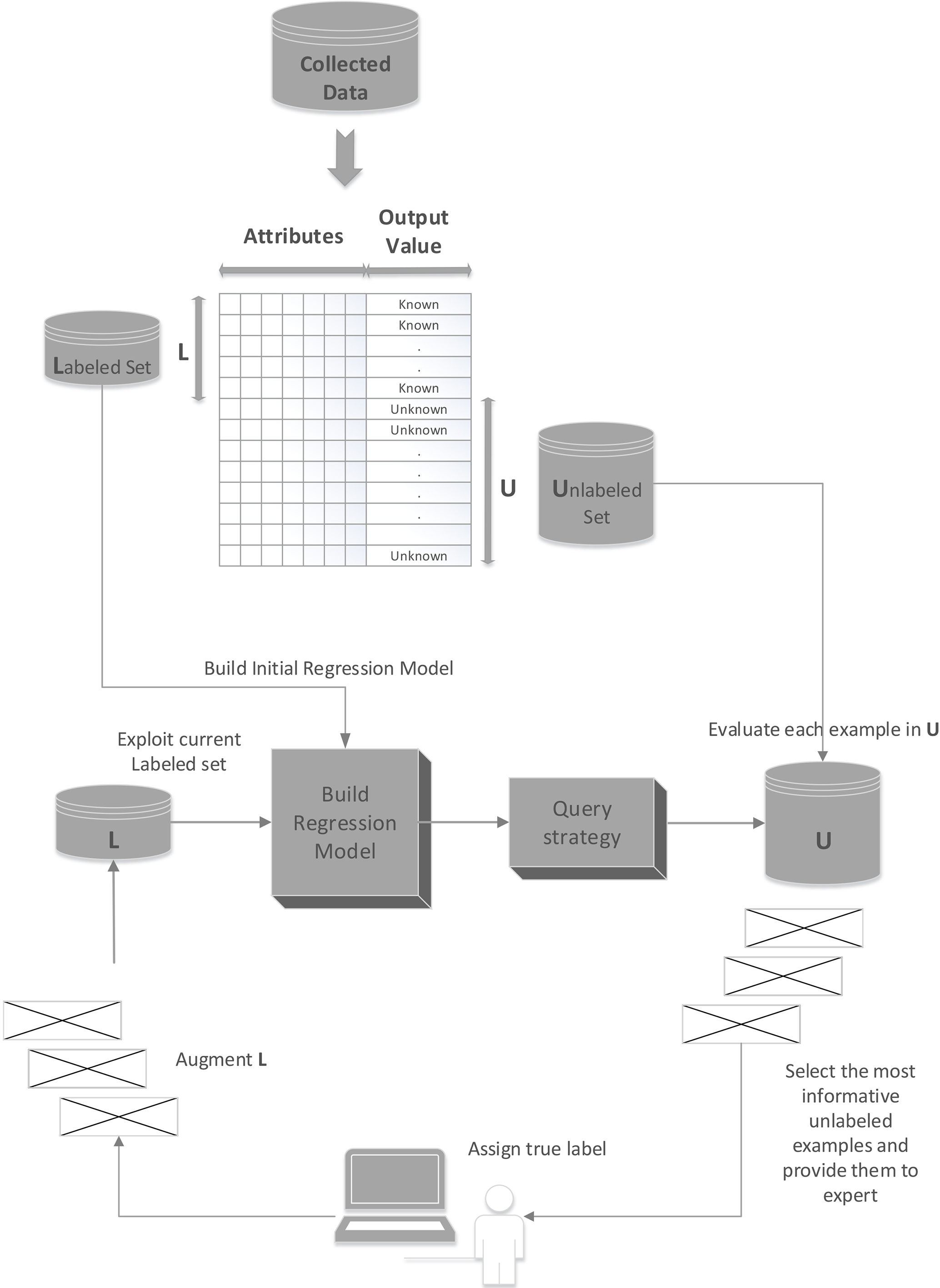
Query by Committee (QBC) is a frequently used query strategy based on a finite set of classifiers, hereinafter referred to as committee learners, each of whom is trained on a small pool Uncertainty sampling is another widely used but also simple scenario, according to which the active learner queries the labels for the most uncertain to label unlabeled examples. Several measures have been employed under this strategy, but the majority of them are not directly applicable to regression tasks, since there is no notion of the posterior probabilities of output classes for real-valued variables [14]. In this case, the posterior variance is used instead, querying the label of the unlabeled example with the largest posterior variance [15]. Random sampling is evidently considered as the baseline strategy for comparison to other active learning methods. Unlike the other query strategies, random sampling queries the label of randomly selected examples from the Expected Model Change (EMC) concerns a theoretic active learning strategy aiming to select the examples which entail the maximum change to the models’ parameters when new queried examples are added, where the model change is defined as the difference between the current model parameters and the updated ones [8]. Expected Error Reduction (EER) is another theoretic active learning strategy measuring how much the generalization error is likely to be decreased for each unlabeled example. In practical terms, the example implying the minimum expected error is queried for labeling, which, however, results to high computational cost, since the expected error must be calculated for each specific unlabeled example [8]. Variance Reduction is a frequently used query strategy for regression problems aiming to reduce the generalization error of a regression model given in Eq. (1) by minimizing the output models’ variance which corresponds to the third term of the Eq. (2):
where Bagging and Boosting, constitute two very powerful and effective ensemble methods for constructing a committee of classifiers [18].
Regression analysis is a statistical method for building a mathematical model that best fits a specified set of data. This model is generally referred to as “regression model” and is utilized for the prediction of the value of a real-valued output variable
On this basis, the active learning regression problem can be defined as follows. Given a small set of
A plethora of significant studies deals with the implementation of active learning methods for classification problems, contrary to regression which is clearly less studied as easily identified in the pertinent literature. Since there is no study reviewing the main active learning methodologies that have been developed for regression tasks, we intend to provide a brief but concise review for some of the most preeminent studies concerning the active learning methods for regression tasks and which are outlined and discussed below.
Early works on active learning for regression were introduced by Krogh and Vedelsby [19] and RayChaudhuri and Hamey [9], thus serving as a reference point for almost all subsequent studies. Krogh and Vedelsby were among the first to extend the QBC approach for classification problems to regression ones by proposing an ensemble of five Neural Networks (NNs) for real-valued functions. Initially, the networks were trained individually on the same set of one single labeled example, while adding the example with the largest ambiguity at a time. Ambiguity was used to measure the disagreement among committee members on an input example and is defined as the variance of the weighted ensemble output averaged over unlabeled data. Moreover, they proposed an efficient approach for finding the optimal ensemble weights from unlabeled examples, thus leading to better generalization error. RayChaudhuri and Hamey [9] proposed a similar active learning scheme using ten different NNs trained on random subsamples of a randomly sampled dataset consisting of ten labeled examples each one. Subsequently, the variance of 100 randomly selected unlabeled examples is calculated, the one example with the higher variance is added to the previous labeled subset and the process is repeated until the maximum model variance is less than a predefined threshold.
On the basis of the previous studies, Burbidge et al. [10] considered a committee-based active learning method for regression tasks. The variance minimization criterion was used for querying the labels of unlabeled examples with a view to minimizing the expected generalization error, which includes a term regarding learners’ variance. Concerning the learners, a committee of five linear regressors was applied with a second order polynomial kernel. Moreover, each learner was trained on different subsets of the labeled data, thereby setting out the disagreement among committee members and subsequently the samples with the maximum disagreement among themselves were collected. The proposed approach proved to be very powerful and effective enough, especially in the case of a small learner’s bias.
At the same time, Sugiyama and Rubens [20] proposed Ensemble Active Learning (EAL), an active learning framework for choosing the best model to minimize the generalization error. According to EAL, all the models are applied to all training input examples and the corresponding outputs are collected. The term model refers to the number and type of linearly independent functions and the optimization parameter of a linear regression model, while the generalization error is defined by the expected squared error for the test input examples. Finally, the generalization error is computed for each model and the final model is the one which minimizes it. The main advantage of this method is the over-fitting risk reduction of a single and usually randomly selected model.
More recently, a number of very rewarding studies have been carried out in the active learning field by applying Support Vector Machines (SVM) for regression. Ceperic et al. [21] presented sparse Multi-Kernel Active Learning Support Vector Regression (MK-ALSVR) consisting of two layers: a non-linear preprocessing layer and a linear one. The algorithm starts with one data example in the training set, while a Radial Basis Function (RBF) kernel is applied to the model that best fits the data by optimizing the model parameters. The difference between the model output and the entire training set is calculated, the next data example is selected, and the training dataset is gradually augmented with simultaneous incremental construction of the model using the same kernel, but with different parameters. Using multiple kernels (in this case it is achieved through different parameters), whilst constructing the model in an incremental process, guarantees its high performance (the RMSE measure is used) as confirmed by the experimental results.
In the same context, Demir and Bruzzone [22] presented a novel method based on
Cai et al. [14] put forward an active learning framework for regression termed EMC Maximization (EMCM). According to this approach, the examples which result into the largest “changes” to the models’ parameters are selected (a linear regression model is used). In particular, for each unlabeled example the models’ parameters are updated using the gradient of the error with respect to each single training example. In this way, the unlabeled example with the largest expected change is chosen each time and the training set is gradually augmented. The current framework was applied for both linear and non-linear regression, using the non-parametric Gradient Boosting Decision Tree (GBDT) learner in the second case. In a more recent study [23] the EMCM method was extended to batch mode active learning, under which, the k most informative examples are selected in each query instead of a single one.
A stream-based active learning algorithm for linear regression was proposed by Sabato and Munos [24]. Initially, the dataset is partitioned by stratification into a finite set of subsets while the Ordinary Least Squares (OLS) approach is applied to each of them. It is important to note that the algorithm is regarded as a black box, meaning that theoretically any other algorithm could be used instead. Ultimately, a generalized median procedure is used for choosing one of the resulting predictors and the algorithm converges to the globally optimal oracle risk, under a feasibly undefined model.
Very recently, Riquelme et al. [25] studied the case of online active learning for optimal prediction of high-dimensional linear models based on a threshold sampling rule. From a total of
In response to the two previous studies, Lughofer and Pratama [26] proposed an online stream-based active learning approach incorporating the uncertainty sampling strategy while using three efficient sample selection criteria regarding the uncertainty in model outputs and parameters, as well as the extrapolation degree in conjunction with the models’ non-linearity degree. In this way, the boundless online data streams are loaded in the form of sequential sub-samples which are automatically rejected or accepted for updating the model. The aforementioned criteria were applied together with “generalized evolving Takagi-Sugeno” fuzzy systems for handling non-linear problems. Compared to random sampling, the method achieved lower error rates using only a small percentage of the total number of data streams sub-samples.
It follows from the abovementioned studies that pool-based and stream-based sampling is predomi- nantly used for regression tasks. These scenarios have proven to be more flexible than membership query synthesis for both classification and regression tasks, since the former is usually problematic in the case of a human expert [8]. In addition, stream-based sampling can handle both offline and online data streams [27], while pool-based assumes that the pool of unlabeled examples is invariable. Moreover, stream-based sampling obtains better results if the distribution of input examples is uniform [8], however, is extensively affected by data distribution changes over time [27].
Proposed method
The proposed regression algorithm (ALERegression) is based upon the pool-based scenario for asking queries, since it is independent from the distribution of input examples [28] and it has been successfully applied to a wide range of active learning problems for regression tasks. The adopted sampling strategy is the QBC, where a distance criterion is introduced for discerning the examples that should be extracted from the unlabeled pool and provided afterwards for labeling by a domain expert.
Let
More specifically, the first active regressor is an M5P algorithm that stems from model trees. This kind of regression algorithm is based on the initial demonstration of Quinlan [30] modified in [31] and its main function is to construct tree-based piecewise linear models. Its modifications were made with the purpose of tackling appropriately at the same time both categorical and numerical variables and missing values while reducing the tree size, as well as avoiding continuing the recursive split when only few instances have remained in a node. Especially, the last property namely the reducing of tree size offers better comprehensibility and leads to predictive behaviors that seem compatible enough with several kinds of regression problems [32].
The second regressor is an SVR algorithm based on the well-known Support Vector Machines, which has been widely used for regression problems improving the generalization performance [21]. The initial purpose of SVR was to describe all the training instances through a suitable function that does not diverge from the corresponding real value more than a pre-defined quantity [33]. Several variants of SVR have been formulated regarding the exploited kernels in case of non-linear problems, the cost functions and the optimization process. In our case, Sequential Minimal Optimization (SMO) is preferred, being updated by corrections proposed in [34] regarding some inefficiencies that occurred during the operation of the original algorithm. As it concerns its pre-process function, any nominal feature is transformed suitably into the appropriate number of binary features, while a normalization process is applied before the main core of this algorithm takes place.
Finally, the third component of the constructed committee is a RF algorithm able to operate into regression mode [35]. Its main function is based on growing ensemble tree regressors built over random splits of the initial feature vector space. The selected instances for each induced tree are filtered through a bootstrap process, enabling their replacement back to the original pool of training instances for being exploited by any other tree regressor, after having been selected randomly. No pruning stage is applied and the outputs of all the created tree regressors are averaged so as to finalize the prediction of the whole algorithm. The great applicability of RF over several applications is reported in the literature, while one of the most powerful assets of RF is the unwrapping of useful relationships that may exist into provided features.
Having defined the active regressors of the committee and the regressor that is responsible for the final estimation of the ensemble method, a general description of the proposed process follows next. Each one of the active regressors is trained on the same initial labeled set (
In each iteration, all active regressors are applied on the current unlabeled set
Subsequently, the most confusing unlabeled examples from current unlabeled set
In this section, a brief description of the conducted experiments is given, concerning the adopted settings that will clarify the discrimination of the presented comparisons. The experiments were conducted in two phases – one phase with experiments on benchmark datasets and the second one on artificial created ones – which are described below.
Experiments on benchmark datasets
At first, 25 datasets were mined from the publicly available UCI repository, describing problems stemming from various scientific fields. Hence, the assumption of a proposed algorithm (ALERegression) with powerful generalization ability is clearly more effective, rather than restricting our evaluated datasets to specific domains. Moreover, in order to obtain a clear enough insight into the predictive ability of the proposed algorithm, two different labeled ratio (
Furthermore, two other parameters that have to be defined are the ratio of the initially labeled instances (
Correlation coefficient (
20%)
Correlation coefficient (
Correlation coefficient (
RMSE (
RMSE (
For determining the effectiveness of the algorithms used in the experiments, two widely used me- trics were employed: The correlation coefficient (CorCoef) and the Root Mean Square Error (RMSE). The produced results per labeled ratio are presented in Tables 1–4, created using the 10-cross-validation resampling technique, while the higher value per each dataset is bold highlighted. In general, it is observed that the majority of the datasets favor the performance of the proposed algorithm per each scenario. Another useful conclusion is the improvement that the RandomL (M5P) method scores in all cases compared to the supervised regressors, thus demonstrating the benefits of the active learning approach. However, the far better results achieved using a targeted query (RPO) and computed on the presence of the formatted committee, denote clearly the need for more oriented queries in order to better predict the target value, spending much computational resources and employing human expertise for acquiring true values, or at least values that represent the knowledge of the related human factor.
In order to compare the performance of the used methods, the Friedman Aligned Ranks non-parametric test [36] and the Hochberg post-hoc test [37] were applied (with a significance level
Statistical comparison (
Statistical comparison (
Also, the contribution of the three base learners on the selection of the most confusing examples was indirectly analyzed considering the distribution of the middle model in the RPO measure while computing Eq. (3). The distribution of the middle model was extracted while evaluating 10 of the best benchmark performing datasets for the 2 labeled ratios (20% and 30%) that were examined above.
The distribution of base regressors as middle model in the two scenarios (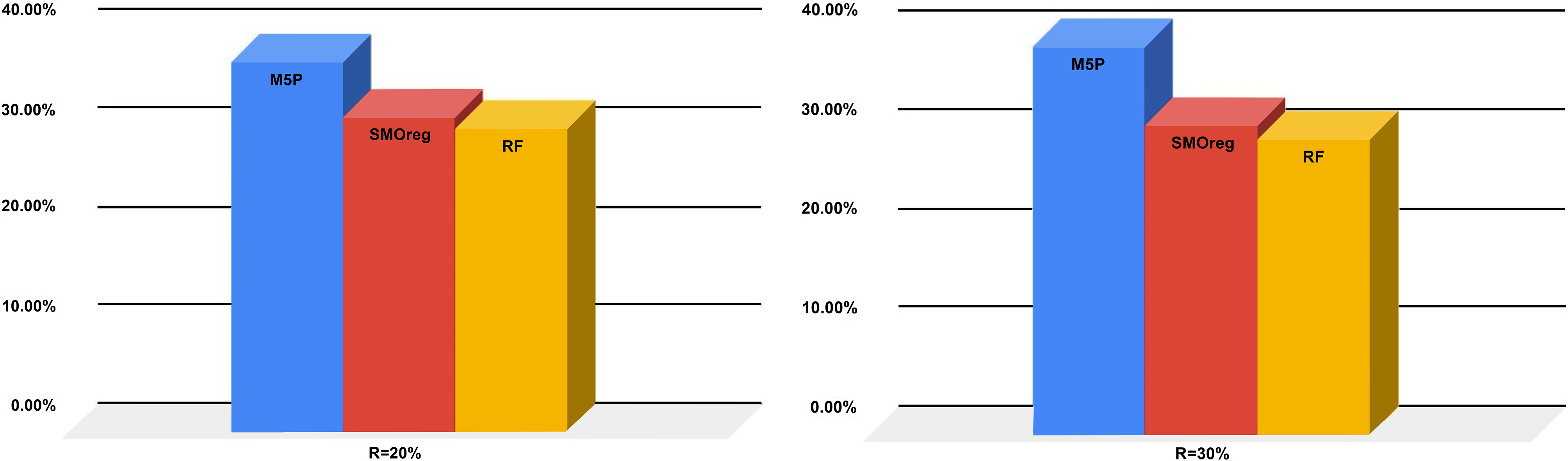
As can be concluded from Fig. 2, there is a strong alternation of the middle model and therefore between the models that make up the min and max predictions in RPO, thus suggesting that all three models are contributing to selection of the unlabeled data.
Finally, the corresponding supervised regression algorithms using the participants of committee as base regressors built on the full training set (
In addition, we experimented on artificially created data to gain a better insight into strengths and weaknesses of the proposed approach. Therefore, we investigated the influence of noise intensity and extreme outliers.
Comparing correlation coefficient of proposed algorithm against supervised regressors on whole training set
Comparing correlation coefficient of proposed algorithm against supervised regressors on whole training set
Artificial dataset initial parameters
The RMSE values regarding the gaussian noise applied (0.10–0.40) for 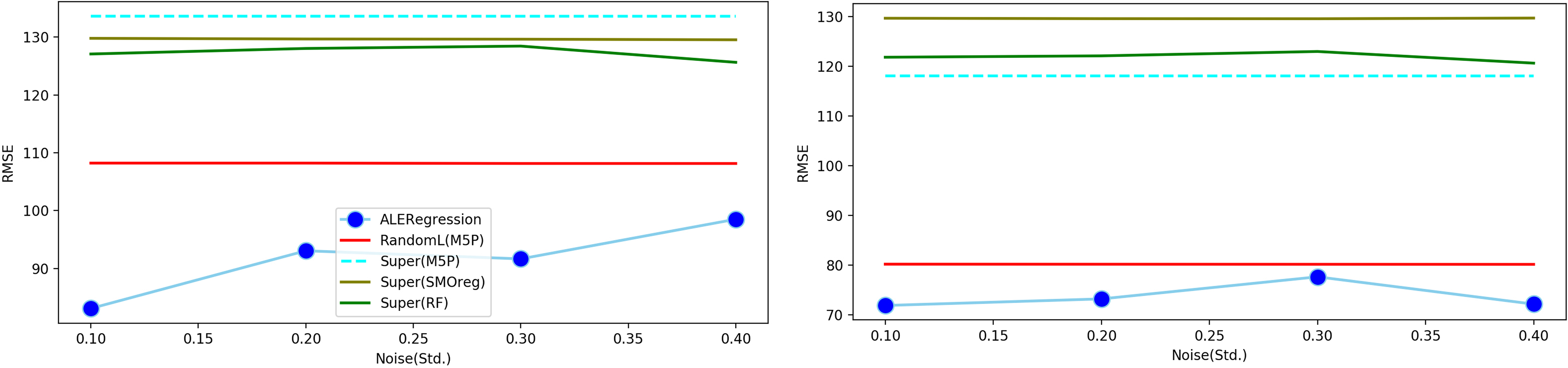
The RMSE values regarding the percentage of outliers (4%–10%) for 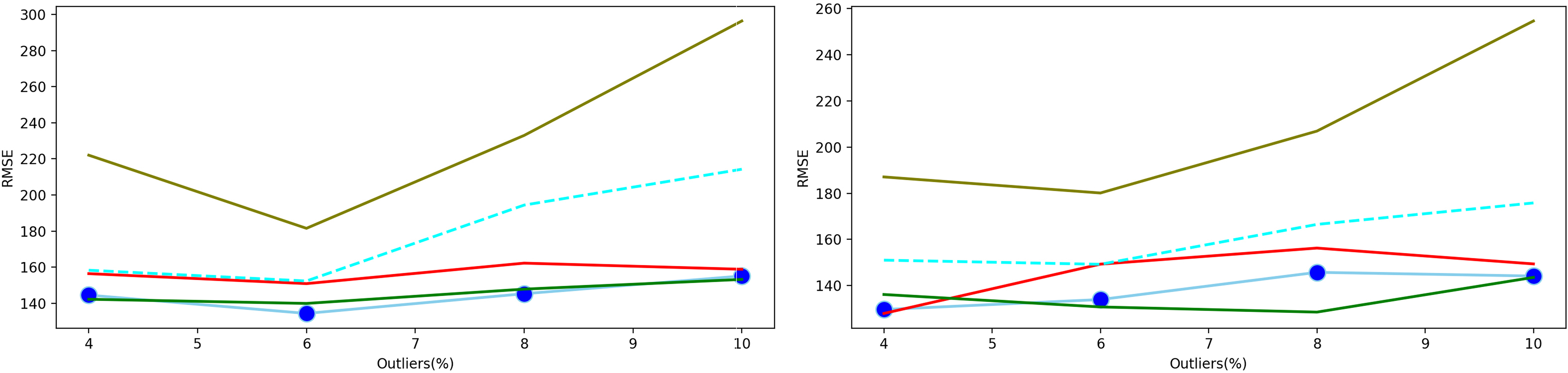
Initially, we generated an artificial dataset utilizing a random regression problem [38]. To further complicate the relation between the response and the independent variables, we applied the cube root function on the latter. For the generated dataset we considered the following parameters: the number of samples, the number of features, the number of informative features (i.e. the number of features applied to build the linear model used to produce the output), the noise intensity and the percentage of outliers. These parameters were set as presented in Table 8.
Subsequently, we injected gaussian noise to the dataset, with a standard deviation value ranging from 0.10 to 0.40. The obtained RMSE results for
Moreover, we investigated how the presence of outliers in the dataset affects the performance of the proposed algorithm. Therefore, a percentage of outliers, ranging from 4% to 10%, was added in the dataset. The obtained RMSE results for
Before we proceed to the conclusory remarks, some promising points are made here. Therefore, two attractive improvements that could be implemented inside the learning kernel of the proposed algorithm could be the integration of Local Weighted approaches per regressor, as it was proposed for SMOreg in [39], or apply dynamic selection methods for choosing accurate enough regressors inside ensemble schemes or improving Committee’s participants selection per dataset [40]. Another one perspective that should be considered is the demanded time resources, especially for vast amounts of data. Combination of clustering methods during pre-process steps has been employed in regression tasks and could be proven highly beneficial in case of AL schemes which are characterized by iterative structure. Feature engineering concepts should also be examined in the case that more sophisticated base regressors are going to be combined into different QBC approaches [41].
In a future work, we will also investigate the introduction of multiple query measures for the ranking of the unlabeled examples. New query measures can be relevant to the RPO method, which was introduced in the present work, like modifying RPO to ignore outlier predictions from the computed range, or completely different approaches than the range metric used. Another technical characteristic of the proposed algorithm is that its iterative nature in combination with the deployment of multiple learners renders the algorithm suitable for parallel execution using multi-threading and GPUs. Extending the structures and the procedures of the algorithm to support parallel execution may also be a vital feature. Use of incremental learners, such as those in case of [42], where a density criterion is used for detecting the most appropriate samples, could also offer time affordable approaches.
Another interesting topic that could extend this work derives from the combination of the different learning approaches and multiple learners. The first idea involves the combination of active learning [43] and semi-supervised regression [44] methods. The proposed algorithm, as an iterative method, can take advantage of schemes like SSL self-training to further enrich the labeled set in conjunction with the AL approach that is already embedded, thus reducing the need for labeled instances, which is considered as an expensive factor due to the need for human expertise in the process of labeling. The second one incorporates the field of deep learning [45]. To further increase the learning capacity of the proposed algorithm, convolutional neural networks can be embedded in the proposed algorithm if the appropriate pre-process procedures are implemented. Such an extension can make the algorithm suitable for use with big data, thus tackling a wide range of important real-world problems like computer vision and speech recognition.
In summary, this work presented a new wrapper algorithm for regression problems utilizing multiple learners and active learning techniques. A plethora of experiments were conducted for evaluating the efficacy of the proposed algorithm in a wide range of datasets against well-known learners using supervised and active methods in different labeled ratios. The experimental results on a plethora of benchmark datasets demonstrate the efficiency of the proposed method, since it prevails over the baseline active learning approach employing the random sampling strategy, as well as familiar supervised methods, as statistically confirmed by the Friedman Aligned Ranks nonparametric test and the Hockberg post-hoc test. To further promote the use of the algorithm, a WEKA package containing the wrapper method has been developed, while more details can be found in the Appendix section.
Footnotes
Appendix
The implementation of the proposed algorithm (ALERegression) was developed as a software package for the WEKA data mining tool, since WEKA is one of the most widespread and easy to use tools in the machine learning community. The package includes the java source code along with the precompiled package. The ALERegression package can be downloaded at the following link: