






Abstract
Background:
Very few studies have investigated the impact of cognitive frailty in clinical settings, especially in memory clinic populations.
Objective:
To examine the impact of cognitive frailty on activities of daily living (ADL), cognitive function, and conversion to dementia among memory clinic patients with mild cognitive impairment (MCI).
Methods:
The subjects of this retrospective study were 248 MCI patients (mean age, 76.3±5.4 years; females, 60.9%). All subjects completed a comprehensive geriatric assessment at baseline and at least one assessment during 3-year follow-up. Frailty was defined by generating a frailty index (FI), and MCI patients with frailty (FI≥0.25) were considered to represent cognitive frailty. As primary outcomes, the Barthel Index, Mini-Mental State Examination, and incident dementia were evaluated during follow-up. At baseline, patients were assessed for apolipoprotein E (APOE) phenotype. A linear mixed model, as well as a Cox proportional hazards regression model with adjustment for confounding variables, was performed.
Results:
Of these patients, 75 (30.2%) were classified as cognitive frail. APOE ɛ4 carriers accounted for 26.7% of those with cognitive frailty and 44.5% of those without (p = 0.008). Cognitive frail patients showed a faster ADL decline (estimate, –1.04; standard error, 0.38; p = 0.007) than patients without cognitive frailty. Cognitive frailty was not associated with cognitive decline and incident dementia.
Conclusion:
Our findings demonstrated cognitive frailty increases the risk of dependence but not cognitive outcomes. Cognitive frailty may have heterogeneous conditions, including APOE ɛ4-related pathologies, which may affect the cognitive trajectories of patients with MCI.
INTRODUCTION
Mild cognitive impairment (MCI) is considered a transitional state between normal aging and dementia [1]. Although older adults with MCI are at high risk of developing dementia compared to an age-matched population [2], a significant number of subjects may remain stable or revert to normal cognition [3]. To date, there is great interest in identifying modifiable risk factors that predict conversion from MCI to dementia, and a meta-analysis has shown some modifiable risk factors including diabetes, metabolic syndrome, and low dietary folate [4].
In this context, frailty has received attention in relation to cognitive impairment and dementia. Frailty is characterized by increased vulnerability to stress due to a cumulative decline in multiple physiological systems, resulting in an increased risk of adverse health outcomes [5]. A recent meta-analysis demonstrated that frailty status is associated with the risk of incident dementia among community-dwelling older adults [6]. Moreover, based on the numerous evidence available to support a significant association between frailty and cognition, the concept and operational definition of “cognitive frailty” was first proposed in 2013 by an international consensus group [7], where cognitive frailty is defined as the simultaneous presence of frailty and cognitive impairment (clinical dementia rating = 0.5) in older individuals without a definite diagnosis of dementia [7]. Cognitive frailty is conceptually considered to be a state of reduced cognitive reserve, and an international consensus group sought to identify a condition of cognitive impairment caused by physical conditions, rather than neurodegenerative disorders, although cognitive frailty may also represent a precursor of neurodegenerative processes [7]. Indeed, there is still insufficient evidence to support this novel cognitive condition caused primarily by physical factors [7], and there are few studies investigating the underlying mechanisms of cognitive frailty.
Nevertheless, following the first operational definition of cognitive frailty, several population-based studies have shown that cognitive frailty is associated with a high risk of disability, poor quality of life, death, and incident dementia [8, 9]. In contrast, to date, very few studies have investigated the impact of cognitive frailty in clinical settings, especially in memory clinic populations. In the Gait and Brain study recruiting 252 older persons from geriatric clinics and a retirement community, cognitive frailty was not a risk for dementia. However, when each component of frailty was combined with cognitive status, the simultaneous presence of slow gait and cognitive impairment predicted incident dementia [10]. Given that cognitive frailty is characterized by its potential for reversibility [7], the detection of potentially modifiable risk factors for clinical progression, including cognitive frailty, is an urgent challenge particularly in these high-risk older adults.
Of the multiple operational definitions of frailty proposed to date, the frailty phenotype [11] and the frailty index (FI) [12] are widely used. The frailty phenotype and the FI share common characteristics, but are conceptually different [13]. The use of the frailty phenotype is considered to be preferable as a screening tool for frailty in an initial estimation [13], with most of the past studies of the cognitive frailty model shown to use the frailty phenotype [8, 14]. In contrast, based on the concept that frailty results from “accumulation of deficits”, the FI takes into account functional disability, diseases, and geriatric syndrome and can be applied to every individual, independently of their functional and cognitive status [13]. Moreover, an FI, generated after a comprehensive geriatric assessment, can provide the information required to intervene in their frail conditions [13]. In addition, a systematic review suggested that the FI was associated with late-life cognitive decline and incident dementia [15], indicating the FI may be an appropriate instrument for determining the vulnerability of dementia, i.e., cognitive frailty [15]. To date, there have been several studies investigating the cognitive frailty model defined by using the FI, which have showed the prevalence and associated factors of cognitive frailty [16] and have showed that cognitive frailty increased the risk of mortality among community-dwelling older adults [17] and oldest-old people (aged 90 or more) [18].
Therefore, in the present clinical study especially involving memory clinic populations, we defined cognitive frailty using the FI and examined the impact of cognitive frailty on clinical progression including activities of daily living (ADL), cognitive function, and conversion to dementia among patients with MCI. The impact of cognitive frailty thus identified should enable clinicians to identify those at risk and to implement appropriate interventions to mitigate the consequences of cognitive frailty in memory clinic populations.
METHODS
Design, setting, and subjects
In this retrospective study, we identified 248 outpatients according to the following inclusion criteria: 1) patients who had first presented during the period from October 2010 to December 2016 and followed up at the Memory Clinic at the National Center for Geriatrics and Gerontology (NCGG) of Japan; 2) those aged 65–89 years at first presentation; 3) those who had been diagnosed with MCI according to the criteria of the National Institute on Aging-Alzheimer’s Association (NIA/AA) workgroups [19]; 4) those who had completed a comprehensive geriatric assessment (CGA) at baseline and at least one follow-up assessment (for up to a maximum of three years from baseline). The median follow-up period at final follow-up was 2.5 years (interquartile range, 1.6–3.0 years). The local Ethics Committee of the NCGG approved the study protocol. The purpose, nature, and potential risks of the study were fully explained to the subjects, and all subjects gave written informed consent before participating in the study.
Definition of frailty and cognitive frailty
In the present study focused on memory clinic patients, frailty was defined based on the accumulation of deficits in the subjects by generating a FI [12, 20]. The FI included 35 deficits composed of their instrumental ADL difficulties, comorbidities, and geriatric syndrome. To avoid circular analysis, basic ADL difficulties and cognitive functions were not included in the FI, given that the primary outcome measures in the study were decline in basic ADL and cognitive function. Each deficit was dichotomized into 0–1, and the values of 0 and 1 were assumed to indicate the absence and presence of the deficit, respectively. All the deficits used to generate the FI, as well as their prevalence, are shown in Supplementary Table 1. The FI score was calculated for each individual as the ratio of actual to potential deficits (deficits present in the individual divided by 35), with the FI ranging between 0 (no deficits) and 1 (all deficits). In line with a previous study [21], the subjects were divided according to the degree of their frailty into non-frailty (FI < 0.25) and frailty (FI≥0.25). Then, in this study, frail patients with MCI were considered to represent cognitive frailty [7].
Outcome measures: activities of daily living, cognitive function, and incident dementia
At baseline and during follow-up, all patients were evaluated for their basic ADL by caregivers using the Barthel Index [22] as well as for cognitive function. The Barthel Index includes 10 items to assess basic self-care capabilities, such as feeding, transferring from a bed to a chair, bathing, bowel control, and bladder control, with the score ranging from 0 (complete dependence) to 100 (complete independence). Cognitive function was assessed using the MMSE [23] by clinical psychologists. The MMSE scores range from 0 to 30, with lower scores indicating impaired cognitive functioning. Incident dementia was defined as a clinical diagnosis of dementia based on the NIA/AA criteria during follow-up [24]. The type of dementia was classified as probable or possible Alzheimer’s disease (AD) [24], probable or possible dementia with Lewy bodies (DLB) [25], and frontotemporal dementia (FTD) [26].
Other variables
Information about the subjects’ age, sex, education, living situation (living with their family or alone), smoking status (current smoker or not), alcohol consumption (drinking daily or not), and body mass index (BMI) was obtained from their clinical charts. The study also examined potential confounders for their basic ADL, cognitive function, and incident dementia, which included apolipoprotein E (APOE) phenotypes (APOE ɛ4 carrier or APOE ɛ4 non-carrier), depressive mood, and behavioral and psychological symptoms of dementia (BPSD). All patients were evaluated for depressive mood using the self-administered 15-item Geriatric Depression Scale (GDS-15) [27] as well as for BPSD using the 28-item Dementia Behavior Disturbance scale (DBD) [28].
Statistical analysis
In the univariate analyses, all patients were examined for differences in the baseline characteristics according to frailty status using the Kruskal-Wallis test and χ2 test. To clarify the differences in the baseline scores and rates of change in the Barthel Index and MMSE according to frailty status, linear mixed models (with individual identity as a random effect) were conducted in which cognitive frailty, time of the visit (years), and cognitive frailty×time interaction were entered. The baseline age, sex, education, smoking status, living situation, alcohol consumption, APOE ɛ4 carrier status, GDS-15 score, and DBD score were included as covariates. Additionally, the APOE ɛ4 carrier status×time interaction was tested, given that APOE ɛ4 has been established as a risk factor for cognitive and functional decline [29]. Sensitive analyses were also conducted with adjustment for baseline Barthel Index and MMSE scores as well as for their time interaction. Moreover, to clarify which dimensions of the ADL frequently declined, linear mixed models were conducted in which the sub-items of the Barthel Index were entered as dependent variables.
To examine the association between cognitive frailty and conversion to dementia, a Cox proportional hazards regression model was employed with adjustment for the confounding variables, i.e., baseline age, sex, education, smoking status, living situation, alcohol consumption, BMI, APOE ɛ4 carrier, Barthel Index, MMSE, GDS-15 score, and DBD score, and the adjusted hazard ratios (HRs) for incident dementia and their 95% confidence intervals (CI) estimated.
All statistical analyses were performed using STATA 14.0 (Stata Corp, College Station, Texas, USA). p-values <0.05 were considered statistically significant.
RESULTS
Baseline characteristics
At baseline, the subjects had a mean age of 76.3±5.4 years, a mean MMSE score of 25.2±2.4, and a mean Barthel Index score of 99.1±3.0. Of the 248 subjects assessed, a total of 75 (30.2%) subjects were classified as cognitive frail. Table 1 summarizes their baseline characteristics according to cognitive frailty status, which shows significant differences in age, sex, education, drinking status, Barthel Index score, GDS-15 score, DBD score, FI score, and APOE status, but no difference in MMSE total score (Table 1) by cognitive frailty status. Regarding the sub-item of MMSE, cognitive frail subjects showed lower score of serial sevens (2.9±1.7 versus 3.4±1.6, p = 0.029) but higher score of delayed memory (2.2±0.9 versus 1.6±1.2, p < 0.001) than those without cognitive frailty (Table 1). APOE ɛ4 carriers accounted for 44.5% of those without cognitive frailty and 26.7% of those with cognitive frailty (p = 0.008).
Baseline characteristics of patients (n = 248) according to cognitive frailty status
APOE ɛ4, apolipoprotein E ɛ4 allele; BMI, body mass index; DBD, Dementia Behavior Disturbance scale; GDS, Geriatric Depression Scale; MCI, mild cognitive impairment; MMSE, Mini-Mental State Examination; SD, standard deviation.
Decline in activities of daily living and cognitive function
Table 2 shows the results of the multivariate linear mixed models. The linear mixed models demonstrated that cognitive frail subjects showed a faster decline in ADL (cognitive frailty×time: estimate [Est] = –1.04, standard error [SE] = 0.38; p = 0.002) than subjects without cognitive frailty (Table 2, Fig. 1A). Sensitive analysis adjusting for baseline Barthel Index and MMSE and their time interaction also demonstrated a significant association between cognitive frailty and decline in ADL (cognitive frailty×time: Est = –0.78, SE = 0.39; p = 0.048). Cognitive frail subjects showed a faster ADL decline in almost all dimensions except for bowel control and bladder control (Supplementary Table 2).
Estimated effects of cognitive frailty on the decline in activities of daily living and cognitive function among 248 patients with MCI
APOE ɛ4, apolipoprotein E ɛ4 allele; BMI, body mass index; DBD, Dementia Behavior Disturbance scale; Est, estimate; GDS, Geriatric Depression Scale; MCI, mild cognitive impairment; MMSE, Mini-Mental State Examination; SE, standard error.
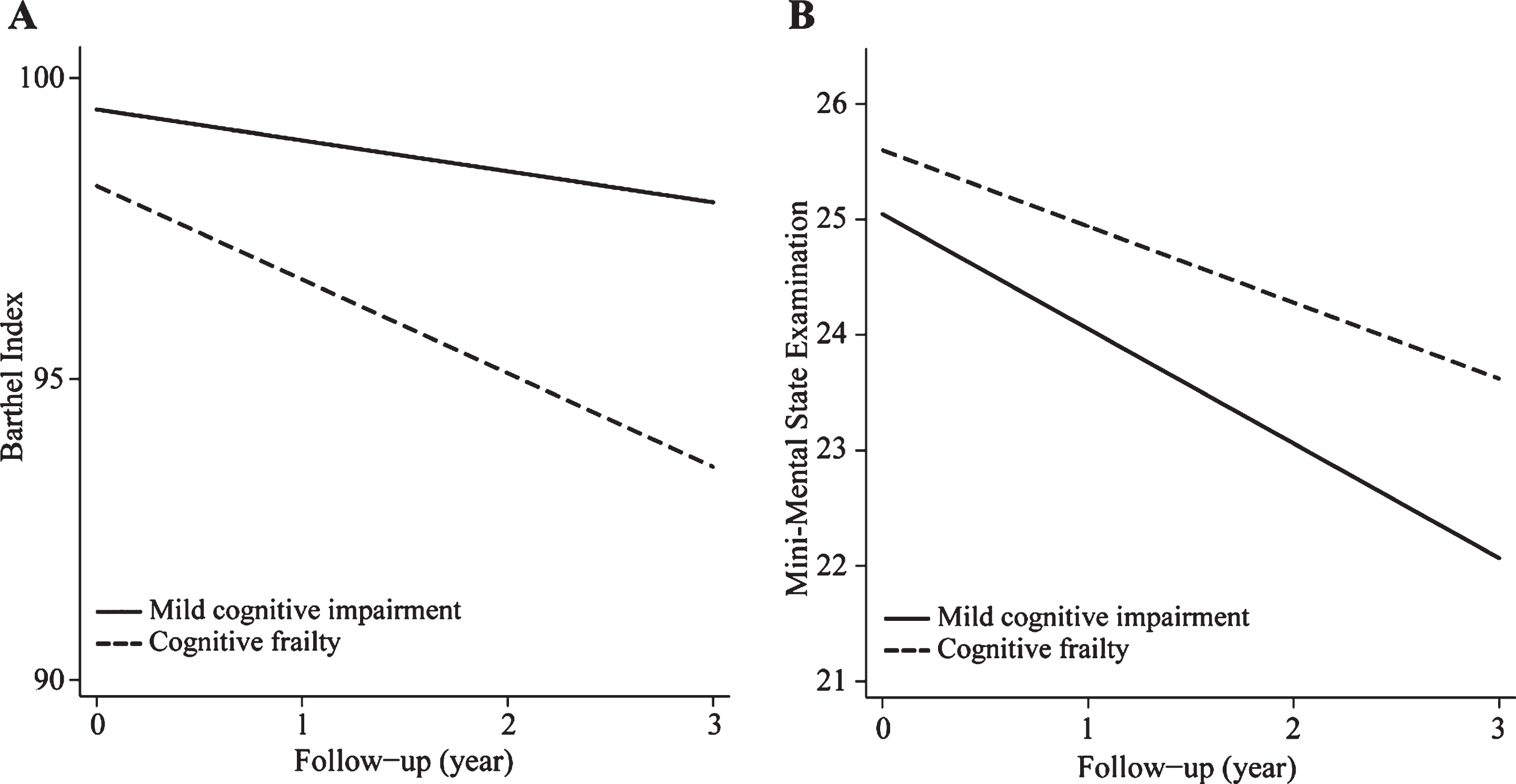
Decline in activities of daily living (A) and cognitive function (B) according to cognitive frailty status.
Cognitive frail patients did not show a faster cognitive decline (cognitive frailty×time: Est = 0.33, SE = 0.21; p = 0.113) compared to patients without cognitive frailty (Table 2, Fig. 1B). APOE ɛ4 carriers showed a faster cognitive decline (APOE ɛ4 carriers×time: Est = –0.63; SE, 0.20; p = 0.001) (Table 2). This result remained unchanged in sensitive analyses adjusted for baseline Barthel Index and MMSE scores as well as for their time interaction (cognitive frailty×time: Est = 0.31, SE = 0.21; p = 0.141).
Incident dementia
During the follow-up, 82 patients (33.1%) progressed to dementia (160.3/1000 person-years). Of these, 78 progressed to AD (probable AD, n = 43; possible AD, n = 35), two each to DLB and FTD. Of the 173 MCI patients without frailty, a total of 62 (35.8%) patients progressed to dementia with an incident rate of 173.6/1000 person-years. Of the 75 patients with cognitive frailty, a total of 20 (26.7%) patients progressed to dementia with an incident rate of 129.5/1000 person-years. Table 3 shows the results of the unadjusted and adjusted Cox proportional hazards regression models. In the unadjusted and fully adjusted models, cognitive frail subjects did not show an increased risk of incident dementia, compared to subjects without cognitive frailty. The fully adjusted model demonstrated that having a lower MMSE score (HR, 0.88; 95% CI, 0.79–0.97), having a higher DBD score (HR, 1.03; 95% CI, 1.00–1.06; p = 0.027), and being an APOE ɛ4 carrier (HR = 1.72; 95% CI = 1.09–2.71; p = 0.019) were associated with increased risk of incident dementia.
Unadjusted and adjusted hazard ratios and 95% confidence intervals for developing dementia according to cognitive frailty status among 248 patients with MCI
APOE ɛ4, apolipoprotein E ɛ4 allele; BMI, body mass index; CI, confidence interval; DBD, Dementia Behavior Disturbance scale; GDS, Geriatric Depression Scale; HR, hazard ratio; MCI, mild cognitive impairment; MMSE, Mini-Mental State Examination.
DISCUSSION
The present study investigated the impact of cognitive frailty defined by the “accumulation of deficits” approach on clinical progression among the memory clinic patients with MCI. We found that the cognitive frail subjects showed a significantly faster decline in ADL compared to MCI patients without frailty. However, cognitive frailty did not have an additional impact on cognitive decline and incident dementia.
Unexpected findings of this study are that cognitive frailty did not impact on cognitive decline and incident dementia, although patients with cognitive frailty were more likely to be older, female, and less educated and have a higher DBD score than those without, and all these factors have been reported to be associated with a greater risk for dementia [30]. To date, there has been only one study examined impact of frailty defined by the “accumulation of deficits” approach on cognitive outcomes among patients with MCI in clinical-based study. In a 5-Year Observational Study that focused on 91 patients with amnestic MCI, a higher FI was associated with a higher risk of conversion to AD [31]. Their results were different from our findings. The reason for this inconsistency is not clear, however, this might be due to the difference in characteristics of subjects, because this study focused on highly selected amnestic MCI patients and there were no patients represented as frailty (mean FI score = 0.10, standard deviation = 0.05). Moreover, all MCI subjects converted to dementia were diagnosed as having “probable” AD, which means that study participants of this study are more likely to have typical AD pathology.
In this context, a possible explanation for our unexpected findings may be accounted for by the pathological features underlying cognitive decline. In our study, almost all patients progressed to dementia were clinically diagnosed with AD. However, of the 78 patients progressed to AD during follow-up, 35 (44.9%) were diagnosed as having “possible AD”, which is considered when there is an AD-atypical course or evidence of a mixed etiology (concomitant cerebrovascular disease, features of DLB, other neurological disease or a non-neurological comorbidity or use of medication that can have a substantial effect on cognition) [24]. In this situation, it is noteworthy that the subjects with cognitive frailty accounted for a lower proportion of APOE ɛ4 carriers than MCI patients without frailty (26.7% versus 44.5%, p = 0.008), suggesting the existence of other factors as well as AD pathologies that can lead to cognitive decline and dementia. Moreover, cognitive frail patients showed lower performance in serial sevens but higher performance in delayed memory than MCI patients without frailty, although the MMSE total score was not different. Performance in working memory and delayed memory were reported to be more impaired among ischemic vascular dementia and AD, respectively [32]. Indeed, our previous study focusing on memory clinic population showed that cognitive frail subjects had higher volume of white matter hyper intensities compared to those without cognitive frailty [33]. Based on the results of these previous studies, our MCI patients with frailty seem to have heterogeneous conditions involving non-neurodegenerative disease and AD, and these pathological features may affect the cognitive trajectories of patients with cognitive frailty. However, there is still lacking of studies examining the impact and underlying mechanism of cognitive frailty among memory clinic populations.
The current study showed that there was a significant association between cognitive frailty defined by the “accumulation of deficits” approach and faster ADL decline. To date, several cross-sectional and longitudinal population-based studies have demonstrated a significant association of frailty or cognitive frailty with disability [34–37]. Our results are consistent with these previous studies and thus extend the notion that cognitive frailty increases the risk of dependence in older adultswith cognitive impairment. A look at the breakdown of the ADL declines showed that cognitive frail patients had frequently experienced ADL declines in several dimensions, including self-care capabilities and lower extremity function, except for bowel and bladder control. Our previous study found that impairment of bladder control including urinary incontinence was frequently seen from early stages of dementia [38] and that cognitive impairment, particularly frontal lobe-related dysfunction, was associated with occurrence of urinary incontinence over 1-year follow-up [39]. Together with these observations, our results suggest that impairment of bowel and bladder control may be caused not so much by frailty but by cognitive dysfunction. Given that the goal of treatment and care of dementia is to help affected individuals to live independently [40], our findings highlight the need for a comprehensive assessment including frailty to prevent dependency in older adults with cognitive decline.
This present study has several limitations. First, our study lacked the information about the losses to follow-up, including death, voluntary dropout, and change of address, that may have biased our findings. Second, our study lacked objective physical measures, such as muscle strength and gait performance, which are closely associated with cognition [10] as components of frailty and as outcome variables, for lack of space and/or time required to assess these measures and manage associated risks. Third, the sample size was relatively small and the results may not be readily generalized to other populations due to the focus on outpatients who presented to the Memory Clinic. Finally, no biomarker information was made available for Aβ pathology or other pathologies that ensured a reliable diagnosis of dementia.
In conclusion, while cognitive frailty as defined by the “accumulation of deficits” approach was significantly associated with a faster decline in ADL, cognitive frailty did not impact on cognitive decline and incident dementia among MCI patients. Our study highlights the notion that cognitive frailty as defined by the “accumulation of deficits approach” increases the risk of dependence and that cognitive frailty may have heterogeneous pathologies. Further intervention studies are required to establish a successful preventive measure against dependency in older adults with cognitive impairment.
Footnotes
ACKNOWLEDGMENTS
The authors thank the Bio Bank at National Center for Geriatrics and Gerontology for quality control of the clinical data.
This work was supported by funds from Research and Development Grants for Longevity Science (grant number 17dk0207027h0002) from the Japan Agency for Medical Research and Development; the Research Funding of Longevity Sciences (grant number 30-1) from the National Center for Geriatrics and Gerontology; and a Grant-in-Aid for JSPS Research Fellows (grant number 17J03037) from the Japan Society for the Promotion of Science. The funders had no role in study design, methods, data collections, analysis, and preparation of paper.
