






Abstract
Background:
C9orf72 hexanucleotide GGGGCC (G4C2) large repeat expansions within the first intron of the gene are a major cause of familial frontotemporal dementia, but also of apparently sporadic cases. Alleles with > 30 repeats are often considered pathogenic, but the repeat length threshold is still undefined. It is also unclear if C9orf72 intermediate alleles (9–30 repeats) have clinically significant effects.
Objectives:
We correlated the presence of C9orf72 intermediate alleles with clinical diagnoses in a perspective cohort referred to a secondary memory clinic.
Methods:
All samples were genotyped with AmplideXPCR/CE C9ORF72 Kit (Asuragen, Inc), an optimized C9orf72 PCR amplification reagent.
Results:
We showed that in patients with Alzheimer’s disease (AD) the frequency of the intermediate repeat alleles was significantly increased versus controls (34/54, 63%AD versus 16/39, 41%CTRLs, *p = 0.01, OR 2.91 CI 95%1.230–6.077), whereas no significant differences (p > 0.05) were observed when comparing all other dementias with non-demented individuals.
Conclusion:
Our findings suggest that C9orf72 intermediate repeat units may represent a genetic risk factor, contributing to the occurrence of AD. Nevertheless, further longitudinal studies, including larger cohort of subjects with intermediate alleles with long-term follow-up, would be needed to confirm these results.
INTRODUCTION
C9orf72 hexanucleotide GGGGCC (G4C2) large repeat expansions within the first intron of the gene are a major cause of autosomal dominant frontotemporal dementia (FTD) and amyotrophic lateral sclerosis (ALS), but also of apparently sporadic cases [1, 2]. A repeat length of > 30 units is defined as pathogenic in accordance with one of the original studies about C9orf72 expansions [1]. Healthy individuals have 2–30 repeat units on both alleles, commonly 2, 5, and 8 units [3]. Nevertheless, it is important to underline that an exact cut-off to distinguish normal and pathogenic expansions has not been determined with certainty, also due to the technical limitations of the repeat-primed PCR (RP-PCR) technique. As with expansion, the threshold for intermediate length repeats also varies in studies, but allele length > 7 has been shown to associate with the C9orf72 founder haplotype in the European population [4]. Intermediate repeat alleles (7–30 or 20–30 repeats) have been hypothesized to predispose to neurodegeneration by decreasing C9orf72 promoter activity as compared with short repeat alleles [5]. A recent review [6] showed that most studies did not find association between intermediate length alleles and a variety of neurodegenerative diseases, though expansions > 20 repeats units have been described in some FTD and ALS cases [7–9]. Moreover, intermediate expansions (> 8 but < 30) are much less frequent in healthy subjects [10] but also somatic instability and intergenerational changes have been observed occurring from a repeat number > 10 units [11, 12]. To date, there are no data available from clinical studies, specifically designed to evaluate the role of C9orf72 intermediate expansions as risk factor for neurodegenerative diseases in the Italian population.
As already mentioned, the molecular characterization of the hexanucleotide repeat can be challenging, as the large size and high GC content of pathogenic C9orf72 expansions hamper polymerization during PCR and limit the utility of conventional PCR-based fragment sizing methods. Recently, a novel more performing two-mode, multiplexed PCR chemistry for the genotyping of the C9orf72 repeats has been developed. This assay balances co-amplification of gene specific (GS) and RP-PCR products tailored for capillary electrophoresis (CE)-based, accurate sizing of C9orf72 repeats from genomic DNA samples [13]. In light of the above, we analyzed C9orf72 intermediate alleles in a consecutive cohort of subjects referred to a secondary memory clinic, undergoing clinical and instrumental workup in suspicion of neurodegenerative dementias, and negative for the C9orf72 expansion (> 30 repeats). Genetic profiles were correlated with clinical diagnoses.
METHODS
Patients
The population consisted of 209 subjects (107 males and 102 females, mean age at disease onset ±standard deviation: 66.5±8.4 years, range: 52–80), who were admitted to the Alzheimer Center of the University of Milan, Fondazione IRCCS Ca’ Granda, Ospedale Policlinico, between January 2017 and December 2019 in suspicion of neurodegenerative dementias. The clinical workup included detailed past medical history, general and neurological examination, routine blood tests, formal neurocognitive assessment [14] brain computed tomography (CT) scan or magnetic resonance imaging (MRI), and, when indicated, [18F]-fludeoxyglucose positron emission tomography, and lumbar puncture (LP) for cerebrospinal fluid (CSF) biomarkers amyloid-β (Aβ), total tau (tau), and tau phosphorylated at position 181 (pTau) determination. Normality references considered were: Aβ≥600 pg/mL; tau≤500 pg/mL for individuals older than 70 years and≤450 pg/mL for individuals aged between 50 and 70 years; Ptau ≤61 pg/mL [15]. The presence of mutations causing common and rare dementias was excluded in patients with a very early onset (< 60 years) or a remarkable positive family history (three cases over two generations or more) by next-generation sequencing [16].
When primary psychiatric disorders (PPD) at onset were evident or suspected, patients were referred to the Psychiatric Unit of the same Institution for clinical interview and characterization by the administration of semi-structured interviews based on DSM-IV criteria (Structured Clinical Interview for DSM-IV Axis I Disorders and Structured Clinical Interview for DSM-IV Axis II Disorders) The diagnosis of AD and FTD were done according to current criteria [17]. Sixteen patients were diagnosed with different neurodegenerative disorders (other dementias): dementia with Lewy bodies (n = 7) [18], vascular dementia (n = 9) (NINDS criteria). Lastly PPD were diagnosed according to Ducharme et al. (2020) [19].
As control group (CTRLs), we considered individuals diagnosed with subjective memory complaints or non-AD mild cognitive impairment patients (non-AD-MCI), who were not cognitively impaired at testing (MMSE≥28) and did not have alterations at instrumental analyses (CSF biomarkers, imaging). These subjects did not develop dementia over a 1–3 year follow up.
The study was approved by the local ethics committee (Parere 532_2019bis del 13-6-2019 - Comitato Etico Milano Area 2).
Genetic analysis
All samples were genotyped with AmplideXPCR/CE C9ORF72 Kit (Asuragen, Inc), an optimized C9orf72 PCR amplification reagent. The genomic DNA was amplified using a three-primer G4C2-Repeat Primed (RP)-PCR configuration, followed by fragment sizing on a 3100 Genetic Analyzer (Thermo Fisher). ROX 1000 was used for sizing by capillary electrophoresis and the size of the PCR products were converted to the number of G4C2 repeats using size and mobility conversion factor with GeneMapper v 4.1 software (Thermo Fisher).
A cut-off of≥9 repeat units was chosen to distinguish short (2–8) from intermediate (9––30) C9orf72 hexanucleotide expansions, based on the following criteria: 1) Most healthy individuals harbor 2–8 repeats [20]; 2) Decreased transcriptional activity with increasing number of repeats (7–24) has been observed in healthy subjects [5]; and 3) Somatic instability has been shown occurring from > 10 repeats [3, 21].
Statistical analysis
Categorical variables were reported as proportion and/or percentage, continues variable as mean (SD) values. Fisher’s exact test for categorical variables were applied as appropriate. Continuous variables (i.e., age at symptom onset) were compared with t test. For statistical analysis GraphPad 9.0 was used.
RESULTS
For this study, 209 unrelated subjects, referred to the Alzheimer Center of the University of Milan, Fondazione IRCCS Ca’ Granda, Ospedale Policlinico between January 2017 and December 2019, were included. They were all genotyped for C9orf72 G4C2 during the clinical and diagnostic evaluation. G4C2 C9orf72 large pathogenic expansions (>145 repeats) were detected in 13 (6%) patients diagnosed with FTD, who were excluded from subsequent analysis.
The demographic data of patients are described in Table 1.
Demographic data of patients included in the study
*Available in 24 subjects.
The remaining 196 subjects presented C9orf72 G4C2 repeats, classified in short (2–8 repeats), i.e., normal. and intermediate (9–30 repeat units). The most frequent repeat units in our cohort were 2, 7/8 and 10 repeats at least in one allele (Fig. 1a). 38%of patients carried an intermediate allele as compared with 8%in controls. Considering patients with AD, the frequency of the intermediate repeat alleles was significantly increased versus controls (34/54, 63%AD versus 16/39, 41%CTRLs, *p = 0.01, OR 2.91 CI 95%1.230–6.077), whereas no significant differences (p > 0.05) were observed when comparing all other groups with controls (Fig. 1b; Table 2). Stratifying according to gender and ApoE status, no significant association was observed (p > 0.05). Regardless of diagnosis, the presence of at least one intermediate allele does not seem to affect the age at onset in patients (short repeat units 67 years versus intermediate repeat units 66 years, p > 0.05).
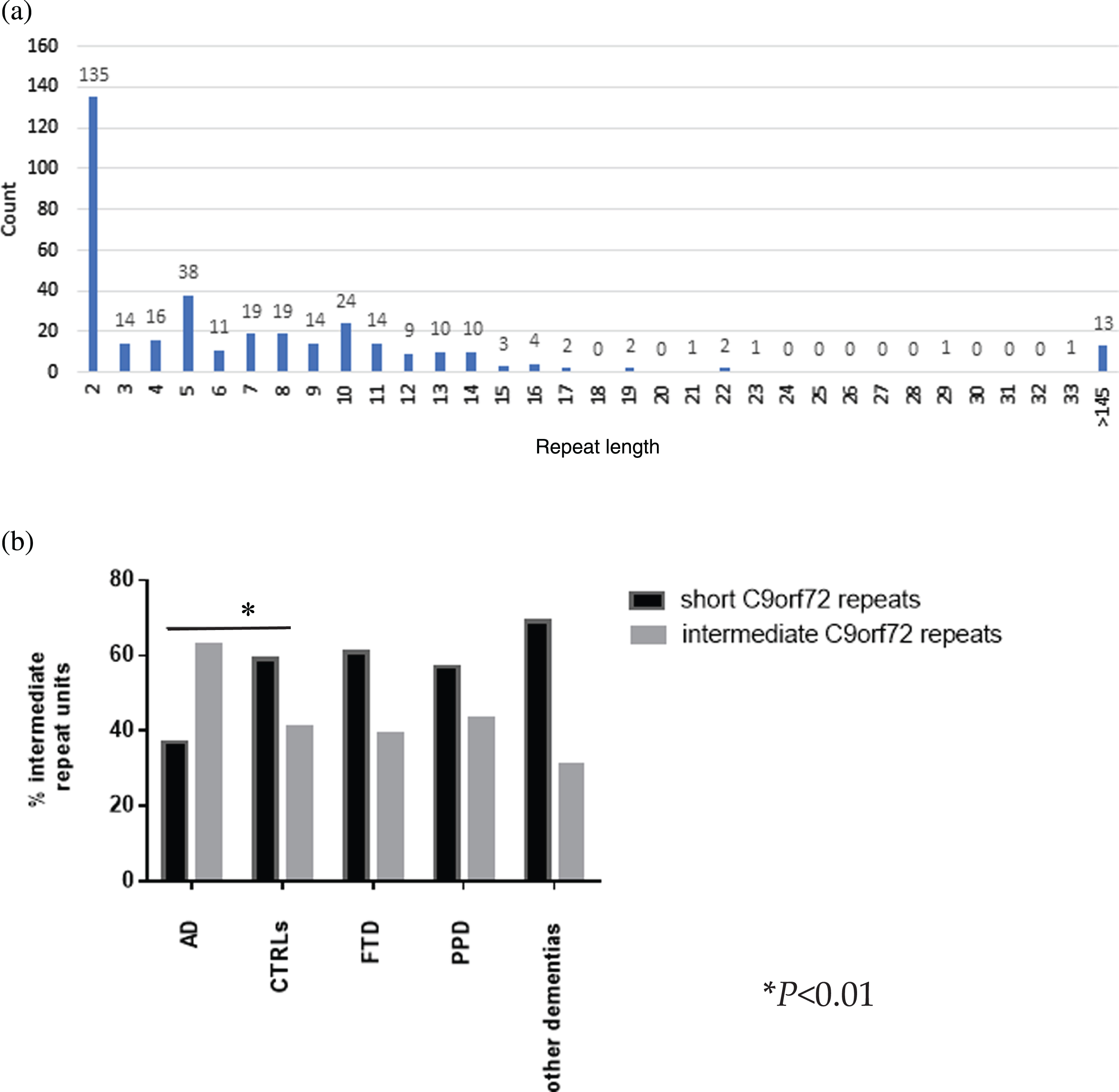
a) Repeat length distribution of all alleles in our dataset. > 145 denotes expansion. b) Frequency (%)(Y-axis) of intermediate repeat units in patients as compared with controls. For AD patients, statistically significant association between intermediate and short C9orf72 repeats carriers as compared with controls was reported (Fisher’s exact test *p = 0.01, OR 2.79 CI 95%1.286–6.077).
Comparison of frequency of intermediate C9orf72 repeats between groups
Positive family history for dementia or psychiatric disturbances was observed in thirty-one patients, representing the 35%of intermediate C9orf72 repeat carriers, whereas in non-carriers a positive family history was reported in 29%(p > 0.05, data not shown).
Considering, exclusively, the presence of psychiatric symptoms in the family, a trend towards an increase of frequency in intermediate repeat carriers was observed (16/20 44%intermediate versus 9/31 22%short carriers, p = 0.05).
Intermediate repeats were present on both alleles in nine subjects (AD n = 3; FTD n = 2; PPD n = 2; other dementias n = 1; CTRLs n = 1). Despite the presence of heterogeneous diagnoses, all of them presented positive family history for dementia and/or psychiatry disorders.
DISCUSSION
In this study, we observed that the frequency of C9orf72 intermediate alleles is increased in patients with AD, suggesting they could act as risk factors for the development of the disease. No association was instead found with sporadic FTD and PPD. Nevertheless, regarding FTD, patients with large expansions of one allele have been excluded without considering the length of the second allele. In addition, it is known the C9orf72 expansion is associated with a wide spectrum of clinical presentations and the penetrance is incomplete. Therefore, it is still a matter of debate whether the mutation is pathogenic or may act as a strong risk factor which, in combination with other unknown environmental and genetic factors, may or may not reach the threshold for the appearance of symptoms. Given the comments above, apparently negative data shown here should be considered cautiously and validated in the future.
Concerning PPD patients, we did not find any association with intermediate expansions, in contrast to other findings showing that intermediate repeat length alleles appear to associate more frequently with neuropsychiatric phenotype [6]. It is worth noticing, however, that a trend was observed also in our cohort of patients; in fact, 43%of PPD were carriers of an intermediate length allele. Moreover, independent of the clinical diagnosis, the presence of psychotic symptoms and/or positive family history for psychiatric illness were identified in thirty-one patients (35%) presenting the intermediate C9orf72 allele. In addition, all the nine patients harboring intermediate expansions on both alleles presented a positive family history for psychiatry disorders, leaving open the question whether intermediate alleles may play a role in the development of psychiatric symptoms, possibly in a dose-related fashion. A further consideration is that the definition of PPD encompass a broad spectrum of disturbances, ranging from depression to psychotic manifestations, thus we cannot exclude a specific associated syndrome.
When dealing with the C9orf72 expansion, an important limitation likely responsible for contrasting findings reported in the literature is merely methodological. The “critical” repeat size required for initiation of neurodegeneration as well as the effective role of C9orf72 intermediate alleles in neurodegenerative diseases remain unknown probably due to the lack of standardized C9orf72 genotyping method, mandatory for comparing, among Centers, allele size accurately. The methodology herein used could be easily approached for the harmonization of a shared protocol among laboratories, as it is based on the use of commercially available kits already proven to detect C9orf72 G4C2 expansions [13].
In conclusion, our findings suggest that C9orf72 intermediate repeat units may represent a genetic risk factor, contributing to the occurrence of AD. However, the implications of an intermediate number of repeats are still debated. Up to now, in literature no association between intermediate C9orf72 alleles size and higher disease risk for AD was reported.
We acknowledge, however, that 1) apparently negative data shown here in FTD and PPD need to be replicated, particularly those in PPD, in which the small sample size may contribute to the lack of statistical significance; and 2) follow up of controls should be longer, to exclude the development of cognitive impairment. Therefore, a further longitudinal study, including larger cohort of subjects with intermediate alleles with long-term follow-up would be needed, in order to unravel potentially new clues concerning the role of C9orf72 alleles in neurodegenerative diseases, especially in AD.
