






Abstract
Background:
Memory complaints are frequent among young adults presenting in general practice. Many of them will have reversable, functional cognitive impairment that can easily be mistaken for dementia. Its accurate and timely identification is warranted to prevent further escalation to overt dementia syndrome.
Objective:
To evaluate the recommended primary care screening cognitive tools for dementia for use in younger people.
Methods:
2.5 years clinical data were collected during the course of ongoing patient care for all assessed face-to-face patients in a secondary care memory service for younger adults. Cognitive screening and assessment tests used in primary [General Practice Assessment of Cognition (GPCOG)] and secondary [Addenbrooke’s Cognitive Examination-III (ACE-III), Rowland Universal Dementia Assessment Scale (RUDAS), Salzburg Dementia Test Prediction (SDTP)] care were analyzed for their accuracy to identify dementia and memory complaints. Area under the curve in receiver operating characteristic curves was used to measure predictive value of tests for a clinical diagnosis of dementia.
Results:
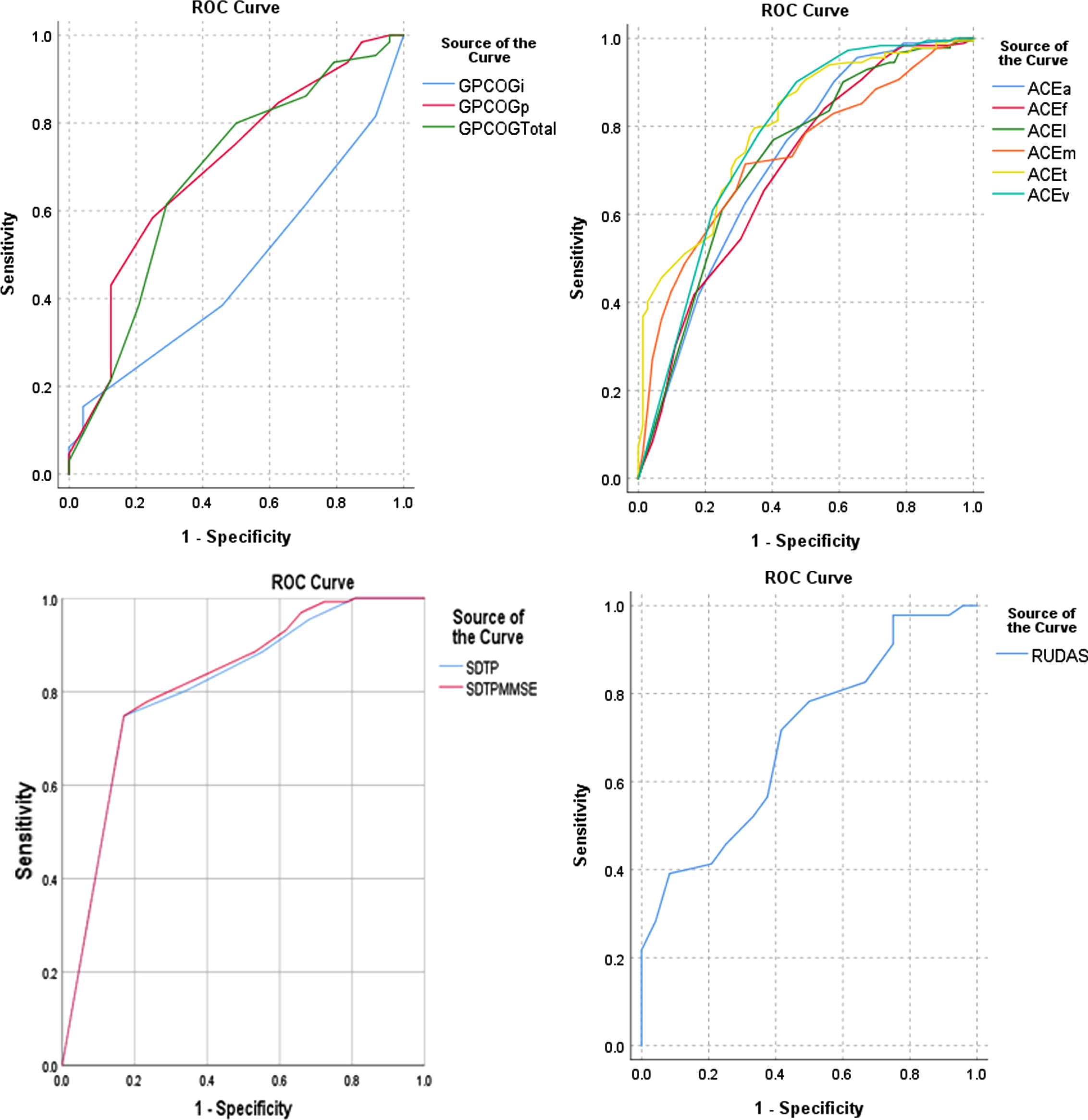
348 young adults were assessed for cognitive impairment. Following comprehensive Memory Clinic assessments, 241 (69.25%) were diagnosed with memory complaints in the absence of relevant neuropathology and 107 with dementia. GPCOG, especially the informant part, and RUDAS had low accuracy to identify dementia (AUC = 0.465 and AUC = 0.698, respectively). In contrast, ACE-III and SDTP demonstrated the highest accuracy (AUC = 0.799 and AUC = 0.809/0.817, respectively).
Conclusion:
Dementia screening in younger people will benefit from SDTP incorporated as part of the screening cognitive toolset. The national guidance on dementia screening tools, diagnostic pathways, and management should also refer to younger adults.
Keywords
INTRODUCTION
Aging well, frailty, and dementia are major priority areas of core competency needed by both health and social care staff to identify and support the mental health needs of (older) people [1]. Effective and efficient screening tools are, thus, required to aid the diagnoses of mental health conditions so that the right and timely treatment be provided as early as possible. This is especially important for adults with suspected early onset dementia.
An early diagnosis of dementia facilitates access to right health services and support and helps people take control of their condition, plan for the future, and live well with dementia. It also eliminates the possibility of other potentially treatable conditions with dementia-like symptoms be overlooked and untreated. With the increasing focus on identifying modifiable dementia risk factors [2], early dementia screening in younger adults should be an essential part of the primary prevention. This will both reduce the risk of dementia development put in place early intervention to, potentially, slow its progression.
Currently several validated cognitive instruments are recommended for initial assessment in non-specialist setting, i.e., 10-point cognitive screener, 6-item cognitive impairment test, Memory Impairment Screen, Mini-Cog, and Test Your Memory [3]. It is recommended these initial assessments be supplemented with a structured instrument such as the Informant Questionnaire on Cognitive Decline in the Elderly (IQCODE) or the Functional Activities Questionnaire [3]. However, these instruments have been all recommended as generic cognitive screening tools, not considering their utility for younger people. The most widely used short screening tool for dementia, the General Practice Assessment of Cognition (GPCOG) [4], appears to be biased in relation to age, with lower GPCOG patient score associated with older age [5]. However, these two studies included only a minor portion young people (11.3%; 50–74 years) [5] and excluded people with functional cognitive impairment [4].
Since the number of people living with early onset dementia in the UK has substantially over exceeded the projected increase of 15% (in 2007) [6] by 4- to 20-fold in 2014 and 2021 [7], respectively, there is a growing need to address the clinical usefulness of the currently recommended screening instruments for use in younger adults. A preferred way of assessing the validity of any clinical diagnosis psychometric assessment is to test the accuracy of the measure onto a ‘gold standard’, which in this instance would be expert clinical diagnosis [8, 9]. We, therefore, report on the recommended dementia cognitive screening tools [3] and their accuracy in relation to young adults vis-á-vis their (dementia) clinical diagnosis obtained following comprehensive clinical assessments (based on clinical and physical examination, augmented with validated neuropsychological tests and neuroradiological investigations) in a secondary memory clinic health caresetting.
METHODS
Description of setting and data collection
Over 2.5 years period (September 1, 2018-February 28, 2021) out of > 1,200 referrals of community-dwelling young adults to secondary care memory service for younger people, 348 [176 men and 172 women (50.58% versus 49.42%)] were offered comprehensive cognitive assessments and they were all included in the study (Fig. 1). Although majority of referrals came from primary care, a minor portion (n = 41, 11.78%) were referred by secondary healthcare (28 from Adult Mental Health Services, 8 from neurology, and 5 from other medical specialties, i.e., one patient each from pain clinic, oncology, obstetrics and gynecology, respiratory medicine, and urology). All were assessed face-to-face in the outpatient Memory clinic, diagnosed by consultant psychiatrists (EBM-L and MC), and included in the study, irrespectively of their educational background, English proficiency, or being untestable.
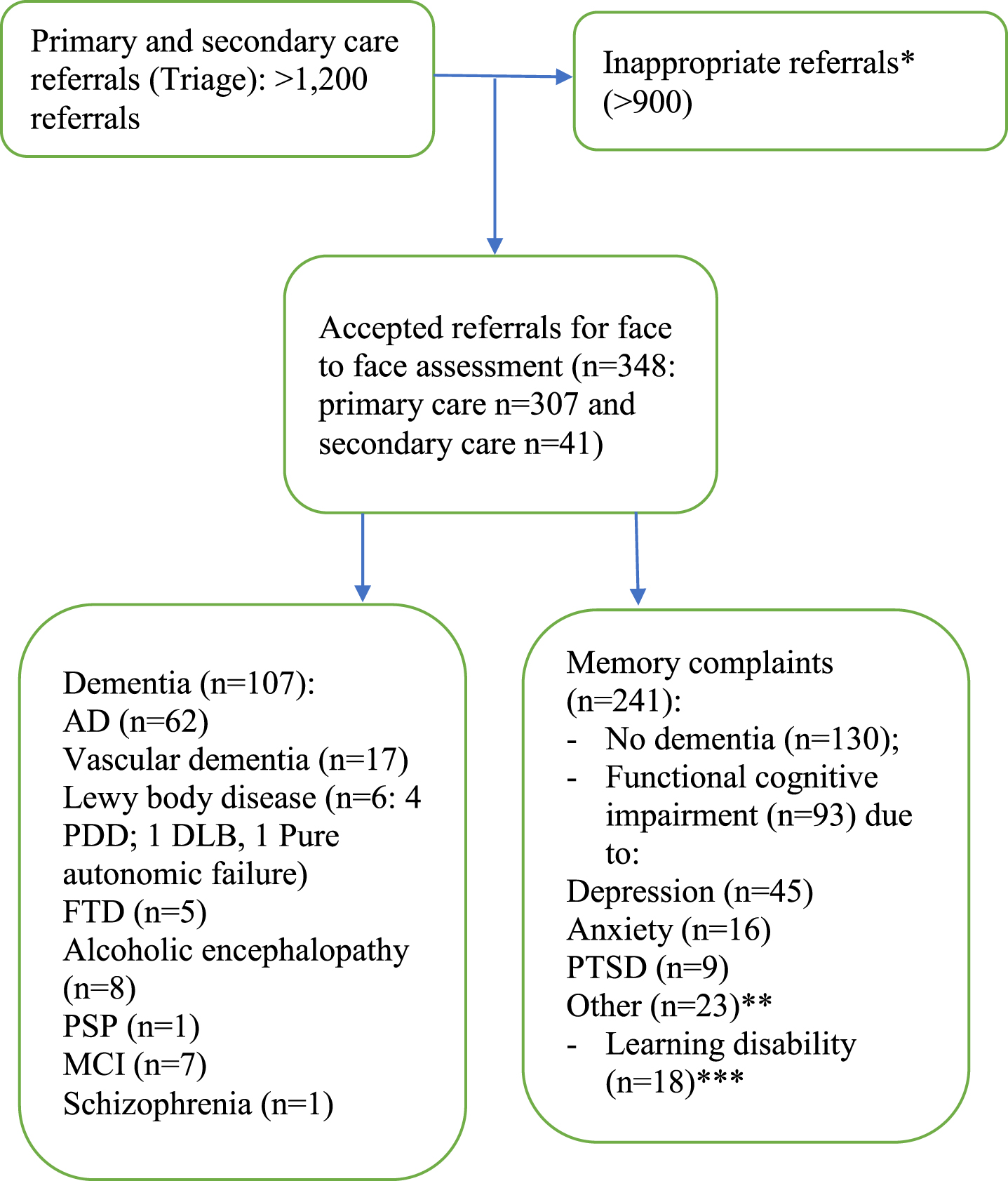
Flow chart of referrals to the early onset memory clinic. All patients who were offered an appointment with the Service were included in the study. The referrals’ inappropriateness was determined vis-á-vis the criteria in ‘Diagnosing dementia in younger people. A decision-making guide’, endorsed by the Royal College of General Practitioners [10]. Three patients had already a diagnosis of dementia prior to the referral to the Service: one patient each with FTD, PDD, and pure autonomic failure. *Only 3 patients were re-referred during the study duration, with subjective cognitive problems: two were offered an assessment, obtaining a diagnosis of functional cognitive impairment (depression and learning disability with OCD***). **The ‘Other’ functional cognitive impairment included: ADHD (n = 2), ASD (n = 2), adjustment disorder (n = 3), anticholinergic drug burden (n = 4), OCD (n = 3), andropause (n = 2), perimenopause (n = 2) besides long standing pain (n = 8, including 6 people with fibromyalgia), personality traits (n = 3), uneventful brain injury/trauma (n = 3), and one patient with ataxia of unknown origin. Please note that 9 patients had dual diagnosis, i.e., depression and anxiety (n = 5), pain and depression (n = 3). In addition, there was one patient with learning disability and OCD (n = 1; ***). AD, Alzheimer’s disease; ADHD, attention deficit hyperactivity disorder; ASD, autism spectrum disorder; DLB, dementia with Lewy bodies; FTD, frontotemporal dementia; MCI, mild cognitive impairment; OCD, obsessive compulsive disorder; PDD, Parkinson’s disease dementia; PSP, progressive supranuclear palsy; PTSD, posttraumatic stress disorder
A total of 254 patients (72.99%) were offered a neuroradiological assessment, with 242 (69.54%) completing: majority had magnetic resonance imaging (MRI) (n = 126) and fluorodeoxyglucose (FDG)-positron emission tomography (PET) (n = 114) brain scans, 6 had dopamine transporter (DAT) imaging, and 18 computerized tomography (CT) brain scans (total n = 264; please note that 22 of them had dual neuroradiological assessments: 2 FDG-PET and DAT, one MRI and DAT, and the rest 19 patients FDG-PET and MRI brain scans). The other 106 patients did not have neuroradiological examination due to refusing at the time of the consultation or being uncooperative during the neuroradiological investigation (n = 12), 3 patients had neuroradiological investigations completed prior the referral within the past 6–12 months by other clinical services and had a diagnosis of Parkinson’s disease dementia, frontotemporal dementia, and pure autonomic dysfunction, whereas in two patients neuroimaging was not recommended due to a surgical intervention secondary to brain injury and serious physical illness. For the rest 89 patients (25.58%) clinical and cognitive assessments indicated that dementia was an unlikely diagnosis.
Where required, patients’ hearing and visual abilities were optimized. Screening cognitive tools [4 , 12] used when referring to secondary care memory clinical service, basic demographic characteristic (i.e., age, gender, ethnicity, and educational \nobreak background) and measures from cognitive tests performed in the Memory Clinic [13 –20] were collected from the NHS Trust electronic patient records (Tables 1 and 2).
Screening cognitive tools used by primary and secondary care referrers and Memory Clinic cognitive assessments
Nearly one third of referrals [n = 104 (29.89% of all service users referred to the young onset dementia service: n = 31 from secondary care and n = 73 from primary care] did not have enclosed any documented cognitive screening tools. 2 patients had a previous diagnosis of dementia (Parkinson’s disease dementia and frontotemporal dementia, referred from neurology and primary care, respectively) and have moved into the area prior being referred to the Service. Only 6 secondary care referrals had cognitive assessments (5 referred from Adult Mental Health Teams and 1 from neurology). Once referred to secondary care, additional cognitive tools were used. Only two patients were untastable and also lacked collateral information. For ACE-III assessments, each (except for one service user) individual part of the scores were recorded, including attention, memory, fluency, language, and visuospatial. The RUDAS scale was used for service users who were not able to complete the ACE-III (n = 70), mainly those who had lower educational background: 11 people were illiterate, 16 could not read or write despite having some schooling, 3 had dyslexia, 16 did not speak English or had physical problems or increased anxiety that prevented them from completing the ACE-III (n = 24). *MoCA-b; **No cognitive assessments done due to patients not communicating and/or not known to carers/informants. ACE-III, Addenbrooke’s Cognitive Examination-III; AMTS, Abbreviated Mental Test Score; CDR, Clinical Dementia Rating Scale; 6CIT, 6-item Cognitive Impairment Test; FTD, frontotemporal dementia; GPCOG, General Practitioner Assessment of Cognition: t- total score, p- patient section, i- informant questionnaire; IQCODE, Informant Questionnaire on Cognitive Decline in the Elderly; MMSE, Mini-Mental State Exam; Mini-ACE, Mini-Addenbrooke’s Cognitive Examination; MoCA, Montreal Cognitive Assessment; MoCA-b, Montreal Cognitive Assessment-Basic; PDD, Parkinson’s disease dementia; RUDAS, Rowland Universal Dementia Assessment Scale; SDTP, Salzburg Dementia Test Prediction; ND, not done.
Participants’ characteristics. The statistical analysis refers to the dementia and control groups
The control group refer to the group with memory complaints. *Please note that there was only one participant who was 66 years old at the time of the assessment but was referred and offered an assessment when 65 years old. f, female; m, male; WB, white British; EM, ethnic minority; SDTP_MMSE, SDTP score transposed in MMSE score. Other abbreviations as in Table 1. *Chi square analysis.
The study had institutional Leicesterhire Partnership National Health Service (LPT) NHS Trust wide Quality Improvement Knowledge Hub Core Team approval.
Instruments used to measure outcomes
Several instruments to measure the cognitive outcomes were used (Tables 1 and 2), including the GPCOG on referral (total /15, patient /9 and informant /6 scores) [4] and cognitive tests performed in the Memory Clinic: Addenbrooke’s Cognitive Examination-III (ACE-III; total ACE-III score /100, and individual subscales: attention /18, memory /26, fluency /14, language /26 and visuospatial /16) [13], The Rowland Universal Dementia Assessment Scale (RUDAS) [16], and Salzburg Dementia Test Prediction (SDTP, /7) [19].
Participants’ characteristics
Mean age of the assessed 348 patients was 58.47 (38–66 years) and comprised of 220 white British (63.22%) and 128 from ethnic minority groups (36.78%): 106 South Asians (including Indians, Bengali, Gujerati, Punjabi, and Pakistani), 8 Black African, Caribbean, or Black British, and 14 from any other white background).
Following Memory Clinic assessments, 241 (69.25%) patients were diagnosed with memory complaints in the absence of relevant neuropathology (MC), whereas 107 obtained the diagnosis of dementia (Fig. 1). In the 241 MC patients, 93 (38.59%) had functional cognitive impairment due to mental and physical health problems and 18 (7.47%) had newly diagnosed learning disability. Patients with MC and dementia had similar age at referral (F = 1.290, p = 0.278) and duration of cognitive complaints (F = 0.0.67, p = 0.977), irrespective of their ethnic background (F = 0.580, p = 0.447) or gender (F = 0.005, p = 0.942). However, adults with dementia clinical diagnosis appeared to be 1.7 years older on average than the cognitively intact (58.00 + 0.38 vs. 59.66 + 0.44 years; F = 6.659, p = 0.010).
Statistical analysis
A database in Excel was created and stored on the LPT NHS Server. Statistical analysis was carried out with SPSS v.26 including standard descriptive statistics [e.g., mean, standard deviation (SD) and frequency]. Area under the curve (AUC) was used in receiver operating characteristic (ROC) curves as a measure of predictive value of the test for a clinical diagnosis of dementia. The AUC can vary between 0.5 and 1— the ideal test has an AUC of 1, meaning 100% sensitivity and specificity. The accuracy was classified according to the traditional point system: 0.90–1.00 = excellent; 0.80–0.90 = good; 0.70–0.80 = fair/acceptable; 0.60–0.70 = poor; 0.50–0.60 =fail; < 0.50 = no discrimination [21], with ROC curves with an AUC < 0.75 being considered not clinically useful [22]. All data analyses were at a 5% significance level.
RESULTS
GPCOG analysis
The GPCOG was most widely used screening tool in primary care referrals (Table 1). However, GPCOG-patient and informant parts were randomly used. Thus, based on the GPCOG referral tool, the patient section with a score less than 4 warrants direct further investigation without doing an informant section, whereas a score of 5 to 8, warrants an informant section screening. Out of the 95 patients who scored 5–8 on the GPCOG, 38 (40.00%) did not have the informant part completed. From this group, only 6 patients (15.79%) obtained dementia diagnosis. In addition, out of the 76 service users who scored 4 or less on the patient GPCOG, there were 26 that had both patient and informant score. However, only 27 (35.53%) of this group of 76 people who according to the GPCOG required further investigations for dementia, obtained a dementia diagnosis. The rest obtained MC diagnosis, largely secondary to mental health problems (i.e., depression and anxiety, posttraumatic stress disorder) or use of anticholinergic medication (opioids and a mixture of opioids antidepressants and antispasmodic agents) (n = 26), with the remaining having attention deficit hyperactivity disorder, autism spectrum disorder, malingering, fibromyalgia, impaired hearing problems, and learning disability (n = 23, 46.94%).
Accuracy of cognitive tests
The ROC curve analysis indicated the GPCOG had a low accuracy to distinguish between people with dementia and those with MC (Fig. 2). Particularly, the informant part of the GPCOG had the lowest accuracy (AUC = 0.465; Table 3). RUDAS, although featured slightly better, had similarly a low accuracy (AUC = 0.698). In contrast, for ACE-III, the total score and all its subscales except for the fluency had fair/acceptable accuracy (AUC = 0.718–0.799). The only cognitive tool that had good accuracy (AUC > 0.800) was the SDTP either used alone (AUC = 0.809) or transformed as Mini-Mental State Exam (MMSE) scores [19] (AUC = 0.817).
Sensitivity and specificity, accuracy, and cut off points of cognitive tools
The control group refer to the group with memory complaints. *Three referrals contained only the GPCOG-total score, which was not down broken to informant and patient GPCOG. AUC, area under the curve; P, true positive; FP, false positive; FN, false negative; TN, true negative. Other abbreviations as in Table 1.
Cognitive assessments versus ethnical and educational background
The ACE-III (F = 1.549, p = 0.202) and SDTP (F = 0.622, p = 0.602) were not influenced by ethnical background, in contrast to the RUDAS (F =3.068, p = 0.034) and the GPCOG (GPCOG total score F = 2.243, p = 0.089; GPCOG patient section F = 2.479, p = 0.063). The RUDAS and the GPCOG differences were largely driven from the poor educational background in the South Asian patients (p = 0.002), who also had poorer English language command compared to the White British and other ethnic minority groups.
DISCUSSION
Summary
In the current study, we describe the use of validated brief structured cognitive instruments that are recommended for initial assessment in non-specialist setting, their usability in younger adults with suspected dementia, and compare them with the accuracy of cognitive tools used in specialized setting (i.e., Memory Clinic). The GPCOG was the preferred cognitive screening instrument in primary care, with the GPCOG’s patient part being most widely used (55.38%). However, the GPCOG’s validity for dementia screening in younger adults was poor, with the informant section performing the worst. Similarly, the RUDAS scale showed poor discriminatory ability to screen for dementia in younger people (AUC = 0.698) and was influenced by their educational level and ethnic background. These findings highlight the limitations of both the GPCOG and the RUDAS scale when used in young adults in primary and secondary care, respectively.
In contrast, a brief simple test based on attention items, the SDTP [19], featured substantially better and was on par with the more elaborate neuropsychological test used in specialist clinical setting, the ACE-III. The sensitivity and specificity of the SDTP matched that of the ACE-III and was comparable to that described for older people (67–85 years) [23], with its accuracy (when transformed to a MMSE score), being the highest (AUC > 0.817). The brevity of this test and its high accuracy makes it suitable to be adopted as an efficient screening cognitive tool for dementia in younger adults in primary care.
Strengths and weaknesses of the study
The strength of our study is that it is a naturalistic study conducted solely on all younger adults (38–66 years) referred to an outpatient Memory Clinic due to subjective memory complaints. They were all assessed by two senior clinicians, specialists in dementia diagnosis and management. The comprehensive secondary clinical care assessments enabled identify a clinically useful brief cognitive screening test, the SDTP, with high accuracy for dementia, that can be easily adopted in primary care when screening young adults with suspected dementia.
The study has a number of limitations largely due to the referral sampling. Due to the small number of referrals using the recommended cognitive screening tools [3], their accuracy could not be determined in our sample. Distinct forms of dementia were not separated due to the smaller numbers of the subgroups, and, similarly, the accuracy of the scales was not addressed in all distinct ethnical groups we had.
Nearly a quarter (23.78%) of primary care referrals were not accompanied with a cognitive screening tool. Frequently quoted reason was the COVID-19pandemic, suggesting that the recommended tools may create difficulties for distant screening. Additionally, the allocated time in primary care consul-tation may play a role. However, known emotional barriers to pursuing cognitive screening (i.e., anxiety associated with fear of aging [24] or diagnosis [25], lack of knowledge [26, 27] described for older people) were not constraints to seeking help in our young adults, since they all sought explanation and further investigations for their MC.
The analyzed sample here represented 30–40% of all referrals received by the young onset dementia service that, upon review by two senior clinicians, deemed to require further investigations based on the provided information. During the study period there were only 3 patients who were re-referred from those who were not offered initial face-to-face appointment: two were offered an assessment and obtained a diagnosis of functional cognitive impairment (depression and learning disability with obsessive compulsive disorder). Despite the rigorous triage process, nearly 70% of the investigated patients either did not have organic memory problems or presented with functional cognitive impairment. Although the recommendations for the cognitive screening are to be accompanied by informant [3], such information was missing in 70% of the referrals. This per se may have contributed to the nondiscriminatory value of the GPCOG informant part in our analysis and the high rate of MC we observed.
Comparison with existing literature
Our current findings complement the high accuracy of the SDTP tool to detect late-life dementia [28] and expand its usability to younger people, therefore making it ideal in screening of dementia in all age groups in primary practice. This tool does not require more than two minutes and requires no further education or training: it consists of three questions [19], i.e., to name day of the week, to name the year, and to spell a five-letter word backwards (‘WORLD’). The method to translate the raw score into the final score corresponding to a MMSE score can easily be programmed into any record keeping system. However, it requires basic literacy and may not be user-friendly for some non-English illiterate speakers. Indeed, only 41 patients from ethnic background (32.03%) completed the SDTP, and all had professional working proficiency in English or above. Since there are no major differences in items of attention subscores on the ACE-III in mild cognitive impairment patients [29, 30], the SDTP, similarly to the MMSE, may need to be used with caution in patients with suspected mild cognitive impairment.
Although the RUDAS scale was originally designed to minimize the effects of cultural and language diversity on the assessment of baseline cog-nitive performance [16], in our young adults, it was influenced by educational and ethnic background. This contrasts recent studies on low educated older people (66–92 years) conducted in secondary outpatient setting, that demonstrated the scale was educationally unbiased [31, 32], that may be due to the recruitment bias in that study [31]. This was not the case in our study, since the majority of our participants were referred from primary care and, except for a minority who came from the adult mental health services, they did not have previous contact and diagnoses with mental health services. Nonetheless, the lack of informant interview could have also contributed, since harnessing the RUDAS and IQCODE increased the diagnostic accuracy in 225 older adults [33]. Whether this is the case for younger people remains to be determined.
The findings from our study indicate that treatable mental health problems can be overlooked when presenting first in primary care and continue presenting with symptoms resembling dementia. Their timely recognition is important since it increases the risk for dementia in older age. For example, third of patients diagnosed with pseudodementia irrespective of their diagnosis (i.e., depression, bipolar disorder, conversion disorder, and psychosis) at follow-up to 18 years will develop dementia syndrome, but their early identification and treatment at a younger age has better outcomes [34]. A systematic review based on 51 studies, found that early onset depression alone increases the risk for dementia up to 3.2–3.7-fold [35].
Implications for research and practice
Memory symptoms are frequent complaints in general practice, with young adults having a heterogeneous presentation, and many having reversable, functional cognitive impairment that can be easily mistaken for dementia. Their accurate and timely identification is warranted to prevent further escalation to overt dementia syndrome. Use of brief cognitive screening tool(s), with high sensitivity and specificity in young adults should aid this. However, targeted dementia screening is offered to at-risk groups (i.e., above the age of 75 years) in accident and emergency departments and general practice [36]. Similarly, the UK national guidance [3] refer to dementia screening tools, diagnostic pathways, and management in older adults only, with no reference to younger adults.
The currently recommended screening cognitive tests for primary care [3] have not been validated for use in younger people with suspected dementia. As demonstrated in our study, these screening and diagnostic tools may differ in their accuracy between older and younger adults and may be influenced by their educational and ethnic background. The purpose of a cognitive screening tool is to prevent further investigation in those individuals who do not need it and the GPCOG has not been able to prevent further referrals to secondary services, leading to unnecessary referrals and further constraint on these services. Potentially, incorporating the SDTP as the primary screening tool with a more refined evidence-based cut-off score could reduce unnecessary further investigations and reduce the burden on secondary care.
