






Abstract
Background:
Despite the high burden of Alzheimer’s disease and other dementias among the Hispanic population worldwide, little is known about how dementia affects healthcare utilizations among this population outside of the US, in particular among those in the Caribbean region.
Objective:
This study examines healthcare utilization associated with Alzheimer’s disease and other dementias among older adults in the Caribbean as compared to the US.
Methods:
We conducted harmonized analyses of two population-based surveys, the 10/66 Dementia Group Research data collected in Dominican Republic, Cuba, and Puerto Rico, and the US-based Health and Retirement Study. We examined changes in hospital nights and physician visits in response to incident and ongoing dementias.
Results:
Incident dementia significantly increased the risk of hospitalization and number of hospital nights in both populations. Ongoing dementia increased the risk of hospitalization and hospital nights in the US, with imprecise estimates for the Caribbean. The number of physician visits was elevated in the US but not in the Caribbean.
Conclusions:
The concentration of increased healthcare utilization on hospital care and among patients with incident dementia suggests an opportunity for improved outpatient management of new and existing dementia patients in the Caribbean.
INTRODUCTION
Dementia is a highly prevalent and expensive chronic condition for health systems, patients, and their caregivers, of which Alzheimer’s disease is the most common. There are an estimated 55 million people aged 65 and older living with Alzheimer’s disease dementia globally in 2021 with an estimated 10 million new cases every year [1]. Individuals with dementia incur higher health care spending than those without dementia [2], partly because utilization of health care services for other serious medical conditions is strongly affected by the presence or absence of dementia, such as coronary artery disease, diabetes, stroke, or cancer [1, 3]. Specifically, dementia has been associated with more intensive healthcare utilizations including hospitalizations, emergency department visits, and life-sustaining procedures [4, 5]. Dementia, of which Alzheimer’s disease represents the majority of cases, thus represents a unique burden to healthcare systems worldwide.
Compared to high-income countries such as the US, relatively limited evidence exists regarding dementia attributable healthcare utilization in developing countries, in particular the Caribbean region. Caribbean Hispanics, especially those of Cuban, Puerto Rican, and Dominican descent, are the second largest Hispanic group in the US [6]. Hispanics in general have been identified as a high-risk minority population for dementia: in the US, the prevalence of Alzheimer’s disease and related dementias (ADRD) among Hispanics aged 65 and older is nearly 17%, which is over two times higher than non-Hispanic Whites of the same age [7]. Hispanics with ADRD are found to have higher rates of intensive healthcare utilization, including hospitalizations and emergency department visits than Whites [7, 8]. These have been largely attributed to socioeconomic and cultural factors including language barriers, lack of access to high-quality healthcare and misconception of dementia as a normal part of aging [7]. However, existing literature on dementia-related healthcare burdens among Hispanics are primarily US based, and focus mostly on Mexican Hispanics, with very few studies focusing on Caribbean Hispanics.
An improved understanding of dementia attributable healthcare utilization in the Caribbean region could offer unique insights to dementia-related disparities and economic burden, both in the US and globally. While certain factors that impede equitable access to quality healthcare in the US, such as language barriers, are likely less relevant in their home countries, Caribbean-dwelling Hispanics face additional challenges for dementia care. A general lack of social care infrastructure, such as homecare and residential care, could mean that dementia patients in the Caribbean region and many other developing countries may rely more heavily on medical care in addition to informal care [9, 10]. In fact, medical care is estimated to account for over a quarter of societal cost of dementia in the Caribbean islands, ranging from 25% in Puerto Rico to 35% in Dominican Republic, compared to 18% in the US [9]. This is further exacerbated by inadequate insurance coverage particularly in the Dominican Republic [10, 11] (see Supplementary Table 7 for an overview of country-level statistics, including out-of-pocket share of healthcare expenditure by country/region). In comparison, medical care is free in Cuba [12]. Adults aged 65 and over in the US (including Puerto Rico) have near-universal insurance coverage through Medicare, although prior literature has documented generally worse quality of healthcare experienced by Medicare enrollees in Puerto Rico compared to their US mainland counterparts [13, 14]. Finally, delayed care due to misconception of dementia as a normal part of aging could also contribute to intensive healthcare utilization among Caribbean-dwelling Hispanics as among US Hispanics.
In this study, we examined healthcare utilization associated with dementia among older adults in both the US (by race and ethnicity) and Caribbean region including Cuba, Dominican Republic (DR), and Puerto Rico (PR). Specifically, we examined the extent to which new dementia onset (in past two years) and ongoing dementia (present two years earlier) may be associated with elevated hospital admissions and outpatient physician visits in these diverse populations. A few factors may drive changes in these different dimensions of healthcare utilization in response to new and ongoing dementia. On the one hand, delayed diagnosis of dementia (either due to lack of adequate healthcare access or lack of patient awareness of the significance of early symptoms) could lead to more intensive utilization, especially hospitalization, at both the onset of dementia and even among patients with ongoing dementia [15]. On the other hand, to the extent that there is timely detection of dementia by healthcare providers and it is being managed in the outpatient setting, there are likely increased physician visits associated with both incident and ongoing dementias [15, 16]. Comparing dementia attributable utilization between older adults in the US and the Caribbean region not only provides an overall assessment of the burden of dementia on these diverse healthcare systems, but also provides suggestive evidence on the relative importance of potential contributing factors to dementia-related disparities by context and race/ethnicity. Comparisons with the US populations using harmonized data and analyses allow us to better benchmark the findings on the Caribbean populations and also draw comparisons with the existing US based literature.
To this end, we employed and harmonized two population-based longitudinal survey data sources on older adults in the US and Caribbean sites (Cuba, DR, and PR), namely, the Health and Retirement Study and the 10/66 Dementia Research Group Cohort Study. Both data sources contain measures on healthcare utilization (namely hospital admissions and physician visits), dementia, as well as key socio-demographics and comorbidities that are important to account for in order to assess the independent associations between dementia and healthcare utilization across contexts and populations.
MATERIALS AND METHODS
Data
10/66
Our data on the Caribbean sample come from the 10/66 Dementia Research Group. The 10/66 data contain population-based household-level surveys of adults ages 65 and over in 11 low and middle income countries and regions. Harmonized questionnaires and field procedures were used across survey sites, which collected detailed information on cognitive assessments, dementia diagnosis, socio-demographic characteristics, and healthcare utilization measures [17]. We used data from both the baseline and incidence waves collected in Cuba, PR, and DR. The baseline wave contains data on over 2,000 adults in metro catchment areas of each of the three Caribbean Islands between 2003 and 2008. These catchment areas were broadly representative of the island/country metro areas. The incidence wave aimed to collect data on all participants in the baseline wave (even if they moved out of the catchment areas) in order to identify incident dementia, using a protocol identical to the baseline wave. The incidence wave data were collected between 2007 and 2010, 3–5 years after the baseline wave in each site.
Health and Retirement Study
For data on the US sample, we used the Health and Retirement Study (HRS), a biennial longitudinal panel study on a representative sample of approximately 20,000 adults over the age of 50 in the US since 1992 [18]. The HRS collects rich data on cognition, demographics, socioeconomic characteristics and health, including details on self-reported healthcare utilization. We used the 2006 and 2010 HRS waves to be consistent with the timing (to the extent possible) of the baseline and incidence waves of the 10/66 data.
Study sample
We included all 10/66 participants in the incidence wave surveys in Cuba, DR, and PR for whom key measures on dementia status, healthcare utilization, and socio-demographic characteristics (age, gender, and education) were non-missing. Our final Caribbean analytic sample included 4,255 individuals, with 1,912 in Cuba, 1,161 in DR, and 1,192 in PR. To ensure comparability across samples, we included all HRS respondents in the 2010 wave who were also in the 2006 wave, aged 65 and older, had non-missing key variables (detailed below), and were either Hispanic, non-Hispanic Black (“Black”), or non-Hispanic White (“White”). We relied on self-reported race and ethnicity in HRS and included Hispanics of all origins to increase sample size. About 60% of our Hispanic subsample were of Mexican origin, with the majority of the remaining 40% of Caribbean origin. Our final US analytic sample included 6,854 individuals, with 524 Hispanic, 837 Black, and 5,493 White. The total study population across all samples was 11,109.
Measures
Dependent variables
We examined four healthcare utilization measures reported in the incidence wave of 10/66 (for the Caribbean sample) or 2010 wave of HRS (for the US sample) as dependent variables: 1) any hospital night, 2) number of hospital nights, 3) any outpatient or physician visit, and 4) number of outpatient/physician visits. These variables encompass utilization of both inpatient and outpatient/physician care, and capture both the extensive and intensive margins of utilization. While relevant questions about these measures were asked in both the 10/66 and HRS surveys, there were two important differences between the two sources. First, the timeframe of reported utilization was different: the 10/66 asked respondents about utilization within the past three months of the interview date, whereas HRS asked about utilization in the past two years. Our statistical approach accounted for these differences, as detailed below. Second, while questions on hospital nights were similar between the two surveys (other than the difference in timeframe), questions on outpatient/physician visits differed between the two sources because of institutional differences in the healthcare systems (see questionnaire excerpts in Supplementary Material 1 and 2). In 10/66, respondents were asked about visits (both any visit and number of visits) to government primary care health center, government hospital doctor, other government health worker and private doctor as separate questions. In HRS, respondents were asked about visits to general emergency room or doctor visits (combined) without distinguishing between different types of providers. For comparability, we combined the four types of outpatient healthcare providers asked in the 10/66 to construct the measures of any outpatient/physician visit and number of visits.
Independent variables
We examined two key independent variables related to dementia status: 1) incident dementia and 2) ongoing dementia. Incident dementia was an indicator that equals one for respondents classified as having no dementia (further details below) at the 10/66 baseline wave (or 2006 HRS wave) and as having dementia at the 10/66 incidence wave (or 2010 HRS wave). Ongoing dementia was an indicator for whether the respondent was classified as having dementia at both waves.
There were again important differences in dementia classification between the 10/66 and HRS surveys, as follows. In 10/66, dementia was ascertained using the dementia diagnosis algorithm developed in the 10/66 international pilot study, defined as those scoring above a cutoff point of predicted probability of Diagnostic and Statistical Manual of Mental Disorders (DSM)-IV Dementia syndrome from a logistic regression equation with coefficients from the Geriatric Mental State (GMS), Community Screening Instrument for Dementia (CSI-D) and 10-word list learning task [19]. This dementia diagnosis has been validated and subsequently used in a large body of literature analyzing dementia in the 10/66 data [17 , 21].
In HRS, there is no official algorithm for dementia ascertainment. Instead, multiple algorithms have been developed by different researchers based on data collected in the HRS interviews [22]. We applied the Langa-Weir method that assigns dementia status based on the score from the modified version of the Telephone Interview for Cognitive Status (TICS-M) included in HRS [23, 24]. The TICS-M is comprised of an immediate and delayed 10-noun free recall test, a serial 7 subtraction test, and a backward count from 20 test. The TICS-M score ranges from 0–27, with higher scores reflecting better cognitive performance. Respondents were classified as having dementia if their TICS-M score was lower than or equal to 6. The Langa-Weir method was validated in prior work using the Aging, Demographics, and Memory Study (ADAMS), a substudy of the HRS that involved 3–4 hour in-home neuropsychological and clinical assessments as well as expert clinician adjudication to obtain a gold-standard diagnosis of dementia [23]. For respondents who could not answer the survey for themselves, the Langa-Weir method uses an analogous algorithm that relies on proxy responses. Because our primary aim is cross-country comparison by race/ethnicity, we did not use alternative classification schemes which explicitly incorporate information on race/ethnicity in their derivation of cut points for dementia. Prior work shows that comparisons between the US and Caribbean dementia populations were robust to alternative dementia classification algorithms applied to the HRS data [25].
Covariates
We followed key literature assessing social cost of dementia to include a list of control variables that are likely associated with both dementia and healthcare utilization, and that can be harmonized across our two data sources [26]. These included age, gender, education, household income, marital status, and non-dementia chronic conditions (indicators for having ever been diagnosed of stroke, diabetes, heart conditions, hypertension, and arthritis). For education, we used different categories across 10/66 and HRS to account for contextual differences across regions [25]. For 10/66 respondents, we used 1) not completing primary school, 2) completed primary school, or 3) secondary school or above. For HRS respondents, we used 1) no high school degree, 2) high school degree or equivalent, or 3) some college or above. Household income from 10/66 was converted to US dollars and adjusted for purchasing power parity. We controlled for comorbidity measures from both waves in each data source, and socioeconomic variables measured as of the second wave in each source.
Statistical analyses
We conducted a series of multivariable regressions to examine the relationships between dementia status and healthcare utilization. A separate regression was estimated for each dependent variable and for each sample. We used logistic regressions for any hospital night and any outpatient/physician visit as dependent variables and used negative binomial regressions for number of hospital nights and number of outpatient/physician visits (including observations with zero nights or visits as required by the model assumption of negative binomial distribution). Indicators for incident and ongoing dementia were included in the same model as the key independent variables.
In order to account for differences in timeframe during which the utilization was measured between the two sources, we reported results from logistic regressions as relative risk ratios (RRs), and results from negative binomial models as incidence rate ratios (IRRs). These metrics allowed us to interpret estimated changes as the ratio of each dependent of variable of interest between the dementia and non-dementia group in each sample, which were robust to differences in scale of the dependent variables. In addition, we reported confidence intervals of RRs and IRRs calculated from the delta method, and p-values associated with the raw coefficients from the logistic and negative binomial regressions.
In our primary analyses, we conducted separate analyses for the full Caribbean sample pooled across three 10/66 sites, and for the full US sample across racial/ethnic subgroups to increase power. In secondary analyses, we estimated separate regressions for each Caribbean country/island (Cuba, DR, and PR) and for each racial and ethnic group in the US (Whites, Blacks, and Hispanics). Additionally, we estimated alternative specifications with our dementia independent variables interacted with gender to examine potential heterogeneity by gender in each subsample. In sensitivity analysis, we employed a propensity score weighting approach to reweight the Hispanic subsample in HRS so that they were observably similar to our Caribbean sample in terms of age, sex, marital status and education (binary indicator for completing secondary/high school versus not completing secondary/high school) and repeated the main analysis on the weighted Hispanic subsample.
The study was approved by the Institutional Review Board of University of California, Berkeley. Informed consent was not necessary as we used secondary data only.
RESULTS
Mean (SD) age in the pooled Caribbean sample was 77.6 (6.5), slightly lower than 79.5 (7.3) in the pooled US sample (p < 0.001), with similar age across subsamples (Table 1). The proportion of females was higher in the Caribbean sample than in the US sample (68% versus 57%; p < 0.001). Hypertension (prevalence at Wave 2:60% in the Caribbean sample, 67% in the US sample) and arthritis (55% in Caribbean, 73% in the US) were the two most prevalent chronic conditions in both samples. Within a three-month period, 3.4% of the Caribbean sample spent at least one night in a hospital, and 51% had at least one physician visit, with an average number of 0.4 hospital nights and 1.6 physician visits. Within a two-year period, 34% of the US sample spent at least one night in a hospital, and 93% had any physician visit, with an average number of 2.9 hospital nights and 12.4 physician visits. Dementia prevalence increased from 7.0% in Wave 1 to 15.2% in Wave 2 in the Caribbean sample, and from 4.9% to 10.9% in the US sample, more than doubled in both samples. At Wave 2, 9.4% of the Caribbean and 7.4% of the US samples were classified as having incident dementia, and 5.7% and 3.5% were classified as ongoing dementia. Dementia prevalence in both waves was the highest in DR among the three Caribbean countries/islands, and both Blacks and Hispanics had higher dementia prevalence than Whites in the US.
Summary statistics of study populations
Proportions are reported for binary variables and means are reported for continuous variables. All summary statistics use data from Wave 2 except for Wave 1 dementia prevalence and chronic conditions. Incident dementia is defined as having no dementia in Wave 1 and having dementia in Wave 2. Ongoing dementia is defined as having dementia in both Wave 1 and 2. The low, medium, and high education levels in the Caribbean sample are (from low to high): no primary schooling, primary schooling, secondary schooling or above. The three levels in the US sample are: no high school degree, high school degree or equivalent, some college or above.
We also showed the characteristics of our study sample in both waves compared to all respondents in each data source in the first wave in Supplementary Tables 2 and 3. About 63% (4,265 out 6,737) of all participants in Wave 1 of the 10/66 data were followed up successfully in Wave 2 and included in our sample, whereas the remaining were not present in Wave 2 either due to mortality attrition or lost to follow-up. The analogous statistic in the HRS data were 68% (6,854 out of 10,087). Compared to the full sample in Wave 1, our study samples in Wave 1 had generally lower healthcare utilization and much lower dementia prevalence, in both data sources.
Figures 1–4 show graphically the adjusted results from multivariable regressions, for each of the four dependent variables. Incident dementia was associated with a statistically significant difference in the risk of hospitalization relative to individuals without dementia in the Caribbean sample (RR: 1.71, 95% CI 0.96–2.46, p = 0.018), with insignificant association for ongoing dementia (RR: 1.30, 95% CI 0.43–2.18, p = 0.443) (Fig. 1). This pattern was similar across Caribbean sites except Cuba and was more prominent among men (Supplementary Table 4A). In comparison, both dementia statuses increased the risk of hospitalization in the US sample by a factor of about 1.3 (RR: ongoing dementia 1.27, 95% CI 1.07–1.47, p = 0.005; incident dementia 1.31, 95% CI 1.17–1.45; p < 0.001). Results stratified by race and ethnicity group showed that the relationship between ongoing dementia and risk of hospitalization was only significant among Whites (RR: 1.35, 95% CI 1.09–1.62; p = 0.007), while the relationship between incident dementia and risk of hospitalization was significant across all racial and ethnic groups (Supplementary Table 4B).
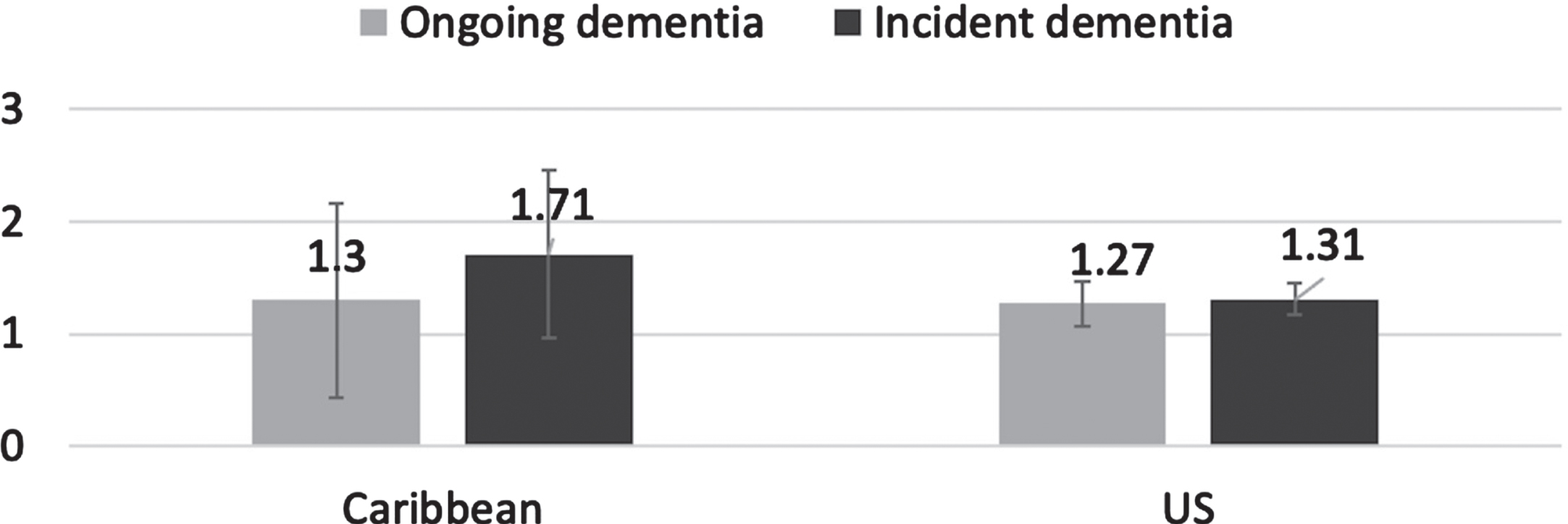
Relative risk ratios of spending any night in the hospital associated with ongoing dementia and incident dementia relative to no dementia, in the Caribbean and US samples. The height of each bar represents the value of the estimated relative risk ratio from a logistic regression with any hospital night as the dependent variable and ongoing and incident dementia as the independent variables, controlling for age, education, income, marital status, and chronic conditions as shown in Table 1. The whiskers represent the 95% confidence intervals of the relative risk ratios. The two bars on the left show results estimated from a single regression on the full Caribbean sample. The two bars on the right show results estimated from a single regression on the full US sample.
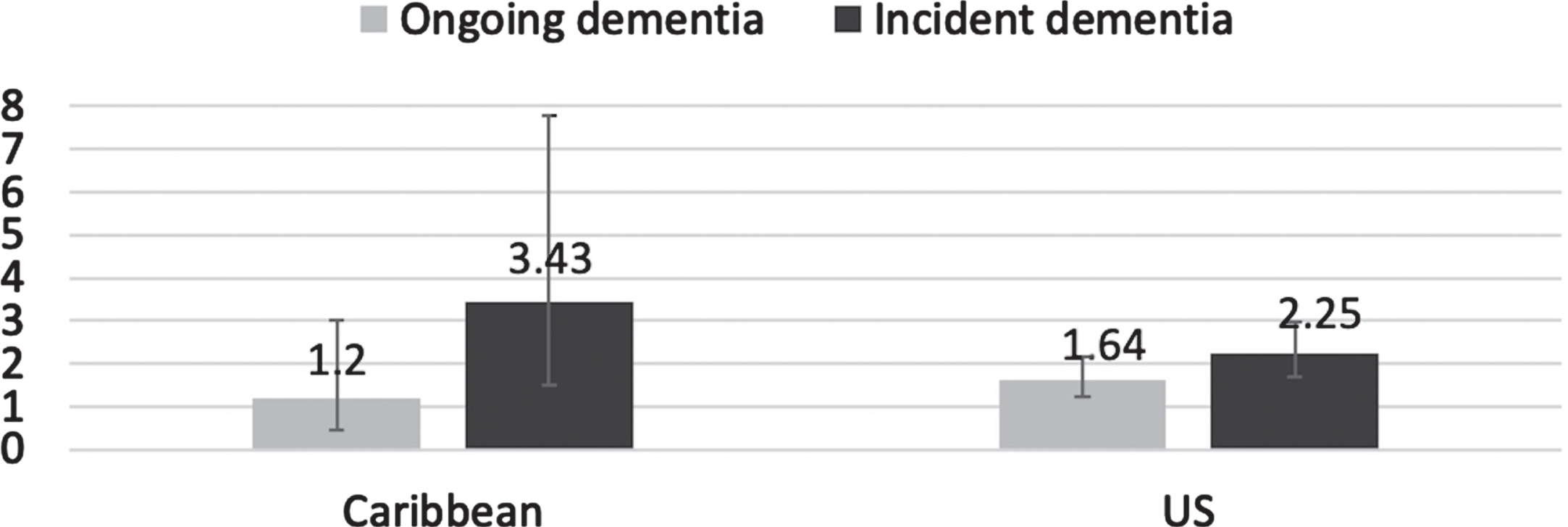
Incident rate ratios of number of hospital nights associated with ongoing dementia and incident dementia relative to no dementia, in the Caribbean and US samples. The height of each bar represents the value of the estimated incident rate ratio from a negative binominal regression with number of hospital nights as the dependent variable and ongoing and incident dementia as the independent variables, controlling for age, education, income, marital status, and chronic conditions as shown in Table 1. The whiskers represent the 95% confidence intervals of the incident rate ratios. The two bars on the left show results estimated from a single regression on the full Caribbean sample. The two bars on the right show results estimated from a single regression on the full US sample.
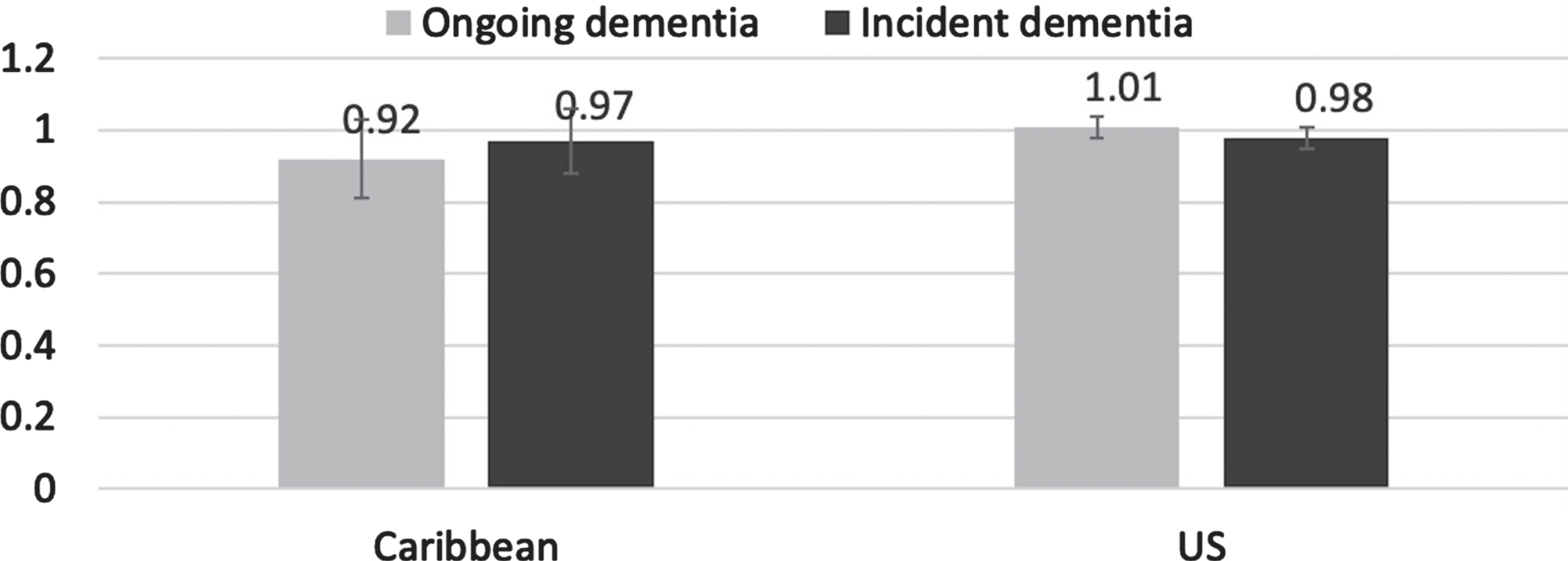
Relative risk ratios of having any physician visit associated with ongoing dementia and incident dementia relative to no dementia, in the Caribbean and US samples. The height of each bar represents the value of the estimated relative risk ratio from a logistic regression with any physician visit as the dependent variable and ongoing and incident dementia as the independent variables, controlling for age, education, income, marital status, and chronic conditions as shown in Table 1. The whiskers represent the 95% confidence intervals of the relative risk ratios. The two bars on the left show results estimated from a single regression on the full Caribbean sample. The two bars on the right show results estimated from a single regression on the full US sample.
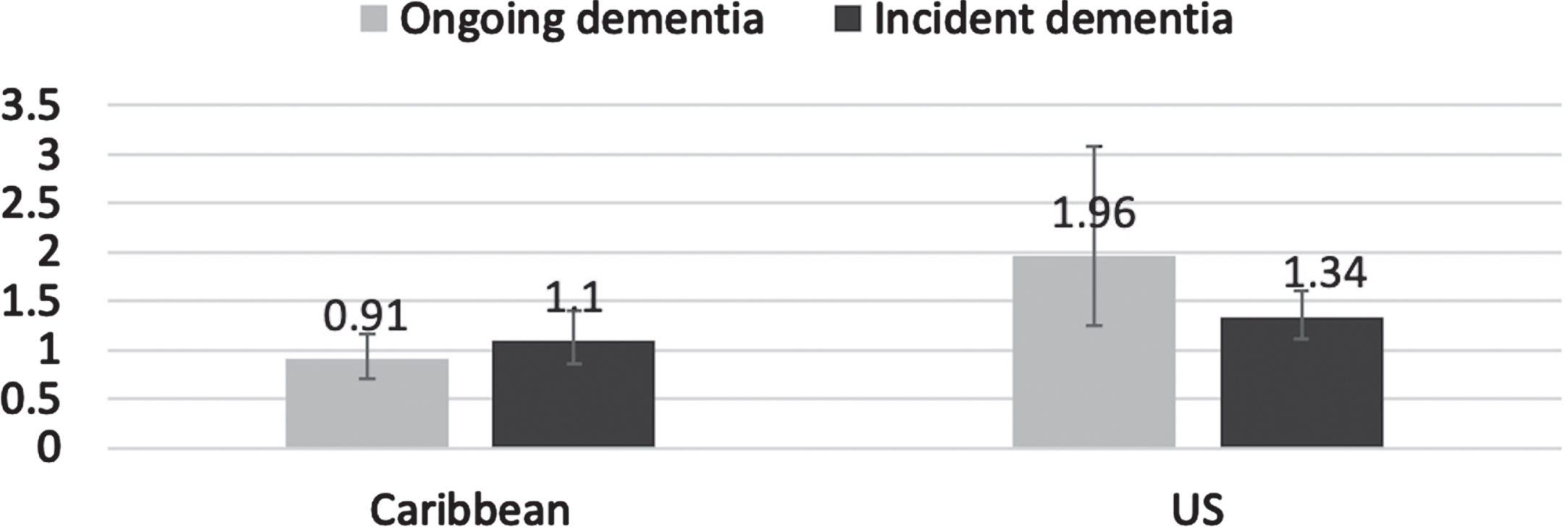
Incident rate ratios of number of physician visits associated with ongoing dementia and incident dementia relative to no dementia, in the Caribbean and US samples. The height of each bar represents the value of the estimated incident rate ratio from a negative binominal regression with number of physician visits as the dependent variable and ongoing and incident dementia as the independent variables, controlling for age, education, income, marital status, and chronic conditions as shown in Table 1. The whiskers represent the 95% confidence intervals of the incident rate ratios. The two bars on the left show results estimated from a single regression on the full Caribbean sample. The two bars on the right show results estimated from a single regression on the full US sample.
Incident dementia was associated with an increase in the number of hospital nights of over three folds compared to cognitively normal individuals during a three-month period in the Caribbean sample (incidence rate ratio (IRR): 3.43, 95% CI 1.51–7.79, p = 0.003) (Fig. 2). The increase in number of hospital nights attributable to incident dementia was particularly prominent in PR (IRR: 9.11, 95% CI 2.36–25.19, p = 0.001) and among males (IRR: 10.66, 95% CI 3.32–34.25, p < 0.001) (Supplementary Table 5A). On other hand, there was little difference in number of hospital nights between those with ongoing dementia versus no dementia. In DR, however, ongoing dementia was associated with a decrease in number of hospital nights (IRR: 0.01, 95% CI 0.00–0.06, p < 0.001). In the US sample, incident dementia was associated with an approximately two-fold increase in number of hospital nights over a two-year period (IRR: 2.25, 95% CI 1.69–2.99; p < 0.001), and ongoing dementia was associated with an increase in the IRR as well (IRR: 1.64, 95% CI 1.24–2.15; p < 0.001) (Fig. 2 and Supplementary Table 5B). The increase in hospital nights attributed to incident dementia was observed in all racial and ethnic groups and was especially large among Hispanics (IRR: 5.89, 95% CI 2.07–16.80; p < 0.001) (Supplementary Table 5B). Hispanic men appeared to be especially affected by incident dementia (IRR: 5.91, 95% CI 1.69–20.68; p = 0.005), although with overlapping confidence interval with Hispanic women (IRR: 3.03, 95% CI 0.76–12.07; p = 0.115).
Neither incident nor ongoing dementia was associated with a change in the risk of having any physician visits, and this is the case in both the Caribbean and US samples, as well as across subsamples (Fig. 3 and Supplementary Table 6). In the US sample, ongoing dementia was associated with an almost two-fold increase in the number of physician visits during a two-year period (IRR: 1.96, 95% CI 1.25–3.08; p = 0.003) (Fig. 4 and Supplementary Table 7B). This relationship was especially prominent among Blacks (IRR: 2.53, 95% CI 1.43–4.48; p = 0.001). Incident dementia was associated with a 1.34-fold increase in these visits for the full US sample (IRR: 1.34, 95% CI 1.12–1.61; p = 0.002), though it was only significant among Whites (IRR: 1.49, 95% CI 1.21–1.82, p < 0.001). By contrast, there were again no statistically significant differences in number of physician visits for either incident dementia or ongoing dementia in the Caribbean sample or subsamples (Fig. 4 and Supplementary Table 7A). Finally, results from the propensity-score weighted Hispanic subsample in the US (Supplementary Table 8) were very similar to the unweighted results in Column 5, Panel B of Supplementary Tables 4–7.
DISCUSSION
We showed that among Caribbean-dwelling Hispanics, incident dementia was associated with a significant increase in the risk of hospitalization and number of hospital nights. While we did not observe the same pattern for ongoing dementia, it was associated with a decrease in number of hospitalizations in DR. We did not find any relationship between incident or ongoing dementia and physician visits in the Caribbean sample. On the other hand, among the US sample, both incident and ongoing dementia were associated with a higher risk of having any hospital nights as well as an increased number of hospital nights, and both forms of dementia were associated with an increase in the number of physician visits.
Our findings suggest that, compared to healthcare system in the US, dementia related burden on the Caribbean healthcare systems is concentrated in hospital care, and among patients with incident dementia, especially men. This may be driven by a few possible factors. On the healthcare supply side, it is more common for initial dementia diagnosis to made during a short (usually two- to three-day) hospital stay in the Caribbean region as opposed to during an outpatient visit as that in the US. Accordingly, compared to the US, there could be poorer ongoing chronic condition management, including diagnosis and management of dementia in the outpatient setting in the Caribbean countries/islands [27]. This may give rise to acute episodes from worsening of existing conditions as the patient experiences dementia onset.
The general differences in healthcare financing and access across countries and regions could also be contributing to the findings (Supplementary Table 1). Of the four contexts, DR had the lowest percentage of healthcare expenditure as share of Gross Domestic Product (GDP), lowest number of physicians and hospital beds per 1,000 population, and the highest out-of-pocket share of healthcare expenditures, pointing to a lack of insurance coverage and inadequate healthcare access. The fact that we found lower rate of hospitalizations among older adults with ongoing dementia compared to no dementia in DR could be due to lower socioeconomic status and inadequate insurance coverage in the dementia population [11]. Even in Cuba and PR where insurance coverage is presumably universal or near-universal, there could be inadequate management of chronic conditions, which would be consistent with existing evidence for lower quality of care in PR relative to mainland US Medicare [14]. A related possible contributing factor is the lack of diagnostic skills, tools or knowledge of dementia among healthcare providers [28], which is also an issue in the US but could be more prevalent in the Caribbean region. Finally, a general lack of post-acute care and long-term care providers and infrastructures in the Caribbean region could also lead to longer hospital stays [9]. It is noteworthy that we found similar patterns in terms of increased hospital nights in response to incident dementia in the US particularly among Blacks and Hispanics compared with Whites, which likely reflects documented racial and ethnic disparities in both routine healthcare and dementia care in the US [29 –31].
On the other hand, supplier-induced demand or at least inefficient care could be contributing to our finding of higher intensity of hospital and physician care in the US among those with ongoing dementia. Existing literature using data from Sweden suggests that healthcare costs were not necessarily higher among dementia patients four to six years after diagnosis. Given that US had both relatively high numbers of physicians and hospital beds per 1,000 population and a more fragmented healthcare system in terms of sources of financing (Supplementary Table 1), it is possible that patients with dementia in the US were more likely to receive unnecessary or low-value care due to their vulnerability compared to those in the Caribbean region. This is an important topic for future research.
On the patient demand side, the potential misconception of dementia symptoms as a normal part of aging may also prevent dementia patients and their families among the Caribbean-dwelling Hispanic population from seeking timely care. Such perception of dementia has been shown to be particularly prominent among Hispanics compared to Whites in the US [7, 32]. The fact that we found larger increases in number of hospital nights in response to incident dementia among men in the Caribbean sample may be related to generally lower use of healthcare services and less contact with the healthcare system prior to dementia onset relative to women [33]. A direct consequence of the lack of demand for timely management of dementia, which is also affected by the access issue discussed above, is potentially higher utilization of informal care in place of formal care for dementia patients in the Caribbean region relative to the overall US population. Lower labor market opportunity cost has also been documented as a key driver for the large amount of informal care provided by family members among disadvantaged households in the Caribbean and Latin America [34].
Our study has limitations. First, the method for assigning dementia status differed in the Caribbean and US samples due to differences in cognitive assessment information between data sources, which could influence the comparability of our estimates. Prior work mitigated this concern to an extent by showing consistency in results across different dementia classification mechanisms in the HRS data [25]. Second, the healthcare utilization measures in the 10/66 were measured during a relatively short time period compared to HRS (three months versus two years), which could lead to noisy estimates for the Caribbean sample. Third, relatedly, to the extent that there was recall bias, it could affect the quality of self-reported utilization measures differently in the HRS versus 10/66 in that utilizations could be under-reported in HRS especially among those with dementia. Fourth, our main study sample likely captured mostly mild to moderate dementia cases as the most severe dementia cases may have dropped out or deceased between Wave 1 and Wave 2, and this could have contributed to the null results on ongoing dementia in the Caribbean sample, although the US sample had largely similar attrition rate between waves. Finally, we were unable to directly examine informal care utilization attributable to incident and ongoing dementia due to substantial differences in relevant survey questionnaires in the 10/66 and HRS data.
Despite these limitations, our study is the first to compare dementia attributable healthcare utilization between the Caribbean and the US populations by utilizing and harmonizing the best available population-based data sources in these two contexts. Taken together, although our findings do not suggest particularly high dementia attributable healthcare burden in the Caribbean compared to the US, they point to potential deficiencies in outpatient management of ADRD as well as other chronic conditions particularly in the Caribbean and suggest potentially high burden of informal care in the region. One important but little explored question is how quality of life of dementia patients in the Caribbean compared with that in the US by race and ethnicity, given differences in utilization of formal healthcare care. Future studies may explore these research questions by comparing both informal care utilization as well as measures of quality of life between these two populations.
Footnotes
ACKNOWLEDGMENTS
We are grateful for the 10/66 and Health and Retirement Study participants for sharing their time and experiences. Julia Pauschardt, MS at London School of Economics provided excellent assistance in data analysis and literature review.
FUNDING
This work was supported by funding from the National Institutes of Health/National Institute on Aging and the Alzheimer’s Association.
CONFLICT OF INTEREST
The authors have no conflict of interest to report.
