






Abstract
Background:
Reliable blood biomarkers are crucial for early detection and treatment evaluation of cognitive impairment, including Alzheimer’s disease and other dementias.
Objective:
To examine whether plasma biomarkers and their combination are different between older people with mild cognitive impairment (MCI) and cognitively normal individuals, and to explore their relations with cognitive performance.
Methods:
This cross-sectional study included 250 older adults, including 124 participants with MCI, and 126 cognitively normal participants. Plasma brain-derived neurotrophic factor (BDNF), irisin and clusterin were measured, and BDNF/irisin ratio was calculated. Global cognition was evaluated by the Montreal Cognitive Assessment.
Results:
Plasma irisin levels, but not BDNF, were significantly different between MCI group and cognitively normal group. Higher irisin concentration was associated with an increased probability for MCI both before and after controlling covariates. By contrast, plasma BDNF concentration, but not irisin, was linearly correlated with cognitive performance after adjusting for covariates. Higher BDNF/irisin ratios were not only correlated with better cognitive performance, but also associated with lower risks of MCI, no matter whether we adjusted for covariates. Plasma BDNF and irisin concentrations increased with aging, whereas BDNF/irisin ratios remained stable. No significant results of clusterin were observed.
Conclusions:
Plasma BDNF/irisin ratio may be a reliable indicator which not only reflects the odds of the presence of MCI but also directly associates with cognitive performance.
Keywords
INTRODUCTION
Dementia is a widespread neurological symptom seen in cerebrovascular and neurodegenerative diseases among aged people. Since the underlying pathological changes may start years before clinical symptoms, early detection of dementia is crucial for clinical neurology [1]. Accumulating research focused on the potential biomarkers for mild cognitive impairment (MCI), the prodromal stage of dementia, such as magnetic resonance imaging, positron emission tomography, electroencephalogram, cerebrospinal fluid (CSF) biomarkers, and blood-based biomarkers [2–4].
The high availability, low expense and little invasiveness of blood samples make blood-based biomarkers a priority for both screening individuals with higher risk of dementia, and evaluating the efficacy of interventional strategies [5]. Several molecules, such as the biomarker profiles in the Amyloid Tau Neurodegeneration (ATN) framework, have been evaluated as potential biomarkers to identify Alzheimer’s disease (AD)-specific neurodegeneration. However, various pieces of research have revealed substantial discrepancies between clinical cognitive symptoms and biomarker-based diagnosis, particularly for older ages [6, 7]. These discrepancies stem from two main sources: high plasticity capacity of the brain, and confounding variables. Brain plasticity refers to a remarkable capacity of the nervous system to modify itself, functionally and structurally, in response to various stimuli, which occurs as a result of changes in a series of interrelated signaling molecules [8]. Compensatory neuroplastic changes at the molecular level in early stage of cognitive impairment or in the aging process increase the complexity of using a single biomarker to identify MCI from cognitively normal individuals [8]. Additionally, the expression of a certain molecule is possibly affected by several confounding variables [9], which reduces the reliability for identifying cognitive impairment. By contrast, a combination of relevant biomarkers may, to some extent, could dampen the inter-individual heterogeneity and be a more reliable approach to early detection of cognitive impairment.
Brain-derived neurotrophic factor (BDNF) and irisin are two molecules associated with cognitive functions, and have been evaluated as potential biomarkers for cognitive impairment [10]. BDNF, a member of the neurotrophins family, plays a fundamental role in synaptic plasticity and long-term potentiation [11, 12]. It also enhances the proliferation, differentiation and survival of neurons, and inhibits neuroinflammation [12, 13]. BDNF is mainly expressed in the brain, and could be detected in peripheral blood. The concentration of BDNF in cerebrospinal fluid (CSF) and blood closely correlates with each other [14]. Mounting evidence indicated that cognitive impairment was accompanied by the reduction of BDNF levels in CSF, and supported positive relations between CSF BDNF concentration and cognitive functions [15]. However, correlations between blood BDNF concentration and cognitive dysfunction remained controversial, especially in the prodromal stage of dementia. Mori et al. and Borba et al. reported lower serum BDNF levels in the MCI individuals than in healthy subjects and observed a positive correlation between serum BDNF level and cognitive performance [16, 17], whereas Angelucci et al. reported higher serum BNDF levels in MCI patients when compared to healthy subjects [18]. The conflicting results may be partly caused by the differences in confounding factors, such as age, body weight, gender, exercise, and other diseases [19].
Irisin is a novel myokine secreted after the cleaving of the membrane protein fibronectin type III domain containing 5 (FNDC5) and acts as an upstream regulator of BDNF [10]. Animal research has proven a neuroprotective role of irisin: peripheral delivery of recombinant irisin or FNDC5 by adenoviral vectors induces expression of BDNF in the hippocampus, reduces hippocampal phosphorylated tau, inhibits neuroinflammation, and improves cognitive function [10, 20]. Nevertheless, evidence for circulating irisin concentration and cognitive status in humans was limited and inconclusive. Kuster et al. reported a positive relation between plasma irisin concentration and cognitive performance among 47 older adults at risk of dementia [21]. However, Lourenco et al. and Kim et al. failed to find any significant differences on plasma irisin levels among people across different cognitive states [22, 23], which partly resulted from the relatively small sample size and potential confounding variables like age, diabetes, body mass index (BMI), and exercise [24, 25]. In addition, some existing evidence suggested that the expression of irisin in blood or CSF may compensatorily increase under certain pathological conditions or during aging process [22, 26]. It was probably another reason for the insignificant differences on irisin concentration among people across various cognitive states.
Based on the above data, we made a tempting assumption that the combination of BDNF and irisin, BDNF/irisin ratio (BIR), might be a potentially more reliable indicator reflecting cognitive status than BDNF or irisin alone. On the one hand, BIR reflected not only the early compensatory process through irisin concentration, but also the result of compensation through BDNF levels. Previous research has clearly indicated that irisin could boost the production of BDNF, and then BDNF could lead to cognitive improvement by regulating neuroplasticity and hippocampal neurogenesis, as well as protecting nerve cells from ischemic injury [27]. Hence, BDNF was one import mediating factor for irisin to exert cognitive benefits. It was reasonable to infer that higher BIR values, meaning higher BDNF levels relative to irisin levels, might exert larger protective effects and associate with better cognitive function; while lower BIR values, meaning lower BDNF levels relative to irisin levels, might induce smaller protective effects and associate with worse cognitive function. On the other hand, both plasma BDNF and irisin were affected by some common confounding factors [19, 24], which could be balanced by the calculation of BIR. Additionally, due to the non-specificity of BDNF and irisin for AD pathology, BIR might be more suitable to identify MCI regardless of the type of pathology.
To test this hypothesis, the present study first examined whether levels of plasma BDNF and irisin alone could differentiate between aged people with MCI and cognitively healthy individuals, and also explored the relations of these plasma biomarkers and cognitive performance. Next, we calculated the ratio of BDNF to irisin particularly, and aimed to test our hypothesis that plasma BIR, the combination of BDNF and irisin, was a potentially reliable indicator to detect cognitive impairment and reflect cognitive performance. Additionally, clusterin, a multifunctional protein linked to AD pathology [28], was taken as a control molecule in the presentstudy.
METHODS
Participants
Participants in the present study were drawn from a cognitive screening and follow-up cohort of older adults in the community (ChiCTR2200065885). Propensity score match method was used to select participants with similar demographic characteristics (age, gender, BMI, and disease history) from 435 old people in the cohort, and 126 pairs of participants were identified. Two participants were excluded because their blood samples could not meet testing standards. Finally, 126 cognitively normal (CN) participants and 124 individuals with MCI were included in the present study. The inclusion criteria for participants were as follows: (1) aged 60 and above; (2) having completed cognitive examinations by the Montreal Cognitive Assessment (MoCA); (3) having completed blood samples collections before or after cognitive tests with an interval less than six months. We excluded illiterate individuals and those with a diagnosis of dementia or MoCA scores no more than 10 [29]. This study was approved by the institutional review board (IRB00001052-21166). All participants gave informed consents to participate in the study. This study followed the Strengthening the Reporting of Observational Studies in Epidemiology (STROBE) Statement.
Data collection
Cognitive function
Cognitive function was measured by MoCA. Participants were classified as MCI group and CN group according to the scores of MoCA. The cutoff values of MoCA score between the two groups were 24/25 for participants with middle school education and above, 19/20 for participants with primary school education, according to the Chinese guidelines for diagnosis and treatment of dementia and cognitive Impairment [30].
Blood biomarkers
Overnight fasting venous blood samples were collected in EDTA-treated tubes in the morning. Plasma samples were prepared by centrifugation for 10 min at 3,000 rpm and then were stored at –80°C until biochemical analysis. Plasma BDNF, irisin and clusterin were measured respectively using commercial ELISA kits of SEKH-0101, SEKH-0353, SEKH-0133 (Beijing Solarbio Science & Technology Co., Ltd., Beijing, China) according to the product instructions.
Covariates
Demographic characteristics were collected by a self-designed questionnaire, including age (continuous variable), gender (men and women), education levels (middle/high school and below, college degree, bachelor and above), BMI (continuous variable), alcohol consumption (never drink, quit, still drink), and smoking history (never smoke, quit, still smoke). Disease history information were acquired through single-item question (yes or no): Do you have any of medical conditions, such as hypertension, diabetes, cardiovascular disease, or cerebral vascular disease. In this study, we only focused on the above four diseases considering that they might have influences on the plasma concentrations of BDNF and irisin. In addition, the self-reported family history of dementia was also collected (yes, no, or unsure). Leisure-time physical activities were assessed using a self-reported approach. we collected the information about the duration for moderate-to-vigorous exercise per session and the frequency in each week. If one exercises three times or more per week with at least 30 min per session, we would assume that he has a regular exercise habit.
Statistical analysis
Outliers were detected and replaced when the concentrations of biomarkers were below the 1st percentile or above the 99th percentile [31]. Skewed data were normalized using log transformation (for BDNF and clusterin concentrations) and reciprocal transformation (for irisin concentration). In order to examine whether there existed differences on the biomarkers or their combination between MCI group and CN group, we first performed the student’s independent samples t-tests between these two groups. Then, we performed logistic regressions separately to explore the influences of plasma biomarkers on the presence of MCI, and adopted linear regressions to explore the associations between plasma biomarkers and cognitive performance (MoCA scores). Regression analyses were first performed without controlling any covariates, and then were conducted with age, gender, education levels, BMI, smoking history, alcohol consumption history, disease history, and family history of dementia as covariates. Stratified analyses were performed according to age (<75 years and ≥75years) and family history of dementia. We also examined the relations between plasma biomarkers and age before stratified analyses. In addition, given that only a small number of participants reported a family history of dementia, we only performed analyses in participants without family history of dementia. All the analyses were performed using Stata 15.1 (StataCorp LLC, Texas, USA) and R 4.1.2 (R Foundation for Statistical Computing, Vienna, Austria).
RESULTS
Demographic characteristics
A total of 250 participants were included with a mean age of 70.59 years (standard deviations (SD) = 5.01). The scores of MoCA range from 12 to 30, with a mean score of 24.22 (SD = 3.45). The concentrations of plasma BDNF, irisin, and clusterin were respectively 9.87 ± 8.61 ng/ml (range: 0.58∼44.05 ng/ml), 25.52 ± 7.56 ng/ml (range: 13.25∼56.40 ng/ml), 176.31 ± 102.90μg/ml (range: 52.81∼608.42μg/ml). Plasma BIR values range from 0.03 to 1.99, with a mean value of 0.42 (SD = 0.39). Detailed characteristics between different groups were listed in Table 1. There was no significant difference on the demographic characteristics between MCI group and CN group except educational levels.
Participants characteristics
Plasma concentrations of BDNF/irisin/clusterin and cognition
Plasma BDNF, irisin, and clusterin levels were presented in Table 2. For plasma BDNF concentration, we did not observe significant differences between groups (Table 2). Logistic regression on BDNF was significant only after adjusting for the covariates (OR: 0.97, 95% CI: (0.93, 0.998), p = 0.040) (Table 3). Linear regression analysis also showed that BDNF concentration (B = 0.06, β = 0.14, p = 0.029) was positively related to MoCA scores only after controlling for covariates (Table 4), with each unit increase in BDNF concentration corresponding to 0.06 score increase in MoCA.
The differences of plasma biomarkers between groups by student’s independent samples t-tests
The plasma concentrations of BDNF and clusterin, as well as BIR values, were normalized using log transformation for t-tests. Plasma irisin concentration were normalized using reciprocal transformation for student’s independent samples t-tests. CN, cognitively normal; MCI, mild cognitive decline; BDNF, brain derived neurotrophic factor; BIR, the ratio of BDNF to irisin; SD, standard deviation.
Logistic regression results with the reference group as CN group
CN, cognitively normal; BDNF, brain derived neurotrophic factor; BIR, the ratio of BDNF to irisin.
Linear regression results
CN, cognitively normal; MCI, mild cognitive decline; BDNF, brain derived neurotrophic factor; BIR, the ratio of BDNF to irisin; B means unstandardized regression coefficients, and β means standardized regression coefficients.
In contrast to BDNF, student’s independent samples t-test showed that the MCI group had higher levels of plasma irisin (p = 0.023) than the CN group (Table 2). The probability for the presence of MCI increased by 5% (OR: 1.05, 95% CI: (1.01, 1.09), p = 0.007) with each unit increase in irisin concentration, and the result was similar (OR: 1.06, 95% CI: (1.02, 1.10), p = 0.007) after controlling for the covariates (Table 3). But the linear correlation between irisin concentration and MoCA scores was insignificant (Table 4).
As for plasma clusterin, no significant results were observed. The results were shown in Tables 2–4.
The regression results about covariates were listed in Supplementary Tables 1 and 5). All the logistic regression models on plasma biomarkers showed that participants with college degree had lower risk of being diagnosed with MCI compared with those with middle/high school education or below. All the linear regression models indicated that higher education levels were significantly associated with higher MoCA scores.
Plasma BIR values and cognition
Student’s independent samples t-test showed that the MCI group tended to have lower BIR values (p = 0.069) than the CN group (Table 2). Logistic regression suggested that the probability for the presence of MCI decreased by 50% (OR = 0.50, 95% CI: (0.25, 0.998), p = 0.049) with each unit increase in BIR values, and linear regression showed that BIR values (B = 1.19, β = 0.13, p = 0.040) were positively related to MoCA scores. The results were similar after controlling for covariates (Table 4, Supplementary Tables 1 and 5).
Stratified analyses
Before stratified analyses by age, we first explored the relationship between plasma biomarkers and age (Fig. 1). Linear regression suggested that both BDNF (B = 0.04, β = 0.22, p = 0.015) and irisin (B = -0.0004, β = -0.19, p = 0.030) increased with aging in CN group, but not in MCI group (Fig. 1). BIR was not significantly associated with age either in the MCI group or in the CN group. Neither was clusterin. Stratified analyses in the subgroup aged less than 75 showed similar results to that in the whole sample (Tables 2–4), except that the logistic regression on BDNF lost insignificance after adjusting for the covariates. In the subgroup aged 75 years and over, we did not observe any significant results of plasma biomarkers or BIR values (Tables 2–4), except that logistic regression on irisin was still significant after adjusting for covariates.
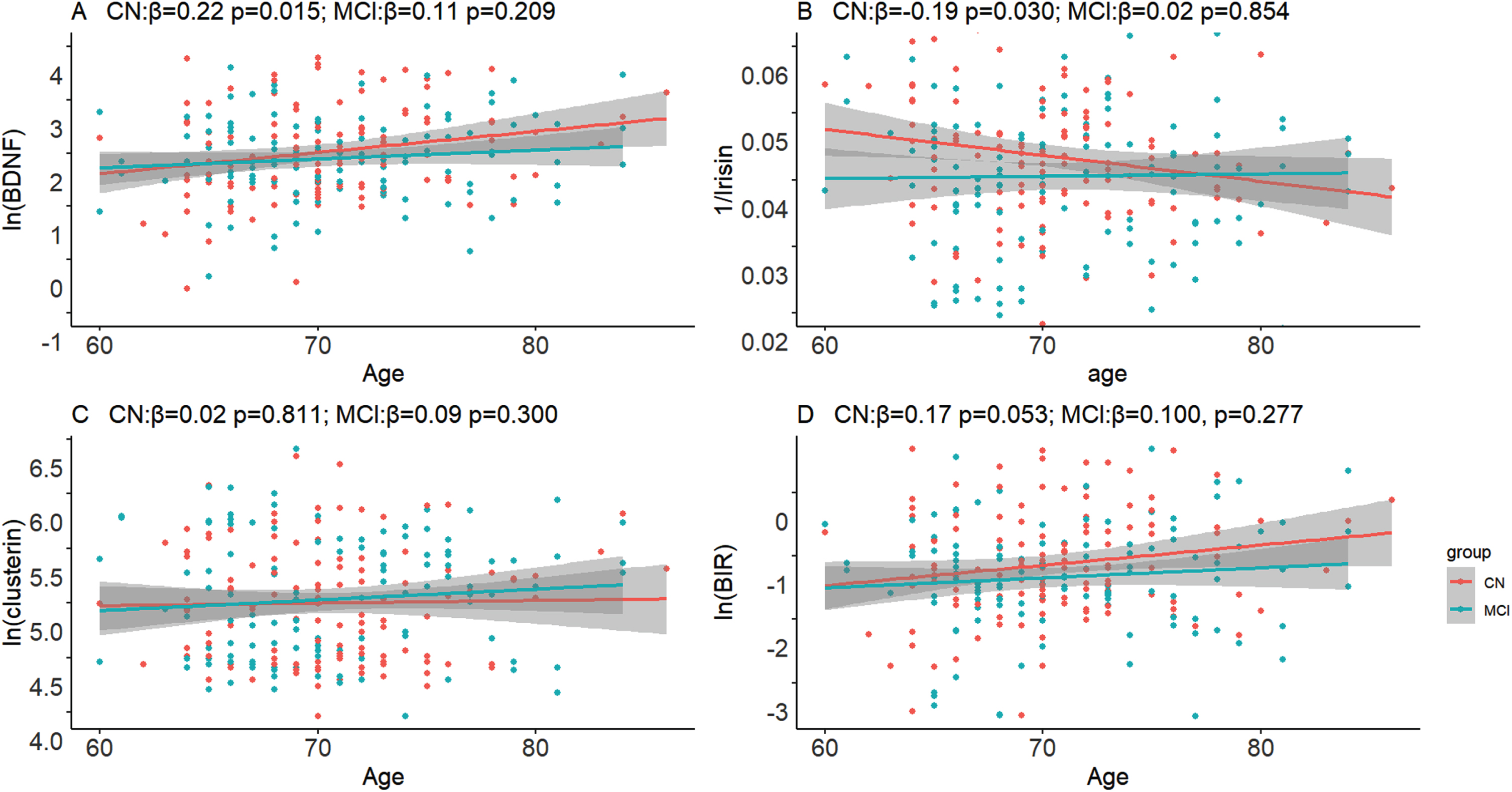
Linear relations between plasma biomarkers and age. CN, cognitively normal; MCI, mild cognitive decline; BIR, BDNF/Irisin.
Data analyses in participants with no family history of dementia showed similar results to that in the whole sample. The differences on plasma BDNF levels and irisin levels between groups were nearly significant, and logistic regression showed both of them were significantly associated with the risk of MCI (Table 3). Linear regression showed that plasma BDNF concentration was positively related to MoCA scores no matter whether the covariates were controlled (Table 4). As for BIR, the MCI group had lower BIR values (p = 0.018) compared to the CN group did in participants without family history of dementia (Table 2), and the probability that participants were diagnosed with MCI lowered by 72% (OR = 0.28, 95% CI (0.11, 0.73), p = 0.009) with BIR increasing by one unit (Table 3). Linear regression indicated that higher BIRs (B = 1.68, β =0.18, p = 0.013) were related to increasing MoCA scores (Table 4). The results of logistic regression and linear regression on BIR values were also significant after adjusting for covariates. No significant results of clusterin were found. The results about covariates were listed in Supplementary Tables 2–4 and 6–8.
DISCUSSION
This study examined the relations between plasma biomarkers (BDNF, irisin, and clusterin) and cognitive function, and raised the concept of BIR in clinical research. We included a relatively large sample from communities, which reflected the true status of aged people without receiving any relevant treatments. Besides, we included multiple covariates to control for the influences of confounding variables. In the present study, four main findings were as follows: (i) the MCI group had higher plasma irisin levels but not BDNF levels than the CN group; (ii) Plasma BDNF but not irisin levels were significantly correlated with cognitive performance after controlling for covariates; (iii) BIR values were lower in MCI group than that in CN group in participants without family history of dementia, and were significantly correlated with both the probability of the presence of MCI and cognitive performance; (iv) Both plasma BDNF and irisin concentrations increased with aging in CN group, whereas BIR values remained stable across the ages. Additionally, we did not observe significant correlations between plasma clusterin concentration and cognition. Stratified analyses in the younger group (<75 years) and in participants without family history supported the above results, while most of the significances were lost in the older group (≥75 years), which was possibly due to the high physiological compensation to aging that covered the differences caused by pathological changes.
Plasma BDNF, one of the most frequently investigated biomarkers related to brain functions, was positively correlated to cognitive performance after controlling for the covariates, which was consistent with the existing evidence [21]. However, we did not find a significant difference on plasma BDNF concentrations between MCI group and CN group, which seemed to conflict with some previous studies [16, 32]. After we adjusted for the covariates which might potentially affect the expression of BDNF, the result of logistic regression was significant. It suggested that the expression of peripheric BDNF was likely affected by many confounding variables, and the differences of plasma BDNF attributed to cognitive impairment might be blurred by other confounding variables [9]. When we only included participants with no family history of dementia, the group difference tended to be significant, and the logistic regression results were also significant both before and after controlling the covariates. It implied that the expression of peripheric BDNF might be affected by dementia-related genotypes, such as APOE ɛ4. Liu et al. reported that APOE ɛ4 carrier status was associated with reduced serum BDNF levels, and suggested that APOE was probably involved in regulating BDNF metabolism [33]. However, we did not measure the genotypes of participants in the current study, and the associations between blood BDNF concentration and relevant genotypes deserved further investigation.
In sharp contrast to BDNF, we found that plasma irisin levels were significantly higher in MCI group than that in CN group, and higher plasma irisin levels were associated with the higher probabilities of the presence of MCI. Due to the cross-sectional design in the present study, we could not directly tell from current data whether the elevation in plasma irisin levels was the cause or consequence of cognitive impairment. However, existing evidence has identified irisin as a protective protein showing elevated expression in response to inflammatory and oxidative stress [34, 35]. Animal studies indicated that exogenous supplement of irisin significantly reduced hippocampal phosphorylated tau, alleviated neuroinflammation and oxidative stress, and inhibited neuronal degeneration [20, 36]. Thus, a rationale interpretation for our data would be that irisin acted as a compensatory molecule against cognitive decline. And the elevation of circulating irisin level was probably a protective response to pathological changes. In particularly, irisin did not directly correlate with cognitive performance in our study, further supported the hypothesis that irisin was a compensatory process marker in response to early cognitive dysfunction. Nevertheless, our result was inconsistent with the study by Kuster et al., which revealed positive relations between serum irisin and memory performance in 47 participants [21]. Given that the low sample size of existing evidence in humans, we should interpret the results cautiously.
The most important finding in our study was the close correlation between lower BIR values and worse cognitive performance as well as the odds of MCI. It suggested that BIR might be a more reliable and sensitive indicator to identify cognitive impairment than BDNF or irisin alone. According to our above results, irisin acted as a compensatory process indicator for early cognitive decline, and BDNF, a downstream molecule of irisin, was more likely an outcome indicator directly associated with cognitive functions. From this perspective, BIR, the combination of BDNF and irisin, was more capable of reflecting whether the compensation is successful or not. On the other hand, MCI group had higher irisin concentrations and tended to show lower BDNF levels in the present study. The opposite directions of relations between plasma BDNF with the presence of MCI, and between plasma irisin with the presence of MCI, contributed to enlarging the differences of BIR between MCI group and CN group. It made BIR more sensitive to a slight change accompanied with cognitive decline. However, given that we only correlated BIR with global cognition in the present study, the results deserved to be validated in future longitudinal cohorts with more participants by adopting more comprehensive markers and multi-domains of cognitive functions.
Another intriguing finding was that the expression of both BDNF and irisin increased with aging in cognitively normal participants, consistent with some previous research [24, 37]. However, several other studies suggested that the levels of irisin and BDNF decreased with increasing age during the whole life cycle course, and that aged individuals had lower irisin concentrations than young individuals [38, 39]. The discrepancy may be caused by sample differences. In the present study, we only focused on people aged 60 and above, and thus the results only reflected the trends in old age. For older people, increasing irisin and BDNF with aging was probably a compensatory and neuroprotective strategy for age-related neurodegeneration. Animal research suggested that exogenous supplement of BDNF and irisin attenuated aging-related neuroinflammation by inhibiting the activation of microglial and astrocyte [20, 40]. However, the age-related compensatory effects were blurred in people with MCI, possibly as a result of either disrupting effects from pathological changes or limited compensation capacity. What was noteworthy was that that BIR did not increase with aging. Due to the same direction of changes of plasma BDNF and irisin with aging, the ratio of BDNF to irisin weakened the age-related compensatory effects. Similarly, BIR also contributed to weakening the heterogeneity on the expression of BDNF and irisin induced by other factors among individuals. It made BIR a more reliable marker reflecting the changes caused by pathological cognitive impairment.
In our study, we did not observe any significant results of clusterin in data analyses. It was not surprising considering its opposite roles in neuroprotection and neurotoxicity in AD pathology [41]. On the one hand, clusterin may interfere with the further aggregation of Aβ by forming clusterin-Aβ complexes and reduce intracellular Aβ by enhancing Aβ secretion [28, 42]. On the other hand, clusterin inhibited Aβ degradations, contributed to the production of tiny diffusible Aβ oligomers and led to oxidative stress, as well as mediated Aβ toxicity [28, 42]. The multiple functions of clusterin made its relations with cognition more complex.
This study had some important implications for both research and clinical practice. Firstly, the finding about BIR provided a new perspective for future clinical professionals and researchers to identify early cognitive impairment, regardless of the type of pathology (AD-specific or non-specific pathology). But before applying it into clinical practice, more research should be conducted to further examine the validity of BIR among people across various stages of cognitive impairment, by linking it with other acknowledged markers, such as MRI, PET-CT, as well as different domains of cognitive functions. In addition, the lost significance of all the biomarkers in the older subgroup (≥75 years) implied that clinical professionals should pay more attention to the early identification of cognitive impairment in this subgroup of people by combining cognition tests with self-reported and caregiver-reported symptoms.
Limitations
The present study is a cross-sectional baseline investigation and unable to explain the cause-effect relations between biomarkers and cognitive impairment. But our cohort is under establishment and is expected to explore the longitudinal relations between these plasma biomarkers and cognition. In addition, we did not include individuals at the stage of dementia, making an incomprehensive understanding of the relations between biomarkers and cognition. Finally, the present study only correlated the plasma biomarkers with global cognition but not specific cognitive processes, and the results should be interpreted with caution.
Conclusion
To a certain degree, both plasma irisin and BDNF concentrations could reflect the status of cognitive functions. Irisin tends to be a compensatory indicator in response to the early cognitive decline, while BDNF is likely an indicator closely linked to cognition performances. BIR, as a composite indicator less affected by age, is probably a promising and reliable biomarker, which not only reflects the odds of the presence of MCI but also is directly correlated with cognitive performance. It has the potential to be a surrogate marker of cognitive function. Considering the cross-section study design, future research should correlate these plasma biomarkers with more objective biomarkers and different cognitive domains, and comprehensively explore their potential in identifying cognitive impairment and evaluating the treatment effects.
AUTHOR CONTRIBUTIONS
Xiuxiu Huang (Conceptualization; Data curation; Formal analysis; Investigation; Methodology; Writing – original draft; Writing – review & editing); Jiaxin Wang (Conceptualization; Data curation; Formal analysis; Investigation; Methodology; Writing – original draft; Writing – review & editing); Shifang Zhang (Conceptualization; Data curation; Investigation); Xiaoyan Zhao (Conceptualization; Data curation; Investigation); Ran An (Formal analysis; Investigation); Yue Lan (Data curation; Investigation); Ming Yi (Conceptualization; Formal analysis; Methodology; Supervision; Writing – review & editing); Qiaoqin Wan (Conceptualization; Formal analysis; Funding acquisition; Methodology; Supervision; Writing – review & editing).
Footnotes
ACKNOWLEDGMENTS
We would like to thank all the nurses for their help in blood sample collection during the study. The sponsors have no any involvement in the study design, methods, subject recruitment, data collections, analysis or preparation of paper.
FUNDING
This work was supported by the National Key R& D Program of China (2020YFC2008804), and the National Natural Science Foundation of China (81871854). The sponsors had no any involvement in this study.
CONFLICT OF INTEREST
The authors have no conflict of interest to report.
DATA AVAILABILITY
The data supporting the findings of this study are available on request from the corresponding author.
