






Abstract
Background:
Older adults with dementia who are on polypharmacy are more vulnerable to the use of potentially inappropriate medications (PIM), which can significantly increase the risk of adverse events and drug-related problems (DRPs).
Objective:
This systematic review and meta-analysis were conducted to map the prevalence of PIM use, polypharmacy, and hyper-polypharmacy among older adults with cognitive impairment or dementia attending memory clinics.
Methods:
Ovid MEDLINE, Ovid EMBASE, Scopus, Cochrane Library, EBSCOhost CINAHL, and Ovid International Pharmaceutical Abstracts (IPA) were systematically searched from inception to April 22, 2024. Observational studies assessing the PIMs use among older adults with CI or dementia were screened. A random- effects meta-analysis was conducted to pool the prevalence estimates.
Results:
Of 5,787 identified citations, 11 studies including 4,571 participants from 8 countries were included. Among all the included studies the pooled prevalence of PIM use was 38% (95% confidence interval (CIn): 27– 50%), highlighting a notable range from 20% to 78%. The analysis identified anticholinergics, benzodiazepines, and non-benzodiazepine sedatives as the most common PIMs. Subgroup analysis revealed a higher pooled prevalence of PIM in the USA (39%; 95% CIn: 10– 78, I2 (%) = 98, 3 studies) and Australia (36%, 95% CIn: 12– 70, I2 (%) = 96, 2 Studies). Additionally, pooled prevalence of polypharmacy and hyper-polypharmacy was reported as (60%; 95% CIn: 46– 73, I2 (%) = 95, 3 studies), and (The prevalence of hyper-polypharmacy was 17.6%; 1 study) respectively.
Conclusions:
The definition of PIMs significantly impacts study results, often more than geographical variations. The variability in criteria and tools like the Beers or Screening Tool of Older Persons’ Prescriptions (STOPP) criteria across studies and regions leads to differing prevalence rates.
Keywords
INTRODUCTION
Cognitive impairment (CI) and dementia represent major public health challenges, especially within the aging global population with implications for healthcare provision, caregiver burden, and economic costs.1–7 The prevalence of dementia more than doubles every five years among the older adults, highlighting an urgent need for effective management strategies and interventions.3,4, 3,4
One of the critical challenges in older adults with CI or dementia is the management of polypharmacy, which refers to the use of multiple medications concurrently.8,9, 8,9 Polypharmacy is particularly prevalent among this population due to the common occurrence of multiple comorbid chronic conditions such as hypertension, diabetes mellitus, and cardiovascular diseases.8,10, 8,10 However, the use of multiple medications increases the risk of potentially inappropriate medications (PIMs) use, adverse drug reactions (ADRs), falls, hospital admissions, and even mortality.11,12, 11,12 PIMs are medications where the risks outweigh the benefits of their use, particularly when safer alternatives exist. This issue is compounded in older adults with CI or dementia, where certain medications can exacerbate cognitive decline and functional impairment. 13
Various implicit and explicit tools and criteria, such as the American Geriatric Society Beers criteria ®, Screening Tool of Older Persons’ Prescriptions/Screening Tool to Alert to Right Treatment (STOPP/START) criteria, and Medication Appropriateness Index (MAI) criteria have been developed to identify PIMs and guide medication management in older adults.14–17 Despite these efforts, the prevalence of PIMs use in this population remains high, with studies reporting wide-ranging prevalence rates across different settings and countries. 12 This underscores the complexity of medication management in older adults with CI or dementia and highlights the need for tailored approaches to optimize medication use and enhance patient outcomes.
Memory clinics play a pivotal role in addressing these challenges. These specialized clinics provide comprehensive assessment and management of memory and CI, employing a multidisciplinary approach to cater to the unique needs of this population.18–20 Investigating the prevalence of PIMs, polypharmacy (5 to 9 medications per day), and hyper-polypharmacy (use of 10 or more medications per day) among patients attending memory clinics is crucial for several reasons, each underpinning the need for targeted intervention strategies to optimize patient care. In different countries, the inclusion criteria for polypharmacy can differ significantly. For example, some healthcare systems may count only prescription medications, while others may include over-the-counter medications and dietary supplements in their definitions. This variability can act as a confounder in research and clinical practice, as the criteria for what constitutes polypharmacy are not universally standardized. Patients attending memory clinics often suffer from CI, dementia, or other memory-related issues, making them particularly vulnerable to the adverse effects of PIMs, polypharmacy, and hyper-polypharmacy. 21 This vulnerability emphasizes the need for careful medication management and review to prevent worsening cognitive function, adverse drug reactions, and potential drug-drug interactions. Moreover, understanding the prevalence and patterns of PIMs, polypharmacy, and hyper-polypharmacy in this population can help in the development of targeted screening strategies.22–24 These strategies can be designed to identify patients at higher risk of medication-related issues, facilitating early interventions and reducing the risk of adverse outcomes. By identifying the prevalence and specific patterns of inappropriate medication use, healthcare providers can better conduct medication reviews, focusing on deprescribing unnecessary drugs, substituting less harmful alternatives, and optimizing overall medication regimens. Data on the prevalence and impacts of PIMs, polypharmacy, and hyper-polypharmacy can inform policy decisions and practice guidelines, leading to improved healthcare delivery.
This systematic literature review (SLR) aims to elucidate the prevalence of PIMs, polypharmacy, and hyper-polypharmacy among older adults with dementia or CI attending memory clinics in various healthcare settings. By examining the overall estimates and identifying frequently implicated medications and associated factors, this SLR seeks to contribute to the optimization of medication management and the enhancement of care quality for individuals with CI, thereby addressing a critical aspect of dementia and CI management in the aging population.
METHODS
The SLR adhered to the methodology outlined by Pai et al., and the reporting followed the PRISMA (Preferred Reporting Items for Systematic Reviews and Meta-Analyses) guidelines.25,26, 25,26 Data extraction and reporting were conducted in accordance with the PRISMA checklist, and the research protocol was registered on the International prospective register of systematic reviews (PROSPERO) under the registration number CRD42023423001.
Search strategy and literature Screening
The databases Ovid MEDLINE, Ovid EMBASE, Scopus, Cochrane Library, EBSCOhost CINAHL, and Ovid International Pharmaceutical Abstracts (IPA) were systematically searched by a researcher (RS) with the assistance of a librarian (CC). All databases were searched from their inception to April 22, 2024. Grey literature source including conference papers were included in the study. A search strategy was created using the Population, Intervention, Control, and Outcomes (PICO) framework. 27 The detailed PICO framework has been published in our protocol.27,28, 27,28 The search terms used in each database included a combination of medical subject headings and keywords related to potentially inappropriate medication, older adults, and dementia, linked by Boolean and proximity operators (AND, OR, ADJ, NEAR). The full list of search terms used in this SLR is found in Supplementary Table 1. Truncation was used on keywords where appropriate. All search strategy results were limited to English language only.
To extend the scope of the review, a bibliographic search of eligible identified articles was conducted to identify any articles that were not identified in the electronic database search. A detailed description of the electronic database search strategies is found in Supplementary Table 1.
Eligibility criteria
The inclusion and exclusion criteria for this SLR and meta analysis (MA) were as follows: (1) older adults (mean age ≥60 years) with CI or dementia; (2) studies conducted in memory clinics located in primary, secondary, or tertiary healthcare settings; (3) cross-sectional studies, cohort studies, randomized controlled trials (RCT), quasi experimental studies, case control studies; (4) reported prevalence of PIMs using any implicit criteria, explicit criteria or combination of both; polypharmacy and hyper-polypharmacy as an additional outcomes when reported. The following studies were excluded; duplicate studies, letters, editorials, commentaries, opinions, case reports, and studies conducted outside memory clinics.
Selection of studies
All search results from the different databases were exported into the systematic review software, Covidence (Veritas Health Innovation, Melbourne, Australia), where duplicates were removed. Two stages of study selection were performed: title and abstract screening and full-text screening. Two researchers (RS and JKG) independently screened the titles and abstracts of the articles according to the inclusion-exclusion criteria. Subsequently, in the second stage, included full-text articles were reviewed by the same researchers using the same inclusion/exclusion criteria. Conflicts were resolved by a third researcher (TP). The number of studies initially screened, evaluated, and excluded following a full-text review is detailed in the PRISMA flow diagram, along with the reasons for exclusion, as described in Fig. 1.
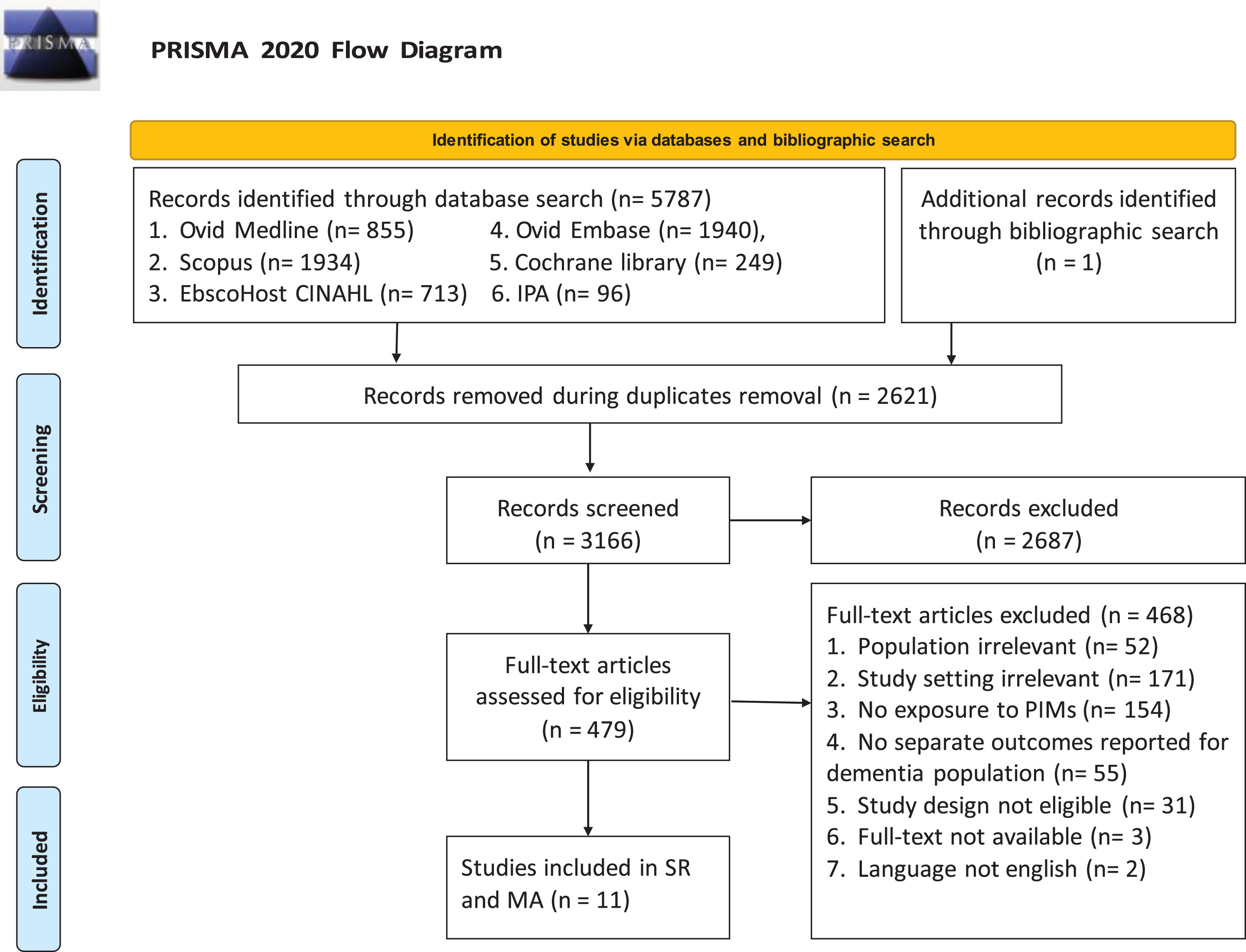
PRISMA diagram of the literature selection in this systematic review and meta-analysis.
Data extraction
Data extraction from eligible studies was completed using a Microsoft ® Excel ® (Office 365 ProPlus Version 1906) spreadsheet. Two researchers (RS and JKG) independently extracted data from all included papers. No authors of the selected studies, including those of the conference abstracts, were contacted for missing information or clarification. We relied solely on the information available in the published articles and abstracts. The extracted data included the basic characteristics of the included studies such as author details, year of publication, country, study design, sample size, mean or median number of comorbidities, mean or median number of drugs, type of clinical outcomes (proportion of patients prescribed at least one PIM, total number of PIMs prescribed, PIM full list (includes all the medications considered PIMs for older adults, regardless of cognitive status. The full list encompasses the drugs mentioned in the Beers Criteria (2003, 2012, 2015, 2019) and the STOPP criteria (2012 & 2015 criteria), PIMcog (focuses specifically on medications deemed PIMs for older adults with cognitive impairment or dementia), proportion of patients on polypharmacy or hyper-polypharmacy, number of changes in a prescribed medication, reduced PIMs prescribing in a patient, changes in drug-related problems, mortality, falls, hospital admission, changes in quality-of-life measures).
Risk of bias (quality) assessment
Two researchers (RS and JKG) independently performed the quality assessment for the included studies and cross-checked between themselves to ensure accuracy. Any disputes between researchers were settled through conversation or by consulting a third researcher (TP). The researchers used the Newcastle-Ottawa Scale (NOS) for evaluating the methodological quality of cross-sectional and cohort studies. 29 Furthermore, the NIH quality assessment tool was employed to assess before-after (pre-post) studies without a control group. 30
Statistical analysis
Meta-analysis was performed by using R software, version 4.3.2 (R Foundation for Statistical Computing). The estimates of PIMs, polypharmacy, and hyperpolypharmacy were expressed as proportions (%) with corresponding 95% CIn. The pooled mean prevalence was presented with 95% CIn. The I2 statistic was utilized to evaluate the extent of heterogeneity among the studies included in the systematic review. This statistic ranges from 0 to 100%, with values below 25% indicating low heterogeneity, values between 25% and 50% indicating moderate heterogeneity, and values above 50% indicating high heterogeneity. 31 As differences between the studies were high (95–99% inconsistency), a random effect model was used in all analysis. Sub-group analysis was performed for different countries, PIM criteria, publication year, study center, mean ages, mean or median number of medications, percentages of males. Tau2 (method of moments estimate of between-study variance) were used for each pooled estimate. The risk of publication bias was inspected by using the symmetry of funnels plot, and Egger’s test were also used. 32
RESULTS
In the process of systematic literature search, we identified a total of 5,787 references across various electronic databases. After removing 2,621 duplicates, 3,166 titles and abstracts were screened against our predefined inclusion and exclusion criteria. Full-text assessment of 479 potentially relevant studies resulted in 11 eligible studies, as shown in Fig. 1.
Characteristics of included studies
The 11 studies were conducted across 8 countries.33–46 Three studies were conducted in USA,38,44,46, 38,44,46 followed by two studies in Australia,33,35, 33,35 one study in UK, 36 India, 37 France, 39 Ireland, 40 Japan, 43 and Italy each, 45 respectively. All the studies included in the present study were published between 2008 and 2023.33–46 Sample size in the included studies varied from 46 to 1780, making a total of 4,571 patients. All the studies included both women and men; however, six studies out of 11 studies included more women than men (men = 48.9%; women = 51.2%). Among the studies, 5 were cross-sectional studies,33,37,38,43,45, 33,37,38,43,45 4 were cohort,39,40,44,46, 39,40,44,46 one was pre- and post-intervention feasibility study (PIM data before intervention was reported for this study) 35 and one was retrospective review. 36 Three studies reported data on the prevalence of polypharmacy (use of 5 to more medications per day),33,40,43, 33,40,43 and only one study reported data on hyper-polypharmacy (Use of ten or more medications per day). 33 Four studies reported PIM prevalence estimates based on the Beers criteria ® (Beers criteria ® 2003; n = 1, 38 Beers criteria ® 2012; n = 2,37,45, 37,45 Beers criteria ® 2019; n = 1, 44 three studies on the Beers criteria ® and STOPP/START criteria (Beers criteria ® 2012 and STOPP criteria 2015; n = 1, 33 Beers criteria ® 2015 and STOPP criteria 2015; n = 2,35,40, 35,40 while the rest of the studies used 2012 or 2015 Beers criteria ® and 2015 STOPP criteria in combination with other PIM criteria.36,39,43,46, 36,39,43,46 The characteristics of the included studies are summarized in Table 1. The mean or median number of medications prescribed among the study participants was greater than 5 drugs in most of the studies (7 studies).33,35,37,38,40,43,45, 33,35,37,38,40,43,45
Characteristics of included studies (n = 11)
AD, Alzheimer’s disease; VaD, vascular dementia; MCI, Mild cognitive impairment; FTD, frontotemporal dementia; DLB, dementia with Lewy bodies.
Global prevalence of PIM use
The prevalence of PIM use varied significantly, ranging from 20% to a notable 78% in the 11 analyzed studies.33–46 Through a comprehensive random-effects model analysis, the pooled prevalence of PIM usage was determined to be 38% among the combined patient cohort of 4,571 (95% CIn: 27% – 50%; p < 0.01). This analysis revealed a marked heterogeneity (I2 = 97%), suggesting considerable variability in PIM usage across different settings and populations, as depicted in Fig. 2.
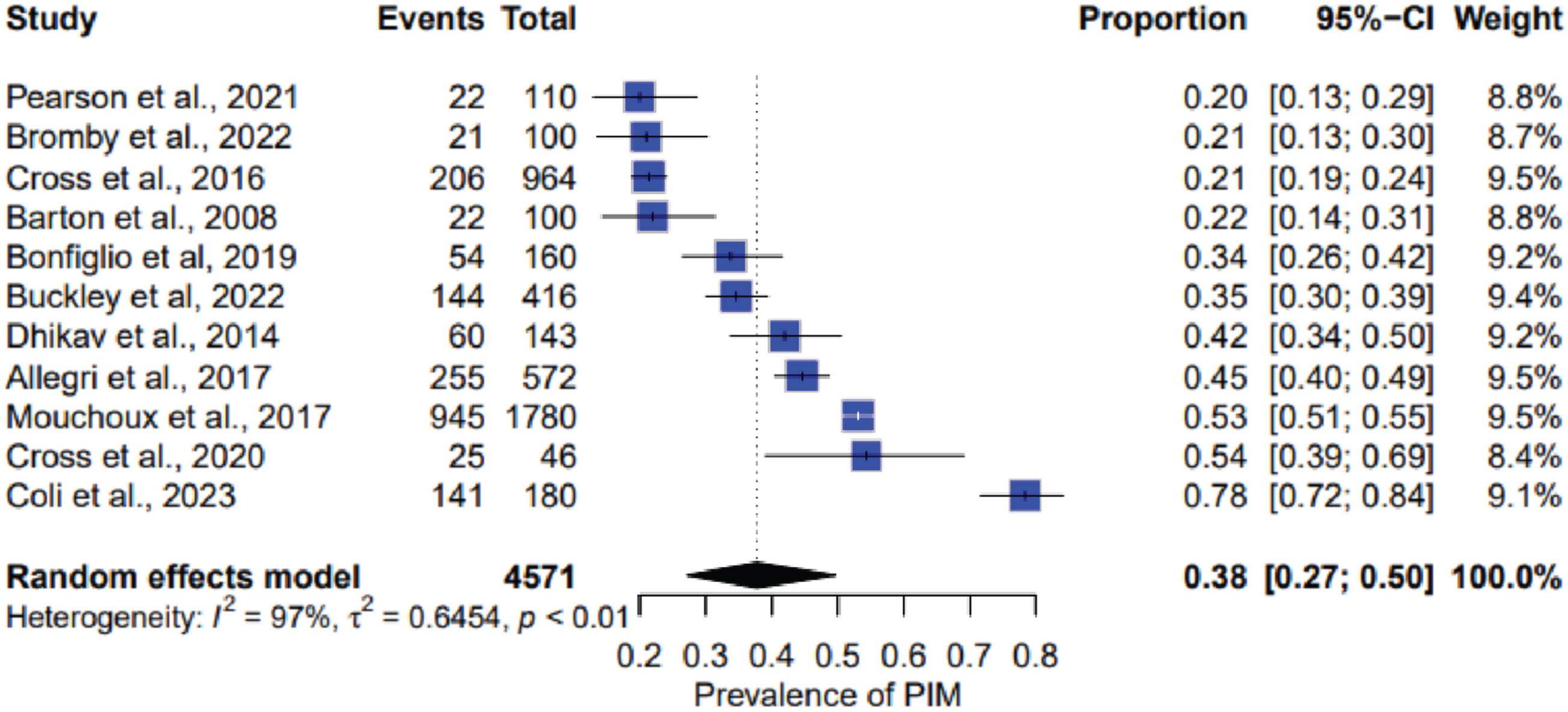
Pooled prevalence of PIMs in older adults with CI or dementia attending memory clinics.
Anticholinergics, benzodiazepines, and non-Benzodiazepine sedatives emerged as the most frequently identified PIMs, detailed further in Supplementary Table 2. Comparison of PIM proportion showed a higher pooled prevalence of 39% (95% CIn: 10% – 78%) for USA,38,44,46, 38,44,46 and 36% (95% CIn: 12% – 70%) for Australia.33–35 The variation in the prevalence of PIM use is further illustrated in the Supplementary Table 2.
Prevalence of polypharmacy and hyper-polypharmacy
Out of 11 publications, only 3 studies, comprising 1,540 participants, reported a prevalence of polypharmacy among older adults with CI or dementia.33,40,43, 33,40,43 The pooled prevalence of polypharmacy was 60% (n = 1,540, 95% CIn: 46% – 73%, p < 0.01; I2 = 95%) as shown in Supplementary Figure 1. It was not possible to do a subgroup analysis as there was only 1 study published in Australia, Ireland, and Japan each, respectively.33,41,43, 33,41,43 The study from Ireland reported higher prevalence of polypharmacy (70%; 95% CIn: 66% – 75%). 40 Finally, only one study investigated the prevalence of hyper-polypharmacy among this population. 33 The study elucidated that the prevalence of hyper-polypharmacy among the analyzed population was 17.6%. 33
Subgroup analysis
The subgroup analysis of the prevalence of PIM use by different countries, publication year, study design, study center, PIM criteria, mean or median age, mean or median number of medications, percentage of male participants is described in Supplementary Table 5. On the basis of country, the highest PIM prevalence was reported in France (53%), 39 and the lowest was reported in the study conducted in the UK (21%). 36 The analysis further highlighted the influence of PIM criteria on reported prevalence rates, with the highest prevalence noted when the Beers criteria ®, STOPP and ACB criteria were combined (78%, 95% CIn: 72–84%). 46 The prevalence of PIM use was higher among the hyper-polypharmacy participants (54%). 33 Differences were also observed based on study design, with prospective observational studies showing a higher prevalence of PIM use at 42% (95% CIn: 28–57%) compared to retrospective studies.
Quality of included studies
The quality assessment of the included studies was assessed using NOS adapted scale for the cross-sectional and cohort studies. The highest score was 9 and the lowest was 2. In the risk of bias assessment, six studies were of lower quality, with a NOS score of <7. One pre-post feasibility study was of poor quality, based on the NIH quality assessment tool for before-after (Pre-Post) study without control group. 35 Detailed description on the quality assessment of the included studies is presented in Supplementary Tables 3 and 4.
Publication bias assessment
The Egger’s test result suggests that there is no statistically significant evidence of publication bias, based on the linear regression test of funnel plot asymmetry (p = 0.3903) as shown in Supplementary Figure 2. However, the high level of heterogeneity indicated by Tau2 (Tau2 = 40.0013) suggests that factors other than publication bias might be contributing to the variability among study results. These could include differences in study populations, interventions, outcomes measured, or study quality.
DISCUSSION
To the best of our knowledge, this is the first meta-analysis to assess the pooled prevalence of PIMs, polypharmacy, and hyper-polypharmacy use among older adults attending memory clinics, with CI or dementia. This SR analyzed data from 11 studies, nearly 4,571 people from 8 countries, reported 38% prevalence among this population.33–46 Tian et al. conducted a SLR and MA to estimate the overall prevalence of PIM use in outpatient services. 48 It analyzed 94 studies encompassing nearly 371.2 million older patients from 17 countries, revealing a global pooled prevalence of PIM use at 36.7%. 48 This study underscores significant regional differences and an increasing trend in PIM use over the past two decades. Compared to the Tian et al. meta-analysis results, we found a similar prevalence of PIM use in older adults with dementia or CI attending memory clinics.33–46
This meta-analysis builds upon and extends the findings of Hukins et al., who reported a wide range of PIM prevalence among older adults with dementia across various healthcare settings, with rates from 14% to 74%. 47 Our study reveals a 38% prevalence of PIM use. The PIMs prevalence in this SLR ranges between 27 to 50%. This range emphasizes the consistently observed variability in PIM usage across different settings and populations, underlining the complexity of medication management in dementia care. This similarity suggests a consistent variability in PIM use not just broadly across healthcare settings, but also specifically within memory clinics. Both our study and Hukins et al. identified anticholinergics and benzodiazepines as the most commonly prescribed PIMs, highlighting the ongoing challenge of prescribing safe and appropriate medications for older adults with dementia. 47 Moreover, our study advances the discussion on methodological inconsistencies highlighted by Hukins et al. We delve deeper into the variation in PIM prevalence by incorporating a broader array of PIM criteria, including the Beers criteria ® and STOPP/START criteria, and analyzing their impact on prevalence rates. One significant factor affecting the variability in PIM prevalence rates is the differences in the availability and commonality of certain drugs across countries. Some medications included in the Beers criteria ® may not be available or commonly prescribed in European countries, and vice versa. Moreover, the discontinuation of drugs like propoxyphene, due to unfavorable risk-benefit profiles, further emphasizes the importance of staying current with these updates. 49 This can lead to variations in reported PIM prevalence when different criteria are applied. Furthermore, the inclusion of different drugs in these tools can thus have a substantial impact on the calculation of PIM prevalence. For example, a drug that is considered potentially inappropriate in one set of criteria may not be listed in another, leading to different prevalence rates. Additionally, the regional prescribing culture, influenced by national guidelines, availability, pharmaceutical marketing, and healthcare policies, can also impact the usage patterns of medications, thus influencing the prevalence of PIMs. This approach sheds light on the critical influence of assessment tools on reported outcomes, echoing Hukins et al.’s observations about the variability in tool application across studies. 47
The sub-group analysis revealed a difference in the prevalence of PIMs use among the older adults with CI or dementia, which could be due to inclusion of a limited number of studies, smaller sample size, or variability in how PIMs were defined and measured across different studies and countries. Three studies were conducted in USA,38,44,46, 38,44,46 and 2 studies were conducted in Australia,33,35, 33,35 where the level of PIM use ranged from 20- to 78%. A notable aspect of our analysis was the variability in PIM prevalence across different geographic locations, with higher rates observed in the USA and Australia.33,35,38,44,46, 33,35,38,44,46 This underscores the influence of regional prescribing practices and healthcare policies on medication management.
Currently, most studies mainly evaluate the use of PIMs through criteria that are mainly divided into 3 categories: explicit criteria, implicit criteria, and mixed criteria. Among them, explicit criteria were the most commonly used criteria to evaluate PIM use. The inability to conduct subgroup analysis based on the different versions of the Beers criteria ® (2012, 2015, or 2019) within our systematic review and meta-analysis could be attributed to several factors inherent to the data and study design variability among the included studies, small number of relevant number of studies included in our analysis. The increasing global burden of PIM use among older adults with dementia or CI underscores the critical need for healthcare providers and policymakers to prioritize the optimization of pharmacotherapy in this population. This includes implementing regular medication reviews, promoting the use of updated PIM criteria like the Beers criteria ® and STOPP/START criteria, and considering the patient’s comprehensive clinical context to minimize the risks associated with polypharmacy and enhance patient safety.
Polypharmacy and hyper-polypharmacy are associated with PIM use in older adults, leading to adverse clinical outcomes. 50 The older adults with dementia or CI have worse health and more multimorbidity than those without dementia, which increases the risk of prescribing PIM. 51 In a meta-analysis of polypharmacy and PIM prevalence in older patients in China, polypharmacy was found to be a risk factor for PIM use. 51 The prevalence of polypharmacy ranged from 53.2% to 89.8% in studies including older people with CI. 51 The prevalence of polypharmacy was higher in older people living with dementia (56.7% to 83.7%) versus in those with no dementia diagnosis (51.5% to 76.8%). 51 In our SR, the pooled estimates showed a similar prevalence (46% to 73%) compared to other studies conducted on older adults with CI or dementia attending different healthcare settings. The effect of documenting PIMs varies between the PIMcog list, which focuses on cognitive impacts, and the full PIM list, addressing a broader range of risks. While PIMcog is crucial in neurocognitive settings to prevent exacerbation of cognitive decline, the full PIM list offers comprehensive protection against various adverse effects. Given that primary care often manages neurocognitive disorders with limited resources, enhancing primary care’s capacity through education, decision-support tools, and policy measures is essential. Collaboration with specialized memory clinics can ensure integrated care, combining primary care’s broad reach with specialized expertise. Addressing PIMs effectively requires a public health approach, emphasizing regular PIM reviews and public awareness to optimize patient outcomes across the continuum of care.
A notable observation from our study is the extensive reporting on the mean or median number of medications prescribed to these patients. However, there appears to be a gap in the literature regarding the reporting on the proportion of patients prescribed with polypharmacy and hyper-polypharmacy. This lack of detailed data limits our understanding of the full scope of polypharmacy and its implications for patient care and outcomes.
Moreover, the gap in detailed reporting on polypharmacy and hyper-polypharmacy prevalence calls for further research in this area. Future studies should aim to provide more granular data (types of medications prescribed, doses, duration of use) on the extent of polypharmacy and hyper-polypharmacy in this population, including the associated risks, outcomes, and potential strategies for intervention. Addressing this gap in the literature is essential for developing targeted approaches to reduce the burden of polypharmacy use and improve the overall quality of care for older adults with dementia or CI attending memory clinics.
This study has several limitations that need attention. First, the small number of studies that could be included in the meta-analysis limit the robustness and generalizability of the findings. Second, the small number of studies included from each country may skew the understanding of PIM prevalence. An important gap identified in our analysis is the variation in the definition of PIM across studies. Specifically, some studies used the full PIM lists (e.g., Beers, STOPP), while others focused only on sections relevant to cognitive impairment (PIMcog). This discrepancy likely affects the reported prevalence rates, with studies using the full list generally showing higher prevalence compared to those using only PIMcog sections. This geographic bias could lead to overestimation or underestimation of PIM use in certain regions, affecting the global applicability of the findings. One limitation of our study is the lack of consistent reporting on the dementia state, such as MMSE scores or dementia stages, across the included studies. The dementia stage can significantly affect the prevalence of certain medications, such as antipsychotics for managing behavioral and psychological symptoms of dementia. More advanced stages of dementia may show higher use of these medications, potentially influencing the overall prevalence of PIMs. Future research should aim to include and report dementia severity to provide a more nuanced understanding of its impact on medication use. The wide range in sample sizes, from a few hundred to several thousand participants across the included studies, may contribute to higher heterogeneity in the study outcomes. The presence of lower quality studies as indicated by NOS scores of less than 7, and classification of one study as poor quality using the NIH tool highlight significant methodological weaknesses within the included studies. The language restriction in the search strategy introduces bias by excluding potentially valuable studies conducted in non-English languages. Lastly, the inclusion of studies that specifically targeted patients at high risk of DRPs and those already using PIMs may influence the reported prevalence of PIM use. For instance, the Cross 2020 study included patients based on the presence of PIMs or other high-risk criteria, which likely contributed to higher prevalence rates. 35 This selection bias is an important factor to consider when interpreting the overall pooled prevalence of PIMs. Future research should aim to include a more representative sample of the memory clinic population to provide a more accurate estimate of PIM prevalence.
Conclusion
Our study highlights the prevalence of potentially inappropriate medication (PIM) use among older adults with dementia or CI, emphasizing the need for improved medication management and research on polypharmacy and hyper-polypharmacy. Addressing these challenges is essential for enhancing patient safety and care quality in this vulnerablepopulation.
AUTHOR CONTRIBUTIONS
Rishabh Sharma (Conceptualization; Formal analysis; Investigation; Methodology; Writing – original draft; Writing – review & editing); Jasdeep Kaur Gill (Conceptualization; Formal analysis; Methodology); Manik Chhabra (Methodology; Writing – review & editing; Formal analysis; Visualization); Caitlin Carter (Conceptualization; Methodology; Resources); Wajd Alkabbani (Formal analysis; Visualization); Kota Vidyasagar (Formal analysis; Visualization); Feng Chang (Writing – review & editing); Linda Lee (Writing – review & editing); Tejal Patel (Conceptualization; Data curation; Methodology; Project administration; Supervision; Writing – original draft; Writing – review & editing).
Footnotes
ACKNOWLEDGMENTS
The authors have no acknowledgments to report.
FUNDING
The authors have no funding to report.
CONFLICT OF INTEREST
The authors have no conflict of interest to report.
DATA AVAILABILITY
The data supporting the findings of this study are available within the article and/or its supplementary material.
