In the present formulation, we used a theoretical approach to observe the behavior of electromagnetic wave scattering from a time reversal symmetry protected/broken topological insulator cylinder of infinite length, when coated with isotropic plasma layer. By using constitutive relations of topological insulator in Maxwell’s equations, electromagnetic scattered and transmitted field equations were refined and expanded in terms of cylindrical wave vector functions. After applying boundary conditions at both interfaces, scattering coefficients were obtained. Scattering behavior was observed by varying isotopic plasma parameters, i.e., plasma density, collisional frequency and core radius. After analyzing the computational results, it was noticed that the scattering behavior of time reversal symmetry protected and symmetry broken topological insulator can be tuned by varying the plasma parameters.
After the remarkable discovery of topological insulators by Kane and Mele [1], many researchers from all over the world started exploring the different aspects of topological insulators [2, 3, 4, 5, 6, 7]. The topological insulators basically composed of ordinary insulators with bulk energy gap, but also contains gapless edges or surface states having bulk energy gap with the time-reversal symmetry. When an external applied magnetic field is applied, the bulk energy gap opens and the time reversal symmetry get broken. In this case a topological insulator purely behave as an insulator, both as bulk and on the surface [8]. This exclusive feature of topological insulators (TIs) results in numerous rare physical properties. In addition to many interesting electronic and transport properties of topological insulators many other unique properties also exist, i.e., quantized topological magneto-electric (TME) effect and magnetic/electric polarization produced by an applied electric/magnetic field [8, 9, 10, 11, 12].
The electromagnetic/magnetoelectric effect of topological insulator is governed by Lagrangian given by [13].
In the above equation and stands for permittivity and permeability, while and represents the electric field, magnetic flux densities, magnetoelectric polarizability and fine structure constant respectively, where [14].
Plasma has been considered as highly ionized state of matter consisting of ions, free electrons [15]. When plasma realized as metamaterials, it finds exceptional usage in telecommunication, defense technology and photonic crystals made up of plasma [16, 17, 18]. Due to exotic properties of plasma, many researchers used plasma as coating material on cylinder and sphere of different materials [19, 20, 21, 22, 23, 24, 25]. Many researchers considered cylinder, sphere and waveguide made up of topological insulators and performed many theoretical investigations have been carried out to analyze the scattering behavior of electromagnetic wave. Ge et al. [26] investigated the unusual scattering behavior of electromagnetic wave from topological insulator cylinder, when its time reversal symmetry is broken/protected. Zeng et al. [27] observed that the scattering behavior of electromagnetic wave from topological insulator cylinder, when time reversal symmetry is kept protected, is completely different from time reversal broken symmetry. Scattering width of topological insulator when hosted by chiral medium was investigated by Ashraf et al. [28]. Scattering characteristics of electromagnetic wave from metamaterial coated topological insulator was theoretically studied by Abbas et al. [29]. Many researchers carried research out on scattering on topological cylinder and sphere [30, 31]. However, the problem of electromagnetic wave scattering from topological insulator coated with isotropic plasma has not been studied yet.
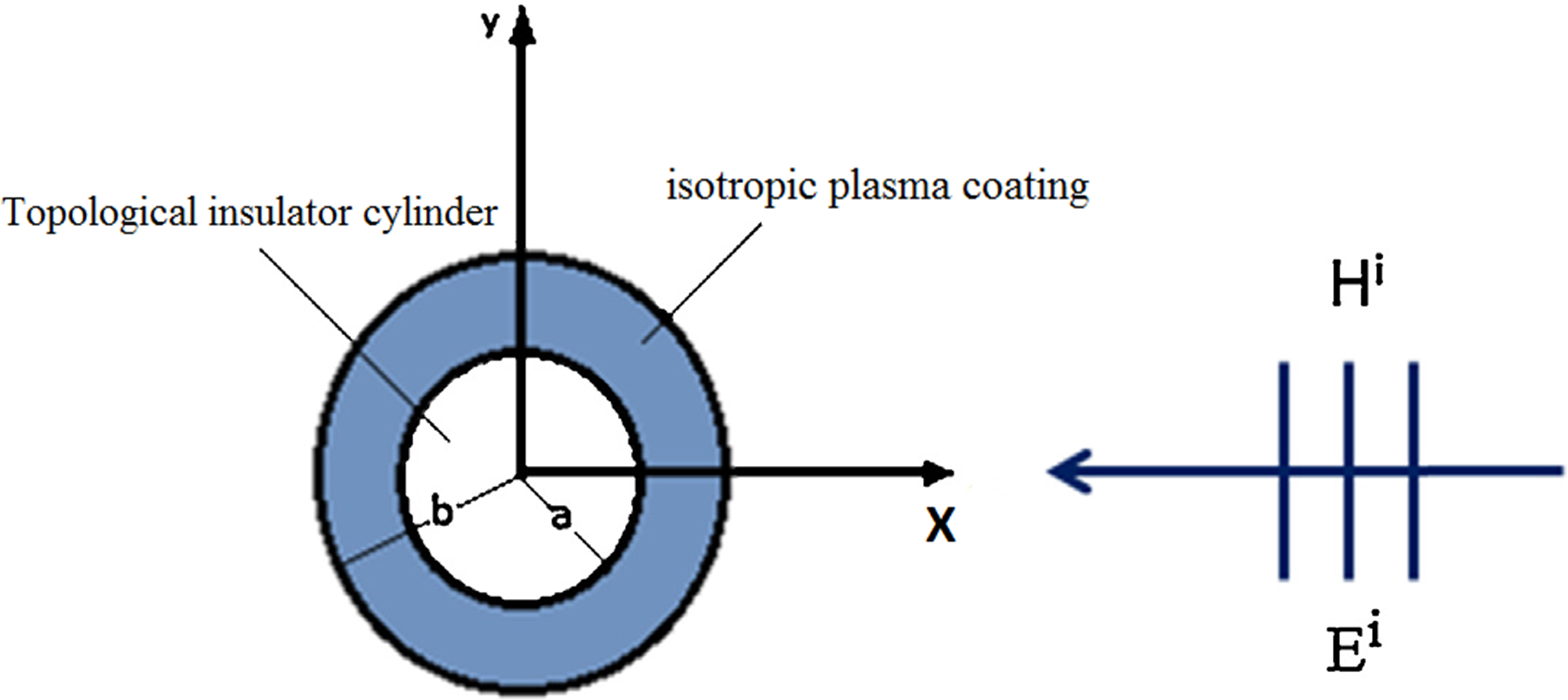
Geometry of presented scattering problem.
The plasma coated topological insulator cylinder can be physically modeled as; when a space craft embedded in ionosphere or come back to earth’s zone, a layer of plasma layer will be produced on its surface due to violent collisions. For the sake of mathematical formulation simplicity, coating layer has been considered of uniform thickness. In order to expand the electromagnetic fields equations, cylindrical wave vector functions were used. The geometry of the present problem was divided into three regions as depicted in Fig. 1. Free space region is termed as 1, free space-plasma coating layer has been considered as region 2 and plasma layer-topological insulator cylinder has been demonstrated by region 3. Scattering coefficients were deduced by enforcing boundary conditions at both interfaces. Echo width (co-polarized and cross-polarized) were calculated by using scattering coefficients, and under special conditions, were compared with already published literature to verify the accuracy of the presented formulation. The time dependence of maintained throughout the mathematical formulation.
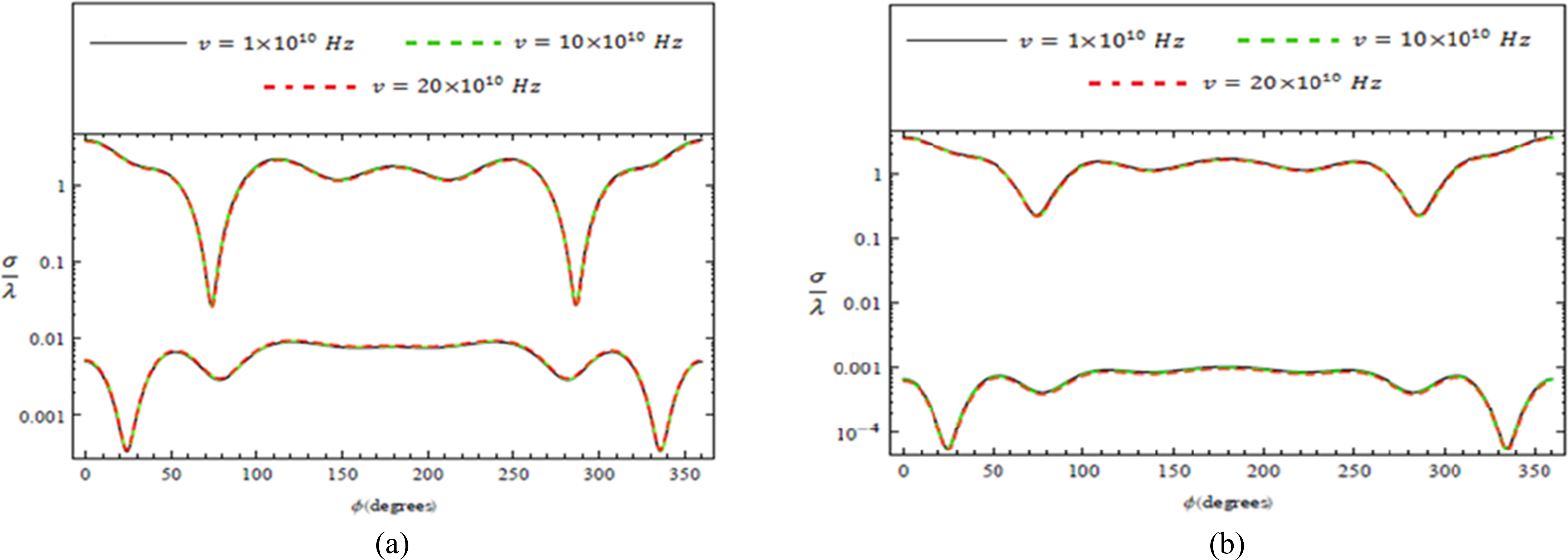
Formulations
The geometry of electromagnetic scattering from topological insulators cylinder coated with isotropic plasma is shown in Fig. 1. TIs cylinder of infinite extent was coated with isotropic plasma parallel to -axis. The coating layer of plasma was considered uniform throughout the formulation. Radius of the coated TIs cylinder was with coating and without coating as shown in the Fig. 1. The electromagnetic wave interaction with isotropic plasma coated topological insulator cylinder is governed by Helmholtz equation , where represents either field or field and is corresponding wave vector. The constitutive relations of both isotropic plasma and topological insulator cylinder are used in Maxwell’s curl postulates for further calculations and are given below.
Topological Insulator
Isotropic Plasma
The whole geometry was divided into three regions. Region 0 is the external medium, i.e. is free space with permittivity , permeability and wavenumber . The medium with wave number is named as region 1, where represents the relative permeability of isotropic plasma medium which is typically and is the relative permittivity of isotropic plasma medium which can be defined in terms of plasma density and collisional frequency as
Where with a plasma density, electron charge, mass of electron, incident frequency, collisional frequency and . While has been considered as region 2 (TIs cylinder core) with relative permittivity , relative permeability and as wavenumber.
If a parallel polarized electromagnetic field propagates along negative -axis and normally incident on ferrite coated electromagnetic conductor cylinder, then the incident electric field in terms of cylindrical coordinates () can be written as
By using the wave transformation the incident electric field in the form of Fourier-Bessel series can be written as
By using Maxwell equations, the corresponding magnetic flux density in the direction of will be calculated as
Where the Bessel function of first kind and its derivative with respect to whole argument is represented by and , respectively. Scattering field from topological insulator cylinder contains cross-polarized component because of magnetoelectric effect. So the scattering field in region by using Maxwell equations can be written as
The total field in the region bounded by two interfaces and in terms of oppositely travelling cylindrical waves can be written as
The total field in the region 3 is:
Equations (7)–(9) contains unknown coefficients, which can be obtained by implementing the below boundary conditions.
where and .
By using Eqs (7)–(9) in above mentioned boundary conditions (Eqs (10)–(17)) eight sets of equation were obtained, which can be written in matrix form as below.
Co and cross-polarized coefficients can be deduced by solving the above matrixes. By using these coefficients in below equations, co-polarized and cross-polarized scattering width can be obtained as
Conversion of present formulation to other materials
Material
PEC
0
1
PMC
0
1
Nihility
0
TIs
100
1
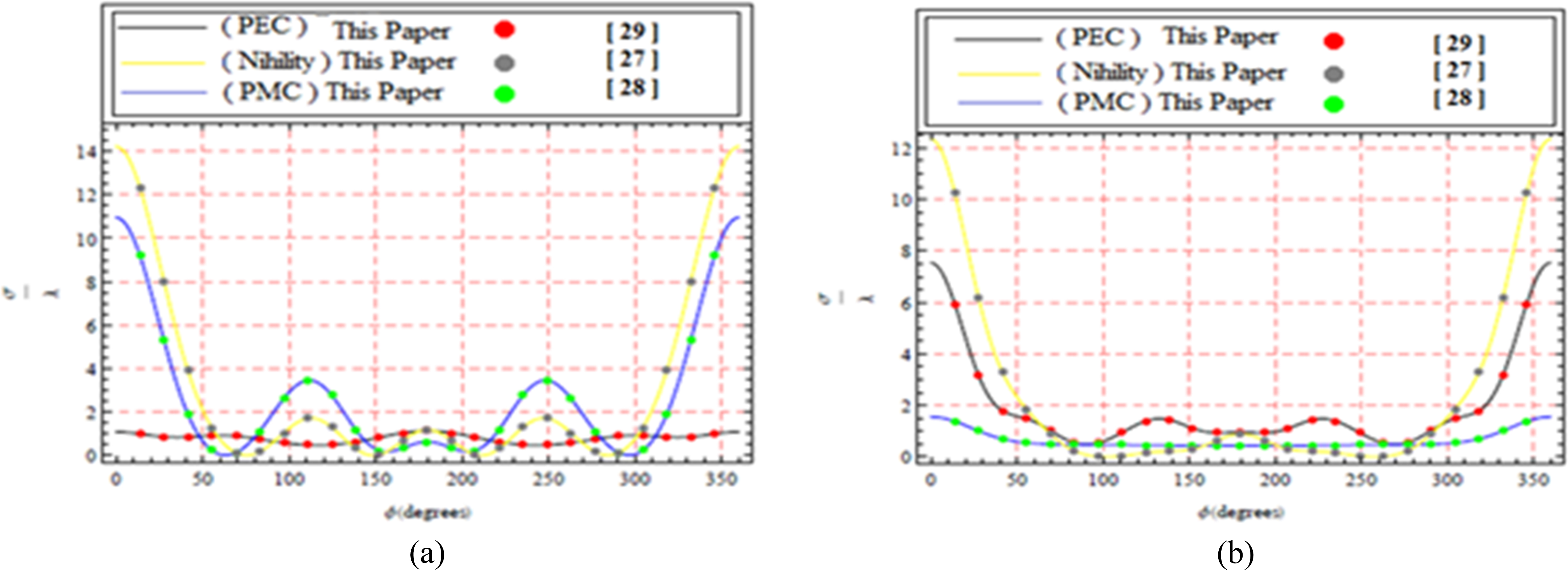
(a) and (b) represents the forward scattering echo width of PEC, PMC and nihility cylinder when 5 cm, 10 cm, 1 GHz with already published literature (a TE case, b TM case). 1 GHz with already published literature.
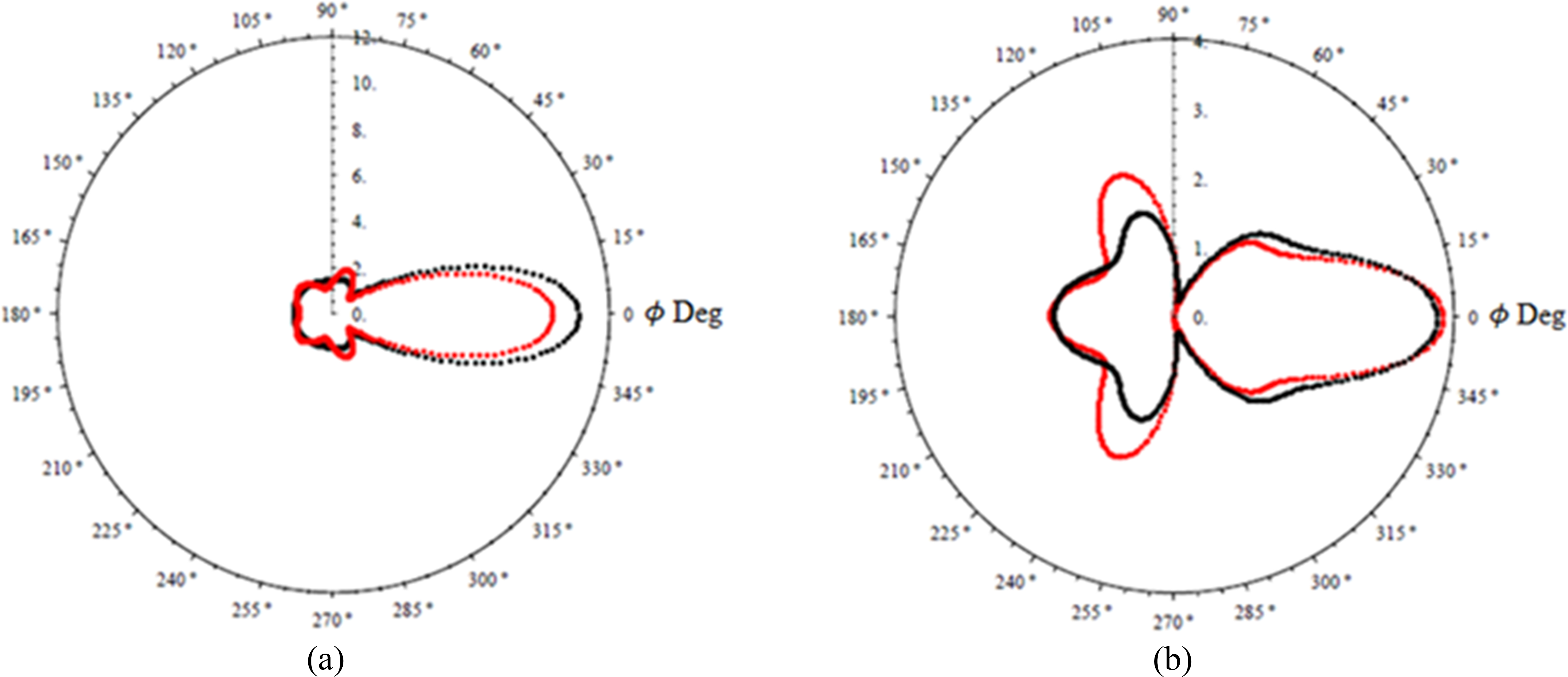
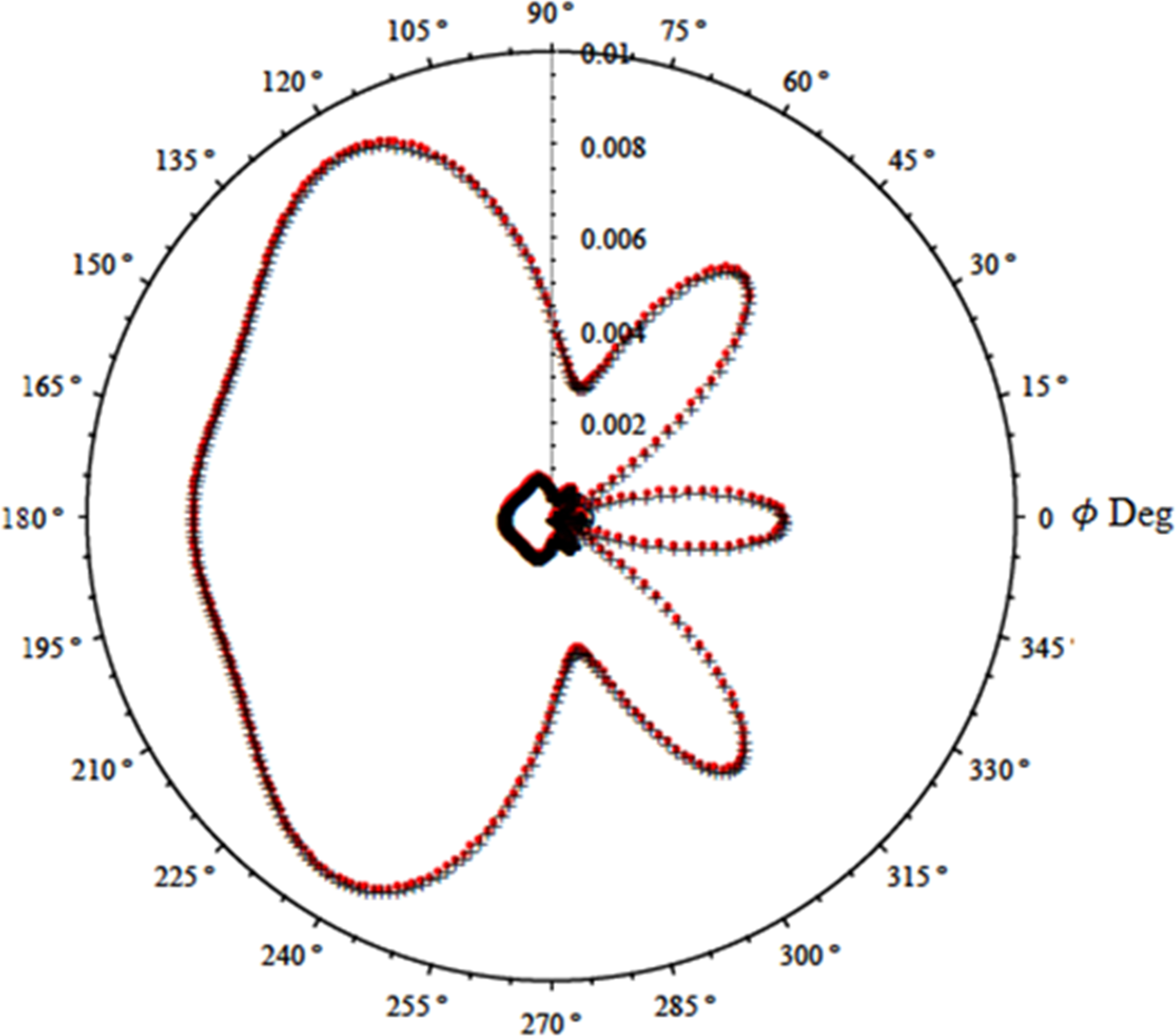
Polar plot of forward-scattered echo width of topological insulator cylinder coated with isotropic plasma under (a) TM polarization and (b) TE polarization .
Results and discussion
In the present section, we demonstrated the obtained results from analytical formulation of electromagnetic scattering from isotropic plasma coated topological insulator cylinder of infinite length in graphical form. In order to confirm the accuracy of mathematical formulations and developed MATHEMATICA codes, the obtained results were compared with the already published literature by using following conversion given in the Table 1.
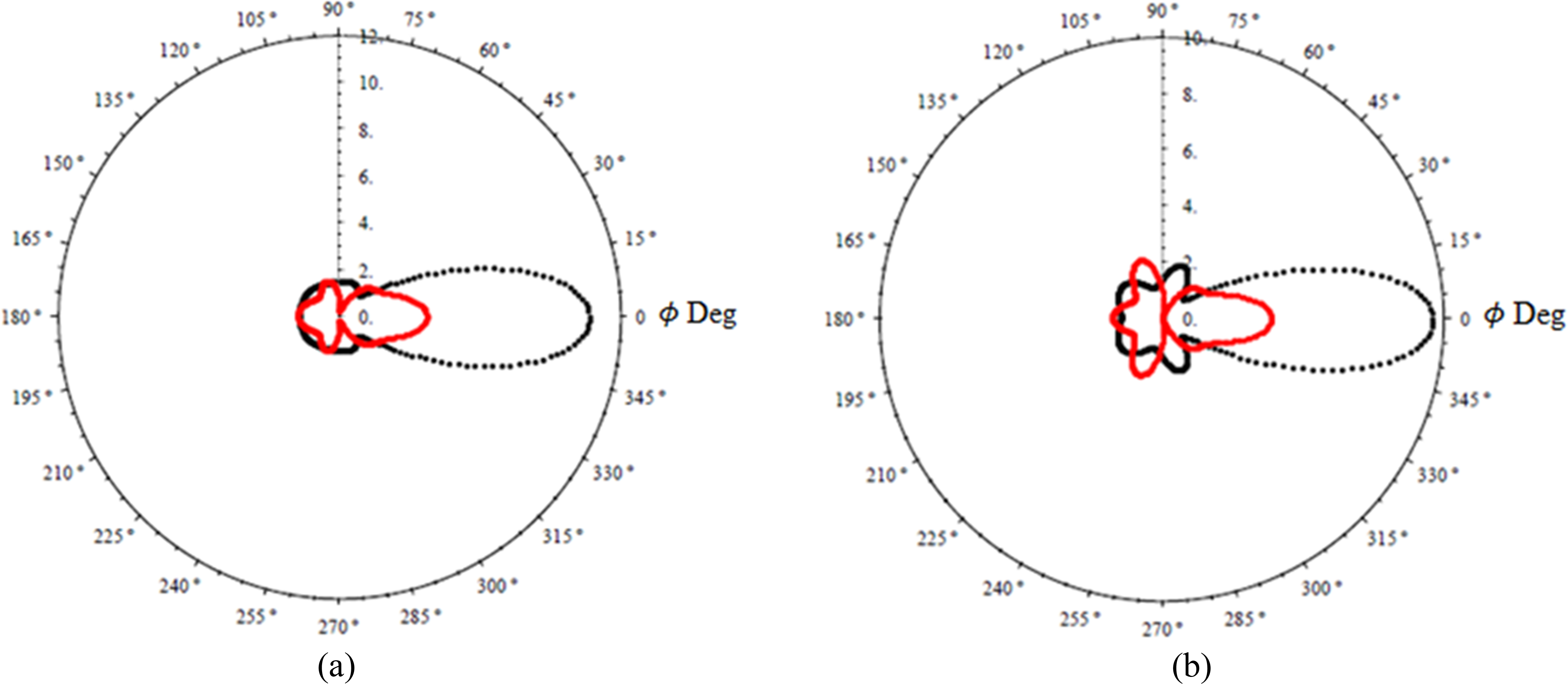
Comparison between TM and TE polarization of forward-scattered echo width of topological insulator cylinder (a) and (b) .
Backscattered echo width of topological insulator cylinder under TM and TE polarization, at and .
Figures 2a and b represents the comparison between echo widths of isotropic plasma coated cylinder of infinite length made up of different materials, i.e., perfect electric conductor PEC, perfect magnetic conductor PMC and Nihility by using conversion values presented in Table 1 and also compared with already published work [32, 33, 34], under perpendicular polarization (TE) and parallel (TM) respectively. By implementing the above specified boundary conditions, a MATHEMATICA code was developed by taking (number of truncation) from 1 to 30 and forward scattered and back scattering echo widths were calculated and represented in graphical form. To compare the results, following parameters were considered 5 cm, 10 cm, 1 GHz. The obtained results and publish literature were found in great agreement, as shown in Figs 2a and b, which confirms the accuracy of present formulation.
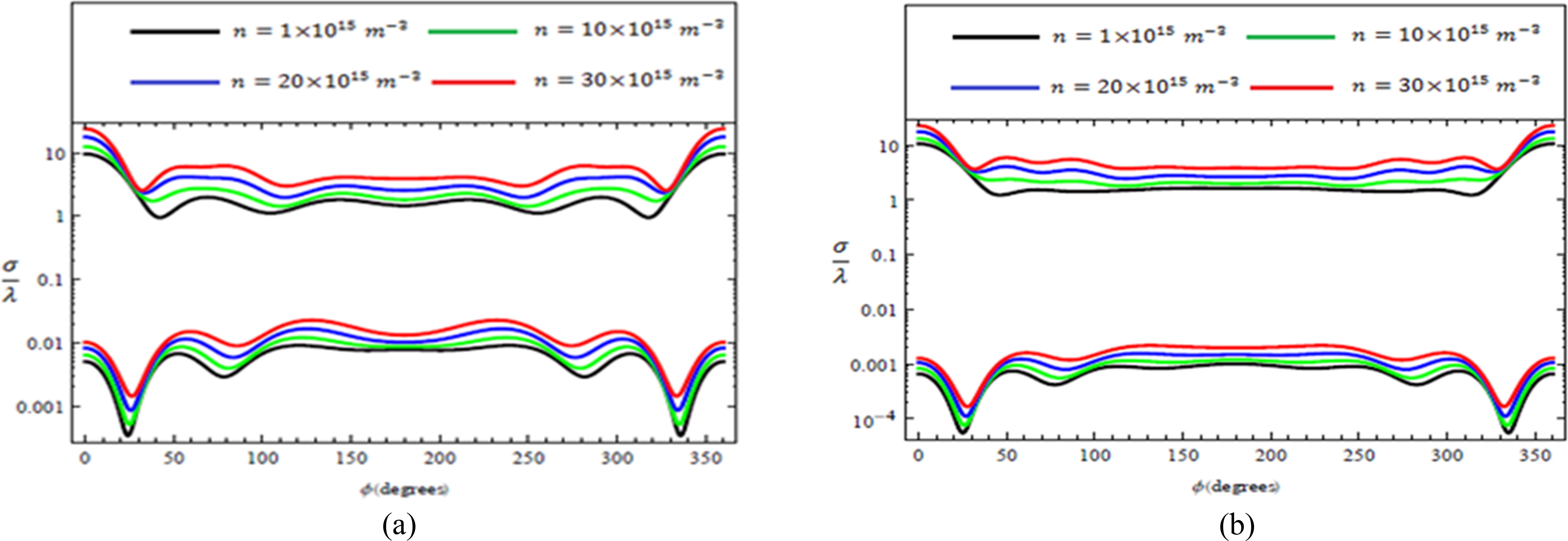
Forward and backscattered echo widths of topological insulator cylinder respectively, for TM polarization case at different values of plasma densities (a) and (b) .
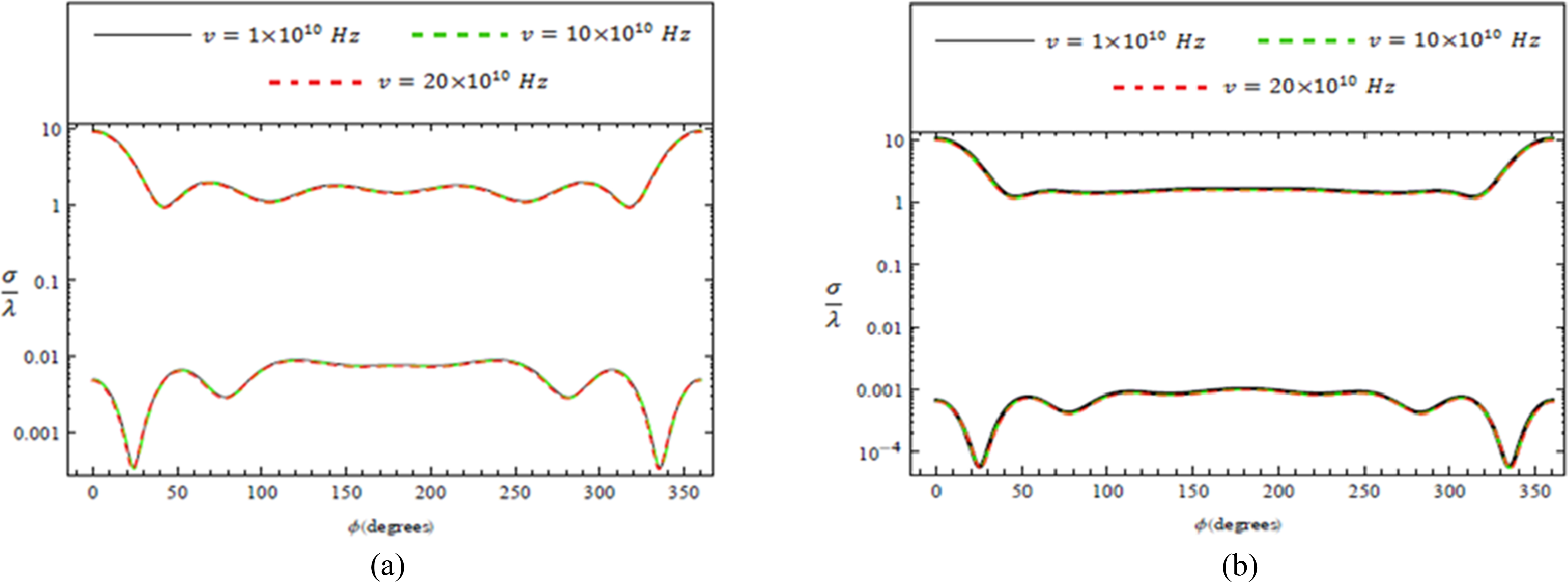
Forward and backscattered echo widths of topological insulator cylinder respectively, for TM polarization case at different values of plasma collisional frequency (a) and (b) .
Figure 3 represents the polar plot of forward scattered echo with of the isotropic plasma coated topological cylinder under TM polarization and TE polarization at and . By analyzing the polar graphs, it was observed that the maximum value of echo width for both cases were numerically observed at , however the maximum magnitude of echo width for has higher value than as depicted in Fig. 3a. The polar plot of forward-scattered echo width under TE polarization has been considered and shown in Fig. 3b for two cases, i.e., and . By observing the Fig. 3b, it was noted that both case near about share same polar pattern, however the magnitude of later case, i.e., was higher. The maximum value of forward scattered echo width also occurred at as that of Fig. 3a. The comparison between TM and TE cases when and was demonstrated graphically in Figs 4a and b respectively. From these figures, it was concluded that the magnitude of TM case followed higher magnitude than TE case, no matter we choose any angle of . The back-scattered echo width of both TE and TM polarization depict the same behavior also same magnitude as shown in Fig. 5, however the maximum value of back scattered echo width occurred at and magnitude of was higher then case. Throughout the analysis in Figs 3 to 9 we have considered 5 cm, 10 cm, 3 GHz, Hz, 100, .
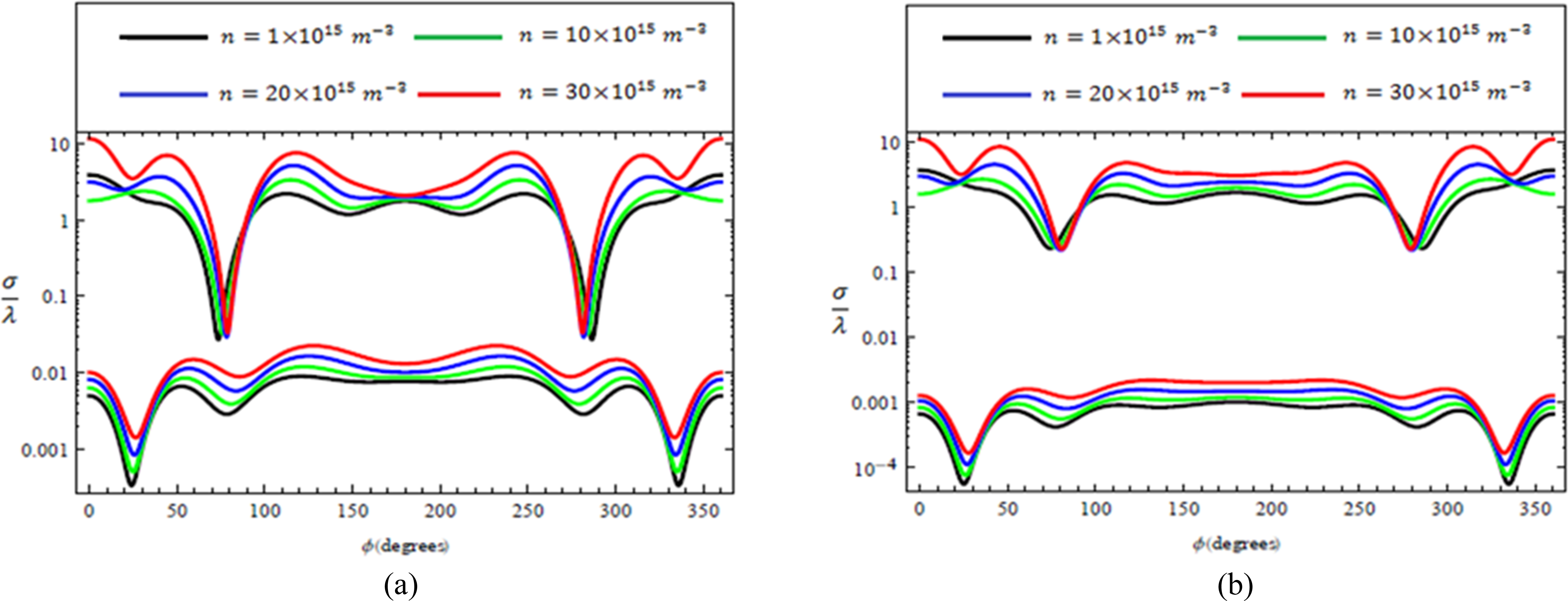
Forward and backscattered echo widths of topological insulator cylinder respectively, for TE polarization case at different values of plasma densities (a) and (b) .
Forward and backscattered echo widths of topological insulator cylinder respectively, for TM polarization case at different values of plasma collisional frequency (a) and (b) .
Figure 6 represents the obtained results of forward and backscattered echo width of plasma coated topological insulators cylinder for TM polarization case at different values of plasma density when the time reversal symmetry of topological insulator cylinder is protected, i.e., and when the time reversal symmetry of topological insulator is broken, i.e., respectively. It was noticed that when symmetry breaks the behavior of echo width (forward and back scattered) changes as compared with time symmetry protected topological insulator cylinder, which can be verified from Figs 6a and b. By increasing the values of plasma densities, both forward and backscattered echo widths also depicted increasing behavior (no matter time reversal symmetry is protected or broken). In order to, analyze the effects of effective collisional frequency on both forward and back scattered echo with when the time reversal symmetry is protected and broken, results were calculated and shown graphically in Figs 7a and b respectively for TM polarization case. It was concluded that collisional frequency did not affect the behavior and magnitude of both forward and backscattering echo widths. Figure 8 represents the behavior of forward and backscattered echo widths of plasma coated topological insulator cylinder when its time symmetry is protected, i.e., and when we take (time reversal symmetry broken) for TE polarization case at different values of plasma density. From Figs 6 and 8 it was observed that for forward scattering echo width of TE case have more peaks then TM case. By increasing plasma density values both forward and backscattered echo width increases. The change in effective collisional frequency does not affect the forward and back scattered echo with no matter we chose any value of for TE polarization case as depicted in Figs 9a and b respectively.
Conclusion
The problem of time reversal symmetry protected/broken topological insulator cylinder, when coated with isotropic plasma layer were solved analytically. By studying the obtained results, it was reported that by varying plasma density both forward and backscattered echo widths of topological insulator cylinder can be tuned more effectively. It was further noticed that forward scattered and backscattered echo widths in both cases, i.e., TM and TE polarization are not dependent on effective collisional frequency of plasma. By comparing both TM and TE polarization forward and backscattering echo widths it was deduced that TM polarization show higher magnitude then TE case. Based on graphical results, it was concluded that the present work will be very help full for target protection and microwave controlling devices.
Footnotes
Acknowledgments
The authors would like to extend their sincere appreciation to The Deanship of Scientific Research (DSR) at King Saud University, Riyadh, Saudi Arabia for their financial support through the Research Group Project No. RGP-1438-020.
References
1.
KaneC.L. and MeleE.J., Z 2 topological order and the quantum spin hall effect, Physical Review Letters95 (2005), 146802.
2.
ChenY.P., Topological insulator-based energy efficient devices, in: SPIE Defense, Security, and Sensing (2012), 83730B-83730B-5.
3.
FuL.KaneC.L. and MeleE.J., Topological insulators in three dimensions, Physical Review Letters98 (2007), 106803.
4.
ZhangX. and ZhangS.-C., Chiral interconnects based on topological insulators, in: SPIE Defense, Security, and Sensing (2012), 837309-837309-11.
5.
QiX.-L. and ZhangS.-C., Topological insulators and superconductors, Reviews of Modern Physics83 (2011), 1057.
6.
HasanM.Z. and KaneC.L., Colloquium: Topological insulators, Reviews of Modern Physics82 (2010), 3045.
7.
QiX.-L.HughesT.L. and ZhangS.-C., Topological field theory of time-reversal invariant insulators, Physical Review B78 (2008), 195424.
8.
QiX.-L.LiR.ZangJ. and ZhangS.-C., Inducing a magnetic monopole with topological surface states, Science323 (2009), 1184–1187.
9.
TseW.-K. and MacDonaldA., Giant kerr effect and universal faraday effect in thin-film topological insulators, in: APS Meeting Abstracts (2010), 35001.
10.
TseW.-K. and MacDonaldA., Magneto-optical Faraday and Kerr effects in topological insulator films and in other layered quantized Hall systems, Physical Review B84 (2011), 205327.
11.
MaciejkoJ.QiX.-L.DrewH.D. and ZhangS.-C., Topological quantization in units of the fine structure constant, Physical Review Letters105 (2010), 166803.
12.
ChangM.-C. and YangM.-F., Optical signature of topological insulators, Physical Review B80 (2009), 113304.
13.
GrushinA.G.Rodriguez-LopezP. and CortijoA., Effect of finite temperature and uniaxial anisotropy on the Casimir effect with three-dimensional topological insulators, Physical Review B84 (2011), 045119.
14.
GrushinA.G. and CortijoA., Tunable Casimir repulsion with three-dimensional topological insulators, Physical Review Letters106 (2011), 020403.
15.
ChenF.F. and SmithM.D., Plasma, Wiley Online Library, 1984.
16.
SakaiO. and TachibanaK., Plasmas as metamaterials: A review, Plasma Sources Science and Technology21 (2012), 013001.
17.
LiW.ZhaoY.CuiR. and ZhangH., Plasma photonic crystal, Frontiers of Optoelectronics in China2 (2009), 103–107.
18.
EdenJ., Emergence of plasma photonics, Breakthroughs in Photonics 2010 (2011), 302.
19.
ChenH. and ChengD., Scattering of electromagnetic waves by an anisotropic plasma-coated conducting cylinder, IEEE Transactions on Antennas and Propagation12 (1964), 348–353.
20.
GhaffarA.YaqoobM.AlkanhalM.A.SharifM. and NaqviQ., Electromagnetic scattering from anisotropic plasma-coated perfect electromagnetic conductor cylinders, AEU-International Journal of Electronics and Communications68 (2014), 767–772.
21.
YaqoobM.GhaffarA.ShakirI.NazM.AhmedS. and NaqviQ., Electromagnetic scattering from a plasma coated perfect electromagnetic conductor cylinder placed in chiral metamaterials, Optoelectronics and Advanced Materials-Rapid Communications8 (2014), 488–494.
22.
YaqoobM.GhaffarA.ShakirI.NazM. and NaqviQ., Electromagnetic scattering from isotropic-plasma coated perfect electromagnetic conductor sphere, Optoelectronics and Advanced Materials-Rapid Communications9 (2015), 274–279.
23.
HamidA. and CoorayF., TE scattering by a perfect electromagnetic conducting semi-elliptic-cylindrical boss on a perfectly conducting plane, International Journal of Applied Electromagnetics and Mechanics38 (2012), 1–8.
24.
OussaidR. and HaraoubiaB., Behavior of a chiral material in terms of a guided wave propagation, International Journal of Applied Electromagnetics and Mechanics19 (2004), 631–635.
25.
HassanM.H.MughalM.J.AliM.M. and NaqviQ.A., Electromagnetic fields in a circular waveguide with DB-boundary conditions internally coated with chiral-nihility medium, International Journal of Applied Electromagnetics and Mechanics40 (2012), 27–35.
26.
GeL.ZhanT.HanD.LiuX. and ZiJ., Unusual electromagnetic scattering by cylinders of topological insulator, Optics Express22 (2014), 30833–30842.
27.
ZengL.SongR. and JianX., Scattering of electromagnetic radiation by a time reversal perturbation topological insulator circular cylinder, Modern Physics Letters B27 (2013), 1350098.
28.
AshrafF.AhmedS.SyedA. and NaqviQ., Electromagnetic scattering from a topological insulator cylinder placed in chiral medium, International Journal of Applied Electromagnetics and Mechanics47 (2015), 237–244.
29.
AbbasG.AhmedS.SyedA.A. and NaqviQ.A., Scattering from a topological insulator circular cylinder coated with DNG/MNG/ENG metamaterials, Optik-International Journal for Light and Electron Optics127 (2016), 2635–2641.
30.
ZengL.SongR.ZengJ.DaiC. and ZhaoZ., Electromagnetic scattering by a time reversal symmetry broken topological insulator sphere, Optik-International Journal for Light and Electron Optics124 (2013), 4319–4324.
31.
ZhaoY.GuiyunC. and LunwuZ., Scattering from a topological insulator elliptic cylinder, Optics and Spectroscopy118 (2015), 305–309.
32.
AhmedS. and NaqviQ.A., Scattering of electromagnetic waves by a coated nihility cylinder, Journal of Infrared, Millimeter, and Terahertz Waves30 (2009), 1044–1052.
33.
AhmedS. and NaqviQ., Electromagnetic scattering from a perfect electromagnetic conductor circular cylinder coated with a metamaterial having negative permittivity and/or permeability, Optics Communications281 (2008), 5664–5670.
34.
ShenC.L.Z., Electromagnetic scattering by a conducting cylinder coated with metamaterials, Progress In Electromagnetics Research42 (2003), 91–105.