






Abstract
Fecal incontinence caused by sphincter dysfunction is a difficult medical problem which has not been fully resolved. An artificial anal sphincter (AAS) is considered an eventual choice as prosthesis to maintain anal continence. Currently, Acticon Neosphincter, the only device certified by the US Food and Drug Administration can not maintain the long-term effectiveness. The crucial problem of this study was to keeping long-term biomechanical compatibility between the AAS and the surrounding tissue. This paper presented a design of an AAS with constant force or pressure using superelastic shape memory alloy (SMA) to solve the problem. A C-shaped superelastic SMA sheet was optimized to obtain constant force or pressure by combing finite element analysis with ANSYS and genetic algorithm in MATLAB. The result of optimization was validated by performing an experiment. The optimized model was embedding into the device to realize clamping the soft tissue with constant force, which was confirmed by experiments.
Introduction
Fecal incontinence caused by sphincter dysfunction is an unresolved problem which has a serious effect on patients, both physically and psychologically. Fecal incontinence is the inability to control the passage of feces through the anus [1–3]. The prevalence of fecal incontinence is estimated that about 1.4% of adults [4,5], 6–7% of elderly people and 10% of patients in elderly nursing homes suffer from FI [1,6–8]. Moreover, many patients have not been reported.
Fecal incontinence has many treatment options. Conservative treatment options include drug therapy and biofeedback. When conservative therapy is ineffective, surgical therapies may be considered, such as sacral nerve stimulation, sphincteroplasty, postanal repair, dynamic graciloplasty, or colostomy [8,9]. However, these options may be insufficient for patients having severe symptoms.
An AAS is a potential treatment method for such patients. Currently, the Acticon Neosphincter (AMS, Minnetonka, MN, USA), is the only device certified by the US Food and Drug Administration. The outcomes of clinical application of the device indicate that patients suffered from many complications, such as ischemic necrosis of soft tissues caused by excessive pressure. It is not a safe and effective device, and it can not maintain long-term efficacy [10].
The key problem of this research is to keeping long-term biomechanical compatibility between the AAS and the surrounding tissue. Clamping soft tissues with constant force or pressure within a safe range is considered as an effective solution for this issue. The idea that allows the restriction of clamping pressure within a safe range was presented by Luo [11,12]. This idea can be realized by using superelastic SMA in devices to limit the clamping pressure, which is based on the unique mechanical properties of an SMA during its stress-induced transformation.
This paper presented a novel AAS with constant force using C-shaped superelastic SMA sheet. The C-shaped SMA sheet has the advantage of smaller space occupation. The optimization design of a C-shaped constant force component was realized by combing finite element analysis with ANSYS and genetic algorithm in MATLAB, and the result of optimization is validated by performing the experiment. The constant force characteristic of the device is evaluated by experiment conducted in artificial intestine with various thicknesses.
Materials and method
A novel artificial anal sphincter
A schematic drawing of the proposed AAS in its open (left) and closing (right) state is shown in Fig. 1. It can be seen that the mechanism consists of two upper claw, two lower claw, two clamping elements, two superelastic SMA sheets and two ropes with position limit. The upper claw connected to lower claw by hinges, and the rope with position limit is a link between clamping element connected and upper claw. The geometric dimensions of superelastic SMA sheet are determined by the optimization in Section 2.2.
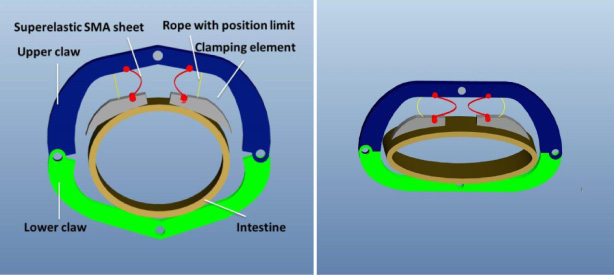
Schematic drawing of the proposed AAS in its open (left) and closing (right) state.
The designed constant force component is composed of a C-shaped superelastic SMA sheet, two sleeves and two pins. The structure of the model is shown in Fig. 2. The pins and sleeves are designed to simulate loading on ends of the sheet. The sleeves are rigid-connected to the superelastic SMA sheet. Connection between the sleeve and the pin is set as surface to surface contact. In simulation a 1/4 model is applied due to the symmetry. Symmetry constraints are applied on section B, C, D and E, as shown in Fig. 2. The degree of freedom in Y direction of area A is constrained and the displacement in X-direction of area A is applied.
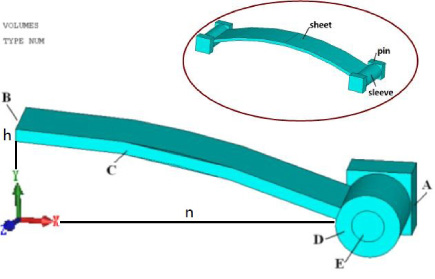
The C-shaped SMA model and its 1/4 part used in optimization simulation.
A Ti-55.9at%Ni SMA is used as the material of the sheet with thickness 0.15 mm and width 2 mm. According to the tensile test with SMA sheet of 0.15 mm in thickness, mechanical properties of the SMA are set as follows: From austenite to martensite the stresses of start and finish points of phase transformation are 311 MPa and 437 MPa respectively, and from martensite to austenite the stresses of start and finish points of phase transformation are 136.7 MPa and 26.7 MPa respectively. The modulus of elasticity is 30,051 MPa and the Poisson’s ratio is 0.3. The pin and sleeve is set to be rigid body with elastic modulus of 150,000 MPa and Poisson’s ratio of 0.3.
The equation for the initial C-shape curve of the sheet is y (x) = ax 2 +1, x ∈ [−n, n], in which a = −1∕n 2. Different initial shapes of the sheet can be obtained by changing values of n. In this case, n was defined as the design variable, and its lower and upper bounds is 4 and 15. The optimization goal is obtaining the maximal displacements range that has a nearly constant force.
A combination of finite element analysis with ANSYS and genetic algorithm in MATLAB is applied to achieve the optimization design of the C-shape SMA sheet. The genetic algorithm toolbox is used. The result of optimization design is validated by performing the experiment of solid model.
The intestine can be thickened caused by the stress shielding effect after implanting artificial sphincter. To measure the internal pressure of the artificial intestine with various thicknesses, single layer artificial intestine, two layers artificial intestine and three layers artificial intestine were prepared, as shown in Fig. 3. The internal pressure of the artificial intestine was measured with a gastrointestinal motility measurement system (Solar GI System, MMS) and a microtip catheter (Type: 3104-00-9722-D, Unisensor) connected to the system. As shown in Fig. 4, the microtip catheter was put into the artificial intestine to measure pressure, and the intestine was installed into the device. The initial pressure of the intestine depended on the displacement of the C-shaped superelastic SMA sheet. The internal pressure of the artificial intestine was monitored and collected simultaneously during the closing state of AAS.
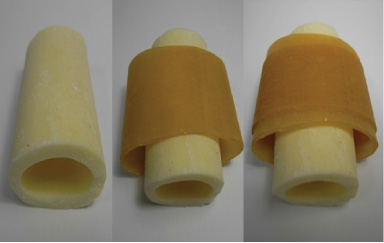
The artificial intestine models with three kinds of thicknesses for experiment.
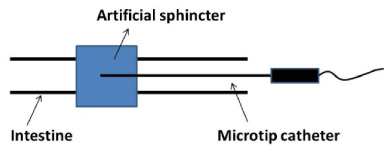
Schematic diagram of measurement for the internal pressure of intestine.
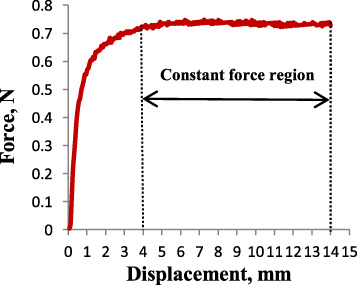
The corresponding experiment curve of the optimized solution.
Based on the optimization method combining finite element analysis with ANSYS and genetic algorithm in MATLAB, the obtained the optimal solution for the case was n = 8 mm. The number of computations with ANSYS is 18, and computational time is 12 hours. The solid model of n = 8 mm was fabricated, and the experimental setup was constructed for measuring the actual force-displacement curve. The experimental curve of the C-shaped sheet with n = 8 mm was shown in Fig. 5. It can be seen that curve slope remains nearly constant between displacement of 4 and 14 mm. The constant force region was approximately 71.4% of the entire input displacement. It was demonstrated that constant force can be obtained within a relatively large deformation range by varying the shape and the geometric parameters of superelastic SMA sheet.
As the force of C-shaped superelastic SMA sheet is proportional to its width, the clamping force to close the intestine canal can be obtained by adjusting the width. The force to close the intestine canal is decided by AAS occlusion pressure and the contact area of the intestine with the clamping element. An AAS pressure of 50 to 60 mmHg is thought be appropriate based on clinical experience [13]. The contact area of the intestine with a clamping element is established as 96 mm2. So the clamping force to close the intestine canal is 0.64 N to 0.77 N. In Fig. 4, the constant force region of the experimental curve with n = 8 mm was roughly 0.71 N. Therefore, the superelastic SMA with n = 8 mm, 0.15 mm in thickness, 2 mm in width can be as the constant force element of the AAS.
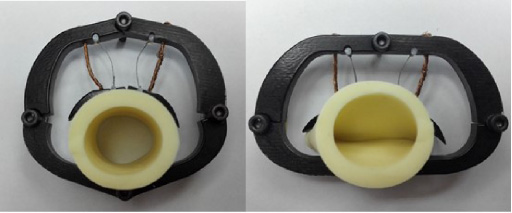
Prototype of the developed AAS in its open (left) and closing (right) state.
A prototype of the developed AAS with the optimized constant force element was shown in Fig. 6. The device has the dimension of 60 mm in length, 60 mm in width, 6 mm in thickness for its open state, and the dimension of 70 mm in length, 40 mm in width, 6 mm in thickness for its close state. The experimental comparison for internal pressure of artificial intestine with three kinds of thicknesses was shown in Fig. 7. It can be seen that the internal pressure of intestine with three kinds of thicknesses is 55 mmHg, 56 mmHg and 54 mmHg respectively. The average pressure of intestine of three kinds of thicknesses is 55 mmHg, and the maximum pressure difference is 2 mmHg. The fluctuation error of constant force is about 3.64%.
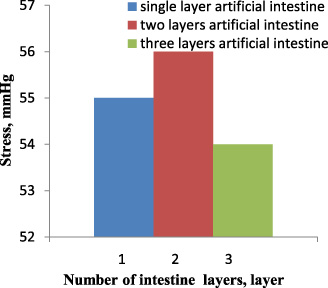
Comparison of internal pressure of artificial intestines with three kinds of thicknesses.
It was demonstrated that the AAS had minimal change in the clamping pressure, even if the thickness of the artificial intestine was changed. This could prevent ischemic necrosis of soft tissues caused by excessive pressure. It was possible that this device would be helpful for patients with fecal incontinence and could have long term effective. Moreover, the device had compact design, and was a simple structure, which making implantation minimally invasive and less complicated.
A novel AAS was developed based on superelastic SMA sheet. A Ti-55.9at%Ni C-shaped superelastic SMA sheet of 0.15 mm in thickness and 2 mm in width was optimized by the optimization method combining finite element analysis with ANSYS and genetic algorithm in MATLAB, and the optimized solution was verified by experiment. It was demonstrated that constant force can be obtained within a relatively large deformation range by optimizing the shape and the geometric parameters of superelastic SMA sheet. The device can make the internal pressure of the intestine with various thicknesses maintaining almost constant force. It is possible that this device will prevent ischemic necrosis of soft tissues and maintain long term effective.
To further verify the constant force characteristic and effectiveness of the device, experiments would be carried out with animal intestine and faked stool to simulate the process of open and closing.
Footnotes
Acknowledgements
The work was supported by the foundation from the National Natural Science Foundation of China (61473193) and Science and Technology Commission Shanghai Municipality (16441905102, 16441905202, 16060502500).