






Abstract
Magneto-mechanical effect describes a phenomenon that mechanical stress changes the magnetization of ferromagnetic materials with the involvement of an external magnetic field. Mechanical stress and the external magnetic field are two key factors influencing the magneto-mechanical effect of ferromagnetic materials. Researches on influences of stress and coaxial magnetic field on the magneto-mechanical effect of ferromagnetic materials are adequate. However, few researches have been conducted to investigate the impacts of non-coaxial magnetic field on the magneto-mechanical effect of ferromagnetic materials. In order to explore the influences of stress and non-coaxial magnetic field on the magneto-mechanical effect, series of mechanical stresses combining with different directions of magnetic fields were applied into a ferromagnetic carbon steel specimen in this paper. A structure-continuous specimen made of a ferromagnetic carbon steel was manufactured. A magnetic field stimulated by an electromagnet in turn applied into the specimen in four different directions to provide multidirectional non-coaxial magnetic fields. During each magnetizing process, series of elastic stresses were loaded into the specimen. After each loading process, the applied magnetic field was powered off, the specimen was removed from the loading machine, and the residual leakage magnetic field of the specimen was scanned. Finally, the distributions and intensities of the residual leakage magnetic fields resulted from different stresses and non-coaxial magnetic fields were compared, the influences of non-coaxial magnetic field on the magneto-mechanical effect of ferromagnetic carbon steel were concluded.
Introduction
Ferromagnetic steel is widely used to manufacture key components of engineering equipment because of its excellent mechanical property, such as railroad tracks, nuclear power, boiler and pipes. When these components are subjected to workload in service, different level of mechanical stresses would exist inside the structure. Mechanical stress is a major factor generating and accelerating the material failure, therefore, quantitative evaluation of mechanical stress inside some ferromagnetic structures through some nondestructive testing methods is very important to estimate the reliability and lifetime of key structures, which is of great significance not only in ensuring the safety, but also in reducing the maintenance costs of key equipments. Traditional nondestructive testing (NDT) technologies (such as eddy current, ultrasonic, x-ray) are mainly used to test the macroscopic material-losting defects inside the structure [1–6], are quite incompetent to quantitatively estimate stress. Recent years, a physical conception named “magneto-mechanical effect” describing a phenomenon that mechanical stress changes the magnetization in ferromagnetic materials with the involvement of an external magnetic field, is attracting a great deal of attentions because its potential in stress evaluation of ferromagnetic structure. Mechanical stress inside a ferromagnetic structure is hopefully evaluated through measuring the leakage magnetic field signals outside the structure as long as the relationship between mechanical stress and the leakage magnetic field signals is clarified.
Lots of researches have been carried out to investigate the mechanism of magneto-mechanical effect and develop the applications based on magneto-mechanical effect. Jiles presented a model of magneto-mechanical effect [7], which explained that stress helped the external magnetic field to overcome the pinning effect that led to magnetic hysteresis phenomenon of ferromagnetic materials, promoted the growth and rotation of the magnetic domain toward the direction of the external magnetic field. Jiles model gave a relationship between elastic stress and the magnetic field for isotropic ferromagnetic materials. But the presentation of this model mainly based on experimental results when the applied external magnetic field was in the same direction with stress. In the application of stress evaluation, Dong applied various stresses into a ferromagnetic specimen in the Earth magnetic field, extracted a gradient parameter from measured leakage magnetic field signal [8], found that the gradient parameter increases monotonously with the increasing of elastic stress. Li measured a non-uniform stress field of a ferromagnetic steel specimen and its leakage magnetic field signal under the action of the Earth magnetic field, reconstructed the magnetization inside the specimen with the measured leakage magnetic field signal by applying a reconstruction algorithm [9–12], found that the direction of the magnetization inside the specimen is in the direction of stress and the intensity of the magnetizaiton increases almost linearly with the increasing of stress [13].
In summary, the above researches on magneto-mechanical effect were mostly conducted under the action of a coaxial magnetic field or a micromagnetic field of the Earth. What will happened in the magneto-mechanical when the external magnetic field is applied in a different direction from stress? Ref. [14] showed that when external magnetic fields were applied in different directions from stress, the magnetizations of the ferromagnetic structure were significantly different, but did not further study the detail of this problem. Therefore, studies on the influences of non-coaxial magnetic fields on the magneto-mechanical effect of ferromagnetic structure are inadequate. Work on this problem is conducive not only in revealing the mechanism of the magneto-mechanical effect, but also in promoting the development of stress evaluation technology for ferromagnetic structure.
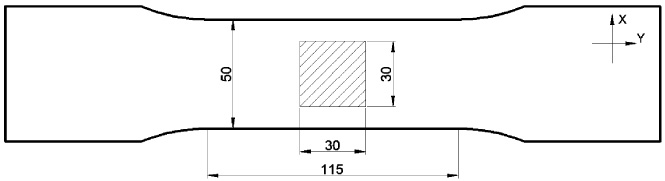
Shape and sizes of the specimen (mm).
This paper manufactured a smooth specimen made of a ferromagnetic carbon steel of Q195. Series of elastic stresses were loaded into the specimen along the length direction of the specimen. During each loading process, a DC magnetic field is applied into the specimen. But the direction of the applied DC magnetic field can be changed in turn in different four directions to provide non-coaxial magnetic fields. After each loading, the specimen was removed from the loading machine, and the residual leakage magnetic fields of the specimen were measured. Finally, the influences of a non-coaxial magnetic field on the magneto-mechanical effect are discussed and concluded.
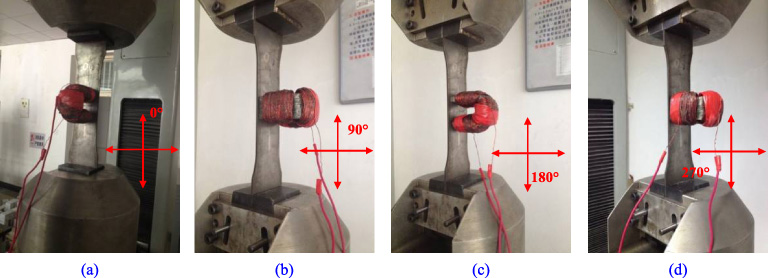
Applied DC magnetic fields, angles between the magnetic field direction and the stress direction are 0, 90, 180, 270 degree, respectively.
A smooth specimen is cut from a 3 mm thick plate of ferromagnetic Q195 carbon steel. The shape and sizes of the specimen is illustrated in Fig. 1. The shadow area in the middle of the specimen is the measurement range of 30 mm long and 30 mm wide. The X-axis is along the width direction and the Y-axis is along the length direction of the specimen. The specimen was subjected to an annealing treatment to relieve the internal stress before loading. A constant DC magnetic field about 5500 A/m stimulated by an electromagnet (the number of turns of the electromagnet coil is 1000, and the length of the electromagnetic loop is 200 mm) was applied into the specimen in four different directions in turn to provide multidirectional non-coaxial magnetic fields with an angular distance of 90° degree. As shown in Fig. 2, angles between the DC magnetic field direction and the stress direction are 0°, 90°, 180°, 270° degrees, respectively.
Angles of applied magnetic field (θ) and stresses (σ) into the specimen
Angles of applied magnetic field (θ) and stresses (σ) into the specimen
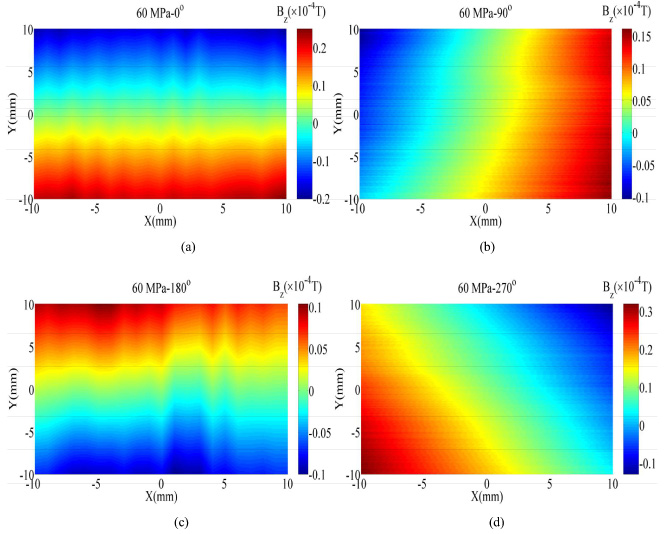
Residual magnetic fields when stress was 60 MPa and the DC magnetic field was applied in different angles of (a) 0°; (b) 90°; (c) 180° and (d) 270°.
During each magnetizing process on the condition that the direction of the magnetic field remains unchanged, series of elastic stresses from 20 MPa to 100 MPa with a stress interval of 20 MPa (as shown in Table 1) were in turn loaded into the specimen simultaneously along the length direction (Y-axis) of the specimen After each loading process, the applied magnetic field was powered off, the specimen was removed from the loading machine, and the normal component of the residual leakage magnetic field of the specimen was scanned by a tunneling magnetoresistance (TMR) sensor. After that, the specimen was degaussed and then clamped on the loading machine again, the DC magnetic field was applied into the specimen in the original direction, the next loading process was cycled. Until the loading cycle from 20 MPa to 100 MPa was finished, the direction of the applied magnetic field was changed to the next angle and the above loading process were cycled again from 20 MPa to 100 MPa.
In order to eliminate the influence of boundary conditions on the measurement results, we extract the middle 20 mm length and 20 mm width data in the measurement area, and make linear interpolation. The measured normal components of the residual magnetic fields (B z) in the measurement range of the specimen under the actions of stress and the external DC magnetic field applied in different four directions are shown in Fig. 3. Because the distribution patterns of the measured residual magnetic fields under different elastic stresses are similar as long as the applied DC magnetic fields is in the same direction, Fig. 3 only shows the measured results loaded with stress of 60 MPa when the DC magnetic field was applied in four directions.
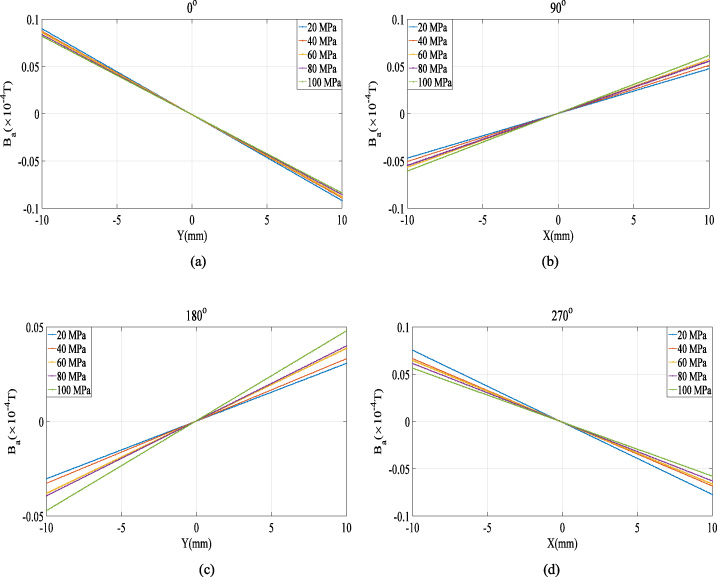
Residual magnetic field signals (B a) when the DC magnetic field was applied in different angles of (a) 0°; (b) 90°; (c) 180° and (d) 270°.
Amplitudes of residual magnetic field B a−amp(×10−4T) of the specimen
From the results shown in Fig. 3, we can see that the direction of the residual magnetic field is not solely determined by the stress distribution or the external magnetic field direction. When the external magnetic field is applied in the angles of 0° and 180° degree, where the external magnetic fields are parallel to the stress direction that is in the coaxial direction of stress, the directions of the residual magnetic fields of the specimen are found in the external magnetic field direction. When the external magnetic field is applied in the angles of 90° and 270° degree, where the external magnetic fields are perpendicular to the stress direction that is in the non-coaxial direction of stress, the directions of the residual magnetic fields of the specimen are found in a direction where the angle between the residual magnetic field direction and the stress direction is nearly 45° degree.
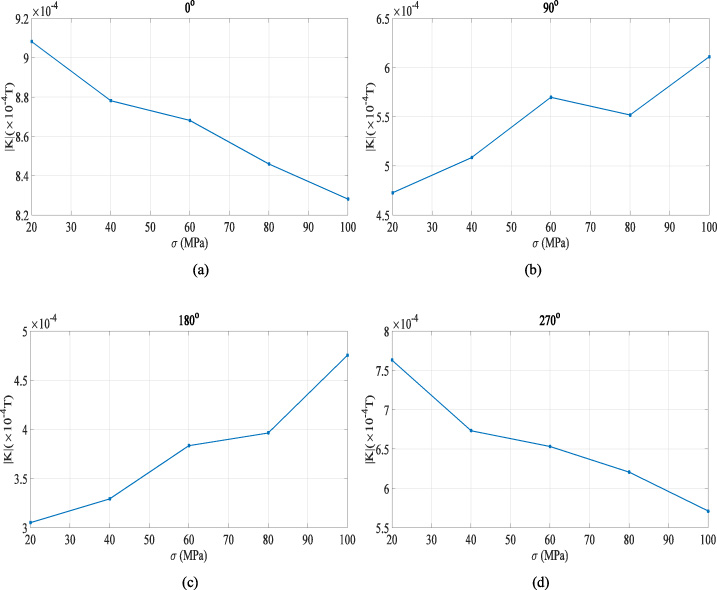
Relationship between |K| and σ when the DC magnetic field was applied in different angles of (a) 0°; (b) 90°; (c) 180° and (d) 270°.
In order to investigate the influences of stress on the residual magnetic field of the specimen when the direction of the applied DC magnetic field is unchanged, the average values of the residual magnetic field signals (B
a) in X-axis from −10 mm to 10 mm when the DC external magnetic field are applied in the 0° and 180° angles, and B
a in Y-axis from −10 mm to 10 mm when the DC external magnetic field are applied in the 90° and 270° angles are extracted and shown in Fig. 4. Compare the results shown in Fig. 4, we can see that the residual magnetic field signals (B
a) changes with stress. Therefore, the amplitudes of the residual magnetic field signals B
a (
From the results shown in Table 2, we can see that the amplitudes of the residual magnetic fields when the external magnetic field is applied in 0° angle are always greater than that in 180° angle. The residual magnetic field decreases with the increasing of stress when the external magnetic field is applied in 0° angle, and increases with the stress when the external magnetic field is applied in 180° angle. B a−amp difference between the external magnetic field applied in 0° and 180° angles decreases with the increasing of stress. The amplitudes of the residual magnetic fields when the external magnetic field is applied in 90° angle are basically greater than that in 270°. The residual magnetic field decreases with the increasing of stress when the external magnetic field is applied in 270°, and increases with the stress when the external magnetic field is applied in 90°. B a−amp differences between the external magnetic field applied in 90° and 270° decrease with the increasing of stress.
Finally, the absolute values of the gradient of the residual magnetic field, |K|, for different stresses are extracted when the external magnetic field is applied in 0°, 90°, 180° and 270°, respectively. The relationship between |K| and stress (σ) is shown in Fig. 5. We can see that |K| increases with the increasing of σ when the DC magnetic field is applied in 90° and in 180°. On the contrary, |K| decreases with the increasing of σ when the DC magnetic field is applied in 0° and in 270°.
Based on the above researches, following conclusions can be obtained:
(1) The direction of the residual magnetic field of the specimen is determined by stress and external magnetic field together.
(2) The amplitude of the residual magnetic field decreases with the increasing of stress when the external magnetic field is applied in 0° and 270°, and increases with the stress when the external magnetic field is applied in 90° and 180°.
(3) Difference of the residual magnetic field amplitude between the DC magnetic field applied in 0° and 180°, 90° and 270° decreases with the increasing of stress.
Footnotes
Acknowledgements
This work was supported by the National Natural Science Foundation of China (Grant Nos. 51367001 and 51507005), the Key Scientific Research Projects in 2015 at North Minzu University (Grant No. 2015KJ06), and the Ningxia First-Class Discipline and Scientific Research Projects (Electronic Science and Technology) (Grant No. NXYLXK2017A07).