







Abstract
In this paper, numerical techniques for simulation of magnetic domain structures of ferromagnetic materials using micromagnetics with large cells are investigated to save the computation cost. The exchange energy is modified to be applicable to large cells considering the angle between two neighboring cells. The demagnetizing energy is also modified to take account of erroneous magnetic surface charges which appear around the domain walls as a result of discretization. The method is then applied to a simple model and the result shows that an ideal vortex magnetic domain structure and domain wall motion can be represented.
Introduction
Several methods for mathematically modeling the hysteresis phenomenon in ferromagnetic materials such as electrical steel sheets have been proposed [1, 2, 3, 4, 5]. However, such methods often require a large number of parameters obtained from measurements. Moreover, these mathematical modeling methods do not consider the magnetic domain structures and the domain wall motion under an applied magnetic field. Therefore, a physical modeling method which considers the domain structures, such as micromagnetics [6], seems attractive.
However, it is difficult to apply micromagnetics to electrical steel sheets, because in a standard micromagnetic simulation, the model is required to be discretized into small elementary cells for which the cell size must be smaller than the so-called exchange length
In this paper, the possibility of the simulation with cubic cells of relative large size (5
Methods
Micromagnetics
According to micromagnetics, the distribution of
where
where
When
By neglecting the terms of orders greater than fourth (i.e.
where
When the model is uniformly discretized into a grid of tightly-packed identical small cubic cells, an appropriate representation of the exchange energy which covers large angle deviation is given as [8]:
where
As for
where
And
The method used in this paper for rotating 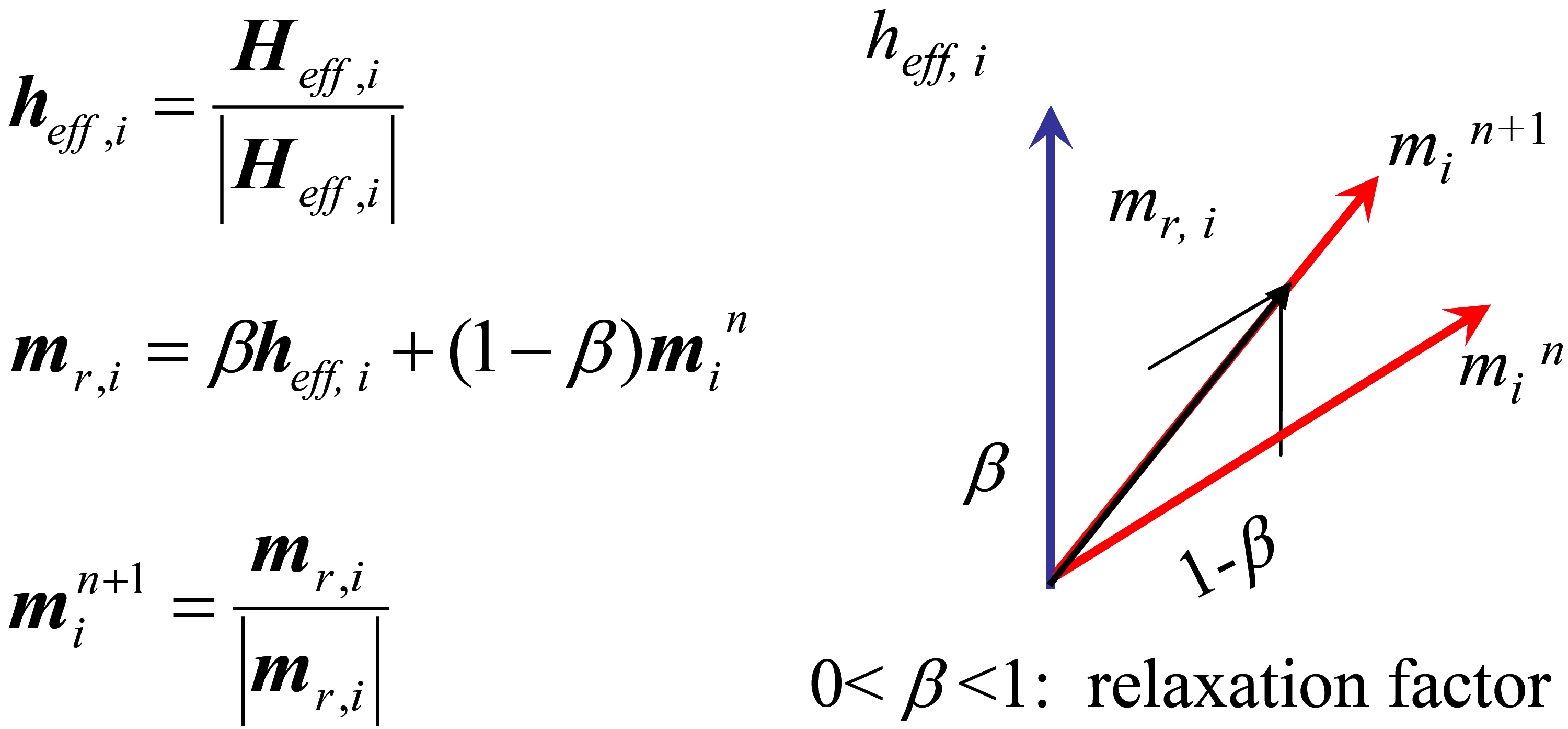
For energy minimization, an initial distribution is given to
Variation of the magnetization angle between two neighboring cells where the rotation takes place within the region shown in gray.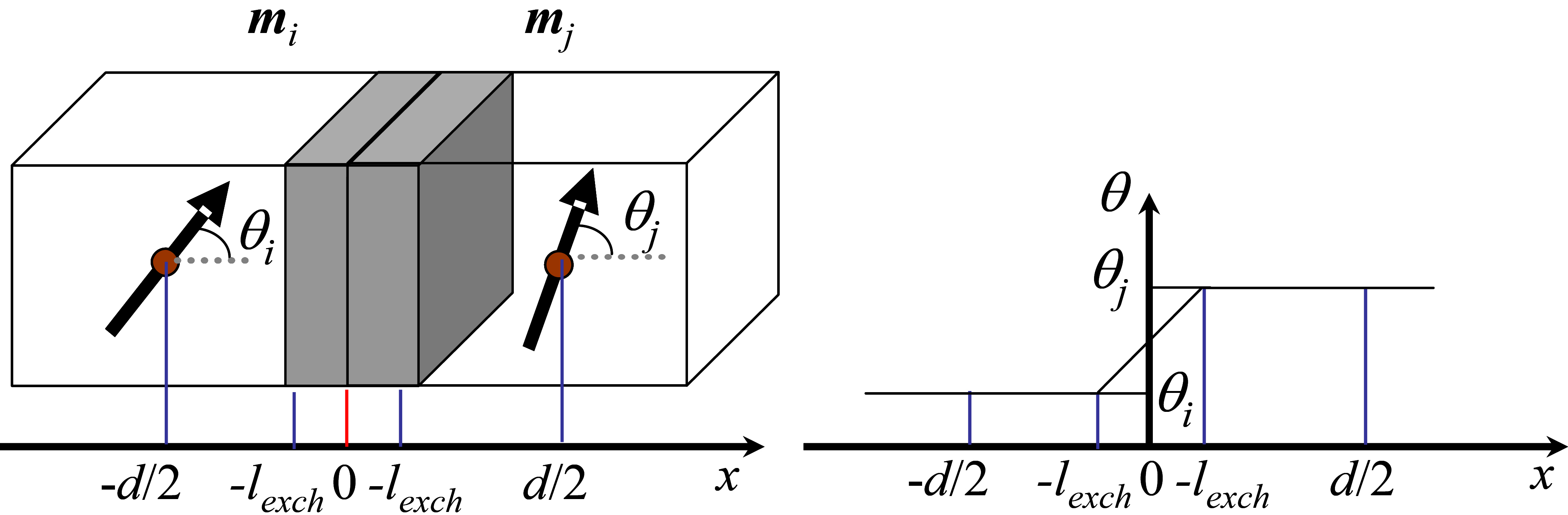
For large cells, the exchange energy is modified. The exchange energy calculation of two neighboring cells with small angle difference, which are considered to be within one domain, is treated differently from that with large angle difference, which are considered to be in different domains. For the two neighboring cells of small angle difference within one domain, the angle variation takes place within a depth of approximately 2
For the two neighboring cells with large angle difference in different domains, the cells boundaries are considered as domain walls. The domain wall energy includes the exchange energy and anisotropic energy and is the result of a balance between them. The actual domain wall energy is two times of the exchange energy or the anisotropic energy as it reaches its minimum when the exchange and the anisotropic energies are equal. Thus the exchange energy for cells with large angle difference can be calculated according to the domain wall energy as follows, which is derived by using domain wall energies with random degree transition in the walls [10].
where
In summary, if the angle difference
(a) A continuum model; the domain structure has zero demagnetizing energy. (b) The same model when discretized into cubic cells; the erroneous surface charges on the stair-like walls create erroneous demagnetizing field with large magnitudes in the neighboring cells.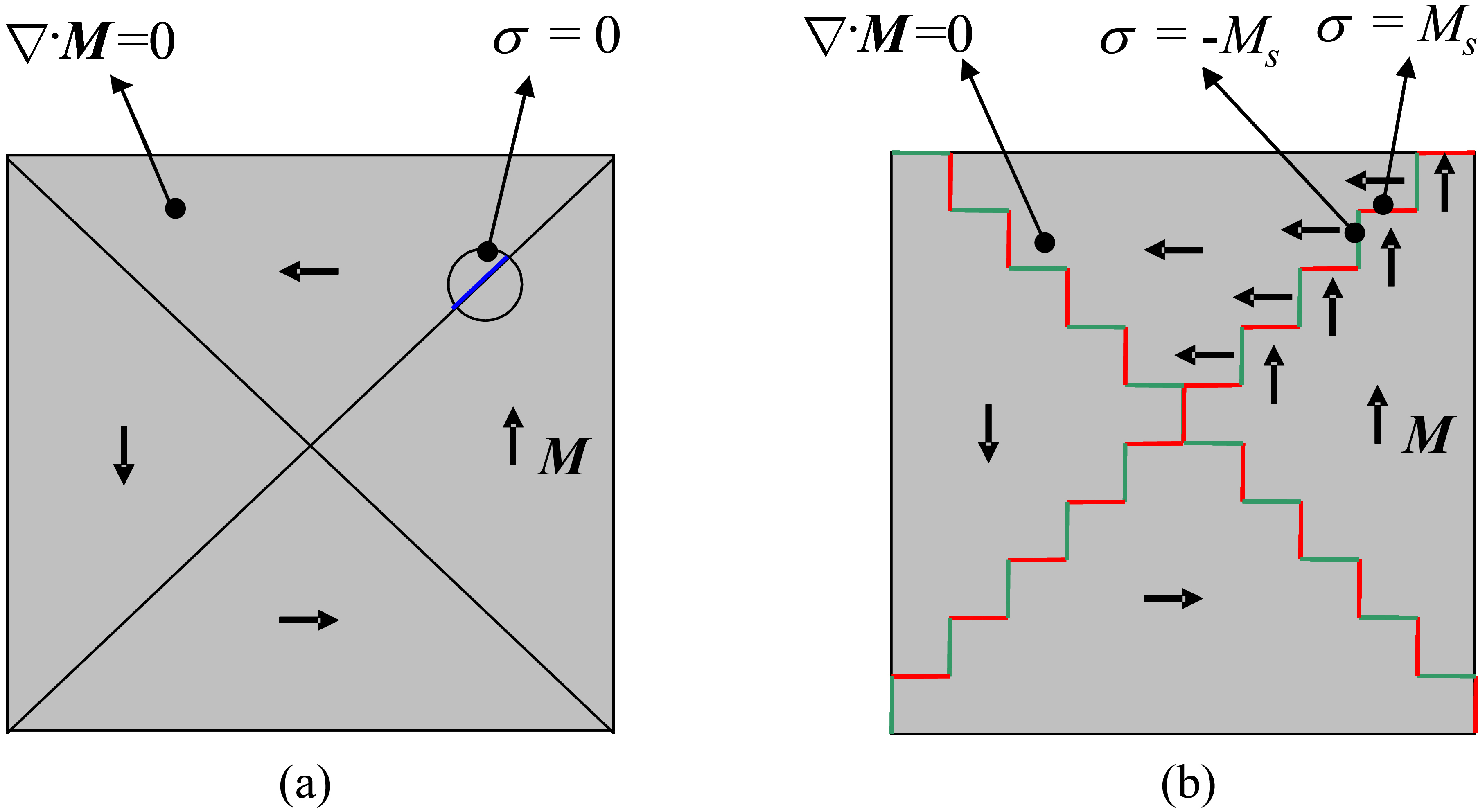
As a consequence of discretization, erroneous surface charges may appear around the domain walls as shown in Fig. 3. The erroneous charges create quite large erroneous demagnetizing field which severely affects the simulated domain structure. The demagnetizing field needs to be modified to take account of such errors. In order to suppress the error, any surface charge
where
Distributions of magnetic moments 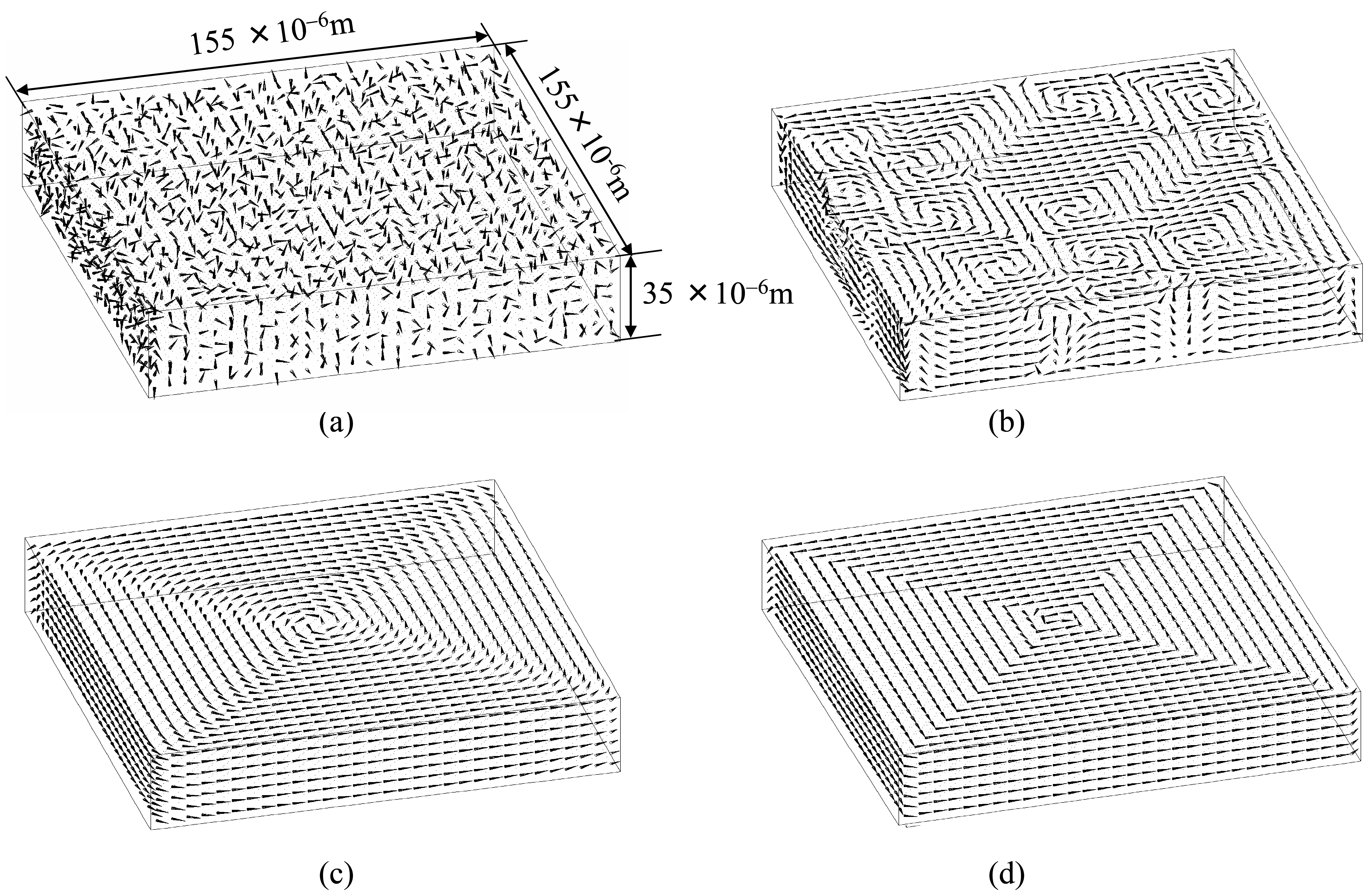
Distributions of magnetic moments 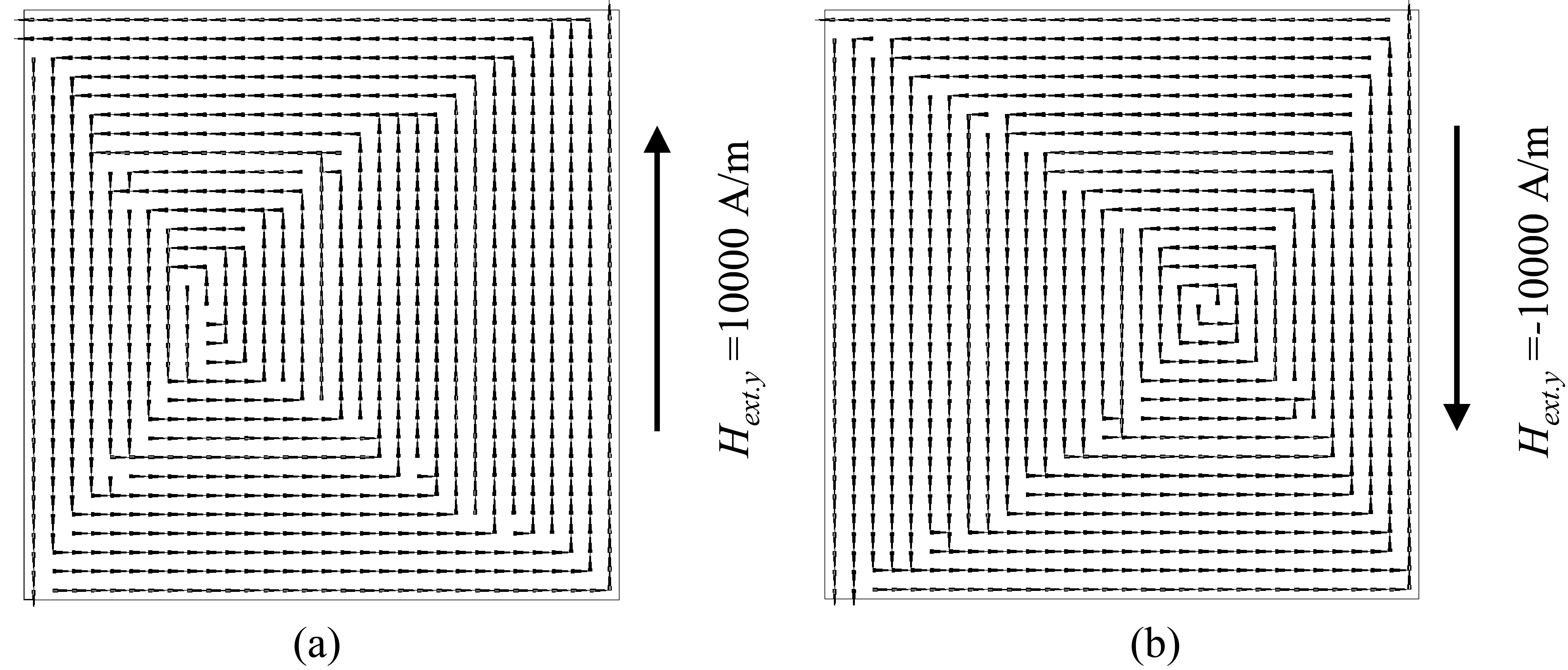
The proposed method is applied to a simple model with the dimension of (155
Conclusions
In the micromagnetics simulation of ferromagnetic materials using large cells, the ideal vortex domain structure can be obtained by improving the calculation methods of exchange and demagnetizing energies. And domain wall motion is also realized by applying external fields.