







Abstract
The use of magnetic separation based on nanoparticles has been an efficient approach in many research fields and different industries. It has shown multiple advantages including high separation efficiency and fast separation speed as well as low cost, comparing to conventional sedimentation or centrifugation methods. The basic contents and modelling principles such as one-way and two-way coupling methods involving magnetic separation have been introduced specifically and comprehensively, which can be used for better understanding the process and optimizing design of magnetic separators. Then typical industry applications of magnetic separation including kaolin beneficiation, water treatment, protein purification, cell separation, and drug delivery have been summarized in detail.
Introduction
Magnetic nanoparticles (MNPs) are a class of engineered materials of which the size is below 100 nm, and can be manipulated by applying external magnetic field. Their surfaces can act as carriers for liquid droplets or gases [1,2]. Generally, Magnetic nanoparticles are composed of magnetic elements, such as iron, nickel, cobalt and their oxides such as magnetite (Fe3O4), maghemite (Fe2O3), cobalt ferrite (Fe2CoO4) and chromium di-oxide (CrO2) [3].
Furthermore, MNPs exhibit magnetic responses similar with paramagnetic materials. Without an external field the magnetic moment is zero. In an external field a rapidly increasing magnetic moment orientate in the direction of the field below certain critical size (depending on the material parameters e.g. 35 nm for Fe3O4). The magnetic moment vectors are arranged in random directions when above blocking temperature. Magnetic nanoparticles become superparamagnetic, i.e. not keeping magnetized and have no attraction for each other when magnetic field is removed, which reduce the risk of particle aggregation [4–6]. Moreover, superparamagnetic nanoparticles show great reaction to an external magnetic field, which allow better manipulation in the application of their magnetic properties, including magnetic separation, magnetic mixing and magnetic levitation [7].
With excellent properties, i.e. high surface-to-volume ratios, chemical stability, lower dose and faster motion ability, etc., MNPs has shown great potential in several fields ranging from environmental applications to biotechnology [8,9]. A functionalization of particles are realized by wrapping with a layer of adsorbed molecules for each particular application [10]. For example, biocompatible molecules allow particles binding to specific bio-targets [11].
The emergence of high gradient magnetic separation (HGMS) in the 1950s, promoted the rapid development and more widespread application of magnetic separation technology [12,13]. HGMS means that motion of magnetic particles depends on the magnetic gradient. The first high gradient magnetic separator appeared in August 1967, that Dr. Iannicelli J of the United States applied the prototype of HGMS in the kaolin industry [14]. The wires inside the separator create a high magnetic gradient with an applied magnetic field. When the suspension containing magnetic materials flows though the column large field gradient around the wire can attract and capture the MNP to its surface [15,16]. Then, manipulating the motion of magnetic particles by magnetic field, which is called magnetophoresis, was first applied in industry during the 1970s [17–19]. And the first nano magnetic separation research article was published in 1973 [12,13].
Comparing with conventional sedimentation or centrifugation, when the object materials are solids or there is no flow speed in the separation process, there shows no obvious advantage in magnetic separation, and filtration is a well-utilized method for faster processing. If the product contains intrinsically magnetic components, magnetic separation can offer higher throughput and greater accuracy [20,21]. In magnetic separation, the material fluid is substantially free from fluid resistance when it passes through the separation device, while the filter is based on solid-state separation, leading to the limited application when the target particles are submicron particles or biomolecules. The magnetic separation technology has the advantages of high efficiency, fast speed, and allowing smaller particle size in the separation system. It can provide better solution when it is difficult or impossible to separate using traditional separation methods. Magnetic separation technology has displayed increasingly emergence in industrial processes.
This article is aimed to summarize the applications of magnetic separators in industrial scale and biotechnology. We begin with the modelling of magnetic separation process, which provides the theoretical basis and demonstrated the parameters critical for the design of the separator. The application of industrial magnetic separators and example of devices are also presented, especially environmental remediation and biomedical applications.
Model of magnetic separation
Motion behavior of particles in a magnetic separation system is determined by the following competing factors in magnetic field and viscous fluid, including: magnetic force F m generated by gradient magnetic field, hydrodynamic force F f , gravitational force, inertia force, Brownian thermal kinetic force, particle-fluid interactions and inter-particle effects including magnetic dipole interactions and Van Der Waals effects, and double layer interactions. To consider all the forces in the magnetic separation process is comprehensive and complex, and simplification must be made for calculation and simulation. For the MNPs with submicron size and negligible mass, gravitational force and inertia force can be neglected. There are conditions for whether or not we should consider Brownian diffusion and particle-fluid interactions, which we’ll discuss below. Therefore, the magnetic force and hydrodynamic force dominant forces [22].
Dominant force calculation
Magnetic force F m and hydrodynamic force F f acting on particles can be mainly calculated by two approaches: The one is based on the Maxwell stress tensor and hydrodynamic tensor which is quite accurate [23,24] and can be applied for various particle shapes [25], while the computation time will be much time-consuming for multiple nanoparticles. The other is based on the dipole-dipole model and Stokes’ law, which is widely used due to much simple characteristic and will be highlighted in the following section.
Magnetic force
The magnetized particles are equivalent to a point dipole with dipole moment to calculate the magnetic force on the particles [26]:
In positive magnetophoretic separation, the magnetic susceptibility of the nonmagnetic fluids 𝜒
f
is very small. The permeability 𝜇
f
is approximately equal to the free space permeability 𝜇0. The magnetization of the nonmagnetic fluids is zero i.e. M
f
= 0, so m
p, eff
= V
p
M
p
, where V
p
and M
p
are the volume and equivalent dipole magnetization of magnetic particle, respectively. Thus,
In adverse with positive magnetophoretic separation, the diamagnetic particles can also be manipulated at relatively high magnetic field gradients. The particles showing negative magnetic susceptibility are repelled from magnetic source, which is called as negative magnetophoresis or diamagnetophoresis. The process often evolved in paramagnetic solutions or ferrofluids made of magnetic nanoparticles. Magnetic force calculation equation actually should be expressed as [22]:
The Hydrodynamic force is obtained using Stokes’ law:
The fluid velocity is governed by the Naiver--Stokes equations and continuity condition, where the fluid is assumed incompressible:
Brownian diffusion are neglected in some applications. Depending on if Brownian diffusion is ignored, two general different approaches are presented to model the motion behavior of nanoparticles [27]. The criterion is [19]:
When other forces overcome the Brownian motion due to random collisions of particle in the suspension, Brownian diffusion can be neglected [27]. Newtonian model is used to predict the dynamic behavior of individual particles. The trajectory of each particle is estimated as below [27]:
When inequation (11) is not satisfied, meanwhile, Brownian motion becomes a dominant factor [28]. A drift-diffusion equation for predicting the dynamic behavior of a volume of particles should be solved. The particle volume concentration c is the total volume occupied by the particles per unit volume of fluid [26], which must obey a continuity equation [19,29,30],
As above, the particle dynamic is mainly determined by gradient magnetic force and hydrodynamic force. However, movement of magnetic particles through viscous liquid creates a disturbance to the fluid flow [32]. The internal mechanism is as below: The momentum of moving particle sustaining magnetic force is transferred to the surrounding fluid in turn [33], thus the hydrodynamic force is changed due to the modified fluid field. Thus take particle-fluid interactions into consideration or not, there are two simulation approaches for analysis [24]. When particles involve low volume concentration c in the separation process, particle-fluid interactions can also be neglected to simplify the analysis. Most theoretical studies assume that the cases in which the particles are in dilute suspension [26]. In this case, the simplified one-way particle-fluid coupling method can be used since the fluid flow is not influenced by particle motion. The other approach is two-way particle-fluid coupling method that the particle-fluid momentum transfer is coupled solved [34,35]. Considering the momentum transfer from particles to fluid, the Naiver–Stokes equations should be added a bulk force term:
During the last years, researchers have been working on more appropriate design and configuration of magnetic separators [28,37], which are classified according to different attributes: dry or wet, continuous or batch, industrial column or microscale separators. In addition, the magnetic sources utilized include permanent magnets, electromagnets or superconducting magnets. Due to its simplicity and convenience, PMs are usually employed in small separators.
Faster flow separators often apply to the target material flows through the separator at a high rate to achieve separation based on HGMS. There is no binding between the magnetic column and the steel wool, and the fluid resistance is small. However, the limitation also exists in the flow separation, which requires significant energy. In order to obtain high-intensity and high-gradient magnetic field, a complex electromagnet is required, and it also limits the size of the column and thus reduces the efficiency. Meanwhile, permanent magnets are often served as magnet source in the magnetic separation batch model, which especially favored in biotechnology even with complex multipole configurations to provide low gradient needed. It is advantageous in small volume separations compared to traditional sedimentation. As the magnetic forces on the particles are small due to the gradient, larger magnetic particles can be used to offset [21,30,38].
Water treatment
Based on the excellent chemical and physical properties and the easy manipulation of MNPs, the use of MNPs for sewage treatment has recently received great attention [39–42]. Water pollution has become a frequently-reviewed issue because the impurities including heavy metals and dyes have negative effects on environment. Most heavy metals are highly toxic, carcinogenic and no biodegradable [43–45]. There are also various methods applied in wastewater treatment, such as membrane filtration [46], coagulation/flocculation [47], solvent extraction [48], precipitation [49], electro dialysis [49,50], etc. However, comparing to this, adsorption has shown its unique advantages like low cost and simplicity. Integrated separation processes involving adsorption based on MNPs have been studied for heavy metals and dyes removal. Nanoscale ferrites (maghemite [51–53], or magnetite [54–56]) and zero-valent iron [57–60] have also been used to remove metals such as arsenic [61–63], chromium [53,63–65] and plumbum [66–68].
The easy functionalization of MNPs makes it easier to bind to specified impurities. Surface modification can provide novel functionality such as amine and acid on the surface of MNPs and increase the efficiency of MNPs for water and wastewater treatment [69]. Most commonly, we use different silane coupling agents to attach alkoxysilane to the MNP surface, even to attach biomolecules and polymers such as PEG [70]. The pH of the working solution can affect the surface functionality of iron oxide. Under acidic conditions, the main functional group on the surface of particles is FeOH+ or FeOH2 +, and under alkaline condition FeO− and Fe(OH)3 − is main form. Below the pHpzc, the adsorbent surface is positively charged, and FeOH+ or FeOH2 + react with anionic metal cation. Above the pHpzc, the adsorbent surface is negatively charged, and metal cation adsorption including Cu (II), Ni (II), Zn (II), Cd (II) and Pb (II) [51,54,63,67,68,71 ] occurred. The mechanism for adsorption of anionic dyes and cationic dyes by Fe3O4@GPTMS@Gly is proposed in Fig. 1. Similar with heavy metals, under acidic conditions the amino group of the sorbent form amino cations (Fig. 1a), which can react with anions of dyes (Fig. 1b). Under strongly alkaline conditions, the carboxylate anion react with the cation of dye (Figs. 1c and d) [72]. Also, Chitosan-coated MNPs and hydroxyapatite-coated MNPs, which included hydroxyapatite (HAP), magnetite (Fe3O4) and maghemite (Fe2O3) have also been shown to have excellent ability to remove metal oxygen anions and metal cations, respectively [71,73]. Based on K. Simeonidis et al. [74], 30 nm isolated nanoparticles wrapped with 𝛼-Fe2O3 layer is proved to be effective removal material. The capacity of absorb As (III) and As (V) is about 1.0 and 2.1 μg/mg and the processed water satisfied the limit value for drinking. Comparing to conventional adsorbents, due to their structure and functional groups on surface, the nanocomposites based on iron oxide coated with polymers such as chitosan, cyclodextrin and organic acids such as humic acid have reported higher efficiencies for dyes removal [75].
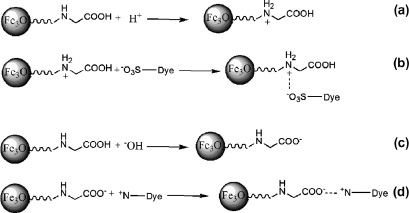
Mechanism for removal of dyes [72].
Kaolin is a natural white clay composed of micro-hexagonal pieces of aluminum silicate. It has a huge amount of utilization, especially in coating and filling paper. In the early 1970s, with the introduction of commercial-scale, high-intensity magnetic separators for wire rods, the first sports magnetic separator was installed and put into use in 1976 by British Chinese Clay Company, for improving the quality of feed clay in the ceramic industry. The separator extracted up to 40% of the iron-bearing minerals, which enhanced the performance of “stained” kaolin and enables these areas to operate [76].
Over the past decades, the production of good quality concentrates from kaolin clay have been sharply increasing as a result of the high demand, motivating countries like India and China with an increasing depletion in high grade kaolin clay reserves to improve their beneficiation techniques. The use of magnetic separators in the kaolin industry gives many operational advantages in the complex beneficiation process. It has improved the quality of the global kaolin and doubled its useful reserves [77]. Generally, higher magnetic field means better quality, increased yield, or longer duty cycles in the separation. Chen et al., (2012) conducted an investigation using an innovative Vibrating High Gradient Magnetic Separator (VHGMS) for the removal of ferrous minerals (hematite and limonite) from kaolin (clay). The results reported a kaolin product grade of 0.50% Fe203 with an 84.56% mass yield, and at a 42.08% iron removal rate and the results were found to be acceptable for commercial application [78]. Although the operating cost of superconducting magnetic separators is higher than that of resistive copper magnets, superconducting magnets have great advantages including high throughput, small grain size and great efficiency [79,80].
Bio-applications
The use of magnetic separation for bio-applications include purification of proteins [81,82], bioseparation [82–84], cell sorting [84,85], bioassays [86,87], magnetofection [84,88–91], AND drug delivery [92–94]. Generally, the magnetic nanoparticles for bio-applications are biocompatible materials. To achieve multifunctionality, coupling MNPs with various biological molecules is required [94,95].
Cell sorting
Two most frequently used methods for cell purification are Fluorescence-Activated Cell Sorting (FACS) and Magnetically-Activated Cell Sorting (MACS). FACS can provide stable performance and better purify, while MACS separating cells labelled with magnetic beads from unlabeled cells using magnetic forces is simpler and provides faster separation speed and higher enrichment efficiency [96]. Generally, MACS can be classified into Bead-based cell sorting which is based on specific particles with surface-binding capacity to capture target cells, via sustaining an external force under an external field. Meanwhile, another rapid cell sorting method, named label-free cell sorting has been more studied nowadays. In another classify way, comparing to cell sorting by magnetophoresis (MAP), traditional mechanical biological separation cells technology can damage the cells. Separation methods such as dielectrophoretic sorting [97,98], electroosmotic flow [99], electro kinetic isolation [100], inertial separation [101,102], have been applied to isolate homogeneous and sieve cell.
High Gradient Magnetic Separation (HGMS) magnetic particles are conjugated to antibodies directed to specific cell surface for marking. A variety of HGMS cell sorting systems have been developed in both macroscale [103] and microscale [104–107]. For micro-electromagnetic devices, high magnetic field gradients and a very strong force can be produced on the target biological cells [108]. Manipulating magnetic particles by control magnetic field in microfluidic devices for cell sorting is also a key issue [109]. Microfluidic cell sorting involves the incubation, the separation and enrichment on a single microfluidic chip. To obtain higher magnetic field gradient, a rotating set of permanent magnets were utilized to trap particles in the microchannel as shown in Fig. 2. The permanent magnets are actuated by a spinning gear. When the sample flow through the channel, the particles are captured and concentrated on the gap of each magnet. Experimental results demonstrated reduced reagent cost and decreased processing time [110]. The problems in magnetic micro particles-based circulating tumor cells separation can be solved by using nanoparticles that are reduced in size by three orders of magnitude, ensuring sufficient contact with cell surfaces (Fig. 3). Due to less steric repulsion, nanoscale size allows higher number of nanoparticles to attach to the cell surface than that of micro-particles [111].
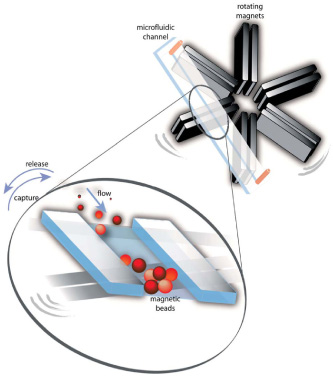
A schematic of a rotating magnetic trap [110].
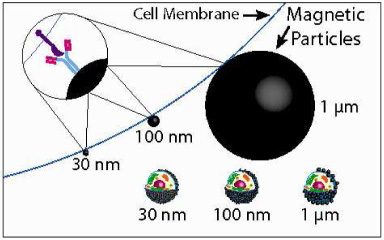
Schematic representation of immunomagnetically labeled cells with particles of different size [111].
Most existing plasmid isolation methods take long processing time. The techniques such as molecular exclusion and anion exchange chromatography produce high-purity plasmid with a short duration. Magnetic particles can be used for different sizes of starting samples. In addition, magnet-based programs can provide additional advantages: suitable for automation, reducing time and can be used for large-scale application. Hubbuch et al. described the integration of proteins using magnetic adsorbents and high gradient magnetic separation techniques as high gradient magnetic fishing (HGMF) [19]. High performance magnet filters and semi-continuous multi-cycle operations enable HGMF to rapidly process large quantities of raw materials. The magnetic adsorbents available on the market, such as MNP coated with silica or polymer are all limited to high prices [110]. The preparation process flow scheme of Fe3O4/PMG/IDA-Ni2+ nanoparticles and its binding of His-tagged proteins is shown in Fig. 4(A) to finally obtain the composite nanoparticles. The superparamagnetic property of nanoparticles core (Fe3O4) provides magnetic manipulation operability. A general process of utilizing permanent magnet to purify the proteins in the container from cell extracts after binding step can be seen in Fig. 4(B) [112].
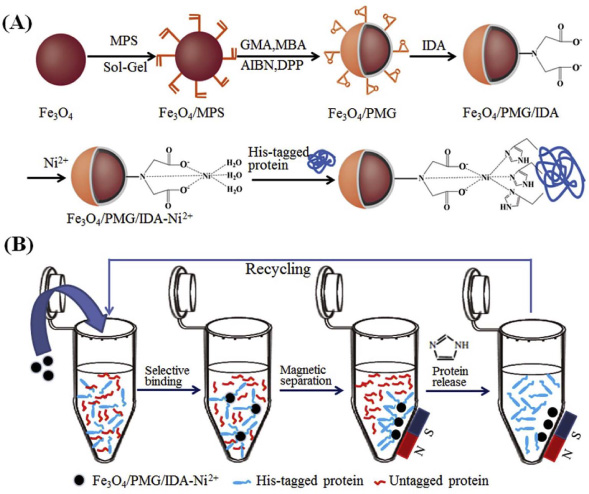
Principles and steps of protein purification applying magnetic separation technique [112].
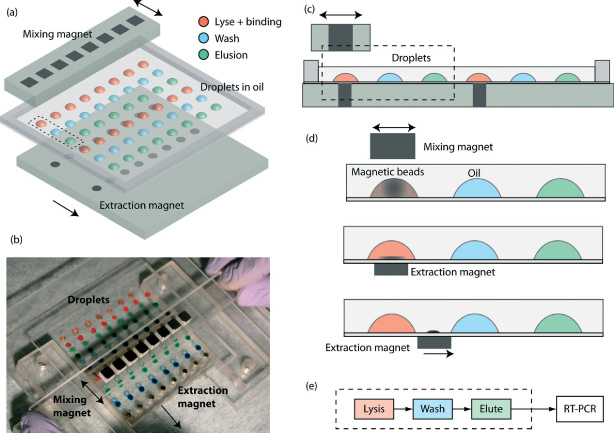
RNA Extraction Set System overview [113].
Xu Shi et al. [113] present a simple, effective lab-on-a-chip device for rapidly purifying RNA from low concentration sample. The RNA Extraction Set device can purify 16 samples simultaneously. Two sets of 16 extracting magnets under the chip pull beads through the buffers. A set of 8 mixing magnets are embedded on a movable plate over the chip. The system overview is shown in Fig. 5 including (a) Equipment schematic, (b) Photo of the RNA Extraction Set System, (c) A cross-sectional view of the chip over an extraction magnetic plate, (d) Working process of the system, and (e) Process flow. Different from lab scale, pilot scale HGMF combining up-scale magnetic field generating device and efficient separation cell are developed. A novel discrete Halbach magnet creates a radial transverse magnetic field in the center of the hole. This HGMF pilot scale design overview and interior sketch of the chamber are respectively shown in Fig. 6(a) and (b) [114]. The numerical symbols represents (1) stirring motor, (2) capillary with three flat ejector for importing the liquid, (3) matrix elements driven by the motor, and (4) impeller respectively.

Novel Discrete Halbach Magnet and separation chamber [114].
Magnetic nanoparticle-based transfection methods, often called “magnetofection” have been demonstrated in a variety of cell application. The transfection efficiency is enhanced due to endocytosis. Magnetofection is defined as utilizing an external magnetic field to rapidly targeting localized gene-MNPs complexes to the cells for transfection. The gene delivery generally has three steps: (1) Mixing of functionalized aggregated magnetic nanoparticles (AMNPs) and DNA. (2) Adding the complexes to the cells. (3) The culture dish is placed in a magnetic field for transfection [115].
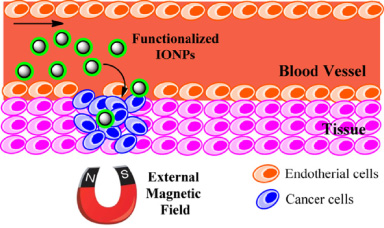
Schematic diagram of MNP-based drug targeting in vivo [116].
In vivo, the magnetic carriers accumulates in the target tumor site to release the drugs which are effectively taken in by the tumor cells as shown in Fig. 7 [116]. MNP-based drug delivery promises to avoid the side effects of conventional chemotherapy in cancer treatment by reducing the extent of drug distribution and reducing the cytotoxic dose. Among a wide range of potential MNPs, superparamagnetic iron oxide nanoparticles (SPIONs) are becoming an increasing popular drug delivery choice because when the magnet is removed, there is no magnetic interactions between particles, preventing large aggregations of SPIONs [117]. Magnetofection could be optimized in reduced cytotoxicity with better nanoparticle coating agents such as anionic surfactants [118], fluorinated surfactant [119], a polymer [120], silica [121], hydroxyapatite [122], which are often recombined with PEI or the modified PEI. In addition, MNP size has a significant effect on transfection efficiency. Comparing to static field, oscillating or altering magnetic fields provide greater transfection rates by promoting the carriers intake and release [120]. Mahendran Subramanian et al. has shown higher gene transfection efficiency and no harm on cell viability using MNPs and a 96-well oscillating magnet array composed of neodymium-iron-boron magnet (Fig. 8A). Contour of the magnetic flux density produced is shown in Fig. 8B [123].
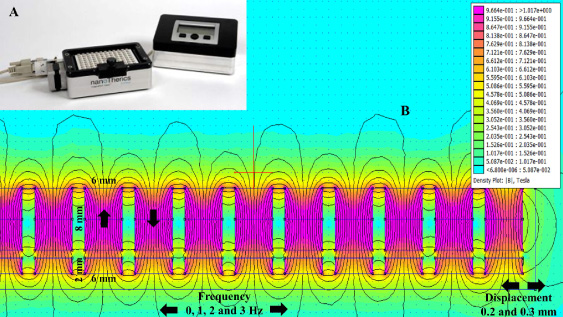
A magnetic gene transfection experimental device [123].
Magnetic separation based on nanoparticles has shown great potential in many applications from environmental treatment to biotechnology, due to the superior properties of MNPs i.e. high surface-to-volume ratios, chemical stability and lower dose. Magnetic separators based on HGMS can be used to achieve good separation efficiency in the cases of continuous flow with a high rate, where electromagnets and superconducting magnets are generally utilized. While the batch separation system, which is advantageous in low-speed and small-volume separation process, usually generates the gradient fields with permanent magnets. To predict dynamics of nanoparticles in these magnetic separation systems, both Newtonian and drift-diffusion models have been described that are depending on whether Brownian motion can be considered. Meanwhile, the two-way coupling model with considering the particle-fluid interaction is also presented.
Various kinds of magnetic adsorbents i.e. nanocomposites based on ferromagnetic matter and other modifier or adjunctions could promote the separation process involving wastewater treatments, aiming at removing heavy metals and dyes. The use of magnetic nanoparticles in bioapplications is growing significantly. Micro HGMS devices, which realize the manipulation of bioprocess including separation on a single microfluidic chip can produce much higher magnetic field gradients and force. Microsystems typically represent faster procedure and less operating costs. It has underlying advantage when integrated with other analysis elements for solving complex problems in microdevice. These devices can be launched increasingly in future clinic applications. Methods for synthesizing, functionalizing magnetic nanoparticles are rapidly developing, promoting the applications in various aspects. Overall, there is an ongoing need of magnetic separation devices in both industrial and batch scale. In the future, the issue of magnetic recovery of particles in the process of MNP-based application, including water treatment or biotechnology, should be an increasing source of concern.
Footnotes
Acknowledgements
This work was supported by the National Natural Science Foundation of China under Grants 51407083 and 51577083. (Corresponding author: Weizhong Wei.)
The authors are with the State Key Laboratory of Advanced Electromagnetic Engineering and Technology, Huazhong University of Science and Technology, Wuhan 430074, China, and Tongji Medical College, Huazhong University of Science and Technology, Wuhan 430074, China (e-mail: