







Abstract
The present work studies magnetohydrodynamic stability with streaming resistive triple superposed fluid layers. This system is influenced by an oblique magnetic field. The solution of motion equations by using the method of perturbation analysis under the boundary conditions which leads to deriving the dispersion relationship describing the behaviour of the perturbed and unperturbed system. The effect of different parameters on the stability and the instability of this system was studied. Regions of stability and instability are identified by drawning the curves to illustrate the regions of stability and instability behaviour. It is found that the magnetic field permeability coefficient, the intensity of the magnetic field values, the increase of the fluids density values and the streaming velocity have destabilizing influences on the considered system. The presence of an oblique magnetic field plays a stabilizing role and can be used to retard the destabilizing influence.
Introduction
Stability of fluid layers or cylinders have gained considerable importance because of their applications in industries and biophysical laboratories, such as medical applications of electrohydrodynamic and Magnetohydrodynamic stabilities as injection of drugs inside the vessels, electric shock to treat the heart attack and effect of the magnetic resonance on blood flow. The axisymmetric (MHD) stability of the fluid cylinder under the action of self-gravitating, inertia and electromagnetic forces have been studied by Brakat [1]. The stability of a basic flow of streaming magnetic fluids in the presence of an oblique periodic magnetic field has been discussed by Moatimid [2]. The Kelvin–Helmholtz instability of viscous incompressible magnetic fluid fully saturated porous medium is achieved through the viscous potential theory has been discussed by Moatimid et al. [3]. Hasan [4] studied the magnetohydrodynamic stability of a gravitational medium with streams of variable velocity distribution for a general wave propagation in the presence of the rotational forces. The effect of a horizontal magnetic field on the stability of three horizontal finite layers of immiscible fluids in porous media has been studied by AlHamdan and Alkharashi [5]. Rayleigh–Taylor instability of a heavy fluid supported by a lighter one through porous medium, in the presence of a uniform, horizontal and oscillating magnetic field was presented by El-Sayed [6]. The instability of plane interface between two supposed (Walters B ′ ) viscoelastic fluids in porous medium, taking into account the effect of suspended (dust) particles has been discussed by Kango and Rane [7]. Kumar and Singh [8] studied the stability of the plane interface separating two Rivlin–Ericksen viscoelastic superposed fluids permeated with suspended particles and uniform horizontal magnetic field is considered following the linearized perturbation theory and normal mode analysis. The Rayleigh–Taylor instability of a Newtonian viscous fluid overlying a Rivlin–Ericksen viscoelastic fluid containing suspended particles in a porous medium was presented by Kumar [9]. The stability of the plane interface separating two viscoelastic (Walters B ′ ) superposed fluids of uniform densities in the presence of suspended particles has been studied by Kumar et al. [10]. The electrohydrodynamic stability of the interface between two superposed viscous fluids in a channel subjected to a normal electric field, also that the two fluids are different in densities, viscosities, permittivities and conductivities has been studied by Li [11]. The instability properties of streaming superposed conducting fluids through porous media under the influence of uniform magnetic field have been investigated by Zakaria et al. [12]. Ahmad et al. [13] studied the stability of anisotropic self-gravitating fluids in 𝛬 dominated era, by taking a cylindrically symmetric and static space-time. The electrogravitational instability of an oscillating streaming fluid cylinder under the action of the selfgravitating, capillary and electrodynamic forces have been discussed by Hasan [14]. The gravitational instability of a rotating Walters B ′ viscoelastic partially ionized plasma permeated by an oblique magnetic field in the presence of the effects of Hall currents, electrical resistivity, and ion viscosity has been discussed by El-Sayed and Mohamed [15]. Dhiman and Sharma [16] studied the effects of non-uniform rotation and magnetic field on the instability of a self gravitating infinitely extending axisymmetric cylinder of viscoelastic ferromagnetic medium, the non-uniform magnetic field and rotation are acting along the axial direction of the cylinder and the propagation of the wave is considered along the radial direction. Also, Dhiman and Sharma [17] studied the self-gravitating instability of an infinitely extending axisymmetric cylinder of a viscoelastic medium permeated with non uniform magnetic field and the non-uniform magnetic field and rotation are considered to act along the axial direction of the cylinder. Hasan [18] presented the electrodynamic stability of a dielectric self-gravitating streaming fluid cylinder, ambient with a different dielectric selfgravitating streaming fluid. Ellahi [19] studied the magnetohydrodynamic (MHD) flow of non-Newtonian nanofluid in a pipe. He assumed that the temperature of the pipe is higher than the temperature of the fluid. The volume of fluid (VOF) model to investigate the potential of Al2O3-water nanofluid to improve the productivity of a single slope solar still, by using the VOF model is utilized to simulate the evaporation and condensation phenomena in the solar still, an entropy generation analysis is used to evaluate the system from the second law of thermodynamics viewpoint have been investigated by S. Rashidi et al. [20]. Hassan et al. [21] discussed the heat transfer performance and fluid flow characteristics of CuAg/water hybrid nanofluids, by using a geometric model of an inverted cone. Hassan et al. [22] studied the water nanofluid flow over a wavy surface in a porous medium of spherical packing beds, the copper oxides particles are taken into account, these properties are rehabilitated when fluid interacts with porous walls, for porous medium, Dupuit–Forchheimer model and using an extension of Darcy’s law model is utilized. The effects of simultaneous implementation of corrugated walls and nanoparticles upon the performance of solar heaters, also, triangular and sinusoidal wall profiles along with varying concentration of nanoparticles have been investigated by Akbarzadeh et al. [23]. Yousif et al. [24] studied the magnetohydrodynamic (MHD) thermal boundary layer of a Carreau flow of Cu-Water nanofluids over an exponentially permeable stretching thin plate numerically and also taken into account internal heat source/sink. Sohail et al. [25] presented a rigorous analysis of the use of the computational analysis of magnetic drug targeting, is a useful approach since it can help to design the nanoscale experiments to get the best results and efficiency. In such investigations, an artificial intelligence when interlinked with the computational techniques provide better insight specially for rheological problems. Ellahi et al. [26] examined the effects of magnetohydrodynamics (MHD) heat transfer flow under the influence of slip over a moving flat plate and the effects of entropy generation. Alamri [27] discovered the effects of second order slip on plane Poiseuille nanofluid under the influence of Stefan blowing in a channel and the role of heat transfer, magnetic field and porosity are all taken into account together.
In the persent work we discuss the magnetohydrodynamic stability under on the influence of oblique magnetic fields with streaming resistive triple superposed fluid layers. The study plan is as follows: The problem is illustrated by presenting hypotheses that have been developed and the appropriate boundary conditions and the steps to solve the problem through Section 2. The dispersion relation is obtained in Section 3. The stability analysis of the problem and the effect of different parameters on the stability and the instability of this system is discussed in Section 4. Section 5 is to summarize the results that we have obtained through our study of the stability analysis.
Definition of the problem
Basic equations
We consider the fluids under the effect of self-gravitation force, electromagnetic force, pressure gradient force and the force due to resistivity. Also, the fluids are considered to be incompressible, no viscous.
Suppose that in the regions (−∞ < z ≤ 0), (0 ≤ z < d) and (d ≤ z < ∞) represent the three superposed fluids of densities 𝜌(1), 𝜌(2) and 𝜌(3) respectively.
The streaming velocity of fluids and the oblique magnetic fields are given by:
Where U, V are the streaming velocities, H 0 represents the intensity of the magnetic field, θ(n) is the angle between the field and the x-axis, such that θ(n) ∈ [0, π] and n = 1, 2, 3.
By combining ordinary hydrodynamic equations and Maxwell’s equations related to electromagnetic field theory. Therefore, basic equations can be written as follows [29,30]
Where 𝜌,
Perturbation theory comprises mathematical methods for finding an approximate solution to a problem, by considering the effect of small disturbances for a small departure from the unperturbed state.
F represent each of the following variables
We can be written the interface as follows:
In the initial state, we can put the basic equations of motion Eqs (3)–(7) as follows unperturbed and perturbed systems of equations, by using Eq. (10).
Unperturbed system
Perturbed system
Where
We can put F
1(x, y, z, t), according to the normal mode technique in the following form:
(i) At the boundaries z = 0 and z = d, the self-gravitational potential and their derivatives across the fluids interface must be continuous (see [31])
From Eq. (51), we get the dimensionless dispersion relation:
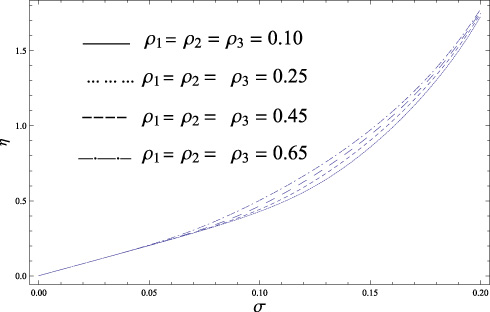
Stability diagram for a system having the particulars: U = 1, V = 1, H 0 = 0.1, μ = 0.1, 𝜙(1) = 𝜙(2) = π.
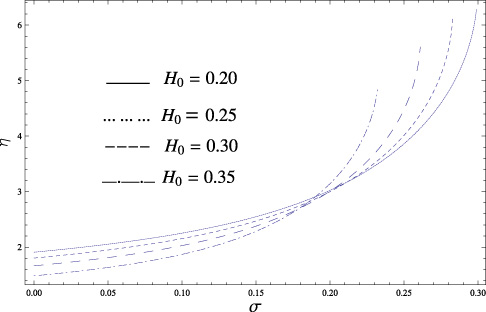
Stability diagram for a system having the particulars: 𝜌(1) = 𝜌(2) = 𝜌(3) = 0.001, U = 1, V = 1, μ = 0.001, 𝜙(1) = 𝜙(2) = π∕6.
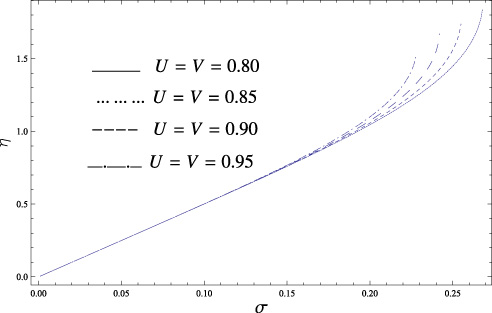
Stability diagram for a system having the particulars: 𝜌(1) = 𝜌(2) = 𝜌(3) = 0.001, H 0 = 0.2, μ = 0.001, 𝜙(1) = 𝜙(2) = π∕6.
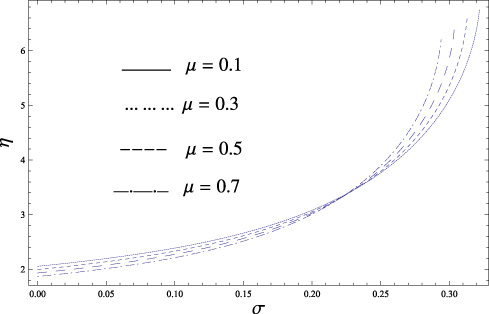
Stability diagram for a system having the particulars: 𝜌(1) = 𝜌(2) = 𝜌(3) = 0.1, U = 1, V = 1, H 0 = 0.1, 𝜙(1) = 𝜙(2) = π∕4.
Stability diagram for a system having the particulars: 𝜌(1) = 𝜌(2) = 𝜌(3) = 0.1, U = 0.8, V = 0.8, H 0 = 0.1, μ = 0.1.
From Fig. 1, corresponding to (𝜌(1) = 𝜌(2) = 𝜌(3) = 0.10, 0.25, 0.45, 0.65), it is found that the stable domains are (0 < σ < 0.236), (0 < σ < 0.234), (0 < σ < 0.232), (0 < σ < 0.230). The neighboring unstable domains are (0.236 < σ < ∞), (0.234 < σ < ∞), (0.232 < σ < ∞), (0.230 < σ < ∞).
From Fig. 2, corresponding to (H 0 = 0.20, 0.25, 0.30, 0.35), it is found that the stable domains are (0 < σ <0.3), (0 < σ <0.284), (0 < σ < 0.262), (0 < σ < 0.233). The neighboring unstable domains are (0.3 < σ < ∞), (0.284 < σ < ∞), (0.262 < σ < ∞), (0.233 < σ < ∞).
From Fig. 3, corresponding to (U = V = 0.80, 0.85, 0.90, 0.95), it is found that the stable domains are (0 < σ < 0.269), (0 < σ < 0.256), (0 < σ < 0.243), (0 < σ < 0.229). The neighboring unstable domains are (0.269 < σ < ∞), (0.256 < σ < ∞), (0.243 < σ < ∞), (0.229 < σ < ∞).
From Fig. 4, corresponding to (μ = 0.1, 0.3, 0.5, 0.7), it is found that the stable domains are (0 < σ < 0.323), (0 < σ < 0.314), (0 < σ < 0.305), (0 < σ < 0.295). The neighboring unstable domains are (0.323 < x < ∞), (0.314 < x < ∞), (0.305 < x < ∞), (0.295 < x < ∞).
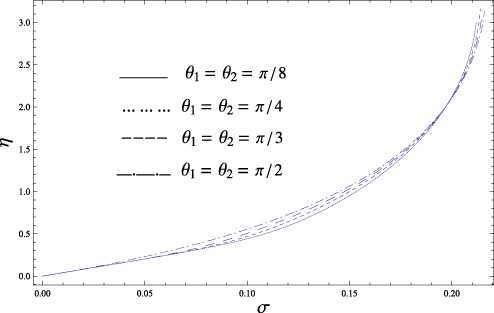
From Fig. 5, corresponding to (𝜙(1) = 𝜙(2) = π∕8, π∕4, π∕3, π∕2), it is found that the stable domains are (0 < σ < 0.213), (0 < σ < 0.215), (0 < σ < 0.216), (0 < σ < 0.217). The neighboring unstable domains are (0.213 < σ < ∞), (0.215 < σ < ∞), (0.216 < σ < ∞), (0.217 < σ < ∞).
Previously, we observe that the increase of the intensity of the magnetic field, the magnetic field permeability coefficient and the density of the fluid values has a destabilizing influence. On the contrary, the increase of the angle between the field and the x-axis has a stabilizing influence. According to all previous studies, we find that the uniform streaming has a destabilizing influence ([3,28]).
Conclusions
From the foregoing discussions, we have examined the influence of the existence of self-gravitating, the oblique magnetic fields, streaming resistive triple superposed fluids layers. We plotted (σ −𝜂) plane and studying the effect of different variables on the process stability.
We may deduce the following:
According to all previous studies, the streaming velocity has a destabilizing influence. The increase of the magnetic field permeability coefficient has a destabilizing influences The increase of the intensity of the magnetic field values has a destabilizing influence. The increase of the fluids density values has a destabilizing influence. The increase of the angle θ between the field and the x-axis has a stabilizing influence.