







Abstract
Magnetorelaxometry imaging is a novel tool for quantitative determination of the spatial distribution of magnetic nanoparticle inside an organism. The use of multiple excitation patterns has been demonstrated to significantly improve spatial resolution. However, increasing the number of excitation patterns is considerably more time consuming, because several sequential measurements have to be performed.
In this paper, we use compressed sensing in combination with sparse recovery to reduce the total measurement time and to improve spatial resolution. For image reconstruction, we propose using the Douglas-Rachford splitting algorithm applied to the sparse Tikhonov functional including a positivity constraint. Our numerical experiments demonstrate that the resulting algorithm is capable to accurately recover the magnetic nanoparticle distribution from a small number of activation patterns. For example, our algorithm applied with 10 activations yields half the reconstruction error of quadratic Tikhonov regularization applied with 50 activations, for a tumor-like phantom.
Keywords
Introduction
Magnetic nanoparticles (MNP) offer a variety of promising biomedical applications. For example, they can be used as agents for drug delivery or hyperthermia, where the aim is to heat up specific regions inside a biological specimen [32]. These applications require quantitative knowledge of the magnetic nanoparticles distribution for safety and efficacy monitoring. In this paper, we consider magnetorelaxometry (MRX) imaging, which is a novel and promising non-invasive technique to spatially resolve the location and concentration of MNPs in vivo [4,23]. It beneficially combines a highly sensitive magnetic measurement technology for MNP imaging with a broad range of parameters and has the potential to image particle distributions in a comparably large volume [9].
In MRX imaging, the magnetic moments of the magnetic nanoparticles are aligned by a magnetic field generated by excitation coils [24]. Therewith, a magnetization can be measured from the MNP. After switching off the excitation field, the decay of magnetization (relaxation) is recorded, typically by SQUIDs (superconducting quantum interference device), yielding information about the particle concentration and related properties. If the relaxation is measured by a sensor array, the particle distribution can be reconstructed by inverse imaging methods [3,23].
In multiple excitation MRX (ME-MRX) imaging, several inhomogeneous activation fields generated by an array of excitation coils are applied. With such a coil array, a variety of inhomogeneous excitation fields can be generated, for example, by switching on the coils in a sequential manner [29]. First experimental realizations of ME-MRX with sequential activation and least squares estimation for imaging have been obtained in [23]. ME-MRX imaging using sequential coil activation and standard image reconstruction techniques requires a large number of measurement cycles and thus a considerable time for data acquisition. Recently, different approaches have been proposed using advanced excitation schemes [1,8,11].
A strategy to maintain high resolution while reducing measurement time is via compressed sensing (CS), a new sensing paradigm [5,12] that allows to capture a high-resolution image (or signal) by using fewer measurements than predicted by Shannon’s sampling theorem. CS replaces point-measurements by general linear measurements, where each measurement consists of a linear combination of the entries of the image of interest. Without prior information, recovering the original image is highly under-determined. The standard theory of CS predicts that under suitable assumptions on the image (sparsity) and the measurement matrix (incoherence), stable image reconstruction is nevertheless possible. CS has led to several new sampling strategies in medical imaging, for example, for speeding up MRI data acquisition [25], accelerating photoacoustic tomography [18], or completing under-sampled CT images [7]. While these applications involve relatively mildly ill-conditioned problems, ME-MRX constitutes a severely ill-conditioned or ill-posed problem [2,13]. No standard approaches for image reconstruction combining compressive measurements and such severely ill-posed problems exist.
In this work, we investigate CS techniques for accelerating ME-MRX. For that purpose, we consider random activations of the coils as well as sparse deterministic activation schemes. In order to image the MNP distribution from the CS data we propose a sparse reconstruction framework. We propose ℓ 1-Tikhonov regularization together with a positivity constraint on the set of reconstructed MNP distributions, and apply the Douglas-Rachford splitting algorithm [10] for its minimization. We evaluate the performance of the resulting sparse recovery algorithm using different phantoms in dependence of the number of activation patterns. In any of the cases, the sparse recovery algorithm reduces the root mean square error (RSME) by more than 50%. For two of the three phantoms (CS and smiley), the deterministic scheme outperforms the random pattern by around 10% in terms of reduced RSME. For the third phantom (tumor), all tested sampling patterns roughly give the same results. We therefore can propose the sparse sampling pattern among the tested schemes, in combination with the proposed sparse recovery framework.
The forward model in ME-MRX imaging
This section gives a precise formulation of the forward problem of ME-MRX imaging and CS. Throughout this text we work with a discrete model [4,27,31]. A continuous model has recently been presented in [13].
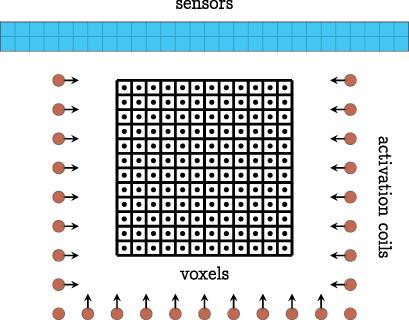
Illustration of a simplified two-dimensional ME-MRX setup consisting of an array of activation coils and two layers of sensors arranged around the volume of interest. The coil locations
In MRX imaging, an activation field is applied to a region of interest containing MNPs. We assume this region to be divided into a number of N
v
quadratic voxels, each represented by its midpoint located at
Assuming the concentrations n (
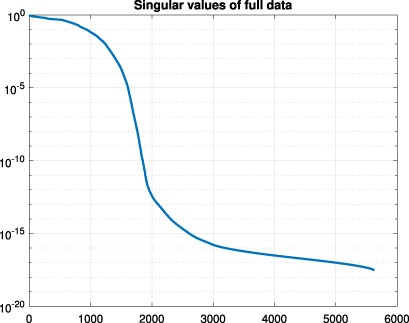
Singular values of the Lead field matrix on a logarithmic scale. The Lead field matrix uses 110 × 120 = 13200 measurements for 752 = 5625 unknowns. The rapid decay of the singular values is due to the severe ill-conditioning of the MRX imaging problem. Increasing the number of measurements results in a similar rapid decay which indicates the inherent ill-posedness of the inverse problem.
In ME-MRX imaging, the volume is (partially) surrounded by an array of excitation coils and sensor arrays (see Fig. 1). The coils can be steered to generate different types of activation fields. In the following we denote by
The multiple coil setup has been realized in [1,29] and shown to significantly improve the spatial resolution compared to a single coil activation [29]. However, consecutive activations lead to a more time consuming measurement process. In order to accelerate data acquisition and to improve imaging resolution, we use CS techniques and develop a Douglas-Rachford based sparse reconstruction algorithm.
The basic idea to employ CS for ME-MRX imaging is to use m specific coil activations, with m ≪ N
c
, instead of activating all N
c
coils in a sequential manner. Because of linearity, the data corresponding to the jth random activation pattern are given by
In order to write the reconstruction problem in a compact form we introduce some additional notation. First, we define the CS measurement vector as
With the above notations, the CS data in (6) can be written in the compact form
In order to recover the MNP distribution, the inverse problem ((10)) (or ((11))) has to be solved which is known to be severely ill-posed, see Fig. 2. We note that no standard approach for image reconstruction combining compressive measurements and severely ill-posed problems exist. This section, therefore, is also of interest from a general perspective on CS for inverse problems.
Sparse Tikhonov regularization
We consider ((11)) as a single inverse problem with system matrix
We call
The k-restricted isometry property (k-RIP) of Due to the severe ill-conditioning of the Lead field matrix Standard CS theory requires orthogonality of the sparsifying transform, which means that
In order to minimize ((12)), we propose using the Douglas-Rachford minimization algorithm, which is a backward-backward type splitting method for minimizing the sum F + G of two functionals F and G. For our purpose we take 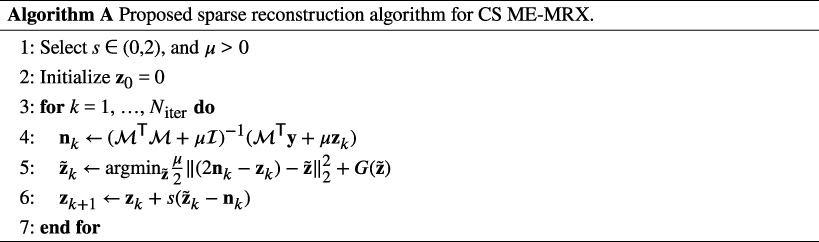
The Douglas-Rachford algorithm is a splitting type algorithm for minimizing F + G which alternatingly performs updates according for F (in our case, the residual functional or data fitting term) and G (in our case, the regularizer). Because the regularizing term is non-smooth, standard methods such as Newton type methods cannot be applied. Splitting type methods are a natural choice in this case, and the implicit step in line 5 in Algorithm A accounts for the non-smoothness of G. Other splitting algorithms that are well suited to treat the non-smooth regularizer include the forward-backward splitting algorithm [10] and the Chambolle-Pock algorithm [6]. These algorithms use explicit gradient updates for the data fitting term requiring a matrix inversion. Therefore, they are not well suited for ME-MRX imaging. The Douglas-Rachford algorithm performs an implicit update for the data fitting term (line 4 Algorithm A), which is recognized as quadratic Tikhonov regularization step for the given equation and potentially accelerates the iteration.
For our numerical experiments, we take
Under the reasonable assumptions that the regularizer G is lower semicontinuous and convex, and that the sparse Tikhonov functional
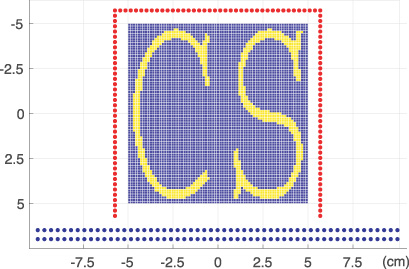
Full data setup for the numerical simulations. The phantom is contained in a square region of interest, the sensors are arranged in two parallel layers (blue dots), and the coils for full activation are arranged around the phantom in U-form (red dots).
For the following numerical simulations, we use a data setup similar to the realization in [1]. For simplification, we consider a two-dimensional setup representing one voxel plane, containing two parallel arrays of detector elements (one measuring the horizontal (1,0) and one measuring the vertical (0,1) component) located outside a quadratic region of interest. Circular shaped activation coils are arranged in U-form around the region of interest, all having the same normal vector (0,1). The used arrangement of sensor and coil locations for the full measurement data setup is shown in Fig. 3. For our simulations, we choose a discretization of imaging space into N v = 752 voxels covering a region of interest of [−5,5] × [−5,5] cm2. The data are generated for N s = 110 positions and full measurement data correspond to N c = 120 activation coils outside the region of interest.
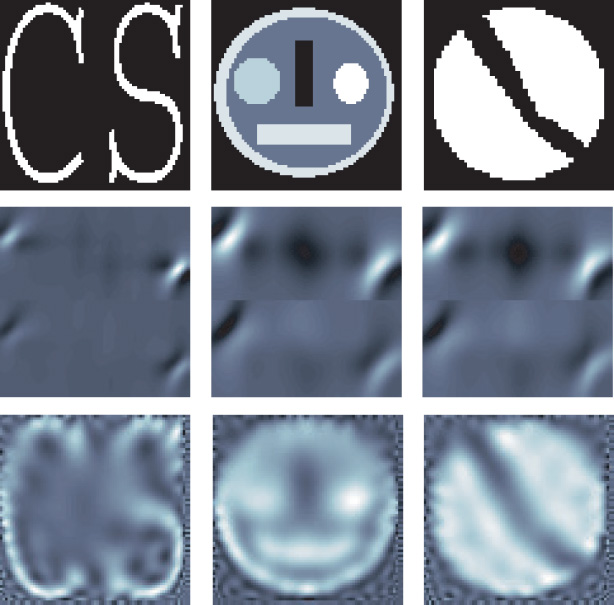
Phantoms, data and full measurement data reconstruction. Top row: CS-phantom (left), smiley-phantom (middle) and tumor-phantom mimicking cancerous tissue with included blood vessel (right). Middle row: Corresponding full measurement data. Bottom row: Reconstructions from full measurement data using standard quadratic Tikhonov regularization.
To set up the forward model ((2)), ((4)), ((5)), we first have to compute the magnetic fields generated by each coil. For that purpose, we follow the approach of [1,3], where any circular activation coil is approximated by short line segments, each carrying the same current I
0. Every coil is modeled by 45 line segments for numerical calculations of the magnetic field. This is considered to be a sufficiently accurate approximation since the deviation of only 36 line segments from the analytical solution was shown to be already below 1% in [22]. Using this approximation, the induced magnetic field at the voxel center
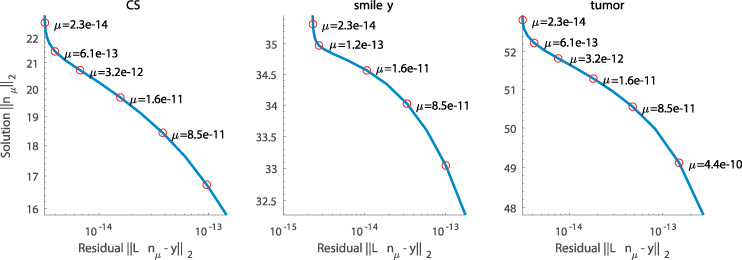
Selection of the regularization parameter by the L-curve method. Each image shows a log–log plot of the residual functionals versus the solution norm in dependence of the regularization parameter. The L-curve method predicts an L-shaped curve and advices to select a regularization parameter close to the corner of the L-curve. In our results we empirically found that taking the regularization parameter slightly smaller than advised by the L-curve method yields accurate results.
For the presented results, we use three different magnetic particle distributions which, together with the corresponding measurements full data, are shown in Fig. 4. Any column in the measurement data (in Fig. 4 and below) corresponds to a single activation pattern and contains the data of all detectors. The phantoms are rescaled to have maximum value 1 and the forward operator
The CS forward matrix
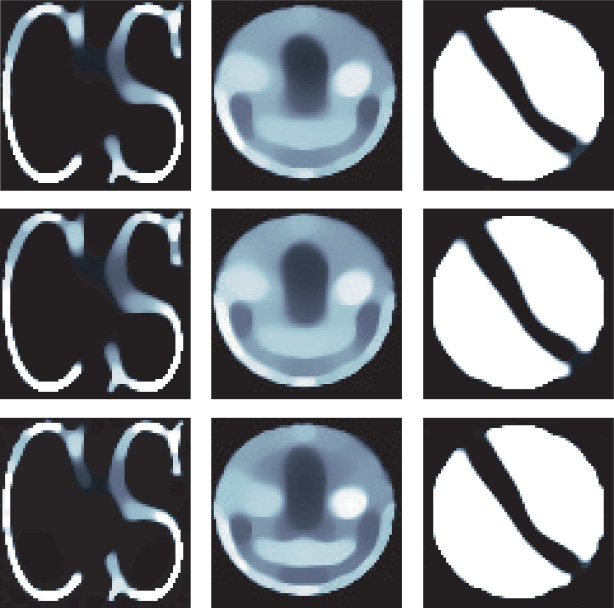
Reconstruction results with Algorithm A from 40 coil activations. Top row: Gaussian activation matrix. Middle row: Bernoulli activation matrix. Bottom row: Sparse deterministic activation pattern.
Evaluation metrics for Gaussian measurements (row 1) Bernoulli measurements (row 2) and deterministic activation pattern (row 3) using 40 activation patterns. The bottom row shows the same evaluation metrics for Tikhonov regularization for full activations
The system matrix
We observed that after 50 iterations the reconstructed MNP stagnates which indicates that the iterates are close to the minimizer of the Tikhonov functional. The reconstructed MNP distributions using Algorithm A from 40 coil activations are shown in Fig. 6. Each reconstruction takes about 50 seconds in Matlab R 2017a on a MacBook Pro (2016) with 2.9 GHz Intel Core i7 processor.
To quantitatively evaluate the reconstruction results, we compute the relative root mean squared error (RMSE) ∥
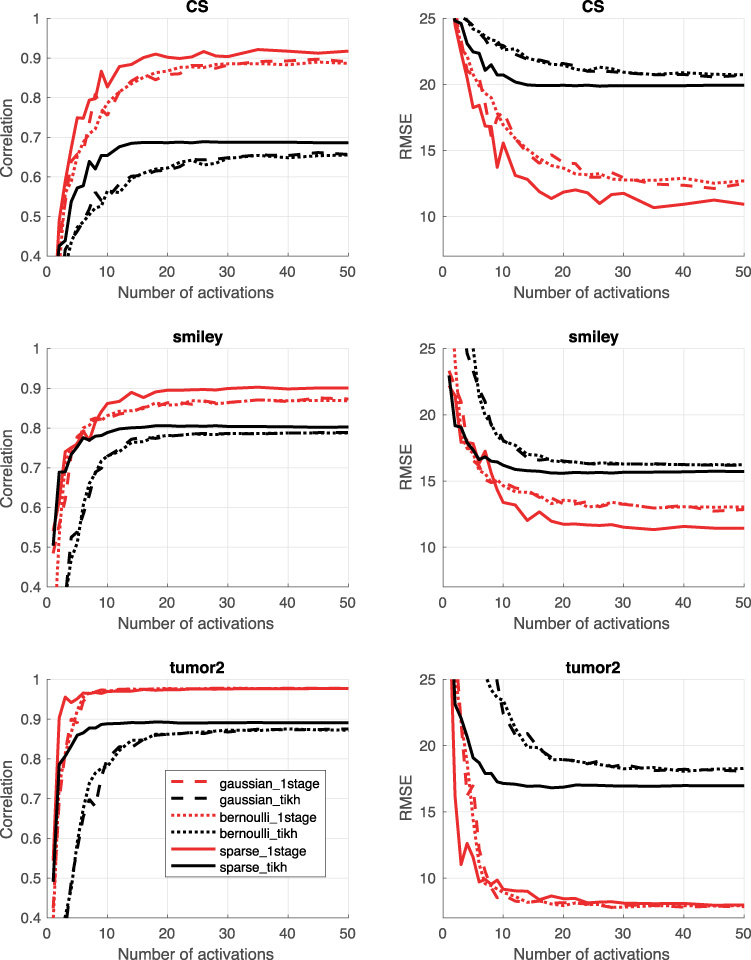
Quality evaluation in dependence of the number of coil activations. Left: correlation between reconstructions and the true phantoms. Right: RMSE of the reconstructions.
Figure 7 shows a convergence study (for the correlation and the RMSE) in dependence of the number of activations. We see that the Douglas-Rachford algorithm constantly outperforms Tikhonov regularization and significantly reduces the RSME and increases the correlation. For the CS and the smiley phantom, the deterministic sampling pattern has a significantly smaller RMSE than the random schemes. We address this behavior to the strong smoothing effect of the forward operator, which removes most high frequency components in the data. In the full forward matrix
The use of multiple coil activation patterns in magnetorelaxometry imaging is time consuming and requires performing several consecutive measurements. It is therefore desirable to make the number of coil activations as small as possible, while keeping high spatial resolution. For that purpose, we investigated CS strategies in this paper. We compared Gaussian random activations, Bernoulli activations and deterministic sparse sampling schemes. For actual image reconstruction, we proposed a Douglas-Rachford splitting algorithm applied to the sparse Tikhonov functional; see Algorithm A. For a small number of coil activations, the random schemes slightly outperform the deterministic scheme for the smiley-phantom and tumor phantom. For a large number of activations, the deterministic sampling scheme clearly performed better than the random sampling patterns. We explain this behavior by the severe ill-conditioning of the Lead field matrix, which is more severe for a large number of activations. Only for a small number of activations, where the resolution is poor anyway, the incoherence at the low frequencies is not destroyed by the smoothing effect of the Lead field matrix. The reconstruction results clearly demonstrate the proposed Algorithm A significantly outperforms standard algorithms such as Tikhonov regularization. Depending on the complexity of the phantom between 6 (tumor) and 30 activations (CS) are sufficient for the used framework and further increasing the number of activations only decreases the RMSE by a few percent; see Fig. 7.
Several interesting research directions following this work are possible. First, we can replace the inner TV minimization in the single-stage approach by a different algorithm which should accelerate Algorithm A. Second, the derivation of theoretical error estimates for the single-stage approach is of significant interest. Results in that direction can advise which type of MRX measurements are best to obtain accurate results for certain phantom classes. Moreover, the derivation of adaptive compressed sensing strategies for online monitoring is of significant interest. Advising optimal coil activations given previous activations is a practically important challenge that will benefit from theoretical error estimates, numerical simulations as well as real-world experiments. Such issues will be addressed in future work. In this paper, we investigated standard random compressed sensing schemes (using Gaussian and Bernoulli activation patterns and sparse sampling). Using more problem adapted and task oriented measurement design we expect to derive improved coil activation schemes.
Footnotes
Acknowledgements
This work has been supported by the Austrian Science Fund (FWF), project P 30747-N32, and the German Science Foundation (DFG) within the priority program COSIP, project Cos-MRXI (BA 4858/2-1).