






Abstract
Modern induction heating systems involve usually many non-linear systems with different constraints, making difficult implementing classical controllers. In this context, model predictive control arises as a powerful technique able to provide high performance controllers with advanced functionalities. This paper will discuss the benefits of this control technique for induction heating systems and will provide an example of application for domestic systems. As a conclusion, MPC will help powering future induction heating systems with improved control capabilities and performance.
Keywords
Introduction
Induction heating consist on applying an alternating magnetic field to a material, usually with ferromagnetic properties, to induce currents that will lead to the material heating. Induction heating (IH) has spread to a number of applications [1] ranging from industrial to biomedical or domestic ones due to its benefits in terms of performance and efficiency. Among the main benefits of IH, fast heating, repetitive and accurate process, safety and being a contactless heating method are the most relevant ones.
IH systems usually rely on a power converter in order to generate the required high frequency current/voltage to supply the coil that generates the alternating magnetic field (Fig. 1). These systems usually feature resonant power converters [2] to obtain the required medium frequency currents, which are sometimes combined with dc–dc converters for better load-power adaptation and power factor correction [3]. Modern IH systems are highly non-linear and, consequently, designing the control scheme requires taking into account a wide variety of constraints including power converter, heating process, and industrial process constraints. Under these conditions, classic control techniques are difficult to tune and include all the possible constraints and desired performance.

Typical power conversion flow in an IH system.
In the past, several approaches have been followed to try to achieve high-performance controllers. As the load characteristics changes with temperature, usually the controller task becomes heavy. An original control scheme is described and tested in [4–6] for a six-coil system called zone-controlled induction heating (ZCIH) in a longitudinal flux configuration. Paper [6] presents the use of a current control method based on a circuit model using real and imaginary current/voltage components instead of the current amplitude and phase angle control in the classical approaches. State feedback decoupling provides separate current control on each phase with high dynamics but with a high computation burden due to numerous high rank matrix transformations. The six currents remain in phase in this application where no dc–dc converter is needed unlike in [4]. In order to obtain appropriate dynamics, resonant control of the inductor currents has been presented in [7] versus other classical control techniques. However, still all these techniques are based on linearized control techniques that makes difficult, or not feasible at all, the use of complex constraints and control targets.
All these modulation and control algorithms have been implemented either using analog [8] or digital techniques. Nowadays, digital implementations using digital signal processors (DSPs) or field-programmable gate arrays (FPGAs) are preferred due to their advantages in terms of configurability and performance. In particular, several design methodologies [9], monitoring [10] and control architectures [11–13], and accelerated simulation techniques [14] for IH systems have been proposed taken advantage of FPGAs. Still, real-time implementation of advanced controllers using cost-effective digital control hardware is a challenge.
In this context, model predictive control (MPC) arises as a powerful tool to provide high-performance controllers being able to include different nature restrictions in the optimization process. This paper will review the fundamentals of model predictive control and its applications and will provide an application example and future perspectives.
Model predictive control uses the mathematical model of a dynamic system to predict its future behaviour and compute a sequence of optimal control inputs to satisfy given constraints and optimize a desired performance measure (Fig. 2).
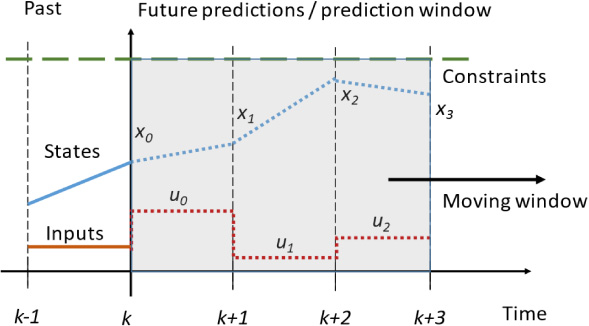
Schematic description of Model Predictive Control. A mathematical model is used to predict the future states of a dynamic system and compute a sequence of optimal control inputs by solving an optimization problem.
The mathematical model used is usually described in the form of differential equations as
In the past, MPC has been applied to many industrial systems, from aerospace and mechanical systems, to chemical processes. In the last years, MPC has been also applied to electrical/electronic systems, providing a breakthrough in control possibilities in modern power electronic systems [15]. These control approaches have opened the window for improved performance in many areas.
However, considering IH applications, little research or industrial applications have been yet described. In [16], a furnace control is proposed and compared with current state-of-the-art alternatives, highlighting benefits of MPC, and an IH furnace with a parallel-resonant load and unity input power factor is described in [17]. In [18], Laguerre functions are applied in order to obtain a less demanding computational complexity.
Despite its little current adoption, there is a great potential for MPC applications to IH due to several distinctive elements inherent of IH processes. Some of them are summarized as follows:
Temperature evolution. IH processes, by definition, produce changes in the temperature of the IH target that may be very fast and in a wide range. These may lead to changes in the plant to control, becoming a challenging control problem. MPC can therefore provide tools to identify temperature variation, predict its evolution and, consequently, optimize the controller.
Geometry and coupling. Geometry of the IH system and, specifically, the electromagnetic coupling of the IH coil and the IH target are challenging aspects. This may significantly change the plant and, consequently, lead to different performances. This is especially important in those systems with a wide load variation, such as domestic induction heating, where a wide variety of geometries and positions are used in a non-predictable way. In this context, MPC again provides tools to predict and adapt the controller to these plant variations.
Resonant tank and soft-switching. Usually, power converters for induction heating systems rely on the use of resonant converters [2] to achieve high-efficiency [19]. Despite their benefits, resonant power converters require fine tuning of the resonant tank and the soft-switching conditions. In this context, MPC is a valuable ally in order to ensure that the power converter is being operated in a high-efficiency and reliable operating point being able to consider complex constraints.
Component dispersion and aging. Finally, as in any other electronic system, there can be a significant effect of the component dispersion due to tolerances or aging in the final plant performance. This is especially true in IH systems which suffer usually heavy thermo-mechanical stress, use capacitive and magnetic elements with wide tolerances and geometrical variations, and rely on resonant converters highly affected by these effects. For these reasons, MPC is a helpful ally to cope with these elements and to optimize the controller under this wide range of operating conditions.
The MPC implementation consist on defining a function to be optimized subject to a certain set of constraints. By putting this formulation in the context of IH, a set of parameters is discussed as follows.
When dealing with the optimization function, different options are possible depending upon the application. The most obvious is the target output power, which is the desired target in many industrial IH processes. However, the actual target temperature can be also considered, either by direct measurement or by using real-time estimators. Other possibilities such as the system efficiency, switching frequency or settling time can also be considered. Moreover, the combination of several of these factors can be considered by using weighting factors in the optimization function, making possible to achieve complex performance targets in a straight-forward way not possible using conventional control methods.
The constraints will be taken into account to obtain the optimum controller in MPC. Unlike other classical control approaches, complex constraints such as instantaneous magnitude values, ranges, or Boolean conditions can be considered. Assuming the IH context, important parameters such as current and voltage, efficiency, switching frequency ranges, power and/or temperature limits or soft-switching conditions can be considered. This opens the windows to a far wider range of optimization possibilities, making possible to implement higher performance systems, with higher efficiency and reliability. Besides, since the performance can be optimized and the stress on each subsystem part can be optimized, cost-effective implementations can be achieved.
Some of these benefits and formulation examples are discussed in the next Section, where an application example to domestic induction heating is presented.
Application example: Domestic IH
Domestic induction heating [20] (Fig. 3) is a representative example of IH system [1] where the IH target is a pan/pot for culinary purposes [21]. It has many elements in common with industrial or biomedical systems, and some specific challenges, especially regarding the wide output power and load coupling variability [22]. In this Section, an example of application of MPC to domestic IH [23,24] is briefly discussed.
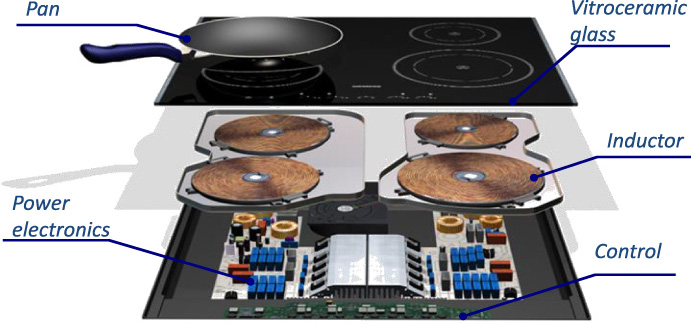
Induction heating home appliance.
Domestic induction heating is based on creating an alternating magnetic field to generate heat in the induction target by means of Eddy currents and magnetic hysteresis [1]. Typically, planar induction coils to fit the low-profile structure are used (see Fig. 3), and resonant power conversion as discussed before is applied.
Domestic IH requires optimizing the power converter operation, i.e. soft-switching and reduced switching frequency for high efficiency, while avoiding acoustic noise. This is especially important in this application, where the user performance is defined by the perceived output power and noise. Consequently, the constraints discussed in the previous section severely affects to this application.
This problem considers a half-bridge series resonant inverter (Fig. 4) that is controlled using both switching frequency f
sw
and duty cycle D. In this example (see expression (2)), the cost function (a) considers both the output power P
o
and the switching frequency f
sw
, weighted by the parameter 𝛼. By doing this, the required output power is obtained while the switching frequency is minimized in order to minimize switching losses. This optimization is evaluated each switching period, providing optimized transient performance.
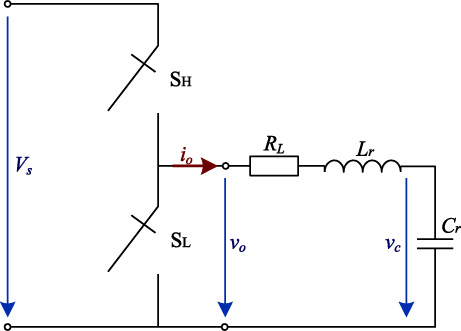
Half-bridge series resonant converter.
Figure 5 shows the simulation results obtained by solving problem (2) after each switching cycle for a conventional domestic IH load, including the main waveforms, control inputs, and output power. In this figure, it can be seen that the controller achieves the target output power (dashed line in the bottom plot) within a few switching cycles while keeping the control inputs within the desired ranges. Moreover, the controller ensures that ZVS operation is achieved, even during transient behaviour, by ensuring the proper current sign during the switching times, guaranteeing consequently a high-efficiency and reliable operation. As a conclusion, MPC has proved to be a useful tool for improving control systems of domestic IH systems subject to a wide variety of constraints [25].
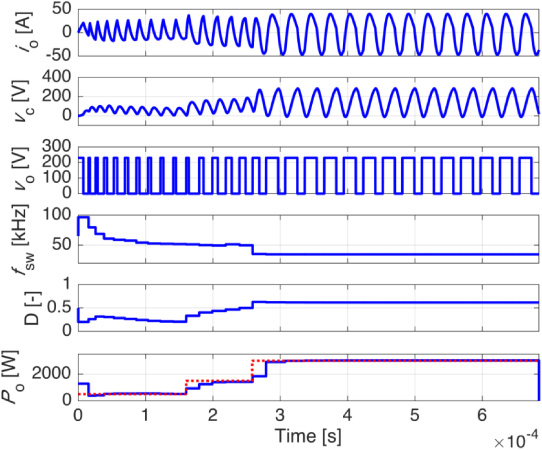
MPC applied to domestic IH performance results [24].
Domestic induction heating technology is gaining acceptance in the domestic market due to its benefits in terms of performance, efficiency and safety. The development of this technology and its modern applications requires new and innovative power converter design with increasingly complex control strategies. These control strategies must take into account not only the output power target, but also complex constraints such as soft-switching operation, acoustic and flicker emissions, and switching frequency constraints, among others. In this context, classical control techniques cannot provide an easy implementation to fit all these requirements.
MPC is a powerful tool to implement modern high-performance IH controllers, where complex constraints can be considered in the optimization process. This paper has reviewed the state-of-the-art and main applications, and has detailed an example of application for domestic IH. This example has proved the ability of MPC to ensure, not only the output power requirements, but also complex operational conditions optimization in a feasible manner. Future challenges will include taking into account additional restrictions as well as the embedded implementation of these controllers [26].
Footnotes
Acknowledgements
This work was partly supported by the Spanish MINECO under Project TEC2016-78358-R, by the Spanish MICINN and AEI under Project RTC-2017-5965-6, co-funded by EU through FEDER program, by the DGA-FSE, and by the BSH Home Appliances Group.