







Abstract
In order to improve the electrochemical performance of the neural electrode the polyaniline coatings were modified on roughened Pt (PANI/rPt 1 ) electrodes using electrochemical method. The roughness factor (f R up to 424) of Pt surfaces increased significantly through electrochemical roughening processing. PANI/rPt electrodes showed excellent interfacial properties. Specifically, about 5.6-fold increase in the charge density of PANI/rPt (f R = 424) was observed, while the interfacial impedance (103.5 Ω) was reduced by 50% compared to that of PANI coatings on the smooth Pt surfaces (PANI/sPt 2 ). The results indicate the potential application of PANI/rPt as an efficient and stable future neural interface. In addition, the wear test shows that the coating did not fail during the wearing period and holds an excellent wear resistance ability.
Introduction
Currently, the emerging neural electrode for nerve recording and stimulation has been widely used to restore lost or impaired neurological functions [1,3]. As the key component connecting the tissue-electrode interface, neural electrode has shown huge potential for clinical therapies and neural prostheses [2,4]. In order to ensure high spatial resolutions and minimize tissue injuries during and after implantations, in most cases neural electrode has small geometric size [2,5]. However, small geometric size often leads to increased impedance and lower signal-to-noise ratio [6]. Moreover, it also results in high charge density, nerve cells and electrodes would be damaged when charge density exceeds the charge injection limit [7].
Neural interfaces with low impedance and high selectivity are demanded for chronic use. Nowadays, several approaches have been used, such as conducting polymer material modified electrodes and electrodes with increased effective surface area [3,5,8–10]. Among these methods, modifying electrodes with conducting polymer coatings such as polyaniline (PANI) or poly (3,4-ethylenedioxythiophene) (PEDOT) has attracted widely attention [9,11].
Currently, platinum (Pt) is the most popular material for neural electrodes [12]. The interfacial impedance of Pt can be reduced significantly by electrochemical roughening via repeatedly oxidation – reduction cycle (ORC) method [10,13]. Hence, exploiting suitable conducting polymer coatings to modify these high surface area roughened electrodes have potential in effectively improving their long-term electrochemical properties. In previous studies, the effect of surface roughness on the interfacial properties of PANI coating on a roughened Pt electrode has been characterized. PANI coating was electrochemical polymerized on the roughened surfaces. The morphology and the electrochemical performance, including the charge density and electrochemical impedance, have been investigated to evaluate the performance of this PANI/rPt electrode.
After implantations, the electrode would be placed into a long-term biological micro-motion environment. [14,15] Therefore, the conductive polymer coating would inevitably face the problem of friction and wear. In this research, a type of wear test machine was used to verify the anti-wear ability of the polymer coating.
Experiments
Procedure for electrochemical roughening of Pt electrode
A 2-mm-diameter Pt disk was abraded firstly using metallographic sand paper, and then polished on clean billiard cloth with 0.3 and 0.05 μm alumina powder to obtain a mirror finish. Ultrasonically cleaned with acetone, HNO3, and deionized water were in sequence. Then, the smooth electrode was roughened by the procedure similar to Arvia et al. [16,17]. The main steps of the electrochemical roughening of the smooth electrode are as follows:
(1) Before electrochemical roughening, the Pt electrode was electrochemically cleaned by cyclic voltammetry (CV) between −0.2 and +1.25 V with a scan rate of 0.5 V/s in 0.5 M sulfuric acid solution, until all unstable atoms or clusters were removed and a reproducible hydrogen adsorption/desorption peak was obtained.
(2) The surface of Pt electrode was electrochemically roughened by ORC. A repetitive square wave potential cycle of 1 kHz with lower and upper potentials of −0.2 and +2.4 V was applied to the electrode in 0.5 M sulfuric acid solution for 15 s to 300 s, and then the potential was held at −0.2 V until the electroreduction of the surface was completed.
(3) After roughening, the electrode was subjected to potential cycles between −0.25 and +1.2 V at 0.5 V/s in a fresh 0.5 M sulfuric acid solution again until reproducible cyclic voltammograms were obtained.
The surface roughness factor (f
R
) was calculated through the relationship:
The morphology of the roughened Pt surface was characterized by atomic force microscopy (AFM) Multimode Nanoscope IIIa (Bruker Daltonics Inc, America) in tapping mode using silicon nitride tips. The surface roughness of the roughened Pt electrodes with different f R were analyzed using Veeco Nanoscope analysis software.
PANI film was prepared in 0.2 M aniline and 0.5 M H2SO4 aqueous solution. Then the roughened Pt electrode (rPt) with different roughness factors were subjected to potential cycles between −0.1 and +0.9 V at 0.05 V/s for 20 circles. After polymerization, the obtained PANI/rPt electrode was then completely cleaned using deionized water to remove the free ionic and dried by nitrogen. The morphology of PANI/rPt electrodes surface was characterized by Zeiss Ultra Plus high-resolution scanning electron microscope (SEM).
Electrochemical properties of PANI/rPt interface
CV measurements of PANI/rPt interface were performed in PBS solution using the CHI660D. The obtained cyclic voltammograms of PANI/rPt Interface were subjected to potential cycles between −0.3 and +0.9 V at 0.05 V/s. Charge density (σ) was evaluated through the function:
In this study, electrochemical impedance spectroscopy (EIS) measurements were performed in PBS solution under open circuit potential in a frequency range of nerve signals (1 Hz ∼ 100 kHz) with a sine signal of 50 mV amplitude using the electrochemical workstation at room temperature.
After pre-treating the platinum sheet, Polyaniline-deposited platinum sheets was prepared by cyclic voltammetry deposition techniques for 40 cycles through above method. In this experiment, a multi-functional wear tester was used. In precise, a ball-on-disk (friction pair of 45 steel, load 0.5 N) reciprocating friction test was applied to the coating under a dry room temperature environment.
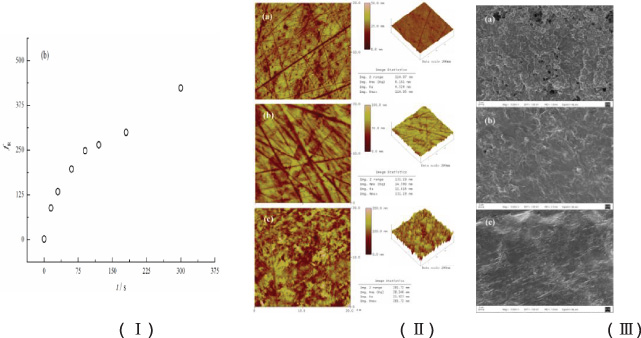
(I) f R as a function of roughening time. (II) AFM images and roughness of rPt surfaces for electrodes for different roughening time: a∕0, b∕30 s, c∕120 s. (III) SEM images of PANI/rPt electrodes for different roughening time: a∕0, b∕30 s, c∕120 s.
Electrochemical roughening
The smooth Pt surface was electrochemically roughened by applying periodic high frequency square wave voltage pulses. In this study, the surface roughness was controlled by changing the roughening time (ranging from 15–300 s), while the other parameters were fixed. Figure 1(I) shows f R as a function of roughening time. The f R can be estimated by the area of the cyclic voltammogram. It can be observed that the surface roughness of Pt electrode increased significantly after roughening. Table 1 shows that f R is corresponding to different roughening times.
f
R
corresponding to different roughening times
f R corresponding to different roughening times
The surface features were observed by AFM. Figure 1(II) shows that three representative AFM images of the morphology of the smooth Pt surfaces, and the corresponding roughened Pt surfaces at the nanoscale. The morphology of the surface changed significantly as the surface roughness of rPt electrodes increased. As shown in Fig. 1(II), RMS roughness (peak-to-valley height across the surface) of the smooth electrodes was about 6 nm (Fig. 1(II)(a)), while after 30 s roughening time, RMS roughness of the moderately rPt electrodes (f R = 134) was up to 16 nm (Fig. 1(II)(b)). As the roughening time increases (120 s, f R = 265), RMS roughness of the rPt electrodes was to 28 nm (Fig. 1(II)(c)), and the nanostructures aggregated and form small “nodule” structures, the rPt surfaces exhibited more uniform morphology in vertical dimension as the f R increased.
The surface features of PANI coatings on roughened Pt electrodes were observed by SEM. Figure 1(III) shows SEM images of the morphology of PANI coatings on the roughened Pt surfaces for different roughening time. As shown in Fig. 1(III)(a), PANI coatings modified on the smooth Pt surfaces (PANI/sPt) is porous and with less nonuniformity. As the f R of Pt surfaces increased (f R = 134), PANI coating modified on roughened Pt surfaces (Fig. 1(III)(b)) exhibited more compact and uniform morphology, and decreased porosity. After further roughening of the Pt surfaces (f R = 265), PANI coating deposited on roughened surfaces shows a significantly homogeneous morphology, demonstrating a uniform deposition of PANI coatings. As mentioned above, we could draw conclusions that PANI nanoparticles as well as oligomers have been deposited on the Pt surfaces during electrochemical polymerization. The increased surface after roughening process can provide more active sites as condensation nuclei during the growth process of PANI, and with the competition between different nucleation centers, the varied polymerization rates may result in more even and orderly PANI coatings.
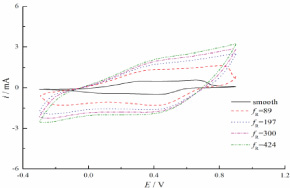
CV of PANI/rPt electrodes with different f R .
Charge density
As shown in Fig. 2, the CV testing of PANI coatings on the smooth and roughened Pt surfaces reveals the switching properties of the composite interface. A higher charge density represents a higher conductivity of the interface. The area of cyclic voltammograms of PANI/rPt is much bigger than that of PANI/sPt. According to function (2), the charge density of PANI coatings are 0.20 C/cm2 on smooth Pt surfaces (2 mm), while 0.69 C/cm2, 1.03 C/cm2, 1.18 C/cm2, and 1.32 C/cm2 respectively on roughened Pt surfaces with different f R . It can be observed that compared to that of PANI/sPt electrode, the charger density of PANI/rPt electrode (f R = 424) increased by about 5.6 times which could meet the need of neural electrode performance improvement. In addition, due to the increase of surface roughness, PANI/rPt interface shows enhanced interface areas, providing more active places for faradic reaction, and larger specific capacitance than PANI/sPt.
Interfacial impedance
EIS is a type of prosperous technique for analyzing the properties of conducting polymer electrodes. The extracellular neural signal amplitude is 50 ∼ 500 μV and biologically relevant frequency is 1 kHz. In this study, EIS measurement was performed in PBS solution under open circuit potential in a frequency range for nerve signals (1 Hz ∼ 100 kHz) with a sine signal of 50 mV amplitude at room temperature. EIS provides information on the charge transfer characteristics of the coating. Figure 3 shows the impedance spectra in Bode format for PANI coatings on both smooth and roughened Pt surfaces in PBS solution. The interfacial impedances of PANI/rPt interfaces are obviously less than that of PANI/sPt interfaces, and the impedance decreases with increasing surface roughness over the whole range of frequencies. This may be caused by the significant increase of the surface areas of Pt electrodes with the formation of PANI.
Generally, 1 kHz is the frequency characteristic of neural biological activity. Therefore, impedance at 1 kHz is often used as the standard to evaluate implantable neural electrodes. At this point, the impedance of PANI/rPt was reduced from 220.8 Ω (PANI/sPt) to 103.5 Ω (f R = 424). This lower impedance at 1 kHz suggests significantly enhancing of the performance of neural electrodes with PANI/rPt interface.
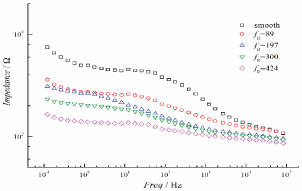
Impedance of PANI/rPt electrodes in PBS over a frequency range of 101–105 Hz.
SEM images (Fig. 4) shows that there is obvious fish scale structure in the polyaniline coated grinding groove, which indicates that the coating exhibits certain plastic deformation after wear and shows the characteristics of adhesive and abrasive wear. Due to the humoral lubrication, compared with the experimental environment (steel ball friction pair, dry friction environment), the real in vivo environment could be relatively mild. As shown in Fig. 4, the polymer coating did not wear out after the whole severe wear test, which indicates that the coating holds an excellent anti-wear ability. The future studies include studying the precise electrical properties changes of the coating after wear.
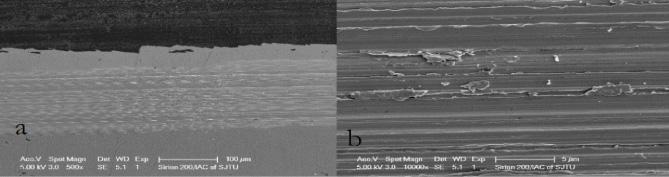
SEM images of polyaniline coating (a) 100 μm (b) 5 μm.
Pt electrodes have been electrochemically roughened to a maximum roughness factor of 424 and PANI coatings have been deposited on the roughened Pt surfaces, then PANI/rPt electrodes were investigated in vitro. The roughness factor of Pt surfaces increased significantly after electrochemical roughening in a controlled manner. In comparison to PANI/sPt electrodes, PANI/rPt electrodes exhibited more uniform and compact morphology, and PANI/rPt electrodes show superior interfacial properties with the increase of roughness factors. The charge density of PANI/rPt (f R = 424) increased by about 5.6-fold and the interfacial impedance (103.5 Ω) was reduced by around 50%. This study highlights the usefulness of PANI/rPt with low impedance and high charge density, which indicates its potential use as a stable and efficient neural interface.
The wear test results indicate that the abrasive wear process leads to significant plastic deformation of the polyaniline coating, accompanied by large-grain-size abrasive particles. In addition, the coating did not wear out under a relatively severer condition (compared with the real in vivo environment), indicating that the coating holds an excellent anti-wear ability.
Footnotes
Acknowledgements
The work was funded by the National Natural Science Foundation of China (Grant No. 51675330). The authors would like to thank Yi Chen and Huiqin Li from Instrumental Analysis Center and Advanced Electronic Materials and Devices Center of Shanghai Jiao Tong University respectively for generous help during AFM and SEM experiments.
1
PANI/rPt: roughened platinum electrodes modified by polyaniline coatings.
2
PANI/sPt: smooth platinum electrodes modified by polyaniline coatings.