







Abstract
Because reactors applied to electric vehicles are typically driven under a DC-biased current, a constant inductance property is required. When a high-performance DC-biased reactor is designed, the topology optimization (TO) is an effective design method owing to the high degree of structural change in the magnetic circuit. However, there exists no report regarding the TO method in the steady-state time domain with magnetic nonlinearity. In this paper, based on the time-domain adjoint variable method, a novel sensitivity analysis approach for the steady-state time domain with thorough consideration of the magnetic saturation is proposed. Through the proposed method, the TO of the iron core and winding structures in a pot-type reactor was carried out to enhance the DC-biased characteristics. Furthermore, the eddy current loss occurring on the aluminum plate installed outside the reactor was suppressed by the multi-objective TO. The interesting structure of a pot-type reactor that enhanced the DC-biased characteristics and reduced the eddy current loss on the outer conductor plate was also illustrated.
Keywords
Introduction
Reactors utilized in electrical circuits installed in electrical vehicles have to be downsized and made adaptable to large currents [1]. In DC-biased reactors for such currents, inductance deterioration owing to the magnetic saturation in the iron core is a serious problem because the behavior of the electrical circuit is unstable. Furthermore, the leakage magnetic field from the reactor causes malfunction of the electric circuits and the electromagnetic environment inside the xEV. Therefore, the design of a high-performance reactor with a stable inductance property and a lower leakage magnetic flux to the surrounding area is required.
To satisfy these design requirements, the topology optimization (TO) method [2], which has a high degree of structural change in the magnetic circuit, is applied to the design method. A sensitivity-based TO [3,4], which combines the electromagnetic field analysis based on the finite element method (FEM) with design sensitivity analysis utilizing the adjoint variable method (AVM) [5], is widely utilized from the viewpoints of fast convergence and derivation of a reasonable structure.
When the DC-biased characteristics of the reactor are evaluated under actual driving conditions, it is necessary to consider the magnetic saturation of the iron core and to evaluate some physical quantities in the steady state. Although frequency-domain analysis [6] can directly introduce a steady-state solution, it cannot realize an electromagnetic field that includes higher harmonic components derived from magnetic nonlinearity. Therefore, a time-domain analysis that considers the magnetic saturation of the iron core is essential. When the design sensitivity with magnetic nonlinearity is carried out, the time-domain AVM [7,8] must be applied to TO. Subsequently, the inductance of the DC-biased reactor is evaluated through the steady state of the electromagnetic field. However, a time-domain AVM for steady-state quantity has not been proposed.
In this paper, a novel analysis approach of design sensitivity analysis for the steady state in the time domain with magnetic nonlinearity is proposed. The accuracy of the design sensitivity of the objective function derived from the proposed method is verified, and the TO method using the steady-state sensitivity is applied to pot-type reactors [1]. The design goal of a pot-type reactor is to minimize the eddy current loss on the outer shielding plate induced by the leakage magnetic flux from the reactor and maximize the self-inductance with DC-biased AC current. Hybrid objectives are achieved by optimizing the topology of the magnetic core and the winding distribution.
Topology optimization method for steady-state electromagnetic field
Topology modeling
In this study, the design domains of the iron core and the winding were explicitly separated. The design variables of both domains are defined as follows:
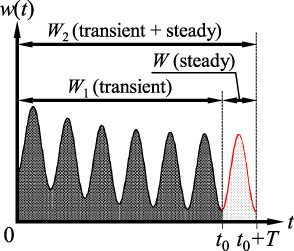
Example of objective function in steady state.
The objective function in steady-state is defined as follows:
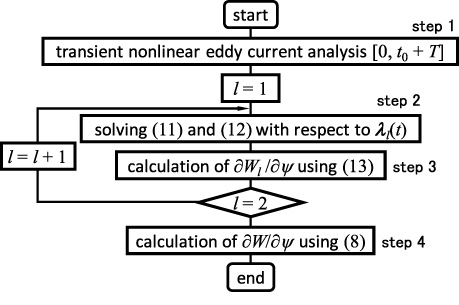
Flowchart of sensitivity analysis in steady-state.
The procedure for the AVM-based sensitivity analysis in the steady state is summarized in Fig. 2. The transient nonlinear eddy current analysis is carried out using a step-by-step procedure based on the backward Euler method, with both
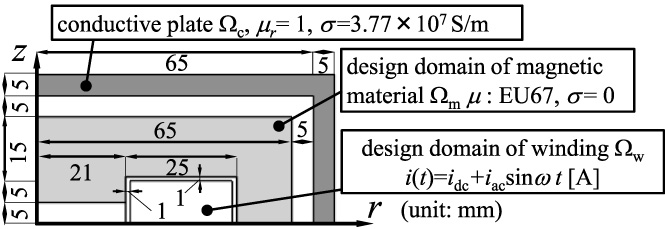
Analysis model of pot-type reactor.
A 2-D axisymmetric pot-type reactor model is illustrated in Fig. 3, where the design domains are set to Ωm and Ωe. While the structure of the magnetic core is optimized in Ωm, the winding structure is optimized in Ωe. The number of elements and nodes were set to 5,623 and 2,895, respectively. The optimization objective is to minimize the eddy current loss W
e
induced on the outer conductive plate and to maximize the square of the DC-biased self-inductance W
L
. Both W
e
and W
L
were calculated in the steady state (t0 ≤ t ≤ t0 + T). The optimization problem is formulated as follows:
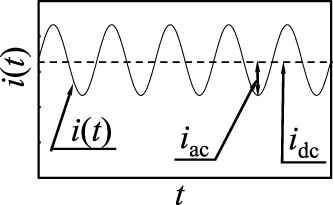
DC-biased AC current.
Parameters for topology optimization
Here, to consider the constraints g1 and g2, the objective function W is combined with the constraints by the augmented Lagrangian method [10]. The steepest descent method is adopted as the optimization method.
The parameters for TO are illustrated in Table 1. The constants ϵFEM and ϵAVM represent the convergence criterion values based on the relative norm in a linear system derived from FEM and AVM, respectively. The incomplete Cholesky conjugate gradient method is applied to the solver for linear systems derived from FEM and AVM. The constant ϵNR is the convergence criterion for the Newton–Raphson method, in which the iteration is terminated when the maximum change of magnetic flux becomes a value less than ϵNR. The constant ϵopt is the convergence criterion value for the optimization method in which the maximum change in W becomes less than ϵopt.
Results of sensitivity analysis
To verify the accuracy of the sensitivity analysis derived from the proposed method, the sensitivities derived from the time-domain AVM were compared with the finite-difference method (FDM). The formula for the sensitivity-based FDM is as follows:
The sensitivity distributions of ∂W e ∕∂𝜓 and ∂W L ∕∂𝜓 are illustrated in Fig. 5. It can be observed that the sensitivity in the design domain of the winding is larger than that of the magnetic core. The sensitivity distribution on the line at z = 7 mm is demonstrated in Fig. 6. The sensitivity distributions are quite similar between the AVM and FDM in Figs 6(a) and (b). The maximum sensitivity values (∂W e ∕∂𝜓)max and (∂W L ∕∂𝜓)max are also quite similar between AVM and FDM, as shown in Table 2. The elapsed time of the AVM shown in Table 2 was much less than that of the FDM.
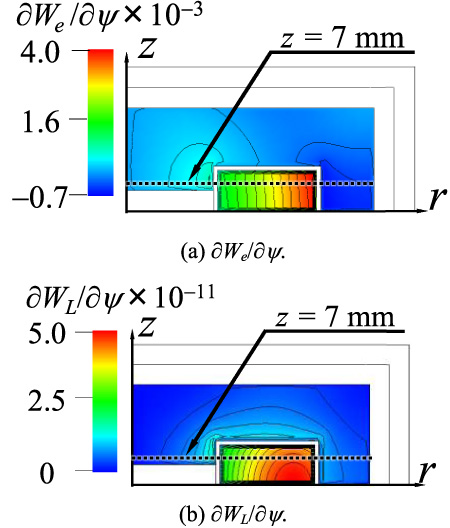
Magnitudes of design sensitivity.
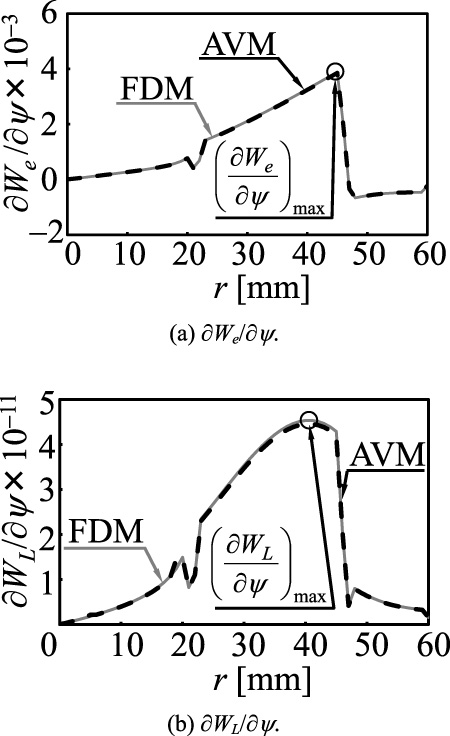
Sensitivity on the line at z = 7 mm.
In this section, single-region TO for Ωm and multi-region TO for both design domains Ωm and Ωe were carried out. The initial structures of a single-region and multi-region TO are shown in Fig. 7(a) and Fig. 7(b), respectively. Both initial structures converged to the best objective function among several trials of topology optimization. Table 3 shows the optimization conditions. Here, the DC-biased characteristics were evaluated by setting N to 6 in Eqs ((15)) and ((16)) with totally six different DC current values (idc = 50, 150, 250, 350, 450, and 550 A) are used.
Comparison of maximum sensitivity
Comparison of maximum sensitivity
Figure 8 shows the results derived from the single-region TO. Figure 8(a) shows the optimized magnetic core derived from the minimization of W e without the maximizing the W L . It can be seen that a one-layer shielding suppressing the leakage magnetic flux to the outside was generated. Figure 8(b) shows the optimized magnetic core derived from the maximization of W L without the minimization of W e . In this structure, the material was concentrated around the air gap to reduce its reluctivity. Figure 8(c) shows the magnetic core with both the minimization of W e and the maximization of W L . The resultant structure resembles the average shape shown in Figs 8(a) and (b). Although the gray scale area is negated, a reasonable core is obtained to satisfy the hybrid objectives.
Figure 9 shows the structures derived from the multi-material TO. The optimized structures of the iron core shown in Fig. 9 share similar portions to those shown in Fig. 8. The winding shown in Fig. 9(a) is located at a distance from the outer aluminum conductor. The winding shown in Fig. 9(b), which is optimized to increase the W L , is located on the z-axis side. The winding shown in Fig. 9(c) considers both the minimization of W e and the maximization of the W L is generated at the bottom of ΩW.
Figure 10(a) shows the DC-biased characteristics in the structure derived from the condition c e = 0 or 1 with c L = 0. When idc is increased, the inductances of all the structures deteriorate. The inductances of the optimized structures exhibit a higher performance than that of the initial model. In Fig. 10(b), when c e is set to 1, the structure to reduce W e is successfully obtained. Although the inductance properties of the optimized structures are deteriorated in comparison to those of the initial structure, the eddy current loss is reduced by TO. From this result, it can be deduced that the multi-region TO is more effective than the single-region TO.
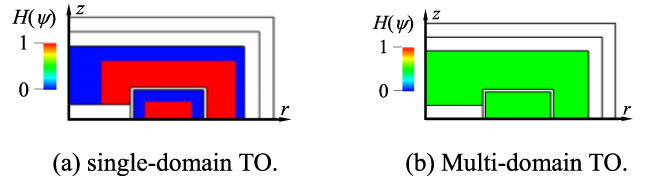
Initial topologies.
Optimization condition
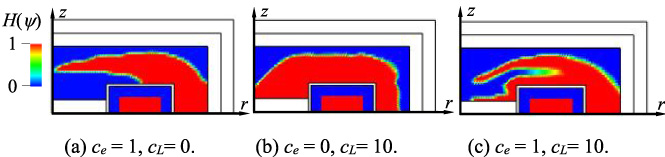
Optimized structures of single-region TO (Ωm).
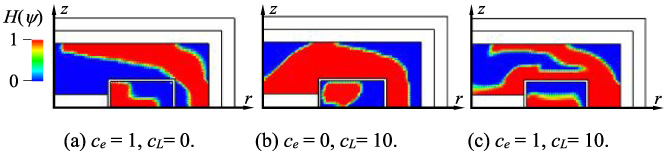
Optimized structure derived from multi-region TO (Ωm and Ωw).
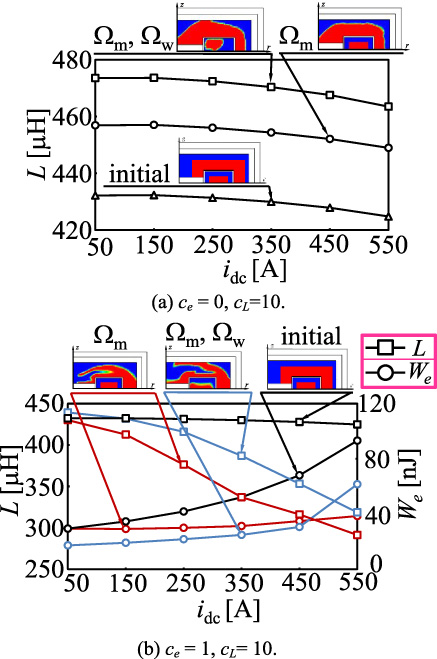
DC-biased characteristics.
As shown in Table 4, the elapsed time for all optimizations was several hours. The converged values of V1(𝜓1)∕VΩm and V2(𝜓2)∕VΩw largely satisfy the constraint conditions.
Results of topology optimization
A: Intel Core i7 4790 K at 4.0 GHz with 16.0 GB RAM. B: Intel Core i7 6850 K at 3.6 GHz with 128.0 GB RAM.
To realize TO in the steady state of the time domain with magnetic nonlinearity, a design sensitivity analysis procedure based on the time-domain adjoint variable method was introduced. The proposed approach can accurately derive the design sensitivity in the steady state of the time domain. Using the proposed method for its sensitivity, a reasonable structure for a high-performance pot-type reactor was obtained with the higher DC-biased inductance and the lower leakage flux.
Footnotes
Acknowledgement
All results were derived from Mr. Masuda who was a master’s student in my laboratory. For some reasons, he could not appear as a co-author of this manuscript. I would like to express sincere gratitude to him for his significant contribution.