







Abstract
In this study, we focused on the heat transfer through a uniformly inclined rectangular duct caused by the electro-osmotic peristaltic flow of an unsteady non-Newtonian nanofluid. With couple stress, the fluid obeys the Papanastasiou model. The flow is through a porous medium that follows Darcy’s law in a modified form. In addition, Dufour and Soret effects, mixed convection, the impacts of a chemical reaction, and the effects of viscous couple stress dissipation are all considered. The governing equations that explain the velocity, temperature, and concentration of nanoparticles are simplified when wave transformation is used. The homotopy perturbation method was used to solve these equations analytically. Additionally, a collection of figures is used to discuss and visually illustrate the consequences of the physical characteristics. In fact, the modified Darcy’s law makes the velocity gradient appear in the momentum equation, which increases the contribution of the velocity gradient to the velocity profile. In addition, the electro-osmotic parameter and Helmholtz-Smoluchowski velocity have a significant impact on the velocity gradient’s direction, as well as the velocity gradient’s ability to be either positive or negative, depending on their values. In addition, in the case of forced convection, the values of the Nusselt number and the Sherwood number are highly affected by the value of Helmholtz–Smoluchowski velocity. The current findings have applications in biology and medicine, particularly in cancer therapy, which involves peristaltic blood pumps(arteries) and suspended gold nanoparticles (nanofluid). According to our knowledge, no prior studies have merged the couple stress Papanastasiou model and the modified Darcy’s law.
Introduction
Non-Newtonian fluids are substances that do not adhere to Newton’s law of viscosity and instead continuously deform (flow) when shear stress is applied (such as polymer solutions, blood, pastes, glues, etc.). In recent years, non-Newtonian fluids had a wide range of usages, including the chemical and petrochemical industries, the food processing industry, metallurgy, drilling activities, and bioengineering. In order to better understand the flow problems of various models of non-Newtonian fluids under various external impacts, several studies have been made in this area. In their study, Eldabe et al. [1] concentrated on magnetohydrodynamic (MHD) peristaltic transport of non-Newtonian (power-law model) nanofluid through a non-uniform inclined channel in a non-Darcy porous medium while taking into account the impacts of thermal radiation, heat generation, and Ohmic dissipation. Eldabe et al. [2] studied the peristaltic mo‘tion of MHD Herschel Bulkley nanofluid in a non-uniform vertical duct under the impact of Ohmic dissipation and chemical reaction. The system of equations governing the peristaltic flow of MHD nano-coupled stress fluid through a non-Darcy porous medium inside of a horizontal channel, under the effects of heat generation, Ohmic and viscous couple stress dissipations, and chemical reaction, was solved by Abbas et al. [3] using the homotopy perturbation method (HPM). The governing equations for the peristaltic flow of MHD Bingham–Papanastasiou nanofluid through porous media inside of a symmetric vertical channel, under the influence of Hall currents, thermal radiation, and chemical reaction, were solved by Eldabe et al. [4] using HPM. Abouzeid [5] performed an analytical investigation regarding the impact of Cattaneo-Christov heat flux on the MHD flow of biviscosity nanofluid between two rotating discs. For the system of equations that control the MHD peristaltic flow of couple-stress fluid with heat and mass transfer inside a horizontal channel, Hina et al. [6] were able to get an exact solution. The system of equations governing the MHD squeezing flow of non-Newtonian nanofluid through a porous medium was solved using HPM by Abouzeid and Ouaf [7]. Bhattacharyya et al. [8] investigated MHD transport of a couple stress fluid with peristalsis through a porous medium in an inclined asymmetric duct with heat and mass transfer, as well as in the presence of Dufour and Soret effects.
A nanofluid is a suspension of nanoparticles in a very small size range (up to 100 nm) in a base fluid such as water, oil, or ethylene glycol. The most prevalent nanoparticles are non-metals like Fe2O3, CuO, and Al2O3 or metals like Al, Ag, and Cu. In fact, compared to micro-fluids, nanofluids have improved thermo-physical characteristics such as thermal conductivity, thermal diffusivity, viscosity, and convective heat transfer coefficients. Additionally, the suspension’s stability is improved; yet, in some problems, nanoparticles interact with each other and congregate. As a result, nanofluids have sparked widespread interest as they are involved in numerous applications in industrial and biomedical fields such as cooling nuclear reactors, cooling electronics, solar water heating, domestic refrigerators, chillers, drilling, lubrication, cancer therapy, drug delivery, and photodynamic therapy. Accordingly, many researchers have investigated the flow of nanofluid under various external influences. MHD flow of Jeffrey nanofluid with peristalsis under the influence of buoyancy forces, thermophoresis, and Brownian diffusions was investigated by Reddy and Makinde [9]. The third-grade nanofluid peristaltic flow was investigated by Eldabe et al. [10] under the influence of a radially variable magnetic field, internal heat generation with thermal radiation, and mixed convection. In a three-dimensional rectangular duct, Riaz et al. [11] investigated the peristaltic flow of Jeffrey nanofluid through a porous media in the presence of mixed convection, Dufour, and Soret effects. The references [12–16], include more recent researches that focused on the peristaltic flow of nanofluid under various external effects.
The phrase “electro-osmotic flow” (EOF) describes the movement of an electrolyte solution through a channel with charged walls while being influenced by an external electric field. In order to form an electric double layer (EDL), the channel walls pull in counter-ions from the electrolyte solution and repel co-ions. The ELD is composed of two distinct layers: the Stern layer, which contains counter-ions that are clustered on the walls due to strong electrostatic attraction, rendering them immobile; and the Gouy-Chapman diffuse layer, which contains both co-ions and counter-ions and they are free to move under the influence of the external electric field, dragging the bulk fluid along with it (electro-osmotic flow) [17–19]. Analytical research for the electro-osmotic MHD peristaltic flow of Jeffery fluid through micro annulus was provided by Mekheimer et al. [20]. Chaube et al. [21] investigated the electro-osmotic peristaltic flow of micropolar fluid inside micro-ducts. An analytical investigation for the peristaltic flow of biviscosity nanofluid through a micro-duct under the influence of electro-osmotic phenomena and the effects of mixed convection, thermophoresis, and Brownian diffusions was presented by Moatimid et al. [22]. Eldabe et al. [23] investigated Newtonian nanofluid electro-osmotic peristaltic flow through a porous medium in the presence of Hall currents, thermophoresis, and Brownian diffusions.
Due to its numerous usages, in science and technology, including the generation of crude oil, fermentation processes, nuclear waste disposal, microelectronic devices, and hemodialyzers, fluid flow through porous media has garnered a lot of attention [24]. All previous research on the flow of fluid through porous media has been based on Darcy’s law, which stipulates that the pressure gradient is linearly proportional to the fluid velocity in the porous medium. Later, it was discovered that Darcy’s law only applies to low flow rates. Darcy’s law was amended by Forchheimer in 1901 to include a quadratic velocity element to account for the microscopic inertial impact (non-Darcy effect) [25,26]. Recently, Darcy’s law is recommended to be altered to consider the impacts of the non-Newtonian fluid’s rheological behavior [27,28]. Rastogi et al. [29] investigated the flow of a power law non-Newtonian fluid on a vertical plate through a porous media with a double diffusion phenomenon. In their research, Darcy’s law was applied using the apparent viscosity of the non-Newtonian model rather than the Newtonian viscosity. Eldabe et al. [30] investigated the effects of Ohmic dissipation, chemical reaction, and heat generation in the MHD peristaltic flow of pseudoplastic nanofluid with temperature dependent viscosity via a porous medium. The temperature-dependent viscosity was used in their investigation instead of the Newtonian viscosity, which modified Darcy’s law. Hayat et al. [31] explored the effects of thermal radiation and Ohmic heating on the MHD peristaltic flow of Carreau-Yasuda nanofluid in a symmetric conduit through a porous medium. In their work, the apparent viscosity of the non-Newtonian model is utilised and denoted by
The electro-osmotic peristaltic flow for a non-Newtonian nanofluid with nanoparticles in the presence of the chemical reaction effect is a topic that is rarely studied. Additionally, as far as we are aware, no previous studies have combined the modified Darcy’s law with the couple stress Papanastasiou model. Therefore, the focus of this study was on the electro-osmotic peristaltic flow of Papanastasiou nanofluid in an inclined channel through a porous medium that complies with modified Darcy’s law while being affected by couple stress, viscous couple stress dissipations, mixed convection, chemical reaction, Dufour effects, and Soret effects. The recent discoveries have biological and medical implications, particularly for the treatment of cancer using peristaltic blood pumps (arteries) and suspended gold nanoparticles (nanofluid).
Mathematical formulation of the problem
Consider the peristaltic flow of a non-Newtonian nanofluid in two dimensions via a symmetric, inclined tube with an external electric field. Consequently, the walls (nonmetallic) are negatively charged whereas the nanoparticles (metals) are positively charged. Hence, electro-osmotic phenomena are taken into account. Papanastasiou model with couple stress effect is followed by the fluid. The flow is through a porous material that, in non-Newtonian instances, complies with a modified Darcy’s law. Considering the Cartesian coordinates in the fixed laboratory frame, where the X-axis is the tube axis. Figure 1 modulates the problem where the elastic walls of the channel and peristaltic movement are represented by the dot lines and the solid lines respectively. The lower wall has the temperature T 0 and the solute concentration is C 0 while the upper wall has temperature T 1 and the solute concentration is C 1. The geometrical shape of the wall deformation is taken as [13]:
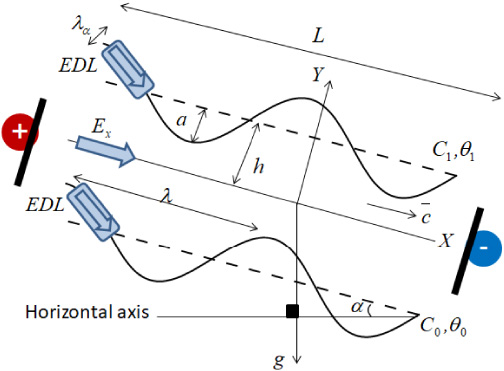
Physical model and coordinates system.
Y = ±H (X, t), where
The vector forms of the governing equations are [22]:
The appropriate boundary conditions correlated to the governing equations in the moving frame are:
Homotopy perturbation method (HPM) represents an effective technique to solve linear and non-linear partial differential equations with initial or boundary conditions. Accordingly to solve the system of Eqs (37), (39) and (40) with the aid of HPM technique we follow the following steps:
Considering 𝛽 is a small parameter, such that 0 < 𝛽 ≤ 1 so that:
Suppose that the solution of the system of Eqs ((37))–(40) exists and written in a power series as follows:
Therefore the series of Eqs (46)–(48) is convergent for all cases.
The effects of some parameters entering the problem on the obtained solutions, for the axial velocity, temperature distribution, and nanoparticle concentration, are discussed through the Figs 2– 13.
Physically, the nanoparticles are good conductors of heat, so that Pr is fixed at a small value due to the presence of strong thermal diffusivity. Also, the hypothesis of small Re indicates that the viscous forces are dominant, thereby small value of n 0 and large value of l 2 are considered to match the large value of μ0. Moreover, the large value of 𝛺 is chosen to satisfy the thin electric double layer (EDL) [34]. On the other hand, since the positive y-axis is taken along the path from the lower wall of the tube (y = −H) towards the upper wall (y = H) so the dimensionless of T and f should depend on the difference T 0 − T 1 and f 0 − f 1 respectively. If we considered the temperature at the lower wall is higher than that at the upper wall, hence the values of G r , B r , Ec, N b , N t and S are taken to be positive.
Considering that the values of the entering parameters are fixed except for the variation in the illustrated parameters, the graphs of the axial velocity u satisfy the boundary conditions (41) and the velocity gradient ∂u∕∂y is positive near the lower wall (y = −H) and negative near the upper wall (y = H). Hence, along the positive direction of the y-axis, u gradually increases till a definite value (the peak of the curve is a maximum point) where u = u max then it gradually damped.
Figure 2 shows that the axial velocity u increases as l 2 increases, this behavior is in agreement with Adesanya et al. [35] and Umavathi et al. [36]. Physically, the couple stress parameter l 2 indicates the length of the polar additives [37], as l 2 increases length of the polar additives increases and the velocity is enhanced.
Figures 3 and 4 and show u decreases as U
HS
or 𝛺 increases respectively. Physically [38], electro-osmotic parameter 𝛺 is inversely proportional to the Debye length
The discussions for the rest of the figures are omitted to save space and avoid repetition (increase–decrease).
The graphs of the temperature T satisfy the boundary conditions (41) and the temperature gradient ∂T∕∂y is positive near the lower wall (y = −H) and negative near the upper wall (y = H). Hence, along the positive direction of the y-axis, T gradually increases till a definite value (the peak of the curve is maximum point) where T = T max then it is gradually damped. Physically, heat transfer between the fluid and the surrounding walls takes place in order to rich the equilibrium state, since the temperature at the lower wall is higher than that at the upper wall (T 0 > T 1), accordingly the temperature of the fluid layers increases gradually near the lower wall (T > T 0), then it starts to lose its energy gradually (cooling) (T > T 1).
Figure 5 shows that T increases as Ec increases, this result is in agreement with Eldabe et al. [1], Abbas et al. [3], Abou-zeid [39,40], Mansour, and Abou-zeid [41], Ouaf and Abou-zeid [42] and Eldabe et al. [43–45]. Physically, from the definition of Ec (Eq. (32)), considering that T 0 and T 1 are fixed, it is clear that as Ec increases the velocity of the peristaltic wave increases. In viscous fluid, the increment in kinetic energy enhances the internal heat energy (viscous dissipation). However, this effect does not appear in the 2nd order solution where Ec had no effect.
Figure 6 shows that T increases as N t increases, this is in agreement with Eldabe et al. [46], Abou-zeid et al. [47], and Abou-zeid and Mohamed [48]. Physically, the increment in N t indicates that the thermophoresis force is enhanced which tends to shift nanoparticles from the hot region to the cold region, the movement of the particles causes an elevation in the kinetic energy of the system, hence the temperature increases [49], and [50].
However in the 2nd order solution, the interference between Pr and N t exists as it is found that N t has a dual effect as shown in Fig. 7, this result is in agreement with Eldabe et al. [1], Eldabe et al. [2], Abbas et al. [3], Abou-zeid [40], Mohamed and Abou-zeid [51], Eldabe et al. [52,53]. Physically, near the lower wall (y = −H), the temperature gradient ΔT is positive, therefore the increment of N t implies that the thermophoresis force increases in the negative direction and reduces the temperature, while near the upper wall (y = H), where ΔT is negative, the increment of N t implies that the thermophoresis force increases in the positive direction and enhances the temperature [1].
The discussions for the rest of the figures are omitted to save space and avoid repetition (increase–decrease).
The graphs of the concentration f satisfy the boundary conditions (41) and the concentration gradient ∂f∕∂y is negative near the lower wall (y = −H) and positive near the upper wall (y = H). Hence, the direction of increasing f is the downwards along negative direction of the y-axis. Physically, this phenomenon agrees with Fick’s law as well as the fact that f decreases as T increases (see Eldabe et al. [2]).
Figures 8 and 9 show that f increases as Princreases, while it decreases as N b increases. These results agree with Eldabe et al. [1,2], Mohamed and Abou-zeid [48–51], and Ismael et al. [54]. Physically, Prandtl number P r represents the ratio between momentum diffusivity and thermal diffusivity, as Pr increases the thermal diffusivity (transfer of heat through the fluid layers) decreases. This implies that the flow (spread) of the nanoparticles (good conductors of heat) through the fluid is damped. Hence, the concentration increases. On the other hand, Brownian motion is the random motion of particles within a fluid due to their collisions. Thereby, as N b increases the spread of nanoparticles increases (the concentration decreases).
The discussions for the rest of the figures are omitted to save space and avoid repetition (increase–decrease).
Figures 10 and 11 depict the influences of both Pr and 𝛺 on the reduced Nusselt number Nu with the axial coordinates x respectively. It is noticed Nu increases (negativity increases) as Pr increases, while it decreases as 𝛺 increases. Physically, the results show that Nusselt number is negative and this is because the temperature of the fluid is higher than that of the wall [55]. Moreover, Nusselt number characterizes the heat transfer from a fluid to the wall, at small Prandtl number, the thermal diffusivity of the fluid is relatively high compared to its momentum diffusivity. This means that the fluid can transfer heat more easily than it can transfer momentum. As a result, thermal boundary layer near the wall is thin, and the heat is transferred more readily from the fluid to the solid surface, resulting in a higher Nusselt number. This behavior is in agreement with Abou-zeid [39] and Abou-zeid and Mohamed [48]. On the other hand, the as 𝛺 increases the Debye length decreases, hence, the electrical double layer formed at the fluid-solid interface becomes thinner, as a result the velocity profile near the surface is weak, which increases the thickness of the thermal boundary layer and decrease the heat transfer coefficient.
Figures 12 and 13 illustrate the influences of both N b and N t on the Sherwood number Sh with the axial coordinates x respectively. It is observed that Sh is positive and it increases as N b increases while it decreases as N t increases. These behaviors are in agreement with Abou-zeid [39] and Abou-zeid and Mohamed [48]. Physically Sherwood number is a dimensionless number that represents the mass transfer rate between a fluid and a solid surface. As N b increases the random motion of the particles becomes more active, and they travel further distances before colliding with other particles or obstacles in the fluid. This leads to a more efficient transport of the species to the wall surface, and thus the mass transfer rate is enhanced. On the other hand, as N t increases the thermophoretic force increases which in turns decreases the concentration profile of the nanoparticles, thus the particles have less chance to gather near the wall and Sh is reduced.
The discussions for the rest of the figures are omitted to save space and avoid repetition (increase–decrease).
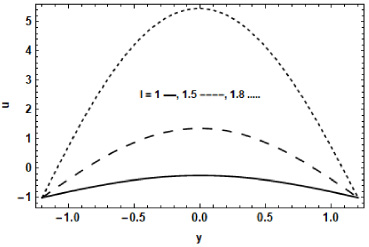
The velocity distribution for different values of l where H = 1.2, ∂P∕∂x = 1, n 0 = 0.1, n 1 = 0.3, 𝛼 = Pi∕6, Re = 0.05, G r = 3, B r = 2, k = 0.6, U HS = 0.3, 𝛺 = 2, N t = 0.8, N b = 0.4, Ec = 2, k 𝛼 = 0.05, Pr = 0.4, S = 1.
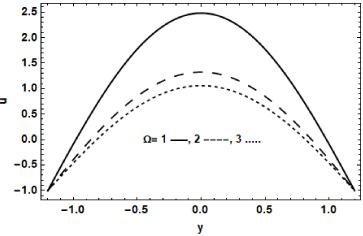
The velocity distribution for different values 𝛺 where H = 1.2, ∂P∕∂x = 1, n 0 = 0.1, n 1 = 0.3, l = 1.5, 𝛼 = Pi∕6, Re = 0.05, G r = 3, B r = 2, k = 0.6, U HS = 0.3, N t = 0.8, N b = 0.4, Ec = 2, k 𝛼 = 0.05, Pr = 0.4, S = 1.
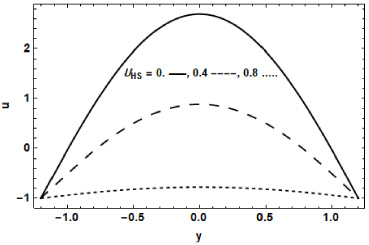
The velocity distribution for different values of U HS where H = 1.2, ∂P∕∂x = 1, n 0 = 0.1, n 1 = 0.3, l = 1.5, 𝛼 = Pi∕6, Re = 0.05, G r = 3, B r = 2, k = 0.6, 𝛺 = 2, N t = 0.8, N b = 0.4, Ec = 2, k 𝛼 = 0.05, Pr = 0.4, S = 1.
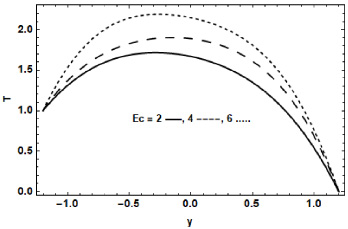
The temperature distribution for different values of Ec where H = 1.2, ∂P∕∂x = 1, n 0 = 0.1, n 1 = 0.3, l = 1.5, 𝛼 = Pi∕6, Re = 0.05, G r = 3, B r = 2, k = 0.6, U HS = 0.3, 𝛺 = 2, N t = 0.8, N b = 0.4, k 𝛼 = 0.05, Pr = 0.4, S = 1.
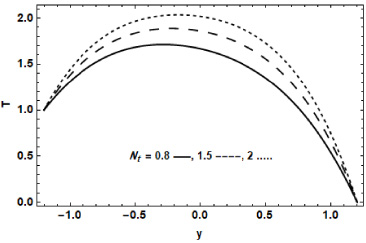
The temperature distribution for different values of N t where H = 1.2, ∂P∕∂x = 1, n 0 = 0.1, n 1 = 0.3, l = 1.5, 𝛼 = Pi∕6, Re = 0.05, G r = 3, B r = 2, k = 0.6, U HS = 0.3, 𝛺 = 2, N b = 0.4, Ec = 2, k 𝛼 = 0.05, Pr = 0.4, S = 1.
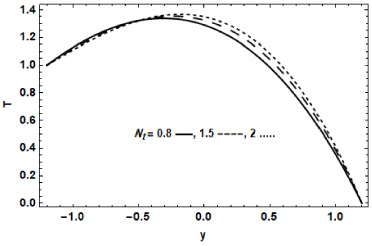
The temperature distribution till the 2nd order solution for different values of N t where H = 1.2, ∂P∕∂x = 1, n 0 = 0.1, n 1 = 0.3, l = 1.5, 𝛼 = Pi∕6, Re = 0.05, G r = 3, B r = 2, k = 0.6, U HS = 0.3, 𝛺 = 2, N b = 0.4, Ec = 2, k 𝛼 = 0.05, Pr = 0.4, S = 1.
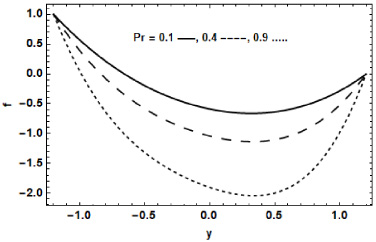
The concentration for different values of Pr where H = 1.2, ∂P∕∂x = 1, n 0 = 0.1, n 1 = 0.3, l = 1.5, 𝛼 = Pi∕6, Re = 0.05, G r = 3, B r = 2, k = 0.6, U HS = 0.3, 𝛺 = 2, N t = 0.8, N b = 0.4, Ec = 2, k 𝛼 = 0.05, S = 1.
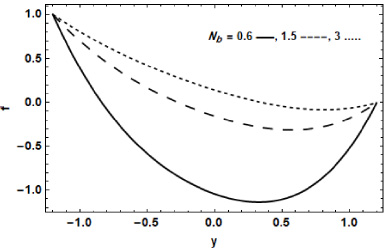
The concentration for different values of N b where H = 1.2, ∂P∕∂x = 1, n 0 = 0.1, n 1 = 0.3, l = 1.5, 𝛼 = Pi∕6, Re = 0.05, G r = 3, B r = 2, k = 0.6, U HS = 0.3, 𝛺 = 2, N t = 0.8, Ec = 2, k 𝛼 = 0.05, Pr = 0.4, S = 1.
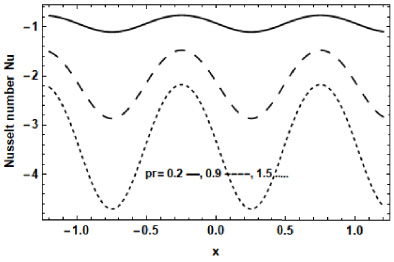
The reduced Nusselt number is plotted versus x, for different values of pr where ∂P∕∂x = 1, n 0 = 0.1, n 1 = 0.3, l 2 = 1.5, 𝛼 = Pi∕6, Re = 0.05, G r = 3, B r = 2, k = 0.6, U HS = 0.3, 𝛺 = 2, N t = 0.8, Ec = 2, k 𝛼 = 0.05, S = 1, N b = 0.4.
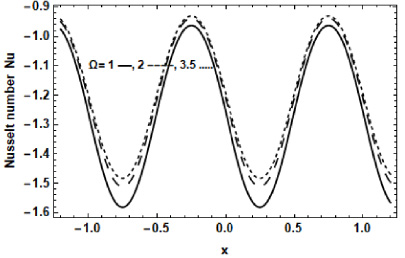
The reduced Nusselt number Nu is plotted versus x, for different values of 𝛺 where ∂P∕∂x = 1, n 0 = 0.1, n 1 = 0.3, l = 1.5, 𝛼 = Pi∕6, Re = 0.05, G r = 3, B r = 2, k = 0.6, U HS = 0.3, N t = 0.8, Ec = 2, k 𝛼 = 0.05, S = 1, N b = 0.4.
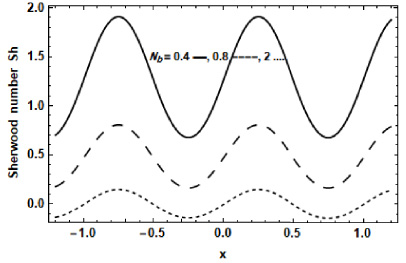
The Sherwood number Sh is plotted versus x, for different values of N b where ∂P∕∂x = 1, n 0 = 0.1, n 1 = 0.3, l = 1.5, 𝛼 = Pi∕6, Re = 0.05, G r = 3, B r = 2, k = 0.6, U HS = 0.3, 𝛺 = 2, N t = 0.8, Ec = 2, k 𝛼 = 0.05, S = 1, N b = 0.4.
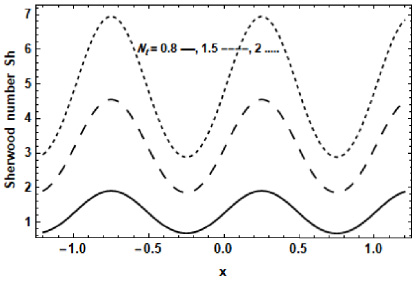
The Sherwood number Sh is plotted versus x, for different values of N t where ∂P∕∂x = 1, n 0 = 0.1, n 1 = 0.3, 𝛼 = Pi∕6, Re = 0.05, G r = 3, B r = 2, k = 0.6, U HS = 0.3, l = 1.5, 𝛺 = 2, Ec = 2, k 𝛼 = 0.05, Pr = 0.4.
Comparison between the present work and Abbas et al. [3] for various values of k and l
Since Abbas et al. [3] got an analytical solution for the axial velocity and mentioned the constants in the Appendix. In addition, in the case of Newtonian fluid (μ = μ0), the skin friction coefficient τω in our work (defined in Eq. (42)) and in the work of Abbas et al. [3] is the same. Considering in our work n 0 = U HS = S = 𝛼 = G r = B r = 0, and M = F = 0 in the work of Abbas et al. [3], the two works are close to each other. The numerical values for the skin friction coefficient τω, are calculated in both works for various values of k and l. It is clear from Table 1 that the behavior of τω in our work approaches it in Abbas et al. [3].
In this paper, a mathematical model has been developed to study the peristaltic movement of unsteady incompressible non-Newtonian nanofluid with heat transfer through a symmetric inclined channel. The fluid obeys Papanastasiou model with couple stress and flows in the presence of external electric filed where electro-osmotic phenomenon is taken into consideration. Moreover, the flow is controlled by several external effects such as thermal diffusion, diffusion thermo, mixed convection, viscous couple stress dissipations, chemical reaction, and modified Darcy’s law for porous medium. The most significant results of this study can be summarized as follows:
At 𝛼 = pi∕2, it represents the study of the same model in a vertical tube, while at 𝛼 = 0 represents the study of the same model in horizontal tube. To study of the same model in the case of T
0 < T
1, f
0 < f
1, it is recommended to replace T
0 and T
1, f
0 and f
1 in the definition for the parameters E
c
, N
t
, and N
b
. The study of the same model in the absence of the electric field can be obtained at U
HS
= 0 . In the 2nd order solution, it is found that N
t
and N
b
have dual effect on temperature distribution T, as shown in Fig. 7, where these dual effects vanish in the 3rd order solution. Due to the presence of the modified Darcy’s law, the term (n
1∕2k)(∂u∕∂y) appears in the momentum equation and hence the contribution of the velocity gradient on the velocity profile is enhanced. The axial velocity u decreases as the electro-osmotic parameters U
HS
or 𝛺 increases, while it increases as the couple stress parameter l
2 increases. In the case of forced convection, the values of the Nusselt number and the Sherwood number are highly affected by the value of Helmholtz–Smoluchowski velocity, as it is found that both Nu and Sh decrease with small values of U
HS
while they increase with large values of U
HS
.
Applications
Peristaltic pumps of Papanastasiou nanofluid are useful in the following [56–58]:
Juice production Drag reducing agents, printing technology, damping and braking devices Pizza sauce dispensing Oil-pipeline friction reduction Acid/base dispensing Chemical processing industry and plastics processing industry Circuit board manufacturing Transfer of fuels and lubricants.
Footnotes
Acknowledgements
The authors thank the reviewers for their valuable remarks which improved and enriched our manuscript.
Data availability
The datasets in the current study are available only from the corresponding author on reasonable request.
Appendix
T
1
Temperature at y = H
a
The amplitude of the wave
x
Axial coordinate
A
Chemical reaction parameter
y
Transverse coordinate
B
r
Local nanoparticle Grashof number
z
The valence number of ions.
The wave velocity
D
B
Brownian diffusion coefficient
𝛼
Half the angle between the walls of channel
D
T
Thermophoretic diffusion coefficient
θ
The fluid temperature in the fixed frame
e
The electronic charge.
T
av
Local absolute temperature
E
c
Eckert number
𝜙
Electric potential for EDL (Zeta potential)
f
The nanoparticle concentration
𝜉
Zeta potential at the upper wall
f
0
The nanoparticle concentration at y =0
U
HS
The dimensionless Helmholtz–Smoluchowski velocity
f
1
The nanoparticle concentration at y = h
𝛺
Electroosmotic parameter
g
The gravitational acceleration
𝜂
Couple stress coefficient
G
r
Local temperature Grashof number
τ
y
Yield stress
H (x)
Transverse vibration of the wall
τ0
Dynamic viscosity of fluid
k
Permeability constant
μ
Apparent viscosity of fluid
K
c
Thermal conductivity
𝜌
e
Density of the total ionic energy
k
𝛼
Dimensionless Chemical reaction parameter
ϵ
Electric permittivity
k
B
Boltzmann constant
n
+
The number of density of cations
l
2
Couple stress parameter
n
−
The number of density of anions
m
Continuation parameter
𝛾.
Shear strain
N
b
Brownian motion parameter
𝜆
Wavelength
N
t
Thermophoresis parameter
𝜆𝛼
The thickness of EDL (Debye length)
N
0
Bulk volume concentration for positive or negative ions
𝛽
c
Nanoparticle expansion coefficient
P
The fluid pressure
𝛽
t
The thermal expansion coefficient
Pi
180°
𝜌
f
The density of the fluid
P
r
Prandtl number
𝜌
P
The density of the particle
Sc
Schmidt number
(𝜌c)
f
Heat capacity of the fluid
T
The fluid temperature in the moving frame
(𝜌c)
P
Effective heat capacity of the nanoparticles material
T
0
Temperature at y = −H