







Abstract
BACKGROUND:
Lycium barbarum L. has received considerable attention due to nutritional value of berries and its cultivation in Europe has attracted growing interest.
OBJECTIVE:
The aim of the study was characterization of Lycium barbarum L. berry cultivated in North Macedonia in terms of nutritional and functional properties and comparison with Lycium chinense M. variety.
METHODS:
Minerals, total proteins, sugars, antioxidant activity, fatty acids, carotenoids and polyphenols were determined and lipid indices were evaluated. Principal Component Analysis was used to describe variability of composition, while heat map to recognize the parameters significantly different for varieties.
RESULTS:
Lycium barbarum L. cultivated in North Macedonia represents a rich source of K, Cu, Mn, P, Zn, Mg, Fe and antioxidant compounds. Polyunsaturated fatty acids (mainly linolenic acid) were dominant in oil resulting in very low atherogenic and thrombogenic indices. A variability of 35.1% was ascribed to minerals, carbohydrates and proteins, 22.3% to ω-6 fatty acids and lipid indices of oil, 19.4% to nutrients with antioxidant activity and 13.4% to ω-3 fatty acids (n-3 and n-3/n-6 ratio).
CONCLUSIONS:
Chemometric analysis highlighted significant differences in terms of inorganic nutrients, antioxidant capacity, proteins, sugar profile and lipid indices in Lycium barbarum L. compared to Lycium chinense M.
Introduction
The nutritional and beneficial health effects of fruits were often emphasized [1–6]. Lycium barbarum L. belonging to the Solanaceae family has 1-2 cm long reddish-orange ellipsoid berries of sweet-and-tangy flavor with native area probably in Southeastern Europe, while Lycium chinense M. has its origin in Southwest Asia (China). Due to its special nutritional composition (free sugars, carotenoids, polyphenols, flavonoides, vitamins, fatty acids, minerals, proteins, etc.) with health benefits such as immunity enhancement, antioxidant, anti-aging and anti-tumor effects, Goji berry has been proposed as functional food and included in the category of “superfoods” [4, 7–17]. Other major aspects of the medicinal quality of Goji fruit are heart disease risk reduction, hypoglycaemic, hypolipidemic and neuroprotective effects, prevention of some eye diseases and male fertility facilitation [18–20]. However, Goji berry consumption could be associated to risk of allergic reactions [21].
Goji have been an important part of the traditional Chinese medicine for more than 2000 years. Rapid increase in consumption in Europe is noticed at the beginning of the twenty-first century [11, 22]. Goji berries are consumed fresh, dried, processed into juice [4, 23], as ingredient in snack, yoghurt and cereal bar [24] or as capsules and concentrated extracts [4]. Goji organic extract is added as natural antioxidant in extra-virgin olive oil and soybean oil to improve the oxidative stability and sensory profile such as taste, color or turbidity [24–27].
In Asia Goji is cultivated mostly in China, Taiwan and Japan, while in Europe most frequently in Southeastern countries. There is growing interest in Goji cultivation in Greece [10, 15], Italy [8, 16], Romania [12] and Bulgaria [28]. In recent years, Goji cultivation expanded to other European countries, such as Switzerland [11], Spain [4] and Poland [9]. Chemical composition of Goji fruits differs by variety and cultivation region so that the potency of their bioactivities may also be different.
The aim of this study was the evaluation for the first time of Lycium barbarum L. berry cultivated in North Macedonia and comparison with Lycium chinense M. variety. Functional properties were assessed through fatty acids (FAs) profile, lipid indices, antioxidant activity of methanolic extracts, total phenol content (TPC), total carbohydrate content (TCC), phenolic, sugar and carotenoid profiles. Several nutritive elements and total proteins were evaluated and their intake was related to Recommended Daily Allowance (RDA). Principal Component Analysis (PCA) and heat map were used to describe variability of chemical composition of Lycium barbarum L. and recognize the parameters significantly different from Lycium chinense M.
Materials and methods
Chemicals
All reagents, ICP multi-elemental standard solution IV Certipur 1000 mg/L (23 elements), single element standard solutions 1000 mg/L of As, Hg, Mo, P and S, and multi-component standard of fatty acid methyl esters (FAMEs) Mix C8-C24 were purchased from Merck (Darmstadt, Germany). The ACL-Kit for photochemical luminescence (PCL method) used to estimate antioxidant activity was purchased from Analytik Jena (Germany). Matrix modifiers 10% NH4H2PO4, 1% Mg (NO3)2 and 1% Pd(NO3)2 used in atomic absorption spectrometry were purchased from Perkin Elmer (Shelton, USA). Ultrapure water (18 MΩ cm resistivity) (Millipore, Bedford, USA) was used throughout the experiments.
Goji berry samples
Berries of Lycium barbarum L. variety (8 samples) were collected during July-September 2017 from 5 organic plantations located around the town of Kochani, in North Macedonia (Latitude//longitude of location 1 : 41°54’3.82”N, 22°22’1.34”E; location 2 : 41°54’14.80”N, 22°24’55.47”E; location 3 : 41°53’26.74”N, 22°22’45.77”E; location 4 : 41°53’13.20”N, 22°21’54.42”E; location 5 : 41°55’5.98”N, 22°26’47.71”E). Goji cultivation started in this area in 2012. Amounts of 2-3 kg fruits from 5–7 plants were sampled in the same day from the top, central and bottom part of the plant. Fresh fruits were transported to the laboratory in polypropylene bags. Fruits were air-dried in a convective dryer Memert UFE-500 (Buchenbach, Germany) at 60°C for 24 h to constant weight as described in [13]. Dried fruits were ground in a laboratory mill, sieved (< 250μm) and stored in closed vials at 4°C until analysis. The reference sample was berries of Lycium chinense M. variety, purchased in Beijing, China, with guarantee of authenticity. It was subjected to a preliminary preparation similar to Lycium barbarum L.
Sample preparation and analysis
Determination of TCC and sugar profile
The phenol/sulfuric method of Dubois et al. [29] adapted by Skenderidis et al. [15, 30] for goji berry was used for the determination of TCC. Amounts of 0.25 g dried goji berry were subjected to ultrasound-assisted extraction in 5 mL water for 1 h at 50°C. The supernatant was separated by centrifugation for 20 min at 5000 rpm and filtered (0.45μm nylon membrane). An aliquot of 1 mL extract was diluted to 100 mL with water. Then 80–100μL were mixed with 0.5 mL of 4% (w/w) phenol and 2.5 ml of 95% (w/w) sulfuric acid, diluted to 5 mL with water and incubated for 10 min at 90°C. The optical density was measured at 490 nm with the T 80+ Double beam spectrophotometer (PG Instruments Ltd., UK). The TCC was expressed in g D-glucose equivalents/kg dry weight (d.w.) based on a 6-point calibration curve (0–10 mg/L).
Glucose, fructose and sucrose were determined by thin-layer chromatography (TLC) using HPTLC Sil G 60 (20×10) plates (Merck, Darmstadt, Germany) with automatic applicator Linomat 5 and Camag TLC Scanner 3 (Camag, Mutternz, Switzerland) after 1 : 20 dilution of the aqueous extract with ethanol according to Farag [31]. Separation was achieved from 50μL sample by elution with chloroform:acetic acid:water (6 : 7:1, v/v/v) mixture. The separated spots were visualized using a coloring reagent containing 2% (w/v) diphenylamine, 2% (w/v) aniline in acetone and 10 mL of 85% (w/w) phosphoric acid after 5–10 min heating at 100–105°C. The ImageDecipher-TLC software version 2.0 (BioDit Global Technology) was used for measuring the spot areas. The 5-point calibration curves were generated from aliquots in the range 5–25μL of 1.25 mg/mL sugar in ethanol and the results were expressed in (g/kg d.w.).
Determination of mineral composition and proteins
The concentrations of Na, Mg, K, Ca, Mn, Fe, Cu, Zn, S, P and Mo were determined by inductively coupled plasma optical emission spectrometry (ICP-OES) using SPECTRO CIROSCCD instrument (Spectro, Kleve, Germany) in the solution resulted after microwave assisted digestion in a mixture of 9 mL HNO3 and 3 mL H2O2, and diluted to 25 mL. Determination of microelements (As, Cd, Cr, Ni, Pb) was carried out by graphite furnace atomic absorption spectrometry (GFAAS) with appropriate matrix modifier using the PinAAcle 900T Perkin Elmer spectrometer (Norwalk, CT, USA). Mercury was quantified on solid sample by thermal decomposition atomic absorption spectrometry (TDAAS) using the Automated Direct Mercury Analyzer Hydra-C (Teledyne Instruments, Leeman Labs, USA). An amount of 200 mg solid sample was subjected to combustion in the furnace module, the generated Hg vapor was trapped in the amalgamator and Hg signal was measured as peak-area.
The protein content was estimated by indirect method based on nitrogen determination in solid sample (6.25 standard conversion factor) [32]. The nitrogen content was determined using a Flash EA 2000 CHNS/O analyzer from Thermo Fisher Scientific (Massachusetts, USA) by combustion of 2–3 mg solid sample at 900°C. The instrument calibration (K factor method) was performed using atropine (4.84% N). The protein content was expressed as (%) in dry mass.
Determination of FAs by GC-FID
An amount of up to 2 g sample accurately weighed was subjected to extraction with 20 mL CHCl3/CH3OH (2 : 1, v/v) under mechanical shaking (100 rpm) for 1 h at room temperature. The filtered extract was dried over anhydrous Na2SO4. After filtration, the organic extract was evaporated to dryness under a gentle N2 stream using Laborota 4010-DIGITAL rotary evaporator, Heidolph Instruments GmbH & Co (Schwabach, Germany) and the resulted oil was stored at 4°C until analysis. Base-catalyzed transmethylation was used for the conversion of fatty acid glycerides into the corresponding methyl esters, according to the SR EN ISO 5509 : 2002 procedure. An aliquot of 50 mg oil was dissolved in 4 mL isooctane in a test tube provided with ground glass stopper. Then 200μL of 2 mol/L methanolic potassium hydroxide were added and the mixture was vigorously shaken for 30 s. Further 1 g NaHSO4 H2O was added and the solution was vigorously shaken for 30 s [7, 8]. The analysis of methyl esters extracted in isooctane was achieved by gas chromatography–flame ionization detection (GC-FID) using Agilent 7890A GC System (Santa Clara, California, USA) with a split/splitless injector (split ratio of 1 : 50) and a DB-WAX fused silica capillary column (30 m×0.32 mm i.d.) with a film thickness of (0.25μm). The FAMEs were identified by comparing the retention times in the chromatogram with those of a reference mixture of FAMEs (C8-C24 in isooctane). Individual FAMEs were quantified and the FAs profile was expressed in (% w/w) of polyunsaturated (PUFA), monounsaturated (MUFA) and saturated (SFA) fatty acids. The PUFAs/SFAs ratio, artherogenic index (AI) and thrombogenic index (TI), oxidisability (Cox) and oxidative susceptibility (OS) were calculated [33, 34]:
Three assays, namely quenching of photochemical luminescence (PCL) of free superoxide anion radicals, DPPH (2,2-diphenyl-1-picrylhydrazyl) radical scavenging and ABTS•+ (2,2′-Azino-bis-(3-ethyl-benzthiazoline-sulphonic acid) radical scavenging were used to estimate antioxidant activity.
In the PCL assay, photochemiluminescence of free superoxide anion radicals was measured by optical excitation of a photosensitizer using the PHOTOCHEM device, Analytik Jena (Germany). Samples were prepared following the procedure recommended by the manufacturer. An aliquot of 300 mg dried Goji berry was macerated overnight at 4°C in 3 mL methanol then subjected to ultrasound-assisted extraction for 1 h at room temperature. The resulting suspension was centrifuged with Hettich Universal 320/320R Centrifuge (Tuttlingen, Germany) for 10 min at 3000 rpm and the clear supernatant was analyzed. The antioxidant activity was expressed in TROLOX equivalents (mg TE/kg d.w.).
In the DPPH assay a volume of 290μL of 80μmol/L ethanolic stock solution of DPPH was placed into a well of the multiplate, 10μL Goji berry extract were added then the sample was incubated for 30 min. The absorbance was measured at 517 nm using a Tecan Spark 10M multiplate reader (Männedorf, Switzerland). The percentage of the consumed DPPH radical was calculated with the formula (A0 min–A30 min)/A30 min,blank, where A0 min was the initial absorbance of the DPPH solution at 517 nm, A30 min,blank was the absorbance of the blank (10μL methanol added to DPPH solution) and A30 min was the sample absorbance after 30 min incubation time. The results were expressed in quercetin equivalents (mg QE/kg d.w.) based on a 6-point calibration curve (0–25μg QE/mL).
A similar protocol was followed in the ABTS•+ radical scavenging assay, when 0.5 mmol/L radical ABTS• + solution was generated in phosphate buffer using ammonium persulfate. After 20 min reaction time the content of the bleached ABTS•+ radical was evaluated at 734 nm using the multiplate reader. The result was expressed in gallic acid equivalents (mg GAE/kg d.w.) using a 7-point calibration curve (0–3μg GAE/mL).
The TPC determined by the Folin-Ciocalteu method was expressed in mg GAE/kg d.w. [35]. An aliquot of 5μL of Goji berry extract was mixed with 225μL water and 20μL Folin–Ciocalteu reagent into a well of the multiplate and incubated in dark for 5 min. Then, a volume of 50μL of 20% sodium carbonate solution was added and sample was incubated in dark for 30 min. Seven calibration standards (0–15μg GAE/mL) were prepared similarly to Goji berry extracts. The absorbance of the deep-blue solutions was measured at 725 nm using a Tecan Spark 10 M multiplate reader.
Individual polyphenols were quantified by high performance liquid chromatography with diode array detection (HPLC-DAD) on Shimadzu Nexera 1 system (Shimadzu Sci. Instrum., USA) using a Fortis C18 reversed-phase column (150×2.1 mm i.d., 3μm particle size) (Fortis Technologies Ltd., UK). The mobile phase consisted of water (80–10%):0.1% formic acid (10%):acetonitrile (10–80%). Total run time was 40 min at 1 mL/min flow rate. Polyphenols were identified by comparing retention times in HPLC-DAD and UV/Vis absorption spectra with those of authentic standards, while their quantitation by linear calibration curves and measurement at specific wavelengths. The results were expressed as mg compound/kg d.w.
Carotenoids extraction was adapted from a protocol developed by Hempel et al. [17]. An aliquot of 0.25 g dried fruit was subjected to extraction in 5×2 mL of a ternary mixture (1 : 1 : 1 v/v/v) of methanol:ethyl acetate:light petroleum (b.p. 40–60°C) by sonication for 30 s. The combined extract separated by centrifugation (3000 rpm for 3 min) was washed with water, the organic phase was dried with anhydrous Na2SO4 and then evaporated to dryness under an argon stream. The final residue was re-dissolved in 1 ml ethyl acetate and stored at –20°C until analysis. The determination of carotenoid profile was carried out by HPLC-DAD on Agilent 1200 system (Agilent Tehnologies, USA) using a reversed phase EC 250/4.6 Nucleodur 300-5 C-18 ec. column (250×4.6 mm, 5μm particle size), (Macherey-Nagel, Germany). The mobile phase consisted of mixtures of acetonitrile:water (9 : 1, v/v) with 0.25% (w/v) triethylamine (A) and ethyl acetate with 0.25% (w/v) triethylamine (B). The elution gradient was from 90% A to 50% A in 10 min and 10% in 20 min at 1 mL/min flow rate. The chromatogram was registered at 450 nm and peaks were identified using carotenoid standards [36].
Statistical analysis
The examination of results and common statistics (correlation and regression) are not fully satisfactory for the characterization of superfoods. Multivariate unsupervised statistical approaches are more advanced tools for complex data interpretation to reveal hidden relationships between parameters and to put in evidence the influence of relevant characteristics on nutritional and functional properties of this food. Principal Component Analysis (PCA) was used to describe variability of chemical composition of berry of Lycium barbarum L. variety cultivated in North Macedonia and heat map to recognize the parameters significantly different from Lycium chinense M. The PCA provided the eigenvalues of the data correlation matrix, while Varimax rotation was used to maximize the variation expressed by the principal components (PCs). Only PCs with eigenvalue >1 were retained. For statistical analysis, non-detectable data for some components were substituted with half detection limit. The statistical analysis was carried out with Software Package Statistica 8.0 (StatSoft inc. 1984-2007, USA).
Results and discussion
TCC, sugar profile and protein content
Table 1 presents the content of sugars in berry of Lycium barbarum L. variety cultivated in North Macedonia in comparison with Lycium chinense M. The precisions of determinations for glucose, fructose and TCC (n = 3 parallel measurements) were in the range 2–8%, while for total protein of 4.4–14.2%. The analysis of a Tomato leaves reference material (SRM 1573) used for method validation for protein content provided 98.9–100.0% recovery (n = 3).
Mean values for glucose, fructose, TCC (g/kg d.w.) and protein (%) in Lycium barbarum L. berry cultivated in North Macedonia (samples 2–9) in comparison with Lycium chinense M.
Mean values for glucose, fructose, TCC (g/kg d.w.) and protein (%) in Lycium barbarum L. berry cultivated in North Macedonia (samples 2–9) in comparison with Lycium chinense M.
aLycium chinense M., dry fruit commercially available in China taken for comparison. bConfidence interval (95%, n = 8).
According to data in Table 1, TCC in Lycium barbarum L. variety cultivated in North Macedonia was in the range 212–370 g/kg. Glucose and fructose were found in large quantities, 124–220 g/kg and 102–163 g/kg respectively, while sucrose was below the detection limit in HPTLC (10 g/kg). All values were found to be significantly lower than in the Lycium chinense M. variety for 95% confidence level. Sugar profile dominated by glucose (152.92–284.60 g/kg) and fructose (154.20–259.13 g/kg), and low sucrose content (13.75–36.43 g/kg) were reported by Montesano et al. [14] in dry fruit of Lycium barbarum L. marketed in China, and Zheng et al. [37] in Lycium barbarum L. and Lycium chinense M. varieties cultivated in different regions in China. Zheng et al. noticed also that enrichment in glucose and fructose from 50 to 250 g/kg d.w. and decrease of sucrose from 50 to 10 g/kg d.w. fruit occurred during the 24–34 days after blossom. Moreover, environmental conditions such as temperature, light, water, soil factors (HCO3–, Na+, K+, Ca2+, Mg2+, Cl–, total salt, pH, organic matter and available nitrogen) affect sugar content. The influence of these parameters was not examined within our study, however we noticed lower values for TCC, glucose and fructose in Lycium barbarum L. cultivated in North Macedonia than in the same variety coming from China, Mongolia [14, 37] and Greece [15]. Data in Table 1 for Lycium barbarum L. reveal differences in terms of TCC and individual sugars respectively, possibly due to different ripening stages as also remarked for Lycium barbarum L. and Lycium chinense M. cultivated in China, Mongolia and Greece [14, 37]. In samples of Lycium barbarum L. analyzed by us higher values for TCC (330–370 g/kg d.w.), glucose (195–220 g/kg d.w.) and fructose (130–163 g/kg d.w.) corresponded to samples 3–5 collected in August. Skenderidis et al. [15] found also higher TCC in berries of Lycium chinense M. (440±5.2 g/kg) and Lycium barbarum L. (490±6.8 g/kg) cultivated in Greece and collected in August.
A daily serving of 30 g Goji berry of Lycium barbarum L. from North Macedonia would provide 10.0±2.1% RDA protein for adults (0.8 g/kg b. w.) [38], significantly more than Lycium chinense M. Its nutritional significance is related to indispensable aminoacids such as histidine, isoleucine, leucine, lysine, methionine, phenylalanine, threonine in goji berry [39].
The concentrations of the selected elements in dried Goji berry are presented in Table 2. Precision of measurements (n = 3) for Na, Mg, K, Ca, Mn, Fe, Cu, Zn, S and P in ICP-OES was 2.5–13.6%, for As, Cr, Pb, Cd and Ni by GFAAS of 4.0–12.1% and Hg by TDAAS in the range 7.7–15.4%. Methods were assessed by analyzing certified reference materials of fruits and vegetables that provided recoveries of 87–108%.
Results obtained in elemental analysis of Lycium barbarum L. berry cultivated in North Macedonia (samples 2–9) in comparison with Lycium chinense M.
Results obtained in elemental analysis of Lycium barbarum L. berry cultivated in North Macedonia (samples 2–9) in comparison with Lycium chinense M.
aLycium chinense M., dry fruit commercially available in China taken for comparison. bConfidence interval (95%, n = 8).
Concentrations of K, Mn, Fe, Zn and P were up to 2 times greater, while Cr was two times lower in Lycium barbarum L. compared to Lycium chinense M. under study. The decreasing order of mean concentrations of elements in Lycium barbarum L. berry cultivated in North Macedonia was K >P >Na >Mg >Ca >S >Fe >Zn >Mn >Cu >Cr, similar to that reported by other authors, however with differences in terms of content as a result of the influence of local conditions [4, 40]. Thus similar concentrations were found for K, Mg and Ca and higher for Na and P in Lycium barbarum L. berry cultivated in North Macedonia compared to the same variety cultivated in Italy [16]. Higher concentrations of K and P and much lower for Na were found in our samples compared to Lycium barbarum L. cultivated in Asia [16].
According to Regulation (EU) No. 1169/2011 a value of at least 15% RDA supplied per single portion should be considered a significant intake for minerals and micronutrients, while below 5% it is rather modest [41].
The % RDA contributions from a daily serving of 30 g of dried Goji berry are presented in Table 3.
Percentage contribution to the RDA of minerals for daily serving of 30 g of dried Goji berry related to Regulation (EU) No. 1169/2011
The results reflect a higher contribution to the diet of Lycium barbarum L. compared to Lycium chinense M. Values of % RDA were higher than 15% for 4 elements, namely 34% for K and Cu, 26% for Mn and 18% for P. Values for Zn, Mg and Fe were in the range 6–14%, while for Ca below 5%. Molybdenum was not taken into consideration, since it could not be quantified by ICP-OES in any of samples. The contribution of Cr to diet was difficult to evaluate as in half of samples it was below the detection limit in GFAAS, which resulted in a large dispersion of % RDA (16.8±20.4%). The same observation was made by Llorent-Martinez et al. [4].
Goji fruit has been often referred to as supply for several minerals. Kafkaletou et al. [10] found berry of Goji cultivated in Greece a significant source of K irrespective of variety. Niro et al. [13] has declared dried Goji berries as a great source of Cu, K, P, Fe and Zn, since a daily consumption of 30 g provides an intake of approximately 25% RDA for Cu, 13% K and between 5–10% for the rest of elements. Also, according to Bertoldi et al. [16], Italian Goji berries are a rich source of elements, since a daily portion of 28 g provides 20% RDA for Cu, 15% Mo, 8–17% Fe, 7–13% Cr, 10–12% Mn, 6–9% Mg, P, K, Na, 3–4% Zn and 1–2% Ca and Se. In a speciation study Wojcieszek et al. [42] have found trace metals from berries of Lycium barbarum L. highly bioaccessible to human body, about 56% Mn, 72% Cu, 64% Zn in the gastric extract and approximately 35% Mn, 25% Cu and 31% Zn in the gastrointestinal extract.
In terms of elements with potential risk to human health, Ni, Pb, Cd and As in Macedonian Goji berry had similar concentrations to Goji berry marketed in Spain [4] and Poland [9] and Hg was lower than in Italian Goji [16]. Commission Regulation (EC) No. 1881/2006 [43] sets maximum levels in fresh small fruits only for Cd and Pb. Since we performed analysis on dried fruits it was found more useful to assess exposure risk in connection with the Provisional Tolerable Weekly Intake (PTWI) (μg/kg b.w.) of 7 (Cd), 25 (Pb), 3 (As) and 5 (Hg) [44]. Thus a daily serving of 30 g dried Macedonian Goji berries results in an intake of less than 8% Cd, 3% Pb, 2% As and 1% Hg posing no risk of exposure for an adult of 60 kg. Total Target Hazard Quotient (TTHQ) coming from Cd, As, Hg, Pb and Ni was calculated to assess the non-carcinogenic risk. The calculus was based on 30 g per day ingested dried Macedonian Goji berry, 365 days per year exposure frequency, 60 kg average b.w., 70 exposure years and oral reference doses (RfDs) in μg/kg per day of 1 (Cd), 0.3 (As), 0.3 (Hg), 4 (Pb) and 20 (Ni) [45]. The resulted TTHQ of 0.087±0.036 (95% confidence level), similar to 0.122 for Lycium chinense M. is much lower than 1, so that the exposed population is unlikely to experience any adverse health hazard. Bertoldi et al. [16] also reported no risk exposure through consumption of Italian Goji. The observation is of concern especially for vegetarians.
The FAs composition in oil is summarized in Table 4. The crude lipid content of 12.2±1.2% in dried Lycium barbarum L. berry from North Macedonia was significantly higher (p < 0.05) that in Lycium chinense M. (8.2%). Precision in GC-FID was in the range 5–10% (n = 3 parallel measurements).
Fatty acids profile (%, w/w) in oil of Lycium barbarum L. berry cultivated in North Macedonia (samples 2–9) in comparison with Lycium chinense M.
Fatty acids profile (%, w/w) in oil of Lycium barbarum L. berry cultivated in North Macedonia (samples 2–9) in comparison with Lycium chinense M.
aOil extracted from Lycium chinense M. (dried fruits). bConfidence interval (95%, n = 8).
Twelve fatty acids were identified with chain lengths from C8 to C24. The erucic (C22 : 1n-9) and lignoceric (C24 : 0) acids were not detected in any sample. The lipid profile was dominated by PUFAs (69.23±2.30%), principally due to the presence of linoleic acid (C18 : 2n-6, 67.64±2.41%), followed by SFAs (16.62±2.23%) with palmitic acid (C16 : 0, 10.51±1.16%) and stearic acid (C18 : 0, 3.49±0.31%) as majors, and MUFAs (14.15±0.77%) with oleic acid (C18 : 1n-9, 14.02±0.75%) as major contributor. The individual percentages of the other FAs were below 1% excepting linolenic acid (C18 : 3n-3, 1.59±1.07%) and arachidic acid (C20 : 0, 1.12±0.33%). The t-test emphasized a significant lower content of ΣSPAs, ΣMUFAs and higher content of ΣPUFAs in crude oil from Lycium barbarum L. berries cultivated in North Macedonia than in Lycium chinense M. (p < 0.05). The significant higher content of ΣPUFAs is determined by the linoleic acid, while the lower content of ΣMUFAs and ΣSPAs is the result of lower content of oleic and stearic acids (p < 0.05). There was no significant difference between the two varieties in terms of palmitic acid.
Compared to Goji cultivated in other European (Italy, Portugal and Greece) or Asiatic (China, Mongolia) countries the FAs profile of Lycium barbarums L. cultivated in North Macedonia is significantly different in terms of unsaturated acids [7, 46]. Thus, PUFAs was higher than in berries coming from Italy (48.4%), Portugal (56.8%), Greece (48.54–51.11%), China (44.35; 64.2%) or Mongolia (47.59; 62.3%). On the other side, the content of total unsaturated fatty acids (UFAs) =ΣPUFAs +ΣMUFAs (83.4±2.4%) in the Macedonian goji oil was higher than that reported for oil of Portugal goji (74.0%) and similar to that of Italian origin (78.0–86.0%), China (70.54/85.8%) and Mongolia (73.42/82.0%). Obviously, FAs profile is depending on local conditions and could be used to discriminate the geographical origin of Lycium barbarum L. berry as stated by Cossignani et al. [7].
The lipid indices of oil from Lycium barbarum L. cultivated in North Macedonia compared to Lycium chinense M. and other vegetable oils are presented in Table 5.
Lipid indices in oil of Lycium barbarum L. from North Macedonia compared to Lycium chinense M. and other vegetable oils
aMean±C.I. (95%, n = 8). bExpressed in % (w/w).
Data in Table 5 emphasize the strong influence of FAs profile in vegetable oils on lipid indices. For health benefits PUFAs/SFAs ratio should be at least 0.4–0.5, n-3/n-6 ratio at least 0.2–0.25, AI, TI, oxidisability value (Cox) as low as possible, while oxidative susceptibility (OS) as high as possible [33, 48]. Thus, high values of PUFAs/SFAs ratio (4.29±0.74) and oxidative susceptibility (OS) (3217±125), as well as the low values for AI (0.13±0.02) and TI (0.31±0.04) in Macedonian Lycium barbarum L. oil demonstrate its benefits for health of cardiovascular system. On the other side, the n-3/n-6 ratio (0.024±0.016) was below the trash of 0.2 for healthy food. The reason was that linolenic acid (C18 : 3 n-3) was the single n-3 PUFA identified in oil and it could not balance the major n-6 PUFAs. It was found that the content of n-3 PUFA is strongly dependent on maturation stage and drops significantly at maturity of fruit and seed [55]. A low n-3/n-6 ratio is characteristic for vegetable oils, some of them taken for comparison in Table 5. The oil of Macedonian Lycium barbarum L. has comparable stability to other vegetable oils in terms of C18 unsaturated fatty acids oxidation excepting olive and pumpkin seed oils. These oils are less prone to oxidation (lower Cox) consistent with the much lower PUFAs/MUFAs ratio. The lipid indices of Lycium barbarum L. berry oil are similar to Lycium chinense M. and Italian Goji seed oil extracted from Lycium barbarum L. Overall, Lycium barbarum L. berry and related oil represent a dietary source of essential FAs with anti-atherogenic and anti-thrombogenic effects.
Antioxidant activity, polyphenol and carotenoid profiles determined by PCL, DPPH and ABTS methods are presented in Table 6. Precision of measurements was 3.0–8.5%; 2.5–7.5%; 3.5–9.2% for antioxidant activity in the PCL, DPPH and ABTS methods, 2.5–9.2% for individual carotenoids and 3.5–8.5% for TPC and individual polyphenols.
Antioxidant activity, polyphenol and carotenoid profiles of Lycium barbarum L. berry cultivated in North Macedonia (samples 2–9) in comparison with Lycium chinense M.
Antioxidant activity, polyphenol and carotenoid profiles of Lycium barbarum L. berry cultivated in North Macedonia (samples 2–9) in comparison with Lycium chinense M.
aLycium chinense M., dry fruit commercially available in China taken for comparison. bTROLOX equivalents; quercetin equivalents; gallic acid equivalents. cConfidence interval (95%, n = 8).
The average antioxidant activity of Lycium barbarum L. berry extracts was about half that in Lycium chinense M. variety. The antioxidant activity measured by PCL method was 2037±1084 mg TE/kg.
The TPC of 5906±1262 mg GAE/kg in Macedonian Goji berry was not significantly different from 6220 mg GAE/kg in Lycium chinense M. (p > 0.05). TPC in Goji of Macedonian origin was lower than in selected Goji cultivars in Romania (11600–15700 mg GAE/kg) [12], higher than in Goji cultivars in Switzerland (710–2940 mg GAE/kg) [11] and Italian Goji (7600 mg GAE/kg) [49]. The differences could be attributed to ecophysiological conditions, altitude and soil composition. Polyphenol profile in Macedonian Goji berry is dominated by anthocyanins, namely delphinidin-3-o-rutoside (880±184 mg/kg), while the salicylic acid prevailed among phenolic acids (875±271 mg/kg). Amounts of 14±6 mg/kg ellagic acid, 9±4 mg/kg ferulic acid and 28±8 mg/kg cinnamic acid were also quantified.
A number of 6 specific caretonoids responsible for the pigment profile of goji berries were quantified by HPLC-DAD: 3 free xantophills, namely (all-E)-lutein (LU), (all-E)-zeaxanthin (ZE), (all-E)-β-carotene (bCR) and 3 esterified-xantophills, namely (all-E)-antheraxanthin dipalmitate (ATD), (all-E)-zeaxanthin myristate palmitate (ZMP) and (all-E)-zeaxanthin dipalmitate (ZD). The significant variability in carotenoid profile is related to different degree of berry ripeness, as also observed by Hempel et al. [11]. Thus, specific free carotenoids for unripe fruits or those that have not reached full ripeness, such as lutein, zeaxanthin and β-carotene, were found in higher amount in samples 6 and 8. Total carotenoids in Macedonian Goji berry considering all fruits irrespective of ripening stage were 2962±986 mg/kg, significantly higher than 1475 mg/kg in Lycium chinense M. variety, and 1978 mk/kg in the Asian Goji berry (Lycium barbarum L.) [16]. Considering only berries that reached full ripening (4,5,7,9), total carotenoids were 3593±1404 mg/kg, similar to Italian goji berries (Lycium barbarum L., 3554 mg/kg) but significantly higher than in Lycium chinense M. In fruit in fully ripe state diesterified carotenoids represented more than 98% of total, of which zeaxanthin dipalmitate was dominant (2663±1536 mg/kg) with 73±17% (p < 0.05). This feature of the Goji berries is of great importance related to antioxidant activity as zeaxanthin dipalmitate has higher solubility and biodisponibility than free zeaxanthin. In fruits that did not reach full ripening maturity diesterified carotenoids represented less than 90% (90-73%), while non-esterified carotenoids were in the range 5–12% lutein, 4–14% zeaxantain and 0.2–1% β-carotene. The results led to the idea that August is the optimum harvesting period for Goji berry in North Macedonia.
The variables under consideration for the statistical characterization of Macedonian Goji berry by PCA were mineral nutrients and proteins as % RDA, TCC and sugar profile, antioxidant activity, TPC, polyphenol and carotenoid profiles. For Goji oil the parameters taken into account were FAs profile (SFAs, PUFAs, MUFAs) and lipid indices (PUFAs/SFAs ratio, n-6 and n-3 content, n-3/n-6 ratio, IA, IT, Cox and OS). Natrium and S were not considered, since no associated RDA values were set, while Mo was excluded because in all samples it was below the limit of detection in ICP-OES. Arsenic, Pb, Cd, Hg and Ni were ignored, since individual THQ and cumulative TTHQ indices revealed no health risk. Among antioxidant compounds, apigenine and quercitrine were also ignored in statistics because their content was below the detection limit in most samples.
The individual variables were assigned as strong (loading >0.70), moderate (loading 0.50–0.70) or weak (loading 0.30–0.50) in each factor associated with a particular nutritional and functional property.
Factor loadings after Varimax rotation showed that four principal components described more than 90% of total variance in berry of Lycium barbarum L. variety cultivated in North Macedonia (Table 7).
Factor loadings after Varimax rotation of the first four PCs with eigenvalue >1.0 reflecting the contribution of each variable in grouping the nutritional and functional properties of Lycium barbarum L. berry cultivated in North Macedonia (loadings with strong influence >0.700 are marked in bold)
Factor loadings after Varimax rotation of the first four PCs with eigenvalue >1.0 reflecting the contribution of each variable in grouping the nutritional and functional properties of Lycium barbarum L. berry cultivated in North Macedonia (loadings with strong influence >0.700 are marked in bold)
The first factor (F1) accounting for 35.1% of total variance was associated to mineral nutrients, carbohydrates and proteins. Among minerals, Mg, K, Cu, Zn, P have a strong influence, while Ca, Mn, Fe a moderate one and reflect soil properties. Although Cr is included in this factor, its loading is slightly over 0.5 and can be neglected. This is consistent with the high variability of concentration as highlighted in Table 2. It can be noticed the inverse relationship of minerals with carbohydrates and MUFA, respectively. These correlations could be the result of the influence of soil minerals with direct impact on physiological and biochemical reaction in medicinal plant. Lycium barbarum L. variety is a halophytic plant with strong salt-resistance. Zheng et al. [37] showed that Ca2+, Mg2+, Na+, nitrogen and phosphorus available from soil have a strong influence on the decrease in accumulation of dominant carbohydrates (glucose, fructose) and thus TCC. The influence of minerals on the stability and content of unsaturated acids in medicinal plants and oils is mentioned in the literature. Zhang et al. [56] reported a significant decrease in the content of unsaturated C18 acids with low unsaturation degree in the oil of Paeonia ostii seeds as the content of Cu2+ increases in the soil, but especially as result of accumulation in the plant. This is explained by the prooxidative character of Cu2+ on unsaturated FAs with a significant positive correlation between peroxides of linoleic and linolenic acids and Cu in plant. A similar but smaller effect was observed from Fe2+ and Mg2+. In another study, Miyashita et al. [57] observed that oxidative stability of PUFAs in an aqueous solution with Fe2+-ascorbic acid increases with the number of carbon atoms and the degree of unsaturation. These remarks can be extrapolated to explain the negative correlation between MUFA and minerals in goji berries, however future research will be necessary to elucidate the relationship. F2 describing 22.3% of variability was associated to ω-6 FAs and lipid indices of oil with cardioprotective effect (PUFAs, PUFAs/SFAs, n-6, IA, IT, cox, OS). It can be remarked the small influence of the linolenic acid (C18:n-3) and of n-3/n-6 ratio on this factor. The significant positive influence of linoleic (C18 : 2n-6) acid and PUFAs on lipid indices is in agreement with FAs profile in oil from Macedonian goji berries. F3 (19.4%) was mostly associated to nutrients with antioxidant activity like carotenoids and polyphenols belonging to anthocyanins class (delphinidin-3-o-rutoside) and less to phenolic acids (ellagic, ferulic, salycilic) and cinnamic acid. Salicylic acid has a moderate influence on the antioxidant activity and acts as modulator of polyphenolic acids and flavonoids synthesis [58]. Carotenoids describe 19–33% of characteristics for berries of Lycium barbarum L. cultivated in North Macedonia. Copper has a low negative influence (<0.5) on antioxidative capacity of carotenoids and polyphenols.
The factor (F4) describing 13.6% of total variance was attributed to ω-3 FAs (n-3 PUFA and n-3/n-6 ratio, loading factors >0.70) with beneficial influence on lipid indices of oil.
Grouping the tested variables using the 2D scatterplot of F1 (35.1%) associated to mineral nutrients, carbohydrates and proteins and F2 (22.3%) associated to ω-6 FAs and lipid indices of oil are presented in Fig. 1.
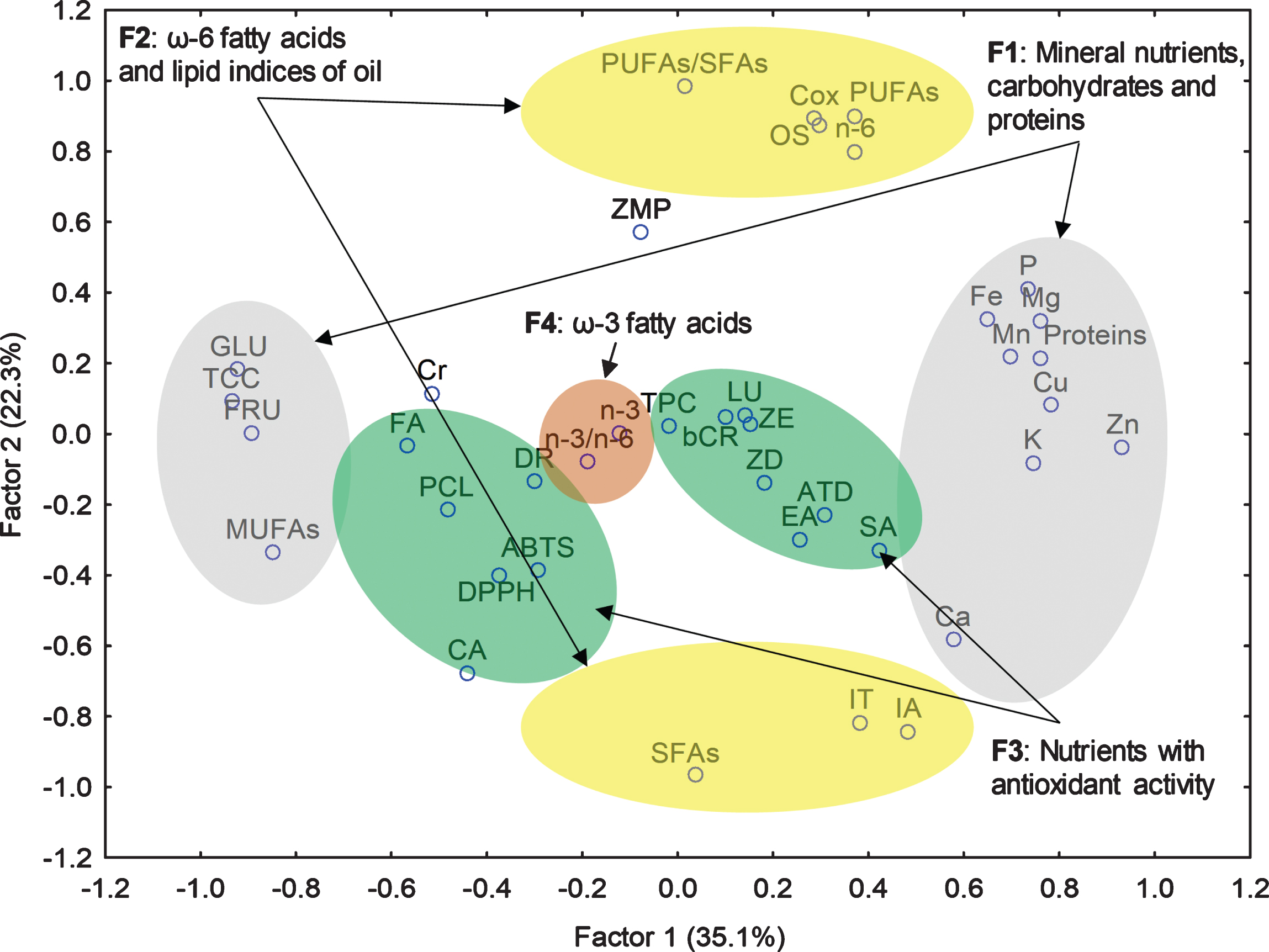
The 2D scatterplot of the first two varimax-rotated PCA factors showing the relationships between the main variables for Lycium barbarum L. cultivated in North Macedonia. SFAs–saturated fatty acids; IA–artherogenic index; IT–thrombogenic index; TPC–total phenolic content; PCL–photochemiluminescence assay; DPPH assay; ABTS assay; MUFAs–monounsaturated fatty acids; PUFAs–polyunsaturated fatty acids; n-6 – ω-6PUFA; n-3 – ω-3PUFA; Cox–oxidisability value; OS–oxidative susceptibility; GLU–glucose; FRU–fructose; TCC–total carbohydrates; CA–cinnamic acid; EA–ellagic acid; FA–ferulic acid; SA–salicylic acid; DR–delphinidin-3-o-rutoside; LU–(all-E)-lutein, ZE–(all-E)-zeaxanthin, bCR–(all-E)-β-carotene; ATD–(all-E)-antheraxanthin dipalmitate, ZMP–(all-E)-zeaxanthin miristate palmitate; ZD–(all-E)-zeaxanthin dipalmitate.
The scatterplot highlighted the four groups corresponding to nutritional and functional components of Lycium barbarum L. cultivated in North Macedonia. Similarities or lack of thereof between this variety and Lycium chinense M. could be easily observed in the heat map after two-way joining analysis as a clustering method (Fig. 2).
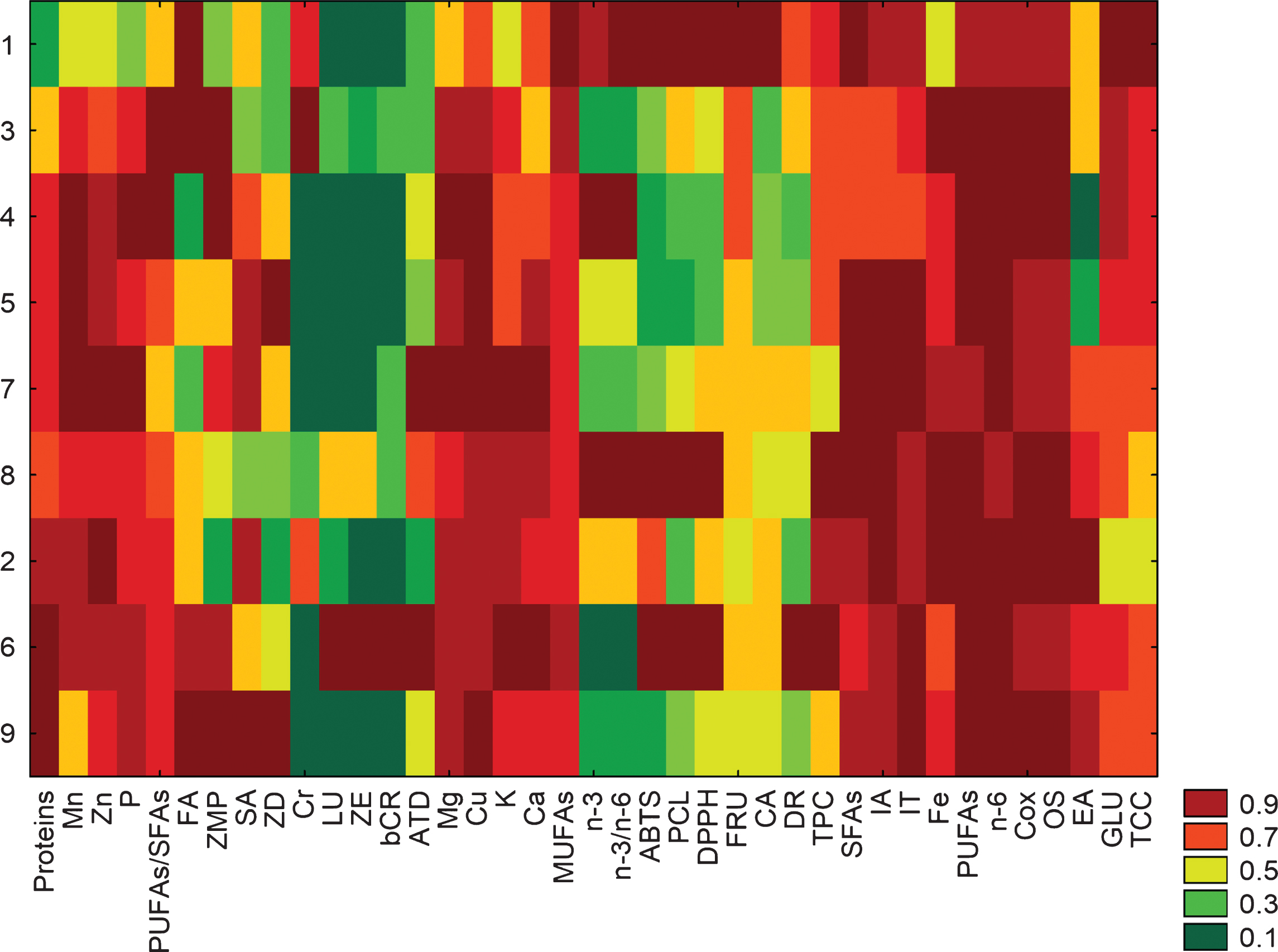
Heat map after two-way joining analysis as clustering method to emphasize similarities or lack of thereof between Lycium barbarum L. and Lycium chinense M. varieties. SFAs–saturated fatty acids; IA–artherogenic index; IT–thrombogenic index; TPC–total phenolic content; PCL–photochemiluminescence assay; DPPH assay; ABTS assay; MUFAs–monounsaturated fatty acids; PUFAs–polyunsaturated fatty acids; n-6 – ω-6PUFA; n-3 – ω-3PUFA; Cox–oxidisability value; OS–oxidative susceptibility; GLU–glucose; FRU–fructose; TCC–total carbohydrates; CA–cinnamic acid; EA–ellagic acid; FA–ferulic acid; SA–salicylic acid; DR–delphinidin-3-o-rutoside; LU–(all-E)-lutein, ZE–(all-E)-zeaxanthin, bCR–(all-E)-β-carotene; ATD–(all-E)-antheraxanthin dipalmitate, ZMP–(all-E)-zeaxanthin miristate palmitate; ZD–(all-E)-zeaxanthin dipalmitate.
The picture emphasizes significantly different patterns for the two Goji varieties mostly in terms of inorganic nutrients, antioxidant capacity, proteins, sugar profile and some lipid indices such as n-3 FAs and n-3/n-6 ratio. The observation is consistent with outcomes in Varimax rotation, which shows that mineral nutrients, carbohydrates and proteins have the greatest influence on the variability of properties of Lycium barbarum L. Also, taking into account only fruits harvested at full maturity (samples 4,5,7,9), Lycium Barbarum L. differs significantly in terms of diesterified carotenoids, zeaxanthin dipalmitate and zeaxanthin miristate palmitate.
Characterization in terms of elemental composition, sugar profile, FAs in oil, carotenoids, polyphenols and proteins highlighted that nutritional and functional properties of berries from Lycium barbarum L. variety cultivated in North Macedonia are significantly different from Lycium chinense M. It was established that Goji cultivated in North Macedonia is a rich source of mineral nutrients (K, Cu, Mn, P, Fe, Mg and Zn), compounds with antioxidative property such as esterified carotenoids, mainly zeaxanthin dipalmitate, and anthocyanins (delphinidin-3-o-rutoside). The lipid profile of FAs dominated by PUFAs, high PUFAs/SFAs ratio, low atherogenic, thrombogenic indices and oxidisability capacity, and high oxidation susceptibility may exert a positive influence on many metabolic functions in the human body. However, n-3/n-6 ratio was below that considered optimal for health because the low concentration of linolenic acid could not balance n-6 PUFA, as remarked in other vegetable oils. Toxic elements found in very low concentrations pose no risk to consumers. Combination of chemical characterization with chemometrics was useful for deepening the knowledge about goji berry and identifying factors associated with nutritional and functional properties. Thus PCA allowed grouping nutritional components and those with bioactive properties as: (1) mineral nutrients, carbohydrates and proteins (35.1%); (2) ω-6 FAs and lipid indices of oil (22.3%); (3) antioxidant activity of carotenoids and polyphenols (19.4%) and (4) ω-3 FAs (13.6%). Carotenoid profile and sugars revealed differences in terms of ripening stage of the analyzed berries. Thus, diesterified carotenoids found mostly in fully ripened fruits were not included in a single factor, however described up to 33% of variability for bioactive properties. The heat map revealed significantly different patterns for berries of Lycium barbarum L. and Lycium chinense M. varieties in terms of inorganic nutrients, antioxidative capacity, protein, n-3 PUFA and n-3/n-6 ratio, as well as zeaxanthin dipalmitate and zeaxanthin miristate palmitate. Overall berry of Lycium barbarum L. cultivated in North Macedonia has proved to be an effective natural dietary supplement.
Conflict of interest
The authors have no conflict of interest to report.
Funding
Romania, project number 33PFE/2018, within PNCDI III.
This work was also supported by a grant of Ministry of Research and Innovation, Romania, project PROINSTITUTIO – Contract no.19PFE/17.10.2018.
Footnotes
Acknowledgments
This work was supported by a grant of Ministry of Research and Innovation.