







Abstract
To optimize energy consumption in wireless sensor networks (WSNs) and prolong life cycle of networks, aiming at the problems in LEACH algorithm, such as random selection of cluster-heads, indeterminate cluster-heads number, accelerated death of cluster-head nodes and so on, an efficient clustering routing algorithm for WSNs (EECR) was proposed. This algorithm is based on LEACH algorithm. In the cluster building stage, four sub-thresholds were designed, i.e. residual energy of node, based on base-station distance, number of cluster-head in networks and round number that nodes are selected as cluster-heads. In stable data transmission stage, the effective path of node was utilized and free spatial model and multi-path attenuation model were integrated to realize effective data transmission. In simulation experiment, the network life, residual energy and information amount received by base station were compared. The results indicate that, compared to LEACH, LEACH-C, HEED and EEUC, the EECR algorithm can effectively reduce energy consumption and prolong network lifetime, and its overall performance is superior to LEACH, LEACH-C, HEED and EEUC algorithms.
Introduction
Wireless Sensor Networks is a self-organized data-centered large-scale network, which data transmission rule is decided by routing protocol and primary goal is to reduce energy consumption. It involves the research of network coverage technology, network topological control technology, routing technology, MAC technology, data fusion, positioning technology, time synchronization, safety performance and so on [1, 7, 8, 9, 15]. WSNs often consume a lot of energy in communication, and the routing algorithm can effectively solve such problem. To data, in order to optimize energy dissipation in network, numerous routing algorithms have been raised, and the earliest one is the Low Energy Adaptive Clustering Hierarchy (LEACH) proposed by Heinzelman et al. [11, 19]. In LEACH, the network is divided into multiple clusters, and each cluster-head in network can directly communicate with base station [2]. The LEACH algorithm imposes restrictions on interior communications of most clusters, thereby increasing network extendibility. The cluster-head is responsible for coordination and fusion work, bringing down total communication in network. As large-scale network deployment is not restricted by communication traffic, compared to the hierarchy of planar topological structure, the energy efficiency is improved to some extent. Isoprobability elected cluster-head can balance energy dissipation in network. However, the cluster-heads in LEACH algorithm are selected at random, and frequent election of cluster-heads would waste part of energy, so it could not be widely applied in large-scale network, and a failed election of cluster-head will make network to lack robustness. In case a dynamic clustering mode is used, it would result in extra overhead and is unsuited to be applied in large-sized repeated jump route. Aiming at the defects of LEACH algorithm, a series of improved algorithms were proposed. Literature [18] LEACH-C protocol uses centralized cluster head generation. When the number of rounds starts, each node sends its own situation to the base station including residual energy and position. The base station combines the information to get the average energy of all nodes. The cluster head is passed. The remaining energy is equal to the average energy and is then optimally selected. However, the disadvantage is that after each round, the base station receives information sent by all nodes in the network, and the cluster head node directly communicates with the base station in a single hop form. Literature [14] the HEED protocol cluster head selection is based on the primary and secondary parameters. The primary parameter randomly selects the cluster head set based on the remaining energy. Energy nodes are more likely to be cluster head nodes. The secondary parameter is used to balance the load between the cluster heads and the nodes belonging to that cluster. However, in the actual application environment, some cluster heads are farther away from the sink node, and the minimum average power is lower, and the nodes are added more, resulting in an increase in the data volume of the cluster head and higher energy consumption. Moreover, the minimum average power is used in the cluster, only the optimal cluster head node is selected for the current time point, and the subsequent “moving trend” of the node is not considered, resulting in an increase in energy consumption. Literature [13] a new delay constrained energy efficient routing technique is proposed. Literature [5] formed clusters in network initialization phase, which was connected by Hamilton path, constructed by greedy algorithm and then applied in data transmission. Literature [4] the EEUC protocol randomly selects nodes with higher energy to become candidate cluster heads, and then uses non-uniform contention ranges to construct clusters of different sizes, so that cluster heads close to sink nodes can reserve data forwarding between clusters. However, the cluster head election process of the agreement is cumbersome and consumes more energy. Literature [17] a new secured routing protocol called Cluster based Energy Efficient Secure Routing Algorithm (CEESRA). Literature [6] put forward a new ucpo routing protocol to solve the randomness of cluster-head and data transmission by single hop method. Literature [3] proposed to scatter measured data as some grade interval and whether data shall be transmitted will be decided on interval. Literature [10] the novel and efficient clustering called Clustering using Eigen Values (CEV) is proposed in this paper with the increased lifetime of the sensor nodes using the spectral graph theory.
This paper proposed an energy-efficient clustering routing algorithm based on LEACH, abbreviated as EECR. This algorithm includes cluster building stage and stable data transmission stage. In cluster’s establishment stage, it defines four sub-thresholds, i.e. residual energy of node, based on base-station distance, cluster-head number in networks and round number that nodes are elected as cluster-heads, thus cluster-heads are obtained; in data transmission stage, after fusing the data from node to cluster-head, due to varied distance between cluster-head and base station during transmission, data transmission shall be conducted by combining free space model and multi-path attenuation model.
LEACH algorithm analysis
The topology control method in WSNs includes planar network topological structure and hierarchical network topological structure. The hierarchical network topological structure divides nodes into cluster-head node and common node. The connection modes between interior node and cluster-head as well as between each cluster-head are as shown in Table 1. In an integral cluster network, data of common node can be uploaded to base station by four different ways, that’s direct single hop, direct multi-hop, indirect single hop and indirect multi-hop.
Connection modes between interior nodes and cluster-heads as well as between each cluster-head
Connection modes between interior nodes and cluster-heads as well as between each cluster-head
In clustering algorithms, LEACH algorithm is a classic one that belongs to direct single hop mode. This algorithm defines the concept of “Round” [12], in which the network is divided into several clusters and the cluster-head is rotated in each round of election, and each round includes the cluster establishment stage and stable data transmission stage. In cluster building stage,
In election, every sensor node randomly generates one number of 0
In which,
The cluster-head collects and fuses data from each node inside its cluster, and then transmits to base station for further processing. Thus, this round is finished, and the next round will repeat above operations.
From above analysis, it can be seen that: LEACH algorithm cluster head P For random elections, the optimal number of cluster head nodes cannot be obtained, and the overall networks consume energy unevenly leading to the easier premature death of the nodes far from base station; LEACH algorithm needs to elect cluster node by broadcast message and non-cluster-head node needs to send message to join in, so frequent election of cluster-heads will result in extra energy consumption; because of the cluster heads and the cell towers are in the form of a single jump, the network structure and transfer data are too large, and the data can be easily lost and consumed too much.
Networks energy-consumption model
The network model includes the following designs: sensor nodes are randomly deployed in network detection area; all nodes have their own unique ID; the position of a node will not change after deployed; the network takes round as cycle, and each round includes cluster building stage and stable data transmission stage; a node could figure out inter-node distance according to the intensity of received signal, and both nodes will consume equal energy in the inter-node communication.
The wireless communication energy-consumption model used in this paper refers to the 1
Wireless communication energy-consumption model.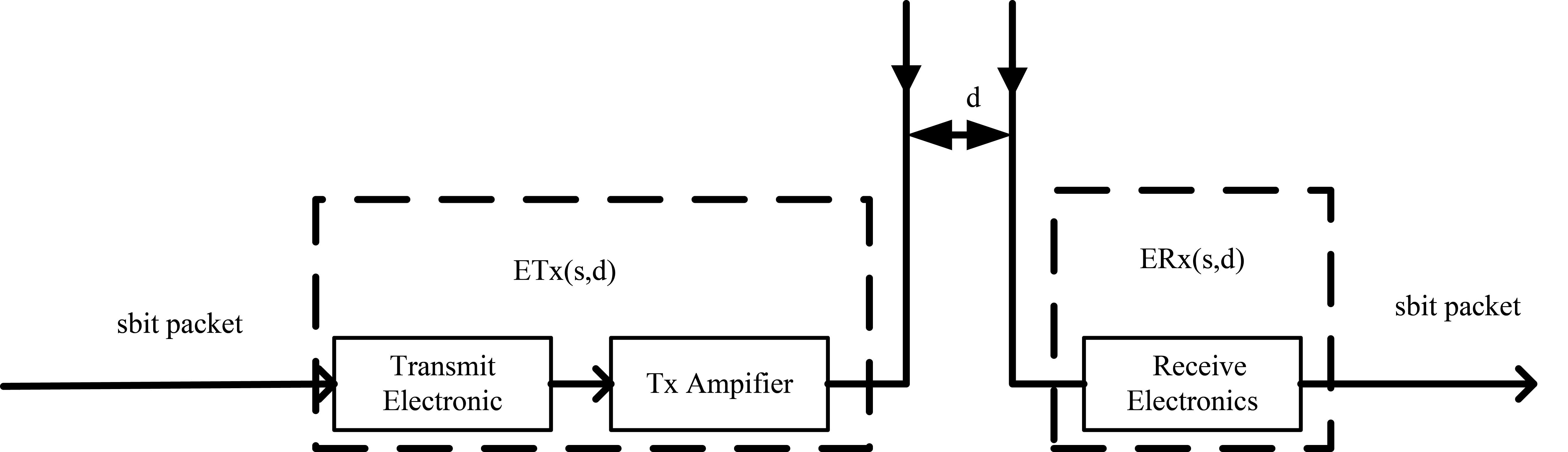
The paper adopted a classic wireless communication model [18], and when a node transmits s bit data, its consumed energy is:
When a node receives s bit data, its consumed energy is:
In which,
In classic LEACH algorithm, the cluster-head is randomly elected, resulting in more energy consumption. This paper designed an energy-efficient clustering routing algorithm (EECR) based on LEACH algorithm, which includes cluster building stage and stable data transmission stage.
Cluster building
In cluster building stage, the calculation of threshold value shall consider the residual energy, base station-based distance, number of cluster-head in network and round number, which are defined as four sub-threshold values.
Residual energy
The residual energy of node in network slowly attenuates with the time. Because cluster-heads often assume a great deal of work, so they consume more energy than other nodes, so as to prevent low-energy nodes being elected as cluster-heads. The sub-threshold value is defined as below:
In which,
The energy consumed by node will increase with communication distance, so it will consume more energy in transmission process than cluster-head in execution process. This is taken as a distance factor to elect optimal cluster-head. Its sub-threshold value is defined as below:
In which,
The distribution mode of cluster-heads can affect energy consumption to some extent. When the cluster-heads are intensively distributed or the distance between cluster-heads is relatively short, their energy consumption will be uneven, so as to prevent the influence led by cluster-head.
In which,
In networks, the cluster-heads assume heavy works and consume more energy. In case that a node is frequently elected as cluster-head, this will expedite the death speed of cluster-head, so as to balance the election frequency of cluster-head. Its sub-threshold value is defined as below:
In which,
In networks, each node randomly forms a numerical value of [0, 1]. If this number is smaller than the new threshold value
In which,
After the optimal cluster-heads are elected, broadcast message will be sent out, and other nodes shall choose which cluster to join in according to signal intensity of broadcast message that they have received respectively and send request to cluster-heads for joining in. Then colonies are formed. In order to prevent interference between colonies, the cluster-heads use CDMA coding to send member nodes of their own colony, base station sends TDMA, and then it’s the time to enter the next stage of data transmission.
Inter-cluster communication chart.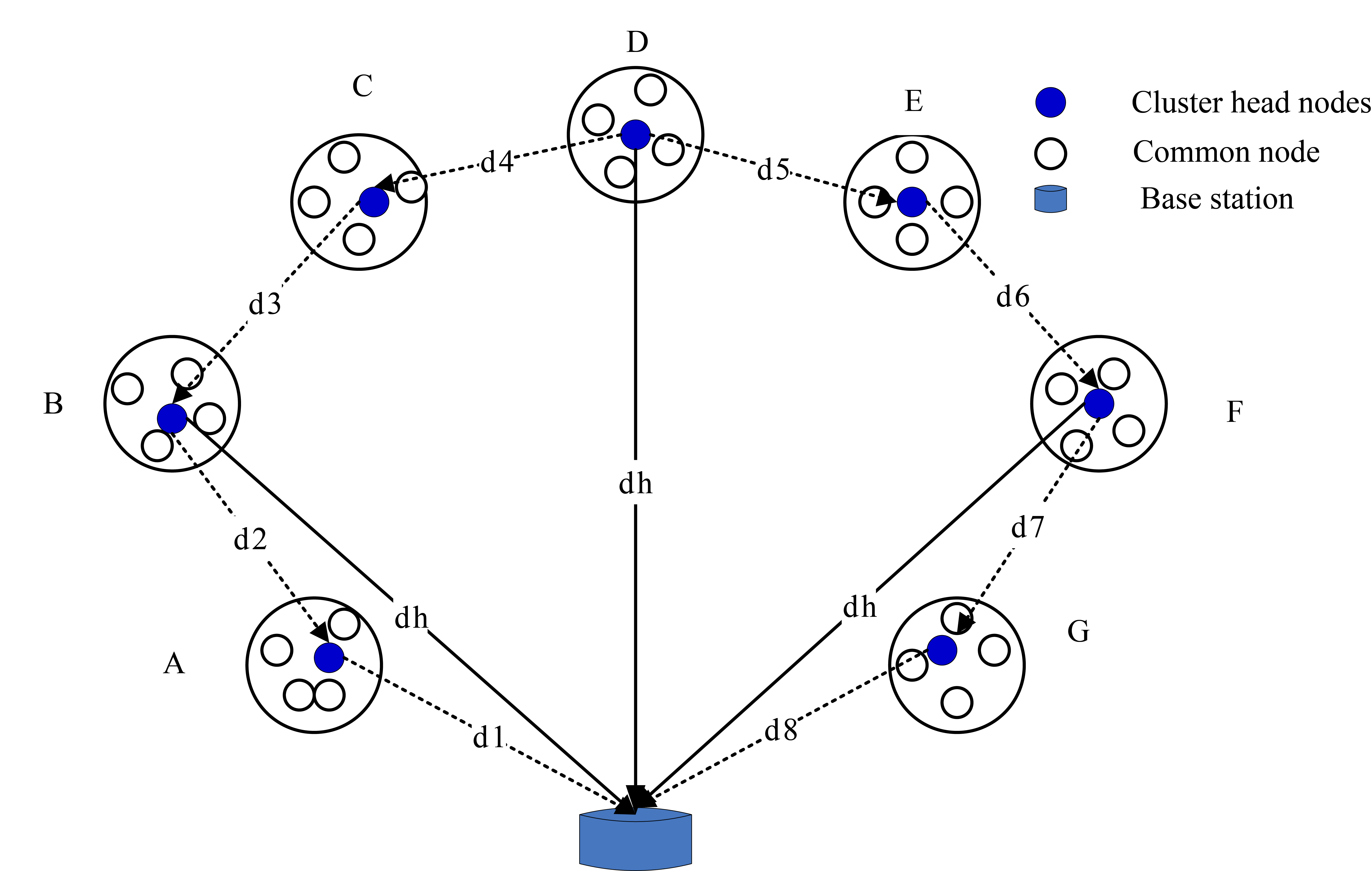
After clustering work is finished, the data transmission stage starts. The nodes composing a colony transmit the collected data information to cluster-head node within their own channel time, and then these cluster-head nodes collect all data information and later fuse them with their own data information. After fusion, the cluster-heads directly transmit data to base station by an integrated mode of multi-hop and single hop.
In the process of data transmission between cluster-head and base station, the transmission process is as shown in Fig. 2.
In Fig. 2, the cluster
When
The data transmission of nodes
When
Regarding the data transmission of nodes
When
For data transmission of nodes
When
Finally, all cluster-head nodes transmit their information to base station according to the combined transmission path of free space model and multi-path attenuation model and obtain the final data.
To verify the precision of improved algorithm in node positioning, Matlab2015 was used to carry out a simulation experiment. The site of simulation experiment was a square area of 200 m
Parameters settings
Parameters settings
In this paper, the simulation experiments of LEACH, LEACH-C, HEED, EEUC and EECR algorithms are compared. The three performance indicators are network lifetime, residual energy and the amount of information received by the base station. The network lifetime is a good running time of the network, and the number of surviving nodes is above half of its total node, which is a normal running state. The remaining energy is the longer the remaining energy in the network when the network is running at the same time. The amount of information received by the base station is the amount of data received by the base station from the cluster head node.
Figure 3 compares the network life of three algorithms changes with number of round when base station is within area. It is seen that, in different round numbers, the network life of EECR is higher than that of LEACH, LEACH-C and EEUC. When a sensor network runs in 310
Network life when base station is within area.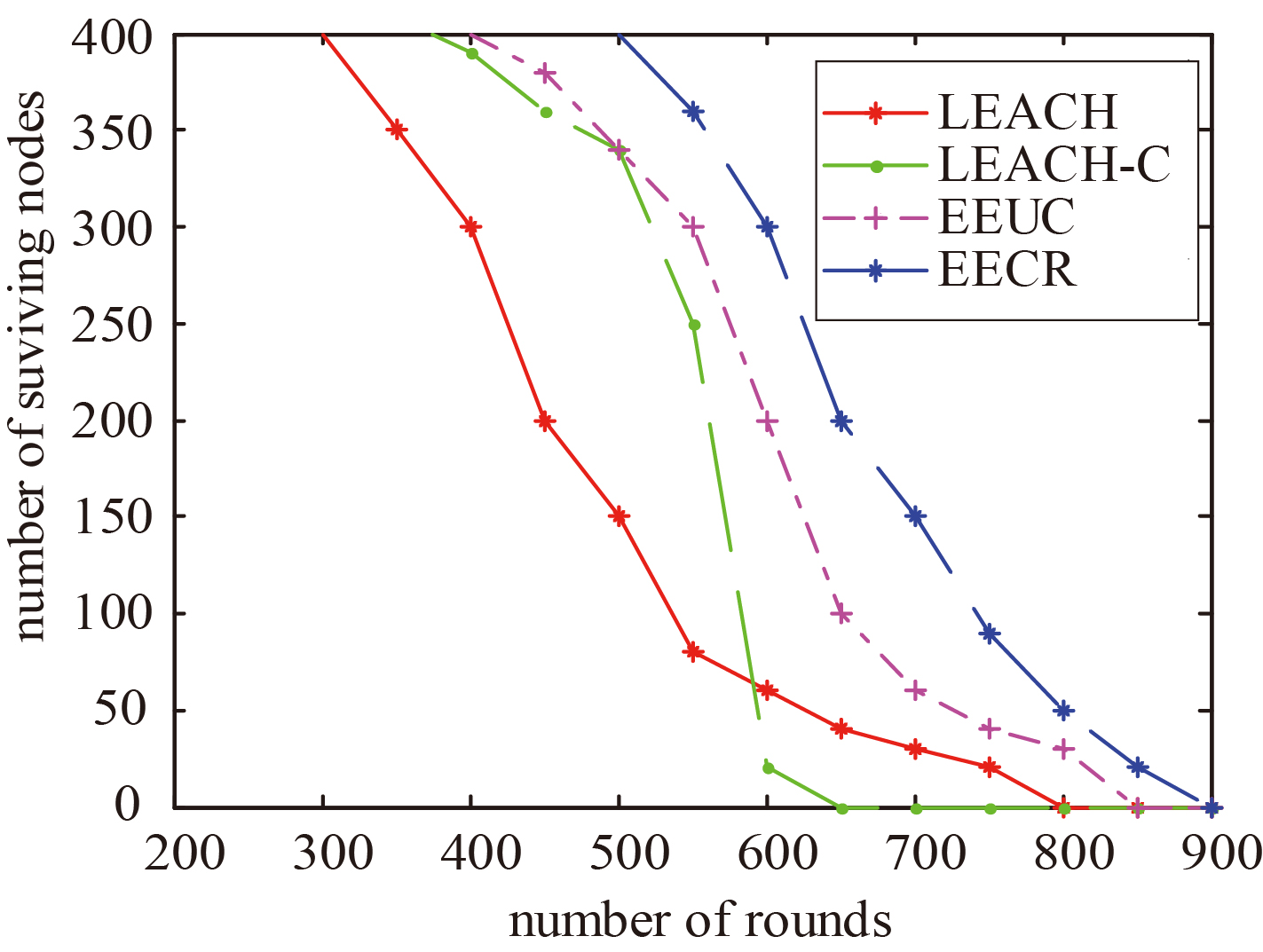
Network life when base station is outside of area.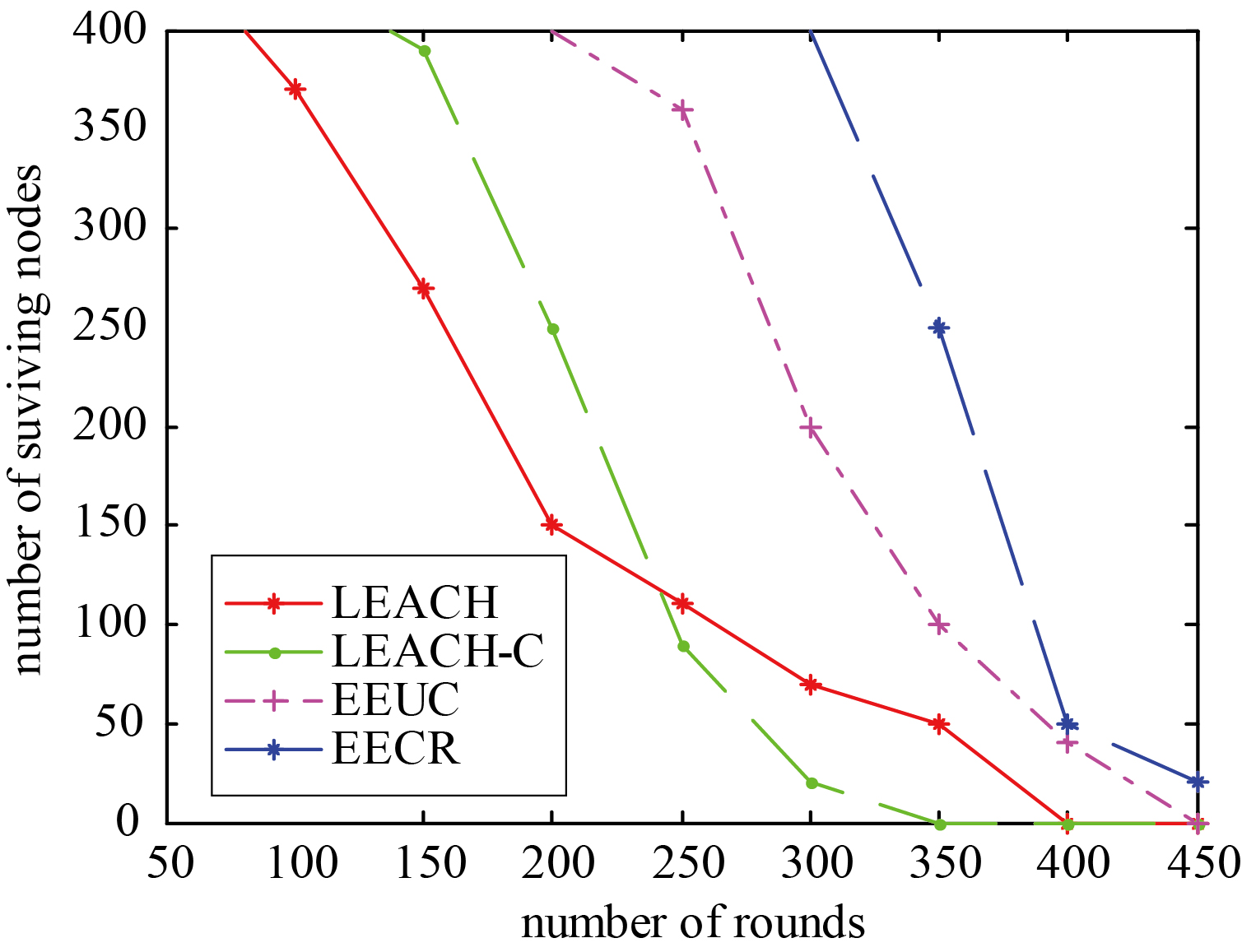
Figure 4 compares the network life of three algorithms when base station is outside of area. It is seen that, in different round numbers, the network life of EECR algorithm is higher than LEACH, LEACH-C and EEUC algorithms. The round numbers of the first death nodes of LEACH, LEACH-C, EEUC and EECR algorithms are 80
Figure 5 compares the residual energy of base station within area in three algorithms. It is seen that, with increased number of round, the residual energy of EECR algorithm is higher than those of LEACH, HEED and EEUC algorithms. When the residual energy of network decreases by 50%, the corresponding round numbers of LEACH, HEED, EEUC and EECR algorithms are 70
The residual energy of base station within area.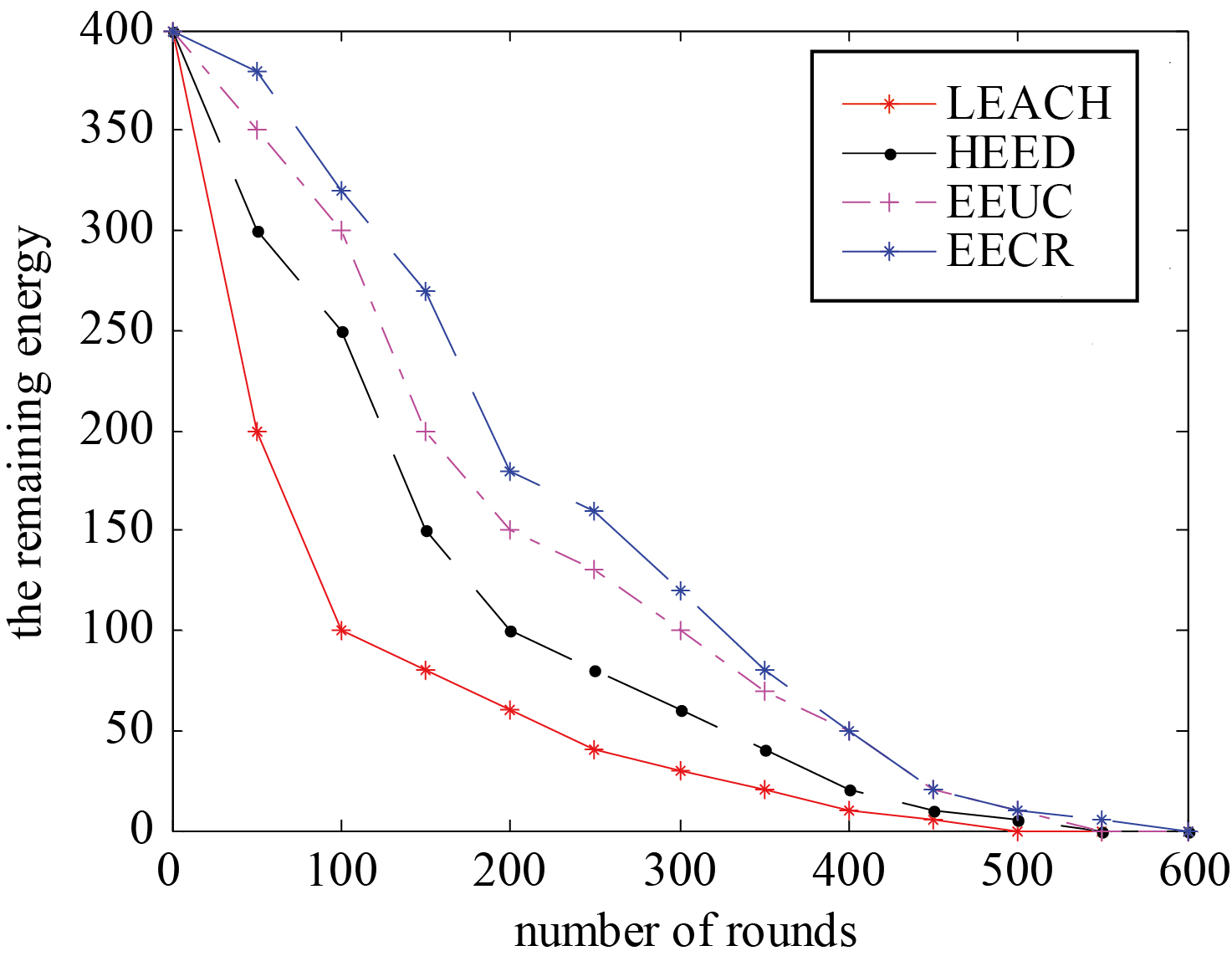
Figure 6 compares the residual energy of base station outside of area in three algorithms. It is seen that, with increased number of round, the residual energy of EECR algorithm is higher than those of LEACH, HEED and EEUC algorithms. When the residual energy of network decreases by 50%, the corresponding round numbers of LEACH, HEED, EEUC and EECR algorithms are 120
The residual energy of base station outside of area.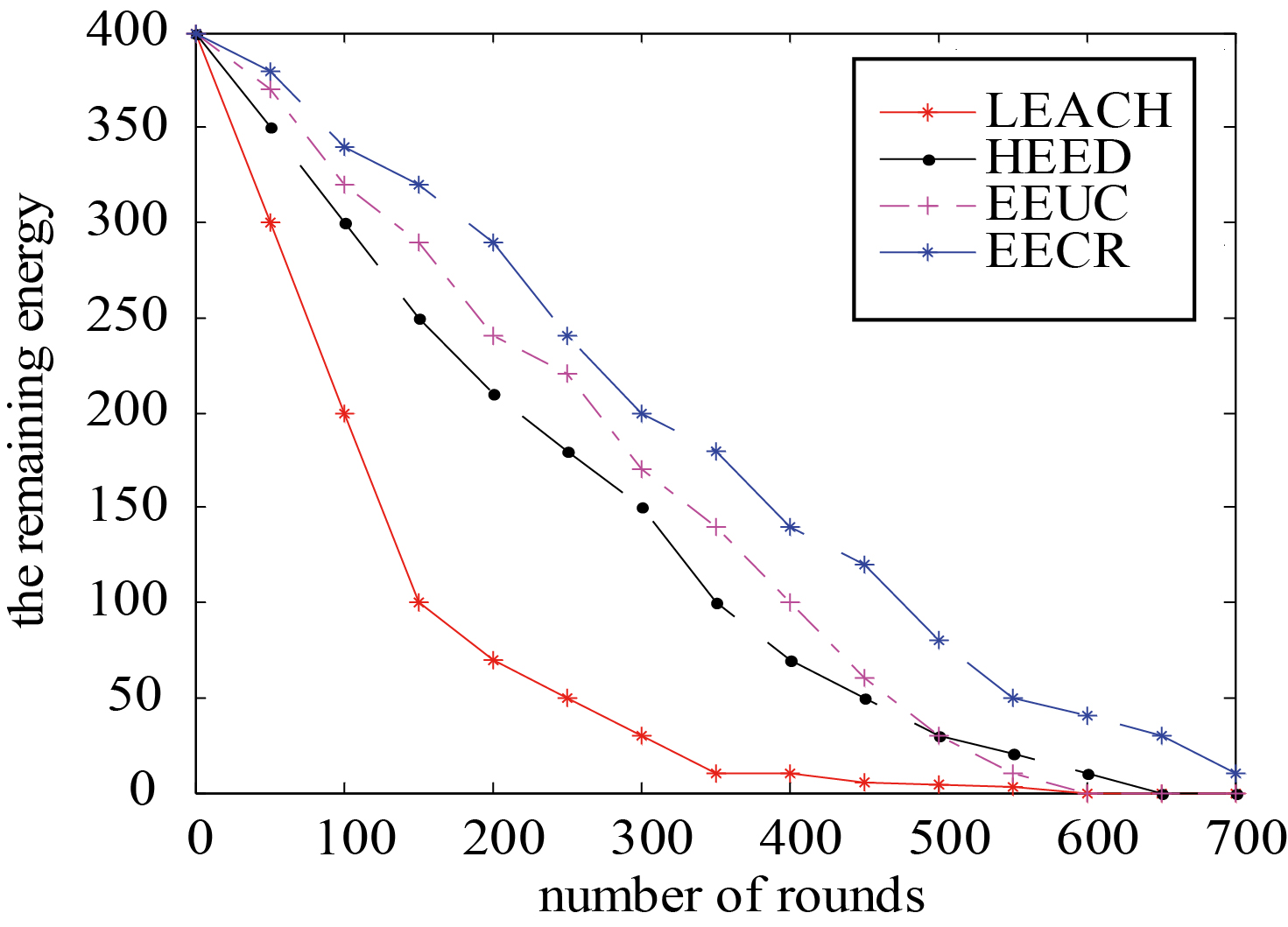
Figure 7 compares the received information amount of base station within area in three algorithms. It is seen that, with increased number of round, the received information amounts of LEACH, LEACH-C, EEUC and EECR algorithms increase continuously. When the sensor network runs to the 250
The information amount received by base station within area.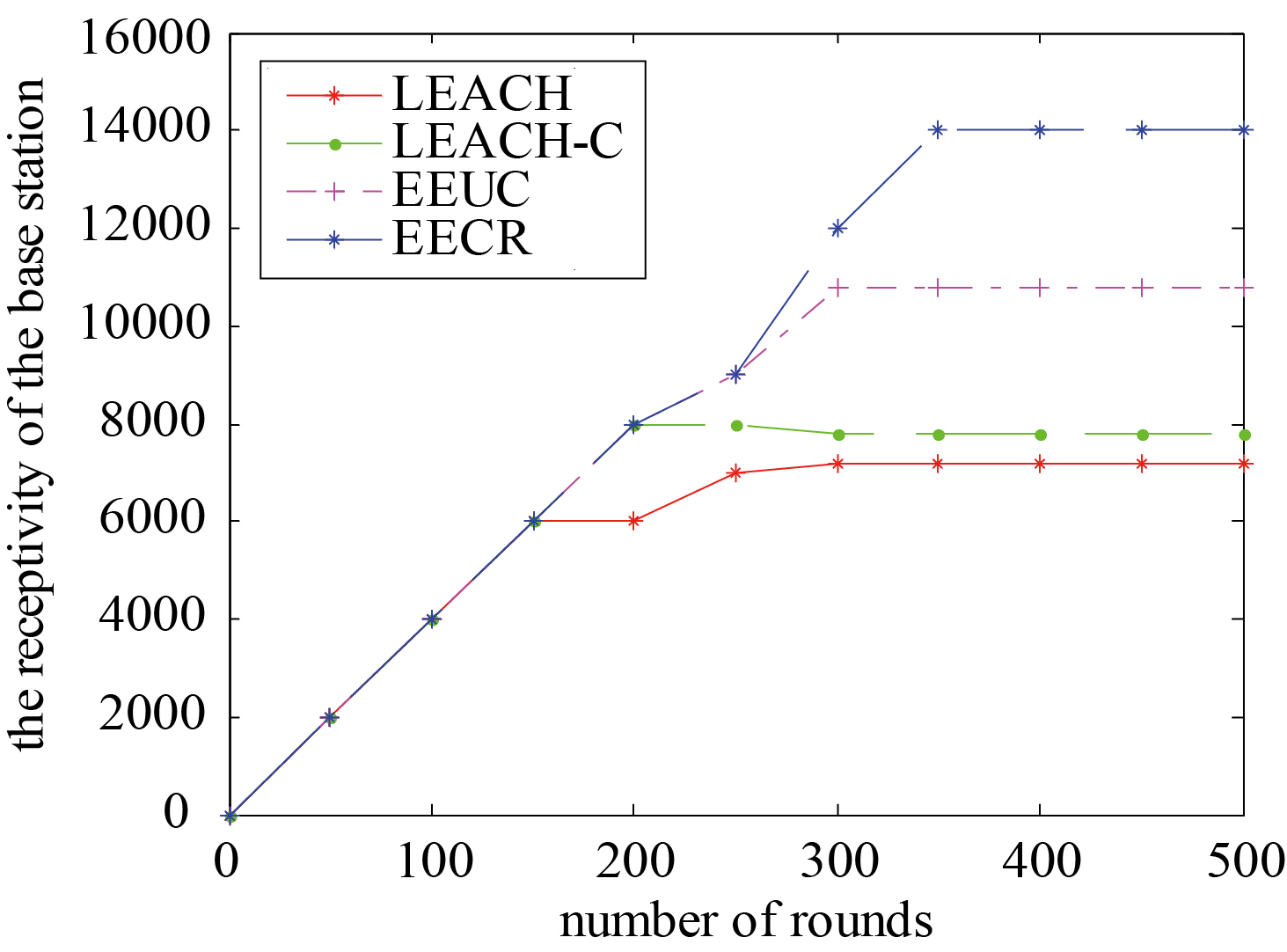
The information amount received by base station outside of area.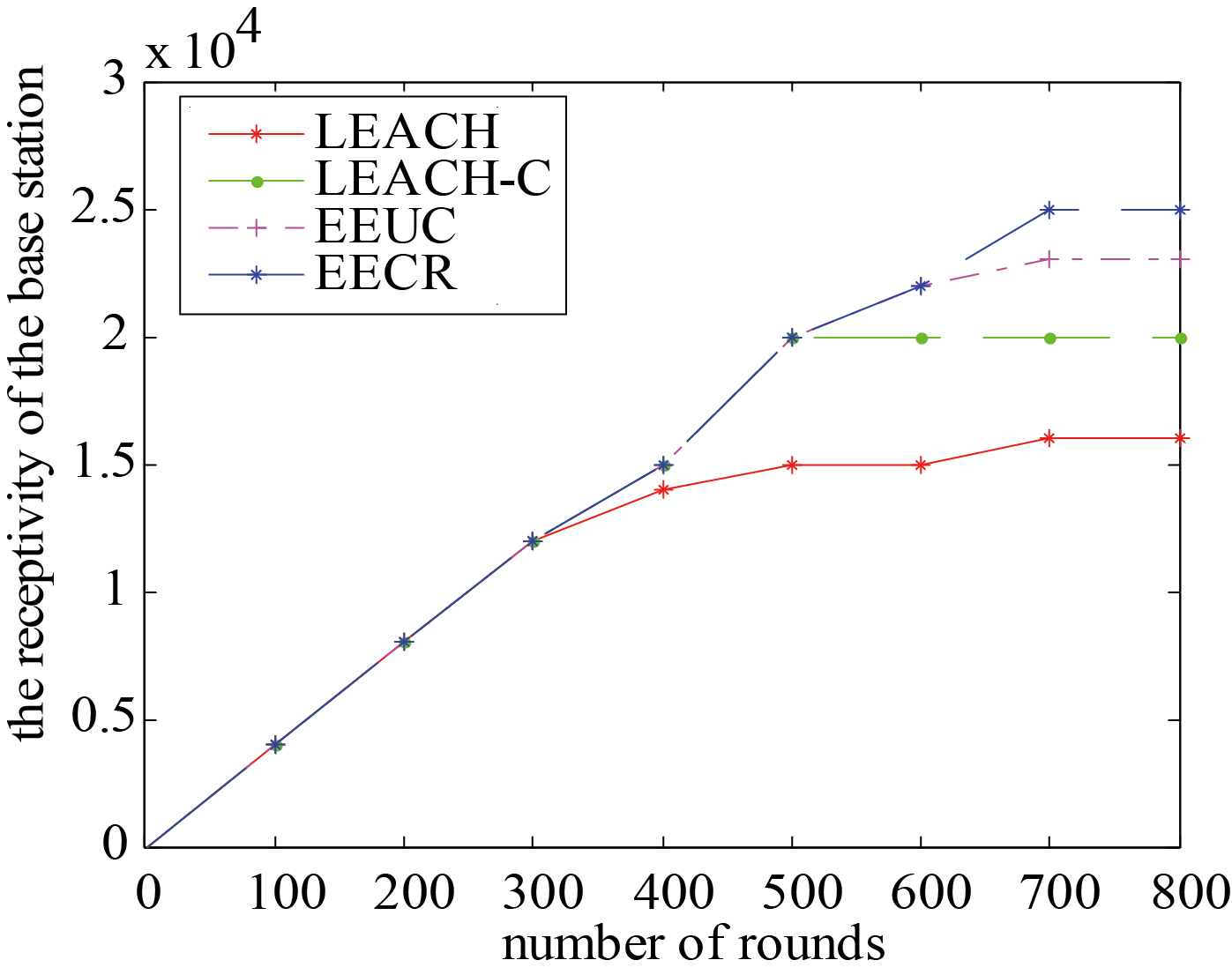
Figure 8 compares the information amount received by base station outside area in three algorithms. It is seen that, with increase number of round, the received information amounts of LEACH, LEACH-C, EEUC and EECR algorithms increase continuously. When the sensor network runs to the 330
The saving of energy consumption plays a crucial role in wireless sensor network. This paper presented an efficient clustering routing algorithm for wireless sensor network, called EECR. The core idea of EECR is to redefine the threshold value, and it uses four sub-threshold values, including the residual energy of nodes, based on base-station distance, cluster-head number in network and the round numbers that nodes are selected as cluster-head; during data transmission, data is transmitted according to effective path of each node, to achieve the high-efficient and energy-saving effects. The simulation experiment indicates that EECR can optimize the energy consumption of entire network. Compared to LEACH, LEACH-C and EEUC algorithms, under the same conditions, regarding different performance indexes, EECR algorithm is superior to and integrally has a better performance than above two algorithms and can effectively extend the surviving time of network. In the next step, the primary work is to study the algorithm in heterogenous network, enabling it more suitable for practical application occasions.
Footnotes
Acknowledgments
The authors acknowledge the National Natural Science Foundation of China (grant: 61261015), the National Natural Science Foundation of China (grant: 61561043).