Quantum mechanical lineshapes of collision-induced absorption (CIA) at different temperatures are computed for gaseous mixtures of molecular nitrogen and methane using theoretical values for the induced dipole moments and intermolecular potential as input. Comparison with theoretical absorption spectra shows satisfactory agreement. An empirical model of the dipole moment which reproduces the experimental spectra and the first three spectral moments more closely than the fundamental theory, is also presented. Good agreement between computed and experimental absorption lineshapes is obtained when a potential model which is constructed from the thermophysical and transport properties is used.
Collision- and interaction-induced spectroscopy is currently a field of essential importance to our knowledge and observation of fundamental phenomena in our general environment [1]. These efforts lean heavily on interaction-induced electric properties. Significant computational [2, 3, 4, 5, 6, 7, 8, 9] and spectroscopic [10, 11, 12, 13, 14, 15, 16, 17] contributions to the field have appeared in recent years: most of them concern interactions between small atoms and molecules.
In previous work, we compared measurements of collision-induced absorption (CIA) spectra of molecular hydrogen and of molecular hydrogen with helium and argon at different temperatures with theoretical profiles obtained with advanced empirical interaction potentials and induced dipole moments for absorption [18, 19, 20]. Encouraged by the observed agreement for these systems, we extend this treatment relying on the thermophysical and transport properties for molecular nitrogen and methane mixtures to construct the parameters of the rototranslational collision-induced absorption spectra using a new isotropic intermolecular potential.
Collision-induced absorption (CIA) in gaseous nitrogen and methane is a subject of known astronomical interest, particularly since the atmosphere of Titan, a satellite of Saturn, is known to consist of these gases. These sources of opacity in the far infrared (FIR) region could be computed on the basis of data that already existed for CIA in molecular nitrogen [21, 22, 23, 24] and methane [25, 26, 27]. Hunt et al. [28] found that the opacity due to N-N and CH- CH collisions alone does not account for the measured opacity at higher frequencies. However, from a knowledge of the induction mechanisms in these gases and by suitably scaling the molecular constants to account for collisions between dissimilar molecules, Courtin [29] included the contribution of N-CH collisions. Subsequently, Dagg et al. [30] measured the CIA in these mixtures at several temperatures in the range 126–212 K. This absorption was modeled by Courtin [31] and was used by McKay et al. [32] to compute the brightness temperature set by the Voyager egress data. However, in order to obtain a fit to these data Courtin’s N-CH absorption coefficients needed to be substantially increased for wave numbers 200 cm. Moreover, Dagg ef al. [30] found a somewhat similar high-frequency discrepancy between the laboratory data and the computed spectra based on known induction mechanisms.
Because of these discrepancies and as the data of Dagg et al. [30] do not extend beyond 450 cm, Birnbaum et al. [33] measured the FIR absorption coefficient of a N-CH mixture up to 550 cm at 162 K, and to 670 cm at 195 and 297 K. The zeroth and first spectral invariants, for N-CH pairs were obtained from these measurements as well as from the measurements of Dagg et al. [30] and compared with theoretical values as a function of temperature. Although the agreement between experiment and theory for is reasonable, the experimental values of are distinctly greater than the theoretical values at all temperatures. Thus, theory predicts insufficient high-frequency absorption ( is mainly due to such absorption, whereas is mainly due to low frequency absorption).
Collisional pairs of molecules in dense phase show an absorption band in the far infrared region of the spectrum [34]. This absorption is due to the induced dipole moment (r) arising from the distortion of the electronic clouds during the collision of two molecules. As the induced dipole moment depends on the distance between the colliding pair, the translational state of the system can change due to the interaction of the induced dipole with the electromagnetic field, giving rise to a rototranslational absorption band. Measurements of collision-induced absorption (CIA) spectra give therefore information on intermolecular interactions. Specifically, spectral lineshapes and intensities reflect certain details of the induced dipole as function of the interatomic separation and the collision dynamics (i.e. the intermolecular potential) [35].
No adequate potential with the parameters fitted well with the different thermophysical and transport properties at different temperatures is currently available for the gas phase of the system under consideration. We calculate the intermolecular potential for the N-CH interaction using mostly the methods outlined in previous work [18, 19, 20]. Only a few essential details are given here. To reiterate, our basic strategy is to include collision-induced absorption in addition to the data on second pressure virial coefficients, viscosity, diffusion, thermal conductivity and thermal diffusion factor data at a wide range of temperatures, in order to fit the simple functional form of the intermolecular potential for N-CH interactions.
The collision-induced absorption, transport and thermophysical properties used in the fitting are complementary ones for that purpose. For these pairs of gas molecules, the measured CIA at different temperatures used is shown theoretically to be capable of providing detailed information about the repulsive part of the relevant intermolecular potential [35]. Pressure virial coefficients reflect the size of and the volume of the attractive well [36], while the viscosity, thermal conductivity and diffusion data are most sensitive to the wall of the potential from inward to a point where the potential becomes repulsive [37].
Spectral profiles of the absorption are calculated numerically with the help of a quantal computer program and are compared to the recent calculated and measured spectra. The comparison of these spectra provides valuable insights on the quality of the existing models of the induced dipole moments and the intermolecular potential for absorption. Calculations of the different thermophysical and transport properties at different temperatures, using different intermolecular potential models, are presented in Sections 2–4. The theoretical method for the calculation of the spectral lineshape intensities of collision-induced absorption with the different ab initio and empirical forms of the induced dipole moment is given in Section 5, together with the computational implementation and the concluding remarks are given in Section 6.
The intermolecular potential and multi-property analysis
In order to calculate the line profiles of absorption and their associated moments, we need the intermolecular potential. Results with different potentials can be compared with experiment to assess their relative merit.
The intermolecular potential we propose in this work is obtained through the analysis of the second pressure virial coefficients [38, 39, 40, 41, 42, 43, 44] and viscosity, thermal conductivity, diffusion coefficients and thermal diffusion factors [45, 46, 47, 48, 49, 50, 51, 52, 53, 54, 55, 56].
For the analysis of all these experimental data we consider the Barker, Fisher and Watts (BFW) potential [57],
where is the potential depth, is the distance at the minimum potential and the rest are fitting parameters.
Even at the present (BFW) level, there are already thirteen parameters (, , , , , , , , , del, , and ) which are far too many to determine from the present data. To circumvene this difficulty we proceeded as follows: the coefficients and are determined from the conditions of continuity and the long-range dispersion coefficient was taken from theoretical calculations of Margoliash and Meath [58], leaving ten parameters (, , , , , , , del, and ) that were varied to fit the the second pressure virial coefficients. This fitting is further supported by the calculation of the viscosity, diffusion data, thermal conductivity and thermal diffusion factor. Calculations were speeded by determining rough values of these parameters and then final convergence was obtained by iteration with the full isotropic potential. This decision leads to potential parameters of Table 1 as our best estimate of the N-CH intermolecular potential.
In addition to the present potential some older and recent empirical Lennard-Jones (12-6) [30, 47, 49, 50, 56], Exp-6 [59], Hanley-Klein HK(11-8-6) [60] and the potential of Bich et al. [61] were considered.
Parameters of the BFW isotropic intermolecular potential and the associated values of
(nm)
(nm)
del
128.3
0.366
0.412
12.9
0.01
0.8186
2.2446
12.5633
72.0
87.0
100.0
(a.u.)
(a.u.)
(a.u.)
96.94
2794.0
84911.0
0.73
0.48
0.57
0.91
0.98
0.76
Reference [58]. is defined by where and are, respectively, the calculated and experimental values of property at point and is the experimental uncertainty of property at point . The subscripts , , and refer to the second pressure virial coefficient, viscosity, the thermal conductivity, the diffusion coefficient and the thermal diffusion factor, respectively. The overall rms deviation was obtained from .
Analysis of second pressure virial coefficients
An effective means for checking the validity of the different potential parameters can be made using the second pressure virial coefficient data [38, 39, 40, 41, 42, 43, 44] at different temperatures. The interaction second pressure virial coefficient at temperature T was calculated classically with the first three quantum corrections from [62]:
where
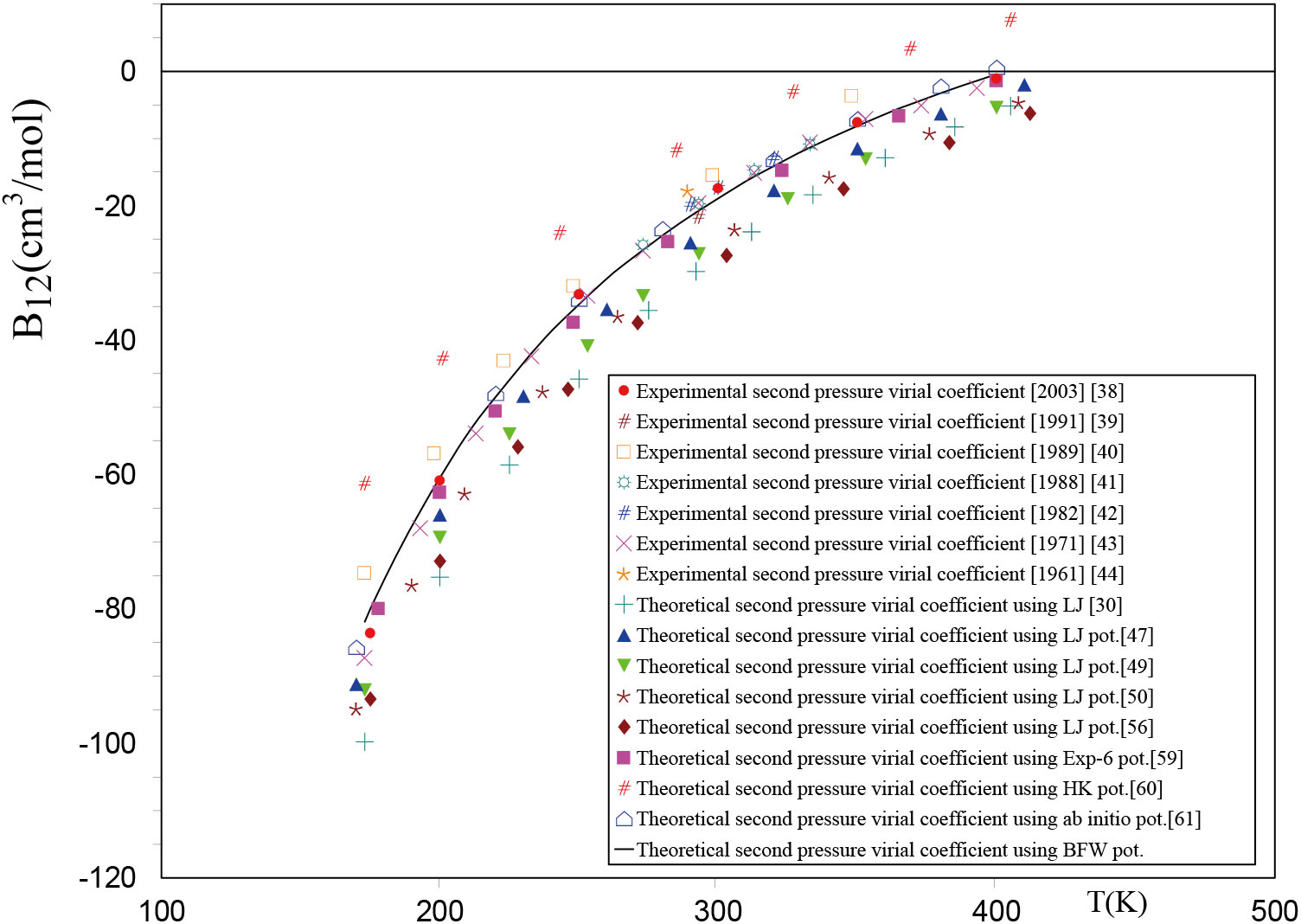
and the first three quantum corrections are given in Ref [62], with , , m and N are the atomic mass and Avogadro’s number. The calculated B was compared with to the experimental results [38, 39, 40, 41, 42, 43, 44] using the present BFW and different intermolecular potentials [30, 47, 49, 50, 56, 59, 60, 61]. As it is clearly seen in Fig. 1 and Table 1, the isotropic BFW potentials give the best agreement with the experimental values over a high range of temperatures.
Second pressure virial coefficients of CH-N in cm/mole vs temperature in K using the present BFW and different intermolecular potentials.
Analysis of traditional transport properties
An additional check for the validity of the different potential parameters can be made using transport properties i.e. viscosity , diffusion coefficient , isotopic thermal factor and thermal conductivity at different temperatures. These are obtained via the formulae of Monchick et al. [63] and their comparison to the accurate experimental and theoretical results [45, 46, 47, 48, 49, 50, 51, 52, 53, 54, 55, 56] becomes obvious by the calculation of the associated values of , as shown in Table 1. The agreement for all systems under consideration is excellent for the whole temperature range.
In addition to the inversion of spectroscopic observations and bulk properties, there are also other sources for the determination of intermolecular forces. These are: 1) quantum mechanical calculations (ab initio method) and 2) molecular-beam scattering. In this work, we restricted our efforts to the extraction of information about the intermolecular potential energy from the transport properties. In this respect, according to the kinetic theory of gases at low density and the Chapman- Enskog solution of the Boltzmann equation, the transport properties can be expressed with the help of a series of collision integrals that depend on the intermolecular potential energy, and are defined as [64]
where is the scattering angle, the transport collision integral, the impact parameter, the relative kinetic energy of colliding atoms and the closest approach of two atoms. Thus, three successive numerical integrations are required to obtain a collision integral. The reduced collision integral is defined by
where is the length scaling factor, such that 0.
The potential energy would serve as the input information required in calculating the collision integrals, and cosequently the transport properties. Kinetic-theory expressions for the transport properties (viscosity, thermal conductivity and diffusion coefficient) in terms of the collision integrals for the binary gas mixtures are given by the following eqations [49, 65, 66]:
where is mixture viscosity and
where , , and are mole fractions, molecular weights in gms, viscosity in at the mixture temperature of species ( 1, 2) and reduced temperature, respectively.
In the above expressions the interaction viscosity is given by
In addition, the binary thermal conductivity in units of (mW/m.K) and diffusion coefficient in (m/s) may be written as
with the pressure in atm and the temperature in .
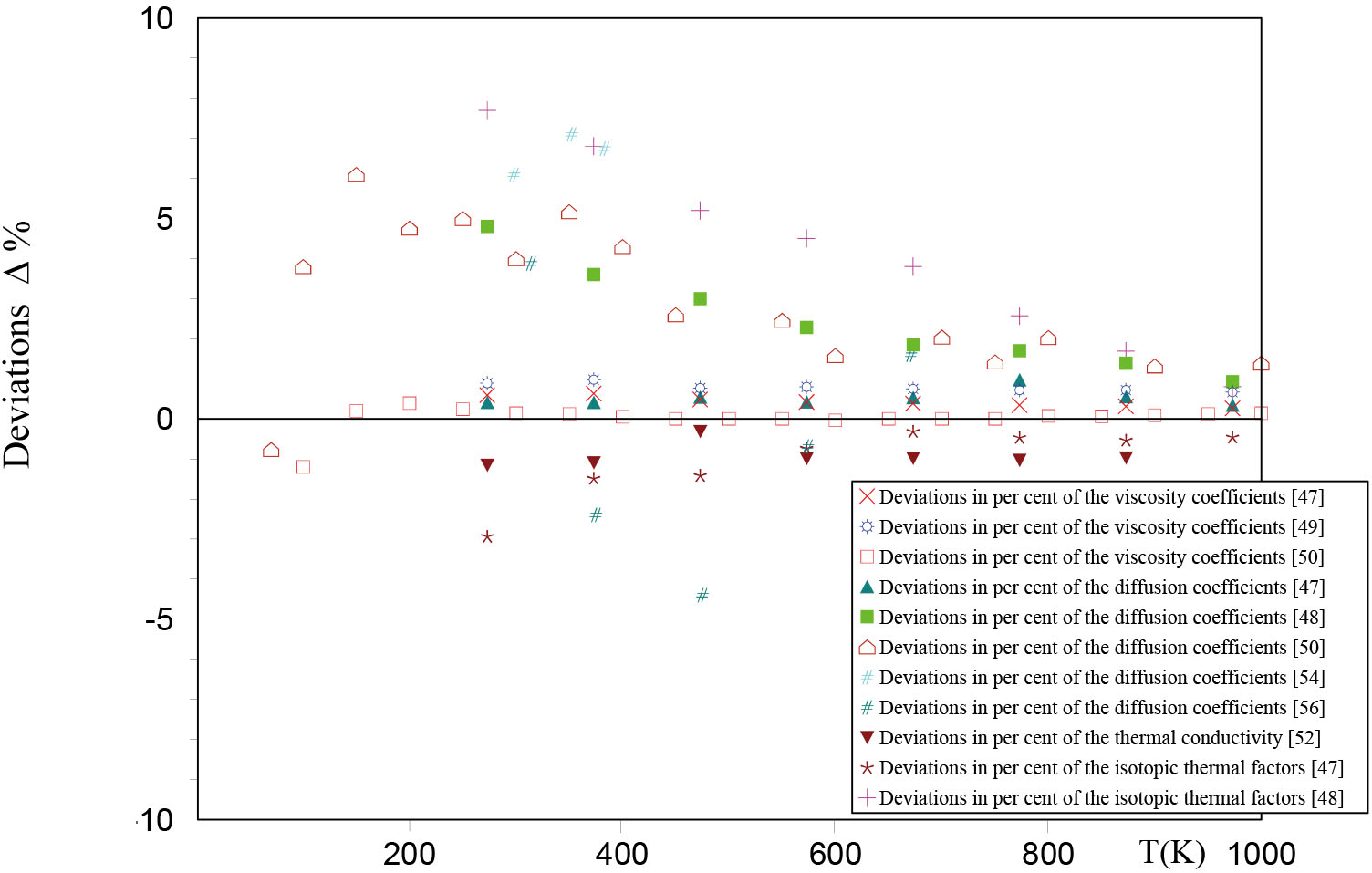
The comparison between the calculations using our new potential and experiment is shown in Fig. 2, for the equimolar mixture viscosity diffusion coefficient the equimolar mixture thermal conductivity and isotopic thermal factor Iso(T). The agreements are good in the whole temperature range.
Deviations in per cent as a function of temperature of the viscosity coefficients , the diffusion coefficients , the thermal conductivity and isotopic thermal factor Iso(T) from the experimental results. Calculations were performed using BFW potential with the parameters given in Table 1.
Theory of rototranslational collision-induced absorption
Collision-induced absorption spectra (CIA) can be computed from quantum mechanical theory if the interaction potential is known along with a suitable model of the collision-induced dipole moment [67, 68]. The absorption coefficient of N-CH consists of three parts [34]. These correspond to the dipole induction by nitrogen and methane molecules.
Multipolar electric fields of molecules like nitrogen or methane induce dipoles by polarization of their collisional partners. Rototranslational CIA absorption coefficients have three different forms, depending on the symmetry of the inducing field. First, the nitrogen-induced spectral components, are due to the electric multipole fields of nitrogen polarizing the methane molecule. Next, methane-induced absorption is due to electric field of methane inducing a dipole in the nitrogen molecule. The third type of dipole induction mechanism is that due to the interaction between the gradient of the electric multipolar field of one moiety interacting with the dipole-multipole polarizability tensor of the other. Such terms, usually much weaker, give rise to so-called double transitions, where both molecules undergo rotational transitions during the collision.
The absorption coefficient arising for N-CH pairs due to all these components are
Here, designates angular frequency; is Planck’s constant; c is the speed of light in vacuum n is the number density of the gas and the are Clebsch-Gordan coefficients.
In the isotropic potential, the complete spectrum is obtained by superimposing basic line profiles, which we will refer to as translational components, ; these are shifted by sums of molecular rotational frequencies and are given by [69]
where the first term in the right-hand side of Eq. (19), the integral, represents the free-free transitions of the collisional pair and is usually the dominant term in this expression. The second term, a sum, gives the bound-bound transitions of the van der Waals dimers with the vibrational and rotational quantum numbers and respectively. The last two terms account for bound-free and free-bound transitions of the molecular pair with the positive free-state energies, i.e. .
Equation (19) is computed numerically if the atomic wavefunctions, which enter the computation of the matrix elements of the dipole moment, are obtained by numerical integration of the radial Schrödinger equation. The integrals over the initial energies are obtained with the help of a 20-point Gauss-Hermite scheme. The partial wave sum is truncated at a maximal intermolecular distance of 2 nm.
It is often inconvenient to use tabular data in spectral moments and line shape computations. We have, therefore, obtained an analytical model of the exchange or overlap dipole in the range of interest by a least mean squares fit. It is of the forms [34]: dipolar terms taken into account in our analysis for the induction by N are
for the induction by CH, the induced dipole moments are
and for the induction by double transitions, the induced dipole moments are
where the symbols 1 and 2 are for the molecular nitrogen and methane respectively. The values of all molecular parameters, such as polarizabilities and multipole moments are included in Table 2.
Parameters of the dipole moment expansion coefficients in a.u. defined in Eqs (20–25)
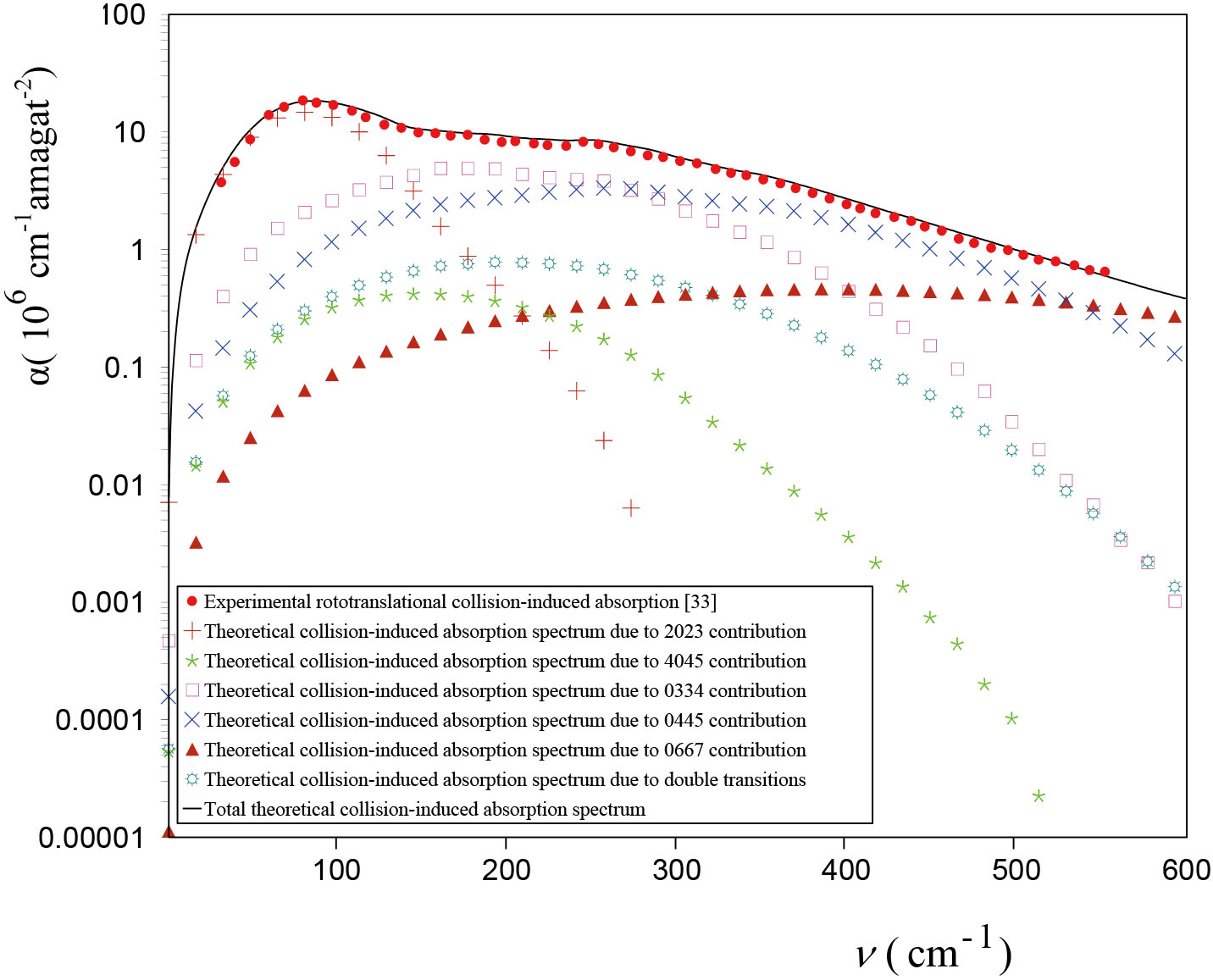
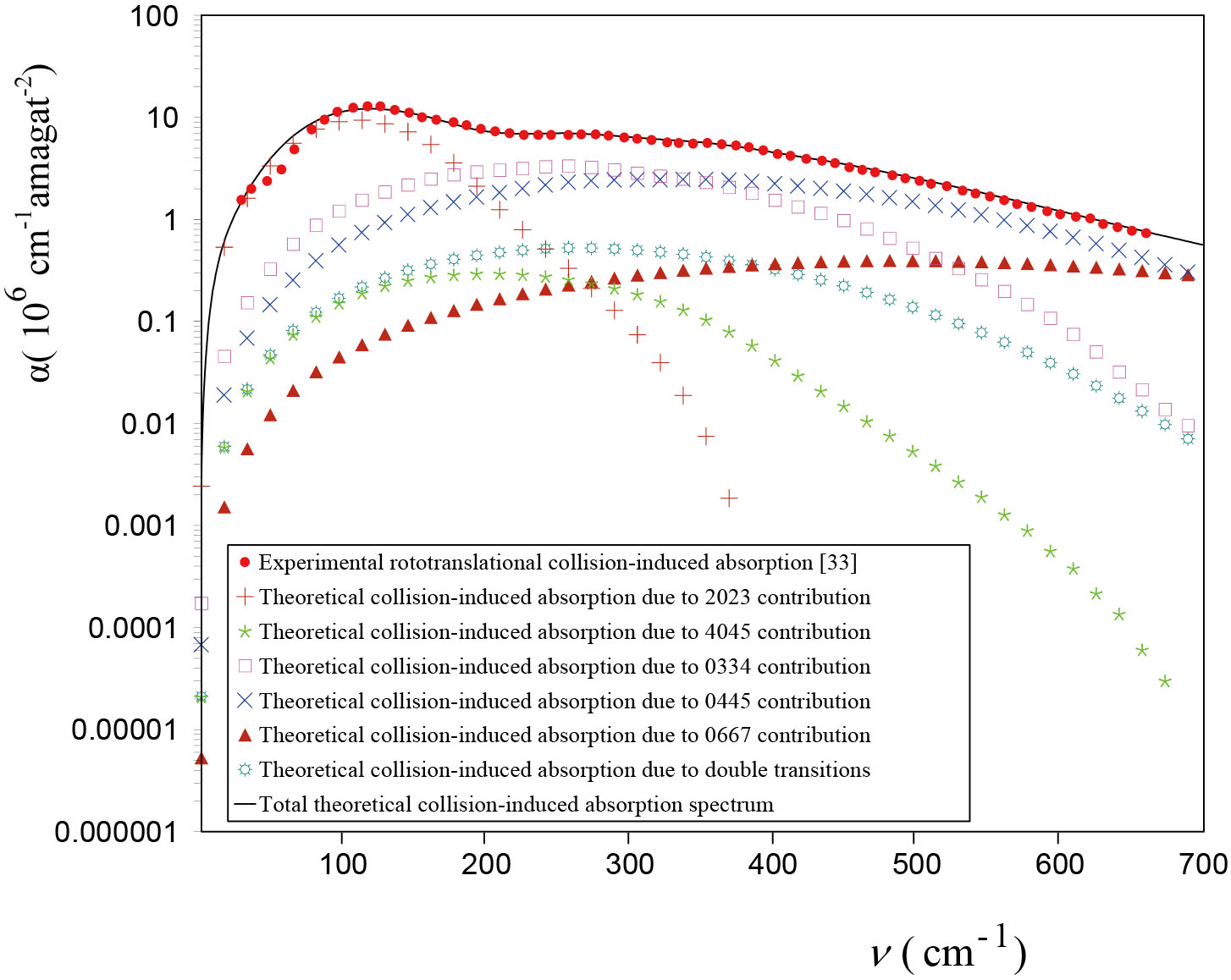
Comparison between the calculated and experimental rototranslational collision-induced absorption spectrum of N-CH at 162 K using the present BFW potential with the parameters given in Table 1 and induced dipole moment Eqs (20–25).
Translational spectral moments of absorption (10 erg cm), (10 erg cm/s and (10 erg cm/ s) from different contributions of N-CH at different temperatures using differtent intermolecular potentials
162 K
195 K
297 K
2023
(2.98)
(1.479)
(0.652)
(2.778)
(1.389)
(0.7323)
(2.540)
(1.299)
(1.031)
(2.973)
(1.490)
(0.657)
(2.777)
(1.40)
(0.7382)
(2.547)
(1.311)
(1.041)
(3.024)
(1.511)
(0.666)
(2.822)
(1.420)
(0.748)
(2.586)
(1.333)
(1.058)
(3.01)
(1.479)
(0.651)
(2.796)
(1.383)
(0.728)
(2.59)
(1.31)
(1.038)
4045
(0.0547)
(0.0724)
(0.0329)
(0.0520)
(0.0698)
(0.0377)
(0.05021)
(0.0698)
(0.0564)
(0.0555)
(0.0740)
(0.0336)
(0.0528)
(0.0712)
(0.0385)
(0.05098)
(0.0713)
(0.0576)
(0.0562)
(0.0749)
(0.034)
(0.0535)
(0.0723)
(0.0391)
(0.0520)
(0.0729)
(0.0589)
(0.0546)
(0.0724)
(0.0328)
(0.0518)
(0.0695)
(0.0375)
(0.0508)
(0.0709)
(0.0572)
0334
(0.507)
(0.485)
(0.219)
(0.479)
(0.465)
(0.250)
(0.455)
(0.459)
(0.369)
(0.511)
(0.492)
(0.222)
(0.482)
(0.471)
(0.253)
(0.458)
(0.465)
(0.374)
(0.518)
(0.499)
(0.225)
(0.490)
(0.479)
(0.257)
(0.467)
(0.475)
(0.382)
(0.507)
(0.485)
(0.2182)
(0.4772)
(0.463)
(0.248)
(0.4595)
(0.463)
(0.372)
0445
(0.272)
(0.528)
(0.246)
(0.265)
(0.522)
(0.288)
(0.274)
(0.555)
(0.455)
(0.274)
(0.533)
(0.249)
(0.267)
(0.526)
(0.291)
(0.275)
(0.559)
(0.458)
(0.277)
(0.541)
(0.252)
(0.271)
(0.536)
(0.296)
(0.282)
(0.576)
(0.472)
(0.272)
(0.523)
(0.2428)
(0.264)
(0.515)
(0.284)
(0.278)
(0.559)
(0.457)
0667
(0.0294)
(0.0895)
(0.0427)
(0.0292)
(0.09)
(0.0506)
(0.0316)
(0.0995)
(0.0826)
(0.0295)
(0.0903)
(0.043)
(0.0293)
(0.0905)
(0.0509)
(0.0317)
(0.10)
(0.083)
(0.030)
(0.0918)
(0.0437)
(0.030)
(0.0926)
(0.0520)
(0.0327)
(0.0104)
(0.0859)
(0.0293)
(0.0886)
(0.0421)
(0.029)
(0.089)
(0.0498)
(0.0321)
(0.10)
(0.0832)
234
(0.079)
(0.068)
(0.0305)
(0.074)
(0.0648)
(0.0346)
(0.0693)
(0.0626)
(0.0501)
(0.079)
(0.069)
(0.0309)
(0.0745)
(0.0658)
(0.0351)
(0.070)
(0.0636)
(0.0509)
(0.0804)
(0.070)
(0.0313)
(0.0756)
(0.067)
(0.0356)
(0.0711)
(0.0648)
(0.0518)
(0.079)
(0.068)
(0.0303)
(0.074)
(0.064)
(0.0342)
(0.070)
(0.0631)
(0.0505)
Total
(3.922)
(2.722)
(1.223)
(3.677)
(2.601)
(1.393)
(3.420)
(2.545)
(2.044)
(3.922)
(2.748)
(1.236)
(3.683)
(2.625)
(1.407)
(3.433)
(2.569)
(2.065)
(3.986)
(2.788)
(1.252)
(3.742)
(2.667)
(1.428)
(3.491)
(2.626)
(2.109)
(3.952)
(2.718)
(1.217)
(3.692)
(2.584)
(1.382)
(3.480)
(2.566)
(2.058)
(4.08)
(2.81)
(1.26)
(3.87)
(2.71)
(1.45)
(3.53)
(2.61)
(2.07)
Theoretical values of spectral moments of absorption using Eqs (20–25) and BFW pot. Theoretical values of spectral moments of absorption using Eqs (20–25) and HK pot [60]. Theoretical values of spectral moments of absorption using Eqs (20–25) and LJ(12-6) pot. [33] . Theoretical values of spectral moments of absorption [34]. Total values of spectral moments of absorption using induced dipole moment [78] and BFW pot.
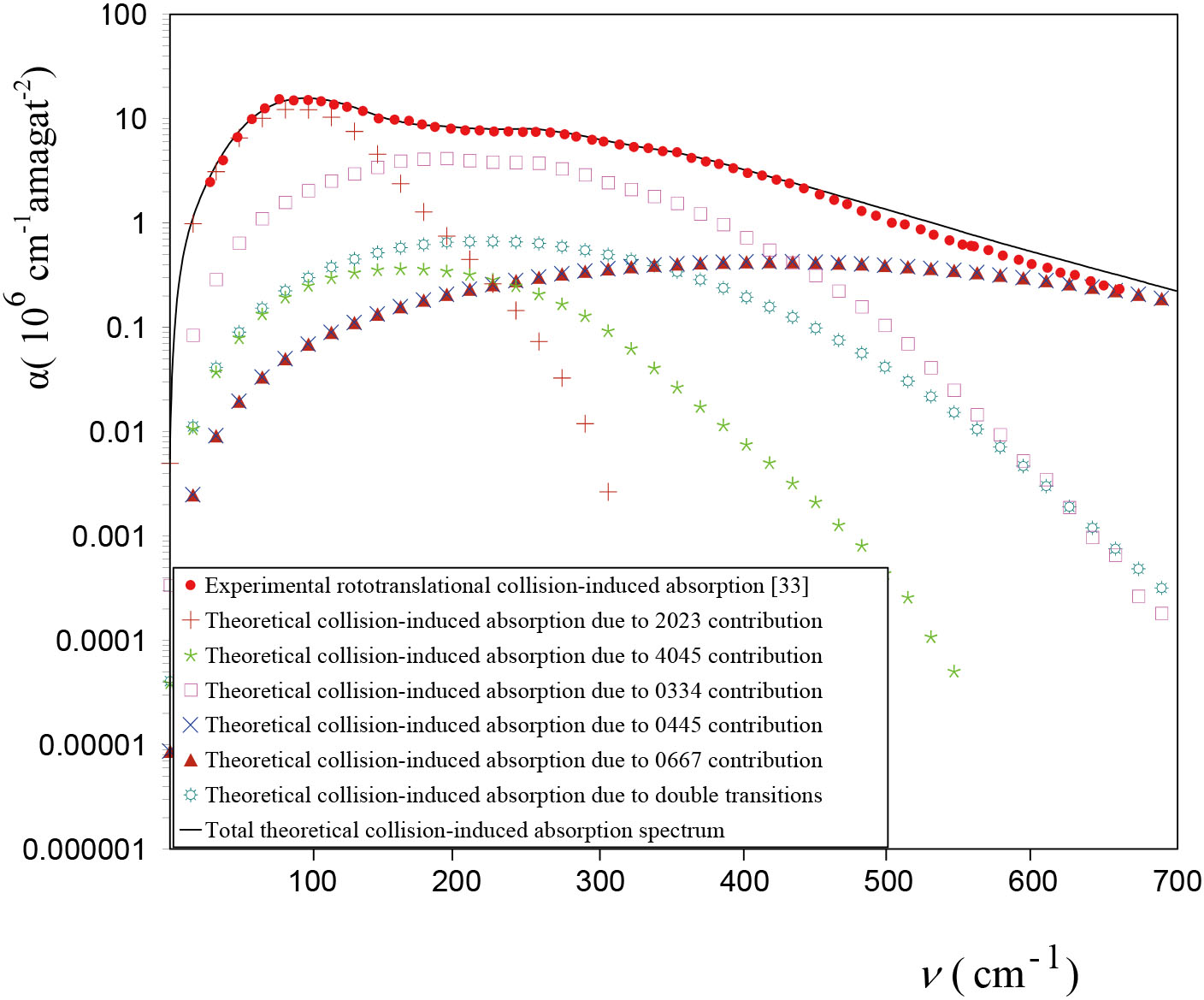
Comparison between the calculated and experimental rototranslational collision-induced absorption spectrum of N-CH at 195 K using the present BFW potential with the parameters given in Table 1 and induced dipole moment Eqs (20–25).
Comparison between the calculated and experimental rototranslational collision-induced absorption spectrum of N-CH at 297 K using the present BFW potential with the parameters given in Table 1 and induced dipole moment Eqs (20–25).
In the present work the anisotropy affects largely the far wing, but only by a few percent, therefore we are looking to calculated the spectrum of absorption at different temperatures using the isotropic potential.
for 0, 1, 2, . These moments can be compared to values calculated directly from the sum rules [75] for which the quantum corrections were made for the pair distribution functions , and [76].
As a first step, we used the induced dipole, Eqs (20–25) with the parameters given above and without the short-range overlap induced component. The lowest three spectral moments of the measurements do not agree with those of the computed lineshape. Therefore, we add a short-range overlap induced component for all contributions.
Since an accurate determination of these spectral integrals requires knowledge of the absorption coefficient at low and high frequencies, which are not available, it is best to approximate the spectral function by a three-parameters analytical model profile, the so-called Birnbaum and Cohen (BC) model [77]. This model was chosen to provide a remarkably close representation of virtually all lineshapes arising from exchange and dispersion force induction. These parameters have been determined by fitting the experimental spectrum, using a least mean squares procedure. The parameters of the fitted induced dipole moments are collected in Table 2 and the associated values of the three lowest spectral moments of the measurements at different temperatures for each contribution are readily obtained. They are given in Table 3, and the absorption spectra using the present potential are shown in Figs 3–5.
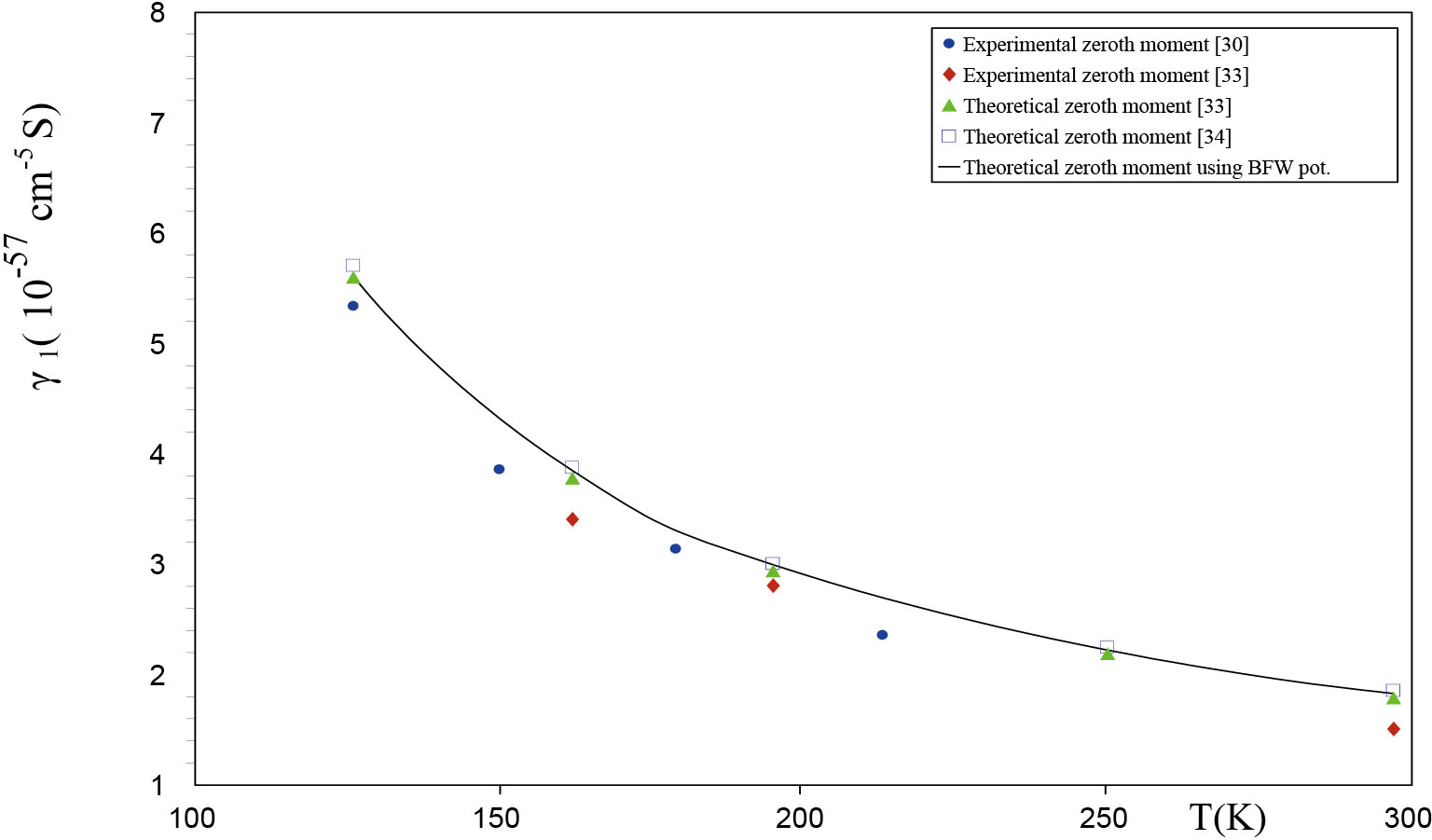
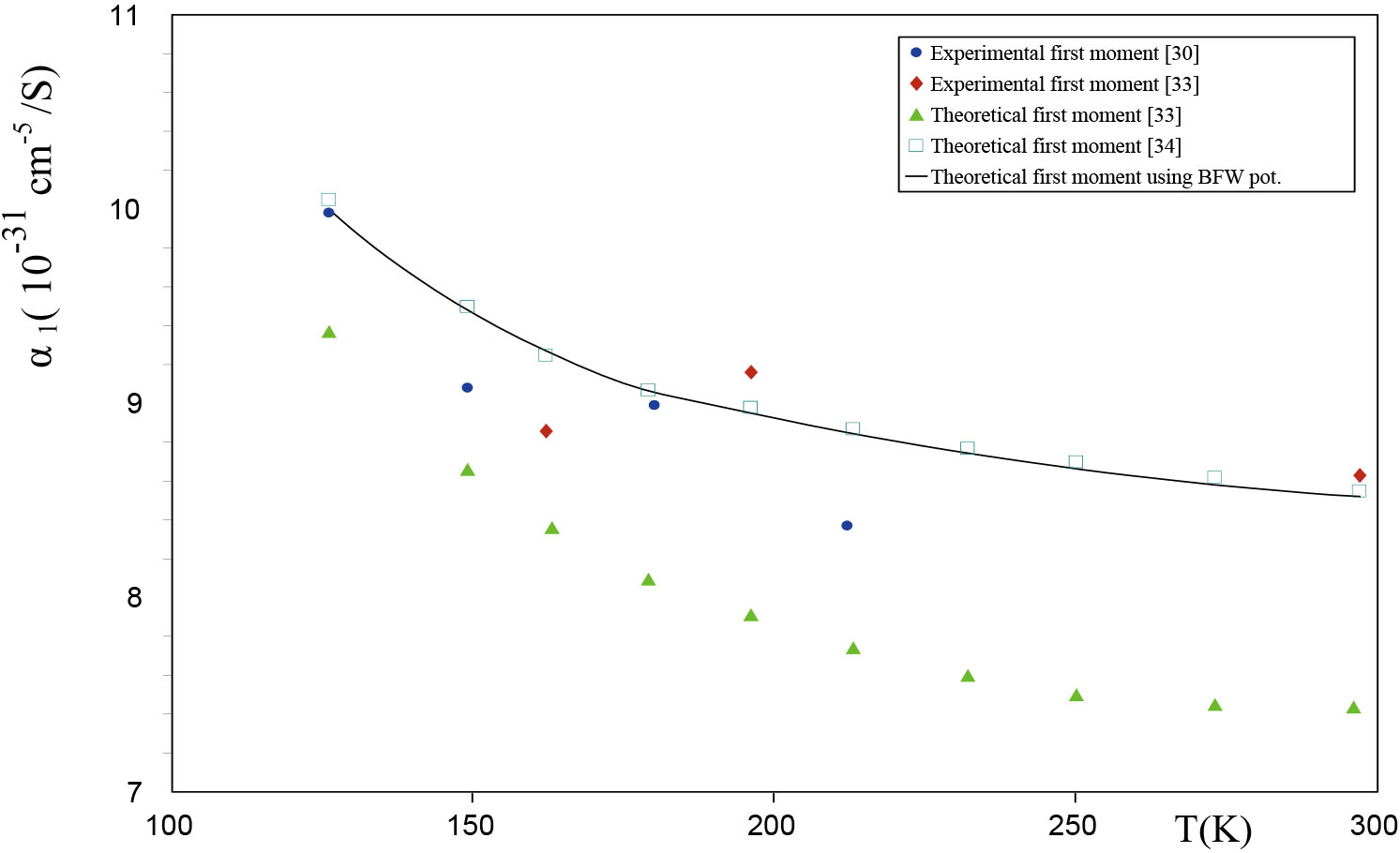
Also, to investigate the induced dipole model, it is convenient to analyze the spectral invariants and which are related, respectively, to the zeroth and first spectral moments by [33]
where and are the rotational constants of nitrogen and methane respectively.
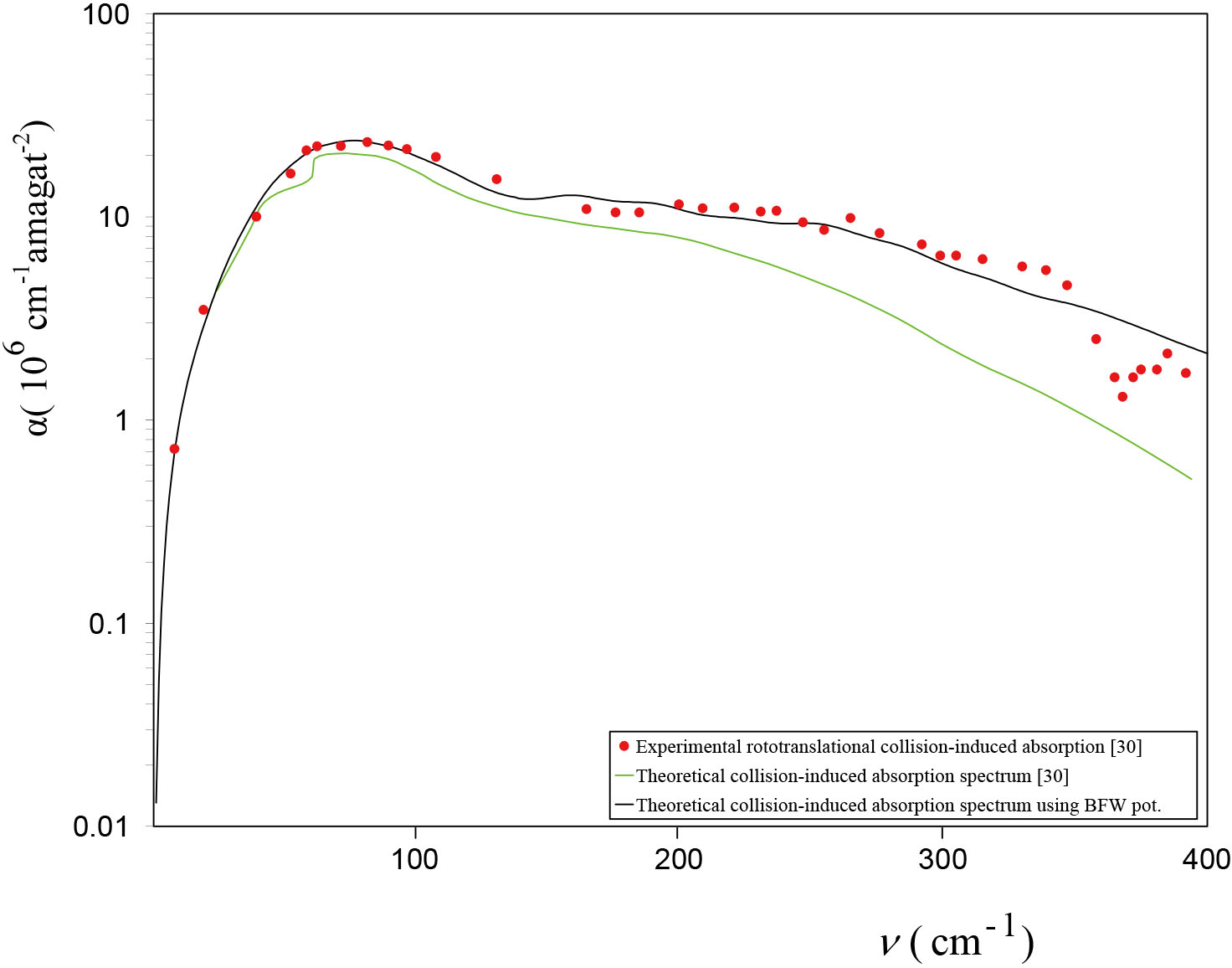
The values of and obtained from the fitted spectra at various temperatures are plotted, respectively, in Figs 6 and 7, which also show the theoretical values. We note that because the above model spectra are based on complete induced dipole model, this model may be reliable for extrapolation to temperatures where the absorption was not measured, although they are adequate for the required frequency extrapolations at the particular temperatures. The experimental and theoretical values of and are in reasonably good agreement. Also, good agreement is obvious between the present theoretical and experimental rototranslational collision-induced absorption spectra at 126 K using the present BFW potential as shown in Fig. 8.
The result of our analysis is therefore that N-CH system develops an incremental dipole moment for the absorption besides the quadrupole-induced dipole, hexadecapole-induced dipole for the induction by N and octopole-induced dipole, hexadecapole-induced dipole and 6 pole-induced dipole for the induction by CH, which contributes substantially at intermediate-range distances and can be ascribed to other mechanisms of electron cloud distortion, such as overlap and electron-correlation effects.
Comparison between the calculated and experimental invariant (10 cmS) of N-CH at different temperatures using the present BFW intermolecular potential.
Comparison between the calculated and experimental invariant (10 cm/S) of N-CH at different temperatures using the present BFW intermolecular potential.
Comparison between the different theoretical and experimental rototranslational collision-induced absorption spectra of N-CH at 126 K using the present BFW potential.
Conclusion
We have adopted a model for the dipole moment with adjustable parameters for each contribution which we determined by fitting to the spectral profiles at different temperatures for absorption using quantum mechanics and Birnbaum-Cohen model.
The results clearly show that in all the spectra, the dispersion term for absorption are not able to reproduce well their mid and high-frequency interaction-induced rototranslational wings. To improve agreement between our theoretical spectra and the experimental ones we considered the multipolar absorption mechanisms specified by Eqs (20–25). Figures 3–6 show the comparison of the experimental absorption and the theoretical one. In the course of our calculations we found that the different frequency parts of the absorption spectra are mainly due to the components , , , , and of the induced moments for absorption mechanisms. These involve the permanent quadrupole moment (), octopole moment (), hexadecapole moment (), 6 pole moment (), dipole-quadrupole polarizability (A) and the isotropic part of the linear polarizability.
This study further demonstrates that the present empirical BFW potential model, with the parameters fitted to the different thermophysical and transport properties as well as absorption intensities at different temperatures is a very reliable representation of the intermolecular potential of the N-CH interaction. Also, it is interesting to note that these empirical models derived for the dipole moment for this system produce lineshape that are in good agreement with experiment at various temperatures.
Footnotes
Acknowledgments
We are much indebted to Drs. J. Borysow, L.Frommhold and G.Birnbaum for making available their published Fortran code with the different results of the collision induced absorption (CIA) for different systems.
References
1.
TabiszG.C. and NeumanM.N., eds, Collision- and Interaction-Induced Spectroscopy. Dordrecht; Kluwer, and references therein, 1995.
2.
MaroulisG. and HaskopoulosA., Interaction induced dipole moment and polarizability in CO…2,Rg Rg = He, Ne, Ar, Kr and Xe, Chem Phys Lett349 (2001), 335.
3.
MaroulisG.HaskopoulosA. and XenidesD., New basis sets for xenon and the interaction polarizability of two xenon atoms, Chem Phys Lett396 (2004), 59.
4.
HaskopoulosA. and MaroulisG., Interaction electric hyperpolarizability effects in the weakly bound H2O…Rg (Rg = He, Ne, Ar, Kr and Xe) complexes, J Phys Chem A114 (2010), 8730.
5.
KaluginaY.N.CherepanovV.N.BuldakovM.A.Zvereva-LoëteN. and BoudonV., Theoretical investigation of the potential energy surface of the van der Waals complex CH4–N2, J Chem Phys131 (2009), 134304.
6.
HaskopoulosA. and MaroulisG., Carbon dioxide interacting with rare gases: Insights from high-level ab initio calculations of polarizability and hyperpolarizability effects, Chem Phys475 (2016), 90.
7.
LiX.MandalA.MiliordosE. and HuntK.L.C., Interaction-induced dipoles of hydrogen molecules colliding with helium atoms: A new ab initio dipole surface for high-temperature applications, J Chem Phys136 (2012), 044320.
8.
KaluginaY.N.BuldakovM.A. and CherepanovV.N., Static Hyperpolarizability of the Van Der Waals Complex CH4-N2, J Comp Chem33 (2012), 2544.
9.
HaskopoulosA. and MaroulisG., Interaction induced electric dipole moment and (hyper)polarizability in the dihydrogen-helium pair, Chem Phys367 (2010), 127.
10.
El-KaderM.S.A.El-SheikhS.M.BancewiczT. and HellmannR., Contributions of multipolar polarizabilities to the isotropic and anisotropic light scattering induced by molecular interactions in gaseous methane, J Chem Phys131 (2009), 044314.
11.
GustaffsonM.FrommholdL.LiX. and HuntK.L.C., Roto-translational Raman spectra of pairs of hydrogen molecules from first principles, J Chem Phys130 (2009), 164314.
12.
LiX.HarrisonJ.F.GustafssonM.FrommholdL. and HuntK.L.C., The anisotropic polarizability of pairs of hydrogen molecules and the depolarized collision induced rototranslational Raman light scattering spectra, J Comput Methods Sci Eng10 (2019), 367.
13.
AbelM.FrommholdL.LiX. and HuntK.L.C., Note: Computation of collision-induced Absorption by dense deuterium-helium gas mixtures, J Chem Phys134 (2011), 076101.
14.
AbelM.FrommholdL.LiX. and HuntK.L.C., Collision-Induced Absorption by H2 Pairs: From Hundreds to Thousands of Kelvin, J Phys Chem A115 (2011), 6805.
15.
GłazW.BancewiczT.GodetJ-.L.MaroulisG. and HaskopoulosA., Morphology of collisional Nonlinear spectra in H2-Kr and H2-Xe mixtures, J. Chem. Phys.138 (2013), 124307.
16.
KarmanT.MiliordosE.HuntK.L.C.CroenenboomG.C. and van der AvoirdA., Quantum mechanical calculation of the collision-induced absorption spectra of N2–N2 with anisotropic interactions, J Chem Phys142 (2015), 0843016.
17.
KorchaginaK.A.SpiegelmanF. and CunyJ., Molecular dynamics study of the collision-induced reaction of H with CO on SMALL WATER CLUSTers, J Phys Chem A121 (2017), 9485.
18.
El-KaderM.S.A.MaroulisG. and BichE., Rototranslational collision-induced absorption and collision-induced light scattering spectra of molecular hydrogen using isotropic intermolecular potentials, Chem Phys403 (2012), 37.
19.
El-KaderM.S.A. and MaroulisG., Spectral lineshapes of collision-induced absorption (CIA) using isotropic intermolecular potential for mixtures of molecular hydrogen with helium, Chem Phys Lett684 (2017), 141.
20.
El-KaderM.S.A.GodetJ-.L.El-SadekA.A. and MaroulisG., Spectral lineshapes of collision-induced Light scatterin (CILS) and collision-induced absorption (CIA) using isotropic intermolecular potential for H2-Ar, Mol Phys115 (2017), 2614.
21.
BuontempoU.CunsoloS.JacucciG.WeissJ.J., The far infrared absorption spectrum of N2 in the gas and liquid phases, J Chem Phys63 (1975), 2570.
22.
DaggI.R.AndersonA.YanS.SmithW. and ReadL.A., Collision-induced absorption in nitrogen at low temperatures, Can J Phys63 (1985), 625.
23.
DoreP. and FilabozziA., On the nitrogen-induced far-infrared absorption spectra, Can J Phys65 (1987), 9093.
24.
StoneN.W.B.ReadL.A.A.AndersonA.DaggI.R. and SmithW., Temperature dependent collision-induced absorption in nitrogen, Can J Phys62 (1984), 338.
25.
BirnbaumG., Far infrared collision-induced spectrum in gaseous methane, Band shape and temperature dependence, J Chem Phys62 (1975), 59.
26.
CodastefanoP.DoreP. and NenciniL., Temperature dependence of the far-infrared absorption spectrum of gaseous methane, J Quant Spectrosc Rad Transf35 (1986), 255.
27.
DaggI.R.AndersonA.YanS.SmithW.JoslinC.G. and AReadL.A., Collision-induced absorption in gaseous methane at low temperatures, Can J Phys64 (1986), 763.
28.
HuntJ.L.PollJ.D.GoorvitchD. and TippingR., Collision-induced absorption in the far infrared spectrum of Titan, Icarus55 (1983), 63.
29.
CourtinR., The spectrum of titan in the far-infrared and microwave regions, Icarus51 (1982), 466.
30.
DaggI.R.AndersonA.YanS.SmithW.JoslinC.G. and ReadL.A.A., Collision-induced absorption in gaseous mixtures of nitrogen and methane, Can J Phys64 (1986), 1467.
31.
CourtinR., Pressure-induced absorption coefficients for radiative transfer calculations in Titan’s atmosphere, Icarus75 (1988), 245.
32.
McKayC.P.PollackJ.B. and CourtinR., The thermal structure of Titan’s atmosphere, Icarus80 (1989), 23.
33.
BirnbaumG.BorysowA. and BuecheleA., Collision-induced absorption in mixtures of symmetrical linear and tetrahedral molecules: Methane-nitrogen, J Chem Phys99 (1993), 3234.
34.
BorysowJ. and TangC., Far Infrared CIA Spectra of N2-CH4 Pairs for Modeling of Titan’s Atmosphere, Icarus105 (1993), 175.
35.
FutrelleR.P., Collision-Induced Absorption as a Probe of Rare-Gas Interatomic Potentials, Phys Rev Lett9 (1967), 479.
36.
MaitlandG.C.RigbyM.SmithE.B. and WakehamW.A., Intermolecular Forces – Their Origin and Determination Oxford; Clarendon, 1981.
37.
MaitlandG.C. and WakehamW.A., Mol Phys35 (1978), 1443.
38.
DymondJ.H.MarshK.N. and WilhoitR.C., Virial coefficients of pure gases and mixtures, edited by FenkelM. and MarshK.N., Landolt-Bornstein – Group IV Physical Chemistry, 21. Heidelberg; Springer-Verlag 2003.
39.
LopatinskiiE.S.RozhnovM.S.ZhdanovV.I.ParnovskiiS.L. and KudryaY.N., Second virial coefficients of gas mixtures of hydrocarbons, carbon dioxide, and hydrogen with nitrogen and argon, Zh Fiz Khim65 (1991), 2060.
40.
DidovicherE.M.ZhdanovV.I.ParnovskiiS.L. and RozhnovM.S., Virial-coefficients of gas-mixtures in nitrogen-C1-C3 alkanes systems, Zh Fiz Khim63 (1989), 1767.
41.
JaeschkeM.AudibertS.van CaneghamP.HumphreysA.E.van RosemalenR.J.PelleiQ.MichelsJ.P.J. and SchoutenJ.A., Ten Seldam. High Accuracy Compressibility Factor Calculation of Natural Gases and Similar Mixtures by Use of a Truncated Virial Equation, CA. Gerg. Tech. Monogr., TM2, (1988), 1963.
42.
MartinM.L.TrengoveR.D.HarrisK.R. and DunlopP.J., Excess second virial coefficients for some Dilute binary gas mixtures, Aust J Chem35 (1982), 1525.
43.
NgH., MSc Thesis, University of Alberta, Edmonton, Alberta, Canada, 1971.
44.
MasonD.M. and EakinB.E., Compressibility Factor of Fuel Gases at 60∘ F. and 1 Atm, J Chem Eng Data6 (1961), 499.
45.
El HawaryT., Messung der Dichte und Viskosität in der Gasphase von Methan, Stickstoff und Methan-Stickstoff-Gemischen mit einer weiterentwickelten kombinierten Viskositäts-Dichte-Messanlage und Einer neuen Viskositätsmessanlage für geringe Gasdichten. Ph.D. thesis, Ruhr-Universität Bochum, Bochum, Germany, 2009.
46.
KestinJ. and RoS.T., The viscosity of nine binary and two ternary mixtures of gases at low denity, Berrichte der Bunsen-Gesellschaft78 (1974), 20.
47.
BzowskiJ.KestinJ.MasonE.A. and UribeF.J., Equilibrium and transport properties of gas mixtures at low density: eleven polyatomic gases and five noble gases, J Phys Chem Ref Data19 (1990), 1179.
48.
MoghadasiJ.PapariM.M.YousefiF. and HaghighiB., Transport coefficients of natural gases, J Chem Eng Jpn40 (2007), 698.
49.
MaghariA. and JailiA.H., Calculation of Transport Coefficients for CH4–N2 and CH4–O2 by the Inversion Method, J Phys Soc Jpn73 (2004), 1191.
50.
FokinL.R. and KalashnikovA.N., Transport Properties of a Rarefied CH4–N2 Gas Mixture, J Eng Phys Thermophys89 (2016), 249.
51.
GnezdilovN.E. and GolubevI.F., Gazov Prom4 (1968), 46.
52.
PatekJ.KlomfarJ.CaplaL. and BuryanP., Thermal Conductivity of Nitrogen-Methane Mixtures at Temperatures Between 300 and 425 K and at Pressures Up to 16 MPa, Int J Thermophys24 (2003), 923.
53.
HumphreysA.E. and GrayP., Thermal diffusion as a probe of binary diffusion coefficients at elevated temperatures. II. Methane + nitrogen and methane + carbon dioxide, Proc R Soc Lond A322 (1971), 89.
54.
MuellerC.R. and CahillR.W., Mass spectrometric measurement of diffusion coefficients, J Chem Phys40 (1964), 651.
55.
BogatyrevA.F.MakeenkovaO.D. and NezovitinovaM.A., experimental study of thermal diffusion in multicomponent gaseous systems, Int J Thermophys36 (2015), 633.
56.
WakehamW.A. and SlaterD.H., Diffusion coefficients for n-alkanes in binary gaseous mixtures with nitrogen, J Phys B6 (1973), 886.
57.
BarkerJ.A.FisherR.A. and WattsR.O., Liquid argon: Monte carlo and molecular dynamics calculations, Mol Phys21 (1971), 657.
58.
MargoliashD.J. and MeathW.J., Pseudospectral dipole oscillator strength distributions and some related two body interaction coefficients for H, He, Li, N, O, H2, N2, O2, NO, N2O, H2O, NH3, and CH4, J Chem Phys68 (1978), 1426.
59.
ShadmanM.YeganegiS. and ZiaieF., Ab initio interaction potential of methane and nitrogen, Chem Phys Lett467 (2009), 237.
HellmannR.BichE.VogelE. and VesovicV., Intermolecular potential energy surface and thermophysical properties of the CH4–N2 system, J Chem Phys141 (2014), 224301.
62.
BichE.HellmannR. and VogelE., Erratum, Ab initio potential energy curve for the neon atom pair and thermophysical properties for the dilute neon gas. II. Thermophysical properties for low-density neon, Mol Phys106 (2008), 1107.
63.
MonchickL.YunK.S. and MasonE.A., Formal kinetic theory of transport phenomena in polyatomic gas mixtures, J Chem Phys39 (1963), 654.
64.
BoysS.F. and BernardiF., The calculation of small molecular interactions by the differences of separate total energies. Some procedures with reduced errors, Mol Phys19 (1970), 553 procedures.
65.
HirschfelderJ.O.CurtissC.F. and BirdR.B., Molecular Theory of Gases and Liquids; New York; Wiley, 1954.
66.
SpurlingT.H. and MasonE.A., Determination of molecular quadrupole moments from viscosities and second virial coefficients, J Chem Phys46 (1967), 322.
67.
BirnbaumG.GuillotB. and BratosS., Theory of collision-induced line shapes-absorption and light scattering at low density, Adv Chem Phys51 (1982), 49.
68.
MillerM.S.McQuarrieD.A.BirnbaumG. and PollJ.D., Constant acceleration approximation in collision-induced absorption, J Chem Phys57 (1972), 618.
69.
BorysowA. and FrommholdL., Theoretical collision-induced rototranslational absorption spectra for the outer planets – H2-CH4 pairs, Astrophys J304 (1986), 849.
70.
KaluginaY.N. and CherepanovV.N., Multipole electric moments and higher polarizabilities of molecules: Methodology and some results of ab initio calculations, Atmospheric and Oceanic Optics28 (2015), 406.
71.
SchmidtJ.W. and MoldoverM.P., Dielectric permittivity of eight gases measured with cross capacitors, Int J Thermophys24 (2003), 375.
72.
HuiszoonC., Ab initio calculations of multipole moments, polarizabilities and isotropic long range interaction coefficients for dimethylether, methanol, methane, and water, Mol Phys58 (1986), 865.
73.
PennerA.R.MeinaderN. and TabiszG.C., The spectral intensity of the collision-induced rotational Raman scattering by gaseous CH4 and CH4-inert gas mixtures, Mol Phys54 (1985), 479.
74.
MeyerW.FrommholdL. and BirnbaumG., Rototranslational absorption spectra of H2-H2 pairs in the far infrared, Phys Rev A39 (1989), 2434.
75.
MoraldiM.BorysowA. and FrommholdL., Quantum sum formulae for the collision-induced spectroscopies: molecular systems as H2-H2, Chem Phys86 (1984), 339.
76.
NienhuisG., On the theory of quantum corrections to the equations of state and to the particle distribution functions, J Math Phys11 (1970), 239.
77.
BirnbaumG. and CohenE.R., Theory of line shape in pressure-induced absorption, Can J Phys54 (1976), 593.
78.
Zvereva-LoëteN.KaluginaY.N.BoudonV.BuldakovM.A. and CherepanovV.M., Dipole moment surface of the van der Waals complex CH4–N2, J Chem Phys133 (2010), 184302.