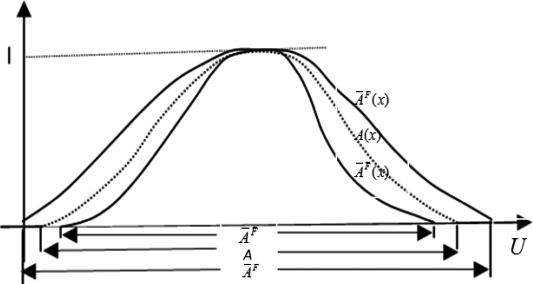
Based on inverse packet sets and fuzzy set, the concept of inverse packet fuzzy sets is proposed in this paper by means of introducing dynamic characteristics into a fuzzy set and improving the fuzzy set . The inverse packet fuzzy sets is composed of a pair of fuzzy sets generated by the fuzzy set and has dynamic characteristic and fuzzy characteristic. Furthermore, on certain conditions, it can be restored to the fuzzy set or the inverse packet sets generated by the Cantor set . As a result, an inverse packet fuzzy sets can be expressed as a series of inverse packet sets by defining its scalar multiplication and its cut sets. Meanwhile some attribute-dependent characteristics of inverse packet fuzzy sets are obtained. The new set model will both enrich the set theory and provide a new basic tool for further practical applications.
Fuzzy sets [1] were proposed by ZADEN L.A in 1965 and are an extension of Cantor sets. It has fuzzy properties represented by membership functions. Since then, the theory of fuzzy sets has been deeply and extensively studied, such as random fuzzy sets, fuzzy logic, fuzzy numbers, fuzzy reasoning and so on [1, 2, 3, 4]. With the improvement of the theory, its applications in various fields are also more and more extensive, for example, fuzzy control is a common one. On the other hand, the inverse packet sets [5, 6, 7] was proposed by Kaiquan SHI in 2012, and it was obtained by introducing dynamic properties into the Cantor set and improving it. Its dynamic properties is expressed by a pair of Cantor sets composed of an internal inverse packet set and the outer inverse packet set generated by the Cantor set . After that, the inverse packet sets has been continuously supplemented in theory and applied to solve practical problems, such as intelligent fusion mining-information discovery, iterative intelligent camouflage and reduction of information, multi-attribute venture capital decision-making, and intelligent retrieval of big data [8, 9, 10, 11, 12, 13, 14, 15, 16, 17, 18, 19, 20, 21, 22, 23, 24].
With the further development of science and technology, the uncertainty and dynamic characteristics of search objects are becoming more and more prominent. For example, patients in the suspected COVID-19 patient collection in Shandong Province have both ambiguity and dynamic changes. Therefore, we consider how to introduce dynamic properties into a fuzzy set, or replace the basic set of an inverse packet sets with a fuzzy set . Based on this idea, we propose the concept of inverse packet fuzzy sets, which not only has fuzzy properties but also dynamic properties. And it can be shown that it is an extension of the fuzzy set , or an extension of an inverse packet sets generated by the Cantor set . Using the properties of fuzzy sets and inverse packet sets, the relation theorems, generation theorems and attribute-dependent theorems of inverse packet fuzzy sets can be obtained.
Preliminaries
Fuzzy set
Let be a finite nonempty universe, call the map
a fuzzy set [1], written briefly as a FS, in which is called the membership function of .
Obviously, if or for every element , the fuzzy set is a Cantor set. So a FS is an extended form of the Cantor set.
Supposed that is a fuzzy set, is a real number and , then are respectively called cut set, strong cut set, the core and scalar multiplication of, and
Let be a nonempty Cantor set, is its attribute set, and , then are respectively called an internal inverse packet set (an internal IPS), an outer inverse packet set (an outer IPS), and an inverse packet sets (an IPS) generated by , and
if the attribute sets of respectively meet
in which is a finite element universe and is a finite attribute universe, , are migration functions, , are migration function families, and .
By the above definitions, it is obvious that if , then
Further analyzing the concept of IPS, we can know if some additional attributes are continually transferred into the attribute setof , meanwhile some attributes in are continually removed out of , can generate a family of IPS in which , are index sets, which shows the dynamic change process of the finite Cantor set and characteristics depending on its attributes perfectly.
Making use of the above statement, we propose the concept of inverse packet fuzzy sets by introducing the dynamic characteristics of IPS into a fuzzy set to expand set theory in Section 3.
More detail contents of theory and applications about FS and IPS can be found in literature [1, 2, 3, 4, 5, 6, 7, 8, 9, 10, 11, 12, 13, 14, 15].
Inverse packet fuzzy sets
In the paper, we only consider the case of nonempty finite universes and nonempty finite attribute sets for convenience.
Definition 1: Let be a fuzzy set on the finite universe , be the attribute set of and , call an internal inverse packet fuzzy set generated by , written shortly as an internal IPFS, and call the membership function of , and
if the attribute set of satisfies Eq. (1), in which , are the membership functions of and differently.
Definition 2: Let be a fuzzy set on the finite universe , call an outer inverse packet fuzzy set generated by , written briefly as an outer IPFS, and call the membership function of , and
if the attribute set of satisfies Eq. (2), in which , are the membership functions of , respectively.
Definition 3: The couple of fuzzy sets composed of and is called an inverse packet fuzzy sets generated by , written briefly as an IPFS, and
The set is called IPFS family generated by the fuzzy set , and
Combining the theories of FS and IPS with definitions 1–3, the following propositions 1–3 are easily obtained.
Proposition 1: If , and are the membership functions of respectively, then
Proposition 3: If for , then is reverted to the fuzzy set . Especially if or for , then is reverted to the Cantor set .
Proposition 4: If are Cantor sets, then is an IPS. It is also said that IPS is a special case of IPFS, on the other hand, IPFS is the extension of IPS.
Supposed that is an internal IPFS generated by , and is an internal IPFS generated by , then an internal IPFS chain can be gotten as follows
Similarly supposed that is an outer IPFS generated by , and is an outer IPFS generated by , then an internal IPFS of chain can be done as follows
Supposed that , and Eqs (9) and (10) are true, then
Note that , , are also internal IPFS, outer IPFS, IPFS generated by in order in Eqs (9)–(11). Thus can generate some IPFS nested sets which forms , and
where is an index set.
It is obvious that nested sets Eqs (9)–(12) show the dynamic change process of .
Theorem 1: (The first relation theorem of IPFS and FS) If , then IPFS is restored to , and
Proof: Since , then . According to definiton 1, , it is also said that the internal IPFS is restored to . In the same way, we can prove if , then the internal IPFS is restore to . Thus the Eq. (13) is satisfied. is reverted to the fuzzy set .
Theorem 2: (The second relation theorem of IPFS and FS) If , then IPFS family is restored to , and
Theorem 3: (The relation theorem of FS and Cantor set) Supposed that is the attribute set of and , then
where is a fuzzy set and is a Cantor set.
The proof of theorem 2 is similar to theorem 1, and the proof of theorem 3 is easy to obtain by the concepts of fuzzy set and Cantor set [1], so omitted.
Theorem 3 shows the relationship between a fuzzy set and its corresponding Cantor set which has the same attribute set.
Theorem 4: (The generation theorem of IPFS) Supposed that is the attribute set of , then is generated by , if there exist attribute set pair that satisfies
where .
Proof: I. Since , then , and , i.e. . Thus there exist the pair of fuzzy sets which satisfy according to Eqs (1)–(5), the theorem 4 is proved.
Corollary 1 follows easily from theorem 3 and theorem 4.
Corollary 1: If is the attribute sets of the IPFS and the IPS , then satisfy
Scalar multiplication and -cut sets of IPFS
By the concepts of -cut set and -strong cut set of fuzzy set , we present the following concepts about IPFS.
Definition 4: Let be a real number and be an IPFS generated by , then is called the scalar multiplication of and , and
where .
Definition 5: Let be a real number and be an internal IPFS generated by , then are respectively called cut set and strong cut set of , and
let be an outer IPFS generated by , are respectively called cut set and strong cut set of , and
let be an IPFS generated by , then are respectivelcalled cut set and strong cut set of , where is a real number, and .
Definition 4 indicates that Eqs (19)–(22) are Cantor sets, furthermore, cut set or strong cut set of an internal IPFS can be thought as internal IPSs of , cut set and strong cut set of an outer IPFS are outer IPSs of for any real number . Thus are IPSs generated by . And they satisfy
II. For , if then . So , namely . In the same way, we have , thus , so
Decomposition theorems of IPFS propose a theoretical foundation and a practical method that expresses an IPFS with the corresponding IPS.
The attribute-dependent characteristics of IPFS
In the part, we discuss deeply the above knowledge and obtain the attribute-dependent relationship of IPFS.
Theorem 9: (The attribute-dependent theorem of internal IPFSs) Let be the attribute sets of internal IPFS generated by fuzzy set in order, if , then
Proof: Since , we suppose that , namely, , then the attribute set of satisfy the condition of definition 1, so can be regarded as an internal IPFS generated by , so for , thus
II and III can be easily obtained by definition 4, definition 5 and I.
Theorem 10: (The attribute-dependent theorem of outer IPFSs) Assume that are the attribute sets of outer IPFS generated by fuzzy in order, if , then
Theorem 11: (The attribute-dependent theorem of IPFSs) Assume that are the attribute sets of in order, if , then
The proofs of theorem 10 and theorem 11 are similar to theorem 9, so omitted.
Theorem 12: (The identification relation of internal IPFSs) Assumed that the attribute sets of internal IPFS are respectively, if , then
where IDE identification.
Proof: Assumed that , then have the same attribute set, according to the relationship between set and its attribute set, we can obtain that can not be identified, namely that contradicts . Thus theorem 12 is proved.
Theorem 13: (The identification relation between outer IPFSs) Assumed that the attribute sets of outer IPFS are respectively, if , then
Theorem 14: (The identification relation of IPFSs) Assumed that the attribute sets of IPFS are respectively, if , then
The proofs of theorem 13 and theorem 14 are similar to theorem 12, so omitted.
Discussion
Using Introducing dynamic characteristics into a fuzzy set and improving it, the model of inverse packet fuzzy sets is proposed. It has vague characteristic and dynamic characteristic. Due to all of its cut sets and strong cut sets can be regarded as inverse packet sets generated by . And any inverse packet fuzzy sets can be expressed as the union of all its cut sets or strong cut sets for . So, we can turn fuzzy problems into deterministic ones. It is also said that we can use inverse packet sets theory to discuss inverse packet fuzzy sets. On the other hand, inverse packet fuzzy sets has the attribute-dependent characteristics. Therefore, its attribute sets can be used to study the dynamic properties of inverse packet fuzzy sets. The presented set model will enrich set theory and, to a certain extent, facilitate practical applications.
Footnotes
Acknowledgments
The paper is supported by the Ministry of Education Humanities and Social Sciences Research Youth Foundation (Grant No: 19YJC910011), the Project of Shandong Province Higher Educational Science and Technology Pro-gram (Grant No: J18KB099).
GuoHLChenBHTangJH. Inverse P-sets and intelligent fusion mining-discovery of information. J Shandong U: Sci Ed. 2013; 13(8): 97–103 (in Chinese).
9.
LiuJQPanZK. P-unknown data set and its filter-separation. J Shandong U: Sci Ed. 2021; 56(02): 1–6 (in Chinese).
10.
ShiKQ. P-information law intelligent fusion and soft information image intelligent generation. J Shandong U: Sci Ed. 2014; 49(4): 1–17 (in Chinese).
11.
LiXH. An algebraic model of P-set. J Shangqiu Normal U. 2020; 36(3): 1–5 (in Chinese).
12.
ShiKQ. P-sets, inverse P-sets and the intelligent fusion-filter identification of information. J Comput Sci. 2012; 39(4): 1–13 (in Chinese).
13.
LiuJQZhangHY. Information P-dependence and P-dependence mining-sieving. J Comput Sci. 2018; 45(7): 202–206 (in Chinese).
14.
HaoXMLiNN. Quantitative characteristics and applications of P-information hidden mining. J Shandong U: Sci Ed. 2019; 54(9): 9–14 (in Chinese).
15.
XuFSYuXQ. Surplus-loss value theorems of attribute cardinal numbers and internal-outer separation of information laws. J Shandong U: Sci Ed. 2017; 52(4): 87–92 (in Chinese).
16.
HaoXMRenTT. -ladder knowledge and -hiding knowledge discovery. Proceedings of the 2015 International Conference on Fuzzy Syst. and Knowledge Discovery; 2015.
17.
HuangWTWeiBY. Iterative intelligent camouflage and reduction of internal inverse P-information. J Huanghuai Inst Techno: Sci Ed. 2016; 25(3): 26–29 (in Chinese).
18.
ZhangLTangJHShiKQ. The fusion of internal P-information and its feature of attribute conjunction. J Shandong U: Sci Ed. 2014; 49(2): 93–97 (in Chinese).
19.
ChenBHZhangL. Attributes relations of data compound-decomposition and data intelligent acquisition. Fuzzy Systems and Mathematics. 2021; 35(3): 167–174 (in Chinese).
20.
ZhangLRenXF. The relationship between abnormal information system and inverse P-augmented matrices. J Shandong U: Sci Ed. 2019; 54(9): 15–21 (in Chinese).
21.
ShiKQTangJHZhangL. Intelligent fusion of inverse packet information and recessive transmission of informations intelligent hiding. J Syst. Eng. Electron. 2015; 37(3): 599–605 (in Chinese).
22.
XuFSYuXQShiKQ. Embedding-camouflage of inverse P-information and its separation -discovery by inverse P-reasoning. J Comput Sci. 2013; 40(8): 200–203 (in Chinese).
23.
HaoXMGuoHFJiangXQ. Multi-attributes risk investment decision making based on dynamic probability rough sets. Proceedings of the 2017 International Conference on Natural Computation, Fuzzy Systems and Knowledge Discovery, Guilin: IEEE; 2017.
24.
HaoXMShiKQ. Big data intelligent retrieval and bige data block element intelligence separation. J Comput Sci. 2020; 47(11): 113–120 (in Chinese).