






Abstract
The rapid development of information technology is changing people’s social life all the time. The big data that entered people’s vision in the new century, after just over ten years of development, has penetrated into everywhere of social life. People have unconsciously used big data analysis as the main research reference in the research of various activities. The development of this research is also based on this currently most popular model. Use big data integration to analyze the challenges and opportunities faced by colleges and universities in international trade teaching. In order to better understand the status quo, this study uses a combination of questionnaire surveys and interview methods to grasp the opinions of students of the major on teaching development using questionnaire survey methods, and use interview methods to understand the impressions and actual needs of some foreign trade enterprises on graduates. Then, based on the analysis of the current situation, the existing problems and the countermeasures to be solved are found. The study found that in the context of big data, international trade students pay more attention to the practical value of the knowledge they have learned and the improvement of their own employability, which is also the ability that foreign trade companies look to professional talents most. Therefore, our teaching in the new era should firmly focus on both to ensure the pertinence and effectiveness of innovative work. The development of this research will help to effectively promote the reform of the international trade curriculum system, and to study it in the context of the development of cross-border e-commerce will highlight the practical significance of the curriculum reform.
Introduction
After entering the new century, the development of China’s foreign trade has improved rapidly, and the demand for international trade professionals has surged [1, 2]. Colleges and universities all over the world have opened international trade majors to cater to market demand, and the employment rate of students has been stable at a considerable state [3, 4]. However, in recent years, due to the compound influence of the new crown epidemic and the “reverse globalization” trend of thought in some developed countries, the demand for talents of foreign trade companies has also risen from extensive to elite. In addition, due to the slow update of the curriculum system, ordinary graduates the employment problem has become very acute in a short period of time [5, 6].
In order to alleviate this contradiction and promote the further deepening of the teaching reform and innovation of the international trade major in colleges and universities, many scholars have carried out valuable research. Many scholars have conducted research from the perspective of the poor working ability of current international trade graduates [7, 8]. It is pointed out that this phenomenon has reached the point where reform is necessary, and the existing teaching model has fallen behind the needs of the times [9, 10]. Put forward to strengthen the exploration of innovative teaching mode work, and put forward valuable suggestions with the reform of teaching content field as the starting point. This part has strong theoretical significance, but it lacks a comprehensive link with classroom reality and student needs. Some scholars’ research starts from the microcosm, and uses specific teaching method experiments to explore ways to improve classroom teaching efficiency [11, 12]. For example, Gaofocuses on research-based teaching methods, and Wu Juan focuses on project-based teaching methods. These studies have strong practical reference value, but they have strong selectivity for students, and it is difficult to adapt to most schools [13, 14].
The development of this research is to make up for the shortcomings of the above two research methods. By combining the questionnaire survey method and the interview method, the actual needs of the students and the market’s competence standards for international trade graduates are mastered, thereby realizing the theory. The scientific combination of research and practical exploration, and then compare the performance of previous graduates in this area, and find out the countermeasures for development. In the countermeasures, it is clearly pointed out that there is a need to greatly improve the link between the international trade teaching system and the actual needs, and effectively improve the students’ practical work ability, in order to better promote the sustainable development of the major. The brief framework of this study is shown in Fig. 1.
Research framework.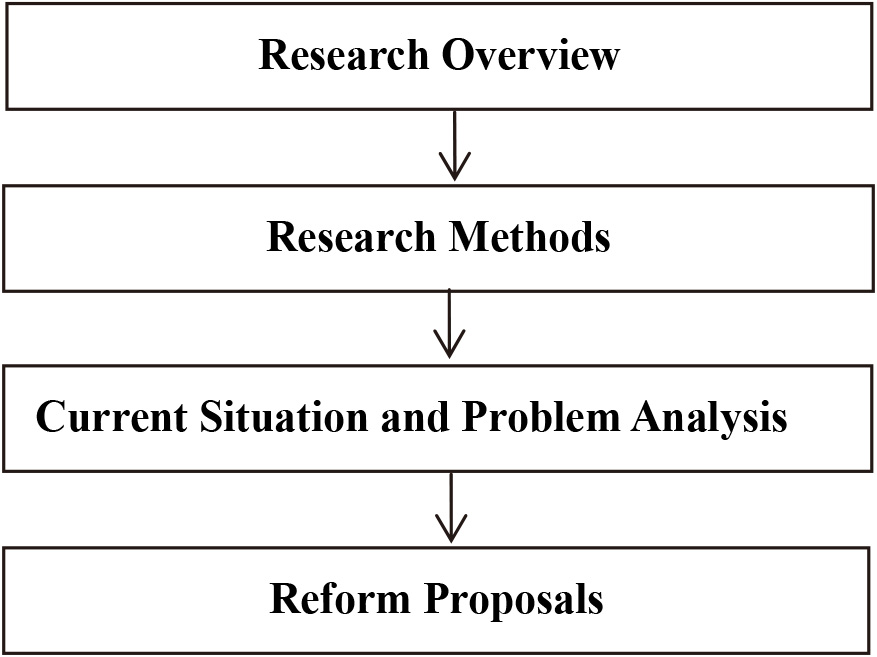
In terms of research methods, this study uses a combination of questionnaire surveys and interview methods. The questionnaire survey method grasps the opinions of the students of the major on the teaching development, and uses the interview method to understand the impressions and actual needs of some foreign trade enterprises on the graduates.
Questionnaire survey method
The study conducted a questionnaire survey among students from 10 colleges and universities offering international trade majors in two provinces including Fujian and Jiangsu. A total of 762 students participated in the survey. The test questions of the questionnaire are designed after reference and reference to the previous questionnaires in related fields, combined with the actual situation of the international trade major and the current social situation. The test questions of the initial questionnaire were verified by hiring some experts and scholars, and a small-scale distribution test was carried out. Some test questions that were not highly relevant to the research were removed, and the test questions that were not rigorous in language organization were rewritten, which finally took 1 time. The month was completed. There are 18 questions in the questionnaire. The aims of question 1and 2 is to understand the natural situation of students and the institutions they belong to. The next 16 questions are divided into 4 areas. Market awareness and suggestions for curriculum enhancement, etc. The specific distribution is shown in the Table 1.
Distribution of test questions in the research questionnaire (
18)
Distribution of test questions in the research questionnaire (
As can be seen from Table 1, in addition to the students’ natural situation, the questions of this questionnaire are mainly aimed at subjective aspects such as students’ attitudes towards courses, so as to better grasp the students’ true intentions.
As the recent new crown epidemic has affected the development of regular interviews, the interviews in this study mainly took the form of telephone interviews. Based on the flow of graduates majoring in international trade from these 10 universities, 30 business managers engaged in foreign trade were randomly selected for telephone interviews. A total of 28 people were interviewed. Among these interviewees, some were owners of enterprises, and some were managers of enterprise human resources. The content of the interview mainly focused on the grading of the business literacy of the graduates majoring in international trade, the main shortcomings of work ability, and suggestions for school training, etc.
Under the background of big data, the current situation and problems of the teaching of international trade in colleges and universities
In the era of big data, in order to meet the needs of the times, many colleges and universities have carried out teaching reform attempts, so that the teaching of this major has shown distinctive characteristics of the times.
The status quo of the teaching of international trade majors in colleges and universities under the background of big data
(1) Strengthen employment orientation and improve work ability
Before the outbreak of the new crown epidemic, China’s international trade has been showing a trend of high development, and the demand for professional talents has also continued to grow. But in sharp contrast, the employment rate of graduates majoring in international trade has been maintained at a relatively low level, at a level of around 90% throughout the year [15, 16]. This is relatively low in the horizontal comparison of the employment rates of various majors. In order to reverse this trend, colleges and universities put forward the “employment-oriented” training slogan, taking the real employment rate and employment quality of international trade graduates as important assessment criteria for discipline construction. Form a “chain management” of enrollment-training-employment. The curriculum system and talent training mechanism centered on employment have been initially formed.
Entering the new century, especially in the last ten years, China’s universities have undergone major changes in the direction of talent training. The training of students is no longer solely based on theoretical basic teaching, but gradually shifts to the direction of equal emphasis on theoretical knowledge and work ability. Emphasize that students can quickly start work in related enterprises or parts after graduation, and have formulated clear theoretical knowledge standards and business ability levels for graduates. The former includes related theories of international economics and trade, import and export trade regulations, and international business communication services. The latter includes analyzing cases based on international economic and trade theories, planning and implementing import and export trade plans, and the ability to communicate and coordinate in the trade process.
(2) Continuous improvement of comprehensive teaching strength
With the continuous improvement of the cognition of international trade teaching, the comprehensive teaching strength of this major is continuously improved at this stage. In terms of the construction of the curriculum system, the original comprehensively covered theoretical courses were changed to two levels: compulsory courses and elective courses [17, 18]. Compulsory courses are mainly based on the teaching of public foundation and professional theory, and elective courses are specified by the scope of elective and personal related courses. Course elective composition. After scientifically setting the ratio of compulsory and elective courses, the focus of theoretical study is more prominent, and students’ learning autonomy is also stronger. The time saved from theoretical teaching was transferred to practical teaching, which was relatively neglected. Class discussions, case analysis, and school-enterprise cooperation training base internships were carried out, which improved students’ practical ability to a considerable extent.
In recent years, China has continuously increased its investment in education, and information terminals have been widely used in schools at all levels. Teachers’ information technology application ability has also been greatly improved. Teachers can choose scientific teaching strategies according to specific content in the classroom teaching process. On this basis, the combined use of multimedia, online teaching, MOOC and other forms has effectively improved the efficiency and attractiveness of classroom teaching.
Problems in the teaching of international trade majors in colleges and universities under the background of big data
(1) The proportion of basic education is too high, and the education of “excellent talents” is insufficient
In the era when big data technology is widely used, Chinese universities still adopt traditional generalist education in the course of teaching international trade. Students learn the same content regardless of their level. Even though the course system of the international trade major has been greatly updated recently, it cannot keep up with the changes of the times as a whole. Basic teaching still accounts for a very large proportion. As a result, it is difficult for students who have studied well to achieve a steady improvement in their overall strength.
The distribution of survey respondents regarding course satisfaction (
762)
The distribution of survey respondents regarding course satisfaction (
According to Table 2, among the students who participated in the questionnaire response, 38.3% of the students were dissatisfied with the existing curriculum system, while only 15.5% were satisfied. This sharp contrast shows that the international trade majors in universities at the current stage although the system has been greatly improved in the near future, it is still a long way from the needs of students.
Survey of the extent of curriculum reform.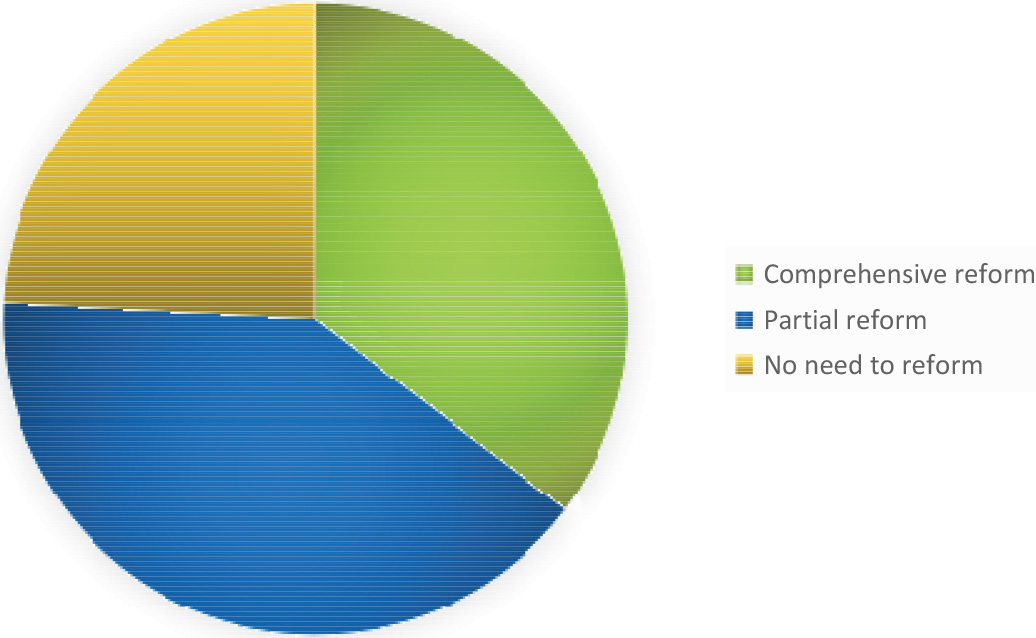
According to Fig. 2, in the survey on the scope of curriculum reform, 35.3% think that a comprehensive improvement is needed, and only 24.2% of students believe that the existing curriculum system can meet their own needs and does not need to be reformed. The overwhelming majority of students agreed with the reforms, and more than one-third of the total number of students who participated in the survey were students who believed that a comprehensive innovation was needed.
(2) The slow update of the curriculum system leads to low practical ability
With the development of the era of big data, changes in the form of international trade are very rapid and frequent. In sharp contrast, the curriculum system of international trade disciplines in colleges and universities cannot keep up with the pace of such changes. Although the reform of the professional curriculum system in colleges and universities requires rigorous demonstration and experimentation, a long demonstration cycle can easily lead to the lack of timeliness of the curriculum system, the lag in the knowledge learned by students, and the level of practical operation that does not conform to the development of the times demand.
The most direct consequence of the slow update of the curriculum system is that it is difficult to quickly adapt to the job after graduation [19, 20]. This aspect can be clearly felt in the telephone interviews with the managers of employment enterprises.
Comparison of ability evaluation.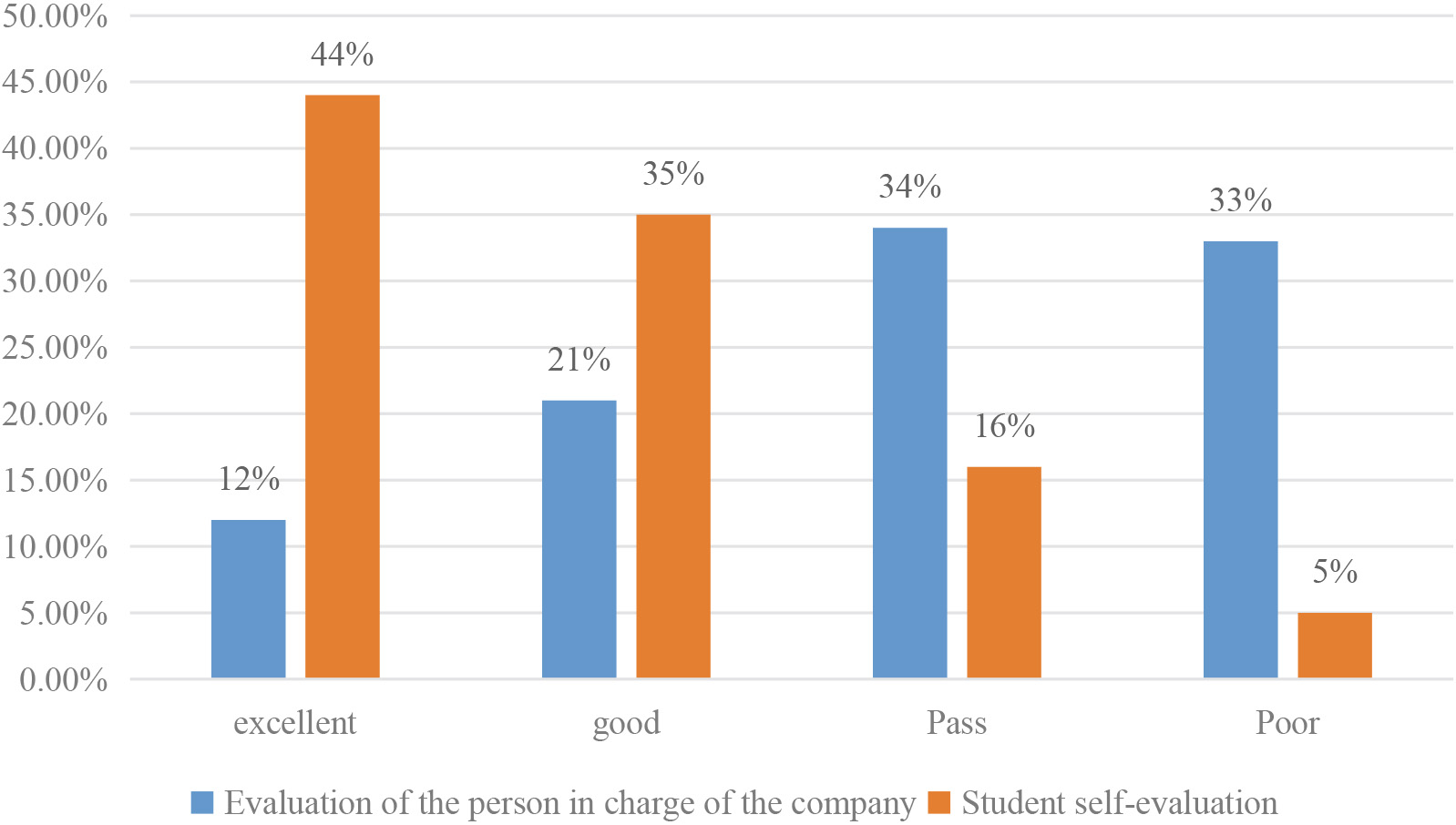
It can be seen from Fig. 3 that at this stage, employers’ overall evaluation of the ability of international trade graduates is relatively low. Those who believe that students’ abilities have reached “excellent” and “good” are still less than one-third in total. The difference is that the students participating in the survey have a very high degree of recognition of their own abilities. As many as 44% think their own abilities are excellent, while only 12% of employers think they meet the standards of excellence. Such a huge deviation shows that the students at the emergence stage did not have a scientific understanding of their own abilities. As a result, if students encounter job dissatisfaction after graduation, they will be dissatisfied with the job position, which severely restricts their further development.
(3) The internship is not implemented properly
Although in recent years, the international trade major of Chinese universities has increased the emphasis on the practical learning of graduates. The previous model of “scattered internship, free choice” for students was changed. The students were divided into several groups and sent to designated units for internships. In the internship report, a combination of group reports and individual summaries is adopted, which not only enhances the students’ team collaboration ability, but also effectively avoids the problem of some students’ overfilling the numbers, which improves the authenticity of student internships as a whole. However, confining students to designated units cannot fully combine the advantages of students. There are still many students who are perfunctory in the internship, and the internship report can be completed after imitating the work of previous graduates.
At the same time, most colleges and universities have an insufficient number of intern instructors for international trade majors, and each teacher needs to be responsible for several groups of students. This makes it difficult for teachers to take care of all aspects of organizing students to carry out learning and practice. They can only manage them through collective mobilization before internship and regular inspections of internship enterprises. More time is to communicate through mobile phones, e-mails, etc., and teachers cannot provide timely guidance for students’ internship activities.
Through the analysis of the current problems in international trade teaching, the researchers put it in the context of big data to construct countermeasures, thus effectively improving the effectiveness of the countermeasures.
Implement hierarchical education and attach importance to “elite training”
Respect students’ differences in learning abilities. In the context of big data, teachers have a more accurate basis for the strengths and weaknesses of students in learning. Teachers divide students into different levels according to their theoretical literacy, practical ability, and potential, so as to formulate scientific training goals. It must be noted that this stratification is not public, but only a reference for teachers to carry out teaching activities [21, 22]. Cultivate students’ areas of expertise, and enhance their overall competitiveness by strengthening their advantages.
For those students with strong learning ability and innovative spirit, general teaching can no longer meet their needs. Teachers should pay attention to raising their upper limit through training. Combine social needs and their own wishes for guidance, through deep-level knowledge counseling and understanding. This allows students to have a more scientific understanding of international economics and trade, which can not only improve their comprehensive ability, but also play an exemplary and leading role among students. According to the specific learning ability and progress of the students, it will cooperate with other colleges and universities to jointly develop courses and train corresponding teachers, and gradually establish a distinctive and hierarchical “layered education” system.
Promote the renewal of the curriculum system
Colleges and universities should formulate plans for the advancement of the curriculum system reform based on the characteristics of the international trade major in the era of big data, and improve the curriculum system to the key work level of the school [23]. Promote the contemporary development of the curriculum system in a step-by-step and planned manner. Make full use of the in-depth analysis brought about by the era of big data, and build a standardized process for optimizing the curriculum system. The college establishes a curriculum reform group based on its own conditions. On the one hand, the purpose is to analyze cutting-edge theories in the teaching of international trade, and on the other hand, it is to conduct comprehensive research on the needs of employers. Then carry out teaching reform exploration based on the results.
Increase funding and build an online learning platform. Ensure that the normal teaching progress and teaching quality are not affected by the epidemic. Online teaching and offline teaching complement each other, and make full use of information technology to build a simulation classroom, so that the focus of the classroom evolves from theoretical explanation to student experience. Create an informationized classroom system that matches the teaching of international trade, establish and improve intelligent teaching classrooms, and promote the intelligent transformation of the classroom. In the teaching reform, colleges and universities should insist on designing teaching content in the context of the era of big data, coordinating teaching resources, and establishing an educational system that integrates classroom teaching and the needs of the times.
Really implement the internship
Internship is a key part of improving students’ employability. It is necessary to increase the degree of attention to the internship and truly implement the internship. The instructor should fully communicate with the students, and analyze their personality, preferences, and interpersonal relationships through various data formed during the student’s school. According to the characteristics of these fields, we will develop personalized internship guidance for students. During the internship, actively use the information terminal to communicate with the students to help them deal with various problems in the work in a timely manner.
The internship report is a student’s internship experience, and under normal circumstances, it also has a direct relationship with the student’s graduation design. Instructors should attach great importance to students’ internship reports. In addition to requiring students to create internship summary in a group form, the submission results should explain the contribution of each member, and each member should submit a short summary based on their own internship experience. Experience. Teachers should also ask questions about students’ experiences and let students answer, so as to dispel students’ fluke mentality that they hope to get through.
Conclusion
Affected by many factors, the teaching of international trade in colleges and universities in China is facing severe challenges at this stage. To deal with these challenges scientifically, it is necessary to make scientific innovations in the international trade teaching system. The development of innovative work should be based on improving the real employment rate of students, and the work ability and sustainable development ability of students should be the focus of training. Strictly supervise the students’ internship process and internship summary, to avoid some students’ mentality of making up their minds, and to help students to integrate their theoretical knowledge through internships. Strengthen the level of teaching, respect the objective gap between students, focus on strengthening the guidance strategy for eugenics in chemistry, formulate one-on-one guidance strategies for outstanding students, avoid unnecessary twists and turns in the process of self-study. It should be noted that in the context of big data, international trade has become a rapidly changing subject because of its close connection with international relations. This leads us to maintain the spirit of innovation when building the discipline, constantly combining the actual needs of economic development and the updating of the theoretical knowledge of the discipline, and using these as an important reference for teaching reforms. Only in this way can we better promote the development of international trade teaching innovation and cultivate talents needed by society. In the next step of research, the researchers plan to adopt the method of comparative research to establish a more specific teaching system by comparing the teaching effect of the experimental class and the control class.
Footnotes
Funding
This work funded by research on employment and entrepreneurship in colleges and universities of Henan in 2020 (No. JYB2020422).