







Abstract
As a new type of energy which is developing vigorously in China, nuclear energy has been widely concerned in all aspects. The circulating water system in the nuclear power plant takes water from seawater, cools the steam engine through the condenser, and then carries waste heat from the outlet to the sea. If the temperature of the outlet is too high, it will not only cause the temperature rise near the water surface of the atmosphere and the ground layer near the shore, but also affect the ecological environment inside the ocean. In this paper, a model based on the echo state network with variable memory length (VML-ESN) is proposed to predict outlet temperature of the nuclear power plant. It can get memory according to the different input autocorrelation characteristic length to adjust the status update equation. The simulation results show that compared with ESN, Leaky-ESN, and Twi-ESN, the proposed model has better prediction performance, with a MAPE of 3.42%. In addition, when the reservoir size is 40, the error of VML-ESN is smaller than that of other models.
Introduction
Nuclear energy is considered as a new variety of energy with the most development value and potential at present due to its advantages of durability, economy, safety and cleanliness. The sustained, healthy and stable development of nuclear energy has provided a strong guarantee for national security and economic development [1, 2, 3]. In China’s nuclear power layout, all nuclear power unit has been in operation and under construction as the coastal sites, the cooling water through the drain into the sea, the quantity of heat of cooling water is not only can cause atmospheric layer near surface and nearshore ground temperatures and many heat after entering receiving waters, and make the water temperature, may be a certain effect on the ecosystem of water body [4, 5]. Therefore, accurate prediction of the outlet temperature of nuclear power plants and timely response measures will help protect the marine ecological environment.
In industrial construction, a lot of research has been done on temperature prediction at home and abroad [6, 7, 8, 9]. In order to predict soil temperature, Li et al. [10] introduced a unique attention-aware long-short-term memory model (ILSTM Soil), which generally performed more accurately than other models. Azari et al. [11] tested six temperature prediction methods, including: Linear Regression (L.R.), K-Nearest Neighbor (KNN), Support Vector Machine (SVM), Artificial Neural Network (ANN), Random Forest (R.F.) and Adaptive Boosting (AdaBoost). The findings demonstrated that ANN performed better than the competition in both training and forecasting temperature values in the Memphis, TN climate. Chen et al. [12] developed a temperature prediction model to compensate incomplete information, and the results of trial showed that the proposed method can cause the error within 2.28%. Qi et al. [13] proposed a prediction method (CRA-ConvLSTM) combining temporal attention mechanism and spatial attention mechanism for sea surface temperature, and the experimental results showed that the model could achieve 0.19
In summary, a model based on VML-ESN is proposed to obtain better water temperature outlet prediction performance of nuclear power plant. It can adjust the state update equation by obtaining memory length according to different input autocorrelation characteristics, and adopts reservoir instead of hidden layer, with strong short-term memory ability. The remaining part of this paper is organized as follows. In Section 2, the theory of VML-ESN is briefly introduced. Experiments and results for the proposed model in this paper are performed in Section 3. The conclusions of this paper are given in Section 4.
Models
Echo state network (ESN)
ESN [21, 22, 23] is a new type of recurrent neural network, the network structure as shown in Fig. 1. It employs the neurons are connected by a random sparse reservoir of
The structure of ESN.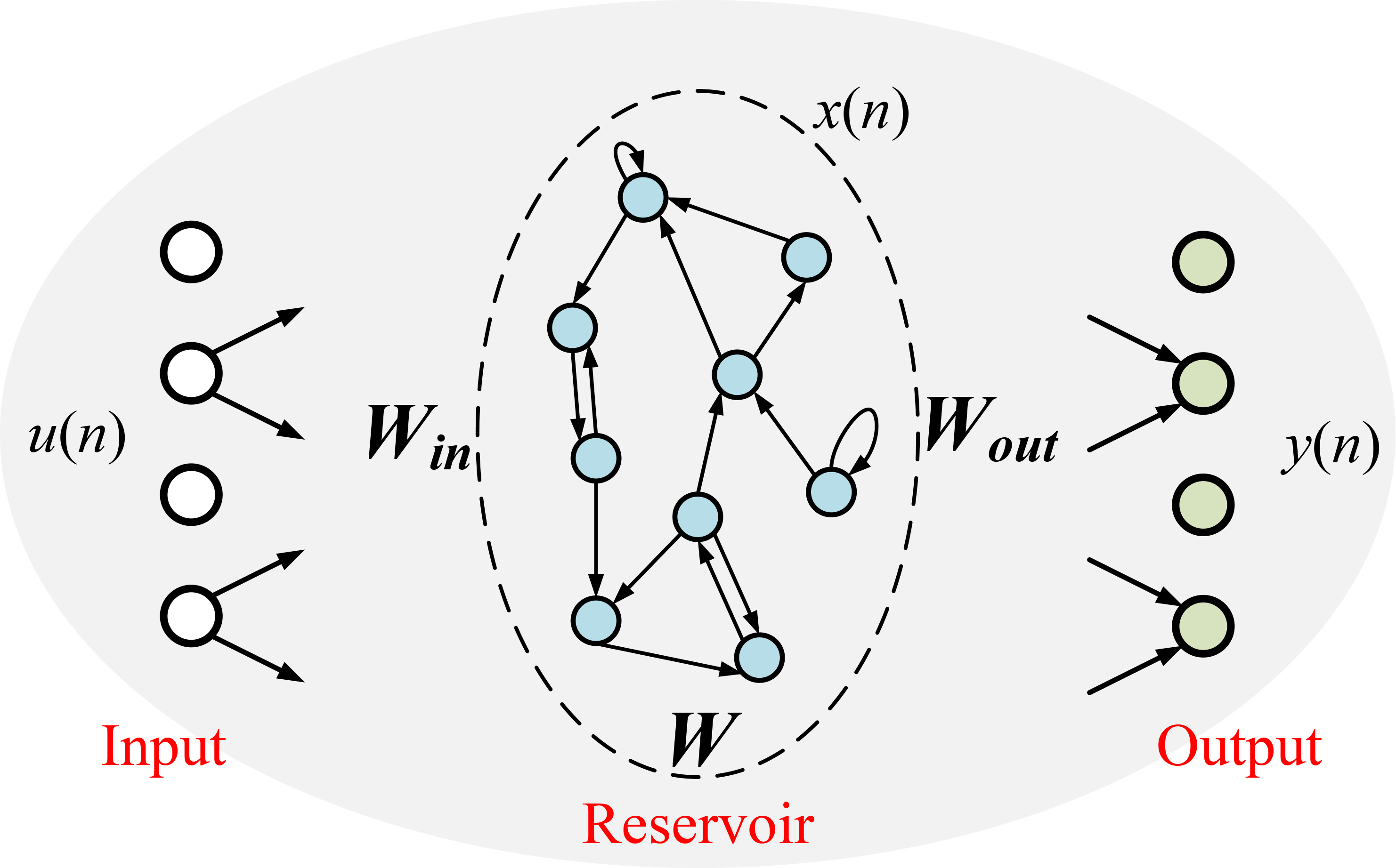
The construction process of ESN includes initialization, training, and use (test). The steps are shown in Fig. 2. First, the initialization operation is performed. Similar to the traditional multilayer perceptron (MLP), the more nodes, the stronger the fitting ability. Since ESN fits the output result linearly only by adjusting the output weight (i.e.
These parameters will affect the short-term memory of the network. The smaller the input weight is and the closer the spectral radius of the internal matrix is to 1, the longer the network short-term memory time is. But as well as enhancing memory, it also makes the network less able to model rapidly changing systems. The second step is to train. It is worth noting that this idling process is essentially initializing the state of the reservoir. The internal connection of the reservoir is random, and the noise of the state of the reservoir obtained from the initial input sequence will be relatively large. Therefore, some data will be used to initialize the state of the reservoir to reduce the impact of noise.
The discrete equation of ESN is as follows:
where
Procedure for constructing an ESN.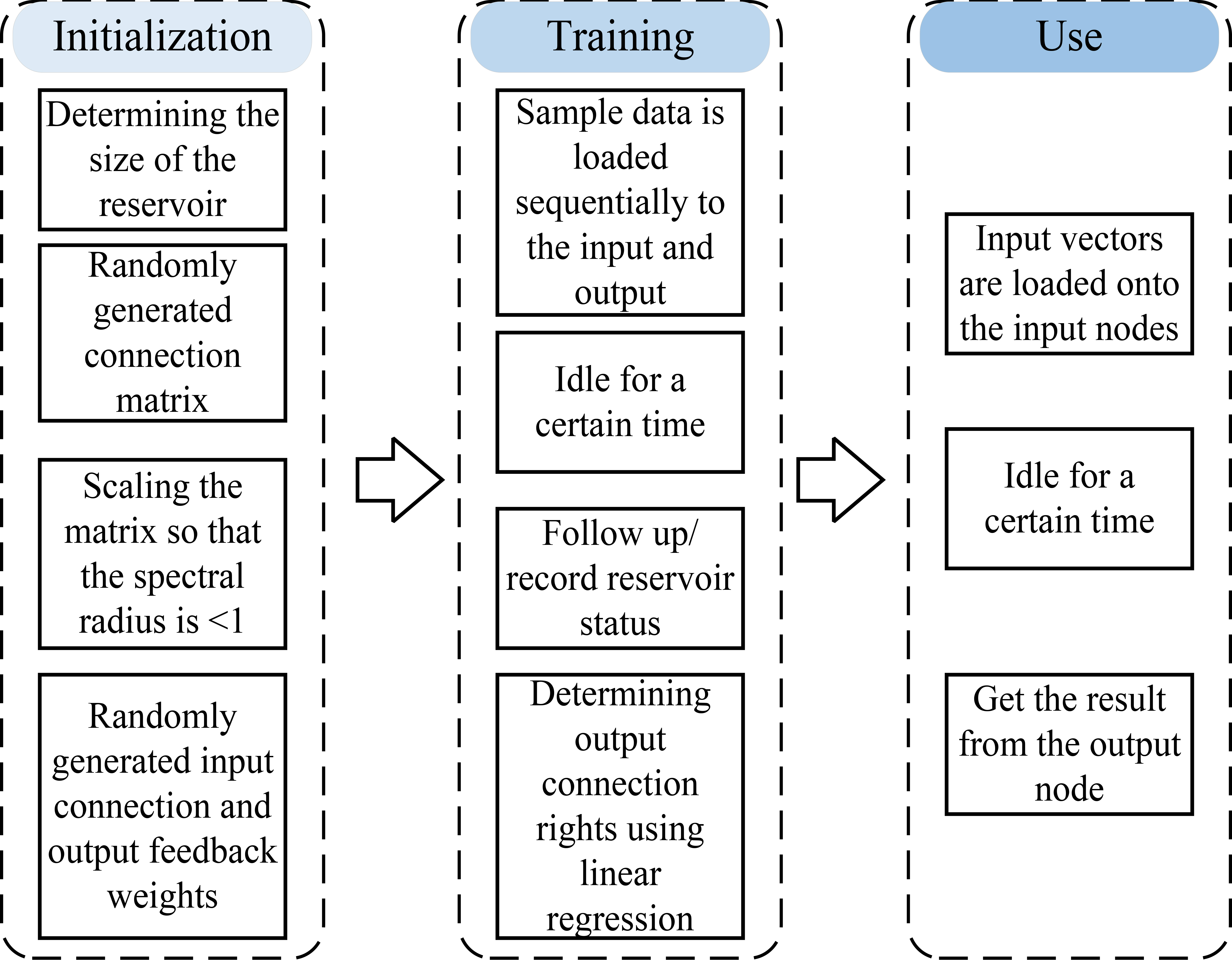
The water outlet temperature prediction method using VML-ESN [24] is presented in this study. It has the capacity for short-term memory and the ability to adaptively alter the state update equation according to the autocorrelation features of the input signal. Varying types of input signals have different autocorrelations. The reservoir state update equation is adjusted to take into account input signal autocorrelation in order to get the best performance for various input signals. As a result, the calculation for the reservoir status update for the ESN can be changed as follows:
where
When
Since VML-ESN is a special ESN, it needs to meet the echo characteristics. A necessary condition for the VML-ESN to satisfy the echo state characteristic is given so as to guarantee that the model adheres to the echo state characteristic.
For the discrete VML-ESN model, the following conditions are satisfied:
It indicates that the VML-ESN model has the echo state characteristic.
Data sources
To verify the accuracy of the prediction model based on VML-ESN, this paper refers to the data from the data acquisition system established by two nuclear power plants for simulation verification. Two nuclear power plants are located near the sea, and they are 1000 meters apart. The original drainage channel of the nuclear power plants is 600 meters long, and the circulating cooling water is discharged into the sea in the east-south direction. The design of the open canal is applied to the design of the water intake and the drainage outlet, i.e., the drainage of the two nuclear power plants is combined into one drainage system. The drainage outlet of the original nuclear power plant is extended to the drainage outlet of the new nuclear power plant, and the drainage breakwater is about 1190 meters long and discharged in the direction of 60 degrees to the north by east. The amount of drainage from the two power stations is now 190 m
Location of water outlet.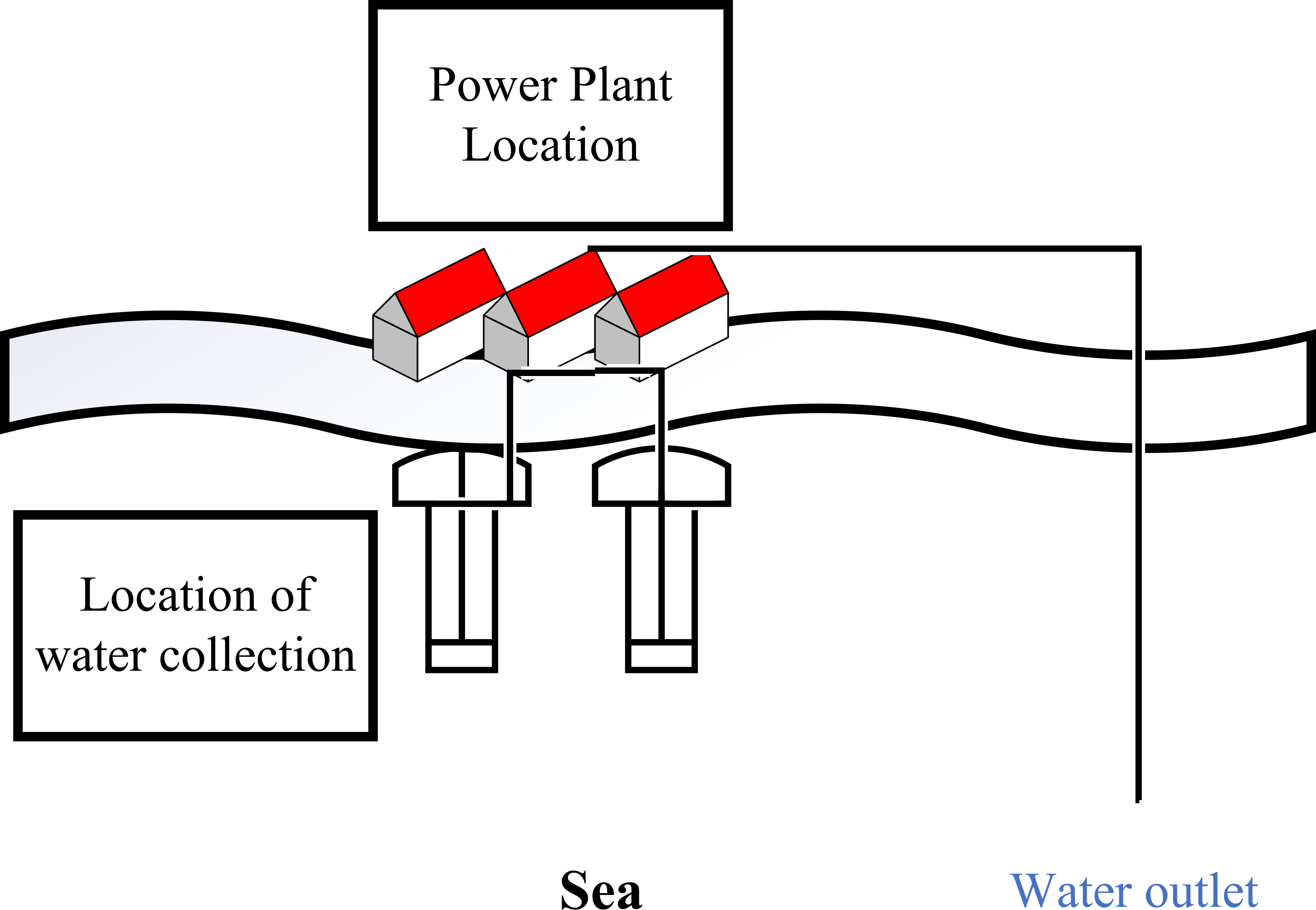
In this paper, under different weather conditions from June to September 2020, outlet temperature and seawater temperature were recorded every 30 minutes. Using this 1000 samples temperature data to train the VML-ESN prediction model. The temperature data are shown in Table 1.
Temperature data
This paper focuses on the simulation of the outlet temperature prediction model through Matlab by establishing a time series with a training sample length of 1000, an initial sample length of 100, a prediction sample length of 100, a network training with an input dimension of 5, an output dimension of 1, a spectral radius of 0.8, and a sparsity of 2%. Firstly, the reservoir size is 40. According to the requirement of test error and test time, the memory length is 2. Then the VML-ESN reservoir state equation is updated as:
The reservoir parameters of the VML-ESN based outlet temperature prediction model are shown in Table 2.
The reservoir parameters of the VML-ESN
To facilitate the observation of the advantages of VML-ESN, BPNN [25], LSTM [26], ESN [22], Leaky-ESN [27], and Twi-ESN [28] are introduced in this paper, and the outlet temperature prediction model is simulated with each of these ESN. NRMSE and MAPE are used as the prediction performance indexes, which are as follows:
where
Comparison of the prediction accuracy of the six methods
Evaluation indexes under different reservoir sizes
Training errors of the four methods
Test errors of the four methods
Target and the predicted results of the four methods.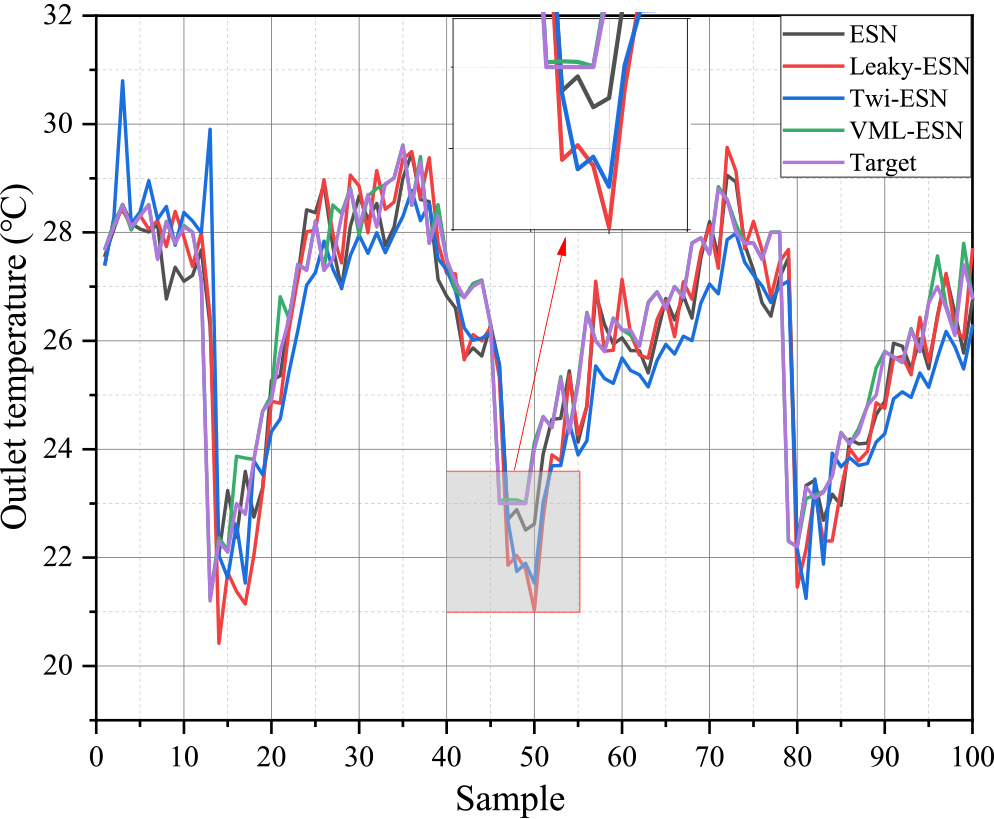
As can be seen from Table 3, the training error and testing error of VML-ESN are smaller than the other three echo state networks with the same reservoir size, and the testing error of VML-ESN is reduced by 1.22 times, 2.27 times and 1.46 times compared with the standard ESN, Leaky-ESN and Twi-ESN, respectively, and the prediction accuracy is also the highest with MAPE
MAPE with different reservoir sizes.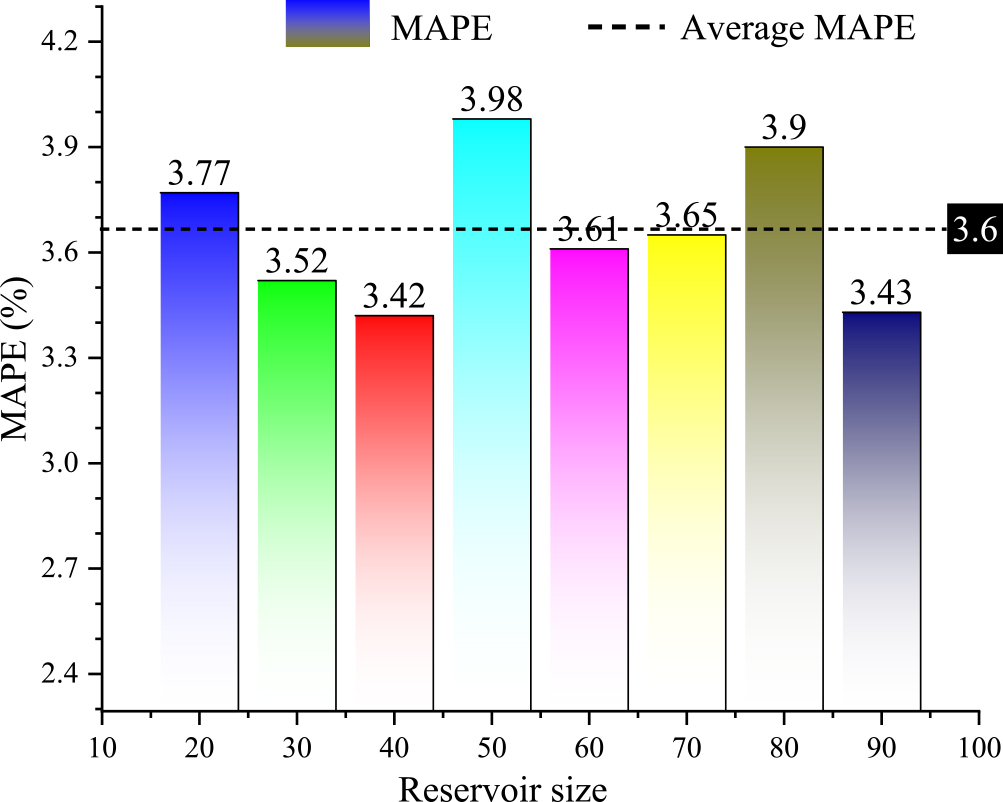
The train and test NEMSE for four methods.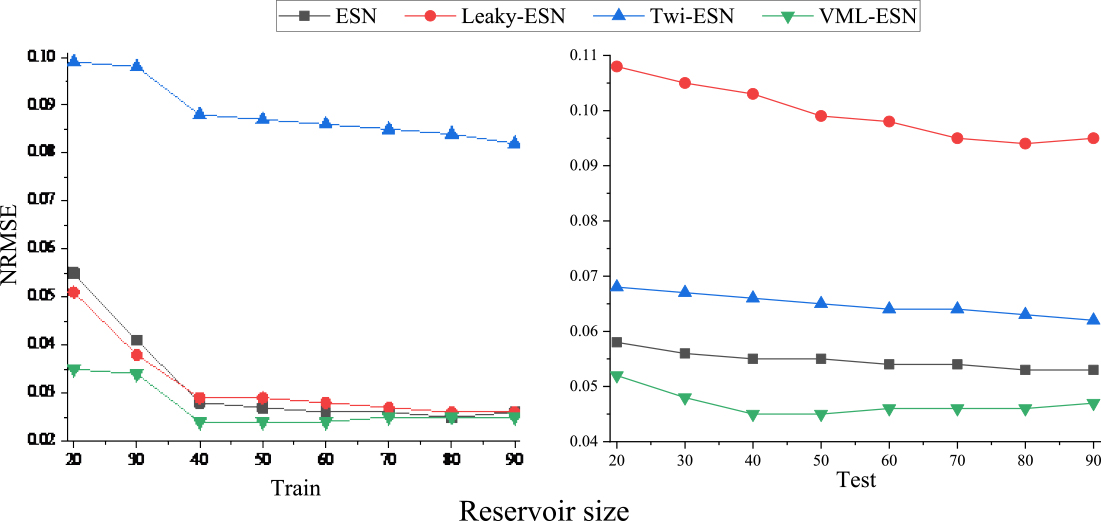
In Fig. 4, it can be observed that the curve of VML-ESN match with the curve of the original data, and the relative error of VML-ESN is the smallest, so it can be indicated that the temperature prediction model based on VML-ESN is the one with the least deviation from the original data among this four methods, and in the actual measurement of nuclear power plants, VML-ESN can overcome the influence brought by environmental factors, and this method is better than the other three echo state networks and can predict the outlet temperature of nuclear power plants more accurately.
There are many factors that affect the accuracy of outlet temperature prediction model. Here we adopt the orthogonal experimental design method, which is a multi-factor and multi-level experimental design method. In this paper, the experiments of orthogonal simulation are carried out by choosing different reservoir size, and changing the size of the reservoir (such as making SP
In Table 4 and Fig. 5, the mean absolute error (MAE) of the prediction model is the smallest when the size of the reservoir SP
The size of the reservoir is still varied and the prediction model is analyzed by comparing the NRMSE of four ESN models with different reservoir sizes.
With different reservoir sizes, it is easy to observe from Fig. 6 that the test error and train error of VML-ESN are much smaller than those of the other three ESN models when the reservoir size SP
The nuclear power plant should design the circulating water system and carefully select the location of the intake and discharge outlets in advance in the pre-construction planning layout based on the safety and economy as well as environmental protection aspects, so that the economic and ecological benefits can be maximized. According to the characteristics of temperature change, an outlet temperature prediction model with VML-ESN is proposed in this paper. Compared with the ESN, the model increases the memory length and adaptively adjusts the standby reservoir state update equation. The training and test errors of VML-ESN are the smallest compared with the other three ESN models under the same reservoir size condition, and the prediction accuracy is also the highest, with an average NRMSE of 0.047.