






Abstract
The rapid development of urbanization has led to the gradual increase of urban residential density. Relatively speaking, the spectrum resources are increasingly scarce, which leads to the increasingly serious interference between communities, and the system performance is also greatly limited. Therefore, in order to improve the efficiency of spectrum resources and solve the problem of user interference between cells, the experiment combines the advantages of clustering by fast search and find of Density Peaks Clustering (DPC), and proposes a two-step clustering algorithm. This method is proposed based on the core idea of DPC after in-depth study of the downlink multi-cell orthogonal frequency division multiplexing system architecture. The proposed model is compared with Matching Pursuit (MP) algorithm and Graph-based algorithm with the sum of clustering distance
Introduction
In today’s society, the acceleration of the urbanization process has gradually increased the density of urban living. In the development of urbanization, wireless communication brings more convenience to people. However, with the continuous increase of urban residential density, spectrum resources in wireless communication networks are increasingly scarce. This situation leads to increasingly serious interference between residential areas, and the system performance of the wireless communication network is also greatly restricted. Therefore, how to improve spectrum resource efficiency to solve the interference problem of users between cells has extremely important practical significance. Channel resource allocation in a wireless communication network refers to theneed to allocate channels and transmission power between users when the number of users in a wireless mobile communication network exceeds a certain scale within a certain range [1]. It satisfies many channel and power constraints, including transmit power [2]. But in reality, the location of the user will change in real time, and the base station that provides services for it will also change accordingly, so the allocation of channel resources must be dynamic. In addition, the interference between users will greatly limit the performance of the system. At present, there are many deficiencies in the channel resource allocation algorithms under common interference conditions, including complex calculation and slow convergence process [3, 4]. And most of the existing research will idealize the multi-cell cooperative network model, and the practical application value is not high [5]. In view of this, to solve the problem of shortage of mobile communication channel resources, this research constructs a two-step clustering algorithm that fits the actual multi-cell cooperation. This algorithm utilizes the objective function of maximum spectral efficiency and combines the advantages of density peak clustering algorithm, so it has higher practical value. Under the conditions of sufficient and tense channel resources, the simulation experiments are compared between the constructed two-step clustering algorithm and the conventional algorithm.
Related work
Clustering algorithms are often used to solveproblems such as displaying the most comprehensive information in the smallest area. This method can perform well when dealing with a large number of data points, so researchers often improve it to apply to various research fields. Deb et al. [6] built a new unsupervised K-means clustering algorithm, which can automatically find the optimal number of clusters without any parameters and initialization operations. The computational complexity of the overall model is not too large, and the final simulation experiment verifies the superior performance of the proposed algorithm. Li et al. [7] found that it is difficult to mathematically calculate the characteristics of the data set when cluster analysis is used for mixed data sets, so a classification method for mixed data clustering algorithms was proposed. The researchers analyzed the advantages and disadvantages of these methods to provide guidance for future research directions. Oliveira et al. [8] found that the topological structure changes frequently due to the rapid movement of mobile nodes in vehicular ad hoc networks. To solve this problem, they proposed a clustering algorithm based on gray wolf optimization. The algorithm can imitate the social behavior and hunting mechanism of gray wolves to create efficient cluster numbers. Experimental results show that this model provides a robust routing protocol for vehicular ad hoc networks and contributes to the high-quality communication of vehicles on highways. In order to prolong the life of the wireless sensor network, Sinaga and Yang [9] started from considering the energy saving of each sensor node in the network, adopted the Particle Swarm Optimization (PSO) algorithm optimization technology, and used the clustering coefficient, sensor Cluster head sensor nodes are selected by optimizing parameters such as node residual energy, sink and the distance from the cluster head to the bar. Experimental results show that the proposed method increases the network lifetime by an average of 65%.
There have been many scholars discussing the research on mobile communication channel resource allocation technology. Kushwaha et al. [10] studied the throughput performance and robust resource allocation design of non-orthogonal multiple access-based heterogeneous vehicular networks. Aiming at the channel estimation error problem caused by the high mobility of the vehicle network, a cascaded Hungarian channel allocation algorithm is proposed. This algorithm is able to obtain the optimal power allocation for the transformation problem. Experiments have verified the effectiveness of the proposed method. In order to improve the service quality of vehicular networks, Li et al. [11] have comprehensively investigated the channel resource allocation schemes of two main vehicular network technologies, dedicated short-range communication and cellular-based vehicular network. In addition, the researchers discussed the challenges and opportunities of the resource allocation of the modern Internet of Vehicles, and made an outlook on the future research direction. Aiming at the problem that ultra-dense networks will hinder the effective allocation of channel resources due to their large scale, Ma et al. [12] conducted an investigative introduction to channel resource allocation methods for ultra-dense networks. At the same time, the researchers provide a taxonomy to classify the channel resource allocation methods in the existing literature. In addition, the study also proved the feasibility of the classification method, which has positive significance for alleviating the difficulties faced by ultra-dense networks. An et al. [13] have studied the trajectory and channel resource allocation of the downlink high-efficiency energy-saving and safe UAV communication system, and have comprehensively considered the service quality requirements, security constraints and channel state information, etc., and proposed a UAV communication system. A joint optimization method for channel resource allocation and UAV jamming strategy. The simulation results show that the proposed method can converge in a small number of iterations and has good application performance.
To sum up, there have been many scholars discussing the related research of clustering algorithm and channel resource allocation technology, but the constructed model still has shortcomings such as complex calculation and slow convergence process. Therefore, in order to build a more practical multi-cell cooperative network model, this experiment proposes a two-step clustering algorithm based on MP image segmentation mechanism and DPC algorithm.
Research on the model of wireless channel resource scheduling based on two-step clustering algorithm
Multi-cell OFDM system construction under interference environment
In this study, the downlink multi-cell Orthogonal Frequency Division Multiplexing (OFDM) system is used to visualize the scene structure. The system includes a master base station (m-AP) and multiple slave base stations (s-AP) and management Channel resource allocation for local gateways [14]. The main base station is located in the center, and the coverage area is
OFDM system scene structure diagram.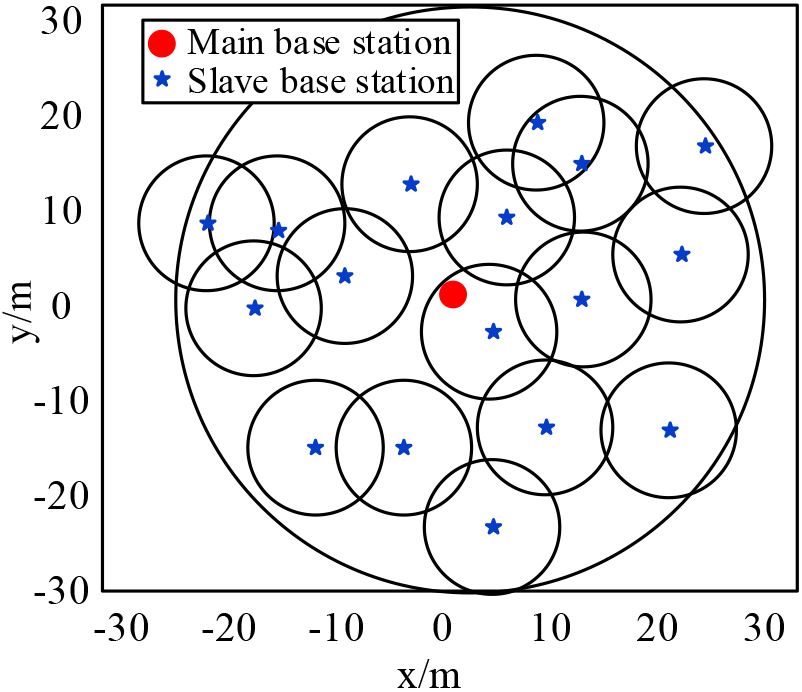
The channel contains
In Eq. (1),
In the OFDM system, the user may experience interference from many base stations, and the received signal’s signal-to-interference-noise ratio is as follows:
According to Shannon’s theorem, the achievable rate of the base station channel used by the user
This study’s optimization objective is to increase network throughput in order to maximize the system’s overall user rate. Its goal function is stated in the following way:
When the base station allocates channels
DPC algorithm is to find high-density clusters and attribute low-density clusters to them, so as to quickly find the density peak point of any data set. The clustering algorithm can show better data classification ability to a certain extent, and its operation principle is simple and can eliminate related noise points. The DPC algorithm assumes that there are some points with low local density around the cluster center and the distance between these points and high-density points is relatively large. This experiment is to judge the cluster center by finding the transition point. Figure 2 shows the running flow of the DPC algorithm. Based on the DPC algorithm, this experiment proposes a two-step clustering method that first clusters the user units, and then clusters the users in the cluster with the goal of total interference.
The running process of DPC algorithm.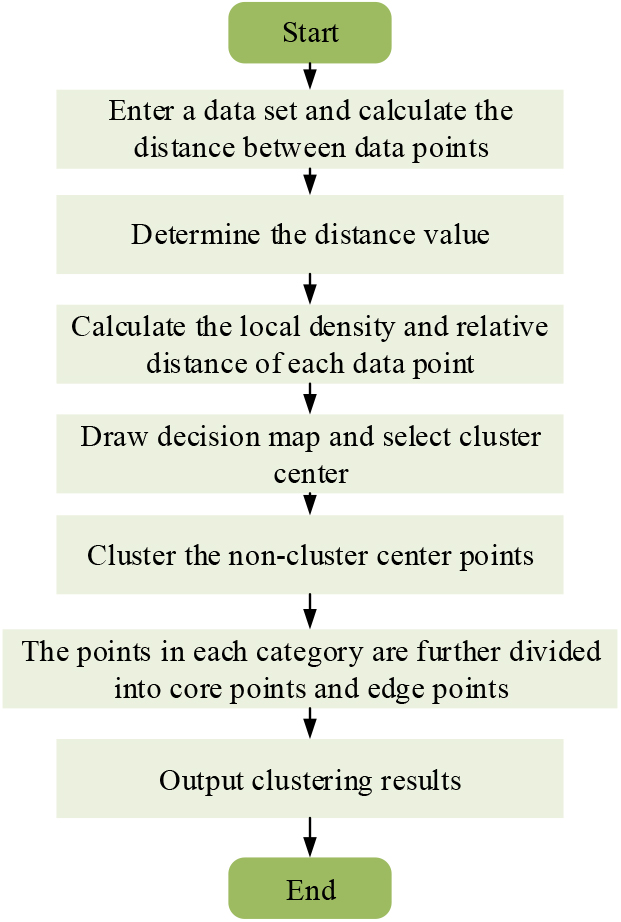
To reduce user interference between units, unit clustering classifies users according to their various features [16, 17]. For the calculation and clustering of each data node, it is necessary to determine the size of its local density value
In Eq. (6),
According to the Gaussian definition, local density value
For
DPC algorithm judges the cluster center by finding the transition point. This study selects
From the above formula, the demonstration process of cell clustering is shown in Fig. 1.
Demonstration process of unit clustering.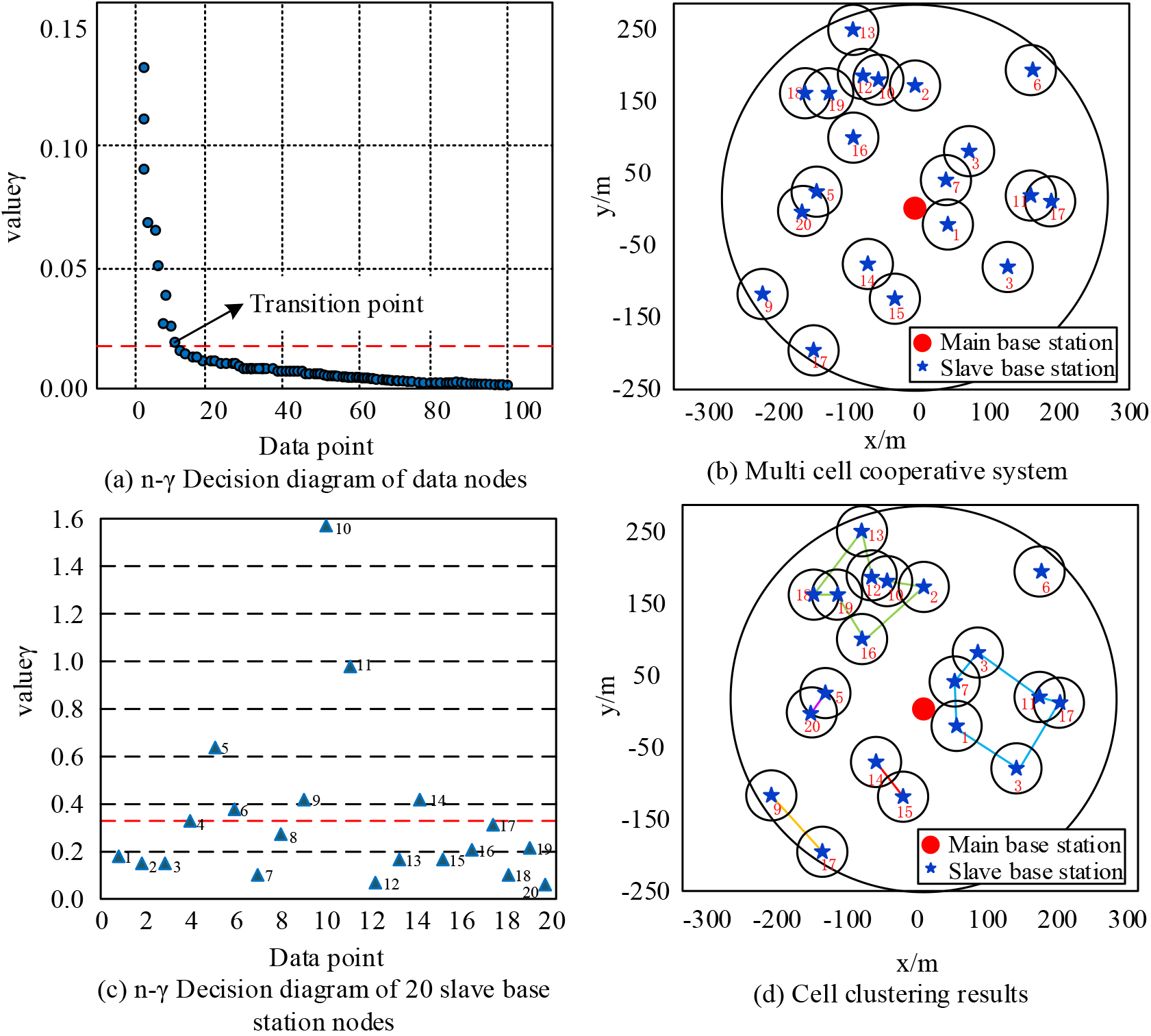
Figure 3a is the core content of the DPC algorithm, that is, the schematic diagram of the decision graph
After the unit cluster is obtained, it is necessary to process the internal user groups, and perform clustering with the goal of minimizing the total interference of users in the cluster. In this study, independent cells are processed separately, and the interference degree of users is expressed as:
In Eq. (9),
According to the Eq. (9), the weight value of the interference relationship
Users who satisfy particular requirements are sequentially added as a cluster, starting with the person with the lowest point degree. In order for the user cluster to be employed as a separate study group, there must be a minimal level of interference between each user and each other inside the cluster, and this interference must not be more than the threshold. In this manner, several clusters are created from all users. The average amount of interference that each user in the user cluster experiences is:
In Eq. (10),
Equation (11) is the calculation method of the threshold
Results of user clustering in different cell sizes.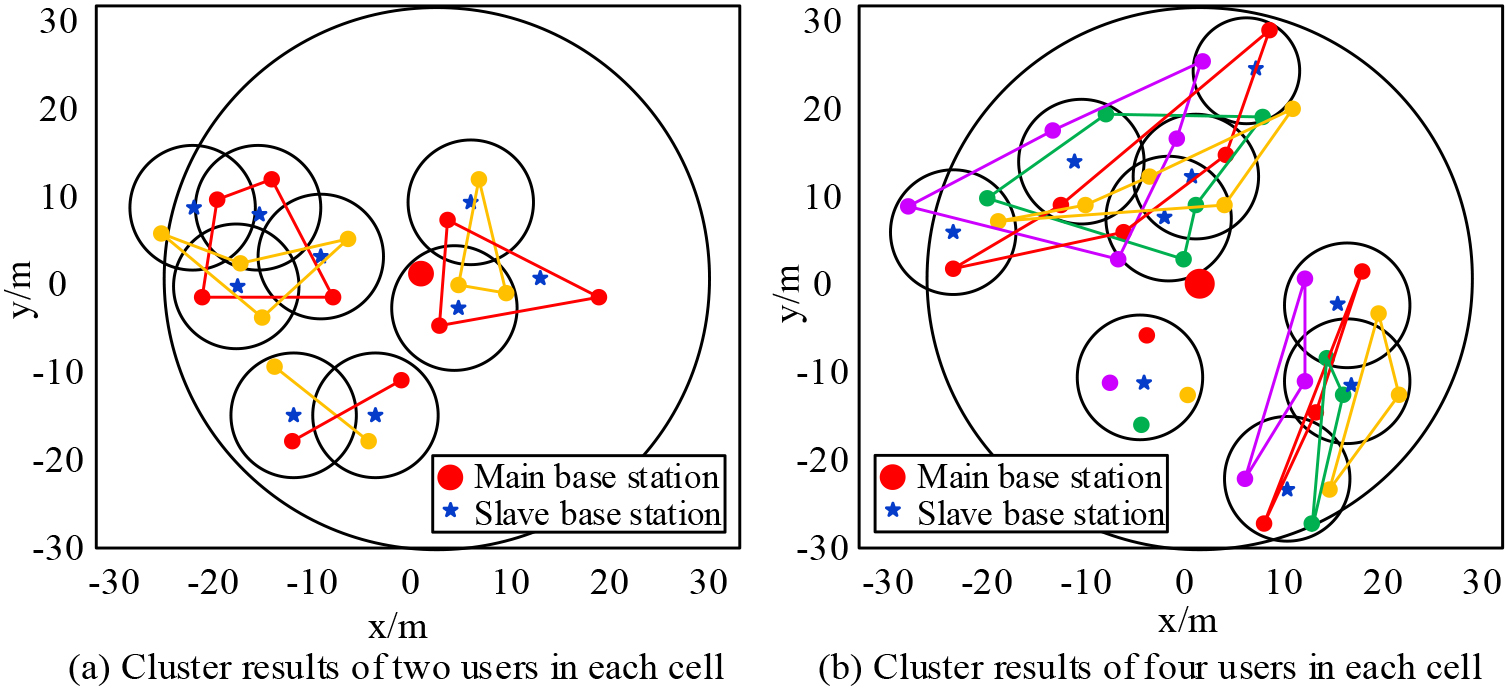
The results of user clustering in various cell sizes with appropriate channels are presented in Fig. 4. The results of the user clustering are displayed in Fig. 4a and b, respectively, for two and four users in each cell. When there is an enough supply of resources, each individual cell that is isolated is clustered individually, and each user that is a part of that cell is likewise considered a separate user cluster. When there are not enough resources, each autonomous cell will form a cluster, which will then include all of the users that fall under that cluster. When clustering, make consistent use of the procedure shown in Fig. 4a.
When distributing sub-channels, it is important to assign two channels to user clusters based on channel resource shortages, and then assign sub-channels to users. This has been demonstrated to be an NP problem.
When there are enough channels, a channel is assigned to each user in the user clusters of all non-isolated base station clusters. The order of channel allocation is decided by the number of users in the user cluster, and channels with higher gains are assigned to user clusters with the most users first. After a user cluster’s channel allocation is complete, the user cluster is separated into assigned sections. Subsequent operations are carried out in unassigned user clusters. Users under the remaining independent base stations are clustered individually and are still assigned based on the aforementioned factors. When channels are few, there is no need to assign channels to independent and non-isolated base stations individually. All user clusters are assigned channels uniformly during resource allocation, and the obtained user clusters do not need to be handled separately.
When power allocation is performed, the allocated power is calculated using the water filling algorithm, and finally the spectrum efficiency is calculated. When the
In Eq. (12),
The channel capacity is the sum of individual parallel channel capacities, and its expression is:
In Eq. (13),
The maximum objective function transforms into:
Using Lagrangian maximization, the optimal energy distribution principle is obtained. The formula is as follows:
Performance simulation of two-step clustering algorithm
In this study, matlab is used to simulate the algorithm, and the simulation software runs under the Widdows10 system. A total of four scenarios were constructed, and the parameter settings of the scenarios conformed to the 3 GPP technical standards. The channel bandwidth, the number of users, and the carrying capacity of the channel in the scene all have a significant impact on the performance of the algorithm. Therefore, in order to more clearly compare the performance changes of the proposed algorithm in the four scenarios, the experiment sets the specific parameters of the four scenarios as follows.
Parameter setting of three scenarios
Parameter setting of three scenarios
The four situations that were created by the simulation experiment are displayed in Table 1. Each scenario has a 2 GHz carrier frequency, a 180 kHz sub-channel bandwidth, a 10-3 bit error rate, and a
Scenario 3 schematic.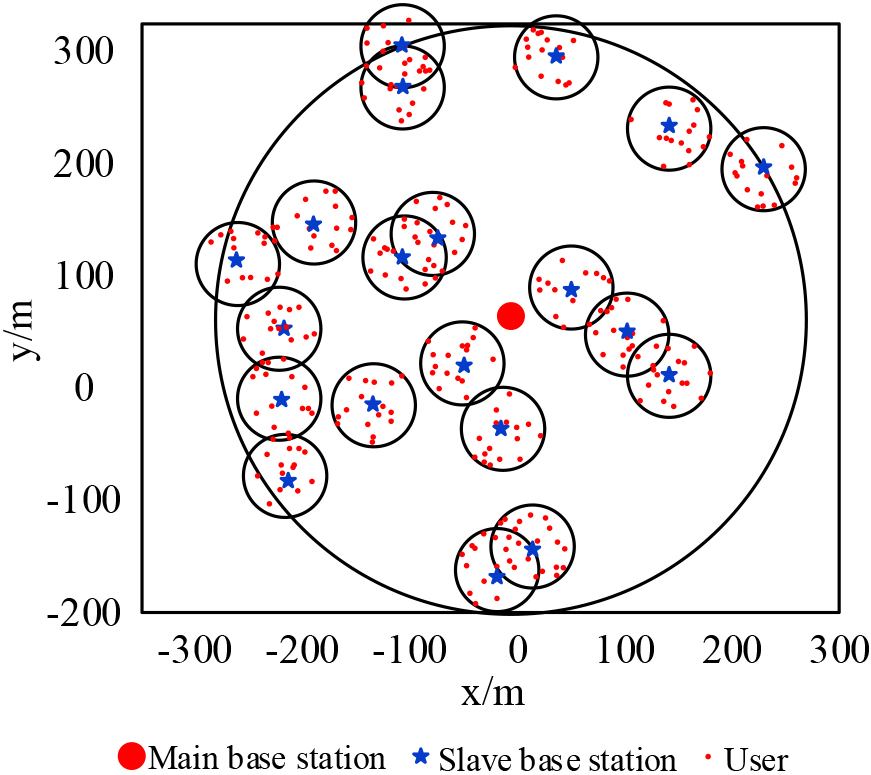
Clustering in scenario 3 is illustrated as an example in the diagram shown in Fig. 5, which is a schematic. Clustering around the master base station has a radius of 289 meters, whereas clustering around the slave base station has a radius of 40 meters. Users who are served by slave base stations are randomly dispersed within the clustering range of those slave base stations. The master base station is situated in the middle of the system, and the slave base stations are randomly dispersed across the system content. In this particular study, a total of twenty cell clusters were created, each containing sixteen participants, and there was some degree of overlap between each cell cluster.
The Monte Carlo approach is employed one thousand times for each iteration, and the output is generated at random based on the coordinates of the base station and the user. During the experiment, the ratio of the amount of channel resources that sub-channels are able to supply to the total amount of channel resources will serve as the criterion for determining whether channel resources are sufficient or limited. When it is established that all sub-channels can be supplied for resource allocation, it is determined that there are sufficient resources for the channel. If the percentage is lower than 80%, then it is determined that there is an inadequate supply of channel resources.
Cumulative distribution function of spectrum efficiency in different scenarios.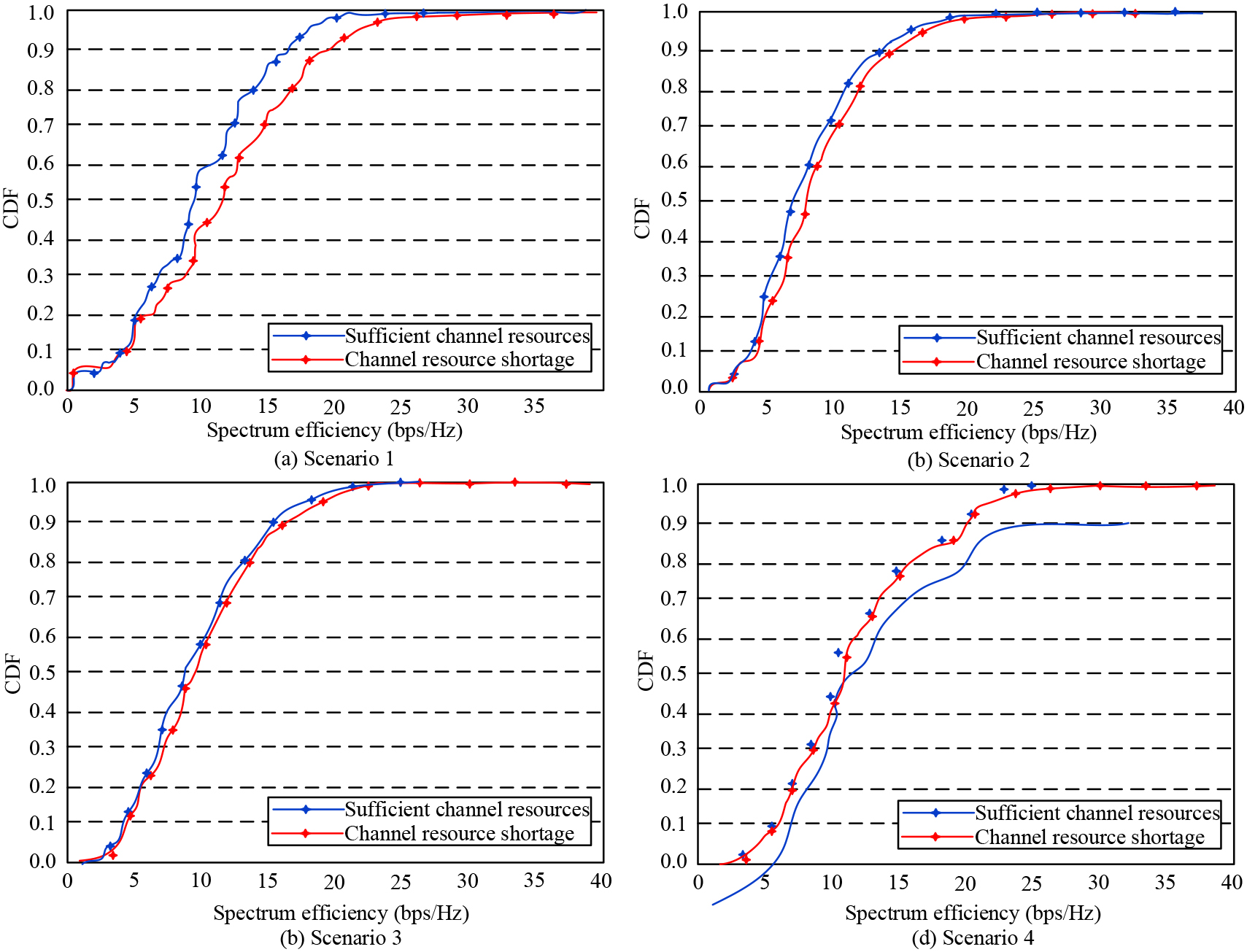
The spectrum efficiency cumulative distribution function (CDF) diagram is depicted in Fig. 6, and it was generated by applying the two-step clustering algorithm to four different setting scenarios. The diagram was created under the two conditions of sufficient channel resources and tight channel resources. When using the two-step clustering technique, there is not much of a difference in the spectrum efficiency between when there are sufficient channel resources and when there are tight channel resources. The performance of the two-step clustering algorithm, on the other hand, is improved when the channel is scarce, and there is no significant variation in spectral efficiency as a result of the varying availability of channel resources. This is because there is less variation in the channel’s resources. This is due to the fact that the system has a greater reuse rate for the channel during periods in which the channel is congested. In each of the four possible scenarios, the spectral efficiency gradually falls as the size of the cell and the number of users increases. This could be because of the increased interference that results from the presence of more users within the cell.
Network capacity graph of two-step clustering algorithm in different scenarios.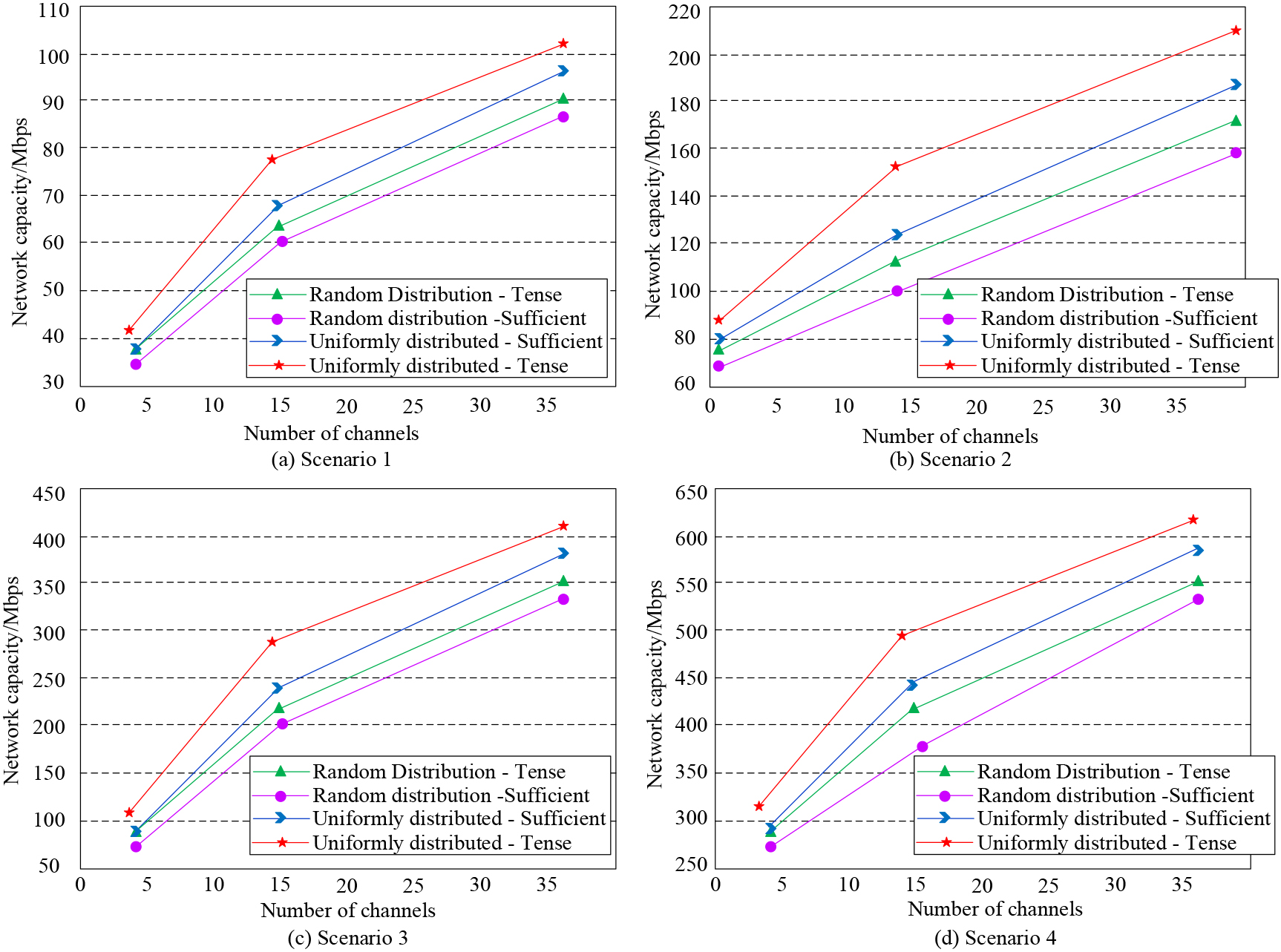
There are two base station layout options in the system: unified and random. In a uniform plan, the secondary base station is in the center; in a random layout, the secondary base station is placed at random locations across the cell. Depending on the secondary base station’s design and whether the channel resources are adequate, four options are possible. The two-step clustering algorithm’s network capacity diagram in four combination modes is shown in Fig. 7. The network capacity of the channel granularity is higher when channel resources are limited. With more sub-channels, the system capacity rises, and for the same channel granularity, the performance of the same distribution from the base station outperforms the random distribution.
MP algorithm and Graph-based algorithm are conventional mobile communication channel resource scheduling methods, and many studies have confirmed that these two algorithms have good performance. Next, the experiment sets the clustering distance of the
Spectrum efficiency of the three algorithms in the case of sufficient channel resources.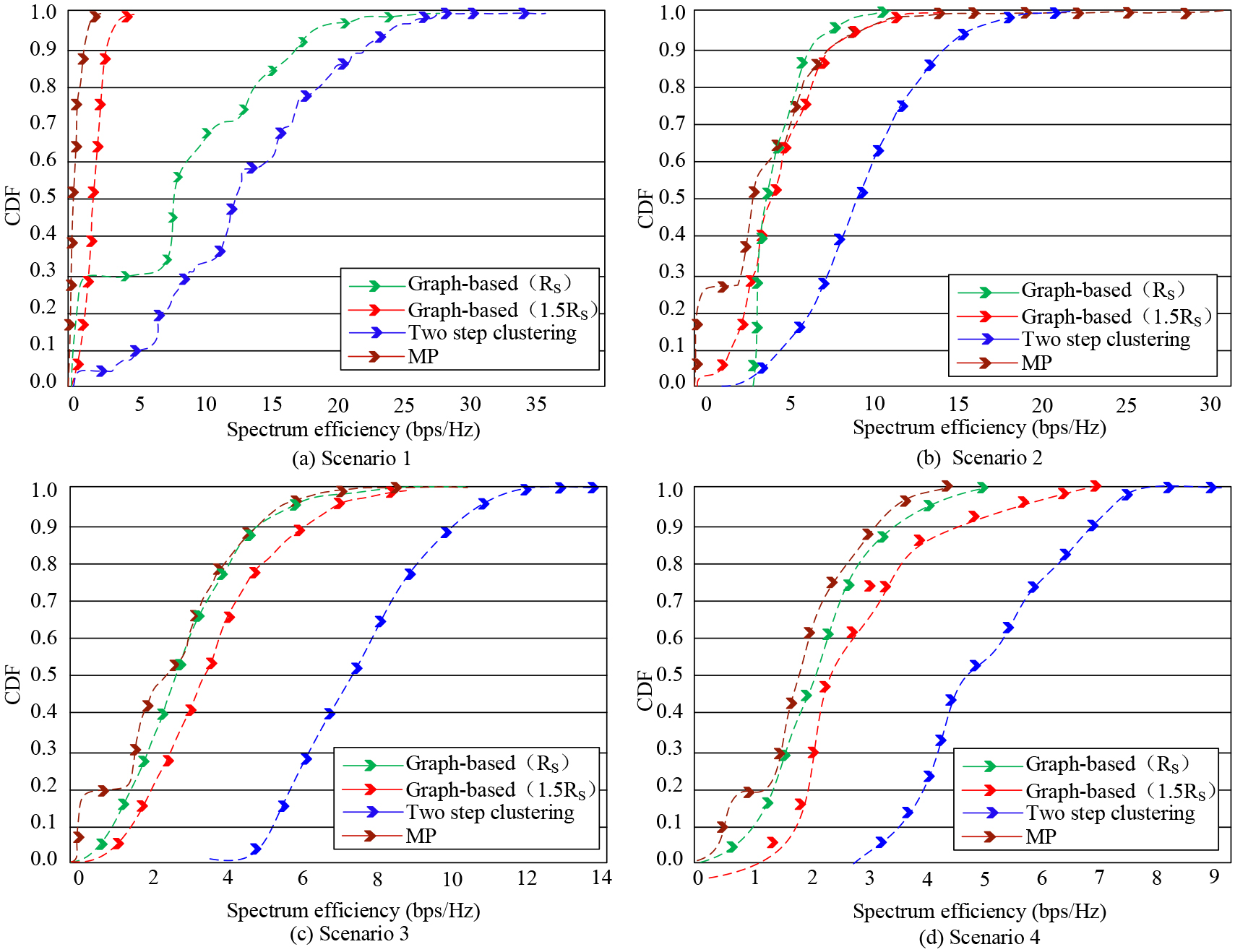
Figure 8 is a CDF diagram of the spectral efficiency of the algorithm under the condition of sufficient channel. With the expansion of the scene scale, the two-step clustering algorithm can achieve higher spectral efficiency than the MP algorithm and
Spectrum efficiency of three algorithms in the case of channel resource shortage.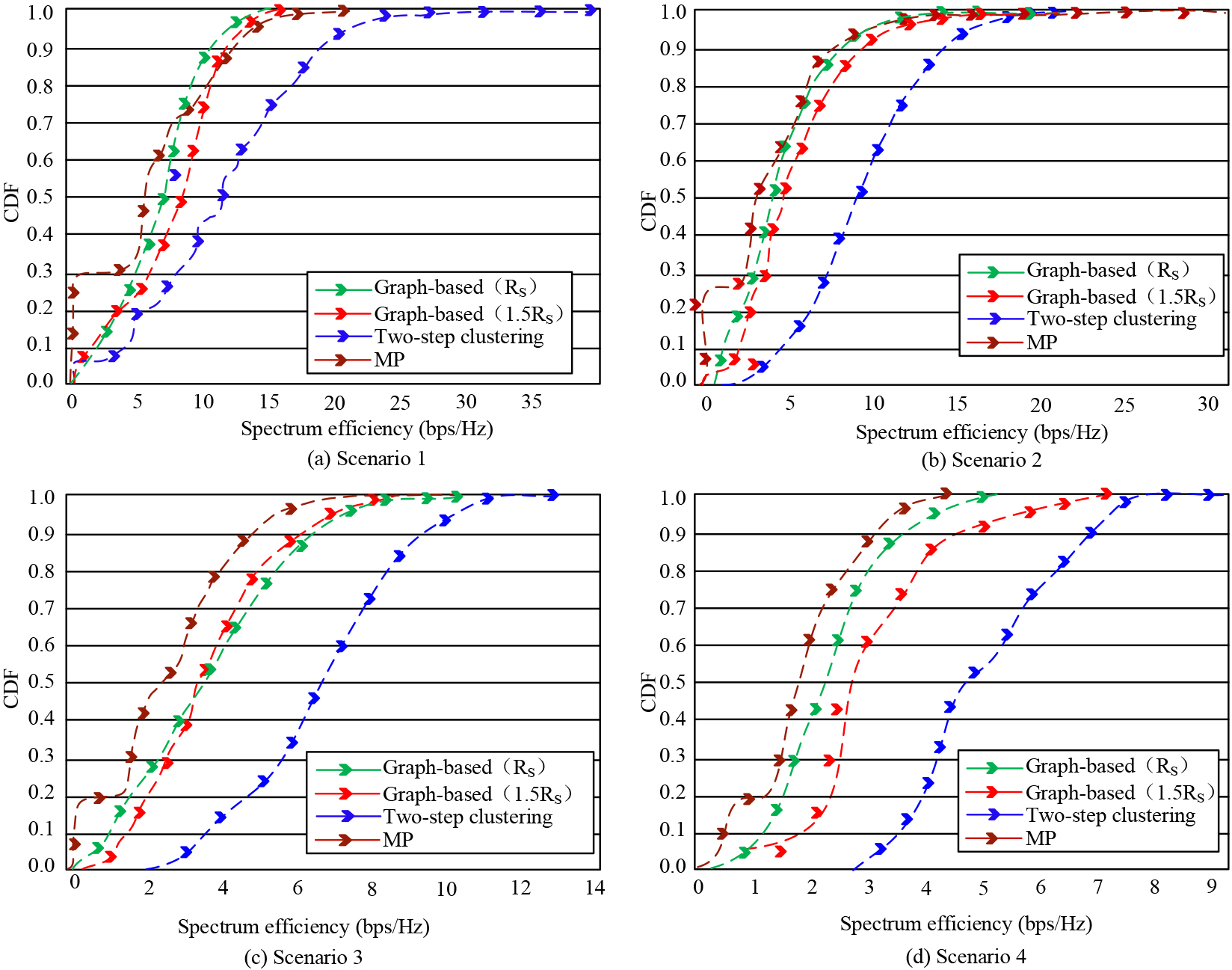
SINR of users under three algorithms.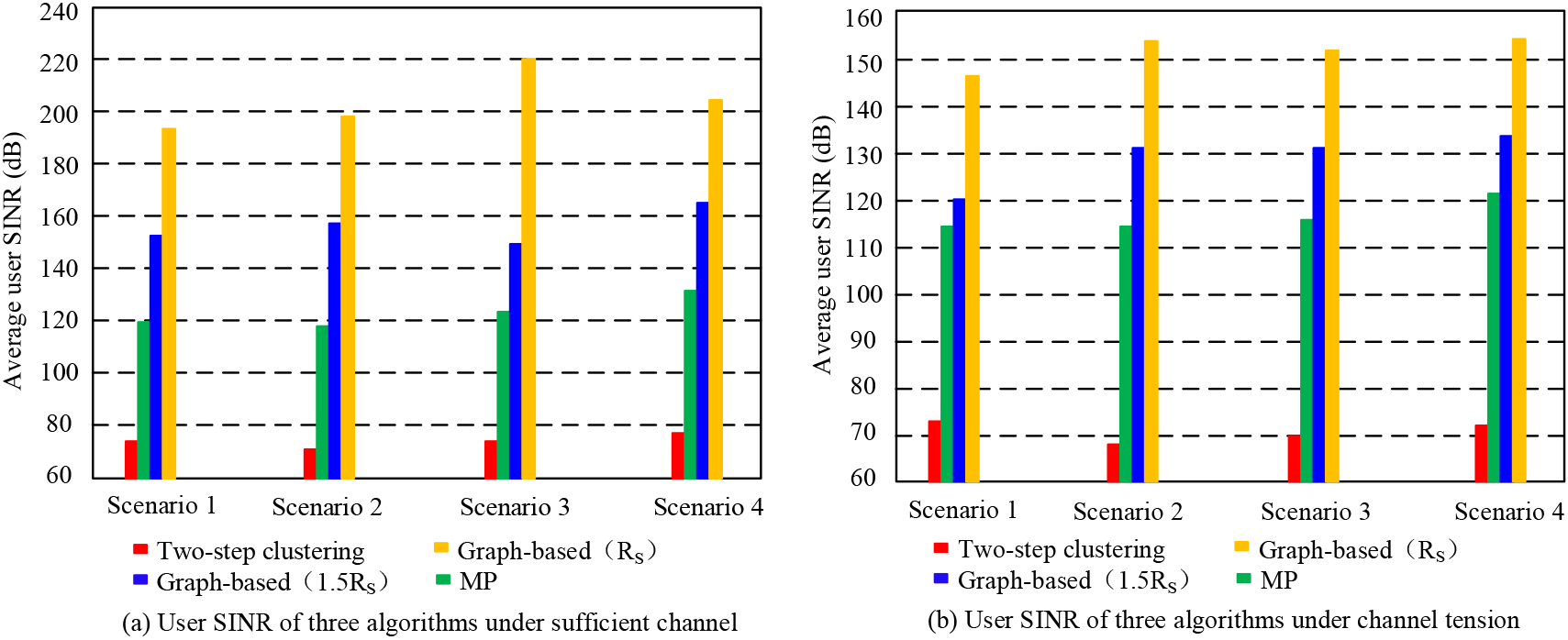
The algorithm’s spectrum efficiency CDF under the influence of channel tension is shown in Fig. 9. In Scenario 1, the two-step clustering algorithm has the best spectral efficiency, which is consistent with the circumstance in which the channel resources are adequate. However, as the cell size increases, the spectral efficiency of the two-step clustering algorithm gradually decreases, but it is always higher than the Graph-based algorithm,
Figure 10 shows the signal-to-interference-plus-noise ratio (SINR) received by users in different scenarios. It is not difficult to find from the figure that in the two situations of sufficient and tight channel resources, the SINR value of the two-step clustering algorithm is the lowest among the three algorithms, and the lowest can reach 75 dB, which has a very obvious advantage. However, the SINR of the Graph-based algorithm with the clustering distance is the
Mobile communication is one of the fastest-growing fields in the current communication field. The concentration and expansion of user populations has caused serious channel congestion, and the shortage of channel resources and interference between users have reduced user experience. Reasonable channel resource scheduling can reduce the probability of user data loss due to interference, and improve spectrum efficiency and user satisfaction. Therefore, with the goal of reducing system interference and improving spectrum efficiency, this research builds a multi-cell cooperative system framework, and constructs a two-step clustering algorithm based on the clustering idea of the DPC algorithm and the graph segmentation mechanism. Simulation experiments are compared with typical MP algorithms and Graph-based algorithms. The results show that the two-step clustering algorithm
Footnotes
Funding
This research was supported by a grant from Scientific Research plan project of Hubei Provincial Education Department (B2019296), Science and Technology Innovation Team Project of Hubei Province Excellent Young and Middle aged in Colleges and Universities (T2021042), Disciplinary group construction project of Wuchang Institute of Technology (2021XK01), and Research and Application of Campus Security Platform Based on Internet of Things of Wuchang Institute of Technology (2021KY02).