







Abstract
The key to the reform of the power system is to design a fair bidding and trading system. Analyzing the transaction process of electricity price competition, suppressing market power and other unfavorable factors, and finding a perfect bidding system are the research goals of this paper. In order to study the competition in the power spot market and power contract market, this paper employs the game model of complete information and the game theory as a tool. The power spot market adopts the Market Clearing Price (MCP) settlement method, in which the power grid determines the maximal real-time price of the generator node as the MCP. The price is based on the three bidding strategy curves of the power plant. As a result, a Nash equilibrium of power plant revenue is formed. According to the Cournot model and Stackelberg model that analyze the power contract market, the long-term equilibrium price of Stackelberg model in the power contract market is higher than that of the perfectly competitive market and less than or equal to the output of perfect monopoly market. The long-term equilibrium price and output in the power contract market are both certain and stable. This paper has analyzed the static game of complete information in the power market and carried out practical application. The results show that the bidding strategies of power plants have a Nash equilibrium and they have an incentive to collude. The MCP mechanism cannot solve the problem of market power influence. The conclusion of the research provides a basis for the design of the power hybrid auction system.
Introduction
Analysis of game competition among different players is important to study the bidding law of the power market. MCP (Market Clearing Price) and PAB (Pay-As-Bid) bidding mechanisms are compared in reference [1] to study the power generation market. The study concludes that the PAB bidding mechanism’s preset index evaluation system has greater advantages. Reference [2] used Evolutionary Game Theory (EGT) to study the power bidding’s Evolutionarily Stable Equilibrium (ESE). It has analyzed the two-bidding strategies of two power companies under random demands. It concludes that MCP bidding is better than PAB bidding in guiding the price of the power market to converge at the lower limit of the bidding. According to references [3, 4, 5], as power plants are capable of adaptive learning, the ensuing long-term bidding evolution features are closer to the reality of the power generation market. This is different from the bidding evolution pattern that have been derived from the traditional game theory. References [6, 7] carried out a simulation of the long-term bidding equilibrium of the two firms’ two-bidding strategies in the power generation market. The results show that a low-price equilibrium can be effectively promoted by setting a reasonable bidding interval. The research provides a scientific reference for policymakers and concerned agencies.
Reference [8] discussed the bidding strategy in the bilateral power market based on Nash equilibrium. Reference [9] established a Stackelberg game model, which analyzes the real-time pricing strategies and interactions among power retailers. The model gets an equilibrium solution and its simulation results can well explain the dynamic real-time pricing of the smart grid. References [10, 11] used game model of incomplete information to solve the Bayesian NE problem in the power market. Reference [12] contained a literature overview of current game theory research in the power market, so we won’t duplicate it here.
References [3, 4, 5] investigated pricing strategies for generation companies under incomplete information. Pricing problem for generation companies is an allocative decision with divisible object, solves an allocative decision problem by auction which discovers price effectively, describes discriminating pricing-auction rule with divisible object auction, builds the Bayesian game model of the divisible object auction under the generator’s private cost information, analyzes bidding behaviors of generation companies, moreover, resolves Nash equilibrium of a Bayesian game, transforms Nash equilibrium of a Bayesian game as Nash equilibrium of the strategic game, with regarding marginal cost as the type of players, and get bidder’s bidding strategy under a certain marginal cost function of bidder.
Although the construction of China’s electricity market is still in its infancy, considering the many advantages of electricity futures, it is necessary to discuss the construction of China’s electricity futures market. However, in recent studies, it is rare to see that in China’s electricity market. On the basis of the current situation of reform, the proposal of China’s power futures trading plan research and design.
In 2022, the National Energy Administration stipulates that 10% of new energy will be introduced to participate in the electricity market competition. One of the possible follow-up directions is to form a low price through the internal competition of the scenery. It is clearly stated that the competitive allocation of new energy is not a competitive price. The national average rate of return is about 8%, and the total investment rate of return is close to 6%.
The methods above have the following problems. First, when applying these methods, some data, such as the revenue function of power plant, is difficult to obtain, so simplified assumptions are made. Second, whether an equilibrium point exists in the power market is unclear in theory. These problems inhibit the application of game theory in power bidding. This paper follows the idea of breaking down complex problems into simple ones. It starts from the reality of power competition to avoid theoretical abstraction and unpractical analysis. It uses basic static games of complete information to analyze the bidding strategy of power plants and find the Nash equilibrium. The conclusion lays a foundation for the design of the power hybrid auction mechanism.
Pricing model of the power spot market based on static games of complete information
The main market for power competition is the power spot market, where most power transactions occur. Therefore, the price formation mechanism of the power spot market is the primary research object. The specific research methodology and findings are as follows.
Introduction of bidding rules in the active power market
The pool bidding rules are the ones that are most frequently utilized globally. First, the power plant will determine a strategy and send its bidding curve to the pool, based on which the pool will make the optimal economic dispatch, arranges a power generation plan, and determines the MCP [13].
Three bidding strategies of power plant
Although the power quotation curve is diversified, there are not many selection strategies for power plants in the quotation competition under the condition of complete information. Bidder will make choices based on actual experience to ensure a high probability of income.
Coal costs account for more than 60% of the total cost of power plants, so coal prices have a great impact on electricity prices. However, coal prices are determined by the market and are characterized by openness and transparency. So coal price is no longer a hidden variable. If this paper studies the bidding mechanism from the perspective of reducing market power, the impact of coal prices on the electricity market can be temporarily ignored. Focus on the study of the characteristics of the influence of the bidding mechanism on the electricity market price.
The bidding strategy of a power plant is based on its production cost. When the bidder is risk-seeking, he will use the high-price bidding strategy, indicating that the bidding price exceeds the cost. The low-price bidding strategy, which states that the bidding price is lower than the cost is what the risk-averse bidder will choose. The cost-based bidding strategy will be chosen by the risk-neutral bidder. Equations (1)–(3) depict the power plant’s bidding cost curve:
The bidding cost curve for risk-seeking bidder is:
The bidding cost curve for risk-averse bidder is:
The bidding cost curve for risk-neutral bidder is:
Where:
The pool refers to the bidding cost curve of power plant and aims to minimize the cost of power generation
Constraint conditions are:
(1) Power flow constraint equation:
(2) Generator active power output limit:
(3) Generator reactive power output limit:
(4) Transformer ratio limit:
(5) Node voltage amplitude limit:
(6) Maximum transmission limit:
To sum up, the economic distribution of generator’s active load is an optimization problem that takes into account minimizing the cost of power generation and satisfying six constraints [Eqs (5)–(10)]. Currently, the most popular OPF methods include the Newton method, the interior point method and the linear programming method [14].
Each power plant has three bidding strategies. There will be
Under the MCP settlement, the power grid uses the Newton method to solve the real-time active power price of the generator node [15], with the goal of minimizing the cost of power generation in a trading period. The expression is shown as follows:
Where:
Under MCP settlement of the pool, the power grid determines the maximal real-time price of generator node as the MCP
After analyzing the income statement and eliminating various combinations of dominated bidding strategies, we obtain the Nash equilibrium under different loads. Power plant i chooses its own optimal bidding strategy after considering the high, medium, and low bidding strategies of other power plants and its income status. The combination of optimal bidding strategies of all power plants constitutes a Nash equilibrium.
Long-term equilibrium pricing of the power contract market using static games of complete information
Power contract market is an important part of the power market. Different from the day-ahead power spot market, it focuses on the analysis of the long-term equilibrium pricing. This section uses static games of complete information and dynamic games of complete information to discuss the long-term equilibrium pricing of the power contract market.
Analysis of the oligopoly of the power contract market
The power contract market is an incomplete competitive market, so its competition characteristics is the first to be analyzed for equilibrium pricing. The features of the power contract market are as follows:
1) Only a few power plants
Due to the economies of scale, there are only a few power plants in the grid. According to reference [16], the minimum size of a coal-fired power plant is 800,000 KW, and the size of nuclear power plants is at least twice of the thermal power plants. If the power demand is fixed, the number of power plants will not be too many. Although the presence of many power plants are conducive for competition, they also increase the trading costs.
2) Interdependence
The power market adopts the competitive bidding. When bidding, the power plant must consider the competitor’s bidding strategy. As power plants cannot control power demand, they cannot determine the power market price alone. They are neither price makers nor price recipients, but price seekers.
3) Entry and exit barriers
The construction of a power plant requires a huge investment. As power generation equipment is very specialized, once it is put into use, it can scarcely be retrieved or used for other purposes. Therefore, the entry and exit barriers to the power plant are raised by this fixed sunk cost.
There are too many uncertain factors in the oligopoly market, making it challenging to estimate the demand curve of oligopoly companies. Therefore, it is hard to determine the market’s equilibrium output and price. However, some close-to-the-reality assumptions can help us find the market equilibrium solution.
Pricing model of the power contract market using Cournot model
The parties in the power contract market are power plants and power users. The trading in the power contract market does not involve the grid. The equilibrium price of the power contract market is a long-term equilibrium of the oligopoly market, and the classical Cournot model is the commonly used analytical model.
Assumptions of Cournot model of the power contract market
1) The reverse demand function of the power contract market has continuous second-order derivatives
The reverse demand function of electric energy product has continuity. It provides convenience for the theoretical research. Being concave and downward sloping, the function is in line with the law of economic supply and demand. It has continuous second-order derivatives, which shows that the electric energy product is a strategic substitution [17].
2) The strategy of power plant is to use naive assumption to predict the output
As the oligopoly market’s strategy is complex strategy, the power plant can adopt either naive assumption or sophisticated assumption. For simple research, the power plant uses the naive assumption, in which the power plant assumes that the competitor will not respond to its decision, and the plant will continue to maintain its original production and prices.
Cournot equilibrium solution of the power contract market
Take the duopoly power market as an example to solve the Cournot equilibrium. And then extend it to the equilibrium output and price of the oligopoly market of n firms.
1) Equilibrium solution of the duopoly power market
According to the assumptions of Cournot model, the common demand curve of firms
Profit function is:
Profit function is:
To maximize the profit, there is MR
2) General equilibrium solution of n oligopoly power markets
From the example above, we have the general equilibrium solution of n oligopoly power markets. Let the unit cost of n power plants be constant
The Nash equilibrium is obtained by solving n best-response functions: For
When the number of power plants
As the power trading is long-term, the bidding game of power plant is repeated and multi-stage. The power trading center will publish the price, so the power plant will know the first strategy of other competitors, before adjusting its bidding strategy in the second stage. The equilibrium point of the oligopoly market under dynamic game analysis is no longer that of Cournot model. The Stackelberg model, which was proposed by German economist Stackelberg, is a commonly used dynamic analysis model of the oligopoly market.
Assumptions of Stackelberg model
Stackelberg model assumes that the sophisticated firm is sure that other firms will naively follow the assumption of Cournot model. Therefore, the sophisticated firm determines its own production according to the reaction function of these naive firms and pursues its own profits like a complete monopoly firm. It does not need any reaction function. Moreover, the dominant firm acts as the leader of the market price or production, while other firms only act as followers [18].
Equilibrium solution of Stackelberg model of the power contract market
The game time order of power plants is as follows: (1) Firm 1 selects the output
The above formula yields:
Since firm 1 can solve the best response of firm 2, like firm 2. If it chooses
Thus, the reverse induction solution of Stackelberg game is:
From the long-term equilibrium pricing analysis of the power contract market, we obtain the following conclusions:
The equilibrium output of Cournot model in the power contract market is The equilibrium output of Stackelberg model in the power contract market is less than the output of perfectly competitive market and greater than the output of perfect monopoly market; The long-term equilibrium price of Stackelberg model in the power contract market is greater than the output of perfect competitive market and less than or equal to the output of perfect monopoly market. The long-term equilibrium price and output in the power contract market show both certainty and stability [19].
Reactive power cooperation model
Coalition of power generation companies, which comprises of n independent power plants and is put in aggregate as
In the case of S equaling N, model (1) means benefits arisen from bidding of the coalition comprising of n power plants [20]. In the case of
Benefits of power plants coalition is obtained on the basis of bidding in the name of the entire coalition. For the purpose of facilitating the formation of the coalition, reasonable benefits rules hereof shall be formulated, which has assignment rules of different categories and each called a solution to coalition cooperation. Among all assignment methods, Shapley value assignment has wide applications in practice. Solution to coalition cooperation defines rules for n-dimensional vector which refers to assignment to each member. In Shapley method, the vector is defined by Eq. (21).
where,
Suppose that among the
Production cost function distribution of power plant
(
)
Production cost function distribution of power plant
In this case, it seems that the power plant i competes with [
Suppose the production cost of power plant
Where,
Therefore, finding the solution to the Nash equilibrium (optimal generation combination) of the n power plants can be transformed into the following multi-objective optimization problem according to Eq. (23):
By finding the solution, the optimal electricity generation, maximum profit and market electricity price of each power plant can be obtained.
Introduction of IEEE-30 node system and power plants
This section uses the IEEE-30 node system to simulate the realistic power generation market (Fig. 1). It analyzes the formation law of on-grid power tariff using static games of complete information and discusses the bidding strategy choice of power plant. The market has 3 power plants a, b, c, and 6 generators, which are located at nodes 1, 2, 5, 8, 11, 13, respectively. Power plant a has generators 1, 11; power plant b has generators 2, 13; and power plant c has generators 5, 8. The economic parameters of generators are shown in Table 2.
Economic parameters of generators and lower limit of watt
Economic parameters of generators and lower limit of watt
Power plants A, B and C have three bidding strategies: high, medium, and low bidding strategies (S, L and A), forming 27 bidding strategy combinations. Then, their cost coefficients are shown in Table 3:
Cost coefficients of power plant
Cost coefficients of power plant
Construction of IEEE experimental switch topology.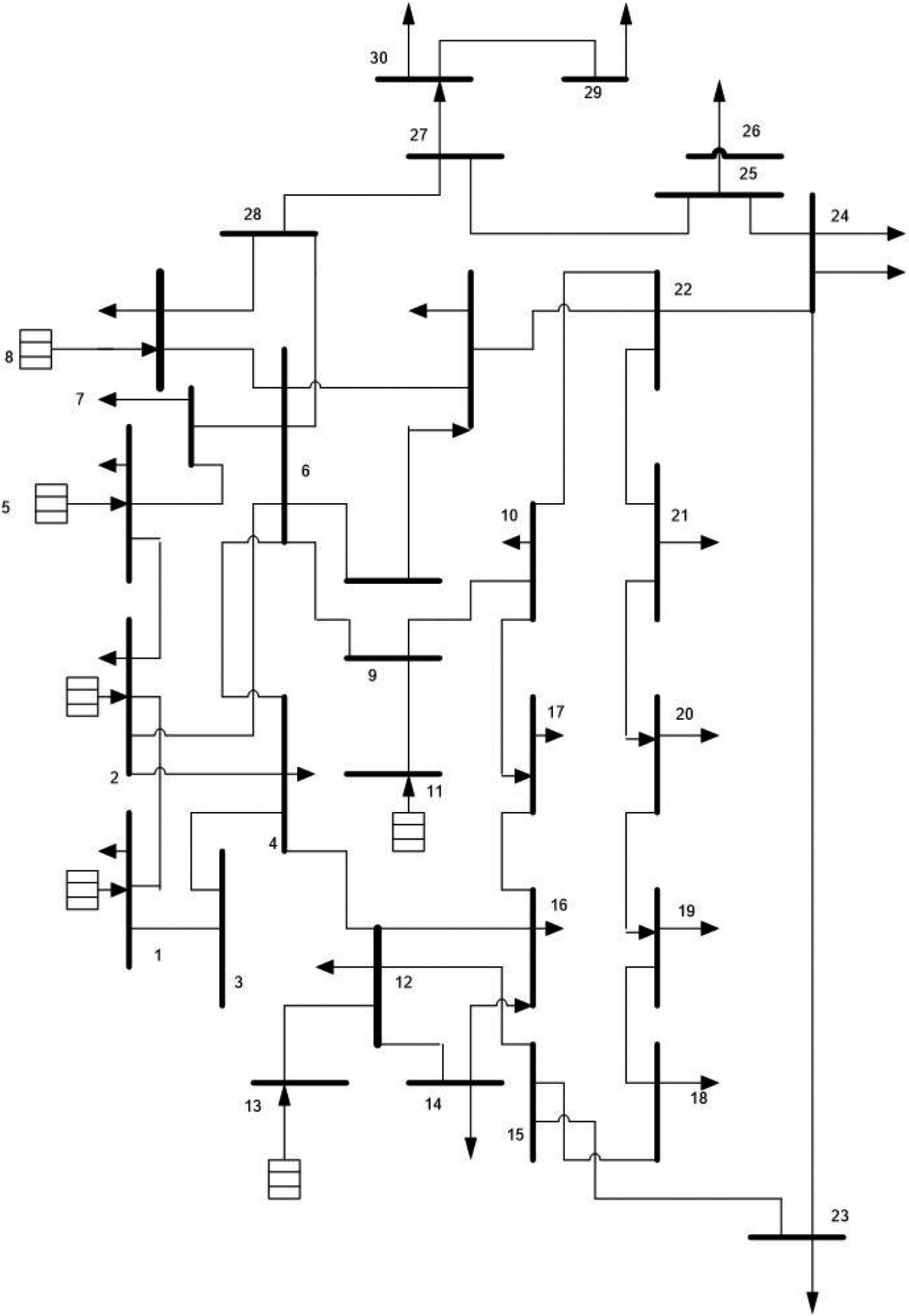
For each bidding strategy combination, the load of 6 generators is distributed according to the principle of minimizing the power generation cost. The normal load is assumed to be 290 MW and the peak load is 370 MW. Through the power flow optimization of load distribution, we obtain the optimal load distribution of power plant, price of generator node, MCP and minimum power generation cost. For brief expression, this paper only lists the load distribution under 6 bidding strategy combinations. Tables 4–6 shows the detailed load distribution scheme.
Watt distribution under 6 bidding strategy combinations (watt 290 MW)
Watt distribution under 6 bidding strategy combinations (watt 290 MW)
Watt distribution under 6 bidding strategy combinations (watt 370 MW)
Cost, price and generators 5, 8 under 6 bidding strategy combinations (watt 290 MW)
After solving the optimal load distribution scheme, we find out the maximal real-time price of generator node as the MCP according to the market clearing principle. By calculating the revenue function of generator:
Power plant revenue under 6 bidding strategy combinations (watt 290 MW)
Power plant revenue under 6 bidding strategy combinations (watt 290 MW)
Power plant revenue under 6 bidding strategy combinations (watt 370 MW)
Power plants A, B, and C seek their own optimal bidding strategy driven by profit maximization according to their income statement. Finally, they get a Nash equilibrium that is acceptable to all. The Nash equilibrium at the two load levels are shown in Tables 9–10.
Nash equilibrium of watt 290 MW
Nash equilibrium of watt 290 MW
Nash equilibrium of watt 370 MW
The Nash equilibrium at the two load levels belongs to the dominant strategy equilibrium. At the normal load level, the optimal bidding strategy of power plant A is the risk-averse bidding strategy, and the optimal bidding strategy of power plants B and C is also the risk-averse bidding strategy. As a result, all the three power plants will choose the risk-averse bidding strategy. At the high load level, the optimal bidding strategy of power plants A and C is the risk-averse bidding strategy, but the optimal bidding strategy of power plant B depends on the bidding strategy combination of power plants A and C. However, as a rational power plant, power plants A and C will choose the risk-averse bidding strategy combination because it can maximize their own benefits. As a result, power plant B will choose S bidding strategy. This also proves that during peak load periods, power plants can use market power to raise prices [20].
The analysis of the static game of complete information in the power market and the practical application prove that the power plant bidding strategy has a Nash equilibrium, and power plants may collude. Under the MCP mechanism, the power plant has the market power to report a high price, especially in the period of peak load. Public bidding can improve the efficiency of market competition, and it provides an opportunity for the power plants to learn and form a tacit understanding. The conclusion provides a basis for the design of power hybrid auction mechanism. Reference [1] believed that PAB does not encourage marginal cost bidding for power plants, as it may not to reduce the power purchasing cost in the market. As for the application of the two settlement methods in the power market, there are different attitudes according to reference [21]. The innovation of this paper is to use the simplest static game analysis to prove that the existing power auction mechanism does not achieve the purpose of fair competition in the power market.
Based on the conclusion and previous research, the use of hybrid auction mechanism, such as English Auction or Dutch Auction, may reduce the market power of power plant and generate the price of free competition. In the first stage of auctioning process, British auctioning method, open and highly efficient, is adopted to eliminate some electricity companies. In the second, new bids are offered by power plants, the hammer price of the first stage being the ceiling price; and the on grid price is decided through Dutch sealed auctioning. Two stage British-Dutch auction mechanism does not only improve competition efficiency in electricity market, but also hold in check simple clearing process and control of power plants over market power. Compared with single auction mechanism, two stage British-Dutch auction mechanism could give play to merits of each mechanism; it combines efficiency with fairness. In addition, in the two stage auction, each power plant is required to offer bids two times only to decide the winner, clearing process and multi iterative bidding both simplified. In the second stage, the mechanism of eliminating the bidder with highest bid and sealed prices encourage bidders to speak truth more voluntarily.