






Abstract
The high-quality development of the logistics industry, which is an essential and strategic industry supporting the national economic operation and a fundamental component of modern industrial system construction, is not only a key component of the high-quality development of the national economy but also the main driving force for the high-quality growth of the national economy. As the supporting industry of the national economy, the logistics industry will also face spatial disequilibrium during development. Therefore, to achieve the coordinated development of the logistics industry, the high-quality development and the spatial-temporal unbalanced development status of the logistics industry in each province must be figured out first. This research established a comprehensive evaluation system for the logistics industry development, which included 14 basic indexes based on the provincial-level panel data of 30 provinces in China during 2009–2020. Then, the regional logistics development level score in China was measured using the entropy weight TOPSIS method, and the differences in the regional logistics development level in China and the dynamic evolution law of their distribution were deeply explored through the Dagum Gini coefficient model. The research results revealed that the evaluation index system (14 basic indexes) for the regional logistics industry development level in China was relatively scientific and reasonable; the regional logistics industry development level in China was increasing year by year, showing a steady upward trend, and the imbalance in the eastern, central, and western regions regarding the regional logistics development was shrinking year by year; the average intergroup contribution rate was 36.33%, the intragroup contribution rate was 31.49%, and the contribution rate of intensity of trans variation was 32.19%, proving that the regional differences exerted a most extraordinary influence on the spatial differences in the regional logistics industry development level in China. The research results have important reference value for summarizing the meaning of high-quality logistics industry development, constructing the evaluation index system for logistics industry development, and exploring the reasons for the temporal and spatial differences in logistics industry development in China.
Introduction
China’s economy has transitioned from a high-speed growth stage to a high-quality development stage, and it is in a key period of changing the development mode, optimizing the economic structure, and transforming the growth momentum [8]. Changing the mode of economic development and improving the total factor productivity have become the main themes of China’s economic development. The logistics industry, a basic and strategic industry in China, provides other industries with specialized circulation services. As a supporting industry of the national economy, the logistics industry plays an important role in promoting economic development, so its high-quality development is significant for achieving it. Moreover, it is also an important force to promote high-quality economic development. A significant path to high-quality economic development lies in facilitating the high-quality development of the logistics industry, which has become one of the important industries in China. With the attribute of producer services, the logistics industry runs through multiple links such as manufacturing and tertiary industry services, and the circulation efficiency of the whole society can be substantially improved by enhancing the efficiency of the logistics industry, which helps other industries to strengthen the quality and efficiency of services, to generate profound influences on different industries in the industrial structure, influence the transition of the entire industrial structure, and optimize the allocation of social resources. There is a large space for improvement in the logistics industry regarding effective resource utilization. The total factor productivity of the logistics industry is an important index to measure its comprehensive efficiency. The increase in the total factor productivity of the logistics industry can not only effectively promote the quality change, efficiency change, and impetus change of the logistics industry but also drive the efficiency improvement and technological progress of other industries due to its characteristics of producer services.
The recent years have witnessed the rather rapid development of China’s logistics industry. However, achieving the high-quality development of the logistics industry refers to realizing balanced and coordinated development, which is the core connotation. In contrast, the scale distribution of urban logistics industries is the most fundamental manifestation of logistics resource allocation, which can be used to judge whether the logistics industry development level and its spatial distribution are reasonable. Nevertheless, interregional economic foundations and other conditions differ in a thousand ways due to the varied resource endowments in China with such a vast territory. Specifically, large cities possess a good foundation for the development of the logistics industry. In contrast, the logistics industry development in small and medium cities is relatively backward, and the insignificant interregional difference in the logistics industry scale distribution impedes high-quality logistics development. Hence, the key to the balanced and high-quality development of the logistics industry lies in measuring the interregional difference in the logistics development level more scientifically, mastering the interregional differences and evolution trends, which is helpful to grasp the evolution law of the logistics industry scale distribution, and operating the logistics scale distribution structure. In the state-advocated regional coordinated development environment at present, it is very crucial to deeply explore the long-term evolution trends of interregional differences in the logistics development level in China, which, on the one hand, can boost the development of regional logistics industries and economy, and on the other hand, provide a new idea for achieving the balanced development of logistics industries and providing a new idea for policy-making.
State of the art
The measurement of the regional logistics development level has been widely studied in the world, and the difference in the regional logistics development level also exists widely in different periods and regions. On a global scale, regarding the comprehensive evaluation of the logistics industry development level and the analysis of the regional logistics development level difference, Gao et al. [6] believed that the logistics industry was a new producer service industry and quantified the development of the logistics industry using the regional entropy coefficient. The results show that the correlation between the logistics industry and industries is sorted, in descending order, as the primary, tertiary, and secondary industries. Ding et al. [5] collected the relevant data on the logistics industry in the Yangtze River Delta region from 2011 to 2020, determined the index weight by the anti-entropy method, and processed the data. The results reveal that the land use level in the Yangtze River Delta region significantly differs in time and space, and the coupling and coordination state between subsystems is significantly different. Chen [1] established an evaluation index system for the container shipping alliance’s cooperative operation level and constructed the container shipping alliance’s cooperative management framework using the fuzzy quality function deployment method. Tian and Zhang [15] used the entropy weight method to evaluate the logistics industry development level in 31 provinces of China. They found that the logistics industry development level has a spatial agglomeration effect, and regional differentiation exerts an obvious local influence on the spatial agglomeration effect of the logistics industry development level. Wu et al. [4] evaluated the ecological efficiency of the linkage between northeast China’s logistics and manufacturing industries during 2011–2019. The results reflect that the spatial aggregation of the logistics industry experiences a spatial evolution process from the southern coast to the central region. Heitz and Beziat [10] analyzed the logistics activities of the parcel industry in Paris. The results show that logistics activities are highly related to the economy, and there are obvious regional differences. Giuliano and Kang [7] studied the regional trends of the logistics industry in the four largest California metropolitan areas from 2003 to 2013. The results show that the metropolitan scale, economic development policies, non-local trade share, and local geography are the main reasons for the regional differences in the logistics industry. Tang et al. [17] discussed and analyzed the structural characteristics of the spatial correlation network of carbon emission efficiency in China’s logistics industry and pointed out that during 2010–2019, the nationwide average carbon emission efficiency of the logistics industry presented a rising trend and a stable spatial correlation network was already formed regarding the carbon emission efficiency of the logistics industries in 30 provinces and districts of China, with an evident spatial spillover relationship. Through research on the spatial agglomeration and location decisions of logistics enterprises, Van den Heuvel et al. [16] concluded that logistics institutions in regional special economic zones were more likely to move to regional special economic zones than non-regional special economic zones. Guo et al. [9] stated that the logistics industry’s population, property, technology, energy, and other factors influence carbon emissions differently. Big cities should formulate corresponding emission reduction policies based on technological innovation, infrastructure, and personnel training. Li and Wang [11] believed that the spatial differentiation of China’s logistics industry in the eastern region was larger than that in the central region on average and that in the central region was larger than that in the western region, presenting evident spatial non-stationarity. Zhang [19] analyzed the relationship between logistics development and economic growth in various regions of China and selected logistics capacity, input, and manpower as three input indexes representing logistics development in different regions. It was found that logistics investment played the greatest role in promoting the economy in developed logistics regions and regions with ordinary logistics development. Liang et al. [13] pointed out that during 2010–2020, the low-carbon logistics efficiency in 13 cities of Jiangsu improved steadily, but the intercity efficiency difference was gradually prominent. Yang et al. [18] reflected that the fiscal revenue level, logistics infrastructure investment level, logistics network accessibility, logistics development level, and urban economy were closely related to the coordinated logistics development level. Quan et al. [14] indicated that economic growth was the main factor in promoting carbon emissions in the logistics industry, followed by the positive impact of population size and energy structure. Li and Sun [12] revealed that the total carbon emissions of the logistics industry in China increased, and the total carbon emissions and growth rate in the eastern region were significantly higher than those in the central and western regions. Intra-regional differences are the main reasons for the overall carbon differences, while regional differences have little impact on the overall difference. Deng et al. [3] analyzed the overall level and spatial characteristics of China’s logistics industry efficiency, and the results showed that there were great regional differences in China’s logistics efficiency, showing a gradual downward trend from east to west. Zhang et al. [20] showed that the coupling and coordination level of economy and logistics in the western region remained low. In contrast, that in most central and eastern regions was relatively high. The coupling and coordination level of China’s logistics industry and regional economic development is not high in different regions.
The existing research literature shows that many Chinese and foreign researchers have proposed the conceptual connotations, characteristics, and implementation paths by combining the logistics industry development theory, the industrial development theory, and the development economics-related theory. Many scholars have established the evaluation framework for the logistics industry development level from multiple aspects, such as the objects, objectives, principles, methods, and evaluation content, using the systematic evaluation method. Different evaluation methods have been integrated to measure the logistics industry development level in different periods and regions. However, evident differences are observed in both methods and time dimensions. Therefore, based on the existing research, an evaluation index system for the regional logistics development level was established, the entropy weight TOPSIS method was adopted to measure China’s logistics industry development level, and its spatial and temporal evolution characteristics were analyzed. Then, the spatial differences in China’s logistics industry development and their reasons were further discussed using the Dagum coefficient model, expecting to provide relevant suggestions for improving China’s logistics industry development level and narrowing its spatial differences.
Entropy weight TOPSIS model
Firstly, China’s regional logistics development level was measured using the entropy weight TOPSIS model, the general calculation method of which is as follows. First, data processing was performed as per the following formula:
Positive indexes were calculated using Eq. (1)
Negative indexes were solved as per Eq. (2)
Equations (1) and (2),
In Eq. (3),
Where
Next, the weight of each measurement index was determined as per Eq. (6).
The weighted decision matrix
Where
The optimal scheme
Then,
Afterward, the relative closeness
Traditional methods to describe the spatial disequilibrium of variables include standard deviation, coefficient of variation, weighted coefficient of variation, and Gini coefficient, which, however, cannot further decompose regional gaps, thus failing to reveal the sources of regional differences. Compared with the traditional Gini coefficient method, the Gini coefficient proposed by Dagum [2] and the decomposition method as per subgroups are defined as shown in Eq. (11), where
In the process of Gini coefficient decomposition, regions should be sorted first according to the mean value of the regional logistics development level. As per the Gini coefficient decomposition method of Dagum [2], the Gini coefficient can be divided into three parts: contribution of intraregional gap
In Eqs (12) and (13) represent the Gini coefficient
Where
Data sources
Constructing an evaluation index system for the logistics industry development level is a comprehensive and complicated subject. To avoid subjectivity and arbitrariness in index selection, measurement indexes were chosen in this study according to the principles of comprehensiveness, scientific merit, systematic, comparability, and operability, which could systematically and accurately reflect China’s logistics industry development level on the premise of ensuring the original data quality and the accuracy of the final measurement result. According to the above principles and combining the existing research literature, the logistics industry development level was restricted as the first-level indexes in three aspects: logistics macro-development level, logistics demand development level, and logistics supply development level. Finally, a measurement index system consisting of 14 basic indexes for the development level of the regional logistics industry in China was established, as seen in Table 1. The industrial structure rationalization index was mainly measured using the factor input structure-output structure coupling degree in the above index system. In this research, the logistics industry development level of 30 regions (restricted by information availability; the data of Tibet Autonomous Region, Taiwan, Hong Kong, and Macao were excluded) in China was measured from the provincial level considering the data availability and the period of samples was 2009–2020. The sample data mainly came from China Statistical Yearbook, China City Statistical Yearbook, China Statistical Yearbook of the Tertiary Industry, China Statistical Yearbook on Science and Technology, and China Energy Statistical Yearbook over the years as well as the statistical yearbooks of different regions.
Relevant data of civil aviation incidents in China during 2005–2020
Relevant data of civil aviation incidents in China during 2005–2020
Taking the statistical data of civil aviation incidents during 2005–2020 released by the official website of the Civil Aviation Administration of China as an example (Table 1) (CAAC, 2005–2020), the civil aviation incidents in 2021 were predicted to verify the model’s effectiveness.
China’s regional logistics development level during 2009–2020
China’s regional logistics development level during 2009–2020
It can be seen from Table 2 that from the national perspective, the entropy weight TOPSIS score of China’s regional logistics industry development level showed an upward trend. According to the time series characteristics, the average score of the national logistics industry’s high-quality development level increased from 0.303 in 2009 to 0.337 in 2020, with an increase of 1.02%. Among them, the score decreased slightly from 2009 to 2012, possibly related to the global financial crisis of 2008. Since 2012, the Chinese government has successively announced the implementation of a moderately loose monetary policy and active fiscal policy, and the fiscal policy was turned from steady to active. Four trillion yuan was invested in infrastructure construction and key projects, and many logistics construction projects fully demonstrated China’s response to international and domestic economic challenges. meanwhile, it was a practical action to strengthen international cooperation and safeguard world economic development. Through the above actions, the development level of China’s regional logistics industry has been improved as a whole.
Descriptive statistical results of China’s regional logistics development level during 2009–2020
It can be seen from Table 3 that from the regional perspective, the scores of the regional logistics industry development levels in 30 provinces of China maintained a steady growth trend from 2009 to 2020, but the score and growth rate displayed specific disequilibrium and significant regional differences. As for regional ranking, the regional logistics industry development level ranking in Beijing and Shanghai almost did not change, indicating that the regional logistics industry development trend in Beijing and Shanghai was steady and improved. However, the development trend could not be neglected. The logistics industry development in the central region was also faced with incomplete infrastructure and a low degree of opening, with the innovation capability remaining to be improved urgently. The western region showed the lowest and slow development of the logistics industry, and the development was limited by many objective conditions, making it necessary to treat the problem comprehensively. The development degree of China’s regional logistics industry was characterized by regional disequilibrium, manifested by a spatial distribution pattern “good in the western region and poor in the western region”. During the sample investigation period, the interprovincial coefficient of variation (CV) of China’s regional logistics development level presented a declining trend year by year, which, from a certain level, reflected the fast growth rate of China’s regional logistics development level in the region with a partially low original development level. In other words, an obvious “catching-up” effect between regions with low and high development levels and the imbalance of logistics development in the eastern, central, and western regions was reduced year by year.
According to Eqs (11)–(19), programming was performed using MATLAB R2017b software, and the corresponding values were measured. Finally, the intraregional and interregional differences in China’s regional logistics industry development level and the sources of spatial differences were summarized using the measured Dagum Gini coefficient, as seen in Table 4.
Difference decomposition results based on Dagum Gini coefficient
Difference decomposition results based on Dagum Gini coefficient
It can be seen from Table 4 that From a national perspective, the spatial difference in the regional logistics industry development level in China was decreasing continuously, and the overall Gini coefficient dropped from 0.286 in 2009 to 0.250 in 2020. A possible explanation was that although the development quality of the logistics industry in all provinces was improved to varying degrees during the sample period, the heterogeneity of basic endowments and development environment among provinces made it possible for provinces with poor development quality to catch up with leading provinces rapidly. The gap between leading and lagged-behind provinces sometimes presented a shrinkage trend.
From the regional level, the intra-regional differences were sorted, in descending order, as eastern region
Contribution rate results based on Dagum.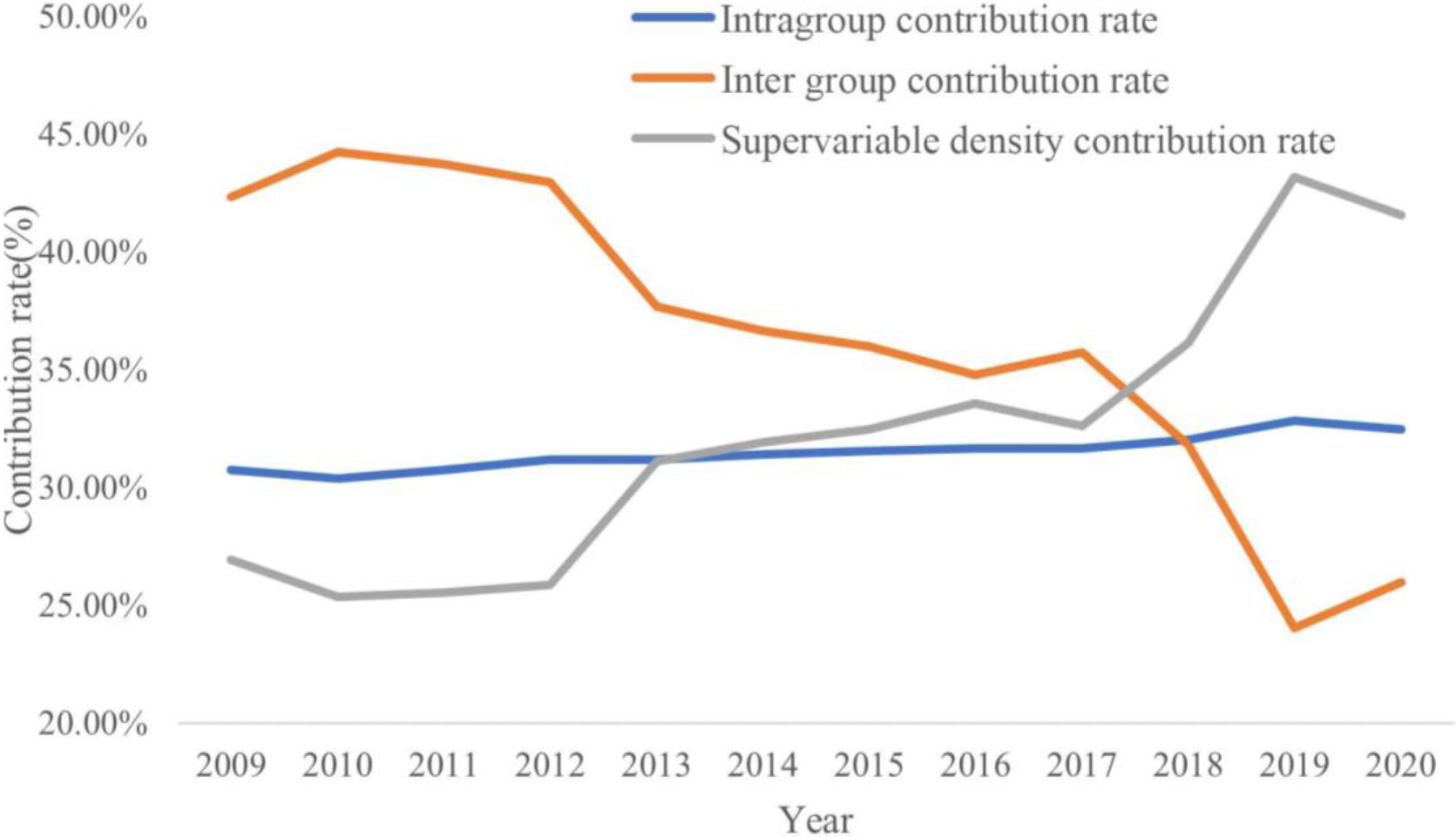
It could be observed from Fig. 1 that the contribution rate of interregional differences to the spatial differences in the regional logistics industry development level in China was the largest, with an average value of 36.33%, showing a rising trend on the whole during the sample period. The contribution rate of interregional differences declined from 42.34% in 2009 to 25.96% in 2020. The contribution rate of intraregional differences to the spatial difference in China’s regional logistics industry development level was the second largest, with an average value of 31.49%, showing a weak rising trend in the sample period. The contribution rate of intraregional differences increased from 30.75% in 2009 to 32.46% in 2020. Trans-variation density was the smallest contributor to the spatial difference in China’s high-quality logistics industry development level, with an average value of 32.19%, presenting an overall rising trend in the sample period. The contribution rate of density of trans-variation grew from 26.92% in 2009 to 41.58% in 2020. The above decomposition results showed that interregional differences exerted the greatest influence on the spatial difference in China’s regional logistics industry development level, and the interregional development differences, especially the differences between the eastern region and the central and western regions, should be further reduced. In addition, importance should also be attached to the typical fact – the high contribution rate of intraregional differences to spatial differences- to coordinate the internally coordinated development more powerfully. Of course, interregional overlap differences played a non-negligible role in spatial differences, and a resultant force could be formed by strengthening interregional collaboration and linkage development to improve the development quality of China’s logistics industry jointly. The research conclusions also enlighten the logistics administrative departments in China to master the dynamic evolution process of the logistics industry and coordinate logistics resource allocation from the national level, to reduce interregional development gaps. Each region, especially the eastern, central, and western regions, should further optimize the interprovincial logistics resource allocation and shield the internal unbalanced evolution trend.
The logistics industry occupies a basic, strategic, and leading position in China’s economic and social development, which is of great significance to the development of the national economy. Its high-quality development is also a powerful driving force to promote high-quality economic development. In the process of fostering high-quality logistics industry development, attention should be paid to the imbalance of logistics industry development between different regions, aiming to shrink the interregional development gaps. In this research, a comprehensive evaluation system, which included 14 basic indexes, for logistics industry development was established first. Second, China’s regional logistics development level score was measured using the entropy weight TOPSIS method. Finally, the differences in China’s regional logistics development level and the dynamic evolution laws of their distribution were deeply explored based on the Dagum Gini coefficient model. Then, the following three conclusions were drawn: (1) The measurement index system consisting of 14 fundamental indexes for China’s regional logistics industry development level was relatively scientific and reasonable; (2) China’s regional logistics industry development level grew year by year, presenting a steady improvement trend, and the unbalanced logistics development phenomenon among the eastern, central, and western regions was mitigated year by year; (3) the intergroup contribution rate, the intragroup contribution rate, and the contribution rate of density of trans-variation were 36.33%, 31.49%, and 32.19%, respectively. It is suggested that deep research can be continuously carried out on measuring high-quality logistics industry development levels from the city level, accurately measuring the factors influencing the high-quality logistics industry development, and establishing richer measurement systems for the logistics industry development level.