






Abstract
Background:
The COVID-19 pandemic has increased the need for remote healthcare options among patients with Huntington’s disease (HD). However, since not every HD patient is suitable for telehealth, it is important to differentiate who can be seen virtually from who should remain as in-person. Unfortunately, there are no clinical guidelines on how to evaluate HD patients for telehealth eligibility.
Objective:
To standardize the teleneurology selection process in HD by implementing a screening tool that accounts for patient-specific factors.
Methods:
We organized various indications and contraindications to teleneurology into a flowchart. If any indications or contraindications were met, patients were assigned to telehealth or maintained as in-person, respectively. If no indications or contraindications were met, patients were given the option of telehealth or in-person for their upcoming appointments. In two implementation cycles, we tested this screening tool among all HD patients scheduled for clinic visits, aided by chart review and phone interview.
Results:
In a cohort of 81 patients, telehealth acceptance among eligible patients increased from 45.0%to 83.3%. Frequency of telehealth visits increased from a pre-intervention baseline of 12.8%to 28.2%.
Conclusion:
Teleneurology utilization among HD patients more than doubled across our study. Our intervention promotes consistency and patient-centeredness in HD clinical care and streamlines the overall telehealth selection process. Future studies can seek to reduce telehealth no-shows and also evaluate the utility of the motor and psychiatric criteria included in our screening tool.
INTRODUCTION
The COVID-19 pandemic has rapidly increased teleneurology utilization throughout the United States. In a mere six weeks after a national emergency was declared in March 2020, several tertiary care centers converted over 90%of outpatient neurology visits to online [1–3], and others have seen their teleneurology volume more than quintuple [4, 5]. This sudden transition from in-person to virtual visits is not surprising, given that telehealth mitigates disease transmission. But aside from social distancing, telehealth confers other benefits such as the overcoming of geographic barriers and overall savings in both time and cost [1–3, 6]. Indeed, the national climate surrounding healthcare policy now favors greater adoption of telehealth, as reflected by the relaxation of requirements on licensure boundaries as well as increased reimbursement for telehealth visits [2, 7].
However, teleneurology has drawbacks, most notably a limited neurological examination. Diagnostic accuracy may be compromised over the computer screen, and some maneuvers cannot be performed without an in-person clinician [1–3]. Moreover, technological requirements pose certain barriers to successful participation in virtual visits [1, 9]. Some patients lack access to internet connectivity or even a computer altogether, while others lack the technical skills required to appropriately configure their online portals. Indeed, not all neurology patients are suited for telehealth, and it is inadvisable to indiscriminately transition every patient to telehealth without weighing patient-specific factors. How, then, do we determine who is eligible for telehealth, and who should be maintained as in-person?
Several studies have already speculated about certain types of patients that may be most suitable for telehealth [1, 10]. Olszewski et al. recommends telehealth for patients who are established and have stable disease symptoms, as well as those who do not require in-person activities such as blood draws [1, 7]. Al Kasab et al. suggests that telehealth is suitable for outpatient visits during the COVID-19 pandemic and for those who only require monitoring of chronic conditions such as multiple sclerosis and epilepsy [7, 10]. However, no study to date has examined how such considerations should be realized in actual clinical practice. Therefore, we piloted a screening tool to evaluate telehealth suitability among patients at a tertiary Huntington’s disease (HD) clinic. This screening tool provides an objective framework for patient-centered decision-making and streamlines the telehealth selection process. Our data show that this intervention can increase telehealth utilization and also selects for patients who are most suitable for and receptive to teleneurology.
METHODS
This study was conducted at a large level 1 HD Center of Excellence that serves approximately 465 patients from over 20 states. Importantly, prior to the COVID-19 pandemic, telehealth was not available for clinic visits at our study center. We organized various indications and contraindications to telehealth into a flowchart (Fig. 1). Indications included immunocompromised status (e.g., AIDS, current chemo-radiation therapy, etc.) and recent (<2 week) SARS-CoV-2 diagnosis in self or in any household member. Contraindications included new patient status; attendance at another same-day activity requiring in-person presence at VUMC such as research studies, disclosure of genetic testing results, or appointments with neuropsychology or rehabilitation services; psychiatric comorbidities [11, 12] such as untreated mood or substance use disorder, aggressive or explosive behavior, or suicidal attempt or ideation within the previous year; unreachability for phone interview; unwillingness or inability to travel to a state in which clinician is licensed (if patient is located outside clinician licensure boundaries); inability or unwillingness to configure the online patient portal if not already configured; and worsening motor symptoms such as progressive dysphagia and recurrent falls that would warrant in-person evaluation. Of note, geographic distance was not included as a criterion since our study center has a financial relief program for long-distance travelers; services include reimbursement for fuel costs and vouchers for local lodging.
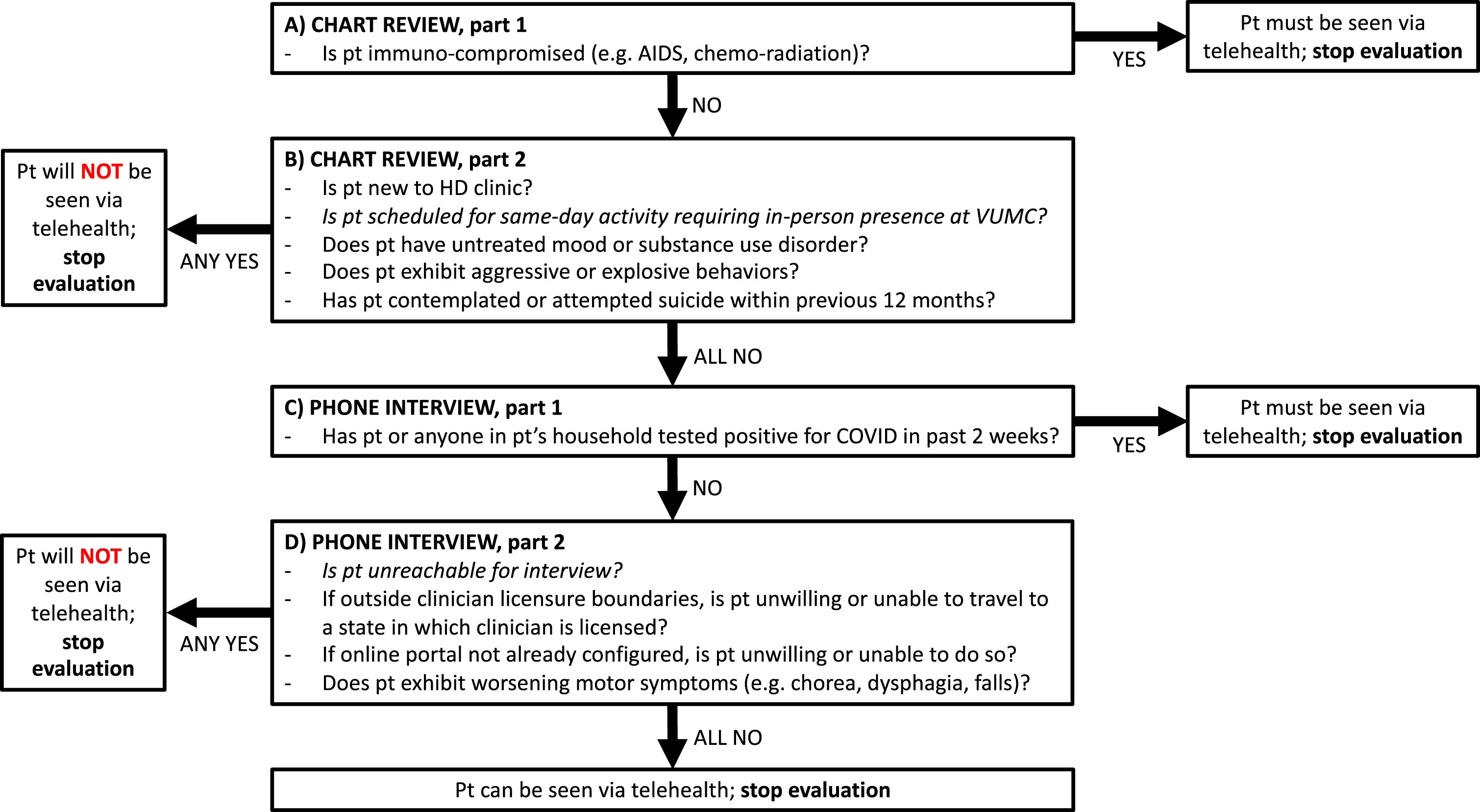
Screening tool to select HD patients for telehealth. Chart review precedes phone interview in evaluation process. Sections A and C contain indications, and Sections B and D contain contraindications to telehealth. Italicized items were added after first implementation cycle. Pt, patient; AIDS, Acquired Immunodeficiency Syndrome; HD, Huntington’s disease.
In two implementation cycles of four weeks apiece, we evaluated HD patients scheduled for clinic visits for telehealth suitability using our screening tool (Fig. 1). Decisions about telehealth candidacy were rendered in interdisciplinary meetings involving neurologists, neuropsychologists, social workers, and clinical researchers. Patients were first evaluated by chart review (Sections A and B) and, if indicated, subsequent phone interview (Sections C and D). During both chart review and phone interview portions, patients were first assessed for indications requiring telehealth (Sections A and C) before they were assessed for contraindications (Sections B and D). Patients were immediately assigned to telehealth if they met any indication (‘yes’ to Section A and/or C); patients were disqualified from telehealth and maintained as in-person if they met any contraindication (‘yes’ to any item in Section B and/or D). If patients answered ‘no’ to all items in Sections A through D, they were given the option of telehealth or in-person for their upcoming appointments.
One week before the visit, patients who chose telehealth were messaged via the online patient portal with instructions on how to access ZoomTM audiovisual conferencing technology, the platform utilized at our study center. Each telehealth appointment consists of an interim history, focused physical and neurological examination, patient counseling, refilling of prescriptions, and placement of appropriate referrals. Among the patients who were given a choice between telehealth or in-person, we tracked the proportion who elected to be seen virtually; we also tracked the show-rate among patients scheduled for telehealth. Finally, we noted the reasons why eligible patients refused telehealth and refined our screening tool accordingly between the two implementation cycles.
RESULTS
In the six months before screening tool implementation, 46 of 358 (12.8%) clinic patients were seen via telehealth. In the first implementation cycle, 20 of 42 (47.6%) total patients answered ‘no’ to all items in Sections A through D (Fig. 1) and thus were given the choice of telehealth or in-person; notably, no patients answered ‘yes’ to Sections A or C. Of the 22 ineligible patients, 8 were new to clinic, 5 were outside clinician licensure boundaries, 4 had significant psychiatric comorbidities, and 2 were unable to configure the online portal. In addition, 3 patients were unreachable for phone interview; however, the screening tool from the first cycle did not yet include this criterion. 9 of the 20 (45.0%) telehealth-eligible patients agreed to transition their upcoming appointments to telehealth, and all showed for their visits. Of the 11 patients who refused telehealth, 5 had same-day in-person activities at VUMC, 3 had worsening motor symptoms, and 3 desired face-to-face interactions with their providers. In the first cycle, 9 of 42 (21.4%) clinic patients were seen via telehealth.
Between implementation cycles, three contraindications were added such that 1) patients scheduled for any same-day VUMC appointment requiring in-person attendance, 2) patients unreachable for phone interview, and 3) patients with worsening motor symptoms were ineligible for telehealth. In the second cycle, 18 of 39 (46.2%) total patients were given the option of telehealth or in-person; as in the first cycle, no patients answered ‘yes’ to Sections A or C. Of the 21 ineligible patients, 10 had same-day in-person activities, 4 had significant psychiatric comorbidities, 3 were unreachable for phone interview, 2 were new to clinic, and 2 were unable to configure the online portal. 15 of the 18 (83.3%) telehealth-eligible patients agreed to transition to telehealth, and 11 of the 15 (73.3%) telehealth-scheduled patients showed for their visits. Of the 3 patients who refused telehealth, all expressed a desire for face-to-face interactions with their providers. In the second cycle, 11 of 39 (28.2%) clinic patients were seen via telehealth. Please refer to Fig. 2 for a schematic of the overall study procedure.
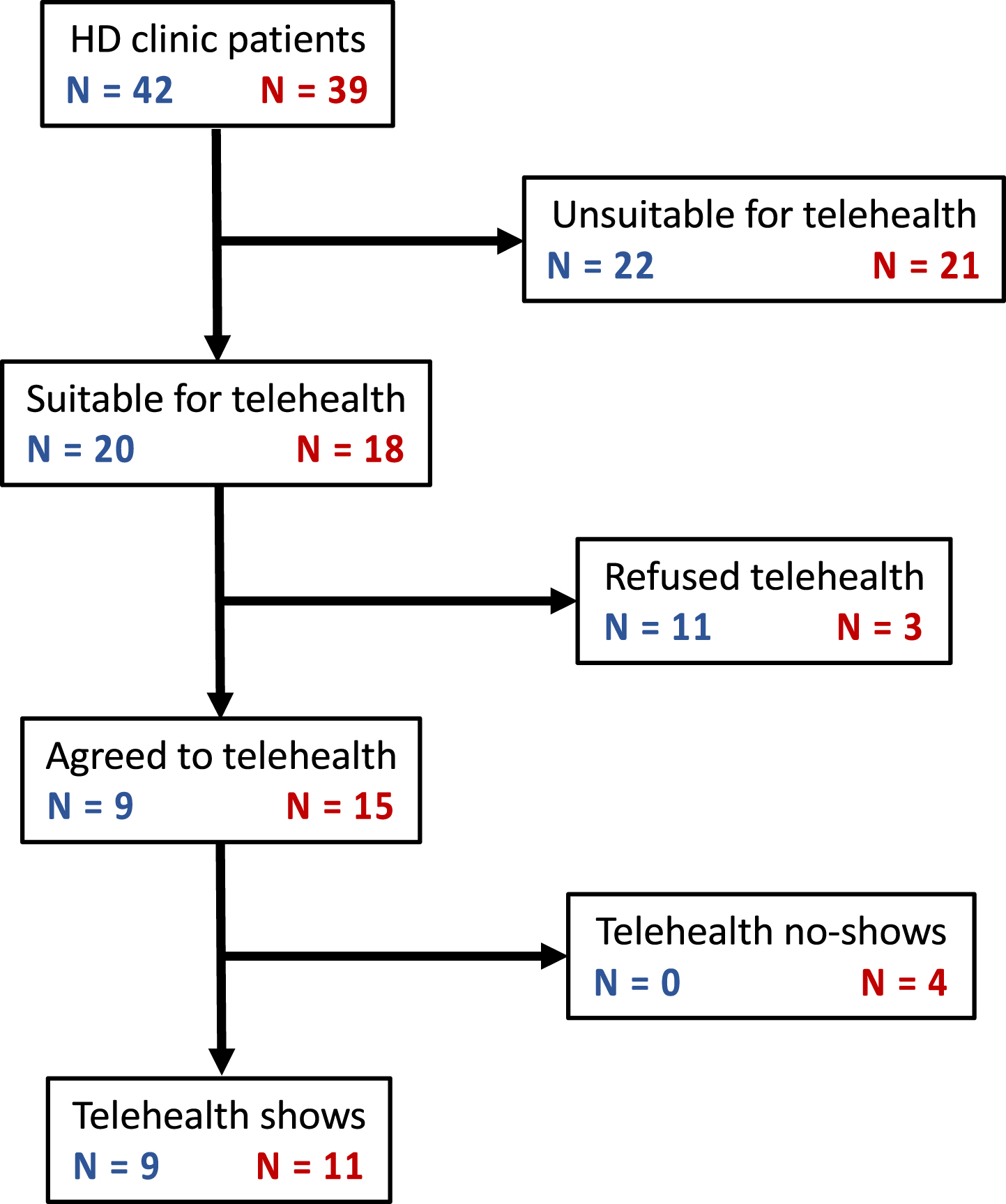
Schematic of study procedure with number of participants at each stage. Blue = first implementation cycle; red = second cycle. HD, Huntington’s disease.
DISCUSSION
Within the eight-week study period, we identified roughly half of all HD clinic patients at our study center as suitable candidates for telehealth. That the screening tool did not include or exclude an excessive number of patients suggests that our intervention could be a worthwhile addition to HD clinical practice. After two implementation cycles, telehealth acceptance among eligible patients increased from 45.0%to 83.3%, suggesting that the screening tool selected for those patients who were most appropriate for and receptive to telehealth. In addition, frequency of telehealth visits more than doubled from a pre-intervention baseline of 12.8%to 28.2%, indicating that the screening tool can increase telehealth utilization among HD patients. Finally, it is worth mentioning that no patients met the two indications—immunocompromised status plus recent positive COVID test in self or a household member—for telehealth as listed in Sections A and C of Fig. 1. Nevertheless, future tests of our screening tool will likely retain these two criteria since virtual visits are the safer option for patients with weakened immune systems and/or potential to spread coronavirus to others. Indeed, immune compromise or COVID-19 infection was judged to take precedence over other factors that may affect patient suitability for telehealth. Of course, resolution of the COVID-19 pandemic would prompt re-evaluation of these criteria.
Previous reports of increased teleneurology adoption during COVID-19 [2–4] as well as telehealth usage in HD [13, 14] indiscriminately converted in-person clinic visits to telehealth without considering patient-specific factors that may influence suitability for teleneurology. While other studies have speculated on what these factors may be [1, 10], we are the first to organize them into a decision-making tool that not only accounts for individual variability among HD patients, but also is feasible to incorporate into clinical practice. Moreover, to our knowledge this is the largest single-center study to date examining telehealth in the outpatient care of HD patients. In a relatively short period of eight weeks, we tested our screening tool in a moderately-sized cohort of 81 patients. By contrast, the next largest study examined 69 HD patients over a much longer period of twenty years [15].
Our intervention affords several advantages in neurological practice, the greatest being standardization of the telehealth selection process. Current evaluations of telehealth candidacy at our study center are subjective and conducted on a patient-by-patient basis. Without an objective framework, clinicians sometimes hesitate to offer telehealth to their patients, decreasing telehealth utilization. Moreover, decision-making processes may vary between clinicians. However, our screening tool allows for clearly-defined criteria to be consistently applied to each individual HD patient. Another advantage of our intervention is efficiency. Streamlining the selection process to a chart review and phone interview could decrease the need for time-consuming deliberations on telehealth candidacy. In addition, conducting a chart review before phone interview reduces the number of patients that clinic staff will need to call in Sections C and D of our screening tool (Fig. 1). Finally, this study represents a timely attempt to adapt healthcare delivery in the midst of a pandemic. In the event of worsening COVID-19 burden or future barriers that may prevent patients from coming to clinic, the study center will be prepared to quickly evaluate a large number of HD patients for potential telehealth visits due to a screening tool being readily available.
However, our study has several limitations. First, we were unable to ascertain the reasons behind our telehealth no-show rate of 16.7%, a figure nearly twice the in-person no-show rate of 9.4%in the six months before our study. A large contributor to no-shows was likely technological barriers associated with telemedicine; a recent survey from our study center found that nearly half of HD patients did not actively utilize the online healthcare platform [8]. Second, in both implementation cycles, several eligible patients refused telehealth due to stated desires for face-to-face interactions with clinicians. This observation echoes the aforementioned study which reported that nearly a quarter of our clinic patients did not wish to engage with telehealth despite its afforded benefits [8]. Since this rationale represents a subjective preference, it cannot be easily incorporated into our screening tool. As such, we expect that the proportion of eligible patients who agree to telehealth will likely not reach 100%. Lastly, since our study was a proof-of-concept that involved only one tertiary medical center, our results must be generalized with caution. The criteria listed in Fig. 1 may not be universally applicable to all HD care centers, and if other clinics aim to implement similar screening tools, individualized implementation analyses may be needed to account for center-specific variations.
As previously discussed, we believe that appropriate teleneurology utilization should not involve completely supplanting in-person visits [7], but rather adjunctive monitoring of established patients who have stable symptoms and do not require in-person activities [1, 10]. Despite its limitations, teleneurology will likely continue to play an important role in outpatient practice even after COVID-19 subsides [7]. In fact before the pandemic, telehealth was already widely used in the longitudinal care of HD patients, occurring in nearly one-fourth of HD clinics worldwide [16]. Accordingly, there are several opportunities to expand on our study. First, since no-shows may result from difficulties with utilizing the audiovisual conferencing technology, we can improve telehealth show rates by evaluating technological literacy among HD patients and offering free tutorials on how to navigate ZoomTM and/or the online patient portal. Second, permanent incorporation of our screening tool into regular workflow requires specifying exactly which clinical staff would be entrusted with the telehealth selection process. This decision must be made carefully since evaluation of a patient’s motor and psychiatric status requires a certain degree of medical literacy and familiarity with HD. Indeed, we anticipate the motor and psychiatric criteria in Fig. 1 to be most difficult for non-clinicians to assess. To overcome this limitation, our flowchart can include an additional criterion that denies telehealth for patients who have not been evaluated in-person for a given time period (e.g., 6 or 12 months).
Third, future studies can experiment with relaxing the psychiatric and motor criteria in Sections B and D of our screening tool (Fig. 1). Since telehealth was not an option at our study center before COVID-19, we erred on the stringent side when devising indications and contraindications. Deteriorations in motor or mental status can manifest as emergencies such as oropharyngeal obstruction or suicide attempt, respectively, which are most effectively managed by inpatient referral. However, as previously suggested, the inclusion of a criterion that requires periodic in-person evaluations of HD patients could obviate the inclusion of psychiatric and motor criteria in our screening tool. Also, the adoption and refinement of telepsychiatry during the COVID-19 pandemic may herald the increased use of virtual visits to assess HD-related psychiatric emergencies [17]. Finally, telepsychiatry can protect other patients and clinicians from HD patients who pose imminent threat to their surroundings, further arguing for tests of our screening tool with modified psychiatric criteria.
In summary, we designed and evaluated a screening tool that evaluates HD patients for telehealth suitability at a tertiary care center. Through step-wise refinement, our intervention increased telehealth utilization and facilitated the identification of telehealth-eligible patients. Moreover, the screening tool’s ability to account for patient-specific factors, standardize the teleneurology selection process, and streamline clinical workflow makes it a valuable addition to HD clinical practice. During an uncertain pandemic marked by increased reliance on virtual visits, we hope that this study will help neurologists optimize the use of telemedicine in order to increase flexibility and access to clinical services.
Footnotes
ACKNOWLEDGMENTS
The work presented here was supported by the VUMC Huntington Disease Society of America Center of Excellence. We acknowledge all our Huntington’s Disease families who teach us resilience and give us hope.
CONFLICT OF INTEREST
The authors SJL, LMH, EH, and KEM report no conflicts of interest relevant to the work included in this manuscript and have no additional disclosures to report. The author DOC has received grant support from the National Institutes of Health (NINDS) and Michael J. Fox Foundation, as well as from AbbVie, Alterity, Bristol-Myers Squibb, C2N, CHDI, Genetech/Roche, Eli Lilly, Prilineia, Lundbeck, Teva Neuroscience, Vaccinex, and Wave Life Sciences. DOC has also received personal fees for consulting for AbbVie, Acadia, Alterity, Huntington Study Group, Lundbeck, Neurocrine, and Teva Neuroscience; however, these are outside of the submitted work.