







Abstract
IEEE 802.22 Wireless Regional Area Network (WRAN) standard employs cognitive radio techniques to utilize the white (i.e., unused) spectrum in the TV frequency band. IEEE 802.22 WRAN employs cellular topology (i.e., point to multi-point communications). IEEE 802.22b is a modified version of IEEE 802.22 that allows peer-to-peer communications among WRAN users of the same cell. One of the issues that significantly affects the performance of WRAN is the spectrum sharing between overlapped WRAN cells (i.e., inter spectrum sharing) as well as among the users of the same cell (i.e., intra spectrum sharing). In this paper, we propose Resource Sharing Protocol for Inter/Intra WRAN communications (RSP-WRAN), which is based on maximizing the Jain’s fairness index in the spectrum-sharing process. Simulation results show that RSP-WRAN, compared to other protocols, achieves high performance in terms of fairness and network throughput.
Introduction
Due to the continuous development of multiple wireless applications [1,7,10,18,19,21,24,30,31,65] and services [3,4,6,11,17,22,25–27,33,50,66], spectrum scarcity is becoming a serious problem [5,8,16,20,23,28,29,32,42,43]. Moreover, a thorough study and analysis of spectrum usage that was conducted by the Federal Communications Commission (FCC) demonstrated that the spectrum is inefficiently utilized in several geographical areas [54]. For example, in New York City, according to the FCC study, the spectrum usage is only about 13.1% for the spectrum between 30 MHz and 3 GHz. The problem is resulting from the static channel assignment policy for the spectrum; many users are idle for long time in their specific licensed bands of spectrum and no other users can use such bands, resulting in inefficient usage of the spectrum.
To mitigate this problem and increase the spectrum utilization, the FCC in 2003, proposed cognitive radio (CR) technology [51,55]. This technology allows unlicensed users (called secondary users) to use the licensed bands of spectrum during the periods when the licensed users (called primary users) are not using these bands. These bands are called spectrum holes or white spaces. According to this technology, the secondary users should not cause harmful interference to the primary users. CR technology has emerged as a solution to spectrum scarcity; it enables efficient and flexible spectrum usage [61]. The first standard for cognitive radio networks was the IEEE 802.22 WRAN standard [14,15,37,47,52,69]. IEEE 802.22 working group includes several known corporations (e.g., Intel, ST Micro, Motorola, CRC, Samsung, Philips, and Nokia). WRANs employ cognitive radio techniques to opportunistically utilize the white spaces in the TV frequency spectrum (VHF/UHF: 54 to 862 MHz) without harmful interference between the WRAN users, which are called customer premise equipment (CPE), and licensed TV users. In particular, the CPEs need to sense TV spectrum to detect the spectrum holes. Once a TV primary user is detected in any TV band, the CPEs must immediately switch to another available band or stop their transmission to avoid any interference. The first applied topology for WRAN is cellular topology (i.e., point to multi-point communications) as shown in Fig. 1. The coverage radius of each WRAN cell is about 33 km and may reach up to 100 km. In each WRAN cell, the CPEs communicate with their base station (BS) over fallow TV broadcast bands (i.e., not used by TV users). The BSs and CPEs have the ability to switch between channels without transmission errors and adapt their sensing, bandwidth, coding, and modulation schemes. Orthogonal frequency division multiple access (OFDMA) is used in up/down links. The WRAN standard did not specify any spectrum-sensing technique [52]. Different sensing techniques proposed for cognitive radio technology can be employed in WRAN [52,62]. The main application of WRAN is supporting remote and rural areas with wireless broadband access [56]. In USA, Africa and Asia, a significant percentage of the population exist in such regions [56]. Other applications of WRAN include multi-dwelling units, single-family residential, public and private campuses, small businesses, multi-tenant buildings, etc. More information about WRAN can be found in [34,53,70].
Problem statement
One of the major issues in WRAN communications is finding a strategy that allows the WRAN users to efficiently and fairly share the available spectrum (i.e., unused by TV stations) without causing interference on each other. This problem is called coexistence problem [41] and it could be between the CPEs of one WRAN cell or between geographically overlapped WRAN cells (see Fig. 1) and it is called in this case self-coexistence problem.
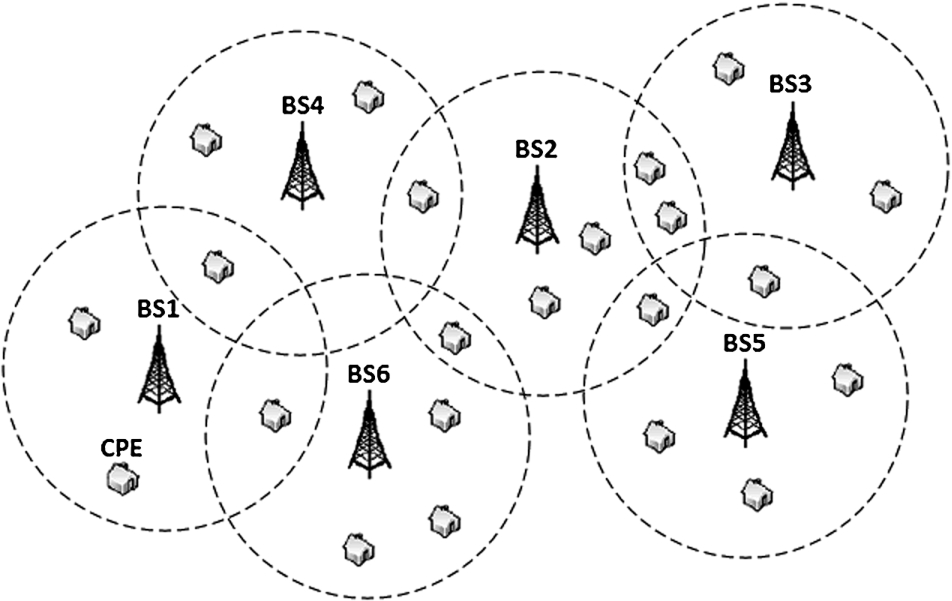
Example of overlapped WRAN cells.
For the self-coexistence problem, if each cell of the overlapped WRAN cells, after the sensing process, randomly use (i.e., without any coordination with other cells) any one of the available channels, then it is likely that an interference between these cells will occur. This kind of coexistence is not easy to solve due to different reasons. Mainly, the coverage range of a WRAN cell can reach up to 100 km, which means a wide interference range; greater than that of other unlicensed technologies. Accordingly, extensive MAC control messaging will be required, which affects spectrum utilization. Moreover, the wide coverage range results in a long round-trip delay that makes the coordination more difficult. Furthermore, for WRAN, there is no licensed spectrum for control signaling which also increases the difficulty of the problem. Unlike other IEEE 802 standards, the IEEE 802.22 working group requires that the self-coexistence problem should be considered as part of the standard and not after issuing the standard [15]. Researchers in this field proposed several techniques and schemes to solve or mitigate self-coexistence problem. Some of them will be introduced later in Section 2.
For the coexistence problem between the CPEs of one cell, the original standard for WRAN (i.e., IEEE 802.22 [15]) solves this problem by adopting a centralized topology for WRAN. According to this topology, the BS in a cell works as a relay for all communications between the CPEs inside the cell. In other words, in this structure, there is no direct communication between any two CPEs in the same cell. Hence, the BS will control and eliminate any interference between communications inside the WRAN cell. However, this is inefficient solution. It results in a limited network capacity because each down-link channel is reserved for one time slot to be used by only one CPE. In other words, in this solution, there is no frequency reuse. Accordingly, a new WRAN working group called IEEE 802.22b was established to enhance the network capacity by allowing the direct CPE to CPE communication inside one cell [46]. Different techniques and algorithms have been proposed to coordinate and manage the interference between different peer-to-peer communications inside a WRAN cell. Some of them are discussed later in Section 2.
The two coexistence problems can be treated as a resource sharing problem. The method used for resource sharing in a network has a severe effect on the network performance in terms of different metrics such as network throughput, fairness, and interference. Due to the randomness in the availability of channels in cognitive radio networks, the spectrum sharing issue is becoming more difficult. Moreover, in WRANs, unlike other cognitive radio networks, due to the wide coverage region, each WRAN cell (or CPE) could have different number of available channels as well as different requests (i.e., the amount of data to be transmitted). Therefore, the spectrum sharing issue in WRAN is more difficult to solve than other networks.
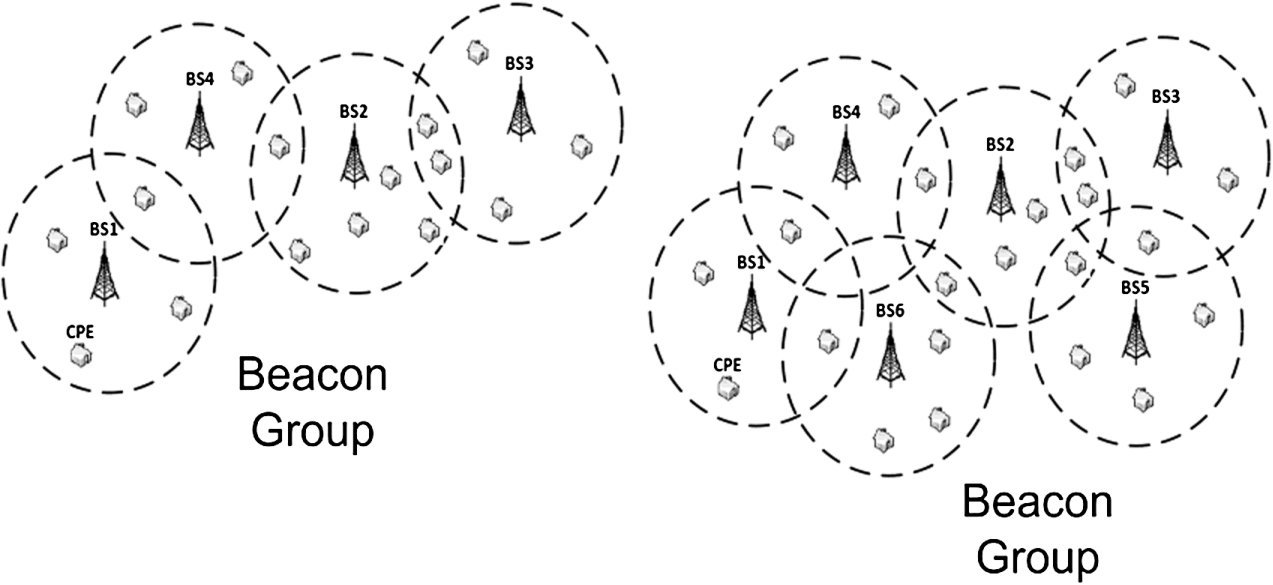
Example of two beacon groups.
In this paper, we study and consider the two coexistence problems. We propose a protocol that addresses the spectrum sharing among different overlapped WRAN cells and among the users of the same cell. The proposed protocol is called Resource Sharing Protocol for Inter/Intra WRAN communications (RSP-WRAN). The design of RSP-WRAN aims at improving the network performance in terms of network throughput, fairness, and interference. RSP-WRAN allows the WRAN users (cells and CPEs) to efficiently and fairly share the available spectrum without causing interference on each other. The operation of RSP-WRAN can be summarized as follows. Firstly, each group of overlapped cells called beacon group BG (see Fig. 2) selects one BS as a coordinator for that group. Then each CPE in each cell sends to its BS information about its location, the list of its available channels, and its request (i.e., the amount of data to be sent). These are forwarded by BSs to their coordinators. Then, each coordinator in a BG builds up two tables: overlay table that depicts the interference map of the overlapped CPEs in the BG and channel table that shows the available channels for each CPE in the BG. After that, each coordinator runs a spectrum sharing algorithm that allows CPEs in BG to use the available channels efficiently, fairly, and without interference among them. The proposed algorithm increases the spectrum capacity by allowing channel reusing among the non-overlapped CPEs. Moreover, the algorithm selects the most fairly channel assignment among all possible assignments. Since CPEs may have different demands (i.e., a number of channels that satisfy its transmission), the proposed algorithm defines a parameter for each CPE to measure the closeness of its demand and the channels assigned to it. Then, Jain’s fairness index [48,49] is calculated for these parameters. Finally, the assignment that results in maximum Jain’s fairness index is selected. RSP-WRAN will be thoroughly explained and discussed in Section 3. Our simulation results show that the proposed RSP-WRAN achieves higher network performance, in terms of fairness and throughput, compared to other proposed protocols.
Organization
The rest of the paper is organized as follows: Section 2 presents some related works. In Section 3, our proposed protocol RSP-WRAN is discussed and illustrated. In Section 4, we use simulations to evaluate the performance of RSP-WRAN. Finally, our concluding remarks are drawn in Section 5.
Related work
Several techniques have been proposed to deal with the coexistence problem in WRAN communications. Some of them were specified for inter cell communications (i.e., the coexistence of overlapped WRAN cells), others were proposed for intra cell communications (i.e., the coexistence of CPEs in one cell), and others considered both inter and intra cell communications.
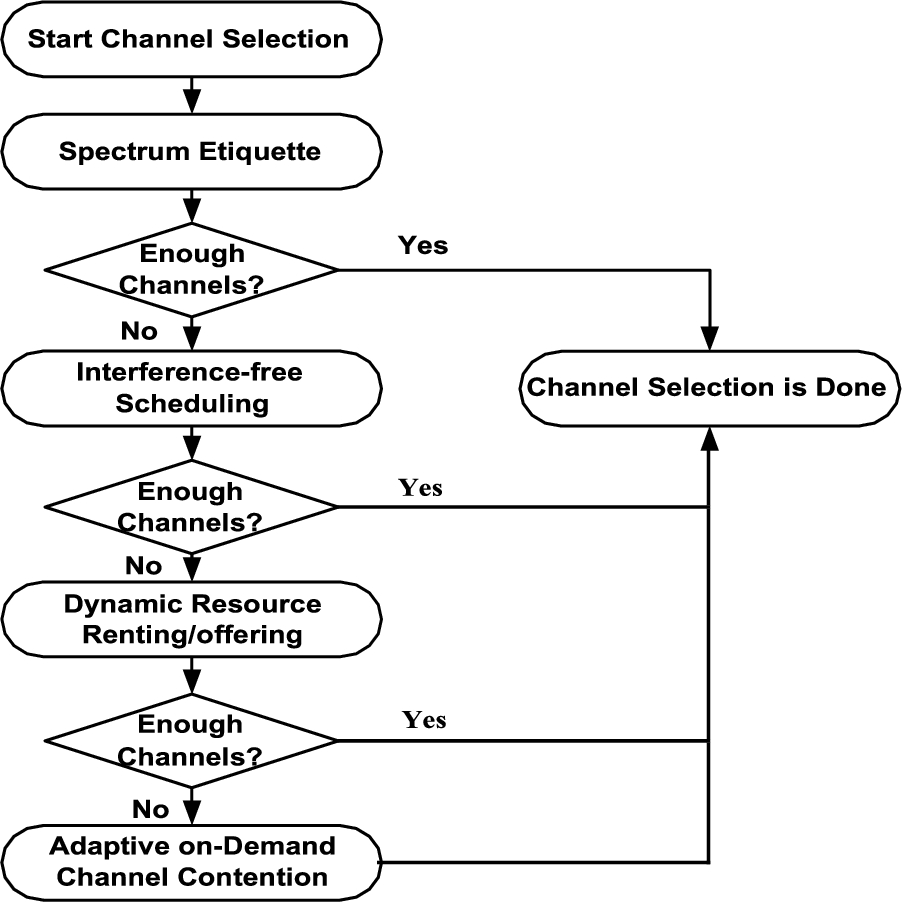
IEEE 802.22 MAC self-coexistence schemes.
To mitigate the coexistence problem among overlapped WRAN cells, a certain coexistence approach was defined in IEEE 802.22 standard [13], see Fig. 3. This approach consists of four processes: spectrum etiquette, interference-free scheduling, dynamic resource renting and offering (DRRO), and adaptive on demand channel contention (AODCC). For spectrum etiquette, each WRAN base-station searches for available channels that not used by its neighbor cells. In the case of no available channels, the base station goes to the next process (i.e., interference-free scheduling) to share the same channels with its neighbors in a non-interfering approach. If the owner of the channel does not allow the channel sharing process, the base station must run the DRRO process. In this process, the cell that has free channels is called offeror and the one that requires free channels is called renter. The offeror broadcasts its available offered channels and a required minimum number of credit tokens (MNCT). Each cell has a certain credit token budget which is similar to money, more information can be found in [39,40]. If the renters hear the broadcasted information, they reply by sending renting requests which consists of the required channels and the credit tokens that can be paid. After that, the renters with the higher credit tokens is granted the required channels. Then, if the base station still needs more channels, the base station runs the final process (i.e., AODCC). In this process, the base station sends to the channel owner a contention request includes the credit tokens that can be paid. If the credit tokens is higher than the MNCT of the channel owner, the channel owner releases the requested channels; otherwise, it rejects the request.
In [38], the authors proposed a contention-based approach for inter cell communications. According to this approach certain messages (i.e., channel contention request, channel contention reply, and channel contention acknowledgement) must be exchanged at each channel reservation time. This leads to a high delay because the wide range of WRAN cell (i.e., 100 km) results in a round-trip propagation delay of about 300 μsec. In [9,67], several techniques were proposed to improve the dynamic-frequency-hopping (DFH) scheme [13] with the aim of mitigating the coexistence problem between overlapped WRAN cells. However, some of these techniques need a high signaling overhead and others require specific hardware such as multiple transceivers and directional antennas. The authors in [39] proposed a protocol for channel allocation in a multiple overlapped WRAN cells scenario. This protocol is called a credit token based rental protocol and it is based on the concept of ascending auctions among the overlapped cells, which can be applied before the DRRO stage in the coexistence mechanism shown in Fig. 3. In [36], the authors proposed a channel sharing technique for overlapped WRAN cells. This technique is based on a credit token using auctioning. In this technique, the authors modeled DRRO as a progressive second price auction to make sure that the overlapped cells will determine their channel requests in a truthful manner. In [12], the authors proposed a Vickrey-based auction mechanism for channel sharing between overlapped cells. This mechanism is a kind of sealed-bid auction that needs the renters to firstly bid and then they will receive the bidding results only one time. Accordingly, the auction is completed in a fast way, resulting in more utilization for the available TV channels and reduced the signaling overhead. The authors in [57] established a sealed-bid double auction between overlapped TV broadcasters and WRAN service providers. Also, in [57], the authors proposed a pricing approach for channel sharing among the WRAN base stations and their users. The authors in [52] proposed a resource transaction algorithm that is based on DRRO and AODCC processes.
It is worth mentioning that all presented solutions in [12,36,39,57], and [52], only consider resource transactions but not interference-avoidance channel selection and spectrum etiquette, which were considered in [63]. The authors in [63] used game theory to analyze the coexistence problem among overlapped WRAN cells. They employed a modified minority game to analyze and model the problem and they proposed a mixed strategy that should be followed by the overlapped cells to achieve the Nash equilibrium. For the cost function in [63], the authors used a function of the form
In [60], the authors proposed a resource sharing algorithm for intra-cell WRAN communications (i.e., among the CPEs of the same cell). This algorithm is called peer-to-peer algorithm (P2P) and it is based on channel reuse to achieve the fairness and network capacity maximization. In [59], the authors proposed an inter/intra resource sharing algorithm, called 2I-RSA. The algorithm has two stages, in the first stage, an elected coordinator collects information from the overlapped cells to build a channel access map that should be followed by all the overlapped cells in order to reuse the available channels without any interference between the cells. In the second stage, based on the channels determined for each cell in the first stage, each cell establishes a channel access map for its CPEs. Note that the same algorithm is used in both stages to build the channel access maps. The idea behind the used algorithm is assigning channels to the overlapped users based on a proposed function that has a logarithmic growth with the number of assigned channels for each user. This used function was selected in order to satisfy the required fairness between overlapped users. In this paper, we consider spectrum sharing among overlapped cells as well as among the CPEs in one cell. Therefore, we propose Resource Sharing Protocol for Inter/Intra WRAN communications (RSP-WRAN). This protocol is discussed in the next section.
According to the IEEE 802.22 standard [15,45], time is divided into 160 msec periodic intervals, called superframes (see Fig. 4). Each superframe is further divided into 16 frames. During each frame, the BS manages the up-stream (i.e., from CPEs to BS) and down-stream (i.e. from BS to CPEs) transmissions. At the beginning of each superframe (i.e., during Superframe Control Header (SCH)), the BS communicates with its CPEs on the operating channel. So all the CPEs will be synchronized with their BS which will control their transmissions.
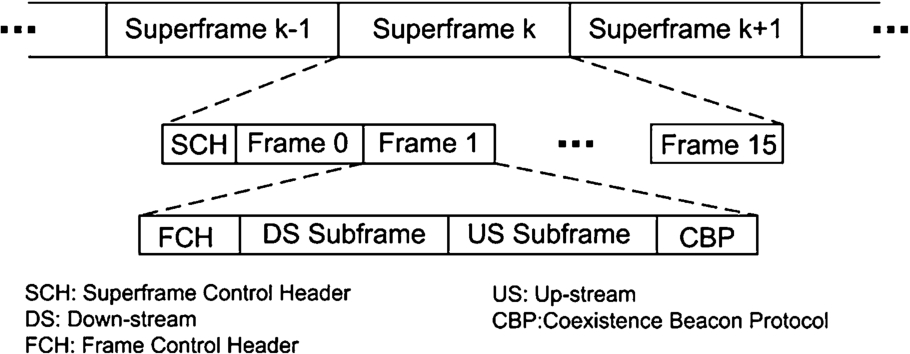
Superframe structure in IEEE 802.22.
Our proposed protocol RSP-WRAN is a time slotted protocol and it is based on the same superframe structure defined by the IEEE 802.22 standard. Since the maximum allowable time of occupying an available channel by a secondary user is 2 seconds [14], the channels assignment process is repeated by RSP-WRAN every 12 superframes (i.e., 1.92 seconds). In a nutshell, every 2 seconds, a new sensing process is performed to determine the available channels and the RSP-WRAN is run to allocate these channels to the CPEs according to their positions and requests. The positions of CPEs are needed to achieve frequency reuse without interference (i.e., to avoid assigning the same frequencies to neighboring CPEs). The request R of a CPE is the number of superframes (i.e.,
The RSP-WRAN protocol is explained in the following steps:
Step 1: In each beacon group BG (see Fig. 2), one BS is elected as a coordinator using the algorithm proposed in [64].
This algorithm is chosen due to its scalability (i.e., it can be efficiently employed for large groups) as well as its reliability (i.e., it has a solution for coordinator crash).
Step 2: Each CPE transmits to its corresponding BS its geographic position, request, and the sensing results (i.e., available channels).
Step 3: Each BS collects the information sent by its CPEs (in step 2) and then forwards such information to the corresponding coordinator (elected in step 1). For the BS-to-BS communications, IEEE 802.22 standard defines a protocol called Coexistence Beacon Protocol (CBP) [68]. CBP is based on transmitting beacons during a certain duration in the WRAN frame (see Fig. 4) to achieve self-coexistence among coexisting WRAN cells.
Step 4: Each coordinator in each BG collects the forwarded information from its BSs (in step 3) and uses such information to build up two tables: the overlay table, that depicts the interference map of the overlapped CPEs in the BG, and the channel table that shows the available channels for each CPE in the BG. The overlay table is an
Step 5: The coordinator runs the proposed spectrum sharing algorithm. This algorithm allows CPEs in the BG to use the available channels efficiently, fairly, and without interference among them. Moreover, our proposed algorithm increases the spectrum capacity by allowing channel reuse among the non-overlapped CPEs. It should be mentioned that, to consider the aggregate interference from the CPEs that use the same channel, the coordinator specifies the transmitted power for such CPEs such that a certain SINR threshold is satisfied at each CPE. In particular, the proposed sharing algorithm generates an access map for 2 seconds duration (i.e., 12 superframes). This access map determines the WRANs that are allowed to transmit on each available channel during each superframe.
The proposed algorithm is depicted in Fig. 5. For the sake of illustration, the details of this algorithm is explained via the example shown in Fig. 1. To generalize the function of the proposed algorithm, in the considered example and in Section 4, we will consider spectrum sharing among “WRAN users” that could be CPEs or BSs. In the considered example, there are six overlapped WRAN users (i.e., BSs) and the overlay table for this scenario is shown in Table 1. For the channel table of this example (see Table 2), assume that there are three available channels: Channel A, Channel B, and Channel C. Let Channel A be only available for WRAN1, WRAN4 and WRAN6, Channel B is only available for WRAN2, WRAN3 and WRAN5, while Channel C is available for all WRANs.
Flow-chart shows the proposed resource sharing algorithm.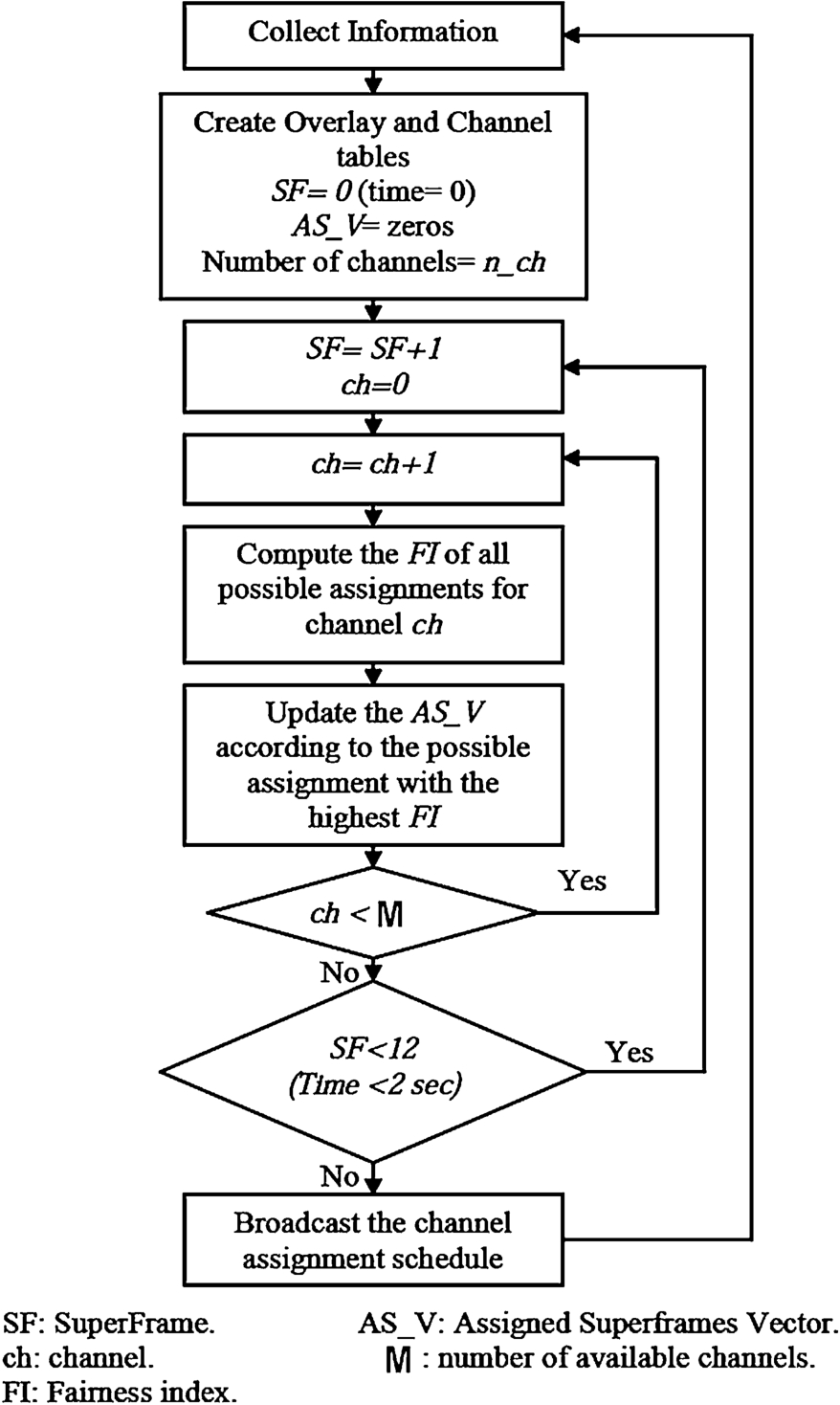
In our example, to explain the channel assignment process during one superframe, let the number of superframes requested by the six WRANs be
Finally, the assignment that results in the highest FI is selected (in the case of equality, any one is selected). Accordingly, Channel A is assigned for WRAN1 during the first superframe and AS_V becomes
Overlay table for the scenario used in Fig. 1
Channel table for the scenario used in Fig. 1
Illustration of channel assignment process during one superframe for the network of the example considered in Section 3.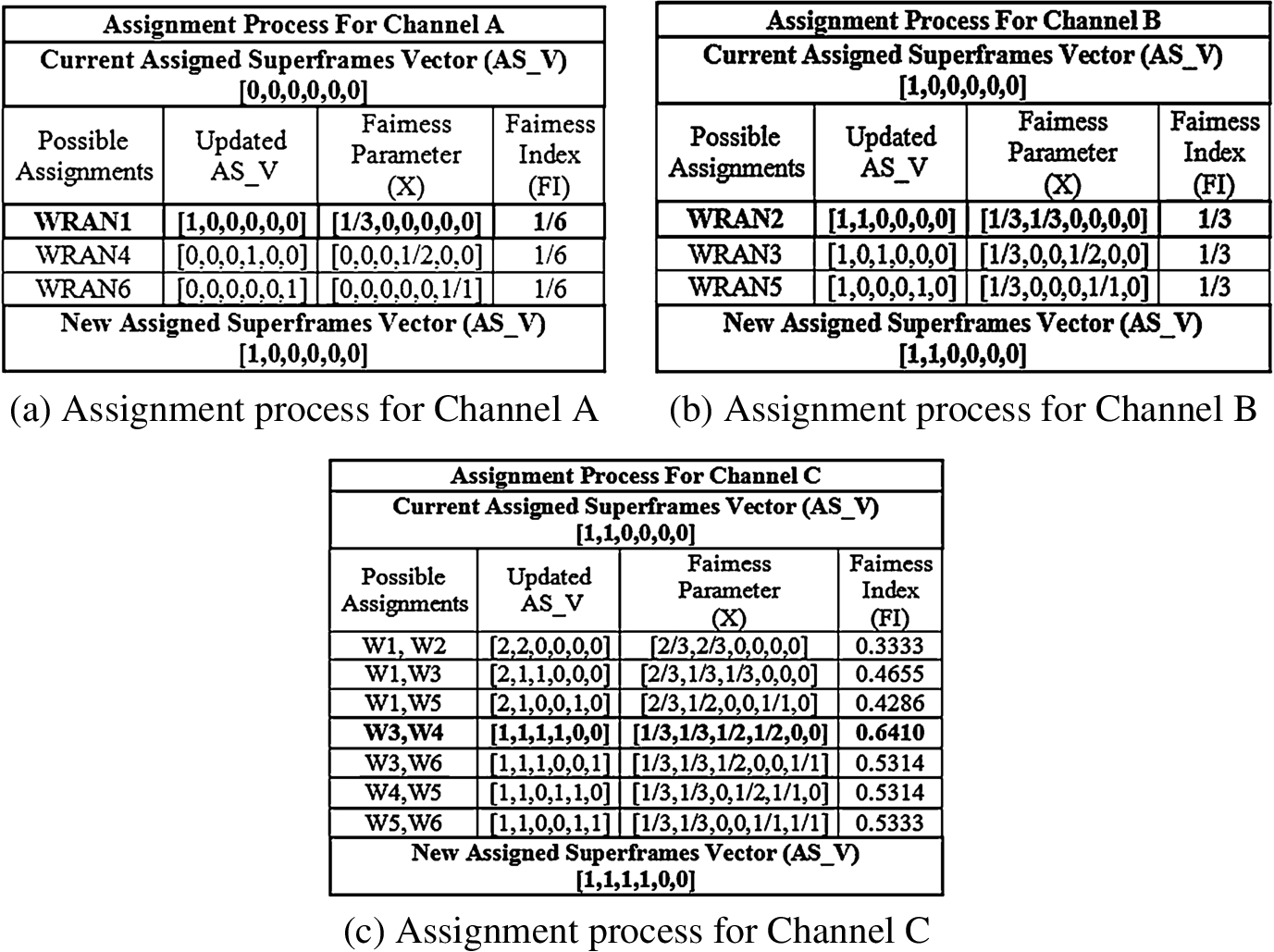
The channels assignment during the first superframe for the scenario shown in Fig. 1.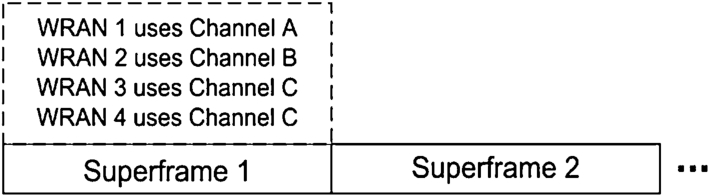
Step 6: After the assignment process for 12 superframes, the coordinator broadcasts the access map for all WRANs in the BG. The AS_V is reset to zeros
Simulation setup
In this section, we study the performance of the proposed protocol RSP-WRAN and compare it with the protocols proposed in [44,59], and [35]. As discussed before in Section 2, in [59], the authors proposed an inter/intra resource sharing algorithm, called 2I-RSA. This algorithm is based on a proposed function that has a logarithmic growth with the number of assigned channels for each user. According to this algorithm, the channel assignment that results in the highest value of the proposed function is selected. In [44], the authors proposed an On Demand Spectrum Contention (ODSC) protocol. In this protocol, WRAN BSs run a contention mechanism in a distributed way to access the available channels.
In [35], the Max-Min mechanism is used as a resource sharing method. The first step in Max-Min mechanism is computing the chromatic number which is the minimum number of different channels required in the network for the simultaneous transmissions without causing interference among them. The second step in Max-Min mechanism is finding the groups of WRANs that can use the same channel without interference. Finally, the available spectrum is divided into a number of bands equal to the chromatic number. Each band is assigned to each group. In the case that a WRAN group requires less than its band, the excess is shared using the same criterion by the remaining groups.
In the evaluation process, we mainly focus on two performance metrics: network throughput and fairness. To evaluate fairness, we calculate the Jain’s fairness index [48] which is computed using (2) in Section 3. These metrics are evaluated for different scenarios.
First, we examine the same scenario considered in [59]. This scenario is shown in Fig. 1. In such scenario, there are six overlapped WRANs. The used simulation time is 1.92 seconds (i.e., 12 superframes). We assume that there are two channels and they are available for all WRANs. Also, we assume that the available bandwidth is 6 MHz (i.e., one TV channel). Furthermore, we assume that the six WRANs need to send the following amount of data (in Mbit)
The simulation results for the scenario are depicted in Fig. 8. These results show that RSP-WRAN and 2I-RSA almost have the same performance in terms of overall network throughput (see Fig. 8(c)) and allowing each WRAN to nearly send its required data (see Fig. 8(a)). However, Fig. 8(b) shows that RSP-WRAN achieves higher fairness index compared with all other protocols. This is because, as explained in Section 3, RSP-WRAN is trying to maximize the fairness index in each step of the assignment process. Also, these results show that ODSC has the worst performance. This is because ODSC is a distributed protocol; resulting in high collision and interference probability. Also, ODSC does not consider the requests of WRANs in the sharing process since it is based on a contention mechanism. On other hand, Max-Min, as RSP-WRAN and 2I-RSA, are centralized protocols. However, Max-Min does not consider a WRAN request with respect to the total requests of all WRANs in the BG. To illustrate, for the scenario shown in Fig. 1, the chromatic number is 3 (i.e., three WRAN groups: WRAN1–WRAN2, WRAN3–WRAN4, and WRAN5–WRAN6). The total available spectrum is 12 MHz (i.e., two TV channels). So, 4 MHz is assigned for each WRAN group. Therefore, by using (1), the amount of data that can be sent in 4 MHz is 7.75 Mbit (during 12 superframes). The first group (i.e., WRAN1 and WRAN2) need to send 6.7 Mbit, so 4 MHz is more than needed. The excessive band is divided among other groups. However, the requests of the second and third groups are not completely achieved. So, in Max-Min, the WRANs that have smaller requests are almost satisfied more than other WRANs.
Accordingly, Fig. 8(a) shows that Max-Min assigns WRAN3, WRAN4, WRAN5 and WRAN6 the same resources even though they have different demands. On the other hand, Fig. 8(a) shows that, in RSP-WRAN and 2I-RSA, the available resources are divided proportionally to the demands. In other words, the curves of the RSP-WRAN and 2I-RSA have the same trend of the request curve.
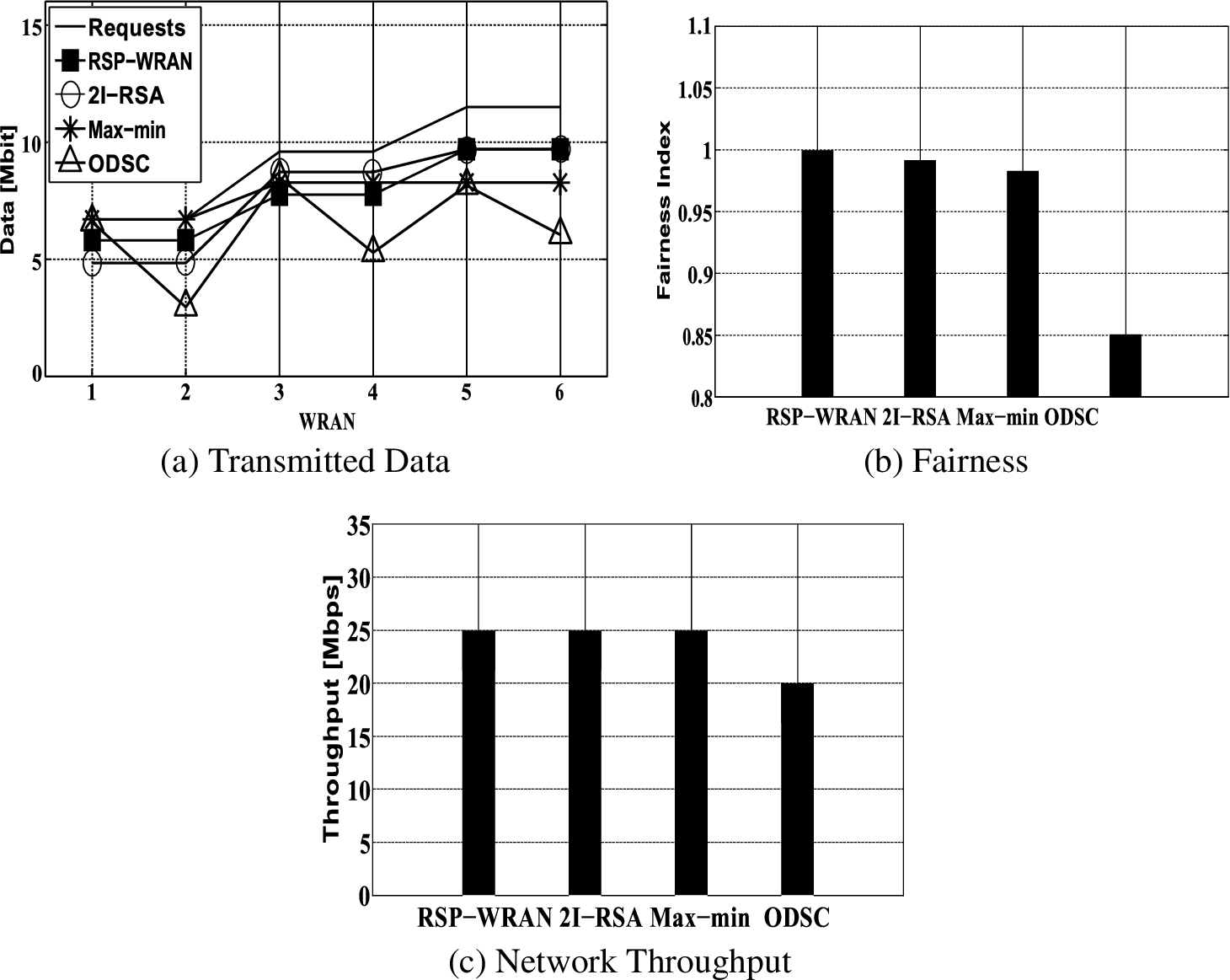
Performance of various resource sharing protocols for the network topology shown in Fig. 1 where 6 WRAN cells are considered and 2 channels are available to all the cells.
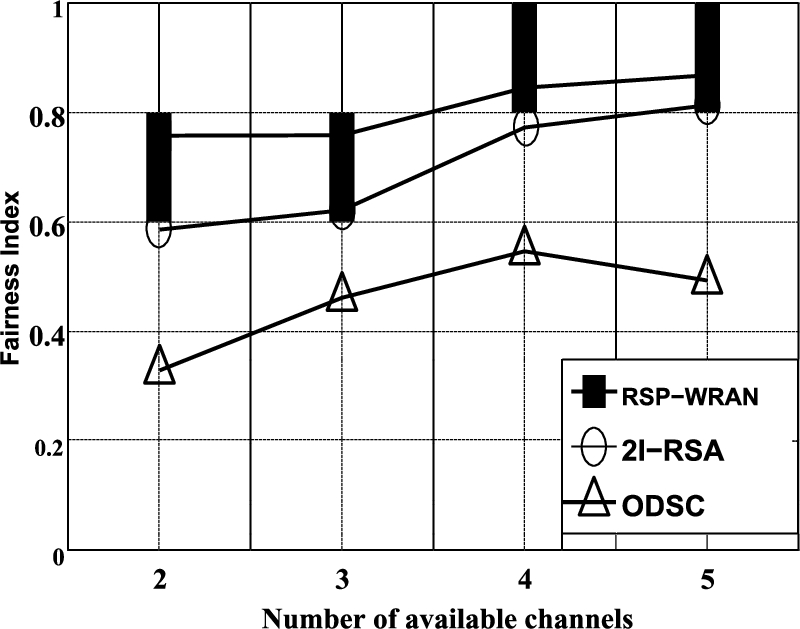
Fairness achieved by various resource sharing protocols in 8 WRAN cells (overlay table is shown in Table 3).
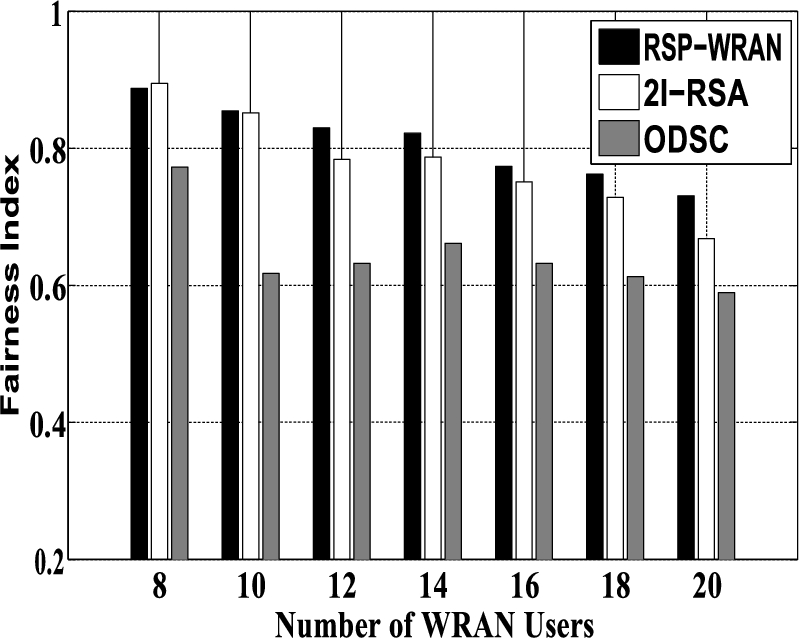
Fairness achieved by various resource sharing protocols for different number of WRAN users with 2 available channels.
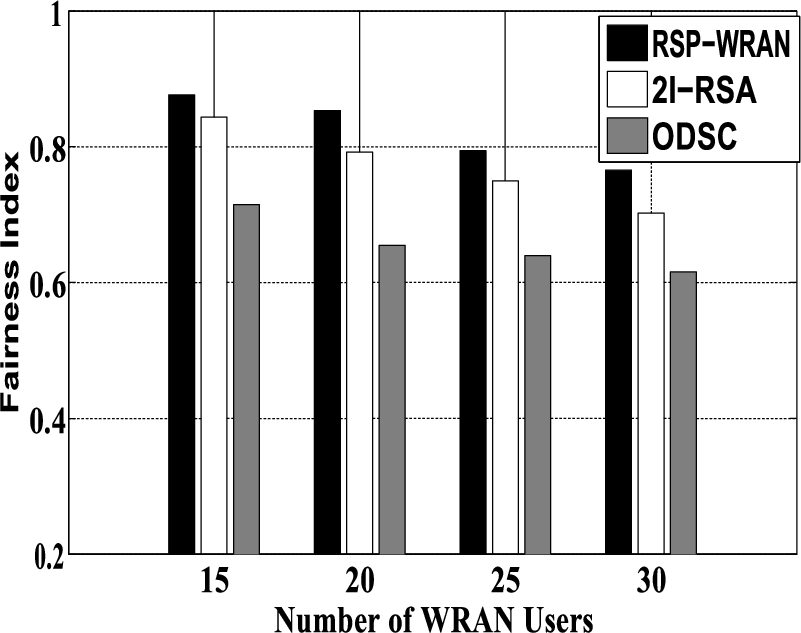
Fairness achieved by various resource sharing protocols for different number of WRAN users with 5 available channels.
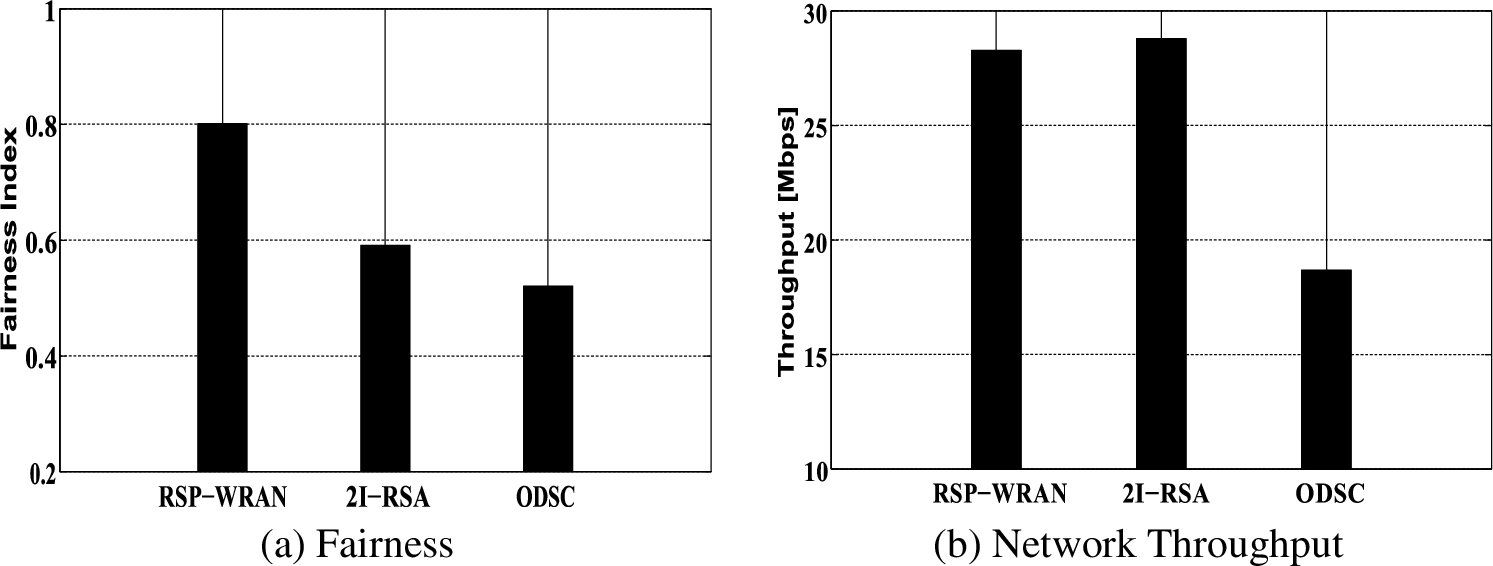
Performance of various resource sharing protocols for 10 WRAN cells, 3 available channels.
To verify the performance of RSP-WRAN, more simulations for different scenarios were conducted. Figure 9, Fig. 10, Fig. 11, and Fig. 12 show the performance of RSP-WRAN, 2I-RSA, and ODSC under different scenarios. It should be mentioned that Max-Min scheme cannot be evaluated under these scenarios because Max-Min scheme requires that all the WRANs should have the same available channels (which is not satisfied in the considered scenarios). This is a required condition for Max-Min scheme to compute the chromatic number.
Overlay table for the scenario used in Fig. 9
Figure 9 shows the effect of changing the number of available channels on the performance of the compared algorithms. In this figure, we consider 8 cells with the overlay table shown in Table 3 and the required transmission load for each cell is selected randomly as follows:
In Fig. 10 and Fig. 11, the number of available channels is fixed to 2 and 5 channels, respectively. However, in these figures, the number of WRAN users is changed. Each result shown in these figures is the average of different experiments. In each experiment, overlay- and channel-tables as well as the required transmission load for each cell are randomly selected. These figures show that our proposed protocol RSP-WRAN achieves the highest fairness compared with the compared schemes.
Overlay table for the scenario used in Fig. 12
Channel table for the scenario used in Fig. 12
In Fig. 12, 10 WRAN cells with 3 available channels are considered. Moreover, the overlay- and channel-tables are randomly selected as shown in Table 4 and Table 5, respectively. From the results shown in Fig. 12, we can see that RSP-WRAN achieves the highest performance in terms of fairness and network throughput. All the above results can be contributed to the fact that RSP-WRAN is based on maximizing the Jain’s fairness in each step of the assignment process (as explained in Section 3).
In this paper, we proposed a new protocol called RSP-WRAN for channels assignment in IEEE 802.11b WRAN. RSP-WRAN is an inter/intra-network resource sharing protocol. When it assigns channels for WRAN users, it takes into account the interference between the overlapped WRANs as well as the interference between the users in the same cell. RSP-WRAN exploits the spatial diversity in the channel assignment to efficiently utilize the available channels and increase the network throughput. RSP-WRAN is mainly trying to satisfy the fairness among the WRAN users. The basic idea behind RSP-WRAN is employing the Jain’s fairness index in the channel assignment procedure. According to RSP-WRAN, after each sensing process (i.e., every 2 seconds duration), each WRAN user knows in which superframes and at what channels it can send data. RSP-WRAN searches in all possible assignments and selects the one that maximizes the Jain’s fairness index. Extensive simulations showed that RSP-WRAN, compared to several resource sharing techniques (2I-RSA, Max-Min, and ODSC) significantly achieves high network performance in terms of throughput and fairness.