







Abstract
As a supporting technology of Bitcoin to achieve the function of account management, blockchain technology has received extensive attention from all walks of life, especially in the financial field. Based on the successful experience of blockchain in the application of digital cryptocurrency, blockchain technology has also exerted an important influence on some aspects of scientific research information management, such as declaration, implementation, and conclusion. Thus, for resolving the problems of academic misconduct in scientific research information management, blockchain technology can be targeted for improvement according to each link of information management to improve the security of the management system. Combining the existing achievements and requirements in real applications, this paper explains characteristics of the blockchain technology and analyzes its disadvantages in scientific research information management compared with the traditional methods. Finally, this paper puts forward some suggestions for applications to provide a reference for the effective application of blockchain technology in scientific research information management.
Introduction
With the prosperity of the academic environment and the growth of scientific research projects, research integrity [8,13] has become a hot issue of great concern to all sectors of society. There are many problems in the management of scientific research information: Initially, there were academic misconduct in scientific research. The types of academic misconduct mainly included forgery, correction, plagiarism, repeated publication, false information, etc. However, with the introduction of the development and application of information technology, some new types of academic misconduct have emerged, including entrusting the third party to submit papers and forging papers [2]. In addition, the collection and collation of information is also affected by issues during the scientific research information management, such as timeline confusion and information loss. Therefore, how to build a correct and safe scientific research information management system has a great positive effect on eliminating academic misconduct, cultural and academic norms, and promoting academic innovation.
The blockchain technology [11] born out of Bitcoin [12] has been developed and improved. It has the characteristics of decentralization, time series data, collective maintenance, programmable, safe and reliable [15]. These characteristics make it an effective way to solve the problem of scientific research integrity in scientific research project management, and to provide another theoretical perspective and technical support for the construction of scientific research integrity system.
This paper will explain the history, characteristics, basic principles and related technologies of the blockchain [19], starting from the management method of scientific research information, pointing out the problems faced by the current scientific research information management, and analyzing the areas from the existing blockchain practice. The specific application and implementation strategy of blockchain technology to the construction of scientific research project management system will also be suggested.
The remainder of this paper is organized as follows. In Section 2, we will introduce the definition and technical characteristics of blockchain technology, explain the principle of blockchain through the application of Bitcoin, and finally summarize the application achievements of blockchain in various fields; Section 3 discusses the improvement and significance of blockchain technology in each link of scientific research project management; finally the summary of our work and the prospect in future are presented in Section 4.
The overview of blockchain technology
Blockchain technology definition and characteristics
In recent years, the application of blockchain technology has shown explosive growth, which is considered to be a subversive innovation after Internet and the mobile/social networks. Blockchain technology is the prototype of the next generation of cloud computing. It is expected to completely reshape human social activities like Internet, and achieve the transformation from the current information Internet to the value Internet. Blockchain technology was summarized in 2008 by a digital currency – Bitcoin [5]. At present, the concept of blockchain has not yet formed a definition recognized by the industry, but some basic agreements have been reached. Blockchain technology is a brand-new use of encrypted chain block structure in the storage structure, using distributed node consensus algorithm to generate and update data, and a flexible scripting system (smart contract) to program and manipulate data decentralized infrastructure and distributed computing paradigm [15]. Figure 1 gives the basic structure and shows the data record distributed in each data block. It is essentially a distributed record or distributed public ledger database of transactions or digital events that all transaction participants have executed and shared [6]. Every transaction in the public ledger is verified by the consensus of most participants in the system, and once the transaction information is completed, the information will always exist, that is, the blockchain contains a verifiable record of every transaction.
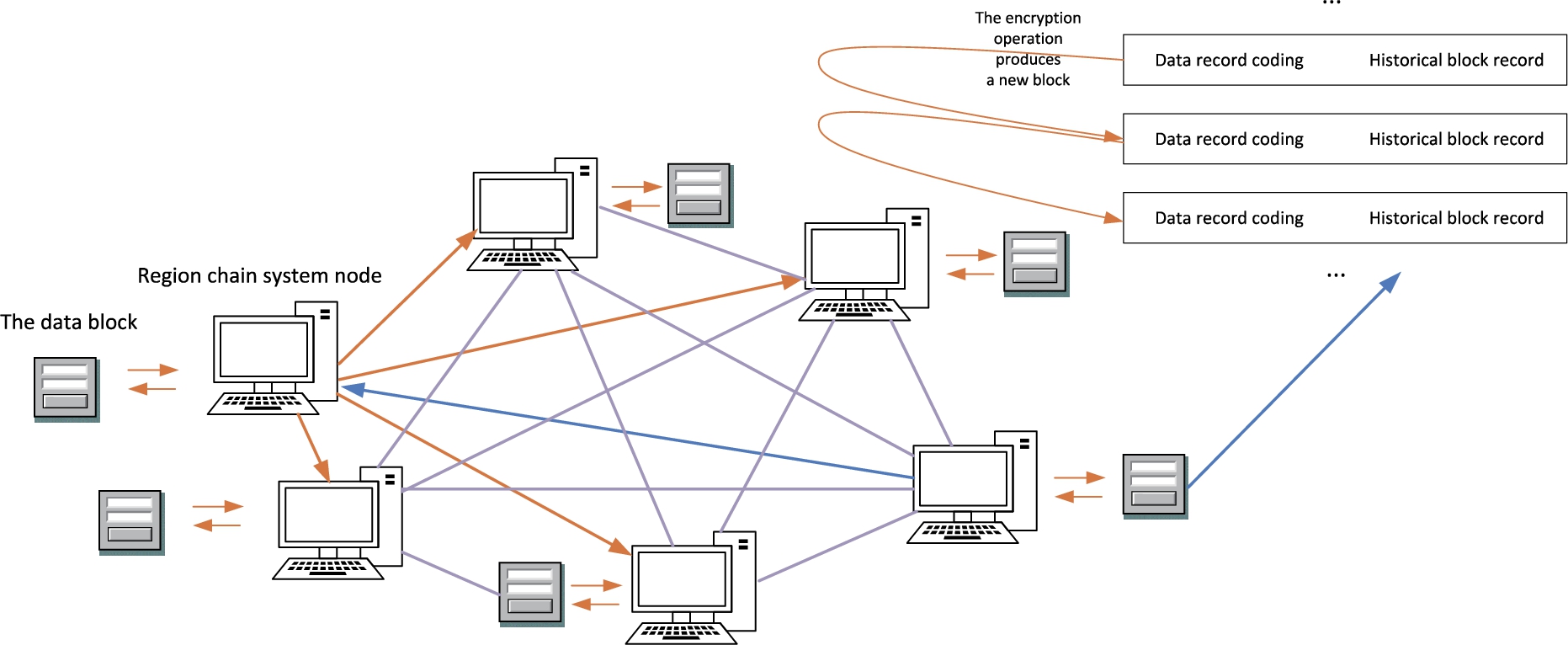
The basic structure of blockchain.
Further, the basic structure of blockchain technology is shown in Fig. 2 [18], including core technology components, core application components and supporting facilities. In the core technology components, there are communication layer, storage layer, security mechanism layer and consensus mechanism layer. Usually the blockchain technology has the following characteristics:
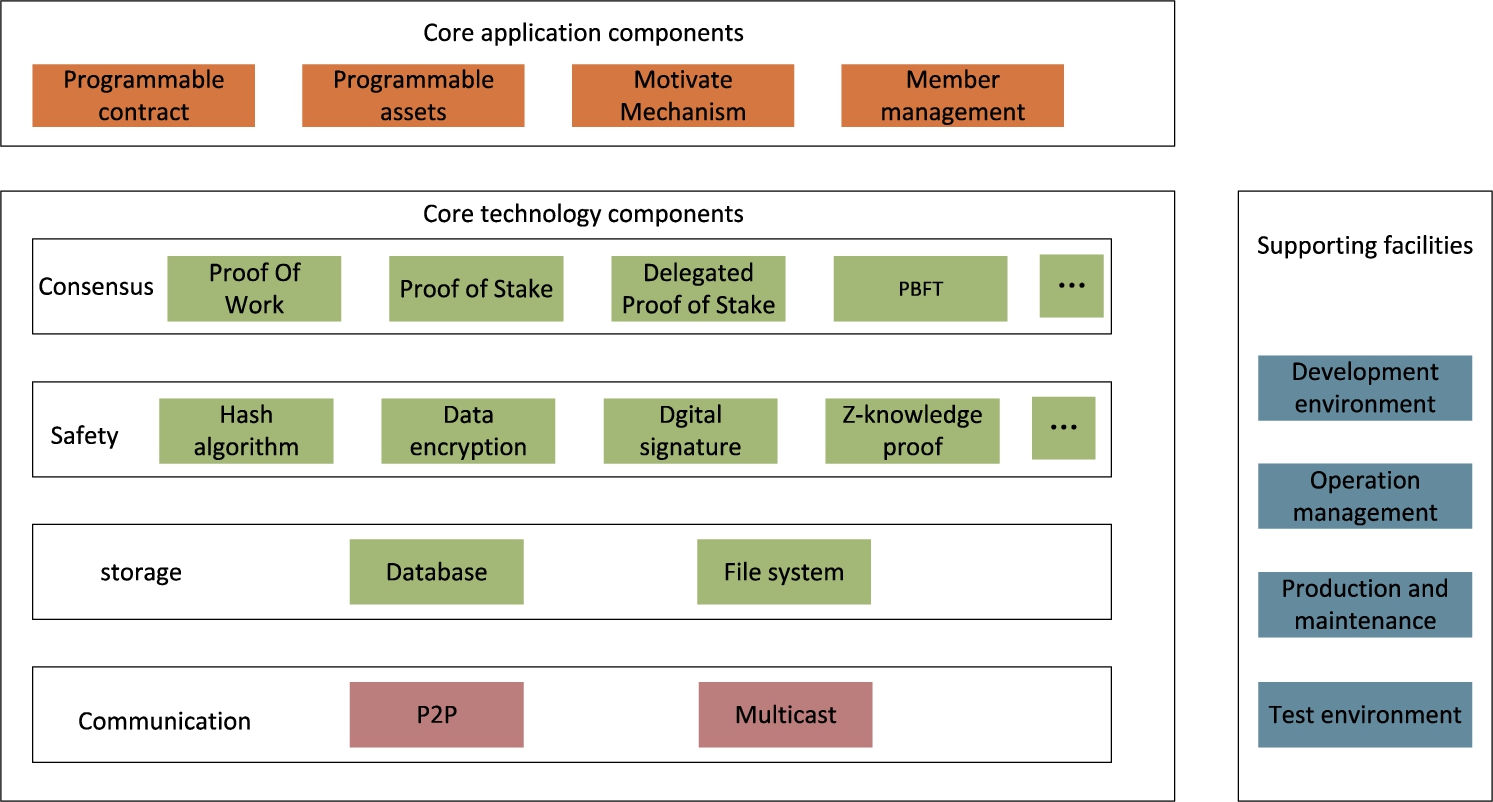
The technology architecture of blockchain.
Decentralization. Blockchain data uses the distributed storage system to complete the process of verification, accounting, storage, maintenance and transmission [15]. The trust relationship between distributed nodes adopts pure mathematical method instead of using a central organization to form a decentralized trusted distributed system [15].
Time series data. Since the stored data uses a chained block structure with timestamps, the time dimension of the data is increased, which makes the data extremely verifiable and traceable [15].
Collective maintenance. To ensure that all nodes in the distributed system participate in the verification process of the data block, the blockchain system uses a specific incentive mechanism and adds new blocks to the blockchain through a consensus algorithm on the selected specific nodes [15].
Programmability. With the help of a flexible script code system, users can easily create the smart contracts or other decentralized applications use [15]. A smart contract is essentially a contract that can replace the legal language to record terms with a piece of code running on the blockchain [3].
Security and credibility. The unmodifiable features of blockchain data are accomplished by the strong computing power that formed by the consensus algorithm, such as asymmetric encryption of the data and the proof of work at each node among the distributed system, which has high security [15].
As a new technology, the blockchain also faces various problems and obstacles that restrict its development. There are currently two prominent problems. One is the resource problem, that the blockchain relies on encryption to provide security and establish consensus on a distributed network. This means that in order to prove users have the right to write to the chain, complex algorithms must be run, and a large amount of computing power is required and highly dependent, but these computing powers do not produce any actual value. The second problem is the regulatory issue. The decentralization of the blockchain can avoid many problems in the structure of the traditional centralized economic system, but it also means that the subject is not clear and is difficult to effectively control the subject.
The most well-known example of the application of blockchain technology is Bitcoin, that was first born in 2008. An individual or group aliased as “Satoshi Nakamoto” published a paper entitled “Bitcoin: A Peer-To-Peer Electronic Cash System” [10], which described the concept and model of peer-to-peer transactions in electronic cash, that is, sending directly from one party to another without paying online through the third-party financial institutions. As we all know, Bitcoin implemented this concept for the first time. At present, cryptocurrency is commonly used to describe all networks and transaction media that use passwords to guarantee transactions, which is completely different from the traditional transactions implemented through the third-party central trust mechanisms. As an Internet protocol, without the existence of intermediary organizations, Bitcoin can transfer value between each other instantly and safely, such as credit third parties, thereby reducing the transaction costs and improving the transaction efficiency.
Literally, the blockchain is a distributed ledger system consisting of a series of data blocks generated using cryptographic methods. Each data block contains a large amount of transaction information to verify the validity of information and generate the next block. These blocks are arranged in the order of generation, where each block is a node. The distinguishing feature of the blockchain is that there is no third-party supervision as a central server, and the transaction information in the block cannot be changed. The Merkel tree can be used in the blockchain to verify whether the data has been damaged [9]. The Merkel tree is a tree-shaped data structure based on Hash algorithm, where each non-leaf node is the Hash value of the leaf node, as shown in Fig. 3. From the bottom to the top in the Meekel tree, two node hashes are connected, and the combined hash is used as the new hash. Then, the new hash becomes the new tree node. Repeat this process until there is only one node, which is the root of the tree. The root hash will be regarded as the only indication of the entire block transaction, and it can be used for proof of work by storing it in the block header. The advantage of the Merkle tree is that a single node can verify whether a certain transaction is included without downloading the entire block.
The information contained in the block can be a financial transaction or any other digital transaction, including documents. Bitcoin uses encrypted proofs instead of crediting the third-party, so that all parties willing to trade can complete the online transactions. Each transaction can be protected by a digital signature and sent to the “public key” of the recipient which is digitally signed using the “private key” of sender. Further, the owner of cryptocurrency needs to prove the ownership of “private key” to consume and trade online. Every transaction is broadcast to every node in the bitcoin network and recorded in the public ledger after verification. In addition, before each transaction is recorded in the public ledger, it needs to be validated. Therefore, two important things need to be ensured for verification node before recording each transaction: (1) Consumers have signature certification for their encrypted electronic money; (2) Sufficient encrypted electronic money in consumer accounts.
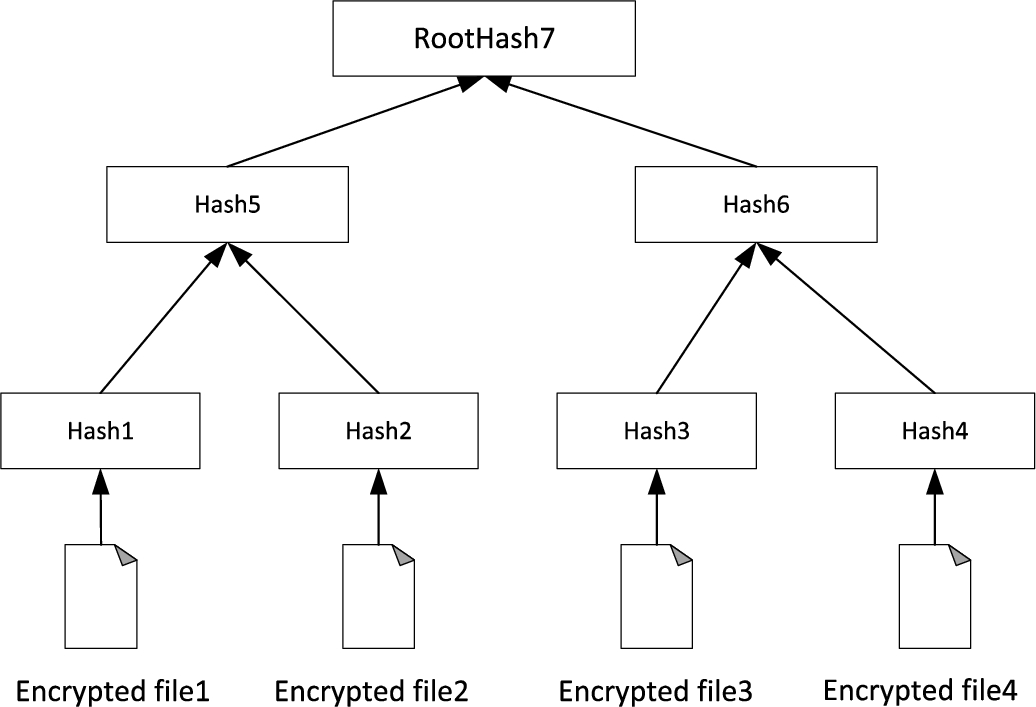
The basic structure of Merkel tree.
Although the advanced applications are mainly concentrated in Bitcoin, the blockchain technology has excellent features such as anti-tampering, non-repudiation, time series data and collective maintenance. Especially, the decentralized nature of its peer-to-peer network has made it widely explored and applied in various fields of finance [14], economy and currency, for example cryptocurrency [7], distributed ledgers [16], document management, asset registration [17], inventory compilation, value exchange, initial coin offe(ICO) [4] and crowdfunding [1], charity, etc.
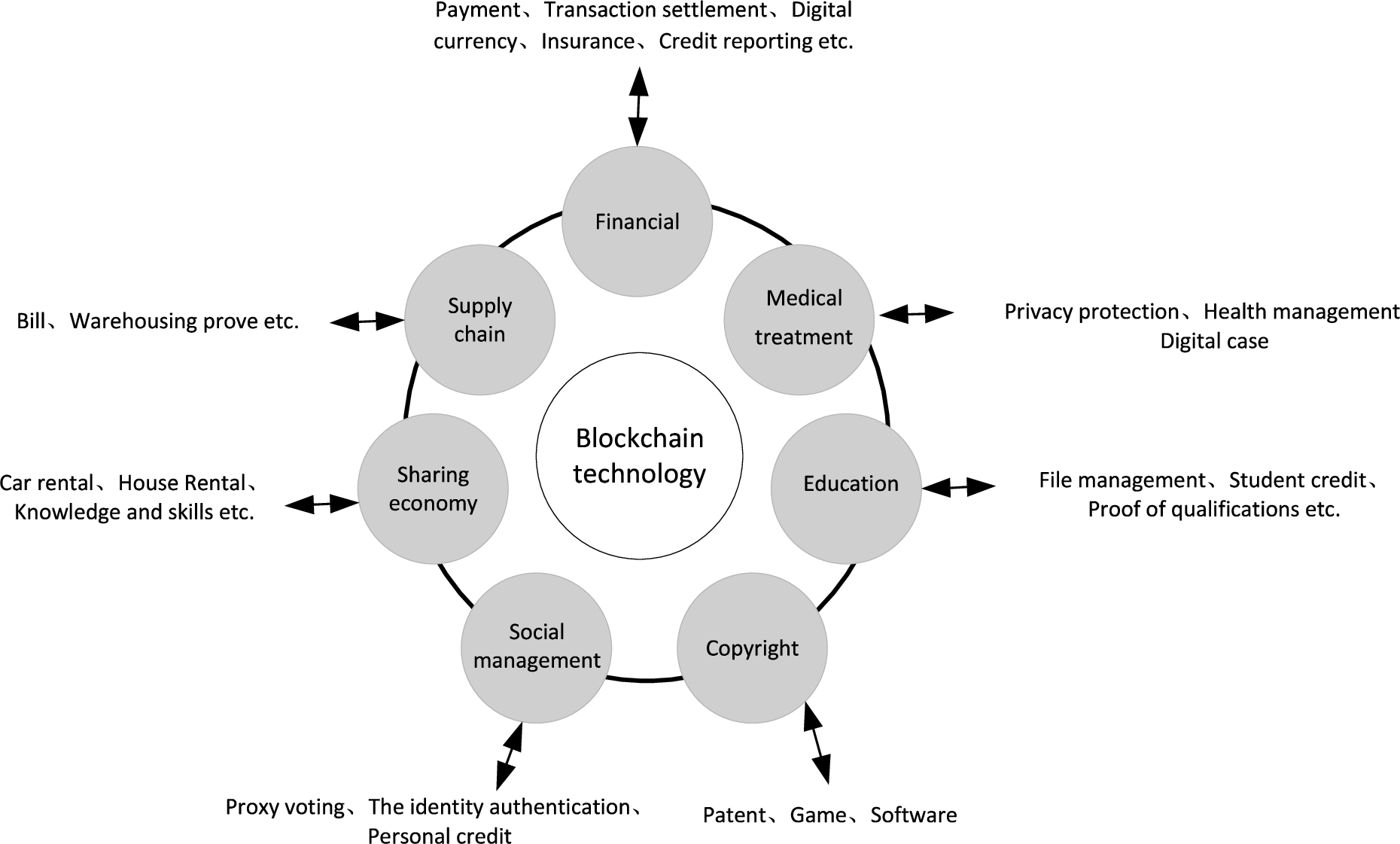
The application of blockchain technology in various fields.
Owing to the characteristics of distributed storage, decentralization, high security and privacy protection, the blockchain technology is particularly suitable for storing and protecting the private data. Specifically, any data can be recorded into the blockchain using hash calculations by recording transactions, where the security is guaranteed by the computing power of the system consensus nodes and asymmetric encryption technology. As shown in Fig. 4, nowadays the blockchain technology is widely used to store personal health data, such as electronic medical records, genetic data, etc. In addition, the timestamps jointly verified and recorded by consensus nodes are non-tamperable, which makes the blockchain technology widely applicable to various data notarization and auditing scenarios. In a similar way, the blockchain technology is also widely adopted in the asset management industry. Due to the immutable modification of time stamps, blockchain can realize the confirmation, authorization and monitoring of the tangible and intangible assets. Morever, the voting system is a representative application of blockchain technology in the field of political affairs. The distributed consensus verification strategy is helpful for the political elections and corporate shareholder voting.
Except that, the blockchain technology will also become an effective way to solve the integrity problem in scientific research project management, and provide another theoretical perspective and technical support for the construction of scientific research integrity system.
For scientific research information management, the scientific research materials and data need to be maintained promptly, while the written materials such as papers and applications require a unique logo to prevent plagiarism. These requirements determine that the blockchain technology can be used to improve the information management system. As a type of data storage and management mode, blockchain can be easily combined with information management. The next section will discuss the innovation and application that the blockchain technology used in our scientific research management.
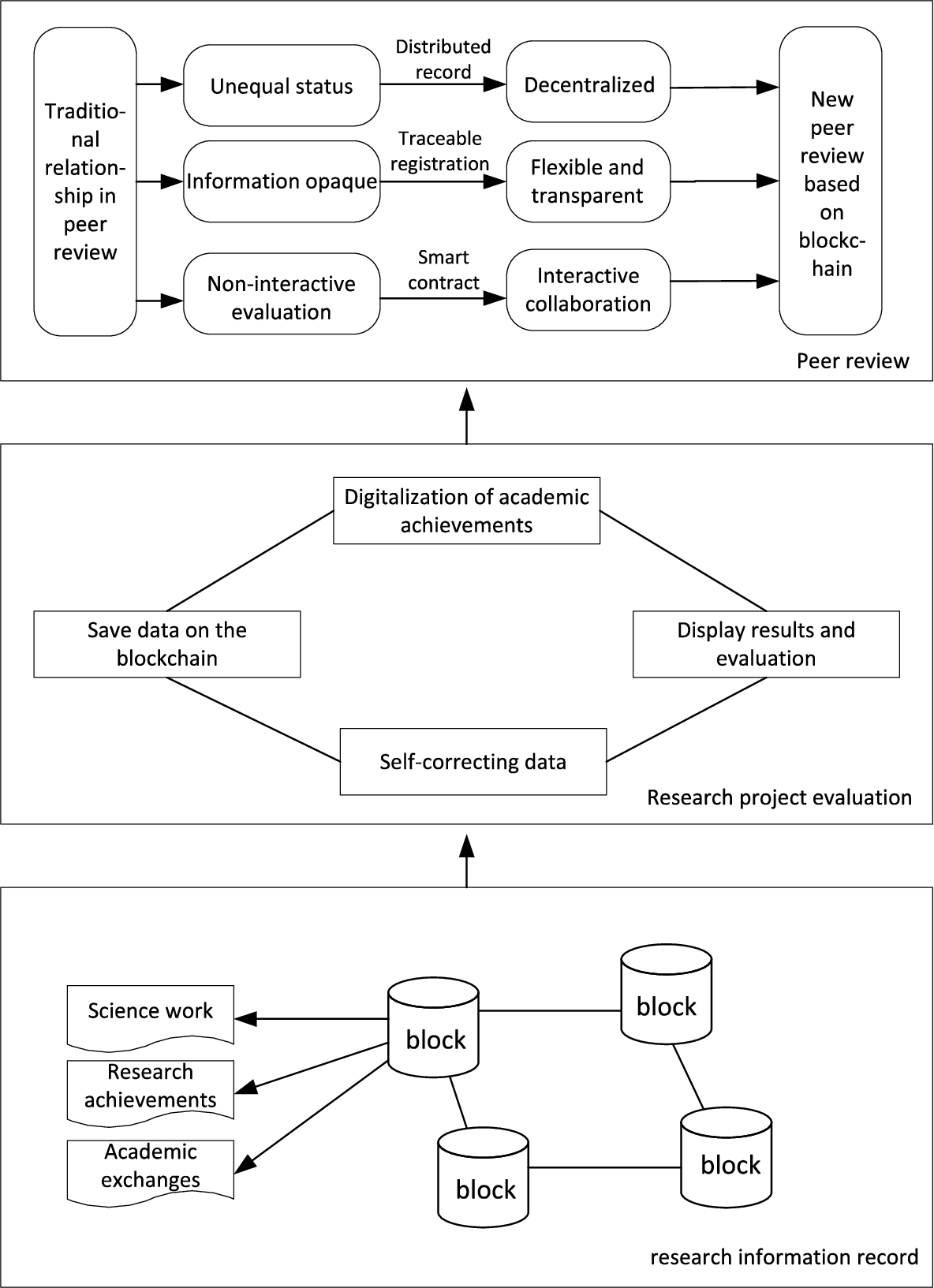
The improvement and structure of the main links.
Scientific research project management mainly includes project application and project management, organization and process management, conclusion acceptance and achievement transformation management. The improvement and structure of the main links are shown in Fig. 5. First, in the recording stage of scientific research information which is recorded in the form of blocks, a unique time stamp is formed in the system. Secondly, the system digitizes the academic achievements, so that they can be sorted out at the conclusion of the question. Finally, the peer review is also conducted in the same system. Different from the traditional peer review model, blockchain-based peer review can record the information and evaluation status of each reviewer, which realizes the two-way communication between reviewers and reviewees, and achieves the transparency of reviews. The specific design will be given in the following chapters.
Data original protection and fraud governance
As we all know, the work carried out in the early stage of the scientific research project and the academic achievements are important indicators for evaluating the applicant’s scientific research capabilities and whether they can complete the applied project. A high-quality application is usually the key to the successful project application. Therefore, when applying for projects, there are often cases that the early-stage results are forged in the application. The applicant regards other people’s achievements as papers as his own. Common academic misconducts mainly include plagiarizing others’ successful applications or applications being applied, or even asking others to write applications on their behalf, and tampering with academic achievements that have been obtained: (1) Taking other people’s achievements, such as papers, as their achievements; (2) Chinese papers are listed in the form of English papers to disguise as English papers; (3) Changing the ranking relationship of papers, improving the applicant’s ranking, and even adding his name to the author information of published papers; (4) Fabricating other relevant information of the paper, such as changing the magazine name of the published paper, or even fabricating a paper which never be published. These behaviors have greatly damaged other applicants of scientific research projects, and have greatly damaged the innovation of scientific research.
At present, the development of academic misconduct detection tools is changing rapidly, which has been able to provide double-checking for scientific research project applications. However, the plagiarism and fraud of original ideas are more concealed than ordinary plagiarism. Moreover, most of the existing double-checking detection software can only detect the repetition rate of the text, and cannot effectively distinguish the plagiarism and data fraud on the content. Even analysis and judgment of non-text formats such as pictures and formulas are powerless. The storage of project applications in the blockchain mode can greatly improve the defects of existing digital applications, such as data traceability and data authenticity. Firstly, the blockchain will create a comprehensive and accurate digital identity information for each applicant, and will record each project application, as well as the results obtained. Above these, the applicant’s research trajectory will be established in a time series manner to form a comprehensive scientific research chain, which can record the work done by the applicant such as published results and academic exchange records clearly and accurately. Therefore, the blockchain technology will stamp each piece of information with a unique, tamper-proof digital certificate through its ledger function. The proven content can be described in any format, such as text, pictures, formulas, etc. The above method proves that the blockchain can build a universal project application database, which can provide a common standard for project applications. Any application materials uploaded to the blockchain will record their information and other relevant information in the ledger. During the application and review process of the project, the application platform built on the blockchain technology will be able to track the usage of the content. Once it is found to be used, the application platform can quickly trace and determine the original creator of its content through its account information. So, any plagiarism will be discovered quickly.
Scientific research project conclusion evaluation
The number and the level of publication have always been the criteria for evaluating whether a scientific research project can be completed. But the scientific research always has unforeseen risks, with great uncertainty. It is normal for the research planned in the application fail to reach the expected goal due to unknown and irresistible reasons, or to obtain a result that is not the project content planned in the application. Seeking truth from the facts reflects the respect for the spirit of science. Therefore, the contents of the application for scientific research projects can be divided into the following situations.
The research results are in accordance with the contents planned in the application. Especially in the case of designing a project with a high degree of innovation, it can achieve the intended purpose, which is the most ideal situation and should be affirmed. The research results did not meet the content of the declaration, but some progress has been made, even major progress. The original plan was not very reasonable, or other special reasons, which made the original plan unsustainable. The applicant had to complete the project from other angles, but still made some progress and obtained some results. This situation should also be affirmed. If the research period is over, no results have been obtained, or there are results that can only prove that the original plan is not possible. For this kind of ending, it is necessary to discuss by situation. The project can be completed if some minor results can be obtained. The complexity and uncertainty of the scientific research determine that the excellent results are always scarce, and most of the results have a little contribution. The confidentiality, distribution and non-tampering of data via blockchain technology provide a new idea for solving the problem of re-certification of the academic research results. Some academic achievements have deviations in the experimental environment, which cannot be repeated and verified by other researchers, leading to the question of the authenticity and reliability of academic achievements. The digitalization of the academic achievements by blockchain provides the abundant information resources for researchers in related fields, and also allows researchers to encrypt confidential data before recording each experimental step on the blockchain to form a record that cannot be tampered with. The contents of these records are open to the project managers for the steps of the experiment and the results obtained in each experimental stage. This technology not only guarantees the confidentiality of those who are not related to the project, but also guarantees the openness and transparency of the experiment process to project managers or project review experts, and completely shows the entire experiment, even if the data of a certain block does not exist. If there is an error in the determined cause, it can also be self-corrected based on the data of other blocks. This can not only effectively solve the problem of re-examination of the experimental results, but also ensure the integrity and correctness of the experiment and enhance the credibility and reliability of the academic research. In this way, a reasonable academic evaluation can be made according to the recorded process.
Peer review
In the process of subject management, peer review mainly exists in the project application and project conclusion. The disadvantages of the peer review system for the current existing project applications are mainly reflected in four aspects: (1) The direction of the review project and the review experts are inconsistent. Due to the limitation of the number of project review experts, there are problems such as subjectivity, the limited ability to review, and deviation from the real needs of scientific research. (2) Since the results of the peer review are not published, it may lead to irresponsibility, abuse of rights, and prejudice among project review experts. (3) The reasons for the plagiarism in the project application include the review experts themselves or helping the project applicants who are familiar with them to plagiarize. This will bring losses to the original creators, and even bring great obstacles to academic innovation. (4) If the project review expert is familiar with the project applicant, it may be passed regardless of the content quality. In the acceptance of the conclusion of scientific research projects, there are also the same criticism and disadvantages of project applications. Anonymity has become the main controversy faced by the current review method, allowing anonymity to easily lead to irresponsible negative evaluations, but the implementation of mandatory real-name will suppress doubts about research results.
This paper believes that the blockchain technology can improve the quality of review by providing a distributed project review platform for scientific research projects. Under the blockchain platform, anonymous public comment with identity authentication and credit guarantee will be more easily realized. First, the scientific research project management system built on the blockchain model can create the accurate digital identity information for each review expert, including academic qualifications, units, job titles, academic achievements, etc. It is conducive to the implementation of more strict evaluation rules that carrying out identity authentication to determine whether it has the evaluation qualifications established by the scientific research project management system [9]. Secondly, in the verification process, the real information of the reviewing experts cannot be publicly obtained, which ensures that their privacy is protected and is conducive to making decisive comments. Thirdly, all project applicants can respond and score each review opinion, and the system can trace the review opinions, so that the review experts are strictly responsible for the review in an anonymous state, and unfriendly comments will be effectively contained. Obviously, blockchain has the ability to keep records permanently, which can make the credibility of the implementer be affected for life. Therefore, in the blockchain mode, the quality of peer review can be improved vidently.
Conclusion
This paper introduced the successful experience of blockchain technology and applied it to the scientific research information management. In conclusion, the blockchain derived from Bitcoin has digitized a variety of information such as results, trust, identity, agreements, etc., which can effectively reduce the storage, costs and risk probability, effectively protect the confidential data, and provide the efficient, transparent, fair processes for finance and society. Nowadays various application systems and many other fields have brought new opportunities for the possible innovative applications. So the blockchain is used in this work to resolve the problems of academic misconduct in scientific research information management, which improve the validity and security of the management system. Undoubtedly, the results and its actual demand put forward the possible important impact of blockchain technology on multiple links of scientific research information management, and put forward some corresponding countermeasures for future applications.
However, unlike the application research in the financial industry, the application of blockchain technology in the field of scientific research information management has not been systematically studied at home and abroad. I hope this article can provide a certain reference for the expansion of blockchain in this field.
Footnotes
Acknowledgements
This work was supported in part by social science planning and research project of Shandong Province (Grant No. 19CZKJ01) and soft science project of Shandong Province (Grant No. 2019RKB01216).
Conflict of interest
The author has no conflict of interest to report.