







Abstract
In this paper, with respect to multiple criteria group decision making (MCGDM) problems in which criteria values are expressed by Pythagorean fuzzy uncertain linguistic variables (PFULVs), we propose an extended TODIM method. Firstly, we define the Pythagorean fuzzy uncertain linguistic set, and propose the operational laws, Hamming distance, score function and accuracy function of PFULVs. Then an extended TODIM method is presented to solve the MCGDM problems under the Pythagorean fuzzy uncertain linguistic environment, and a numerical example with the Pythagorean fuzzy uncertain linguistic information is given to show the effectiveness of the proposed method. Further, we analyze the influence of the different parameter on the MCGDM, and test the practicality of the proposed method.
Introduction
Multiple criteria decision making (MCDM) or MCGDM means that the optimal alternative is selected from the finite alternatives set according to the multiple criteria, which can be regard as cognitive processing. MCDM (or MCGDM) is an important branch of the decision making theory which has been widely applied in human activities [9, 17–19]. Because the real decision making problems were frequently produced from the complicated environment, the evaluation information is usually fuzzy. In general, the fuzzy information takes two forms: one quantitative and one qualitative. The quantitative fuzzy information can be expressed by fuzzy set (FS) [36], intuitionistic fuzzy set (IFS) [1], Pythagorean fuzzy set (PFS) [34] and so on. FS theory proposed by Zadeh [36] has been used to describe fuzzy quantitative information which contains only a membership degree. Based on this, Atanassov [1, 2] presented IFS which consists of a membership degree and a non-membership degree and satisfies the constraint condition that the sum of two degrees is equal to or less than 1. However, sometimes the two degrees don’t meet the restriction, but the square sum of the two degrees is equal to or less than 1. Yager [34, 35] introduced the PFS in which the square sum of membership degree and non-membership degree is equal to or less than 1. In some situation, the PFS has the greater ability to express the fuzzy information than the IFS. For example, if an expert gives the membership about the support to a matter is 0.8 and the non-membership for against is 0.6. Obviously, IFS is invalid to describe this decision information, but it can be effectively described by PFS. In practical decision making, many problems are so complex and indistinct that the quantitative fuzzy information could do no more. In order to overcome these issues, it is best to choose qualitative fuzzy information which can be in the form of linguistic variables or uncertain linguistic variables. Wang and Li [33] combined the IFS with linguistic set and proposed intuitionistic linguistic set (ILS). Based on this, Liu and Jin [13] further defined the intuitionistic uncertain linguistic set (IULS) because the uncertain linguistic set describes fuzzy information better than linguistic set. Similar to the extension of IUFS, we combine the PFS with uncertain linguistic set and propose the Pythagorean fuzzy uncertain linguistic set (PFULS). PFULS can conquer the shortcomings for the PFS which only can describe the criteria’s membership and non-membership to a particular concept and for uncertain linguistic variables in which membership degree is 1, and the non-membership degree or hesitation degree is neglected. Moreover, because the scope of PFS is superior to IFS, the application range of PFULS is wider than IULS. So, the PFULS describes fuzzy evaluation information more appropriately than PFS and IULS. For example, when an evaluator assesses the car performance, he/she thinks that it may be lower than ‘very good’ (s6) but higher than ‘fair’ (s3). The evaluation information comes from the evaluator’s subjective feeling, at the same time, he can respectively give that the membership degree to [s3, s6] is 0.8 and the non-membership degree to [s3, s6] is 0.6. The evaluation result can be regard as < [s3, s6] , (0.8, 0.6)>. Certainly, we can easily find that the sum of the two degrees is 0.8 + 0.6 = 1.4 > 1 and their square sum is 0 . 82 + 0 .62 = 1. Due to the square sum of the membership degree and the on-membership degree is equal to or less than 1 in PFULS, the PFULS exhibits wider applied ranges than IULS in dealing with the real MCDM or MCGDM problems. In exceptional cases, if the upper and the lower of the uncertain linguistic part in PFULS are equal, the PFULS reduces to the Pythagorean fuzzy linguistic set (PFLS) presented by Peng and Yang [24]. In other word, the PFULS is the extension of uncertain linguistic variables, the PFS and the PFLS, which can more easily and precisely describe the uncertain information.
In previous research, many decision making methods under uncertain environment were proposed to deal with subjective evaluation information in real decision making problems, such as TOPSIS [38, 39], VIKOR [20, 31], MOORA [27, 37], ELECTRE [8, 32], PROMETHEE [3, 10], COPRAS [15, 30], OCRA [25], ARAS [11, 22], SWARA [21, 28], EDAS [23, 29] and so on. Devi [4] provided the extended VIKOR method under the intuitionistic fuzzy environment where the weighted vector was expressed by triangular intuitionistic fuzzy set (TrIFS). Peng and Yang [24] used the TOPSIS method to solve the MCGDM problem with the PFS information. Based on prospect theory, Li and Zhao [16] introduced a grey-VIKOR method to deal with MCDM problem where the evaluation information was grey numbers. Stanujkic et al. [27] proposed a new MOORA method to handle lots of decision making problems in real world. Many decision making tools and techniques don’t consider the DMs’ risk attitude. TODIM method based on prospect theory takes the DMs’ psychological behavior into account so that DMs can make a more rational choice under risk. Since the IULS can appropriately describe the uncertain information, Liu and Teng [14] presented an extended TODIM method under the IULS environment. Ren, Xu and Gou [26] further proposed a Pythagorean fuzzy TODIM method which was applied to solve the MCDM problems with PFS information. Due to the shortcoming of the PFS which only can express the criteria’s membership and non-membership to a particular concept, we extend the TODIM method to Pythagorean fuzzy uncertain linguistic environment. In this paper, we introduce an extended TODIM method based on PFULS to solve MCGDM problems in which the criteria values are in the form of Pythagorean fuzzy uncertain linguistic numbers (PFULNs) and the weights of experts and criteria are crisp numbers.
In order to realize the above purpose, the remainder of this paper is constructed as follows: Section 2 briefly introduces the concepts of the PFS, PFLS and TODIM method. Then, we give the related presentations about the PFULS. Section 3 proposes the Pythagorean fuzzy uncertain linguistic TODIM method and describes the procedure of the proposed method in detail. Section 4 gives an illustrative example to demonstrate the effectiveness of the new method and the influence of the attenuation factor of the losses θ. Section 5 gives the concluding remarks.
Preliminaries
Uncertain linguistic set
Let S = {s
i
|i = 0, 1, …, l - 1} be a linguistic term set with odd cardinality in which s
i
represents the possible value for the ith linguistic variable in S. In general, l = 3, 5, 7, 9, etc. For example, if l = 7, then S = {verypoor, poor, slightlypoor, fair, slightlygood, good, verygood}. The linguistic variables s
i
and s
j
should meet the following condition [6, 7]: Ordered linguistic set: if i > j, then s
i
> s
j
; Max operator: if s
i
≥ s
j
, then max(s
i
, s
j
) = s
i
; Min operator: if s
i
≤ s
j
, then min(s
i
, s
j
) = s
i
; Negation operator: neg (s
i
) = s
j
, where j = l - 1 - i.
In order to minimize the loss of linguistic information, the discrete linguistic term set S = {s
i
|i = 0, 1, …, l - 1} is extended into the continuous linguistic set
Suppose
The Pythagorean fuzzy set (PFS)
Based on the Definition 1, Zhang and Xu [38] further proposed the distance between p1 =< (μ p 1 , ν p 1 ) > and p2 =< (μ p 2 , ν p 2 ) >, which was given as follows:
The operational rules of the PFNs can refer to references [34, 35].
The operational rules of the PFLNs can refer to the reference [24].
Based on the uncertain linguistic set and Pythagorean fuzzy set, in this section, we propose the Pythagorean fuzzy uncertain linguistic set (PFULS) and define the operational laws, distance, and comparison method of the PFULS.
Based on Definition 4, when we set some specific values of function g (x), then different operational rules can be obtained. For simplicity we set g (x) = - log x2 so that we can get
According to the operational rule (1) expressed by the formula (9), it is obvious that the formula (13) is right. According to the operational rule (2) expressed by the formula (10), it is obvious that the formula (14) is right. For the formula (15), we can get
and
So, we can get Similar to the proof of formula (15), it is easy to prove that formulas (15–18) hold, which are omitted here. According to the operational rule (1) expressed by the formula (9), it is obvious that the formula (19) is right. According to the operational rule (2) expressed by the formula (10), it is obvious that the formula (20) is right.
If If If If If If
Suppose
If
According to the formula (17), it is easy to find that the Hamming distance
We can get the following equations:
In order to satisfy the above equations, the solution is the following condition:
So, we can get
So,
The TODIM method [5] is based on the prospect theory (PT), which can consider the risk attitude of DMs. However, so far, the existing TODIM methods cannot solve decision making problems under the Pythagorean fuzzy uncertain linguistic environment. In this part, we will extend the TODIM method to solve the MCGDM problems in which the attributes take the form of the Pythagorean fuzzy uncertain linguistic information.
The origin TODIM method
The TODIM method is inspired by the prospect theory (PT), which could consider the bounded rationality of the decision makers (DMs). In other word, TODIM method not only takes the risk averting attitude of the DMs in the face of gain into account but
also pays attention to the risk seeking attitude of the DMs in the face of loss. The method can give the corresponding dominance between each alternative and others with respect to a particular criterion.
Suppose {A1, A2, …, A
m
} is the set of alternatives, {C1, C2, …, C
n
} is the set of criteria, and (w1, w2, …, w
n
)
T
is the weighted vector of the criteria, which satisfies the condition that w
j
∈ [0, 1] (j = 1, 2, …, n) and
For a MCGDM problem with the Pythagorean fuzzy uncertain linguistic information, let A = {A1, A2, …, A
m
} be the set of alternatives, C = {C1, C2, …, C
n
} be the set of criteria. w = (w1, w2, …, w
n
)
T
is the weighted vector of the criteria, satisfying w
j
∈ [0, 1] and
Procedure of the Pythagorean Fuzzy Uncertain Linguistic TODIM method
The extended TODIM method has been effectively applied to lots of MCGDM problems, which can conduct the sensitivity analysis through the different parameter θ. Based on PT, the Pythagorean Fuzzy Uncertain Linguistic TODIM method can make effective choices in risked environment according to the evaluation information expressed by PFULNs. In this sub-section, the steps of the proposed TODIM are described in detail.
For benefit criteria:
For cost criteria:
In this step, it is essential to measure the difference between alternative A
i
and alternative A
t
according to the criterion C
j
. Normally, there are two methods for selection. In one way, the PFULNs can be translated into specific crisp numbers by the score function. But this method generally results in the loss of evaluation information. Another way is to measure the distance between different alternatives, and it doesn’t damage the integrity of information. As a result, we select the second way to calculate the difference between different alternatives.
In this part, we use a numerical example to demonstrate the effectiveness of the proposed method, which is an adaptation of numerical example in [24]. An investment company wants to invest a software project, the potential four alternatives are {A1, A2, …, A
m
}. In the process of selecting ideal alternative, there are three criteria: C1 the technical feasibility; C2 the economic feasibility; C3 the operational feasibility. The weighted vector of these criteria is w = (0.39, 0.26, 0.35)
T
. The evaluation information of alternatives A
i
(i = 1, 2, 3, 4) given by three DMs E
k
(k = 1, 2, 3) with respect to the criteria C
j
(j = 1, 2, 3) are used to constructed the decision making matrices
The evaluation values from expert E1
The evaluation values from expert E1
The evaluation values from expert E2
The evaluation values from expert E3
Based on the Step 6, we can know that δ (A4) > δ (A3) > δ (A1) > δ (A2) so that the ranking of the alternatives is A4 ≻ A3 ≻ A1 ≻ A2. Certainly, the alternative A4 is the best.
Based on the above introduction of the proposed TODIM method, we can know that the parameter θ is crucial to the ranking of alternatives in the process of the decision making. θ is the attenuation factor of the losses, which represents the characteristic of being steeper for losses than for gains. So, in this part, we give the further analysis about the influence on the ranking results of different parameter value θ, which are shown in Figs. 1–3.
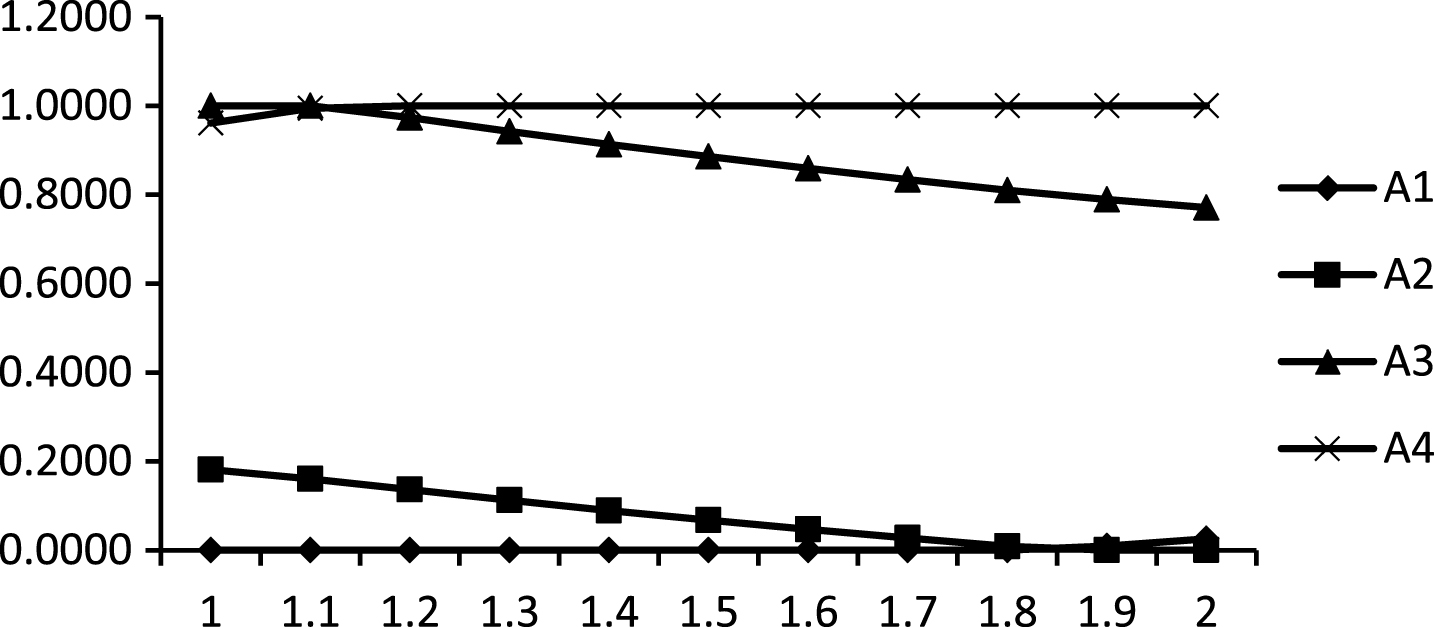
The Overall Values With θ Varying From 1 to 2.
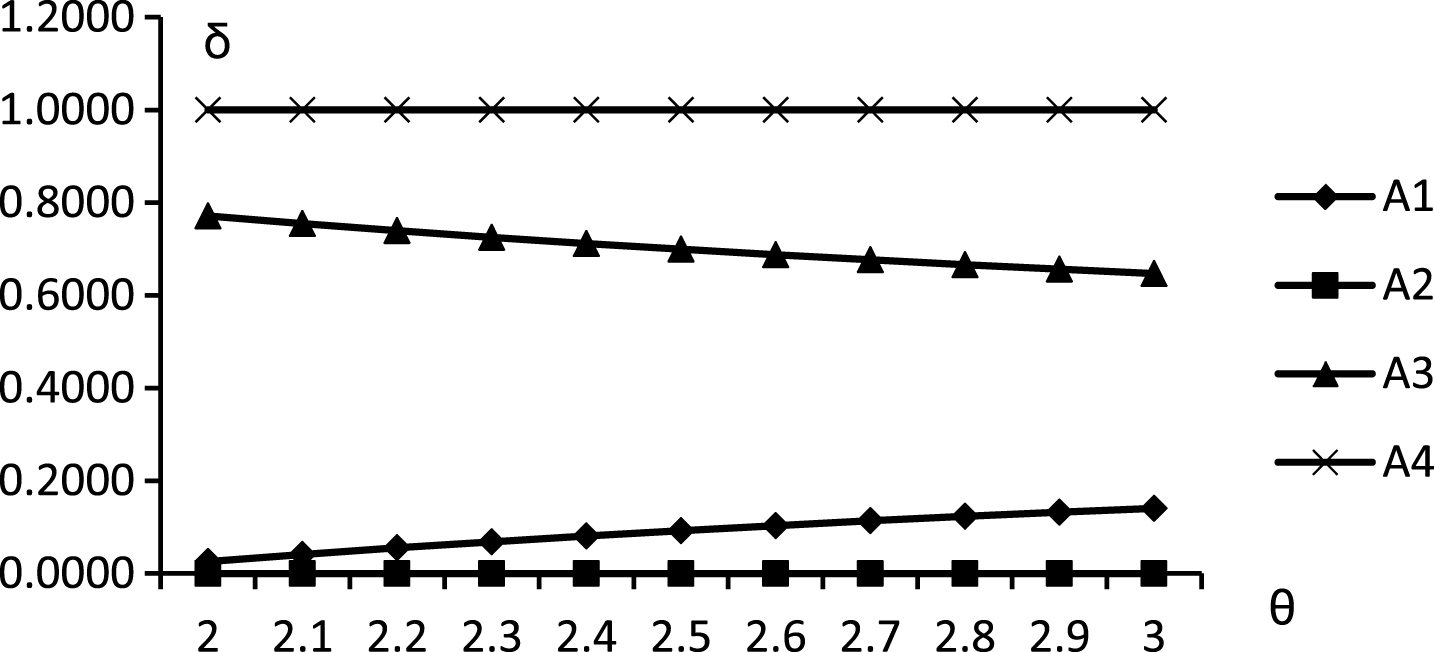
The Overall Values With θ Varying From 2 to 3.
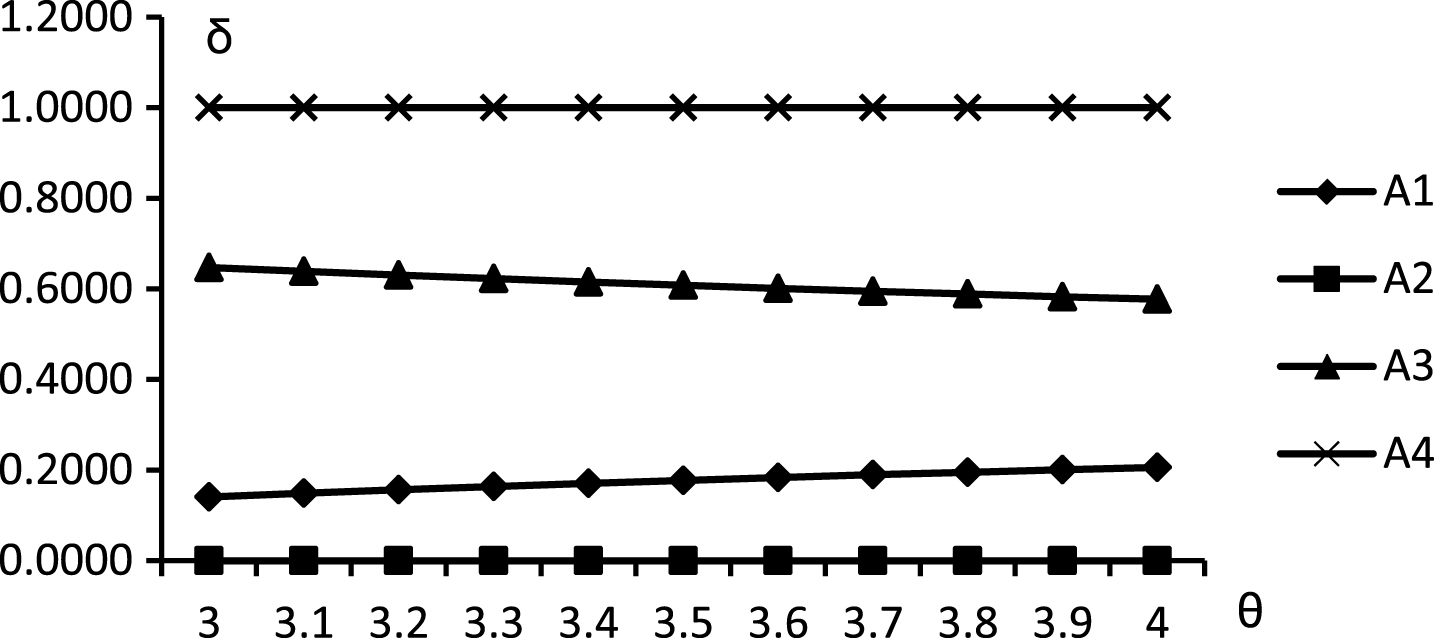
The Overall Values With θ Varying From 3 to 4.
Based on the δ above Figs. 1–3, we can get an ordering rule which is listed in Table 4. According to the Table 4, we can find that the ranking results have changed with different parameter value θ. When the parameter 1 ≤ θ ≤ 1.1, the ranking result is A3 ≻ A4 ≻ A2 ≻ A1; when the parameter 1.2 ≤ θ ≤ 1.8, the ranking result is A4 ≻ A3 ≻ A2 ≻ A1; when the parameter 1.9 ≤ θ ≤ 4, the ranking result is A4 ≻ A3 ≻ A1 ≻ A2. With the change of the θ parameter, the best alternative also changes.
Ranking Results of the Alternatives By the Different Parameter value θ
In order to demonstrate the effectiveness of the proposed method in this part, we compare the ranking results in this paper with the results of two existing methods in reference [24]. We should first transform the PFUNs to Pythagorean fuzzy linguistic numbers (PFLNs) by means of substituting each uncertain linguistic part with the mean value of its upper and lower limits, which are precisely the evaluation information of numerical example in [24]. Then two existing methods in [24] are used to deal with evaluation information take the form of PFLNs. The first ranking result computed by PFLWA operator is A4 ≻ A3 ≻ A2 ≻ A1, which is the same with the result used by the proposed method in 1.2 ≤ θ ≤ 1.8. The second order got by the TOPSIS method is A4 ≻ A1 ≻ A3 ≻ A2. According to contrast between these results, we find that the best alternative is consistent. Therefore, it can demonstrate the efficiency of the new proposed method. Here, the advantages of the new method are listed as follows: The PFULS can more precisely express the uncertainty in the MCGDM than the PFLS. In other words, PFULS is the extension of the PFLS. If the upper and the lower of the uncertain linguistic part in PFILS are equal, the PFULS can degenerate into PFLS. So, we can know that the PFULS has more extensive application prospect than the PFLS. The proposed TODIM method considers the DMs’ psychological behavior, which can help DMs to effectively make decision in the face of risk by changing the attenuation factor of the losses. Neither the PFLWA operator nor TOPISIS method in reference [24] takes the subjective judgment in the face of the gain/loss into account. So, the proposed TODIM method with PFULS information is more practical in handling the MCGDM problems. The method proposed in this paper is the optimization of the existing method in reference [14]. The new TODIM method under the PFULS environment can deal with more MCGDM problems than the TODIM method with IULS information. Because the square sum of membership degree and non-membership degree is less than or equal 1 in PFULS, but the sum of membership degree and non-membership degree is less than or equal 1 in IULS, the proposed TODIM method is better than the existing method in reference [14].
Conclusion
In this paper, we propose an extended TODIM method under the Pythagorean fuzzy uncertain linguistic environment. The PFULS is the combination of PFS with the uncertain linguistic set, which can express the subjective evaluation information more precisely. At the same time, DMs can give the membership degree and the non-membership degree belonging to the subjective evaluation information according to their knowledge accumulation. So, the PFULS can more suitably portray the uncertainty in the real MCGDM. The classical TODIM method is based on prospect theory, which takes the DMs’ psychological behavior into account by using the different parameter θ. Further, we proposed an extended TODIM method to cope with the MCGDM problem under the PFULS environment. In order to demonstrate the effectiveness of the proposed method, we gave a numerical example expressed by PFULS. In order to consider the influence of the attenuation factor of the losses θ, we used different parameters θ to analyze and compare the different ranking results with the two existing methods in reference [24]. As a result, we can prove that the proposed TODIM method is useful and precisely in the process of handling the MCGDM problems. The proposed method not only can portray the uncertainty in real decision making, but also can present the DMs’ psychological behavior in the face of risk. The future studies should focus on widening the scope of the proposed method in the real world. In addition, we should make further effort to improve and perfect the proposed TODIM method so that it can handle uncertain information presented by different forms.
Footnotes
Acknowledgments
This paper is supported by the National Natural Science Foundation of China (Nos. 71771140, 71471172 and 71271124), the Special Funds of Taishan Scholars Project of Shandong Province (No. ts201511045), Shandong Provincial Social Science Planning Project (Nos. 15BGLJ06, 16CGLJ31 and 16CKJJ27) the Teaching Reform Research Project of Undergraduate Colleges and Universities in Shandong Province (2015Z057).