






Abstract
This paper presented an improved fuzzy synthetic model based on combination weighting and a cloud model to optimize wind turbine maintenance strategy and improve operational reliability. First, a condition assessment framework was proposed by analyzing the monitored physical quantities of a working wind turbine. Based on the establishment of a state health evaluation index and health status classification of wind turbines, the weight of each index was determined with a combination weighting method while the membership degree of each state grade was determined with a membership cloud model. A comprehensive evaluation of the health status of the wind turbine was carried out using the method of stratified evaluation. The results showed that the proposed method was effective and feasible. The results also showed that the condition assessment that utilized the improved method predicted the change of operating conditions and more closely matched real operating conditions than the traditional fuzzy assessment method.
Introduction
Wind energy, a type of renewable energy, is quickly growing in popularity, and the number of wind turbines is increasing throughout the world [1]. However, affected by the operating environment, its complex structure, and other factors, the wind turbine appears to be headed toward inevitable failure. This is because the Current maintenance strategy utilizes a traditional preventive maintenance strategy, and problems such as “under repair” and “over repair” result in expensive, time-consuming maintenance [2, 3]. If the condition monitoring information of the wind turbine were used to its potential, implementation of the state maintenance strategy would greatly improve the safety and reliability of the machine and reduce operation and maintenance costs of wind turbines.
Although operation monitoring of the important components of wind turbines has been extensively investigated, research on the overall state of wind turbines and the evaluation of the health degree is lacking [4, 5]. Current evaluation methods include the probability statistics method, intelligent method based on neural network, and fuzzy comprehensive evaluation method, among others [6, 7]. The probability statistical method is suitable for the evaluation of index factors involving independent distribution, but the evaluation results are not good when there exists strong correlation among index factors of the characterization of the wind turbine in the operating conditions. The accuracy of the intelligent method based on neural network requires a lot of training, which makes it unsuitable due to the short running time and small amount of data for new wind farms. A wind turbine generator system is a complex integrated system, its operating state is affected by many factors, and the evaluation process is ambiguous and random. The evaluation method based on fuzzy theory can effectively deal with the vagueness and randomness of the index factors and has recently gained more attention and use in practice [8]. Based on the monitoring data of wind field data acquisition and a monitoring control system in reference [8], the fuzzy evaluation method is applied for the comprehensive evaluation and analysis of the operational status of a wind turbine, and the deterioration function is applied for analysis of the membership degree of the running state. The layer by layer transference of the weight can cause serious deterioration of sub parameters, but the effects at the level of the unit are not obvious. Reference [9] evaluated the status of the doubly fed wind power generation equipment using the method of analytic hierarchy process (AHP) and fuzzy comprehensive evaluation method, and the more subjective weight calculation and determination method of the membership matrix. Reference [10] put forward a method based on the evaluation of wind turbine operation using the local variable weight comprehensive fuzzy evaluation method to evaluate the real-time state of the unit, which avoided subjectivity to a certain extent. The fuzzy inference systems in most existing literature use qualitative reasoning that approximates the specified membership function, and the determination of the membership function has some degree of subjectivity.
Reference [8] selected a distribution function of the triangular and semi trapezoidal combination as the membership function of the evaluation index. The membership functions of reference [11] were used to form a ridge distribution function in the optimization of the final evaluation of the health status of a unit. In view of the membership function of fuzzy systems, reference [12] pointed out that membership function, as the foundation of the fuzzy set theory, uses a precise function curve to process fuzzy phenomena, which solves the fuzzy problem precisely and violates the basic essence of fuzzy theory. Subsequently, the normal cloud model was proposed, and the previously precisely determinant membership function was expanded to construct a normal membership degree distribution expectation function, which has more general applicability and can quantitatively express evaluation indicators effectively and qualitatively describe the conversion process. This model has been applied in the field of equipment effectiveness evaluation and risk assessment [13, 14], and has demonstrated a strong development potential.
In this paper, a fuzzy comprehensive evaluation method based on combination weighting and a cloud model was proposed to solve the problem of fuzziness and randomness in the process of health condition assessments of wind turbine generators. On the basis of the construction of the health state assessment index system and grading of wind turbines, the index weight was derived through a combination weighting method, the grade membership of state was determined by a normal cloud model, and a comprehensive evaluation was carried out to determine the health state of a wind turbine using a hierarchical evaluation method. In the final evaluation results, the criteria were refined according to different situations.
Construction of a health state evaluation model for wind turbines
Evaluation of index system health status of wind turbines
The structure of the wind turbine is complicated, and there are many parameters that affect its operation. To comprehensively reflect the real time response of the wind turbine operational state, this study summarized and analyzed the information of failure mode and mechanism, and the operation and maintenance of historical data of wind power on the basis of field investigation. Furthermore, this study chose representative parameters and constructed a health status evaluation index system for wind turbines, as shown in Fig. 1.
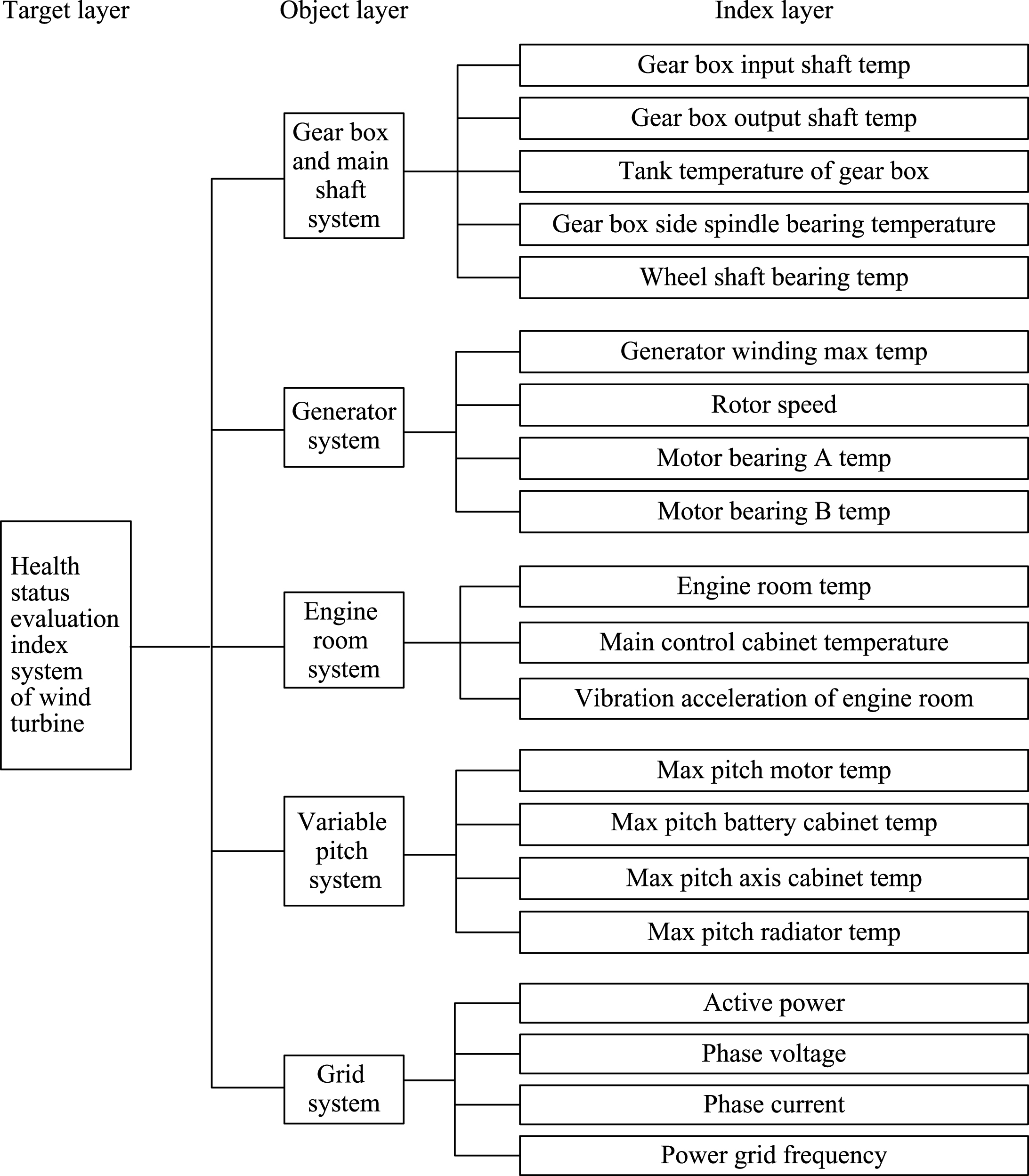
Health status evaluation index system of a wind turbine.
The proposed evaluation index system consisted of the following three levels: target layer, object layer, and index layer. The health status of the wind turbine was the target layer; five evaluation factors in the object layer were acknowledged as U = {U1, U2, U3, … U4, U5} = {gearbox, spindle system, generator system, engine system, variablepitchsystem, andgridsystem}. Each element, U i , in the object layer also contained N indicators of the index layer; that is, U i = {ui1, ui2, … u in }, where u in is the No. n evaluation index of the No. i object in the target element layer. For example, the generator system U2 = {u21, u22, u23, u24} = {maximum temperature of generator winds, rotor speed, temperature of motor bearing A, and temperature of motor bearing B}.
The health status of a wind turbine from health to fault is a relative and gradual fuzzy process, so it is difficult to accurately quantify, and the operating state of the wind turbine can only be described in accordance with the health level. The classification of health status of the equipment commonly used the Division 1–9 grade standard degree method [15]. Through research, comparison, analysis of actual wind turbine working conditions, and historic data of operation and maintenance, which were combined with the experience of experts and maintenance personnel, the health status of the wind turbine zone was divided into four categories: “health,” “sub health,” “attention,” and “fault,” as shown in Table 1 (That is, the comment V = {V1, V2, V3, V4} = {health, subhealth, attention, fault}).
Health status level of wind turbines
Health status level of wind turbines
In the process of fuzzy comprehensive evaluation, the weight of each evaluation index plays a decisive role, which directly affects the rationality of the comprehensive evaluation results.
Analytic hierarchy process determining the subjective weigh
The analytic hierarchy process is an effective method to describe the subjective judgment of human beings. It combines qualitative and quantitative methods, and is a widely used kind of subjective weighting method. Its main steps include the following. Determine the objectives and evaluation factors set. Calculate from the bottom layer-by-layer using pairwise comparison, and determine the importance of the underlying index to the index on the upper layer with the subordination relationship, give a standard form (usually with 1–9 ratio scale), and construct the judgment matrix W. According to judgment matrix W, the maximum eigenvalue of the judgment matrix is obtained by calculating the corresponding characteristic vector. Then, the feature vector is the importance ranking of the evaluation factors – namely, the weight distribution. Examine the uniformity of the judgment matrix R using the formula of CR = CI/RI, where: CR is random consistency ratio for judgment matrix; CI is consistency index of judgment matrix; and RI is average random consistency index of judgment matrix.
Entropy weight method determined the objective weight
The entropy weight method is a kind of objective weighting method based on the information of each factor to calculate the weight. It is based on the original data of the evaluation object, determines the correlation between the evaluation indicators by calculating the information entropy of evaluation indicators, and obtains the weight of the objective significance.
There are n objects, m evaluation indexes, and original data matrix X = [x
ij
] n×m, x
ij
≥ 0 (i = 1, 2, …, n ; j = 1, 2, …, m). Due to the variable range of entropy in the [0, 1], and in order to ensure compliance with the requirements, the original evaluation data needs to be normalized; that is,
For an index x
j
in the system, the information entropy is as follows:
The entropy weight of
Thus, the weight vector based on entropy was obtained, which was the objective weight of each state.
The subjective weighting method that is based on experts’ experiences to empower the importance of the indicators takes full advantage of expert knowledge and reflects the actual situation to a certain extent, though the subjectivity is strong. The objective weighting method is based on objective information, which is reflected by the equipment index, to avoid the influence of subjective factors and determine the weight of each characteristic parameter. Although this method is completely dependent on objective data, it cannot fully consider the correlation between indicators, and sometimes even the obtained weight departs from the important degree of the evaluation index itself.
Therefore, a reasonable weighting method should utilize both the inherent rules of objective information and expert experience to make a decision index weight that unifies subjective and objective factors. This not only combines the advantages of the two methods, but also makes up for any shortcomings, and the acquired weight values are more scientific and accurate. Therefore, this study selected the analytic hierarchy process and entropy weight method, and the multiplication integration method to construct a combination weight, as shown below [15–17]:
The traditional fuzzy evaluation method uses an exact membership function to calculate membership degree of a fuzzy concept in the value of a domain. The precise membership function that represents the fuzzy concept obtains a complete and clear relationship, which itself is against the fuzzy theory, being a precise mathematical function that is not in any way ambiguous. When the traditional form of a membership function describes both this and that, the result is continuous; however, there is a point of mutation, and the first derivative of the curve is not continuous and thus does not the gradual nature of the transition state. The cloud model does not emphasize the function of an exact function, but takes full advantage of the universality of normal distribution and a normal membership function, and generates a quantitative conversion value of qualitative notion through three characters of digital value (expected Ex, entropy En, and super entropy He) that form the generator. The accurately specified membership function is extended to construct the normal distribution function, and the substitution of the fuzzy comprehensive evaluation method by the cloud mode is more scientific and reasonable [18, 19].
Cloud model theory
U is a precise numerical representation of the quantitative domain, and C is a qualitative concept of U. If the quantitative value of x is a random implementation of a qualitative concept of C, the certainty degree μ (x) ∈ [0, 1] of x to C is a random number of stability, as in
x in the distribution field U is called a cloud, and each x is called a cloud droplet. A cloud is a realization, in numbers, of a qualitative concept, and several clouds reflect the overall characteristics of a qualitative concept.
Expected Ex, entropy En, and super entropy He were used as features of the cloud, and connected the fuzziness and randomness of things, which formed uncertain mapping between the qualitative concept and quantitative value. The health status of the cloud model was used to evaluate wind turbines, in which the expectation value of Ex represented the point of the health state classification concept; entropy, En, reflected the randomness of sample data collection in the process of the health state and fuzziness of the data in the health state level; and super entropy, He, embodied the association between fuzziness and randomness in the evaluation process.
Cloud Generator Membership (MCG), the most basic and important algorithm in cloud model algorithms, can be divided into two kinds: the positive cloud generator and the reverse cloud generator, shown in Fig. 2.
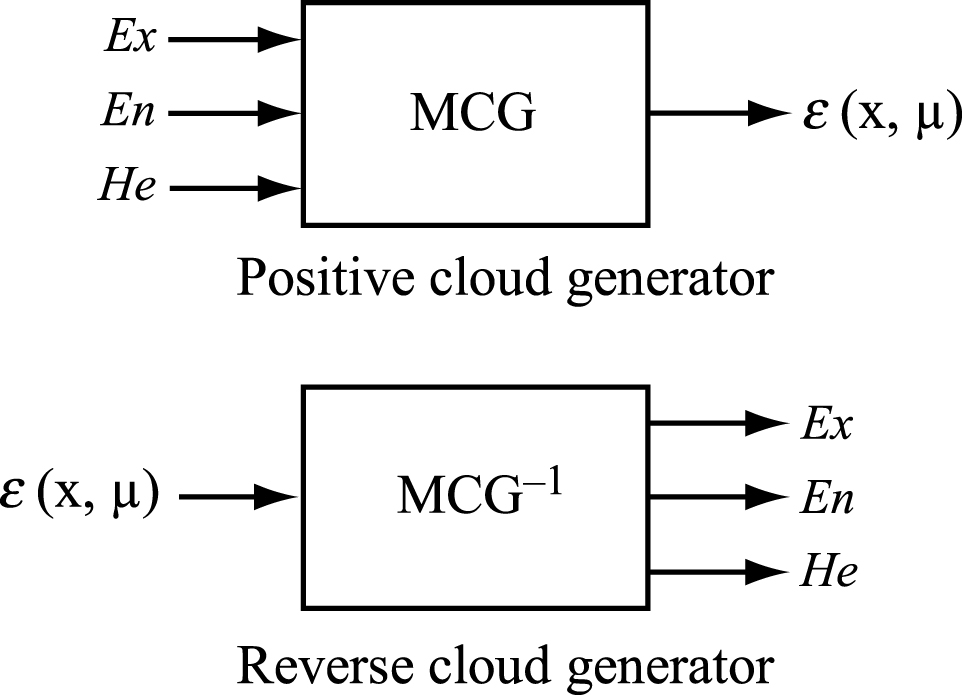
Membership cloud generator.
This study used the normal cloud generator to establish a membership cloud model, and the algorithm process was as follows: Generate a normal random number of En as the expected value, and He2 is Generate a normal random number of Ex as the expected value, and Calculate x
i
, with determination degree μ
i
, becomes a cloud droplet in the number domain; Repeat Steps (1)–(4) for n times, until No. n cloud is generated.
All cloud droplets formed a cloud, as per the concept of representation, where NORM was a function of generating random numbers of normal distribution. Figure 3 illustrates a cloud image obtained by the above algorithm. Among them, Ex = 1, En = 0.15, He = 0.01, and N = 2000 for the number of cloud droplets.
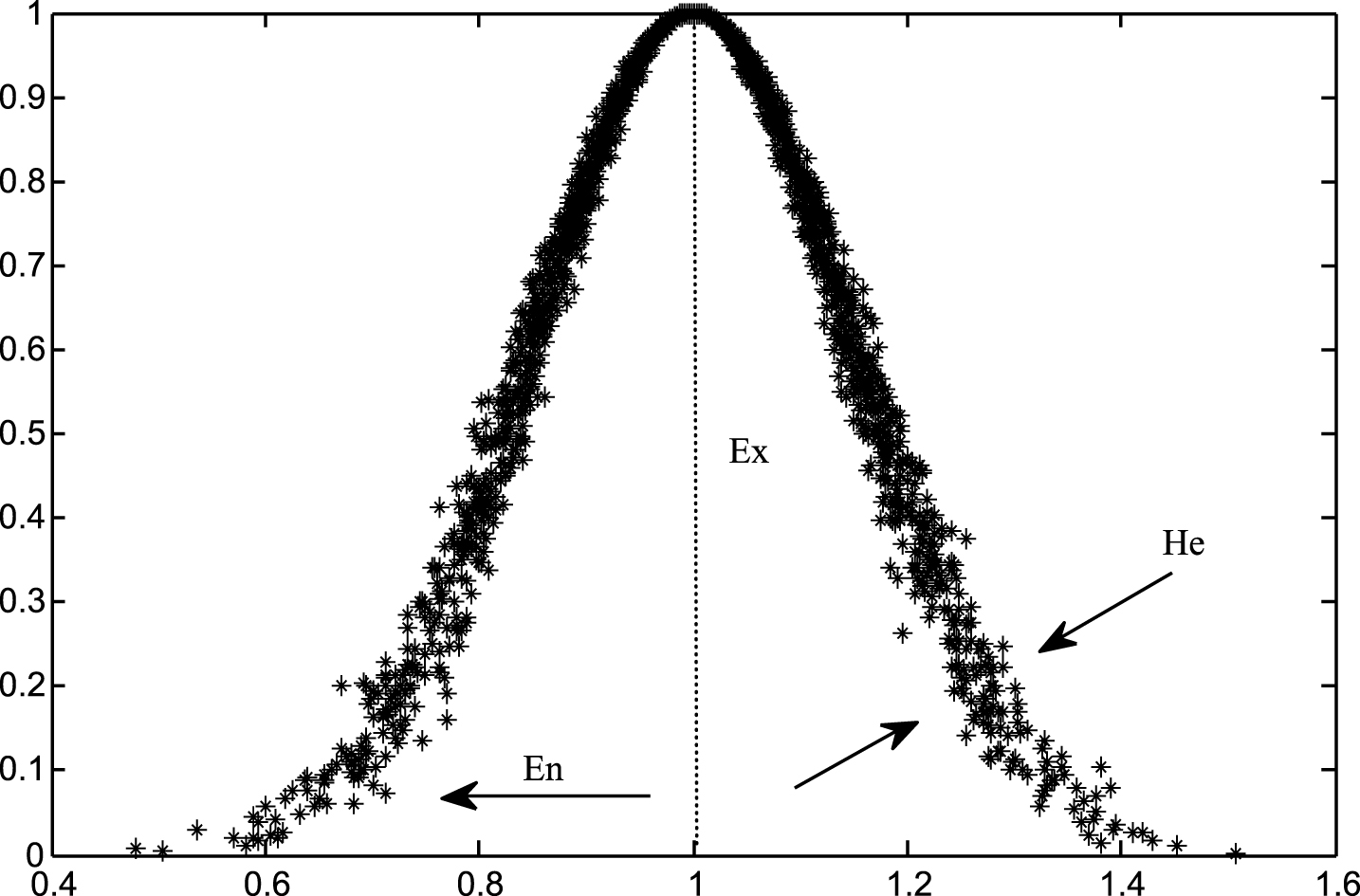
Normal cloud model.
In the data space, the normal cloud model was not a determining probability density function nor a clear membership function curve, but the pan state mathematical image was composed of many cloud droplets generated by the normal generator with two serial connections; it was a telescopic and elastic cloud without a determinant edge that completed mutual mapping between qualitative and quantitative factors.
Normalization of evaluation index
Because of the physical meaning and value range, the health state evaluation indexes of wind turbines are normalized in order to eliminate the influence of dimensions. The relative deterioration degree of the current actual state and the fault state of wind turbines was characterized by introducing a relative deterioration degree. In the range of [0, 1], 0 represents the best, and 1 represents the worst. Health status is mainly related to the calculation of the following three deterioration degree indicators:
(1) The formula for calculating the deterioration degree of smaller indexes, such as the generator, gear box, control cabinet, and other related temperature parameters, is as follows:
(2) The formula for calculating the intermediate indicators, such as speed, phase voltage, phase current, and deterioration degree, is as follows:
(3) The calculation formula for the bigger and more vital types of index, such as active power and deterioration degree, is as follows:
According to the correspondence between the relative deterioration degree and health level, the range of deterioration degree of interval values of V1, V2, V3, V4 were denoted as [0, a), [a, b), [b, c), [c, d), [d +∞). The three numerical characteristics of the cloud model are shown in Table 2 rin which i was a constant rderived from experience and repeated tests; in this study ri = 0.005. According to the numerical characteristics of the cloud model detailed in Table 2 a normal cloud model with a single index was generated.
Digital characteristic determination of cloud model
Digital characteristic determination of cloud model
Taking the cabin temperature as an example, a cloud model was generated by the positive cloud generator, as shown in Fig. 4. The horizontal axis was the value of the relative deterioration degree and the vertical axis was the value of membership. From left to right, the first half of the cloud represented indexes belonging to the health of probability, followed by the sub-health, attention, and fault-three cloud status. When a value of the deterioration degree was given, it could be concluded that a certain degree belonged to a specific status degree of . In the cloud model, the degradation degree and membership was one or multiple transformations, and the membership degree of each deterioration degree was a probability distribution rather than a fixed value. At the same time, the cloud model in every cloud droplet was a random realization; it was not fixed, but a normal distribution following the data distribution. Therefore, the cloud model reflected the uncertainty of the value of the random sample and the membership degree, which effectively showed the correlation between randomness and fuzziness.
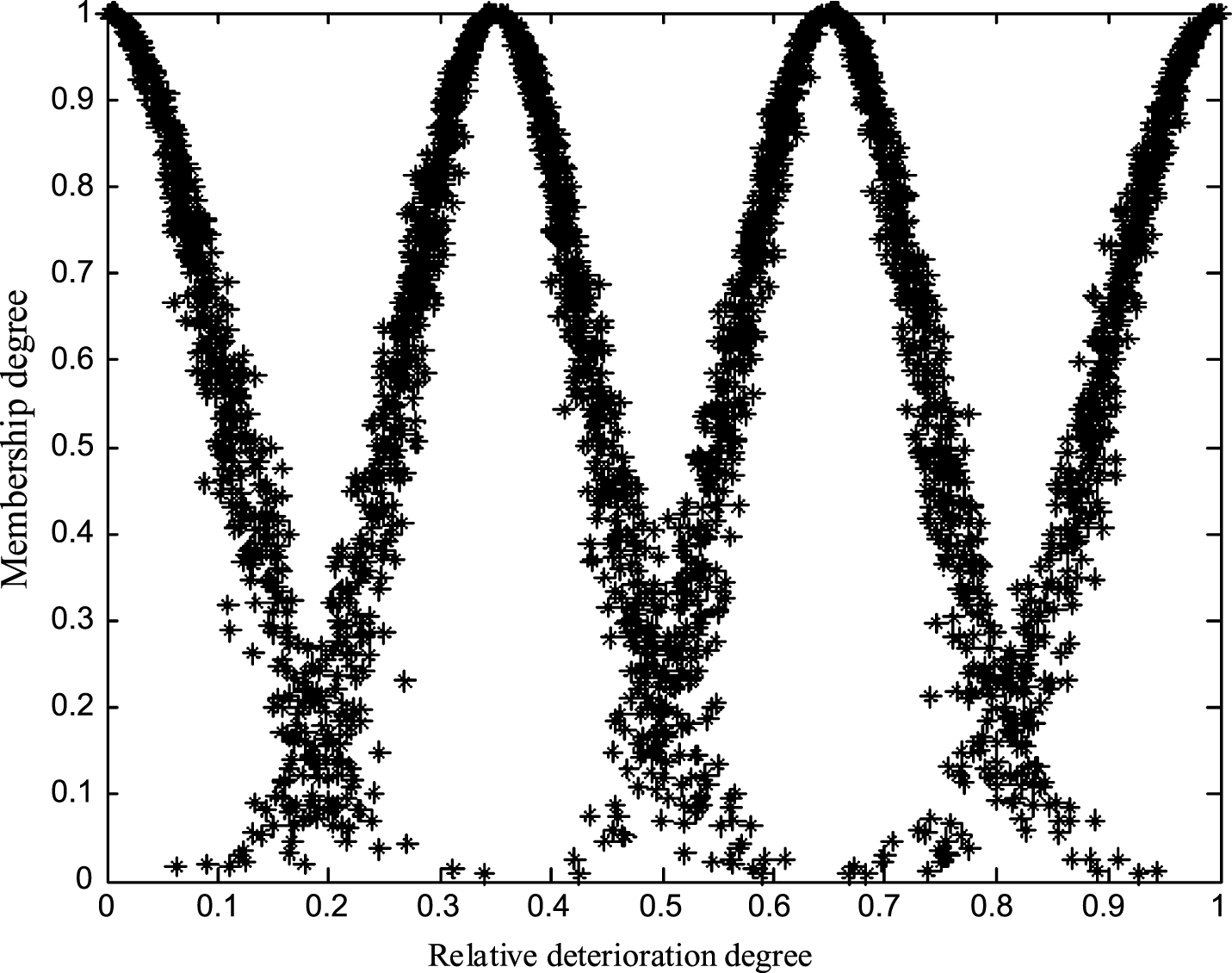
Membership of cloud model.
After calculation of the membership cloud model, the degradation degree of the No. index parameter in No. factor in the object layer belonged to health state , and the membership degree matrix was obtained, as follows:
The expression of the fuzzy comprehensive evaluation was R/B = A, where A is the weight and B is the evaluation vector. There are five kinds of commonly used fuzzy judgment operators. It was discovered that the weighted average fuzzy operator takes evaluation factors in the actual evaluation work into account according to the proportion of their respective weight values, and the final assessment result reflects all the factors, which results in a more reasonable and comprehensive evaluation. Therefore, the weighted average fuzzy operator was selected here.
(1) Evaluation of object level health status
According to the degradation degree matrix R
i
of No. m indicator parameters in No i object and the weight vector of each index parameter, A
i
, the evaluation vector of the comprehensive health state of the object was calculated as follows:
The same method was used to get the evaluation vector of other objects, and the membership degree matrix of the health status in the unit layer R = [B1, B2, … B i ] T was obtained.
(2) Evaluation of health status of unit
According to membership degree matrix R and weight vector A of the health status of the unit level, the final evaluation vector of the unit was calculated as follows:
In order to verify the validity and accuracy of the proposed method, the SCADA system monitoring data of a wind farm in North China was utilized. The online monitoring data of the No. 9 turbine in the 1.5-MW grid-connected wind farm at 16:46 on March 12, 2016, was selected. The deterioration degree of each parameter was calculated according to the deterioration degree function, as shown in Table 3.
Monitoring data and value of deterioration degree of each index
Monitoring data and value of deterioration degree of each index
The membership degree of each index was calculated according to membership cloud models, and after the gear box system was normalized, the index membership degree matrix of the generator system, engine system, pitch system, and grid system (R1, R2, R3, R4, and R5, respectively) were obtained, as follow:
According to the index weights calculated in the second section using the combined weights method, the weight of each factor in the object layer was as follows: A = [0.2806, 0.2294, 0.1189, 0.2479, 0.1232]. The weight of each factor in the index layer was as follows for the gear box and spindle system: A1 = [0.1611, 0.1611, 0.2786, 0.1996, 0.1996]; the generator system was A2 = [0.2584, 0.1246, 0.3085, 0.3085]; the cabin system was A3 = [0.2829, 0.2614, 0.4557]. The variable pitch system was as follows: A4 = [0.1243, 0.2699, 0.2846, 0.3212]; and the grid system was A5 = [0.2714, 0.2349, 0.3001, 0.1936].
An assessment of the health status of the gear box and spindle system revealed the following:
In the same way, the health condition evaluation vectors of other objects were obtained, and the following membership degree matrix of the unit health status was obtained after arrangement:
The final membership degree vector of the wind turbine in each state space was obtained by combining the weight, A, as follows:
The comparative analysis based on the results of the existing literature and field research, combined with the “3En rules” of cloud models (in the domain of U, 99.7% of the cloud droplets contributing to qualitative concept C are in the interval [Ex - 3En, Ex + 3En]). This study used the “minimum level of membership degree greater than 0.1” criterion for each unit’s final state comprehensive evaluation. According to the above calculation results, it was concluded that the comprehensive evaluation of the health status of the unit was “Attention.” From the view of practical monitoring data of wind turbines, the main reason for the results of the evaluation of “Attention” was that the daily operation data on the gear box input shaft and the oil temperature were too high with a degradation trend, and the pitch of the battery cabinet temperature in the variable pitch system was slightly higher. The evaluation results and actual operation numbers were consistent, verifying the rationality and validity of this method.
Table 4 provides the outcome of checking results in the monitoring data in Table 3 using the strategy of literature [11, 20] compared to the method proposed in this study. According to the comparison, the overall evaluation of the three strategies was basically consistent, which verified the effectiveness of the proposed method. Furthermore, the membership value “Attention” resultant from the proposed method was significantly greater than that of the other two strategies, showing that this method could improve the prediction of outcome assessments, which could proactively identify latent problems to avoid occurrence of serious faults of units, and provide reference for reasonable wind farm arrangements for machine group scheduling operations and overhaul maintenance.
Results from different methods
The cloud model proposed in this study optimized the traditional fuzzy comprehensive evaluation method for performing health assessments of wind turbines, which solved the exact function curve that essentially weakened the fuzziness of evaluations, and took into account the randomness. The combination weighting method was used to achieve a blend of the subjective and the objective weight, which avoided the low accuracy of the index weight that occurs when using a single weighting method. The “lowest level of membership degree greater than 0.1” criterion was used to solve the problem of indicators in multiple fuzzy reasoning being deteriorated, diluted, or covered up. The evaluation results of the model in this study were in line with the actual operation of the wind turbine, which showed the operator the health status of the wind turbine and could proactively identify latent problems. At the same time, the daily operation and maintenance of the wind farm was monitored.
Footnotes
Acknowledgments
The research work was supported by National Natural Science Foundation (61573139) and Science and technology project of Hebei Province, China (15214370D).