






Abstract
The application of an intelligent logistics information platform has promoted the development of logistics informatization, and how user usage intention can be improved is an important link for accelerating the promotion of the intelligent logistics information platform. The influencing factor model of user usage intention on an intelligent logistics information platform was developed based on the technology acceptance model, and empirical verification was performed for research hypotheses based on a questionnaire survey to identify the key factors that influence user usage intention and the influencing paths. Results show that information resource, management service, and platform technology have significantly positive influences on user perceived usefulness (PU); management service, platform technology, and application effect have significantly positive influences on perceived ease of use (PEOU); PEOU has a prominently positive influence on PU; and PEOU and PU have significantly positive influences on user usage intention. On this basis, suggestions for optimizing intelligent logistics information platform were proposed.
Keywords
Introduction
With the rapid development of intelligent technology and continuously accelerated globalization, the economic development of various countries has faced unprecedented opportunities and challenges since the beginning of the 21st century [1]. As a critical part of the modern economy, intelligent logistics plays a significant role in reducing social logistics cost and improving logistics transportation quality [2]. To cope with industrial reform, building logistics information processing and service platforms between production and commercial enterprises and logistics enterprises on the basis of big data, cloud computing, mobile internet, and Internet of Things (IoT) technology to form sharing and open logistics ecosphere has become a key trend for the current development of the logistics industry [3].
Intelligent logistics information platform is the basic condition for enterprises to conduct modern logistics business and significantly influences logistics operation efficiency and quality of enterprises and customer satisfaction degree [4]. By integrating automation, visualization, controllability, intelligence, systematization, networking, and electronization, an intelligent logistics information platform can internally realize resource management and process control, and externally provide information exchange and sharing; such businesses cover various fields such as transportation, urban distribution, supply chain management, international logistics, and logistics parks management [1]. With the continuous extension of intelligent logistics information platform functions and fierce inter-platform competition in recent years, intelligent logistics service is not restricted to pure logistics field. Emphasis has been placed on providing individualized customization of logistics demand, such as financial value-added services [5]. Fully understanding the usage intention and usage preference of users of the intelligent logistics information platform and mastering the platform’s main influencing factors is necessary to improve platform architecture and functions and enhance the satisfaction of intelligent logistics information platform users [6].
The government and business circles actively build intelligent logistics information platforms and intelligent logistics service systems on the basis of increasingly fierce market competition and the concept of supply chain integration services. Studies on intelligent logistics information platform are now active in academic circles [7]. These studies, however, focus on technological research subjects, such as platform architecture and platform functional structure, and pay little attention to user usage intention and user experience without discussion and analysis from the perspective of clients [8]; relatively similar studies are mainly qualitative descriptions that lack quantitative analysis. The present study will analyze the main factors that influence user usage intention and acting paths during the construction of an intelligent logistics information platform from the perspective of user usage intention. This study can provide empirical evidence for the evaluation, optimization, and improvement of intelligent logistics information platforms.
Literature review
Existing studies on intelligent logistics information platforms mainly involve aspects such as intelligent production [9], intelligent transportation system [10], physical network [11], and self-organization logistics [12]. Aldin and Stahre [13] analyzed the effect of an intelligent logistics platform on marketing and e-commerce through research cases and believed that the intelligent logistics platform contributed to the development of e-commerce marketing channels and could support marketing flexibility. Cheng and Wang [14] evaluated supply chain management performance on the basis of data on an intelligent logistics platform and argued that national intervention was an important means of promoting intelligent logistics platforms. Few studies have been conducted on intelligent logistics platforms from the perspective of users along with the determination of factors that influence user usage intention.
User-oriented technical analysis models have been advanced [15]. To identify factors that influence the extensive acceptance of information technology, Davis developed a technology acceptance model based on rational behavioral model to analyze the acceptance attitude of users toward information systems. During the follow-up long study period, the technology acceptance model was verified in extensive computing technology, organizational setting, and user group analysis [16]. The initial technology acceptance model assumes that perceived usefulness (PU) and perceived ease of use (PEOU) are the main factors that motivate users to use new technology [17]. Venkatesh and Davis [18] added usage intention to the model to improve it. Luarn and Lin [19] further attempted to extend the technology acceptance model to perceived credibility, perceived self-efficacy, and perceived financial cost. Bienstock et al. [20] used the technology acceptance model to evaluate usage and acceptance of information technology and then built an extended model of logistics service quality based on their proposed model. Lee and Kim [21] verified that technical support, Web experience, task ambiguity, and mutual task independence were important external factors that influence PEOU, PU, and intranet usage. When applying the technology acceptance model to a medical information system, Pai and Huang [22] found that information, service, and system quality influenced user usage intention through PU and PEOU. These research bases provided a useful reference for this study and presented a theoretical basis and referable scale for the application of the technology acceptance model in user usage intention analysis of intelligent logistics platforms.
In summary, to discriminate and identify the key factors that influence the user usage intention of an intelligent logistics platform, this study developed an influence factor model of user usage intention of an intelligent logistics information platform on the basis of the technology acceptance model, verified the influencing factors and their action paths on the basis of questionnaire survey data of 467 intelligent logistics information platform users from five countries (China, America, Germany, Singapore, and Australia), and provided relevant suggestions for improving the experience of intelligent logistics information platform users.
The remainder of this paper is organized as follows: Section 3 discusses the design of the variable structure of an intelligent logistics information platform based on the information success model and proposed research hypotheses and a conceptual model based on the technology acceptance model. Section 4 describes the collection of sample data on the basis of the research questionnaire design. Section 5 presents the data processing and results of the model analysis. Section 6 discusses the research conclusions and suggestions.
Research design
Theoretical basis
Several factors influence the usage intention of intelligent logistics information platform users. This study designed a set of variable structures that satisfy analytical requirements on the basis of the information system success model. The information system success model, which was developed by DeLone and McLean [23] on the basis of information impact theory, covered variable factors such as system and information quality, usage of information system, and user satisfaction degree. On the basis of the significant influences of service quality on information system usage and user satisfaction degree as proposed by Pitt et al. [24], DeLone and McLean [25] added service quality variable to the information success model and constructed a 3D information-system-service quality structure.
On the basis of the usage features of the information success model and the intelligent logistics information platform, this study selected four dimensionalities— information resource, platform technology, management service, and application effect— as the key factors that influence user satisfaction. The variable structure is shown in Fig. 1.
Variable structure of intelligent logistics information platform. Information resource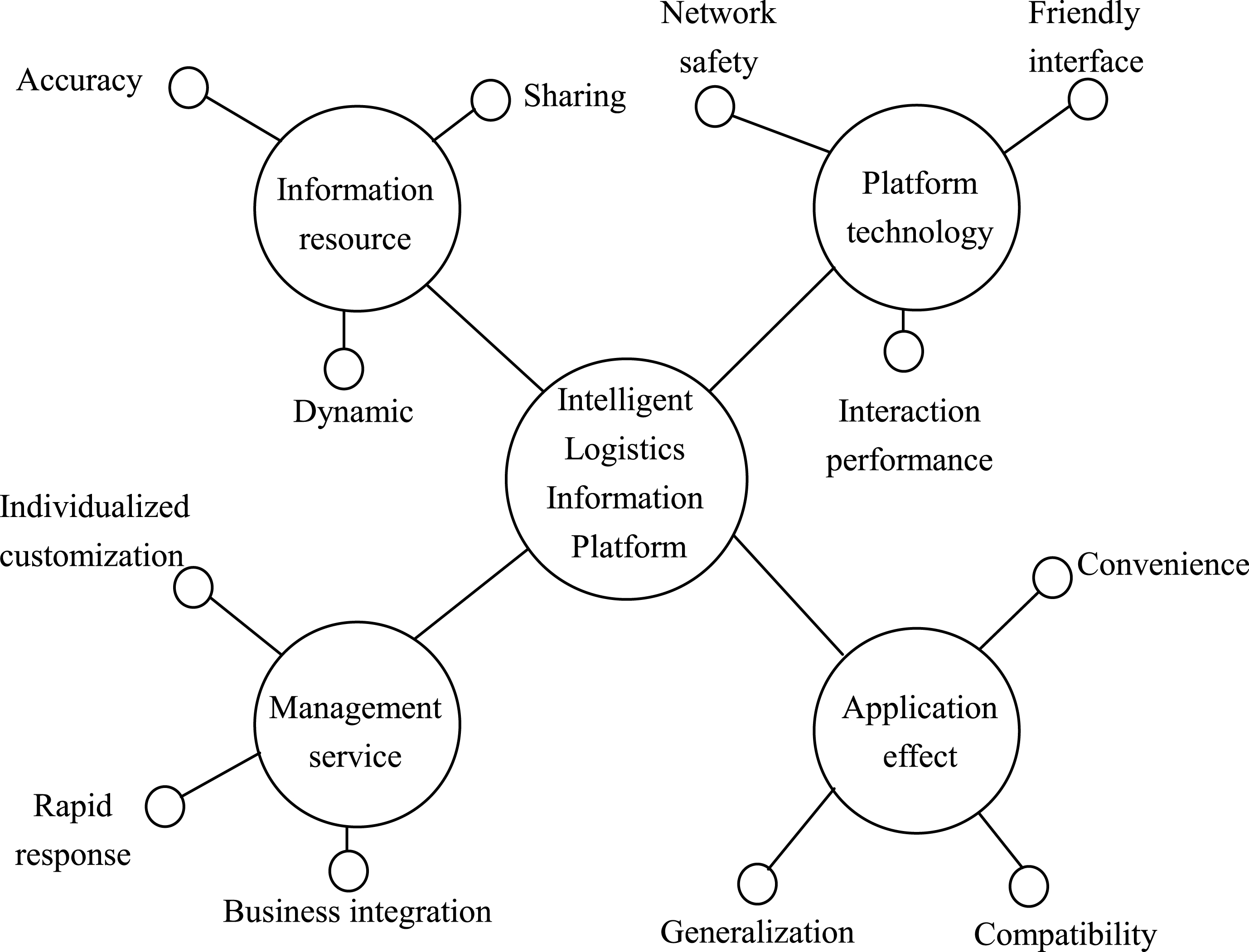
Information resource refers to all kinds of information activity elements. An intelligent logistics information platform gathers multi-channel logistics data and charts from production enterprises, commercial enterprises, logistics enterprises, and government departments; such logistics information are sources on which the platform survives. Information resource provides users with all kinds of services through platform intelligence processing. Unlike other resources, an information resource possesses accuracy, sharing, and dynamic properties. Resource value can be embodied only when information resources accurately reflect logistics information and attempt to avoid information distortion introduced by data error; information resource sharing can provide each platform user with the needed value services, whereas sealed information resource is not good for value transfer [26]. The dynamic property of an information resource means that the user can obtain real-time information and realize order monitoring during the entire transaction.
Management service
Management service is an important support for the operation of an intelligent logistics information platform. A highly efficient intelligent logistics information platform should have individualized customization [27], rapid response, and strong business integration capability in terms of management services. In the Industry 4.0 era, individualized customization is an inevitable trend of the development of the manufacturing industry, and similar requirements will be proposed for the logistics industry and the intelligent logistics information platform on which it relies [28]. Rapid response capability means adaptability to continuously changing user demand and embodies the flexibility of intelligent logistics information platforms [29]. Using intelligent technology owned by the platform to effectively integrate platform businesses and further expand value-added service capability is an important way for the platform to create user value and realize sustainable development [1].
Platform technology
Modern mainstream intelligent logistics information platform realizes the basic construction of the platform on the basis of big data, cloud computing, IoT, and artificial intelligence, and platform technology determines the architecture, function, and interface of intelligent logistics information platforms. This study identifies influencing factors mainly from the performance aspects of platform technology, including network safety, friendly interface, and interaction performance. Network safety is a major basis for maintaining the stability of intelligent logistics information platform and an important guarantee of user information privacy, and it can provide users a sense of safety during transaction [30]; the user interface of each operation helps elevate user perception to rapidly increase platform usage amount; interaction performance is also a key influencing factor, and favorable man–machine interaction can provide the user with the ideal use experience.
Application effect
The definition of application effect in this study is mainly manifested at the application effect aspect of an intelligent logistics information platform. Specific variables include convenience, generalization, and compatibility of platform usage. Convenience requirement lies in the convenience of the usage platform, including smoothness of input, acquisition, and transaction of information, which will significantly influence the utilization rate of the platform [31]. Generalization refers to the condition in which the platform can provide the user with demand access at any time and enable production traders and logistics traders to exchange information anywhere, master business schedules, and conclude transactions [32]. Compatibility is also an important variable; if the intelligent logistics information platform is incompatible with other ports, which causes usage inconvenience, then the user will stop using the platform [2].
The four variables of intelligent logistics information platform generally constitute the main factors that influence user usage intention. To elevate the contribution of the four variables to user usage intention, operators of intelligent logistics information platforms should improve their operational capabilities.
This study developed a conceptual model for the main influencing factors of intelligent logistics information platforms on user usage intention based on the technology acceptance model as shown in Fig. 2. The research hypotheses of the conceptual model are as follows:
Conceptual model. Information resource, management service, platform technology, and PU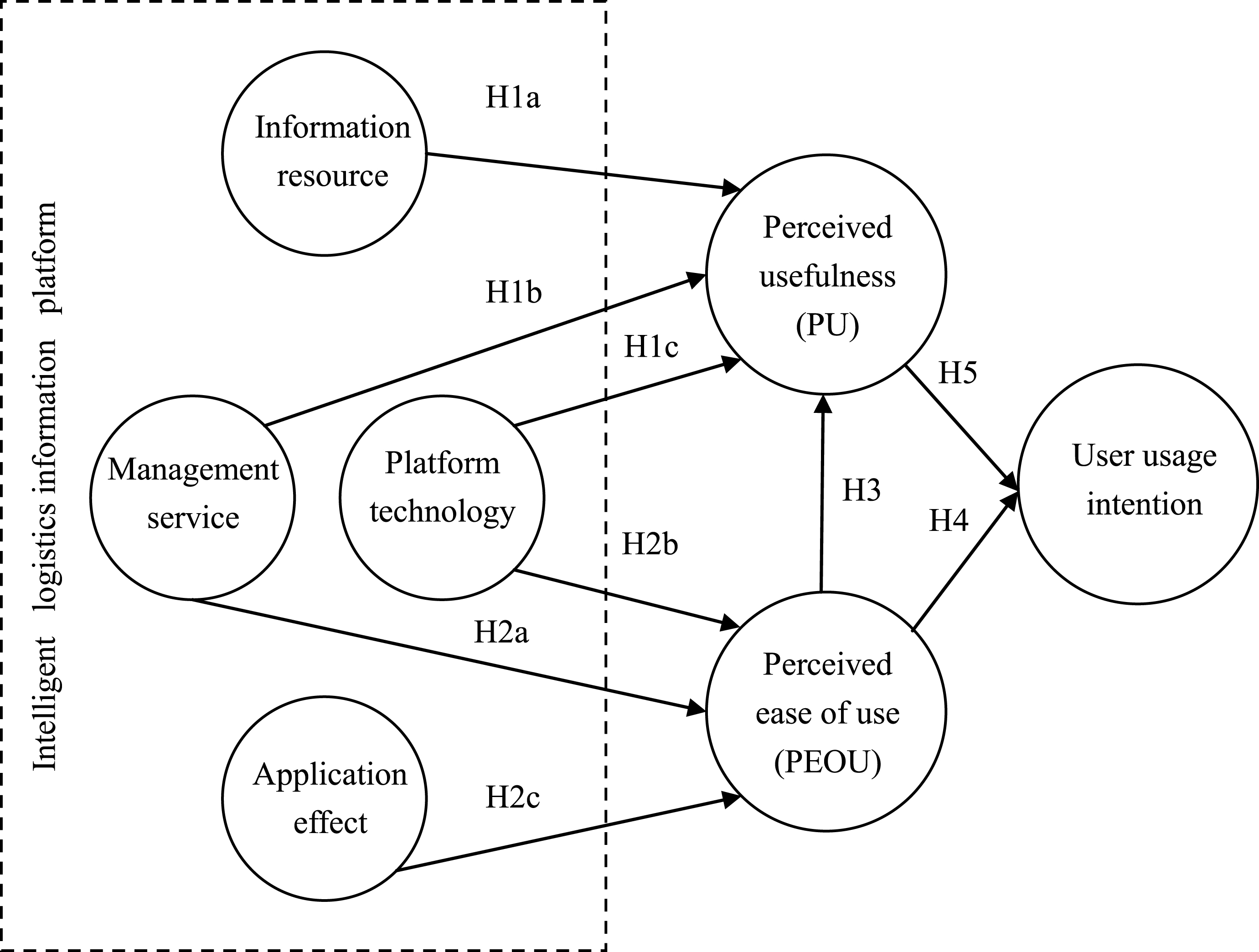
DeLone and McLean [23] verified that information quality directly influences user perceived usefulness, that is, if information quality was good, then the user would believe that the system could provide correct information and knowledge. Davis et al. [33] also mentioned this idea in relevant studies on the technology acceptance model. Pitt et al. [24] further verified the paths for service quality to influence user perception of the information system. DeLone and McLean [25] further confirmed that service quality positively influences PU. Tung et al. [2] also confirmed that the application of electronic logistics information systems in the medical industry could contribute to elevating PU, especially in terms of compatibility. The present study proposes the following hypotheses based on the abovementioned relevant studies:
Information resource has a significantly positive influence on PU. Management service has a significantly positive influence on PU. Platform technology has a significantly positive influence on PU. Management service, platform technology, application effect, and PEOU
Ahn et al. [34] verified that service quality positively influences user PU. When studying the environment of an online shopping platform, Zhang and Prybutok [35] found that service quality influences not only client loyalty but also the PEOU of the online shopping platform. In terms of the influence of platform technology on user PEOU, Hong et al. [36] verified that a friendly interface, such as clear terms and screen design, could influence individual PEOU and that individuals would be happy to continuously use such platform. Jeong and Hong [32], however, believed that the application effect (such as the ability of the platform to be used at any time) could make users feel that the platform is convenient. The following hypotheses were proposed according to the abovementioned relevant studies:
Management service has a significantly positive influence on PEOU. Platform technology has a significantly positive influence on PEOU. Application effect has a significantly positive influence on PEOU. PEOU, PU, and user usage intention
PU and PEOU are two fundamental standards of any technological application [37]. Pahnila et al. [38] verified that user PU directly influences user usage intention. If the user thinks that the technology contributes to working performance, then he will feel positively toward the new technology and will have a more active attitude toward the new technology. This attitude will further influence user usage intention and usage behaviors [39]. Yahia et al. [40] studied the driving factors of interpersonal commerce in social media platform and certified that PEOU of the platform could elevate the usage intention of social commerce. Venkatesh et al. [41] also verified that PEOU directly influences user usage behaviors. When studying intranet, Lee and Kim [42] confirmed a positive relationship between user PEOU and PU. On the basis of the above results, the following hypotheses were proposed: PEOU has a significantly positive influence on PU. PEOU has a significantly positive influence on user usage intention. PU has a significantly positive influence on user usage intention.
Questionnaire design
The questionnaire design in this study adopted the advanced scales of previous studies as much as possible. Most of these scales have been extensively applied and verified, and thus have high reliability and validity. Most of the items were adapted from the Unified Theory of Acceptance and Use of Technology core scale of Venkatesh et al. [41], and several other items were based on the studies of Pai and Huang [22] and Cha [43]. Several Chinese questionnaire items were translated by logistics experts who are proficient in English, while other questionnaire items were revised according to in-depth interviews with people within the industry and according to early-stage prediction effects, and were then translated into English to ensure the equivalence of translation [44]. A seven-point Likert-type scale was used for the final scale. Specific items and sources are shown in Table 1.
Questionnaire items and sources
Questionnaire items and sources
To ensure the representativeness of the survey samples, this study used logistics, production, and commerce enterprises from five countries, namely, China, America, Germany, Singapore, and Australia, as samples for the questionnaire survey. Questionnaire collection took place from June to December 2016, and three methods were adopted in the survey. The first questionnaire collection method was direct visit, with the questionnaires filled and recovered on site; the second method was telephone interview to acquire data information; and the third method was e-mail, with indirect investigation through acquaintances within the industry.
A total of 720 questionnaires were given out, and 485 valid ones were recovered; the recovery rate was 67.36%. Through a consistency check, 18 invalid questionnaires were excluded, 467 valid ones were reserved, and the response rate was 64.8%. Table 2 presents the statistical information and sample feature description of the 467 respondents. Respondents from China, America, Germany, Singapore, and Australia accounted for 40.47%, 22.69%, 11.99%, 12.63%, and 12.22%, respectively. Males accounted for 66.16%, and females accounted for 33.84%; this result indicated that the proportion of males in the logistics industry is considerably higher than that of females. In terms of educational background, the number of respondents with a bachelor’s degree or above was 79.01%. For enterprise type, personnel in logistics enterprises accounted for 44.75%, personnel from manufacturing enterprises accounted for 29.12%, and those from commerce and trade industry accounted for 26.13%.
Statistical data classification and proportion of survey samples
Statistical data classification and proportion of survey samples
Reliability and validity
Questionnaire reliability was verified with Cronbach’s α value, combined reliability (CR), and average variance extracted (AVE). The internal coincidence indicator Cronbach’s α values of all variables were higher than the standard value of 0.7, the combined reliabilities were all higher than the standard value of 0.7, and all AVEs were higher than the standard value of 0.5. These results indicated the favorable construction reliability of the questionnaire. Specific data are shown in Table 3.
Reliability testing result
Reliability testing result
Confirmatory factor analysis results are as follows: fitting indicator data satisfied the basic requirements. After further observation, the factor loads of all variables were higher than 0.5, the T value was at a significant level, the correlation coefficients between variables were all lower than 0.7, and AVE was greater than the square of correlation coefficients. These results indicated that the scale had favorable construction validity.
In accordance with the conceptual model and analysis results, a structural equation model with 21 observational variables and 7 latent variables could be built. LISREL was used to analyze the model, and fitting indicator results are shown in Table 4.
Fitting results
Fitting results
The chi-square value of the structural equation was 458.67; the degree of freedom was 322; NFI, IFI, and CFI values were all higher than 0.9; SRMR was lower than 0.05; and RMSEA was lower than 0.08. Although the AGFI value was lower than 0.9, it was still within the permissible range. The fitting result was generally ideal. The structural equation model and standard path diagram are shown in Fig. 3. Testing results are shown in Table 5.

Structural equation model and standard path diagram.
Testing results of hypotheses
Note: *** means P < 0.001.
As shown in Fig. 3 and Table 5, information resource, management service, and platform technology had significantly positive influences on user PU, and support is assumed to have been obtained. Management service, platform technology, and application effect had significantly positive influences on user PEOU, and support is assumed to have been obtained. PEOU had a significantly positive influence on PU, PEOU and PU had significantly positive influences on user usage intention, and support is assumed to have been obtained.
The conceptual model of influencing factors of user usage intention of intelligent logistics information platform was tested on the basis of the technology acceptance model in this study, and the discrimination of influencing factors was based on the improvement of the information success model. The conclusions obtained through an analysis of the questionnaire data of 467 respondents were as follows: (1) Information resource, management service, and platform technology had significantly positive influences on user PU; (2) Management service, platform technology, and application effect had significantly positive influences on user PEOU; (3) PEOU had a significantly positive influence on PU; and (4) PEOU and PU had significantly positive influences on user usage intention.
The relationships of the theoretical hypotheses were verified, and the relationship outcomes among PEOU, PU, and user usage intention were identical to those in previous literature. This study further verified the relationships of the main variables of intelligent logistics information platforms with user usage intention through PU and PEOU.
On this basis, the management suggestions of this study are as follows: (1) The operators of intelligent logistics information platforms should prioritize the improvement of platform performance. Accuracy of variables, especially information resource, which had a significant influence on user PU, should be guaranteed, and the platforms should be updated in a timely manner. (2) Coordinated development between technology and service should be realized during the construction of an intelligent logistics information platform. Not only platform competitiveness should be obtained by elevating technological level, but diversified user requirements should also be met by improving service capability. (3) Construction of an intelligent logistics information platform should be oriented toward the needs of users. On the basis of user usage intention, starting from user PU and PEOU, we should adjust platform functional construction and flow setting to attract more users.
This study can provide experience and evidence for the application of the technology acceptance model in an intelligent logistics information platform. Empirical results show that the development of intelligent logistics information platforms is not an independent behavior but a process of mutual feedback with users. Data used in this study are relatively cross-sectional data, and new findings may be obtained with longitudinal data in the future. Moreover, considering external environments such as the government and factors such as policies will be a favorable extension of studies within this field.
Footnotes
Acknowledgments
The research was supported by the National Natural Science Foundation of China under Grant No.41501142; Zhejiang Provincial Natural Science Foundation of China under Grant No.LY15D010003; Jiangsu Provincial Postdoctoral Science Foundation under Grant No.1402116C.