







Abstract
With the advancements in cognitive radio network procedures, such as blind sensing, sensing transmission trade-off, energy aware protocols etc, effectively overcomes the power constraint issues of CBAN. In present work, such primary issues have been addressed with the help of look-up table incorporated with energy harvesting (EH). It delivers maximum achievable throughput with minimum energy consumption to obtain self-sustainable pervasive wireless networks. The experimental work has been carried out in three different scenarios (Echelon 1, 2 and 3). The key components such as look-up table and energy harvesting have also been investigated on different system parameters (like energy consumption, normalized throughput, saved and residual energy). The simulation is done with NS-2 and results are shown in Matlab for clarity. Results depict that proposed model consumes less energy and also provides a better normalised achievable throughput as compared to the conventional model.
Keywords
Introduction
The efficient and intelligent use of power sources in cognitive body area networks (CBAN) is of paramount importance specially while providing medical aids in remote areas. The energy efficiency of WBAN and the problem of spectrum scarcity of radio frequency band allocated by Federal Communications Commission (FCC) are two major design parameters in wireless pervasive networks, because of limited battery power of CBAN sensors network and fixed spectrum issues [1–3].
With the recent developments in the wireless networks, the energy harvested WBAN are able to provide solution to the aforesaid problems. Cognitive radio enabled networks give solution to spectrum scarcity issues.
WBAN system is dynamic in nature and uses sensors inside the body as well as outside the body of ailing patient to collect the necessary information for further processing through wireless channels like Bluetooth, ZigBee, Ultra-Wide Band (UWB) usually single hop star topology [4]. The basic obstacle in the operation of the WBAN architecture is that sensor nodes used in collection and transmission of data need to be charged repetitively which is neither preferred nor can it be replaced time andagain [5].
In a sensor node, the gross energy utilized at any instant is dependent on the amount of energy used by the circuit and the transmitted signals. The use of circuit energy can be minimised by using microelectronics based components which use low power as compared to the earlier components but the power utilised in the transmission of signal needs to be worked upon. Thus, the main challenges faced by sensor nodes in WBAN system are low power battery sources and efficacy [6]. It is desirable to provide infinite battery backup for lifetime solution and energy harvesting (EH) is the best solutions for such problem.
Related work
Telemedicine system is very important now-a-days specifically for remote areas and the systems which can operate at ultra low power consumption are need of the hour [3–6]. Ryckaert J et al. explained energy consumption requirement of ZigBee and Bluetooth systems, although its lower but not effective to be used in energy harvesting systems. Ullah S et al. proposed applications of ultra wide band technology Jovanov. E implemented energy harvesting in wireless sensor networks that are deployed in WBAN networks in order to form EH-WBAN [7]. Although various methods were analysed and summarized for energy consumption [8], energy efficient protocols [9–10], as well as EH available in the literature [11–12], sensing/transmission trade off and the wait/switch tradeoff explained [13–14]. Still Spectrum sensing and energy efficiency tradeoff in CBAN is rarely explored in the literature.
Motivation and Contribution to work
Although extensive work has been carried out in the area of telemedicine systems. EH in CBAN network and LUT incorporated cooperative sensing/ transmission are rarely mentioned in literature. In the proposed work, both key issues of spectrum efficiency and energy efficiency are dealt in detail. We proposed multiple stages CBAN system. In this work the preliminary stage incorporates the key feature of UWB system i.e. data security, lowest power consumption (see Table 1), less interference and energy harvesting capabilities. Next stage collect the data and forms a gateway using cognitive radios controller (CRC) capable of reducing redundant data for the next stage which uses CRN to perform cooperative spectrum sensing using LUT to reduce sensing time thereby reducing energy consumed in spectrum sensing. Energy harvesting is used to further enhance the system efficiency and to form a self sustainable system.
The operational infrastructure of the CBAN comprises of three echelons as shown in Fig. 1. The first echelon consists of in body or wearable sensors which enhance measurement of bio-signals [15–16]. The second echelon is a portal to process the gathered signals and help in transmitting these signals to the health care units. The link between second and the final stage forms the third echelon. The second echelon in the proposed model uses the principles of CRN to expedite the processing of third echelon.
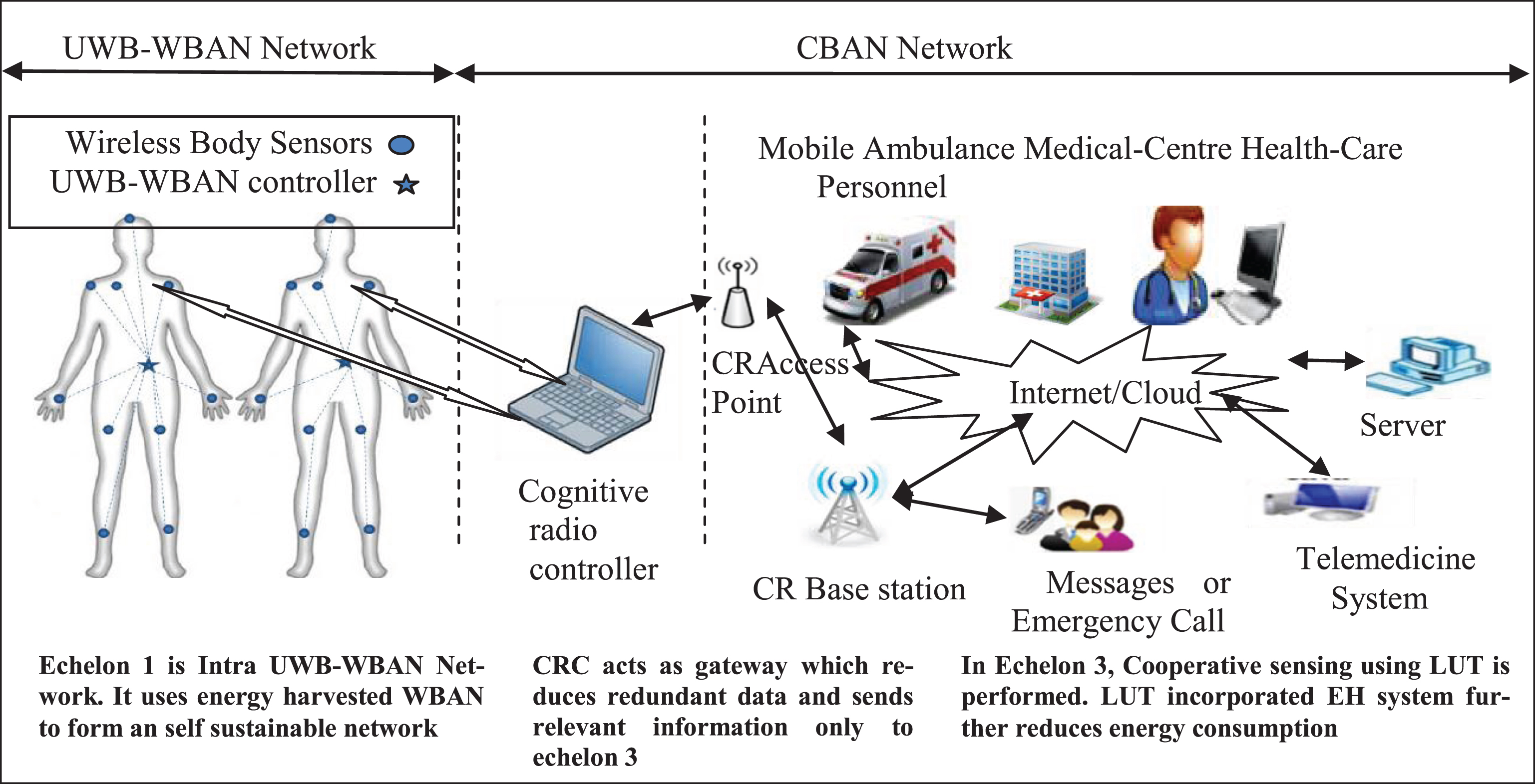
The low cost 3-echelon healthcare system is used to monitor patient of Cardiac and epilepsy symptoms well before time at far-off headquarter/super speciality hi-tech hospital where a team of highly qualified doctors and analysts regularly supervise the patient and give advice whenever required through wireless networks featuring cognitive radios and storing data with cloud space for future reference.
Echelon 1
In Echelon 1 WBAN is installed within an outer body of the subject, the signals from the patient’s body is recorded continuously and is sent the raw data to the telemedicine system database so that it can be timely analysed and if needed emergency signal will be sent to the ambulance, so that ambulance will reaches at the location of the ailing person well in advance [15–17]. The key feature of this stage is that it uses ultra low power-UWB due to its advantages over the other methods as shown in Table 1 (previous section) along with the implementation of energy harvesting.
By implementing energy harvesting concept researchers are trying to shrink the replacement of batteries and to augment the network lifetime of UWB-BAN network [15, 17]. The usage of energy harvesting model in UWB helps in lowering the replacement or recharging of batteries by interacting human energy interacting interface, in this system interface module is used to transform environmental energy into human acquired energy [18–20]. The model uses energies available in the environment namely light energy, motion energy, heat energy etc and stores it in the battery units [18] to form a self sustainable UWB-BAN network.
The harvested power stored is illustrated in Table 2. The stored energy is distributed among the sensor nodes on demand and supply basis thereby increasing the lifetime of the network.
Energy gathered from various environmental energy sources
Energy gathered from various environmental energy sources
This stage is the collaboration of WBAN portal with cognitive radios. It processes the received raw-signals collected from the sensors, removes redundant bits and sends the significant data and acts as gateway for next stage through cognitive radios controller [19].
Echelon 3
The advancement of technology has led to considerable increase in spectrum requirements. However, spectrum scarcity issues that have surfaced due to availability of limited resources and these issue can be handled efficiently using Cognitive Radios. This novel concept senses the unused spectrum bands in all domains namely time, frequency etc. The unused spectrum bands are actually licensed bands available for primary users which are inefficiently utilised by them in a specific time and location. The Cognitive radio is a technique in which the unused spectrum is utilised by the secondary users (SUs) without making any kind of interference to the PUs. Multiple sensing algorithms have been developed till date namely energy detection, Cyclostationary, matched filter etc. All the aforesaid methods have certain constraints. The proposed work has employed the hybrid technique for cooperative sensing of the spectrum. This method uses the concept of Look Up Table which helps in reduction of sensing time which tends to reduce energy consumption. LUT is further incorporated with energy harvesting to obtain more energy efficient system. LUT is described in detail with the help of Fig. 3 in the upcoming section.
Proposed Look-Up Table (LUT) concept.
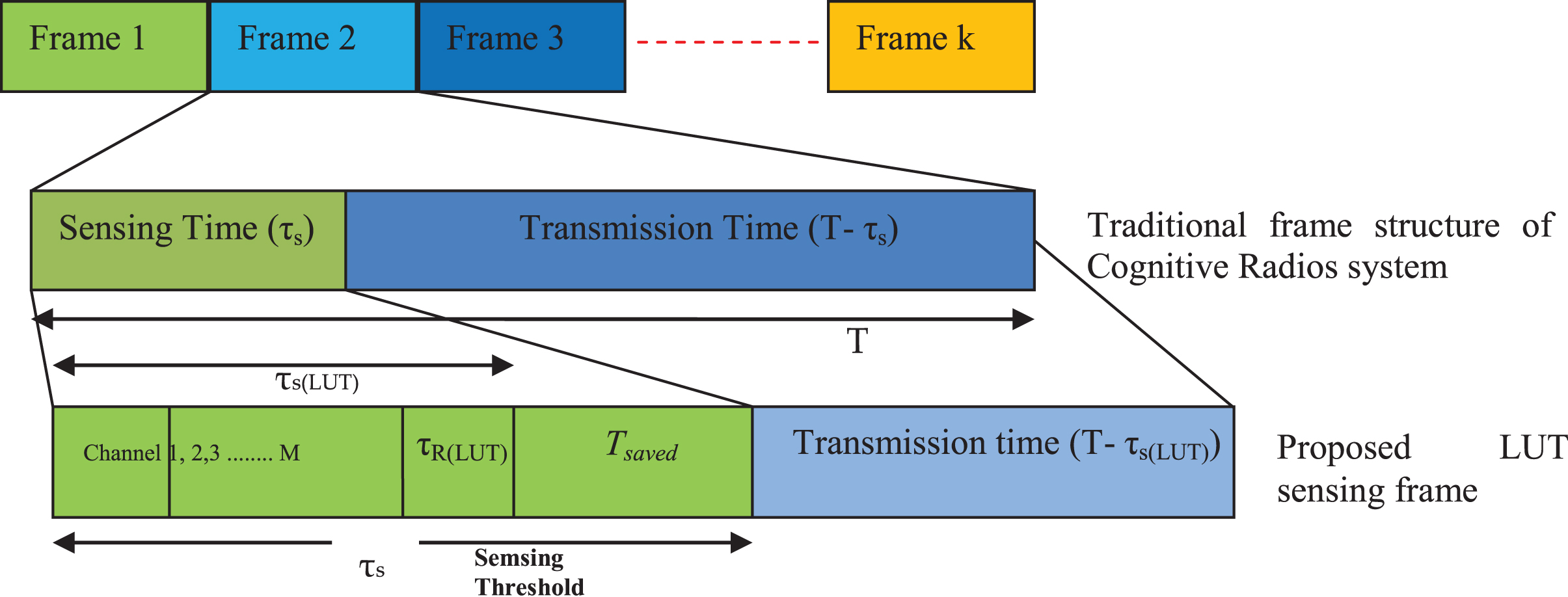
This section introduces the concept of cooperative sensing using LUT and energy harvesting to deliver maximum normalized throughput with minimum energy consumption. Concept of LUT is illustrated in Fig. 2 and optimisation of sensing time using LUT is also explained in upcoming section.
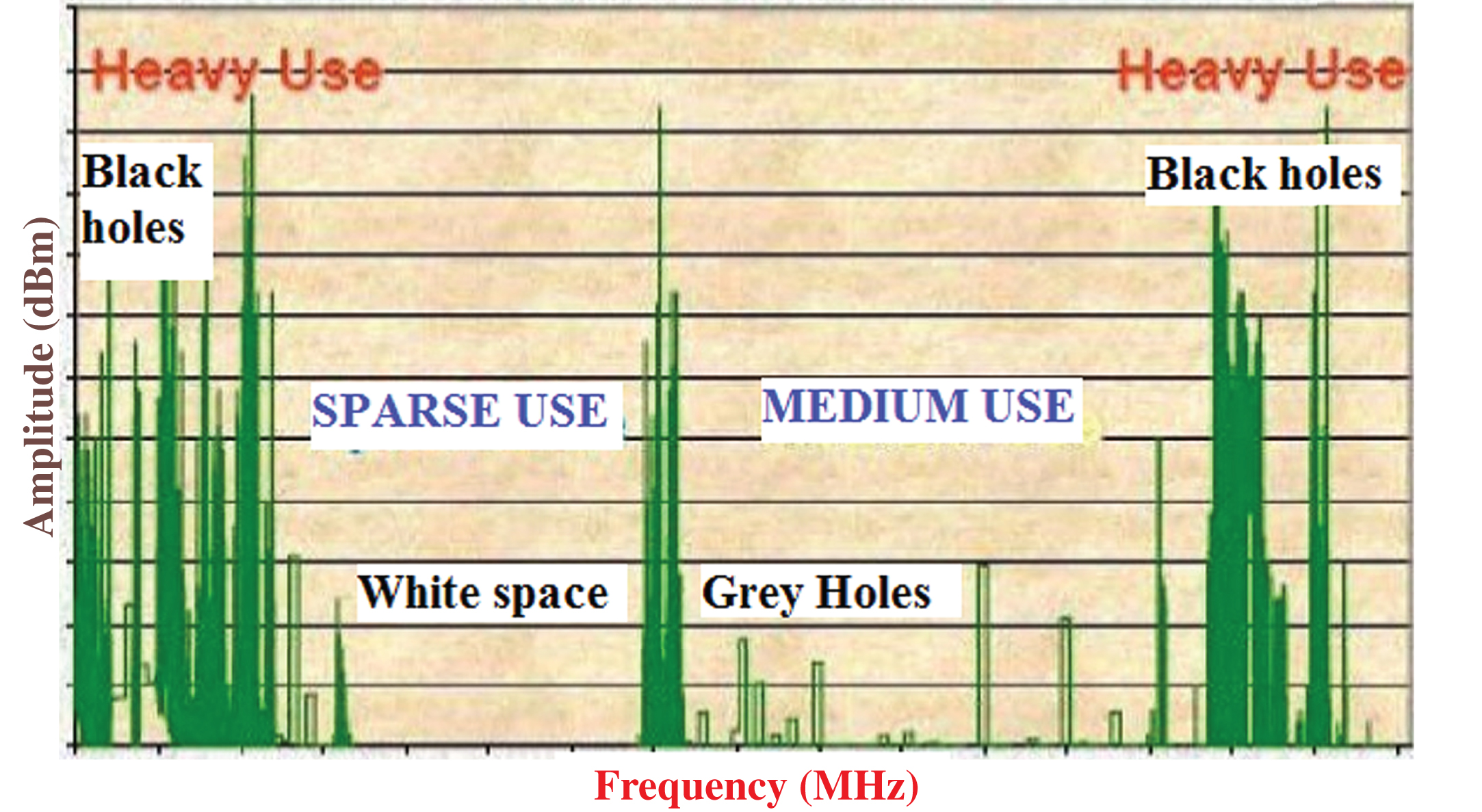
All the secondary network nodes sense the primary network and update the sensing information (presence/absence of PU) to the LUT (fusion centre) after every fixed time frame (T) as shown in Fig. 3. LUT senses RF spectrum and classify spectrum holes into three categories namely Black, gray and white holes as shown in Fig. 2.
Holes can be broadly defined as:
Channel state = 0 Gray Hole: Partially occupied by PU dominating low interference power by PU.
Channel state = 1 Black Hole: It has highly dominated interference power by PU most of the time.
Channel state = 2 White Hole: It is free from RF spectrum interference except for AWGN interference power.
LUT works on a fuzzy based fusion switch in which the information about spectrum sensing are collected and updated to fusion centre after every fixed time frame (T) and then decides which channel has been selected by the CR for data transmission. Working of fuzzy selection switch is shown in Table 3.
Energy gathered from various environmental energy sources
Energy gathered from various environmental energy sources
In general,
Generally in CRN, SU performs wideband sensing to acquire accessibility of vacant slots within the spectrum in all the available channels before data transmission takes place, whereas in this proposed method cooperative sensing is done with the help of M different node (SU’s) and the information collected by all the nodes are stored in LUT for global decision and broadcasting of data for current and next upcoming Frame/slot (Sensing+transmission). Let τR(LUT) is reporting time for look up table (LUT) to refresh and update the information about available channel such that τR(LUT) << τs(LUT).
If τ
s
is standard sensing time used in traditional CR networks within a fixed sensing and transmission frame and τs(LUT) is the time utilized for sensing using LUT such that
Now, Total time required to complete one frame (sensing + transmission) after saving sensing time at a given time interval (t) is given by ₮ which is as follows:
The saved sensing time will be used either for current channel data transmission (if channel is sensed as free) else for next sensing slot. The resultant sensing time will be updated in LUT and new time required for sensing of upcoming frame is given by
And consequently, total time required for next slot sensing and transmission is given as
Total Energy saved while using LUT
Energy Consumption during traditional sensing frame is calculated as
Energy utilized during traditional data transmission frame
Total energy consumed during one frame of data transmission is equal to the sum of energy used while sensing and energy consumed while transmission.
Therefore
From Equations (5 and 8), the total energy utilized using LUT
The saved time as in Equation (1) can also be utilized for data transmission (if the sensed channel is free) which will improve transmission time and correspondingly achieve better throughput (more time for transmission yields to achieve increased throughput). Hence the available energy for data transmission is given by
Algorithm 1 (Table 4), line 1 & 2 initialise sensing time and channels to be sensed, in 3 sorting of channel w.r.t decreasing PUs SNR. Line 4–9 shows the process of sensing and updating LUT and increment channel index. From 11–15 end of loop which computes sensing time using LUT and optimizes sensing time to take minimum energy while achieving perfect detection of PUs.
Pseudo Code for sensing energy minimization
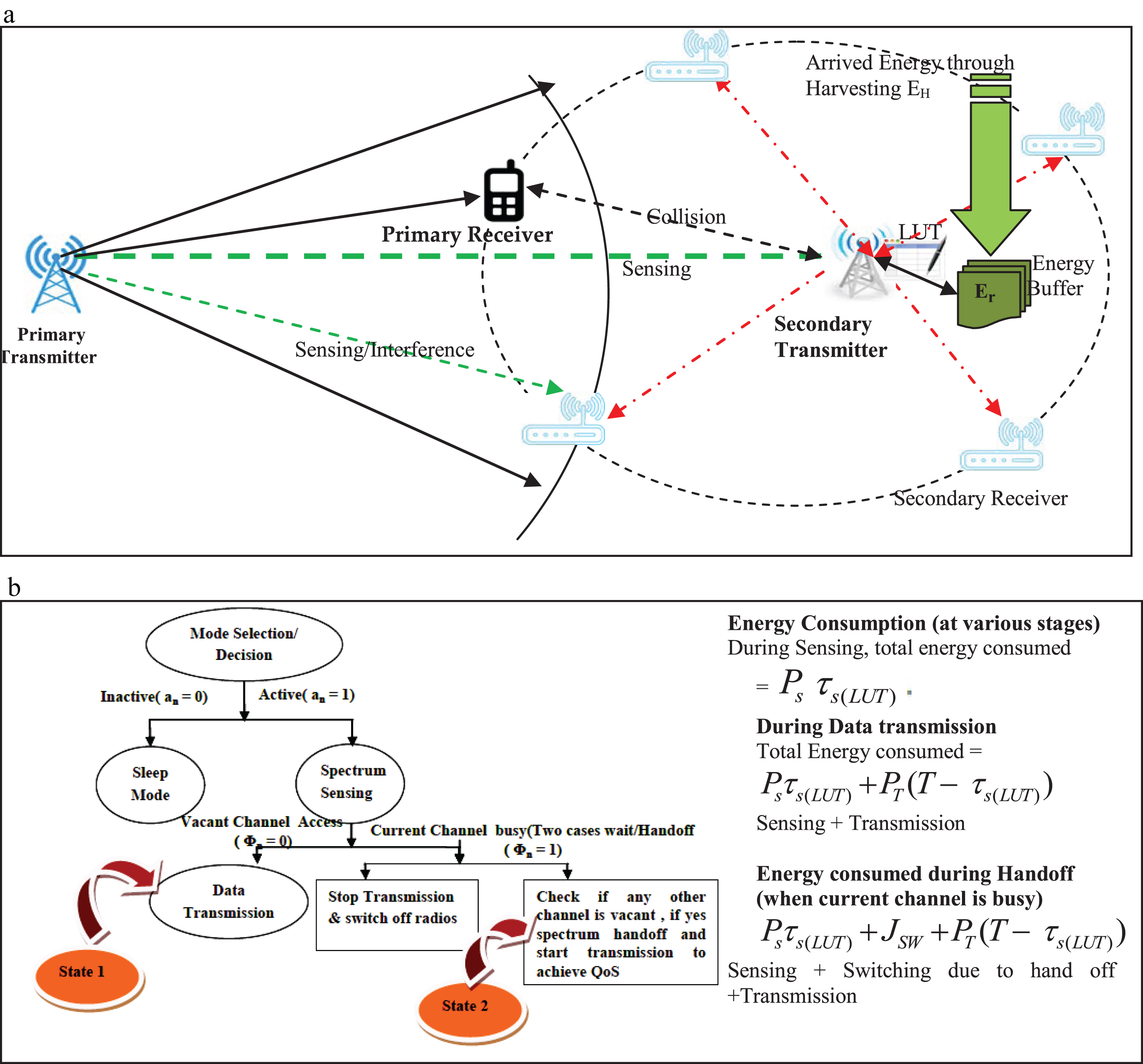
LUT incorporated Energy Harvested secondary network is depicted in Fig. 4(a). It consists of a primary transmitter-receiver pair and a secondary transmitter with multiple SUs receivers in the distributed system [21].
(a) LUT incorporated Energy harvested secondary network. (b) Mode selection switch and Energy consumption at various stages.
Secondary transmitter with the help of cooperative sensing using LUT explores the presence of PUs over all the available channels in the spectrum and continuously updates the information of the current status of channels to the LUT. Given system jointly shows the effect of LUT along with energy harvesting.
The energy collected through harvesting will be stored in energy buffer of SU battery unit. To avoid flooding of harvested energy the capacity of CR battery unit is assumed to be infinity.
Let us assume that energy leakage from energy buffer is negligible. Let EH is harvesting energy that will be stored in energy buffer. Assume that (P
S
τs(LUT)) is sensing energy and P
T
(T - τs(LUT)) is transmission energy respectively. Under this situation CR node first senses the spectrum and then starts its transmission if any one of the PUs channel is vacant at a particular instant of time. This procedure is further explained with the help of a mode selection switch as shown in Fig. 4(b). At initial stage all radios are switched off (inactive: A
n
= 1) and save energy, on the contrary if the radio is on (i.e. A
n
= 1) sensing using LUT takes place and transmission will be performed if atleast one of the channel is sensed as vacant (State 1). If current channel is sensed as busy (Φ = 0) and atleast one of the nearby channel is available, one can handoff to the available channel and continue its data transmission to provide fairly good quality of service (QoS) in terms of achievable throughput of the system (state 2) otherwise if no other channel is available wait at current channel and stop transmission. Figure 5 shows MAC protocol to reduce energy consumption. Let the duty cycle consists of TON and TOFF time in which TON is the duration in which radios are in active mode and TOFF is the duration in which radios are in in-active mode (Sleep mode). Therefore
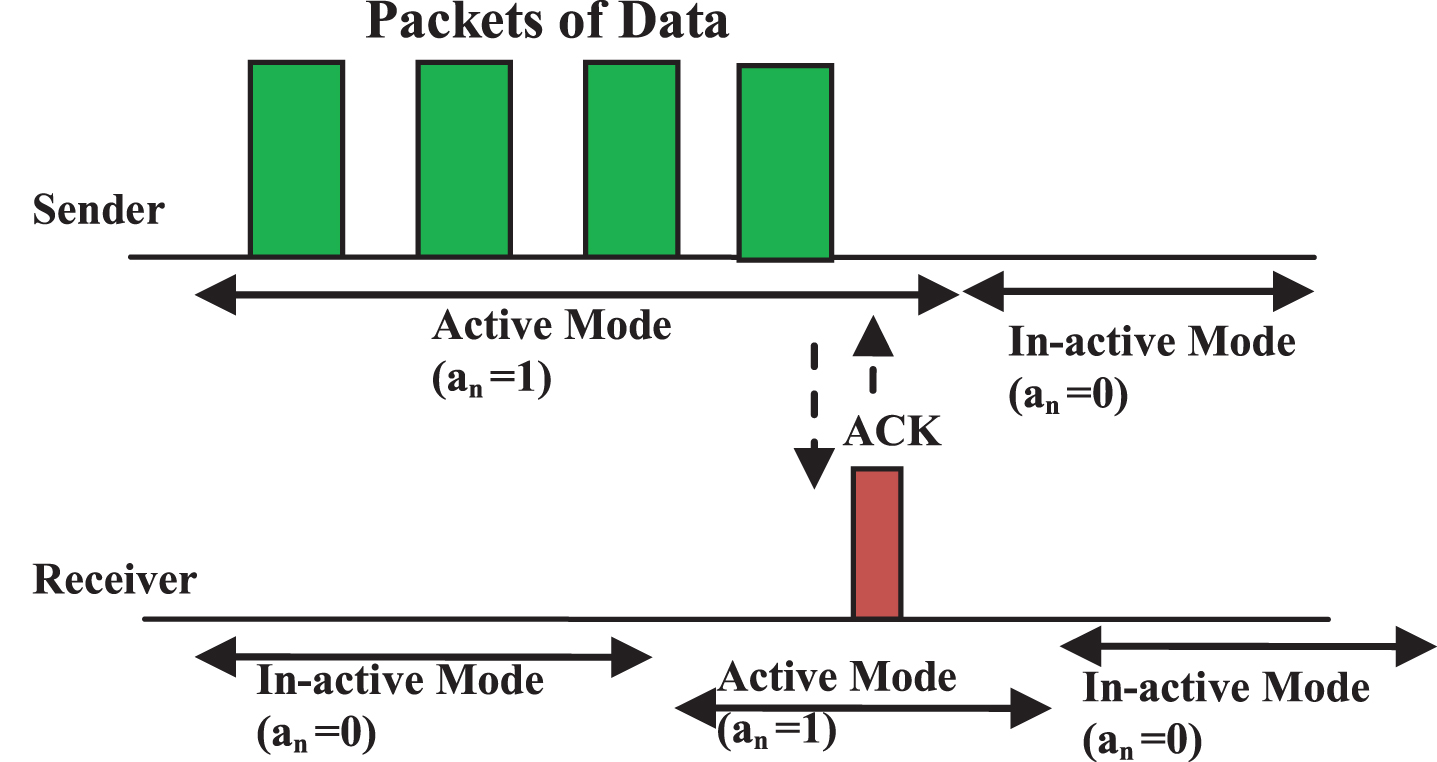
Low Energy consumption based MAC protocol.
Hence
Total Power used from battery is equal to sum of power consumed during active mode and in-active mode.
Recall, residual energy (denoted by E r ) remaining after completion of each time frame (T). Cognitive radio transmitter then employs greedy spectrum access method for throughput maximization
Such that
Energy consumption while sensing is calculated by time τ s . Therefore, minimizing sensing time helps in overcoming two problems, namely utilizing less energy during sensing(P S τs(LUT)) and hence maximizing available energy (P T (T - τs(LUT))) for transmission which further improves the throughput of the system. The graphical representation of saved sensing time using LUT w.r.t time frame (T) as shown in Fig. 6.
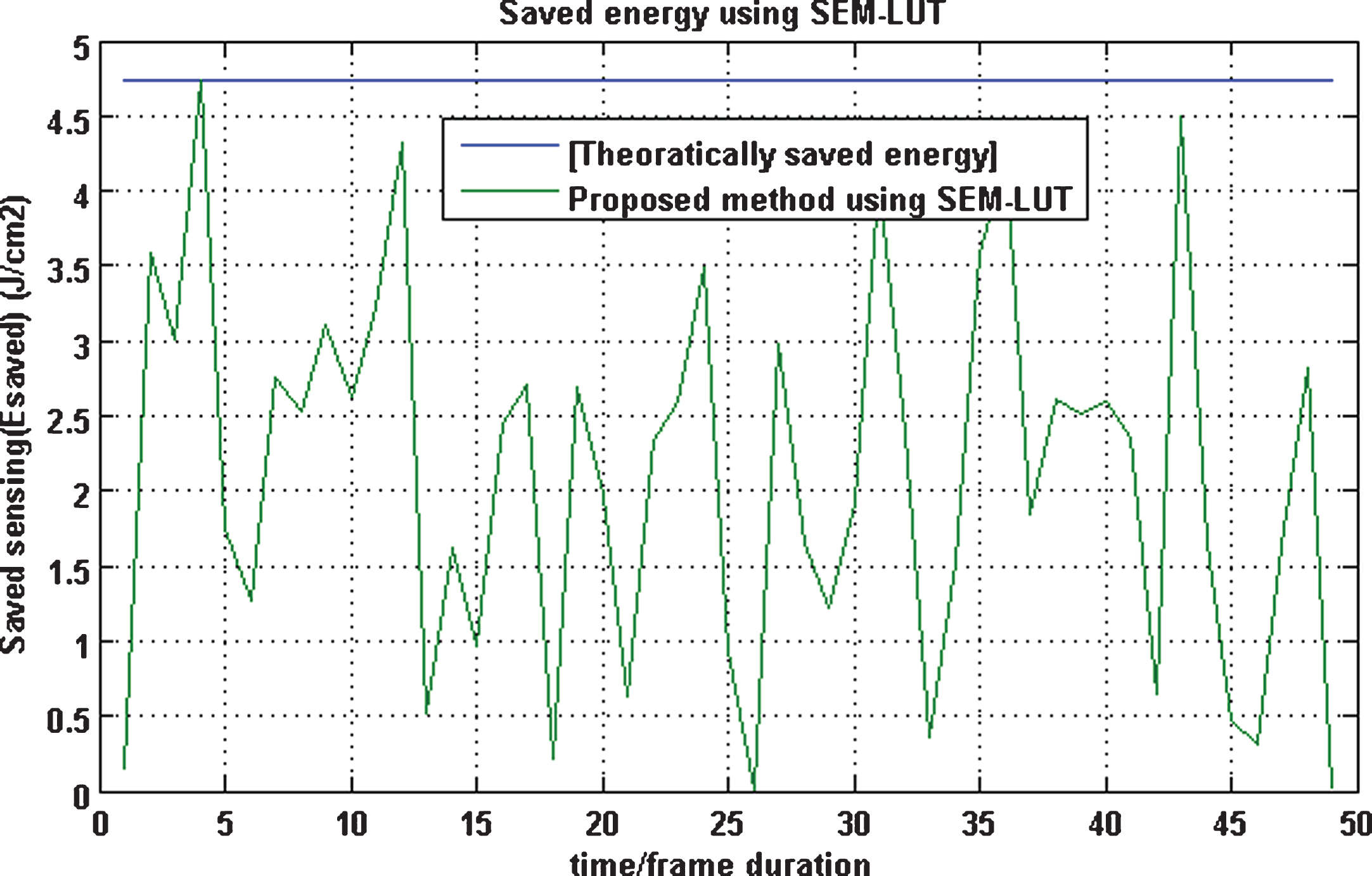
Saved energy (ESaved) vs. Time frame (T).
Total residual energy using LUT and energy harvesting w.r.t frame (T) in Fig. 7. Proposed method reaches theoretical value at T = 42 sec. Figure 7 also represents average value of residualenergy.
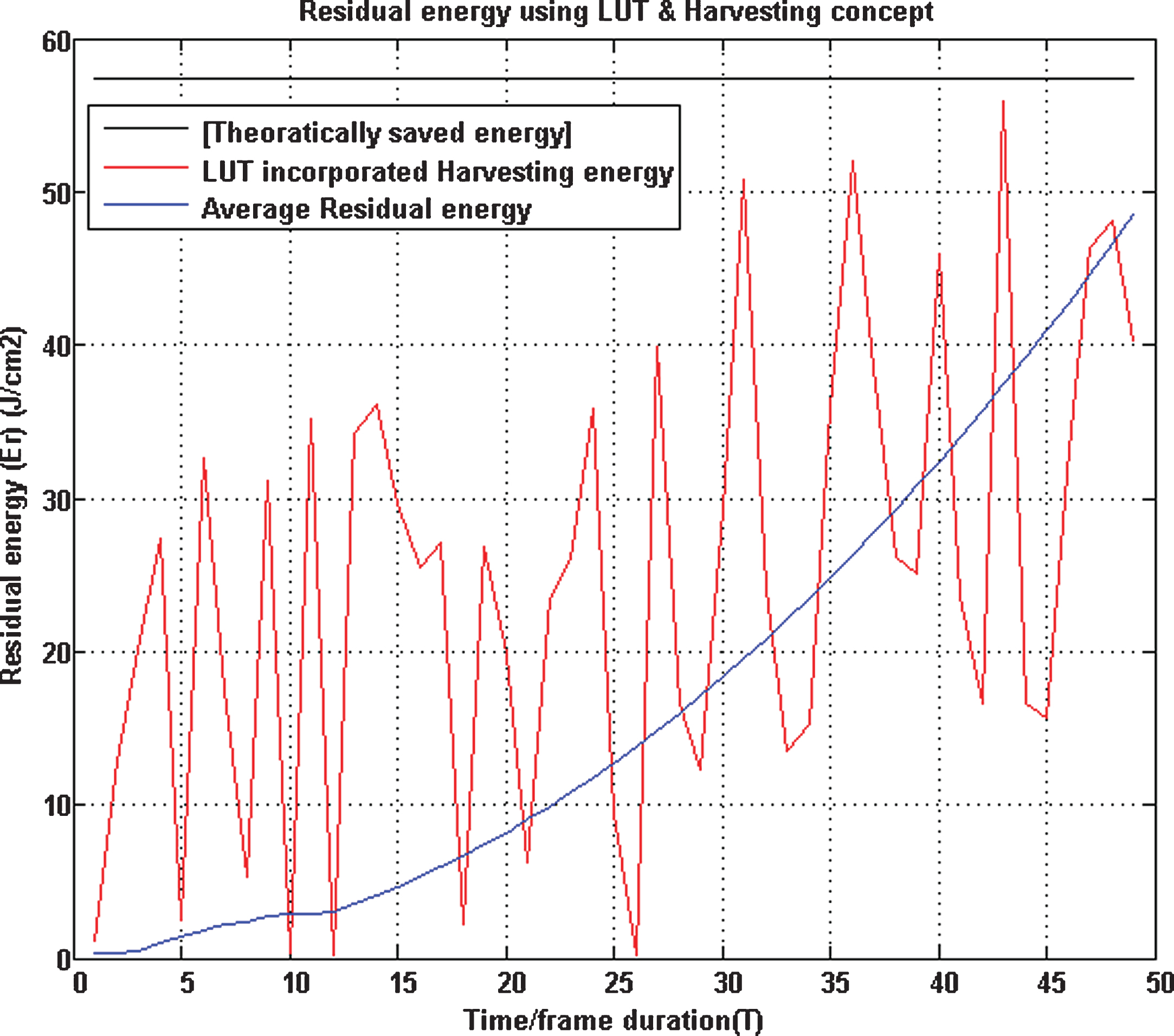
Residual energy using LUT & Energy Harvesting.
A fuzzy selection switch (discussed earlier) is used to select whether the system will utilize residual energy for next slot or main energy source. Fuzzy switch will continuously check whether residual energy >energy consumed during next slot sensing and transmission or just available for sensing i.e.
If
Else if
Then fuzzy selection switch has to check whether E r ≥ E s , if so next slot sensing is done with the help of residual energy and transmission will be done using the main power source of SU and so on. This process will continue till the last transmission slot. Pseudo code for LUT incorporated EH is as shown in Table 5 which explains how the energy consumption is further optimised. In line 1 set remaining time for transmission using LUT for all users, 2 shows initialization of channels whereas 3–7 saving energy & harvesting energy stored in the battery are now used for transmission otherwise if residual energy is less power off radio and stop transmission to save main power source.
Pseudo Code for energy minimization using LUT and energy harvesting
In this section, we recall some background concept of Wang S et al. [13] that will be used throughout this paper.
Let
X k = 0; Status of kth channel as idle
X k = 1; Status of kth channel as busy &
P d & P fa are probability of Detection and Probability of False Alarm respectively both are function of τs(LUT).
Mathematically
Channel sensed as busy| Channel is actually busy
Channel sensed as busy| Channel is actually vacant
The detection probability (Pd) as well as the probability of False alarm (Pfa) can be calculated as:
Where
In this paper, cooperative spectrum sensing using LUT is considered with the help of multiple SUs. Let us define hypothesis for kth receiver as
For k = 1, 2, 3, …… K, we assume following things
All the channel coefficients (chi) are random variables with zero mean value. All the noises are statistically independent of each other for K receivers with same power i.e. Energy [all the noise] = constant
For multiple PUs and SUs sensing data fusion takes place. Suppose the channel coefficient is known for all PU transmitter and receivers. Apply maximal ratio combining we get:
Where
From (23, 24) we can calculate hypothesis for K receivers
Where
Where
Parameters used in simulations are as follows
For validation, we have performed simulation in NS2 using CRCN environment and graphs have been plotted in Matlab for comparative analysis. The parameters taken during simulation are described in Table 6 as shown below.
Specifications for simulation
Specifications for simulation
Let μ is throughput coefficient which is directly proportional to throughput of the system and inversely proportional to the average throughput of the system, μ ∈ [0, 1]
Mathematically,
Where R0 (Average throughput) = (1 - ρ) C0)
ρ = probability of channel being busy and C0 = log 2 (1 + SNR). SNR = signal to noise ratio at the receiver terminal of SU.
A number of results are derived however, for the sake of simplicity of research, only three parameters are selected and by varying one parameter say Ps at a time to check the energy efficiency w.r.t throughput coefficient and delay coefficient.
Let λ is the delay coefficient, it is the ratio of system delay (Đ) to that of packet duration of data to be transmit 𝕊
Table 7 and Fig. 8 show significant improvement in Energy Consumption w.r.t throughput coeff. with Bandwidth (BW) taken as 6 MHz. The Energy Consumption w.r.t delay coeff. is also calculated using same parameters and for validating the proposed technique output results are again compared with existing methods, Wang S et al. [13] and Singh M et al. [14]. All the simulations shown in Fig. 8 are done at time frame = 100 ms.
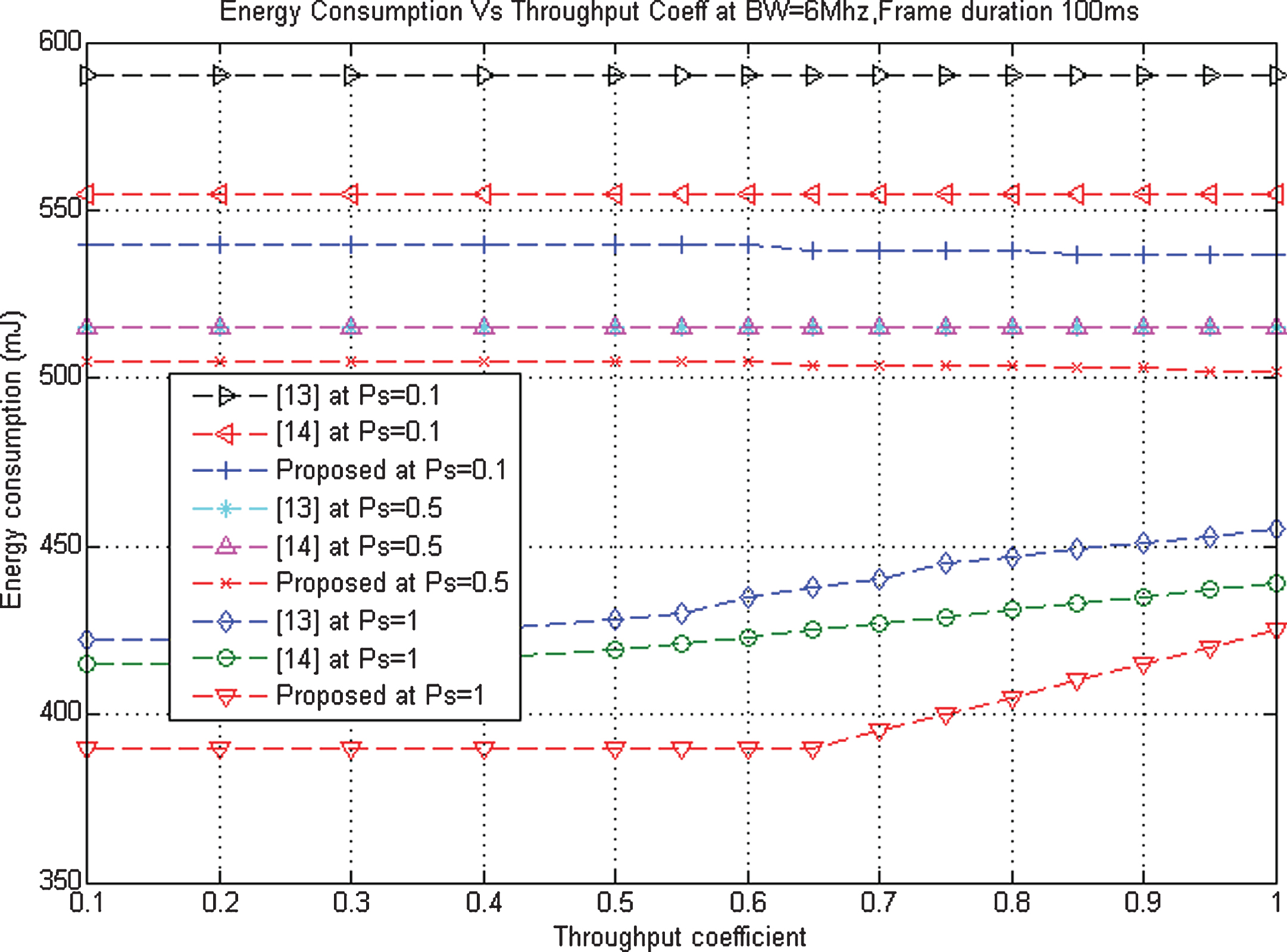
Energy consumption Vs Throughput coefficient (μ).
Table 8 and Fig. 9 show significant improvement in Energy Consumption w.r.t delay coeff. under single TV Band with Bandwidth (BW) taken as 6 MHz and switching energy J SW = 2 mJ and 40 mJ. The Energy Consumption w.r.t delay coeff. are calculated using above mentioned parameters and for validating the proposed technique output results are compared with existing methods, Wang S et al. [13] and Singh M et al. [14].
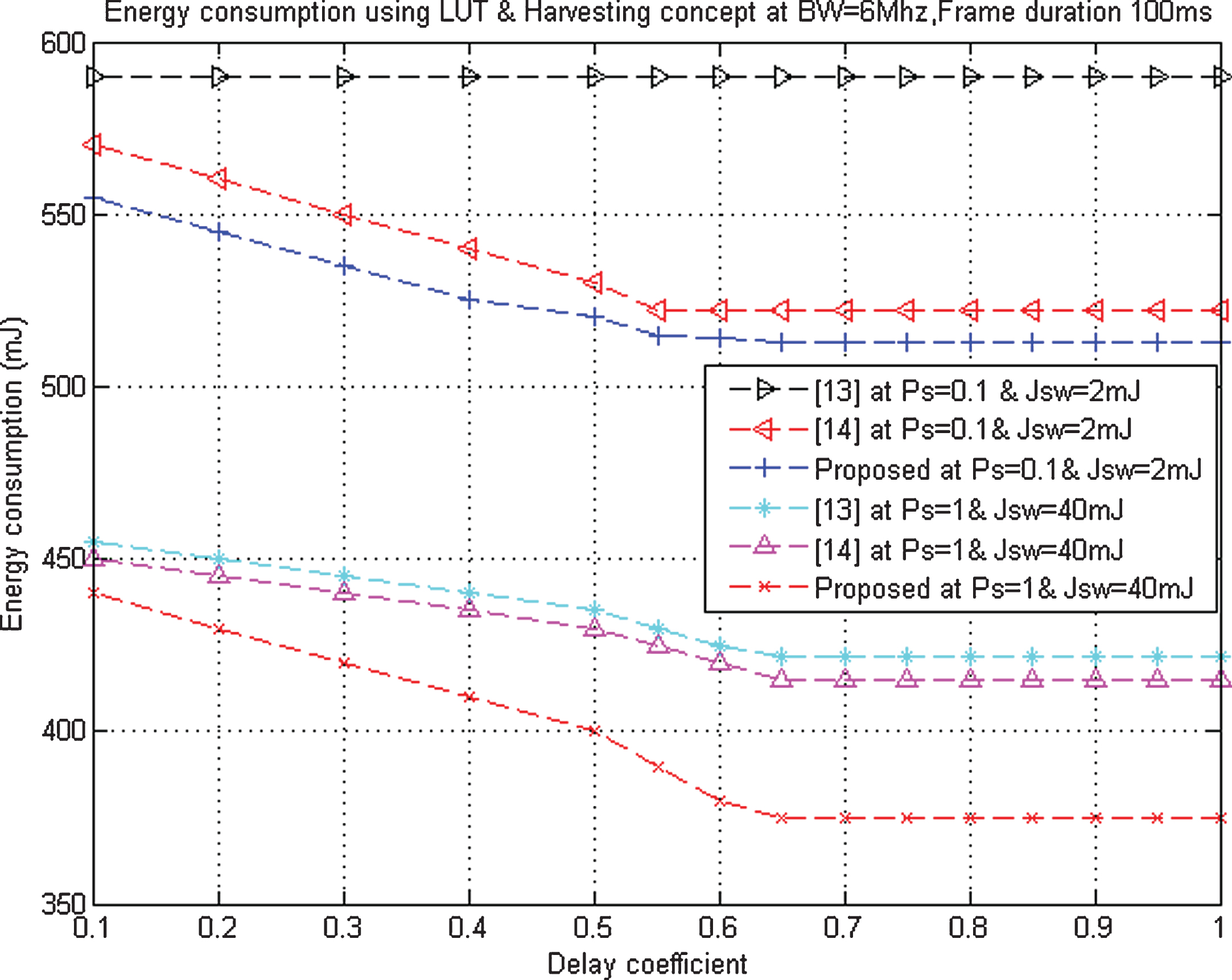
Energy consumption Vs Delay coefficient using LUT & Energy Harvesting at different Switching power (J SW ) and wait probability.
Figure 9 is considered again with the same detection time, the more stringent delay constraint can be met when the probability of waiting for the current channel is reduced without transmission, i.e. when smaller Ps is used. However, higher energy consumption may occur with the use of smaller P s . The optimum τ s and P s pairs produce the least energy consumption while meeting the required delay limits.
Figure 10 shows normalised achievable throughput Vs sensing time which clearly depicted that normalised achievable throughput using LUT is best and very close to theoretical value as compare to ordinary system and achieve throughput greater than 0.95 at 15 ms as compared to ordinary system which takes 20 ms time to achieve the same throughput, Proposed method attain maximum throughput at 30 ms as compare to 40 ms for traditional systems. Statistically proposed system achieves almost 1/3rd time to attain maximum value.
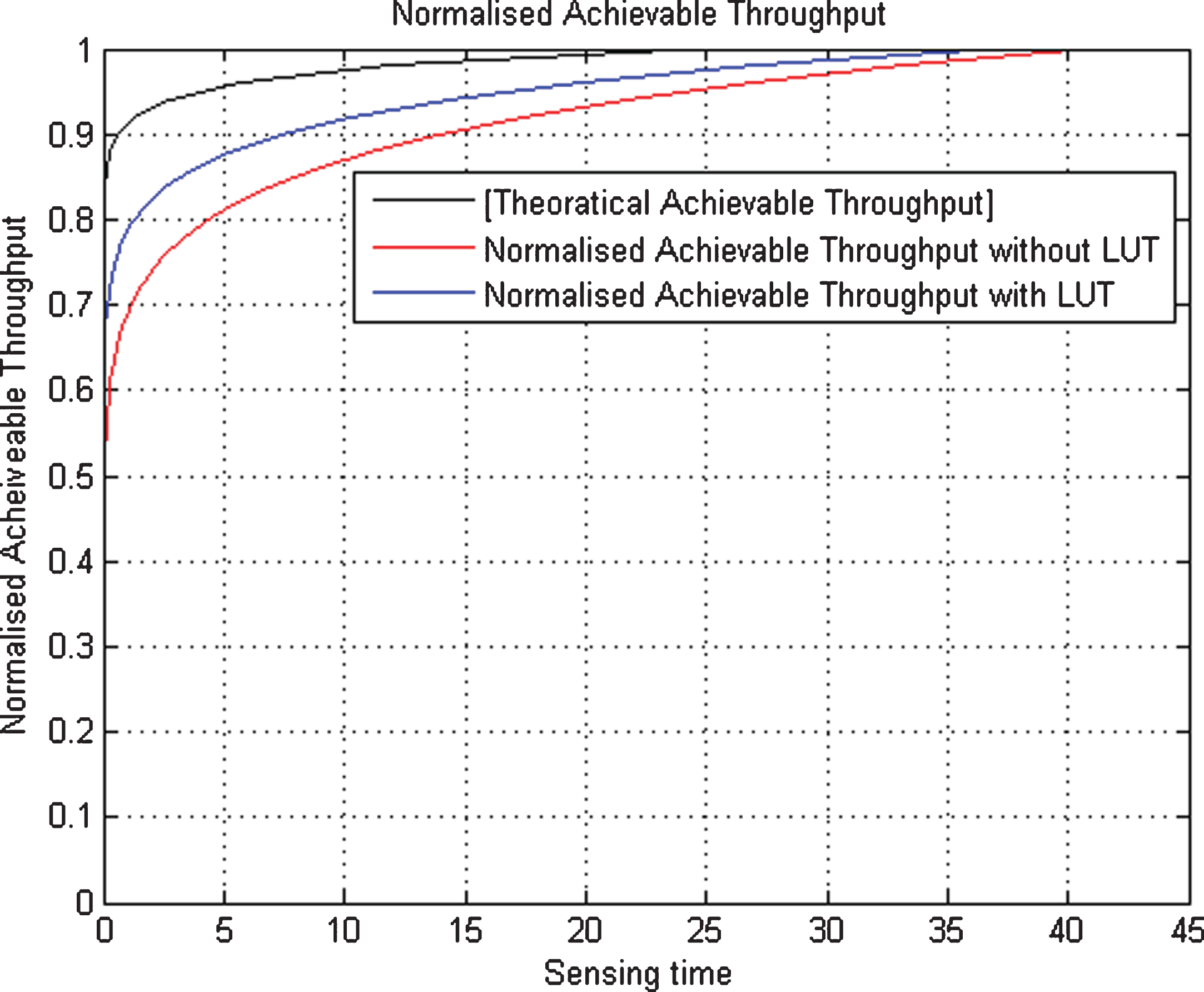
Normalized throughput v/s Sensing time.
Figure 11 Shows normalised achievable throughput vs energy harvested. Figure 11 shows special case of Normalised throughput when harvesting energy is used for sensing and transmission. This is the optimal case of normalised achievable throughput to attain maximum throughput only 50 mJ of harvested energy is utilised.
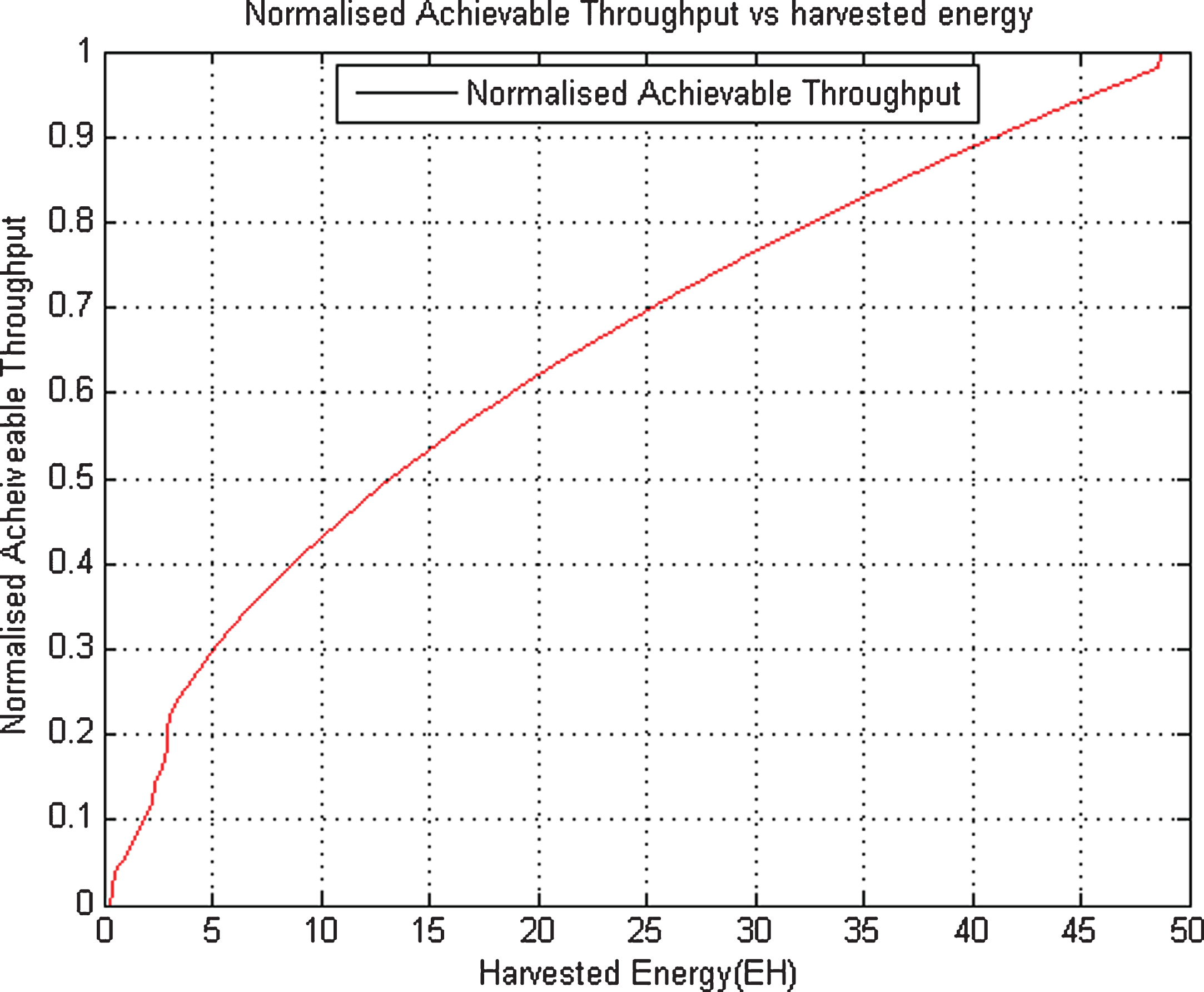
Normalised throughput v/s Harvested energy (EH).
The proposed model comprises of 3 Echelons namely UWB-BAN in Echelon 1 followed by Echelon 2 & 3 to form CBAN. This paper explains the effect of energy harvesting that is incorporated into low-power MAC protocols using Look Up Table (LUT) in telemedicine system. The proposed method used in this paper is able to take advantages of UWB Echelon-1 network which consumes ultra-low power as compared to Bluetooth, Zigbee (narrow-band systems). Furthermore, the concept of energy harvesting is introduced in the designed system to operate the system as self-sustainable in terms of external sources of energy for years. This paper also works on novel cooperative sensing technique using LUT which clearly outperforms traditional sensing methods. Energy saving, energy consumptions and achievable throughput w.r.t sensing time are shown in result section which clearly depict significant improvement over traditional methods. Proposed method outperforms existing methods, consume typically 11% less energy and also provide better achievable throughput statistically 33% using LUT incorporated energy harvesting system.