







Abstract
At present, special domain image encryption and compression algorithms have problems such as poor encryption and image compression, long time consuming of encryption and compression, and no guarantee of image compression quality. In this regard, this paper proposes an encryption and compression algorithm for spatial domain image selection based on hyperchaotic system. The hyperchaotic Chen system is selected to decompose the dynamics of the hyperchaotic system. The decomposition result is replaced by image scrambling, and the chaotic sequence output from the hyperchaotic Chen system is preprocessed. The two groups of sequences are used to complete the image scrambling so that the image is encrypted for the first time. The discrete cosine basis is applied to make sparse representation of the original image after scrambling. The partial Hadamard matrix, which is controlled by the Logistic chaotic map, is used as the measurement matrix in the compressed sensing, and the two-dimensional projection measurement of the image is done to complete the image compression. The hyperchaotic Chen system is used to cyclically shift the projection results to change the pixel value of the image, and the final cipher image is obtained. The experimental results show that the algorithm anti-attack coefficient is 0.99, the average compression time is 7 s, and the compressed image has high resolution and strong confidentiality. The proposed algorithm is superior to the current algorithm in security and other performance, and can provide support for this field.
Introduction
With the development of multimedia technology, mass data can be transmitted and utilized. At the same time, the security of data has become the key problem in the use of data. Spatial domain image is one of the achievements in the development of multimedia technology, and its use value is self-evident, but it is also accompanied by security problems. Currently, encryption has been transformed from a single complete encryption or selective encryption into a combination of encryption and compression coding. The speed of traditional image encryption and compression algorithm is slow, and which is unable to adapt to the needs of social development [1]. Various experts and scholars have conducted in-depth studies on the existing problems in the relevant algorithms, and some of the research results are as follows.
Zheng et al. proposed a reversible information hiding algorithm for encrypted images based on lossless compression [2] The image owner replaced the original image and encrypted it. Secret information concealer divided the encrypted image into several equal size and non-overlapping image blocks, and used lossless compression technology to get the spare space in each block to hide the secret information. The receiver used the extraction key to extract the secret information, and then combined the decryption key to restore the original image correctly. The experimental results showed that the image compression and encryption algorithm was less time-consuming, but the anti-attack was poor, that is, the security was low. Guo et al. proposed image encryption algorithm based on the format compatibility of JPEG image [3]. The AC coefficient was used to grab texture information and generate some regions. Based on the region, the DC coefficient was encoded, and eight different sequential scanning AC coefficients were used, to select the smallest block of bitstream, and the AC coefficient of each block was extracted, so that the AC coefficient was added to increase the scope of replacement. The main process of the algorithm was reversible, but the encryption performance of the encrypted image was not ideal. Wang et al. proposed a compressed sensing based image encryption method [4]. A plurality of amplitude typed spatial light modulator having the same size with images were placed in front of the different images with different positions. By adjusting the intensity distribution of the spatial light modulator, a series of modulated beams were irradiated on different images and were eventually collected by a point detector. Theoretical analysis showed that the process of light passing through spatial light modulator and object was similar to the observation matrix of compressed object in compressed sensing. Therefore, the whole encryption process was regarded as the process of compressed sensing, and the process of decryption was converted to solve the minimization problem. The experimental results showed that this method improved the anti-attack of the algorithm, but it had a long time consuming problem. Chen et al. proposed a lossy image compression algorithm based on singular value decomposition and combined with the change of Contourlet [5]. In this algorithm, the image was made singular value decomposition firstly, and the appropriate singular value was selected according to the contribution of singular value to the image signal to achieve image compression. Then, the image was performed Contourlet transformation and quantization, to achieve the two-stage compression of the image. This algorithm was compared with the Contourlet transform compression algorithm, and the experimental results show that the algorithm was simple and easy to implement, but the image quality after compression was poor. Hui et al. proposed image compression algorithm and wavelet transform based on human visual system [6]. In this algorithm, the wavelet filter was firstly used to select the model and the best filter to obtain the minimum number of non-zero wavelet coefficients. Secondly, the wavelet coefficients of the decomposed wavelet were quantified by using the characteristics of human visual system. Finally, wavelet coding was applied to compress the image. The experimental results show that the algorithm had good security performance, but the problem of long time consuming of image compression was found.
In view of the problems existing in the algorithms and methods of image encryption and compression, an encryption and compression algorithm for special domain image selection based on hyperchaotic system is proposed. The overall framework is as follows:
The dynamics of hyperchaotic Chen system in hyperchaotic system is decomposed, to lay the foundation for image encryption and compression. The spatial domain image is scrambled to disturb the high correlation between pixels, and the first encryption of the image is realized. Combining the hyperchaotic system with two-dimensional compression sensing, a new image encryption compression algorithm is formed. The combination algorithm is used to encrypt and compress the spatial domain image, and the speedup factor can improve the efficiency of the algorithm. Encryption coefficient can enhance image secrecy and security on the basis of original encryption. Experimental results and analysis. The effectiveness of the encryption and compression algorithm for spatial domain image selection based on hyperchaotic system is to verify. The full text is summarized and the future development trend is put forward.
Material and methods
Dynamic decomposition of hyperchaotic system
Hyperchaotic system is a chaotic system has at least two positive Lyapunov indexes, compared with the low dimensional chaotic system, its orbit can be separated in more directions, the phase space and the dynamic behavior are more complex and with larger key space and better pseudo randomness, therefore, it is more suitable for the image’s spatial domain encryption [7]. Based on the decomposition results of hyperchaotic system, the image selection encryption and compression are realized. It is verified that in the Chen system, the hyperchaotic Chen system is obtained by using the nonlinear state feedback controller. It is one of the hyperchaotic systems, and has certain advantages in many chaotic systems. The system is chosen as a chaotic system to realize image selection encryption and compression. To sum up, the system dynamics can be decomposed as follows:
Where, m, n, p, q and t represent the control parameters of the chaotic system, and
Based on hyperchaotic system, the selective encryption and compression algorithm for spatial domain image is used to select t = 0.6. The system has two positive Lyapunov exponents of 0.908 and 0.002, respectively, and its attracting factor is shown in Fig. 1.
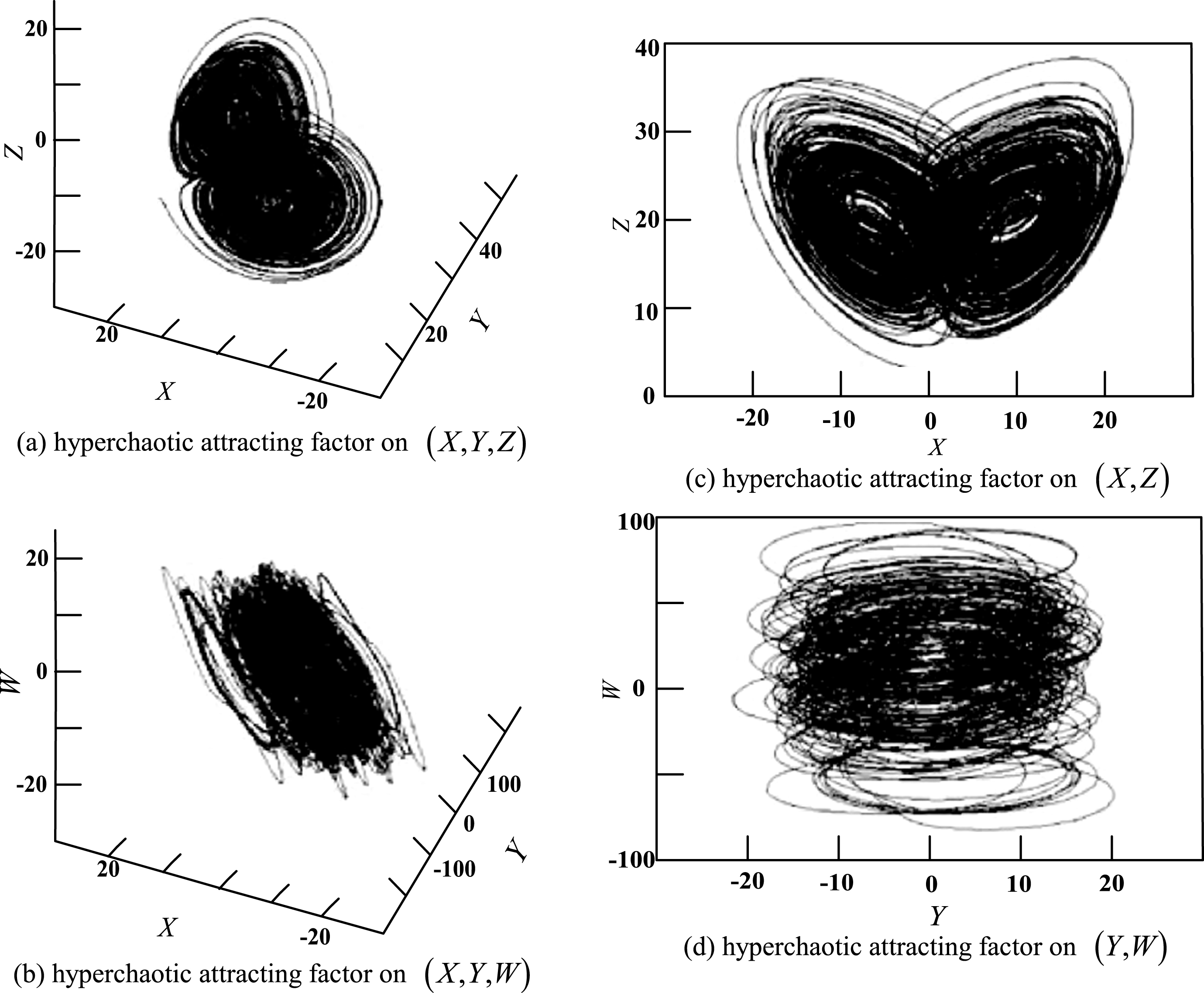
Attracting factor of hyperchaotic Chen system.
In the decomposition of hyperchaotic system dynamics equation, using the control parameters and the state variables of the chaotic system, the system is controlled in the hyperchaotic state [8]. The attracting factor of the hyperchaotic Chen system is analyzed, which provides the basis for the encryption and compression of the spatial domain image selection.
Spatial domain image is one of the digital images and there is a strong correlation between adjacent pixels. In order to disrupt the high correlation between pixels and make the encryption result more ideal, the image scrambling matrix is used to scramble the pixel position of original image [9, 10]. It is assumed that the original spatial image is P (i, j) , i = 0, 1, ⋯, M - 1, and j = 0, 1, ⋯, N - 1 represents the gray value of the image pixel. To sum up, the process of image pixel scrambling is as follows:
The initial values of X0, Y0, Z0 and W0 are given, the hyperchaotic Chen system generates chaotic sequence {X (t) , Y (t) , Z (t) , W (t) |t = 1, 2, 3, ⋯} under the iteration of the four orders Runge-Kutta method. The chaotic sequences X (t) and Z (t) are pretreated.
Where, mod (x, y) represents the acceptation or rejection of x to y, and round (x) represents an integer close to x. By formula (5), it can be seen that X (t) ∈ [0, M - 1], Z (t) ∈ [0, N - 1]. The two sequences after the preprocessing is further processed to obtain the sequence
In conclusion, {X (i) , X (j)} represents the coordinates of the pixel point (i, j) of the original image after the position scrambling, and the image P (X (i) , X (j)) after the scrambling can be expressed as:
Where, κ represents the scrambling coefficient.
According to the above calculation, the spatial domain image scrambling is completed. The whole process can be described as preprocessing the chaotic sequence of the hyperchaotic Chen system. Then, two sets of sequences are used to scramble the image, and the initial encryption of the image is realized by preprocessing and scrambling the output sequence of the hyperchaotic Chen system, which provides convenience for subsequent image re-encryption.
If it only uses the hyperchaotic system to make image encryption, it might expand the image data, so the data volume of cipher image increases, resulting in overburden of image transmission and use [11, 12]. In order to overcome this shortcoming, the scrambling results of image obtained in Section 2.2 is integrated into the combination method of hyperchaotic system and two-dimensional compressed sensing to achieve the selective encryption and compression of spatial domain image. The detailed process is as follows:
If the size of a two-dimensional signal f is N * N, it is sparse decomposed by orthogonal discrete cosine basis, and it is sparsely listed in the column.
Where, Ω represe the orthogonal discrete cosine sparsity basis and η1 represents the column sparsity coefficient. In fact, the practice is sparse.
Where, η2 represents the sparse matrix. Two-dimensional signal f is measured in the Ω domain for two-dimensional projection. The two measurement matrices are ψ1 and ψ2, and the size is M * N. The results of the measurement, that is, the compression results of the spatial domain image can be expressed as:
Where, ∂ represents the image’s compression factor to improve the quality of the compressed image. According to the above process, the size of two-dimensional signal f is M * M after two dimensional compression, which is represented by B, thus the compression of the spatial domain image is realized.
Based on the measurement results obtained by two-dimensional compression, hyperchaotic Chen system and two-dimensional compression sensing are used to complete the selective encryption and compression of spatial domain image. The specific process is as follows:
For an plaintext spatial domain image with the size of N * N, using the above calculation method, the sparse representation of the image in the two-dimensional Ω domain is completed. The measurement matrix ψ1 and ψ2 are constructed by using the partial Hadamard matrix, in which the part of the Hadamard matrix is controlled by the Logistic mapping. The construction process of the measurement matrix ψ1 is as follows: A chaotic sequence ξ = [ξ1, ξ2, ⋯, ξ2N] is constructed by using Logistic mapping, and there are 2N elements in the chaotic sequence. The initial value of the Logistic mapping is θ1. The first N elements of ξ are abandoned and the index sequence s is obtained. The natural sequence l is ordered according to the index sequence s, to get the sequence g. For each row vector z (g1) , z (g2) , z (g3) , ⋯, z (g
M
) of row g, N orders Hadamard matrix z are constructed as the measurement matrix is ψ1, then:
According to the formula (11), the measurement matrix ψ2 is obtained by using the initial value θ2 in the same way. According to the formula (10), the result of selected encryption and compression is B. The values of initial conditions X0, Y0, Z0 and W0 are determined respectively. The step length of the Runge-Kutta equation is 0.001, and the hyperchaotic Chen system is iterated for 22n times, to obtain four hyperchaotic sequences, shown in Section 2.2, which are X (t) , Y (t) , Z (t) , W (t) respectively. Using the formula (12), four chaotic sequences are converted to four integer sequence {T*} respectively, and T represents any one of the four hyperchaotic sequences.
Where, represents the maximum integer that is not more than X.
□ {X (t)}, {Y (t)}, {Z (t)}, and {W (t)} are constructed into a chaotic sequence K, as shown in formula (13).
Where, k1, k2, ⋯, k22n represents the elements in the sequence. Supposing W (t) * mod 3 = 0, then k I = X (t) * is used to implement the cyclic shift operation. Supposing W (t) * mod 3 = 1, then k I = Y (t) * is used to implement the cyclic shift operation. Otherwise, k I = Z (t) * is used to implement the cyclic shift operation.
□ The pseudorandom matrix R is generated by the hyperchaotic system. The matrix can be expressed as:
Where, K* represents the elements in the pseudorandom matrix.
All of the element values in 2 are mapped to the integer interval 3, and there are:
□ All of the element values in B are mapped to the integer interval [0, 255], and there are:
Where, max B represents the maximum element of B, round (*) represents the bracket function to zero, C represents the mapping function, and the element a (i, j) in C is made 8-bit decomposition, i.e.:
Where, a v (i, j) represents the v numbers after the transformation, v = 0, 1, ⋯, 7. Thus, a gray value in an spatial domain image is decomposed into 8 numbers (0 or 1), which is arranged in line in turn, making the original C to change to C8.
□ R is used to make cyclic shift operation for C8, and then the result C′ of the cyclic shift can be expressed as:
□ After the cyclic shift, the final ciphertext image is generated for its result using formula (18) and (19).
Where, τ represents the acceleration factor in the process of image encryption. This value can improve the overall efficiency of the algorithm [13]. μ represents the image encryption coefficient. The image security and security can be enhanced on the original encryption basis [14]. ℑ represents the encryption function of the image, which can accurately select the encrypted part in the image. C′ is restored to the binary image form, and the function compression is mapped to the function elements, so as to realize the whole process of spatial domain image encryption. In formula (19), G represents the final ciphertext image. The corresponding decryption process is the reverse cycle shift operation for the ciphertext image G [15–17].
In the operation of image compression and encryption algorithm based on hyperchaotic system and two-dimensional compressed sensing, the original gray image is made sparse representation by discrete cosine basis. The partial Hadamard matrix controlled by Logistic chaotic map is used as the measurement matrix of compressed sensing, and the two-dimensional projection measurement of the image is carried out to achieve image compression. The Chen’s hyperchaotic system is used to control the cyclic shift operation. Through this nonlinear operation, the pixel value of the image can be effectively changed, and the compressed image is encrypted, which ensures the security and secrecy of the selective encryption and compression of the image.
In order to verify the effectiveness of selective encryption and compression algorithm based on hyperchaotic system for spatial domain image, a related experiment is needed, and the experimental platform is built on Matlab 2017. In the experiment, 50 spatial domain images are selected. The sample images are as shown in Fig. 2, which size is 256*256.
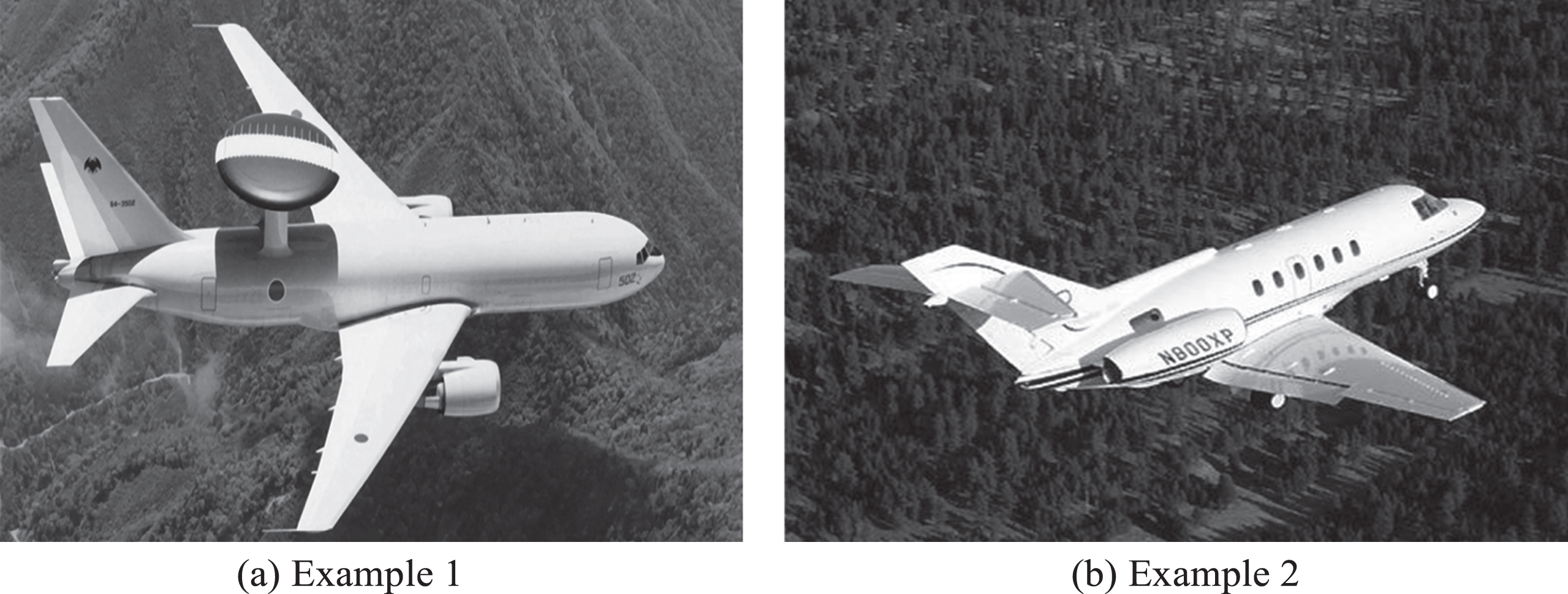
Examples in this experiment.
The experimental indexes are as follows:
The anti-attack of image encryption and compression algorithm£»the secrecy of encrypted image; time consuming of image compression; image quality after compression.
The experimental results are as follows:
From Fig. 3, we can see that with the increase of the time and type of attack, the anti-attack ability of the reversible image hiding algorithm based on lossless compression is not so good. The maximum anti-attack coefficient is 0.35, which shows that the algorithm does not have strong reliability. Based on hyperchaotic system, the selective encryption and compression algorithm for spatial domain image has strong overall attack resistance, and the operation time of the algorithm and the type of foreign attack cannot have a great influence on the operation of the algorithm. The maximum anti-attack coefficient is 0.99. Through the comparison of data, it is proved that the selective encryption and compression algorithm based on hyperchaotic system for spatial domain image is superior.
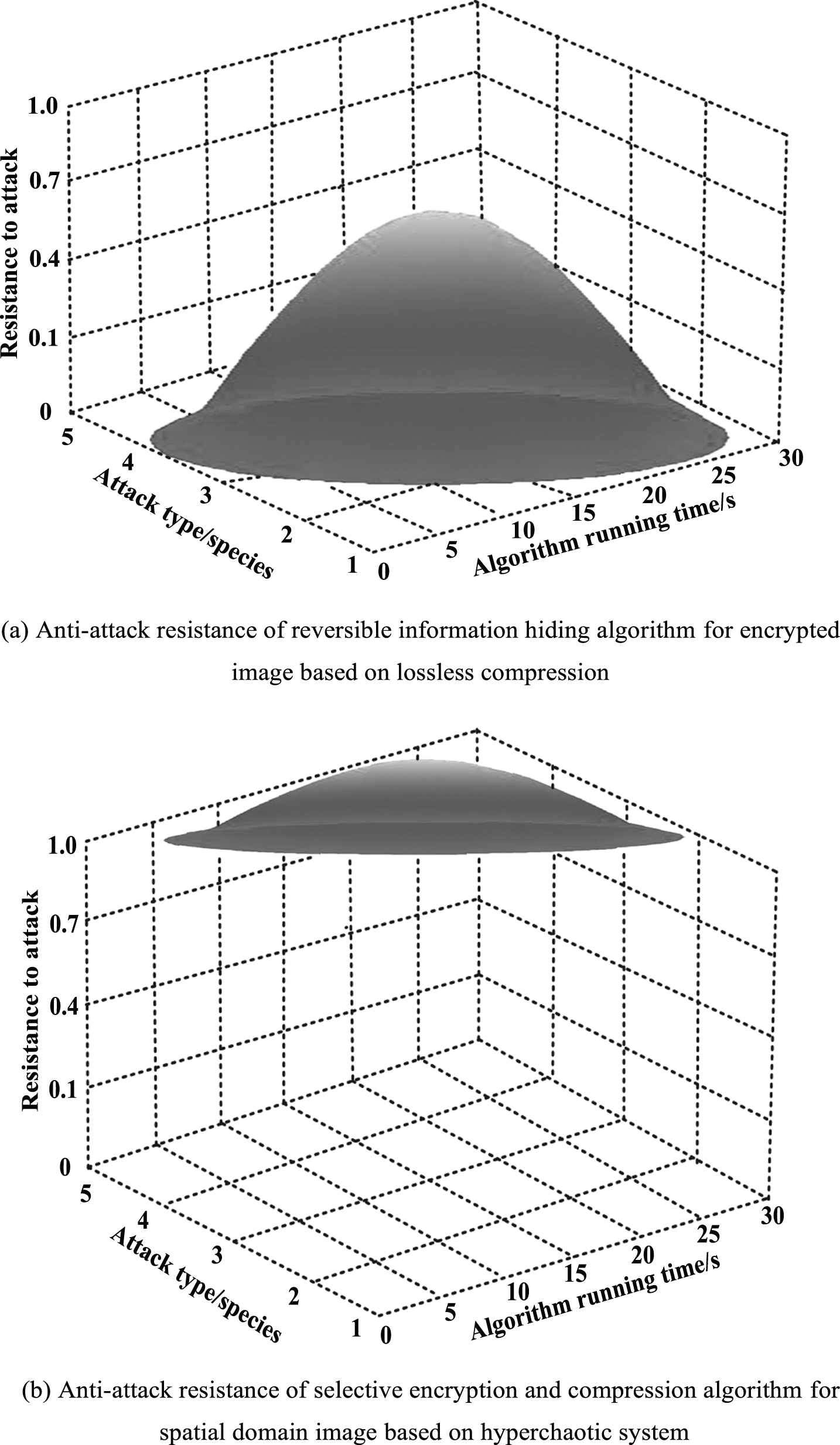
Comparison of anti-attack of different encryption and compression algorithms for images.
According to Fig. 4, the control group is used as the contrast sample of the two algorithms. By contrast, it is obvious that the selective encryption and compression algorithm based on hyperchaotic system for spatial domain image is more reliable than the image encryption algorithm based on JPEG image format compatibility. Although the image encryption algorithm based on JPEG image format compatibility has a certain secrecy capability, it can still easily see the information transmitted in the image, and its security is poor. Compared with the control group, the encryption and compression algorithm based on hyperchaotic system for spatial domain image is more reliable, which is better than the image encryption algorithm based on JPEG image format compatibility.
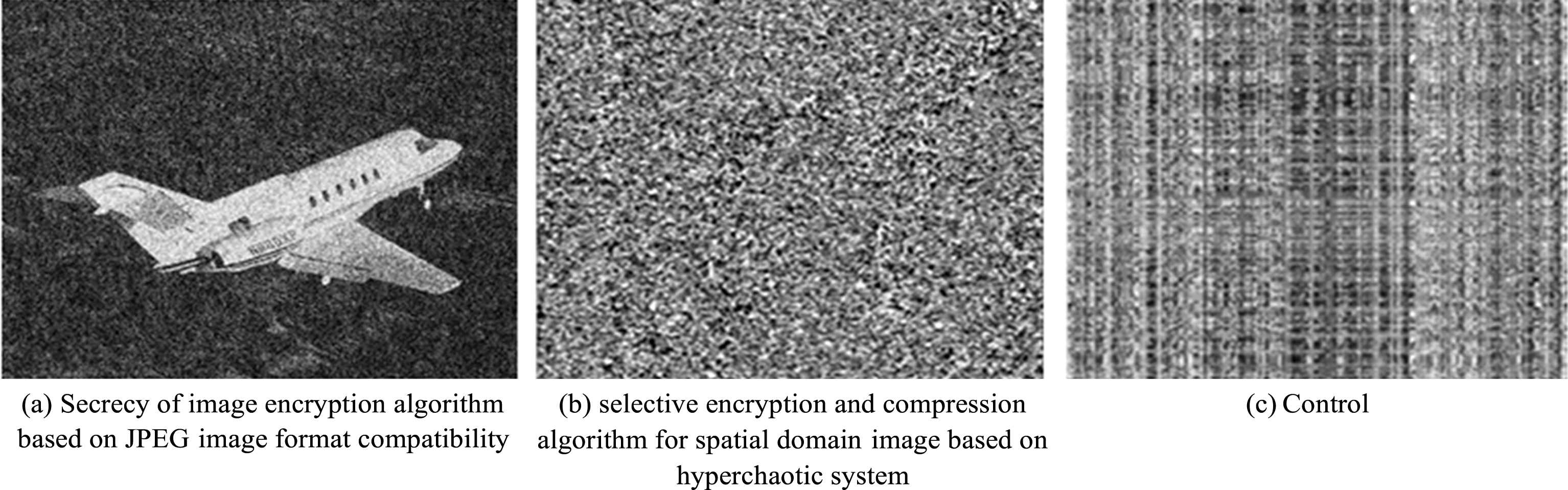
Comparison of the cryptographic of different image encryption algorithms.
In Fig. 5, the time-consuming of image compression is an important index to verify the compression algorithm. The time-consuming of image compression by using the image encryption based on compressed sensing method is an average of 23μs. The average time-consuming of the image compression algorithm based on wavelet transform and human visual system is 18.3μs. The average compression time of image encryption and compression algorithm based on hyperchaotic system is 7μs. According to the data comparison, the time-consuming of image encryption and compression algorithm based on hyperchaotic system for spatial domain image is less and much more practical and scientific.
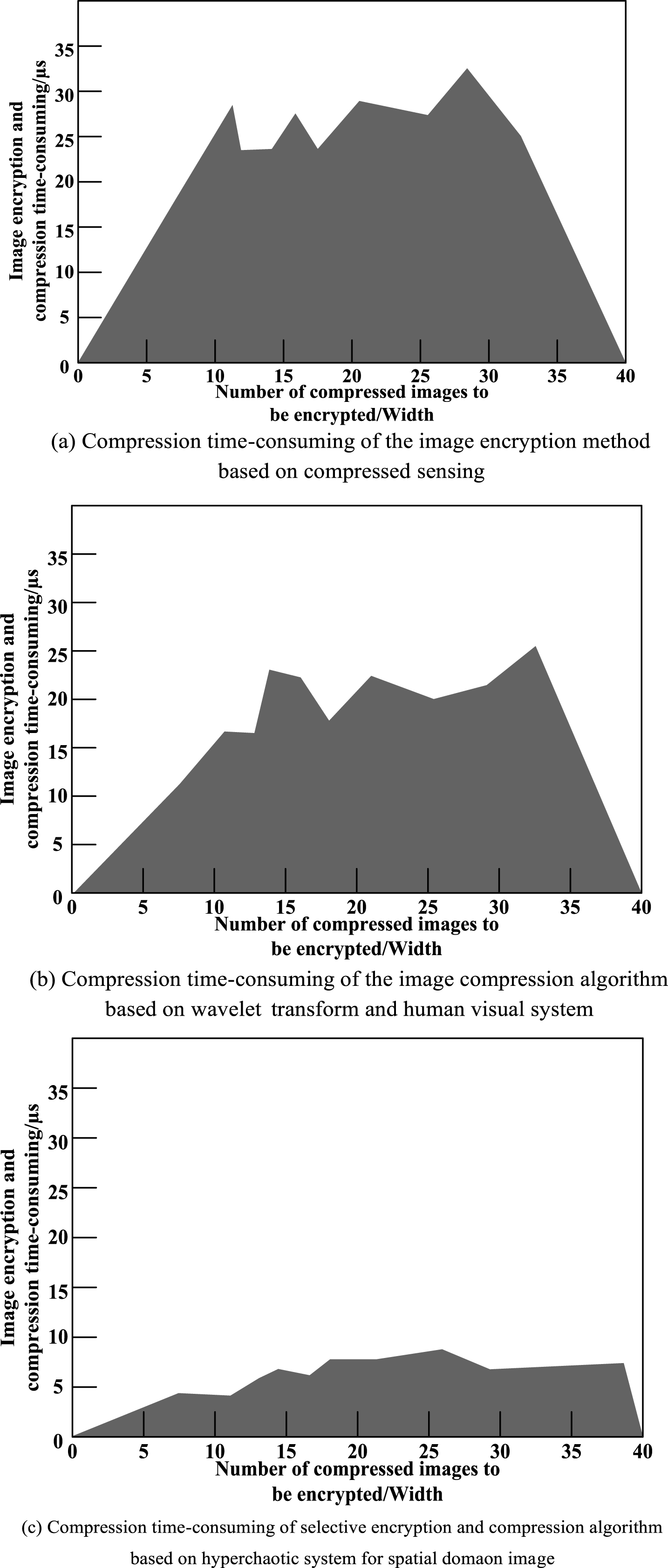
Compression time-consuming contrast of different image encryption and compression methods.
Analysis of Fig. 6 shows that the lossy image compression algorithm based on singular value decomposition and Contourlet change is blurred and the resolution is low compared with the sample image after image compression, and the quality is obviously decreased. The image quality is not affected by the compression operation, and the overall clarity is higher after the operation by the image selective encryption and compression algorithm based on the hyperchaotic system. The results further demonstrate the robustness of the proposed algorithm.
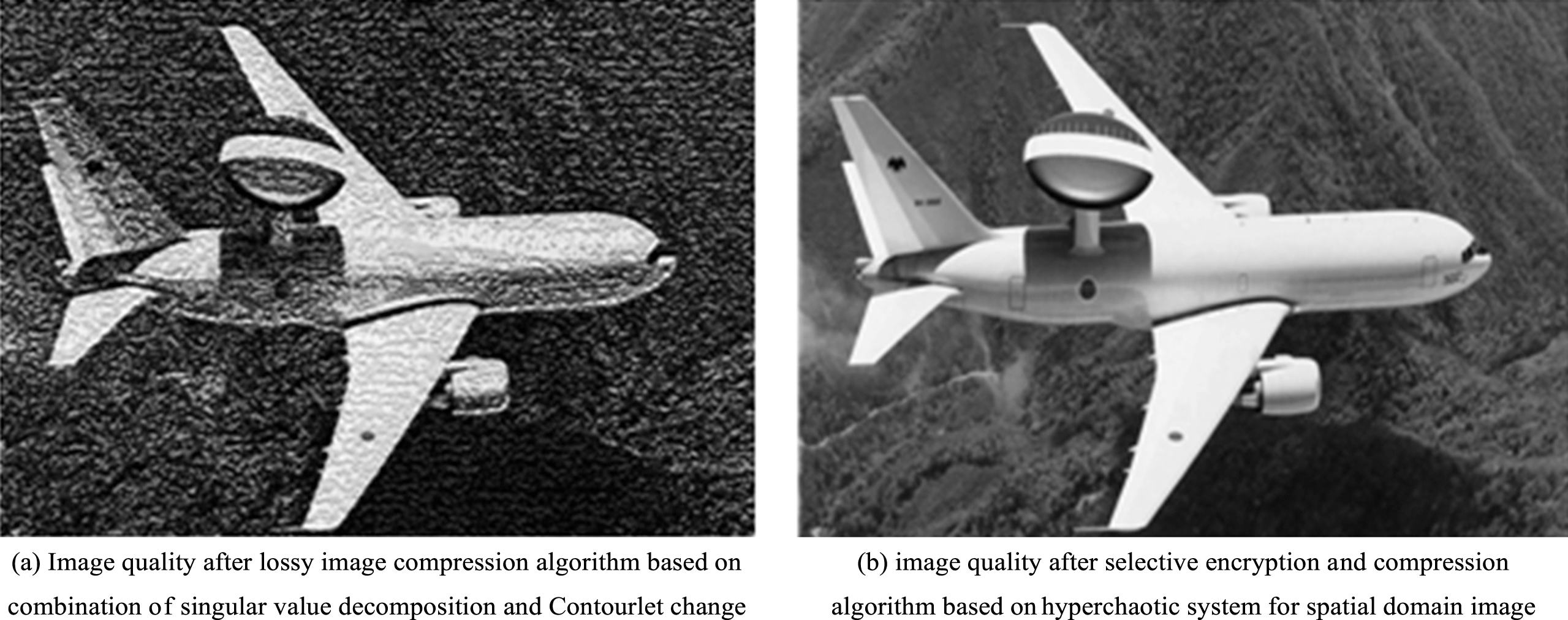
Comparison of image quality after processing by different image compression algorithms.
With the continuous development of computer processing capability and network technology, multimedia has been widely used in various fields of society. Spatial domain image is the current research hotspot, and its encryption and compression are the basic operations for its use. At present, the encryption and compression algorithm for spatial domain image has some problems, such as poor attack resistance, poor image secrecy after encryption, long time consuming of image compression, and no guarantee of image quality after compression, which cannot achieve efficient encryption and compression of image. An encryption and compression algorithm for spatial domain image selection based on hyperchaotic system is proposed. The image compression factor is used to improve the quality of the compressed image. Speed factor is set up to improve the efficiency of the algorithm and reduce the time consuming. The image encryption coefficient can be used to enhance the image secrecy and security on the original encryption basis. The following points are put forward for the future direction ofdevelopment:
The next step can be calculated and analyzed in detail for the decryption; the influence of adaptive encryption algorithm on image compression rate is analyzed; the proposed algorithm is extended to the image’s frequency domain encryption.
Footnotes
Acknowledgments
The Science and Technology Development Program of Henan Province (No. 172102210605).