







Abstract
In order to solve the problem of storing large amounts of data in the wireless sensor network space, the design method of data storage system of wireless sensor network space should be studied. When the current method is used to design a data storage system for wireless sensor network space, there are problems of low storage efficiency and low data storage quality. We propose a design method of data storage system for wireless sensor network space based on fuzzy control. The C/S mode is used to design the client module, transmission module and server module in the data storage system of wireless sensor network space according to the concept of level and modularity. The flow control method based on module control is used to forward or discard data in the network space to complete the design of data storage system of wireless sensor network space. Experimental results show that the proposed method has high data transmission rate and high accuracy of the decision function. It is verified that the proposed method has extraordinary storage efficiency and great data storage quality.
Introduction
With the development of high-tech, the era of information has come, and the amount of data it brings is growing rapidly at the PB level. The storage market enters a period of rapid development [1]. Now, whether it is a mobile terminal, a personal computer or a professional storage device, all have a powerful hardware configuration, data storage capacity has greatly improved. But the local storage has great variability, a hardware failure may result in the loss of all data, causing huge losses to users [2]. More and more companies and research institutions are beginning to realize that there must be a new mechanism to change the status of the storage industry. Current design methods for data storage system of wireless sensor network space have problems of low storage efficiency and poor data storage quality. Therefore, it is necessary to analyze and study the design method of data storage system of wireless sensor network space [3].
Wei Yiqing, Wu Libing, Ren Yongfeng and others proposed a design method for high-speed data storage system. The method uses alternate bi-plane programming and twisted pair and cable extension chip sets to optimize the transmission quality. The data transmission rate of this method is slow, and storage efficiency of the system is low [4]. Chen Tingyu reported a method for designing a data storage system with embedded lossless coding. The single frame video is compressed by the embedded hybrid compression data storage method of Huffman coding and embedded arithmetic encoding. Massive network data storage is completed by directly reducing the system’s real-time storage capacity. But data storage quality of this method is relatively low [5]. Liu Bowei et al. came up with a data storage system design method based on HBase. This method adopts a row key optimization strategy and a table design strategy based on sequential data to solve the problem of data storage dispersion. The storage efficiency of the system designed by this method is low [6]. Ma Lei b a data storage method under the big data environment. Without changing the original data values, the user privacy data structure is changed, an initial key is constructed by establishing an inverse matrix, and a scrambling data dimension is constructed based on the initial key. The scrambling matrix is formed and dispersed irregularly to form the final key of private data to complete the data storage of network space. The data storage quality of this method is poor [7].
In order to solve problems in the above methods, a method of designing a data storage system for wireless sensor network space based on fuzzy control is proposed. The specific steps are as follows:
C/S mode is utilized to design the modules in the data storage system of wireless sensor network space.
The flow control method based on fuzzy control improves the quality of network space data.
The experimental results and analysis verify the overall performance of the data storage system of fuzzy sensor-based wireless sensor network space in both storage efficiency and storage quality.
The overall paper is summarized, and plan for next step is discussed.
Material and methods
The data storage system of wireless sensor network space based on fuzzy control adopts C/S mode, namely client/server mode. The client is a function module provided for the user, and experience of the user for the client directly influences the use of the storage system [8]. The server side mainly provides services for requests of the client. A good response strategy determines response speed of the overall system.
For the sake of system security, data security transmission needs to be studied as a module alone. Therefore, the data storage system of fuzzy sensor-based wireless sensor network space can be divided into three modules:
In order to improve the security of client data, a data protection scheme with two-level encryption mechanism is designed [9]. The first level is virtual disk encryption. Users can enter the virtual disk only after entering their own disk password. The second level is a file filter driver encryption, which is an implementation of file transparent encryption and decryption technology. The second level of encryption is built on the basis of virtual disk encryption, and can further improve data security [10].
The encrypted data of client needs to be transmitted to the server, and the server-side data also needs to be safely delivered to the client. The data storage system of wireless sensor network space based on fuzzy control adopts the idea of message middleware. Multithreading and breakpoints are used in the transmission process to ensure the reliability of the transmission process. SSL encryption protocol is used as the secure transmission protocol and combined with HTTP. The security of user data transmission has been improved through the HTTPS secure transmission mechanism [11].
The server is a cluster that provides storage services and is composed of a metadata server, a data node server, and a backup server [12]. The overall architecture diagram of the data storage system of wireless sensor network space based on fuzzy control is shown in Fig. 1.
Overall architecture diagram of data storage system of wireless sensor network space based on fuzzy control.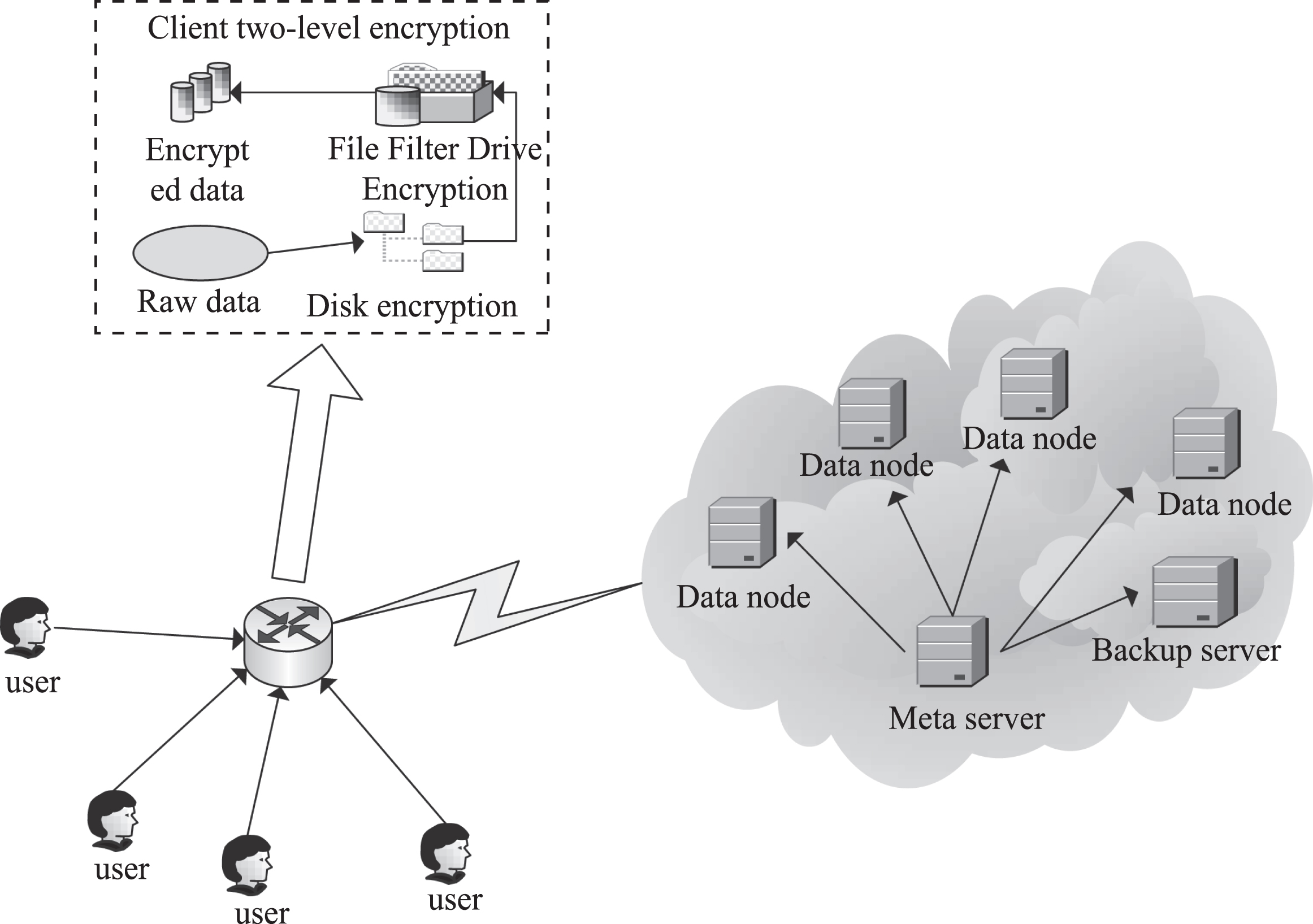
In the data storage system of wireless sensor network space based on fuzzy control, the innovation of client module is to propose a two-level encryption for the client virtual disk. By providing a double protection for user data, the data security and user experience are both improved [13]. The client has four modules: registered login, virtual disk, filter driver of files, real-time monitoring of files, etc. The overall operation flow of the client is designed based on the mutual connection between them, which is shown in Fig. 2.
Figure 2 describes the connection between the four client modules through the client’s overall operation flow. After the user sends a login request, security verification need to be performed. If the user fails to pass the authentication, whether the user exists will be checked. If the user exists, the network connection need to be checked. If the user doesn’t exist, registration is need for the user. If the user pass authentication, they can use the data storage system, load the user image file to construct the virtual disk, enable the first-level encryption of the security client, and can use the virtual disk after the virtual disk key is authenticated. Otherwise, the virtual disk cannot be used. After the client is officially started, the file real-time monitoring module starts, continuously detects IRP packets in the IRP queue, enables second level encrypted file filter driving encryption, and reads the virtual disk when the read request of the IRP is detected. The ciphertext is decrypted. After the decryption, the plain text is displayed to the user through the IRP. When the IRP write request is detected, the plaintext is read from the virtual disk for encryption and the encrypted data is stored in the virtual disk for subsequent calls. When other I/O requests are made, the corresponding I/O processing is performed. Finally, when the user completes the operation and needs to log out of the client, a virtual disk unload request is issued, and the client exits after the virtual disk is completely unloaded.
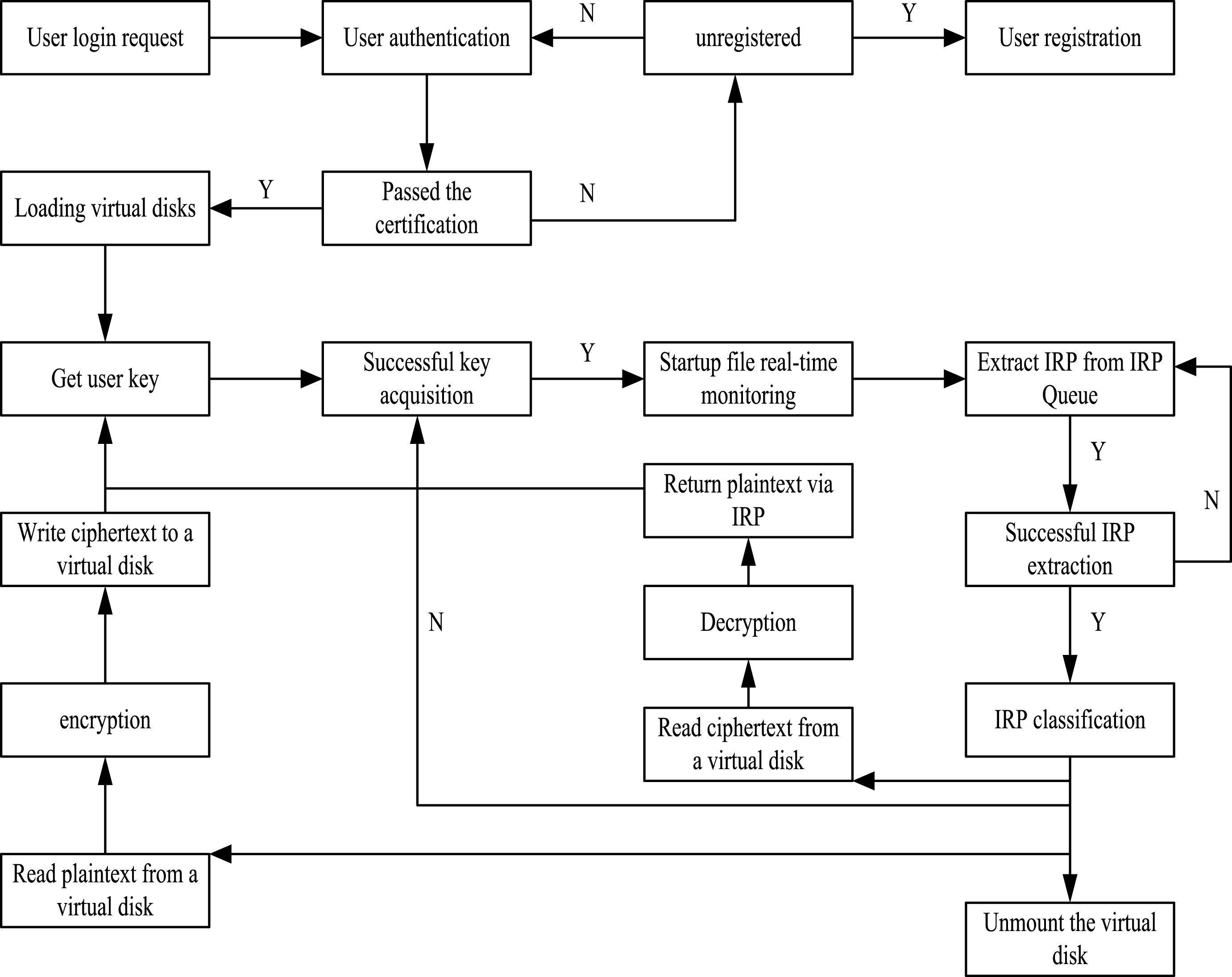
Overall operation flow of client.
The modules in the client are designed:
Registration login module is the portal provided by the entire storage system for users, so its interface should be humanized and beautiful, and able to attract users for the first time [14, 15]. The registration process is shown in Fig. 3.
Registration login process.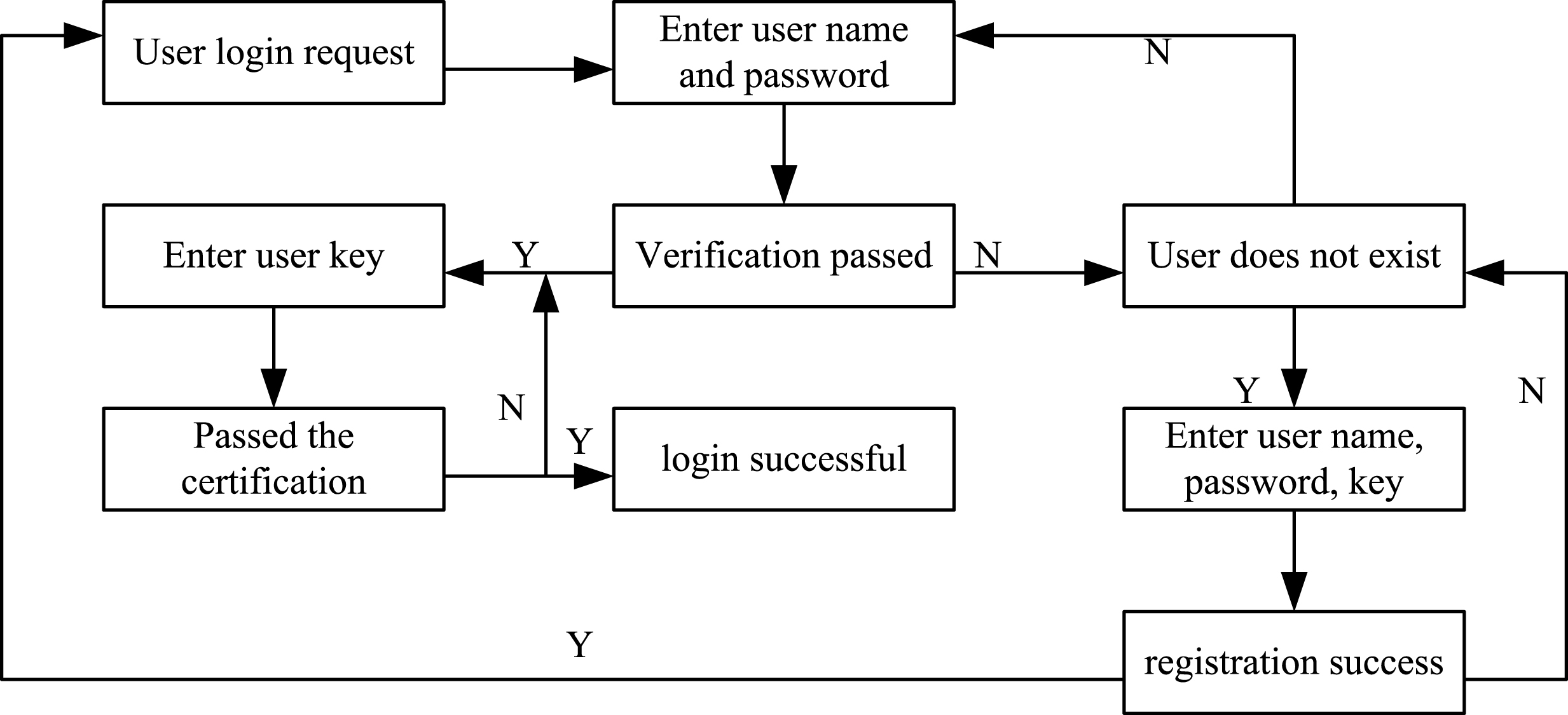
The file filter driver module is the second-level protection of the two-level encryption mechanism. By establishing a transparent encryption and decryption mechanism on the virtual disk, the security of user data on the client is ensured [16–19]. The file system filter driver is a layer of filtering mechanism added on the file system driver. It filters IRP packets bysetting different filtering policies, and processes the IRP packets that meet the filter conditions to complete the processing of interested data packets.
File real-time monitoring design
The file real-time monitoring module is an important part of the client. The files in the virtual disk can be automatically synchronized to the back-end storage cluster because of the existence of the file monitoring module. After the user successfully logs in, the user’s virtual disk is automatically opened. At this time, the file real-time monitoring module is also started. After the monitoring module is started, a monitoring instance is created. This monitoring instance starts the monitor at the same time and monitors the file change of the user’s virtual disk. The monitoring process is as follows:
After the monitor starts, it sends a request for a list of user files to the virtual disk. After the virtual disk service program receives the request from the monitor, it performs corresponding processing and submits a file list of the current user to the File Scheduler for storage. The content is currentList. The user performs various operations after opening the virtual disk, and the virtual disk counts the new user file list. The virtual disk submits the new user file list to the monitor. The monitor receives the new user file list and compares it with the contents of currentList to find the changed content. The monitor submits the changed content to the client for processing. The client sends an operation request such as file creation, update, rename, deletion, and transfer to the server according to different operation conditions. After the monitor processes the changed content, it needs to add the changed content to the currentList to achieve the purpose of updating the user’s current file list. Finally, the updated currentList is submitted to the monitor for storage, and is looped until the user exits.
Transmission module
HTTPS secure transmission design
The transmission module is the core of file synchronization in the storage system. To improve the security of user data transmission, the HTTPS protocol is used to design and implement data security transmission. In the design process of this part, we need to proceed from both the client and server sides to thoroughly analyze the interaction process between them and define their respective responsibilities. The HTTPS secure transmission process is shown in Fig. 4.
From Fig. 4, it can be seen that the secure transmission between the client and the server is based on the SSL handshake mechanism. After the user sends a transfer request, the client sends a handshake signal using SSL. The server of the storage cluster automatically detects and receives signals. According to the received signal, the server certificate is fed back to the client. After the client obtains the certificate, a session key is randomly generated to communicate with the server. The session key is encrypted using the public key provided by the server and transmitted to the server. At the same time, the signature information and the client’s certificate file are transmitted. After the server receives the session key and the signing certificate, the server decrypts the session information with the private key, and verifies the client certificate simultaneously. After the authentication is passed, the client and server communicate using the same key. A data secure transmission path based on HTTPS is established, and the secure transmission of data between the client and the server is completed.
HTTPS secure transmission.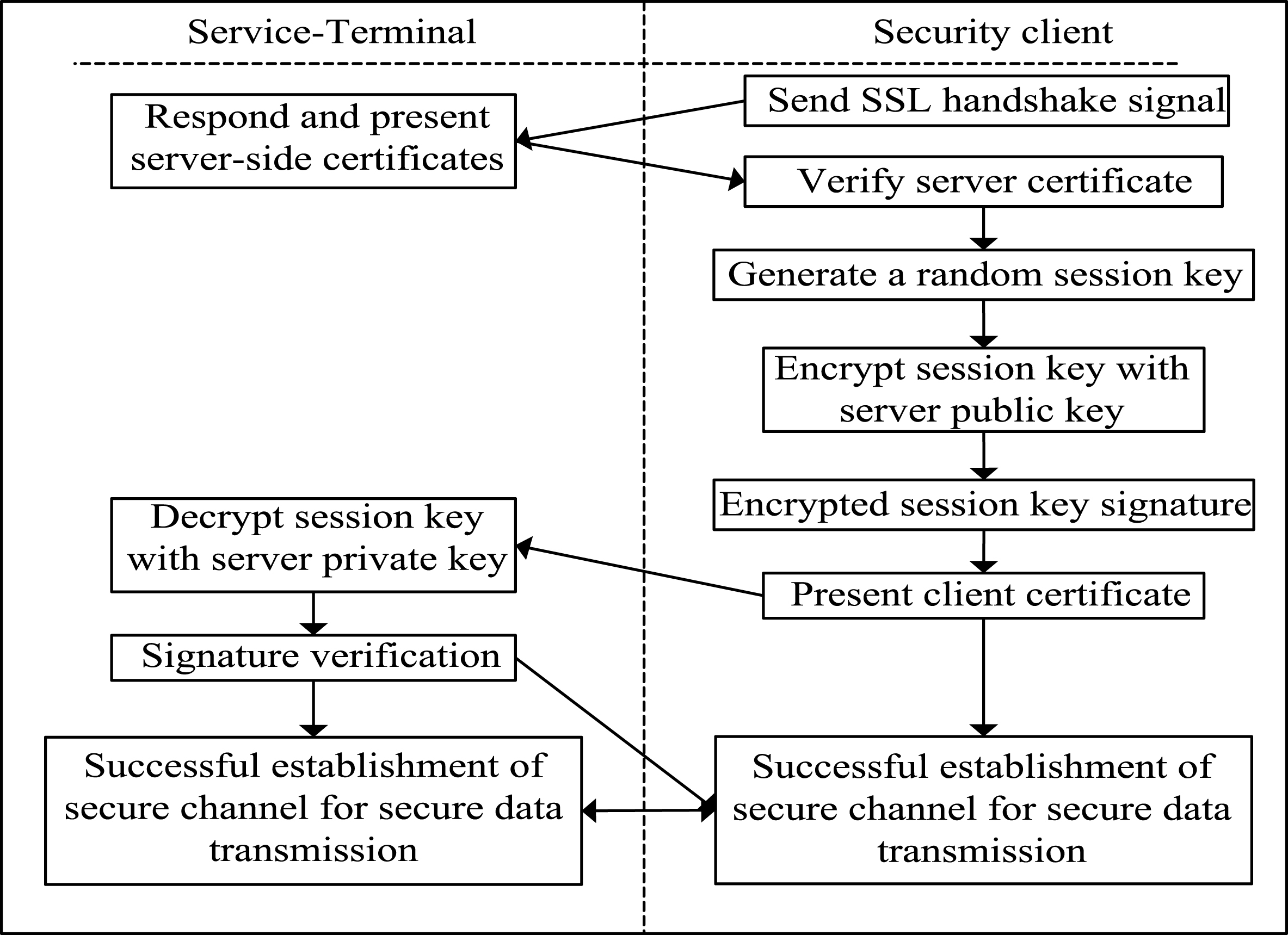
In the synchronization process of the storage system file, in order to improve the reliability of the system, a multi-threaded idea is used to build a file transfer process, which ensures the reliability while improving the user file transfer efficiency and enhancing the user experience.
The client is a terminal provided to the user for file synchronization. When files are synchronized, the multi-thread transmission module needs to be started automatically, the files are divided into blocks according to the number of synchronized threads, and then each thread passes its own file block until the server receives all blocks. The client multithreading process is shown in Fig. 5. The server-side multithreading process is shown in Figure 6.
Client multithreading process. Server multithreading processing.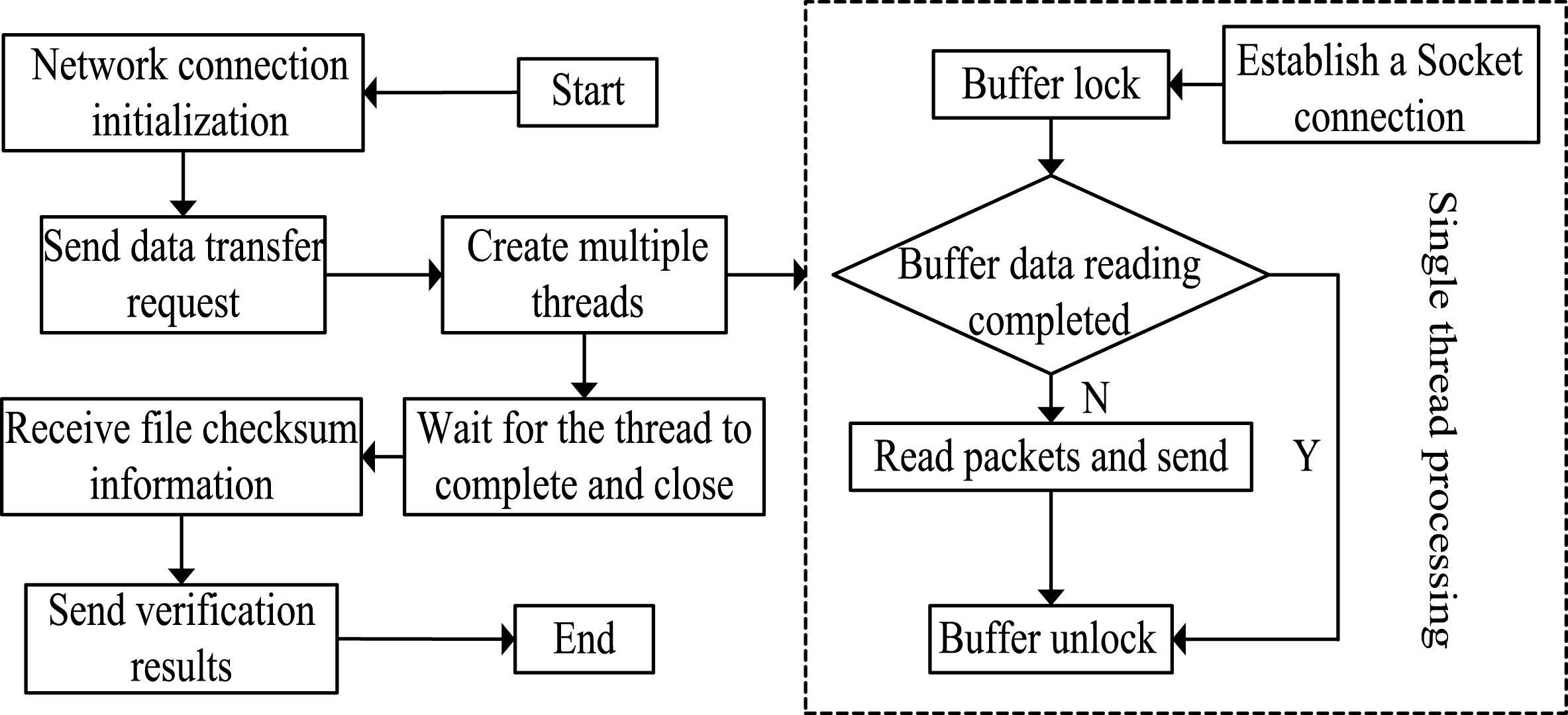
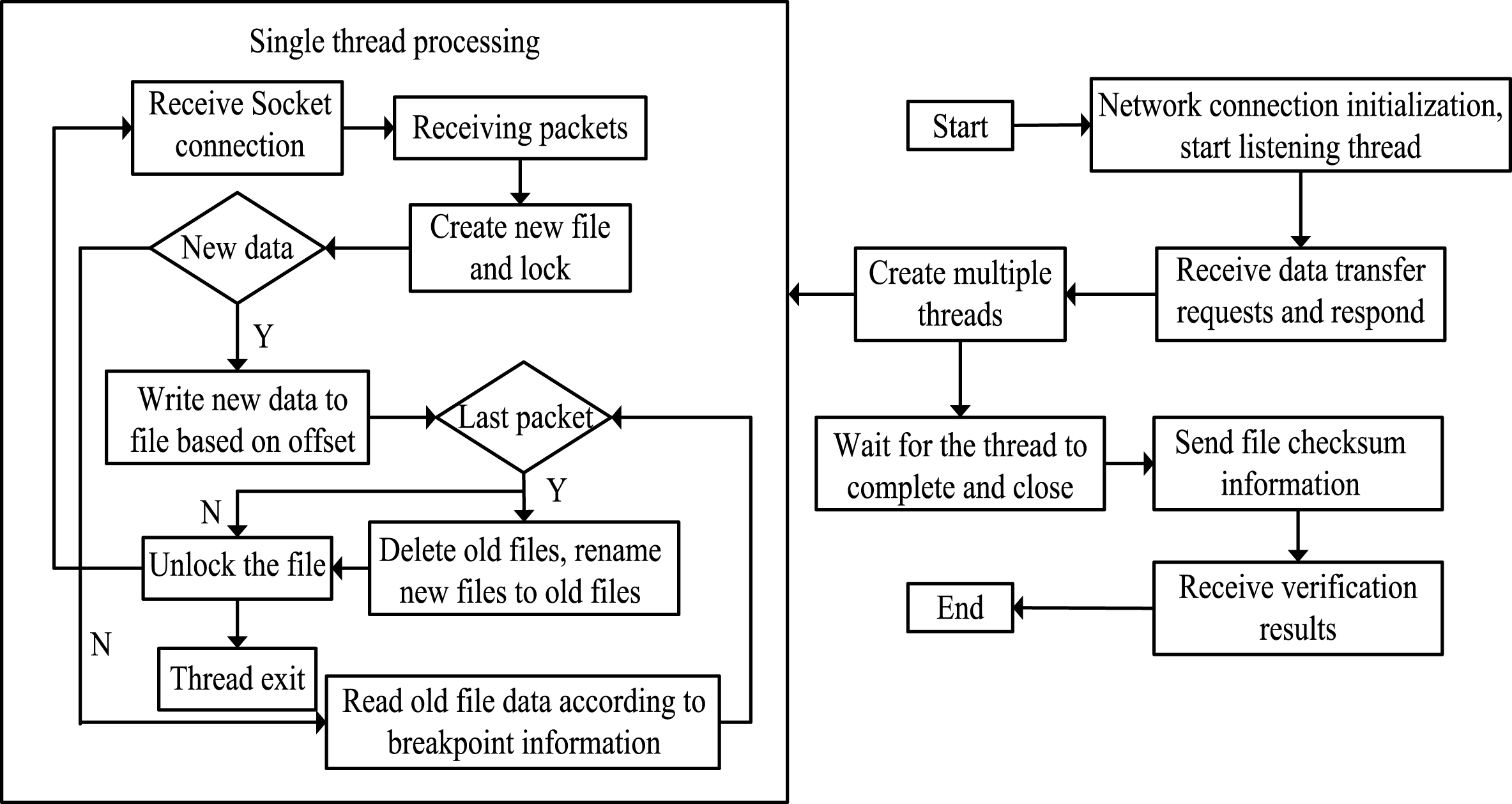
Storage cluster architecture
The storage cluster is a core module of the server, and its architecture directly affects the overall performance of data storage system of wireless sensor network space. Assuming that the provider worth trusting, a storage cluster is built to provide users with data access services. Because metadata nodes have great security risks, it is easy to bring unrecoverable loss to user data storage. In the process of architecture design, the backup of important data on metadata nodes needs to be considered.
Data processing module
In addition to building a storage cluster, the server needs to establish a corresponding data processing module to respond to the client’s request. In the data storage system of fuzzy sensor-based wireless sensor network space, the client file operation requests are mainly processed. Different file operation requests are processed in different ways to meet the storage requirements of user data.
Before designing the data processing flow, a brief analysis is performed on other request processing from the client involved in the data processing module. The data processing module’s operation flow for files is relatively simple, but it involves the processing of various file requests. Therefore, at the design stage, common file operation situations need to be analyzed as detailed as possible to reduce the workload for the system. Combined with the actual situation, the general processing flow for file request operations includes the following sections:
After the server is started, the data processing module starts to listen to requests from the client, mainly file flow and message flow.
If the data processing module listens to the message flow, the message parsing module is invoked to parse the message. If the operation contained in the message is a file creation operation, a new file is created, and after the creation, the file uploading is started until the new file uploading is completed. Finally, the client is notified of the completion message; if it is not a file creation operation, it goes to the next detection process.
If the operation contained in the message is a file update operation, the file is updated, the previous old file is deleted, and finally the completion message is fed back to the client; if it is not a file update operation, the next detection is continued.
If the message contains an operation that is a file rename operation, the corresponding file is renamed and the completion information is fed back to the client after the rename is completed; if it is not a file rename operation, continue the next detection.
If the operation contained in the message is a file deletion operation, the provided file deletion operation is called to delete the corresponding file. After the deletion is completed, the completion information is fed back to the client; if it is not a file deletion operation, the next detection is continued.
If the message contains an operation that is a file transfer operation, the file is copied to the specified location, and the source file is deleted, and finally the completion information is fed back to the client. If it is not a file transfer operation, the operation request to be detected has already been completely detected, and there is no corresponding operation request, and the data processing module ends directly [20–24].
Real-time monitoring module
The real-time monitoring module further improves the usability of the storage system server. Through the monitoring of the storage cluster, file synchronization process, and server performance, the current running status of the entire storage system can be intuitively understood, which is conducive to system maintenance. Since the module is mainly realized through third-party components in the implementation process, the design process mainly describes its module division and the implementation technology it intends to adopt. This module mainly contains threeparts:
The monitoring mainly monitors the entire storage cluster that is established, including the node information and data storage in the established cluster. After the storage architecture is set up, the cluster comes with a monitoring mechanism. Through the form of web pages, the operation status can be monitored intuitively.
The file synchronization monitoring mainly monitors the synchronized users and the files that the user is synchronizing. The file synchronization monitoring is completed on the basis of the multi-thread transmission technology. By establishing a graphical interface on the server, the entire multi-thread transmission process is abstracted to intuitively reflect file synchronization situation of the current system.
The server performance monitoring is mainly to monitor the metadata server. Besides being the management node of the entire storage cluster, the metadata server also has a data processing module deployed on it. Therefore, the overall performance and concurrent threads in the multi-thread transmission process are required to be monitored.
According to the description of the above three parts, the real-time monitoring module can be further divided to facilitate the implementation of the system. The specific module partition diagram is shown in Fig. 7.
Further refinement of the real-time monitoring module.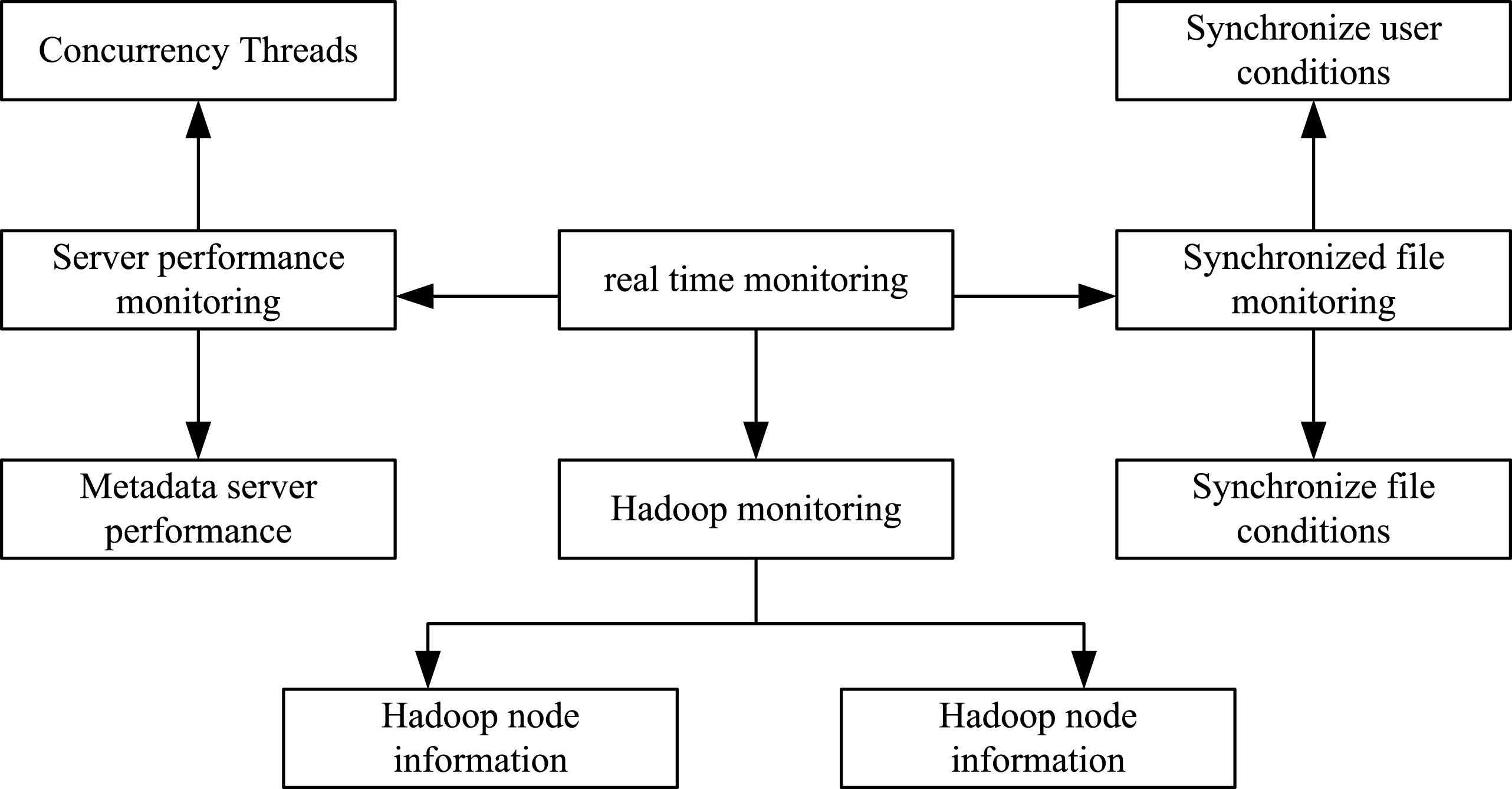
In order to solve the problem of data quality degradation caused by too many dropped frames during the transmission of image and video data in data packets, a fuzzy control based flow control method is proposed to make decisions on forwarding or discarding of P frame through fuzzy comprehensive evaluation, so as to solve the frame loss problem of image and video data and improve the quality of data.
In fuzzy theory, a number in [0, 1] is generally used to indicate the degree to which it belongs to a fuzzy set. The fuzzy set
In Equation (1),
When X and Y are finite sets, the fuzzy relation
Let X = {x1, x2, …, x
m
}, Y = {y1, y2, …, y
m
}, then the fuzzy relationship from X to Y can be written as:
In the equation, r
ij
∈ [0, 1], represents the degree of membership of the relationship
In order to obtain the ideal forwarding decision coefficient, the concept of “fuzzy converter” is introduced, as shown in Fig. 8.
Fuzzy converter.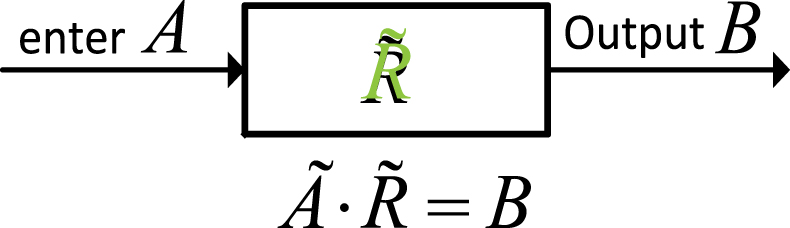
Among them,
Defining a fuzzy composition operation is:
In the equation, B represents the synthesis operation and b
j
is the operation parameter. The operator
The calculation is conducted according to the maximum-minimum rule, that is, use "∧” instead of "*” and "∨” instead of "
Calculation is performed with ordinary matrix multiplication, that is, use “ *” instead of “ *” and “ +” instead of “
The “weighted average” algorithm is often used where there are many sets of factors and it can avoid information loss. The “main factor highlighting” algorithm is often used in situations where there are large differences in data between the statistical fuzzy matrixes. It can prevent “naughty” data from interfering.
In order to achieve fuzzy judgments, a set of factors must be defined. To simplify the process, it is assumed that the forwarding depends on the importance level (s) of the video source and the payment condition cos t (s) of the video source.
The 1st priority in Equation (9) includes applications that require relatively high video quality, such as real-time monitoring. Applications such as video conference, distance learning, and video chat can be set to other lower priorities based on specific circumstances.
In the Equation (10), rent (s) is the rent of the video source s, and Max {rent (s
i
)} is the highest rent in all video sources. Therefore, the factor set is:
The final results include only two: send and discard. Send is set as “1” and discard is set as “0”. The comment set is:
A fuzzy matrix of evaluation is obtained:
Since the rent of the video source is not very different, the vector of weights is:
From Equation (8) we can get the decision vector B = (b1, b2), let P (s) =100b1, then the final decision function is:
In Equation (15), rand () function produces a random number in the range [0,100]. P (s) is the sending weight of the video source s. When P (s) is greater than or equal to the random number, D (s) is 1, that is, the decision result of the frame is ‘send’; when P (s) is less than this random number, D (s) is 0, that is, the decision result of the frame is ‘discard’. In this way, while reducing the channel load, the playback quality of the video source with high priority or high payment is ensured.
In order to verify the overall performance of the data storage system of fuzzy sensor-based wireless sensor network space, a design method for the data storage system of fuzzy sensor-based wireless sensor network space needs to be tested. The experimental environment for this test is Simulink, and the operating system is Windows 7.0. The data transmission speed affects the storage efficiency of the data storage system of wireless sensor network space. When the data transmission speed in the system is faster, the storage efficiency of the system is higher. The design method of the data storage system of wireless sensor network space based on fuzzy control (method 1), design method of high-speed data storage system (method 2), and design method of data storage system with embedded lossless encoding (method 3) are tested respectively, and storage efficiency of different methods are compared, the test results are shown in Fig. 9.
Test results for three different methods.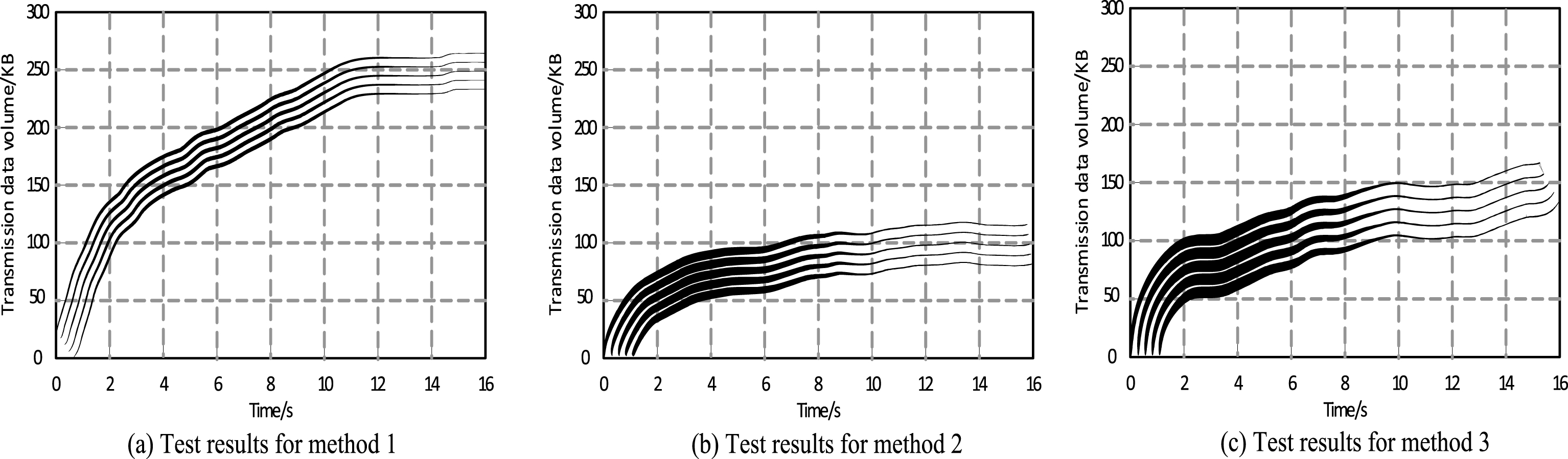
Figure 3(a) shows the test results of design method of the data storage system of wireless sensor network space based on fuzzy control. Figure 3(a) shows that when using the design method of data storage system of wireless sensor network space based on fuzzy control for testing, The amount of data continues to grow over time, and data of network space is transmitted faster in the system. Figure 3(b) shows the test results of the high-speed data storage system design method, and Fig. 3(c) shows the test results of the design method for data storage system with embedded lossless encoding. Figure 3(a) and 3(b) show that in the system designed by these two methods, after the amount of transmitted data reaches a certain amount, it does not increase with the increase of time and remains basically the same, and the transmission rate of data of network space in the system is slow. Comparing the test results of three different methods, we can see that the data transmission rate of data storage system of wireless sensor network space based on fuzzy control is high, and the storage efficiency of the system is higher as well.
D (s) represents the final decision function. When D (s) is 1, the sending decision result is ‘send’; when D (s) is 0, the sending decision result is ‘discard’, which determines the quality of data of network space. The design method of the data storage system of wireless sensor network space based on fuzzy control (method 1), design method of high-speed data storage system (method 2), and design method of data storage system with embedded lossless encoding (method 3) are tested respectively, and the decision results and actual results of different methods are shown in Table 1.
Test results of three different methods
The data in Table 1 show that the result of the decision function obtained by the design method of the data storage system of wireless sensor network space based on fuzzy control is in agreement with actual results, and the accuracy rate is 100%. There are 8 results of the decision function obtained by the high-speed data storage system design method is the same as actual results, and the accuracy rate is 80%. There are 6 results of the decision function obtained by the design method of the data storage system with embedded lossless encoding is the same as actual results, and the accuracy rate is 60%. The higher the accuracy, the better the quality of data storage. By comparing test results of three different methods, it can be seen that the data storage quality of the data storage system of wireless sensor network space based on fuzzy control is higher.
With the continuous development of modern network technology, the data volume has grown rapidly. Therefore, it is necessary to design the network space data storage system. When current methods are used to design the data storage system of wireless sensor network space, there are problems of low storage efficiency and poor data storage quality. A method of designing data storage system of wireless sensor network space based on fuzzy control is proposed. The first step is to design the module of data storage system of wireless sensor network space. The second step is to use the flow control method based on fuzzy control to governor the quality of data of network space, so as to complete the design of data storage system of wireless sensor network space.
In future work, improvements can be made from the following aspects to advance the performance of the system.
The synchronization strategy used to build the storage system is based on the client’s monitoring mechanism. When the client detects the file, it synchronizes. In actual operation, system file transfer performance can be improved by providing more efficient synchronization methods.
Since a two-level encryption mechanism is applied to the client, user data exists in the form of ciphertext in the back-end storage cluster. Therefore, the search problem of ciphertext at the server can be studied emphatically, and the ability of the system to search key data can be improved.
The security and reliability of storage clusters can be further augmented by adopting different security policies and disaster recovery backup mechanisms.