To date, type-2 fuzzy sets have attracted much more interest of the researchers, which are more capable to handle uncertain and imprecision information than type-1 fuzzy sets. Heronian mean is a classical mean aggregation operator which can effectively consider the interrelationships between various arguments. In this paper, we extend Heronian mean to trapezoidal interval type-2 fuzzy environment and present some aggregation operators, such as trapezoidal interval type-2 fuzzy generalized Heronian mean (TIT2FGHM) operator and trapezoidal interval type-2 fuzzy weighted generalized Heronian mean (TIT2FWGHM) operator. Then, we further discuss several desirable properties and particular cases when the parameters take diverse values in detail. Moreover, concerning multiple attribute group decision making problems in which the decision attributes are interdependent and the attribute values take the forms of interval type-2 fuzzy numbers, we propose a new approach based on TIT2FWGHM operator. Finally, we provide a numerical example of providers selection to illustrate the practicality and effectiveness of the proposed method and give a comparison analysis between the proposed method and existing methods.
Type-2 fuzzy sets (T2FSs), which were originally proposed by Zadeh [1, 2], have the capacity to depict higher order uncertainty associated with the natural linguistic expressed by human beings during the course of multiple-attribute group decision-making (MAGDM). To decrease the computational intricacy of general T2FSs, Mendel et al. [3] further presented the notion of interval type-2 fuzzy sets (IT2FSs), which are the special kind of general T2FSs. Until now, T2FSs, especially IT2FSs have attracted much more interest of the researchers and have extensively applied to decision analysis, control science and other fields [4–15, 34–44].T2FSs involve more ambiguities and more computational complexity than type-1 fuzzy sets (T1FSs) [4]. The prominent difference between T2FSs and T1FSs is that the memberships of T1FSs are exact numbers while the memberships of T2FSs are T1FSs [5]. Mendel and John [6] further defined a new representation of T2FSs, which offers an easy way to investigate the vague information of T2FSs. Mendel and Liu [7] developed continuous versions of the Karnik-Mendel algorithm to figure the centroid of an IT2FS, which is more suitable to represent vagueness for applying in fuzzy MAGDM problems [8]. Wu and Mendel [9] transformed IT2FSs into words more efficaciously by using a new vector similarity approach. Wu and Mendel [10] gave a comparative analysis of similarity, uncertainty measures and ranking methods based on IT2FSs. Chen and Lee [11] developed some arithmetical operations between IT2FSs according to the ranking values for MAGDM. To address trapezoidal interval type-2 fuzzy (TIT2F) variable in solid transportation problem, Das et al. [12] developed a defuzzification method. Chen [13] developed a novel method to address MAGDM problems according to the likelihood for TIT2F preference relations. Hu et al. [14] developed interval type-2 hesitant fuzzy (IT2HF) weighted averaging operator and IT2HF order weighted averaging operator based on IT2HF set. Qin and Liu [15] proposed three types of ranking values of IT2FSs on the basis of geometric average, arithmetic average and harmonic average operator and proposed a combined ranking value index to order IT2FSs. Subsequently, Qin et al. [34] presented an IT2F-LINMAP method to solve the problem of supplier selection. Inspired by triangular fuzzy numbers, Yang et al. [35] developed an IT2F-TOPSIS method to handle a MADM problem. Gao et al. [36] developed a grey related group decision making method in the light of IT2FSs. Wang et al. [37] presented a new MADM approach in the light of the conception of three trapezoidal fuzzy number bounded type-2 fuzzy numbers (TT2FNs).Information aggregation operator plays a crucial role in MAGDM, which has received increasing attention [39–44]. Generally speaking, information aggregation operators can be divided into two categories. The first one assumes that the aggregated arguments are independent [16, 17], the second one considers that the aggregated arguments are interrelated [18, 40], in other words, there exists interrelationship between the aggregated arguments. Zhang [16] developed TIT2F weighted averaging operator, TIT2F ordered weighted averaging operator and TIT2F hybrid averaging operator to solve MAGDM problem. Hu et al. [17] proposed the TIT2F weighted averaging operator based on some new operational regulations of trapezoidal interval type-2 fuzzy numbers (TIT2FNs). However, the assumption that the aggregated parameters are independent is unrealistic. In actual decision, the relationship of the decision attributes is usually not independent but interrelated. For example, a company wants to choose the best provider from three potential suppliers, there are four attributes such as the quality of product, the price of product, service performance of supplier and supplier reputation to be evaluated. Obviously, there exists interrelationship among the four attributes. Generally, the higher the quality of product is, the higher the price of product is, and the better service performance of supplier is, the better supplier reputation is. To cope with this issue, Ma et al. [18] presented interval type-2 power averaging operator to resolve TIT2F MAGDM problem. Nehi et al. [19] proposed a hybrid method by combining TOPSIS with Choquet integral to solve MAGDM problems with IT2FNs. Gong et al. [20] proposed several TIT2F aggregation operators derived from geometric Bonferroni mean (BM). Merigĺő [40] developed an immediate probabilistic fuzzy ordered weighted averaging operator to solve fuzzy decision making problems with immediate probabilities.Heronian mean (HM) is a classical mean aggregation operator which can describe the correlations of the aggregated arguments quantitatively [21–23], Liu et al. [24] developed the generalized Heronian OWA operator. Yu et al. [25, 26] extended HM operator to interval-valued intuitionistic fuzzy environment and dual hesitant fuzzy environment. Yu [27] developed some intuitionistic fuzzy geometric HM operators. To resolve the intuitionistic uncertain linguistic MAGDM problem, Liu et al. [28] presented some intuitionistic uncertain linguistic weight arithimetic and weight geometric HM operators. Chu et al. [29] presented some two-dimensional uncertain linguistic (2DUL) weight arithimetic and weight geometric HM operators to cope with 2DUL variables. In the light of intuitionistic fuzzy numbers, Liu et al. [30] constructed several intuitionistic fuzzy HM operators based on the archimedean t-conorm and t-norm. Lately, Liu [44] presented some interval-valued intuitionistic fuzzy power weight HM operators by combining HM operator with power average operator. The power operator or Choquet integral concentrates on the change of the weight vector of the aggregation operators whereas HM and BM operator focus on the aggregated arguments [25]. Compared with BM operator, HM operator not only can premeditate the interrelation between two decision attributes and themselves but also can avoid computing redundancy [25]. Apparently, HM is a very useful tool in decision making, which can deal with the interrelationship between the input arguments by parameter p and q. Until now, there are no relevant studies based on HM operator for aggregating TIT2F information. Therefore, it is urgent to extend the HM operator to TIT2F environment and develop a novel approach to solve MAGDM problems.The concrete structure of the paper is exhibited as follows: Some conceptions regarding T2FSs and HM operator are provided in section 2. In section 3, TIT2F aggregation operator is developed from HM operator. TIT2F weighted generalized HM (TIT2FWGHM) operator is given in section 4. In the light of the TIT2FWGHM operator, a novel approach is developed to illustrate the decision making application in section 5. In section 6, the validity and practicality of the presented approach is illustrated in the form of an example and comparison analysis. The section 7 is about the conclusion.
Preliminaries
In this part, we will review some definitions of T2FSs and HM related to this paper.
Type-2 Fuzzy Set
Definition 1. [6] Let X be the universe of discourse, a T2FS can be expressed by a type-2 membership function as follows:
where Jx indicates an interval in [0,1]. Furthermore, T2FS can also be expressed as
where Jx is the primary membership of x, and ∫u∈Jx denotes the second membership of x.Definition 2. [3] Let be a T2FS represented by a type-2 membership function . When all , then is known as an IT2FS, which is considered as a particular case of a T2FS.
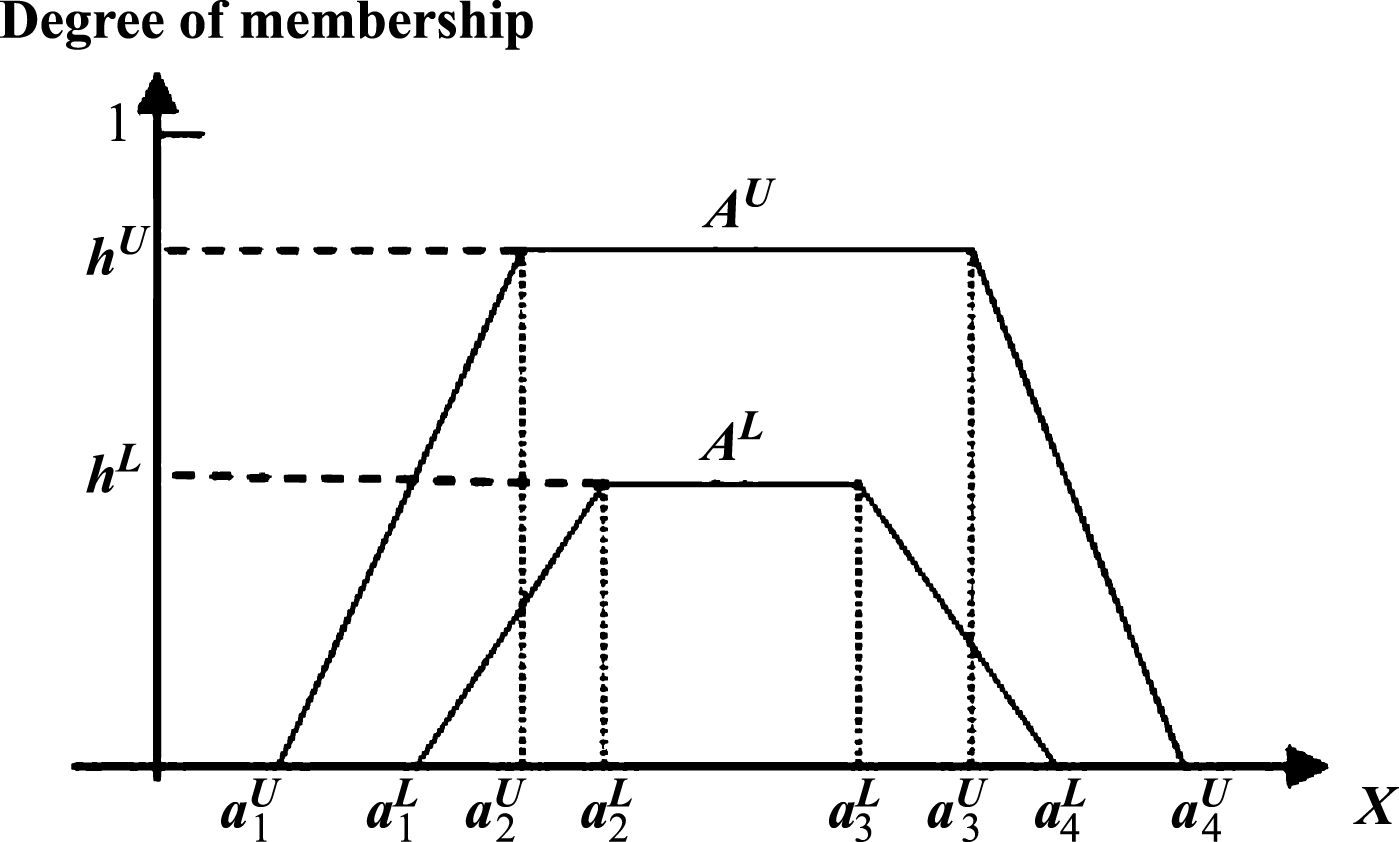
Definition 3. [3] The upper (lower) membership function AU (AL) of IT2FS is type-1 membership function. hU (hL) is the maximum membership function value of AU (AL). Some reference points and values of the membership functions are employed to depict IT2FS , which are displayed in Fig. 1.
Some reference points and values of the membership functions of IT2FS .
Definition 4. [20, 31] For three TIT2FNs , , some arithmetic operation laws are defined as follows:(1) Addition operation
(2) Multiplication operation
(3) Multiplication operation
(4) Power operation
Definition 5. [20] Let be a TIT2FN. Then is an interval-valued probability mean value of TIT2FN , where and are the lower and upper probability mean value of the TIT2FN ,which can be represented as follows:
Definition 6. [20] For two interval-valued probability mean values of , , and . Then, the probability degree formula of TIT2FN is defined as follows:
Definition 7. [20] Let be TIT2FNs, then the fuzzy preference matrix P can be gained,
The ranking value of TIT2FS can be obtained by using the following formula [32]:
where 1 ≤ i ≤ m and . The larger , the greater the TIT2FS .
Heronian mean operator
HM operator, which can interpret the interrelationship of input arguments, is a vital aggregation operator [24]. The definition is described as follows:
Definition 8. [24] Let I = [0, 1] and HM: In → I, and if HM satisfies:
then HM is the abbreviation of Heronian Mean.
Definition 9. [24] Let I = [0, 1] and p, q ≥ 0, GHMp,q: In → I, and if GHMp,q satisfies:
then GHM is the abbreviation of generalized HM operator.
It is simple to testify that GHM operator features monotonicity, idempotency and boundedness [24].
Trapezoidal interval type-2 fuzzy GHM operator
For the purpose of coping with the situation of TIT2F environment, in this section, we shall extend the GHM to TIT2FS and propose some new aggregation operators for aggregating TIT2FNs.
Definition 10. Let be a collection of TIT2FNs and p, q ≥ 0, then a TIT2F generalized Heronian mean (TIT2FGHM) operator is a mapping TIT2FGHM: , where
Theorem 1.Let be a collection of TIT2FNs and be a TIT2FN, then the aggregated result got by the TIT2FGHM operator is also a TIT2FN, which is represented as follows:
where
Proof.
From the operational rules, we have
therefore, we have
which satisfies the proof of Theorem 1.Example 1. Assume 0.9)), , 4, 5 ; 1), (1, 3, 3, 4 ; 0.9)) be three TIT2FNs, we employ the TIT2FGHM operator to aggregate the three TIT2FNs. We take parameter p = q = 1, then
It is simple to testify that the TIT2FGHM operator is idempotent, monotonic, and bounded. However, it does not feature the commutativity.
Property 1.(Idempotency) If all TIT2FNs , thenProperty 2.(Monotonicity) Let and for all i = 1, 2,…, n, thenProperty 3.(Boundedness) Let be a collection of TIT2FNs, and let ,, then
Considering that the parameter p and q can take different values, subsequently, I will discuss several particular cases of TIT2FGHM operator.Case 1 if q → 0, we have
where M = (n + 1 - i).
In this case, the TIT2FGHM operator reduces to the TIT2F generalized linear descending weighted mean operator.Case 2 if p → 0, we have
In this case, the TIT2FGHM operator reduces to a TIT2F generalized linear ascending weighted mean operator.Case 3 if p = 1/2 and q = 1/2, we have
In this case, the TIT2FGHM operator reduces to a basic TIT2FHM operator.Case 4 if p = 1 and q = 1, we have
In this case, the TIT2FGHM operator reduces to a line TIT2FHM operator.
We do not take the importance of the aggregated arguments into account in the discussion of the definition of TIT2FGHM operator. Nevertheless, the weights play a vital part during the course of aggregation in MAGDM. Therefore, we shall discuss the weighted TIT2FGHM operator in thefollowing.
Definition 11. Let be a collection of TIT2FNs and p, q ≥ 0, w = (w1, w2,…, wn) T be the weight vector of , where wi denotes the importance degree of , satisfying wi ≥ 0 and . if
then WTIT2FGHM is known as weighted TIT2F generalized Heronian mean operator.Now let us verify the idempotency of WTIT2FGHM operator. Let all TIT2FNs . According to Definition 11, we have
If wi ≠ wj ≠ 1, then the WTIT2FGHM operator is not idempotent. In actual decision, the importance of the aggregated arguments is generally different and satisfies .
Now let us verify the reducibility of the WTIT2FGHM operator. Let be a collection of TIT2FNs and w = (1/n, 1/n,…, 1/n) T. According to the operational rules of TIT2FNs, we can get
From the analysis above, we can find that the WTIT2F-GHM operator is not idempotent and reducible. Therefore, we present the improveddefinition.
Definition 12. Let be a collection of TIT2FNs and p, q ≥ 0, w = (w1, w2,…, wn) T be the weight vector of , where wi denotes the importance degree of , satisfying wi ≥ 0 and . If
then TIT2FWGHM is known as TIT2F weighted GHM operator.
On the basis of the operational laws of TIT2FNs, Theorem 2 can be derived as follows:
Theorem 2.Let be a collection of TIT2FNs and p, q ≥ 0, w = (w1, w2,…, wn) T be the weight vector of , where wi denotes the importance degree of , which satisfies wi ≥ 0 and . Then the aggregated result got by the TIT2FWGHM operator is also a TIT2FN, and
where
The proof process is similar to Theorem 1.Furthermore, the TIT2FWGHM operator has the following features.
Property 4. (Idempotency) If all TIT2FNs , then
Property 5. (Monotonicity) Let and for all i = 1, 2,…, n, then
Property 6. (Boundedness) Let be a collection of TIT2FNs, and let ,, then
Property 7. (Reducibility) Let be a collection of TIT2FNs, and w = (1/n, 1/n,…, 1/n) T then
Proof.
On the basis of the operational rules of TIT2FNs, we can get
which satisfies the proof of Property 7.
Considering that the parameter p and q can take different values, subsequently, I will discuss several particular cases of the TIT2FWGHM operator.Case 1 if q = 0, we have
Case 2 if p = 0, we have
Case 3 if p = 1 and q = 1, we have
An approach to MAGDM based on TIT2FWGHM operator
Natural language is usually used to evaluate attributes in an actual MAGDM. Natural linguistic variable and their corresponding TIT2FNs for the evaluation of attributes are shown in Table 1 [11]. The corresponding complementary relationship of linguistic variable are displayed in Table 2 [33].
Linguistic variable and the corresponding TIT2FNs
Linguistic variable
TIT2FNs
Absolutely Poor(AP)
((0, 0, 0, 0.1; 1),(0, 0, 0, 0.05; 0.9))
Poor (P)
((0,0.1,0.1,0.3;1),(0.05,0.1,0.1,0.2;0.9))
Little Poor (LP)
((0.1,0.3,0.3,0.5;1),(0.2,0.3,0.3,0.4;0.9))
Fair (F)
((0.3,0.5,0.5,0.7;1),(0.4,0.5,0.5,0.6;0.9))
Little Good (LG)
((0.5,0.7,0.7,0.9;1),(0.6,0.7,0.7,0.8;0.9))
Good (G)
((0.7,0.9,0.9,1;1),(0.8,0.9,0.9,0.95;0.9))
Absolutely Good(AG)
((0.9,1,1,1;1),(0.95,1,1,1;0.9))
The complementary relationship of linguistic variables
AP
P
LP
F
LG
G
AG
AG
G
LG
F
LP
P
AP
Considering a MAGDM problem with TIT2F information, let A = {a1, a2,…, am} (m ≥ 2) be a limited set of feasible alternatives, C = {c1, c2,…, cn} (n ≥ 2) be a limited set of attributes, and w = (w1, w2,…, wn) T be a weight vector of attributes cj (j = 1, 2,…, n), satisfying wj ≥ 0 and . D = {d1, d2,…, dt} (t ≥ 2) be a finite set of decision makers (DMs), and λ = (λ1, λ2,…, λt) T be a weight vector of DMs dk (k = 1, 2,…, t), satisfying λk ≥ 0 and .In the light of Tables 1 and 2, DMs can construct their own linguistic decision matrices and normalize decision matrices R(k) into matrices by the following formula:
where is the complement of .On the basis of the corresponding relation of linguistic variable and TIT2FNs shown in Table 1, we can get the corresponding TIT2F decision matrices provided by the kth DM:
where is a TIT2FN provided by DM dk for the alternative ai over the attribute cj.Subsequently, we shall introduce a new approach based on TIT2FWGHM operator to solve MAGDM problems under IT2FS environment, which includes the following steps:
Step 1. Construct and normalize linguistic decision matrices for DMs dk and transform the normalized linguistic decision matrices into TIT2F decision matrices .
Step 2. Aggregate individual TIT2F decision matrices into a collective decision matrix by using Eq.(29).
Step 3. Aggregate the TIT2F evaluating values into the overall evaluating value by using Eq.(30).
Step 4. The fuzzy preference matrix P can be obtained by using Eq.(10).Step 5. Calculate according to Eq.(12) and rank the alternative.Step 6. End.
Illustrative example
The method of utilizing TIT2FWGHM operator
In this part, an illustrative example adapted from Wang and Liu [33] is utilized to clarify the application of the presented TIT2FWGHM operator. Assume that a company intends to choose the best provider for the most critical parts. Three potential providers a1, a2 and a3 will be evaluated on four attributes (c1: product quality, c2: risk factor, c3: service performance of provider and c4: provider’s profile). Assume that three DMs take part in the process of choosing the most desirable provider. Assume that the attribute weights are w1=0.3, w2=0.15, w3=0.2 and w4=0.35. The DMs’ weights are λ1=0.3, λ2=0.45, λ3=0.25. Then, we employ the proposed approach in this paper to choose the most desirable provider. The proposed approach includes the following steps:
Step 1. First, three DMs employ the natural linguistic variable displayed in Table 1 to evaluate the potential provider ai over each attribute cj respectively, which are displayed in Table 3. Second, in the light of Table 2 and Eq.(28), the original linguistic decision matrices R(k) can be transformed into the normalized decision matrices respectively, which are shown in Table 4. Then transform into TIT2F decision matrices , Due to the space limit, we omit it.
Evaluating values of alternatives over each attribute from DMs
DMs
Providers
c1
c2
c3
c4
d1
a1
LG
G
AG
AG
a2
G
LG
G
G
a3
AG
AG
F
G
d2
a1
G
AG
G
G
a2
LG
G
AG
AG
a3
G
AG
LG
AG
d3
a1
LG
G
G
G
a2
G
AG
AG
G
a3
LG
G
LG
AG
The normalized evaluating values
DMs
Providers
c1
c2
c3
c4
d1
a1
LG
P
AG
AG
a2
G
LP
G
G
a3
AG
AP
F
G
d2
a1
G
AP
G
G
a2
LG
P
AG
AG
a3
G
AP
LG
AG
d3
a1
LG
P
G
G
a2
G
AP
AG
G
a3
LG
P
LG
AG
Step 2. Aggregate individual TIT2F decision matrices into a collective TIT2F decision matrix by using Eq.(30). The results are exhibited in Table 5.
Step 3. The overall evaluating values of providers ai (i = 1, 2, 3) can be obtained by using Eq.(31) (here we take parameters p = q = 1).
Step 4. Based on Eqs.(8) and (9), 0.6783], , 0.6691]. Subsequently, we can get the fuzzy probability degree preference matrix P by using Eq.(10).
Step 5. According to Eq.(12), = 0.3160, , .Step 6. Rank the values of , we can obtain , which indicates that a2 ≻ a1 ≻ a3. That is, a2 is the best desirable provider.The presented method provides a useful way for us to cope with MAGDM problems under TIT2FS environment.
Discussion about the impact of parameters
To explain the impact of parameters p and q, we use diverse values of parameters p and q to arrange the providers. The results are exhibited in Table 6 and 7. We can find out that the ranking results change with the change of the parameters and the best desirable provider changes from a2 to a3 with the increase of parameters p and q, which indicates that parameters p and q play a crucial part in TIT2FWGHM operator.
Ranking results of providers to diverse parameter q (p = 1)
p, q
Ranking order
p = 1, q = 1
a2 ≻ a1 ≻ a3
p = 1, q ∈ [0, 2)
a2 ≻ a1 ≻ a3
p = 1, q ∈ [2, 3.6)
a2 ≻ a3 ≻ a1
p = 1, q ∈ [3.6, 672.5)
a3 ≻ a2 ≻ a1
If parameter p = 1, from Table 6, we can find out,(1) When p = 1, q ∈ [0, 2), the ranking order of three providers is a2 ≻ a1 ≻ a3;(2) When p = 1, q ∈ [2, 3.6), the ranking order changes from a2 ≻ a1 ≻ a3 to a2 ≻ a3 ≻ a1. The optimal provider does not change, but the worst provider changes from a3 to a1;(3) When p = 1, q ∈ [3.6, 672.5), the ranking order changes from a2 ≻ a3 ≻ a1 to a3 ≻ a2 ≻ a1 and the optimal provider changes from a2 to a3.From Table 7, we can detect that,
Ranking results of providers to diverse parameters p and q
Method
Ranking order
p = 0, q = 1
a2 ≻ a1 ≻ a3
p = 1, q = 0
a2 ≻ a1 ≻ a3
p = q ∈ (0, 1.4]
a2 ≻ a1 ≻ a3
p = q ∈ (1.4, 2.1]
a2 ≻ a3 ≻ a1
p = q ∈ (2.1, 336]
a3 ≻ a2 ≻ a1
(1) When p = 0, q = 1(or p = 1, q = 0), the ranking order is a2 ≻ a1 ≻ a3, which does not take the interrelationships between attributes into consideration;(2) When p = q ∈ (0, 1.4], the ranking order of three providers is a2 ≻ a1 ≻ a3;(3) When p = q ∈ (1.4, 2.1], the ranking order changes from a2 ≻ a1 ≻ a3 to a2 ≻ a3 ≻ a1 and the optimal provider does not change;(4) When p = q ∈ (2.1, 336], the ranking order changes from a2 ≻ a3 ≻ a1 to a3 ≻ a2 ≻ a1. The optimal provider changes from a2 to a3, but the worst provider does not change.It is apparently that the intensity of the interaction of attributes greatly affects the ranking order. When the correlation intensity between attributes is becoming greater and greater, the ranking order tends to be consistent.Generally, the larger the values of parameters p and q are, the larger the correlation intensity between decision attributes is. A DM can properly choose the desirable alternative according to his interest and actual attitude. In practice, optimist can select the smaller values of parameters p and q while pessimist can select the larger values of parameters p and q. In order to consider the correlations of the input arguments and make the computation simple, we can take some simple values, such as p = q = 1 or p = q = 0.5, or use p = 0 or q = 0 for the linear weighting.
Comparison with other existing methods
So as to confirm the effectiveness of our method, we shall utilize the example discussed above to compare the proposed method with other existing methods. We first contrast the presented method with method [11] and method [17], which are based on the assumption that the aggregated arguments are independent. Owing to the space limitation, we provide the results directly. The results are exhibited inTable 8.
In the light of Table 8, we can discover that the ranking order of other existing methods is consistent with our developed method. This fact confirms that the method we presented is reasonable and effective for MAGDM under TIT2F environment.By Comparing with method [11] and method [17], the most obvious advantage of the presented method is that the TIT2FWGHM operator takes the interrelationships between various attributes into consideration and can deal with the interactions between the attributes. Our method can use different parameter values based on DMs’ attitude and decision scenery. From Tables 7 and 8, we can discover that we change the values of parameters p and q from p = q ∈ (0, 1.4] to p = q ∈ (1.4, 2.1], the ranking order changes from a2 ≻ a1 ≻ a3 to a2 ≻ a3 ≻ a1 and if p = q ∈ (2.1, 336] the ranking order becomes a3 ≻ a2 ≻ a1. However, method [11] and method [17] cannot adapt to the changing decision scenery. Evidently, it can be predicted that the correlation intensity between various attributes plays an important role. So, our method is more universal and flexible than method [11] and method [17] and has wider range of applications.Method [11] and method [17] assumed that decision attributes are independent which does not satisfy the actual situation. In the following part, we shall compare our method with the TIT2FWGBM operators [20], which consider the interrelation between the input arguments in group decision making. We use some diverse values of parameters p and q in method [20] to rank the providers. The ranking results are exhibited in Table 9. We can discover from Table 9,
Ranking results of providers to diverse parameters in method [20]
p, q
a1
a2
a3
Ranking order
p = 0, q > 0
0.3125
0.5
0.1875
a2 ≻ a1 ≻ a3
p > 0, q = 0
0.3125
0.5
0.1875
a2 ≻ a1 ≻ a3
p = q > 0
0.3119
0.4965
0.1916
a2 ≻ a1 ≻ a3
p > 0, q > 0
-
-
-
a2 ≻ a1 ≻ a3
(1) When p (q) =0, the ranking values and ranking order remain unchanged, no matter how much q (p) is;(2) When p = q > 0, the ranking values and ranking order remain unchanged, no matter how much p is;(3) When p > 0, q > 0, the ranking values change a little but the ranking order do not change;(4) The ranking order of the providers remains unchanged whatever the parameters change.From the analysis above, we can discover that the ranking order in our method can change with the change of the parameters. However, the ranking order in method [20] remains unchanged whatever the parameters change. The possible reason of the result above is that the TIT2FWGBM operator [20] averages the different impact of parameters p and q by computing twice on every attribute, however, the TIT2FWGHM operator sufficiently reflects the different impact of parameters p and q by orderly computing once on every attribute. In addition, the TIT2FWGBM operator has not the property of reducibility although it can handle the interactions between the attributes. Methods [28, 30] proposed some HM operator, but they cannot handle the TIT2F information.In conclusion, we can discover that the presented method is better than the existing three methods.
Conclusions
In this paper,we extend HM operator to TIT2F environment. First, we present TIT2FGHM operator and TIT2FWGHM operator, and further discuss several desirable properties and particular cases. Second, concerning MAGDM problems in which the attribute values take the forms of TIT2FNs and the decision attributes are interdependent, a new approach is proposed to demonstrate the application of MAGDM under TIT2F environment. Finally, an example of providers selection is employed to demonstrate the feasibility of the presented method. The results demonstrate that the developed method provides an effective way for us to handle MAGDM problems under TIT2FS environment. The outstanding characteristics of the proposed method are that they not only can effectively depict the interrelationships between the decision arguments and attributes, but also can flexibly handle MAGDM problems in which the decision attributes are interdependent under TIT2F environment. In the future, we shall extend the HM operator to other environment such as hesitant fuzzy rough set, neutrosophic set and extend the proposed method to other fields, such as performance evaluation, supply chain management etc.
Footnotes
Acknowledgment
This work was supported by the Social Sciences Planning Project of Shandong Province (13BJJJ01), the Natural Science Foundation of China (Nos. 91224007 and 71401012) and the Special Funds of Taishan Scholars Project of Shandong Province (No. ts201511045).
References
1.
ZadehL.A., The concept of a linguistic variable and its application to approximate reasoning-I, Information Sciences8 (1975), 199–249.
2.
ZadehL.A., The concept of a linguistic variable and its application to approximate reasoning-II, Information Sciences9 (1975), 43–80.
3.
MendelJ.M., JohnR.I. and LiuF.L., Interval type-2 fuzzy logical systems made simple, IEEE Transactions on Fuzzy Systems14(6) (2006), 808–821.
4.
MizumotoM. and TanakaK., Some properties of fuzzy sets of type-2, Information Control31 (1976), 312–340.
5.
WuD.R. and MendelJ.M., Aggregation using the linguistic weighted average and interval type-2 fuzzy sets, IEEE Transactions on Fuzzy Systems15 (2007), 1145–1116.
6.
MendelJ.M. and JohnR.I., Type-2 fuzzy sets made simple, IEEE Transactions on Fuzzy Systems10(2) (2002), 117–127.
7.
MendelJ.M. and LiuF.L., Super-exponential convergence of the KarnikĺCMendel algorithms for computing the centroid of an interval type-2 fuzzy set, IEEE Transactions on Fuzzy Systems15(2) (2007), 309–320.
8.
ChenS.M. and LeeL.W., Fuzzy multiple attributes group decision-making based on the interval type-2 TOPSIS method, Expert Systems with Applications37 (2010), 2790–2798.
9.
WuD.R. and MendelJ.M., A vector similarity measure for linguistic approximation: Interval type-2 and type-1 fuzzy sets, Information Sciences179 (2008), 381–402.
10.
WuD.R. and MendelJ.M., A comparative study of ranking methods, similarity measures and uncertainty measures for interval type-2 fuzzy sets, Information Sciences179 (2009), 1169–1192.
11.
ChenS.M. and LeeL.W., Fuzzy multiple attributes group decision making based on the ranking values and the arithmetic operations of interval type-2 fuzzy sets, Expert Systems with Applications37 (2010), 824–833.
12.
DasA., BeraU.K. and MaitiM., Defuzzification of trapezoidal type-2 fuzzy variables and its application to solid transportation problem, Journal of Intelligent & Fuzzy Systems30 (2016), 2431–2445.
13.
ChenT.Y., Likelihoods of interval type-2 trapezoidal fuzzy preference relations and their application to multiple criteria decision analysis, Information Sciences295 (2015), 303–322.
14.
HuJ.H., XiaoK.L., ChenX.H. and LiuY.M., Interval type-2 hesitant fuzzy set and its application in multicriteria decision making, Computers & Industrial Engineering87 (2015), 91–103.
15.
QinJ.D. and LiuX.W., Multi-attribute group decision making using combined ranking value under interval type-2 fuzzy environment, Information Sciences297 (2015), 293–315.
16.
ZhangZ.M., Trapezoidal interval type-2 fuzzy aggregation operators and their application to multiple attribute group decision making, Neural Comput & Applic (2016). DOI: 10.1007/s00521-016-2488-0.
17.
HuJ.H., ZhangY., ChenX.H. and LiuY.M., Multicriteria decision making method based on possibility degree of interval type-2 fuzzy number, Knowledge-Based Systems43 (2013), 21–29.
18.
MaX.Y., WuP., ZhouL.G., ChenH.Y., ZhengT. and GeJ.Q., Approaches based on interval type-2 fuzzy aggregation operators for multiple attribute group decision making, International Journal of Fuzzy Systems18(4) (2016), 697–715.
19.
NehiH.M. and KeikhaA., TOPSIS and Choquet integral hybrid technique for solving MAGDM problems with interval type-2 fuzzy numbers, Journal of Intelligent & Fuzzy Systems30(3) (2016), 1301–1310.
20.
GongY.B., HuN., ZhangJ.G., LiuG.F. and DengJ.G., Multiattribute group decision making method based on geometric Bonferroni mean operator of trapezoidal interval type-2 fuzzy numbers, Computers & Industrial Engineering81 (2015), 167–176.
21.
BeliakovG., PraderaA., CalvoT.Aggregation Functions: A Guide for Practitioners, Springer. Berlin. New York, 2007.
22.
SykoraS., Mathematical Means and Averages: Generalized Heronian Means Sykora S. Stanąŕs, Library2009.
23.
SykoraS.Generalized Heronian Means II, Sykora S. Stanąŕs, Library2009.
24.
LiuH.Z. and PeiD.W., HOWA operator and its application to multi-attribute decision making, J Zhejiang Sci-Tech Univ25 (2012), 138–142.
25.
YuD.J. and WuY.Y., Interval-valued intuitionistic fuzzy Heronian mean operators and their application in multi-criteria decision making, Afr J Bus Manag6 (2012), 4158–4168.
26.
YuD.J., LiD.F. and MerigoJ.M., Dual hesitant fuzzy group decision making method and its application to supplier selection, Int J Mach Learn & Cyber7 (2016), 819–831.
LiuP.D., LiuZ.M. and ZhangX., Some intuitionistic uncertain linguistic Heronian mean operators and their application to group decision making, Applied Mathematics and Computation230 (2014), 570–586.
29.
ChuY.C. and LiuP.D., Some two-dimensional uncertain linguistic Heronian mean operators and their application in multiple-attribute decision making, Neural Comput & Applic26 (2015), 1461–1480.
30.
LiuP.D. and ChenS.M., Group decision making based on Heronian aggregation operators of intuitionistic fuzzy numbers, IEEE Transactions on Cybernetics (2016). DOI: 10.1109/TCYB.2016.2634599.
31.
LeeL.W. and ChenS.M., A new method for fuzzy multiple attributes group decision-making based on the arithmetic operations of interval type-2 fuzzy sets. In Proceedings of 2008 International Conference on Machine Learning and Cybernetics USA, 2008, pp. 3084–3089.
32.
XuZ.S., A ranking arithmetic for fuzzy mutual complementary judgment matrices, Journal of Systems Engineering16 (2001), 311–314.
33.
WangW.Z. and LiuX.W., Multi-attribute group decision making models under interval type-2 fuzzy environment, Knowledge-Based Systems30 (2012), 121–128.
34.
QinJ.D., LiuX.W. and PedryczW., A multiple attribute interval type-2 fuzzy group decision making and its application to supplier selection with extended LINMAP method, Soft Comput21 (2017), 3207–3226.
35.
YangC.X., ChenW. and PengD.H., An approach based on TOPSIS for interval type-2 fuzzy multiple attributes decision making, International Journal of Control and Automation8 (2015), 81–92.
36.
GaoZ.F., ShengG.S. and PengD.H., Method of multiple attributes group grey related decision making based on interval type-2 fuzzy sets, Mathematics in Practice and Theory46 (2016), 219–227.
37.
WangJ., ChenQ.H., ZhangH.Y., ChenX.H. and WangJ.Q., Multi-criteria decision-making method based on type-2 fuzzy sets, Filomat31 (2017), 431–450.
38.
PengB., YeC.M. and ZengS.Z., Uncertain pure linguistic hybrid harmonic averaging operator and generalized interval aggregation operator based approach to group decision making, Knowledge-Based Systems36 (2012), 175–181.
39.
PengB., ZhouJ.M. and PengD.H., Cloud model based approach to group decision making with uncertain pure linguistic information, Journal of Intelligent & Fuzzy Systems32(3) (2017), 1959–1968.
40.
MerigĺőJ.M., Fuzzy decision making with immediate probabilities, Computers & Industrial Engineering58(4) (2010), 651–657.
41.
MerigĺőJ.M., Gil-LafuenteA.M. and YagerR.R., An overview of fuzzy research with bibliometric indicators, Applied Soft Computing27 (2015), 420–433.
42.
Blanco-MesaF., MerigĺőJ.M. and Gil-LafuenteA.M., Fuzzy decision making: A bibliometric-based review, Journal of Intelligent & Fuzzy Systems32 (2017), 2033–2050.
43.
MardaniA., NilashiM., ZavadskasE.K., AwangS.R., ZareH. and JamalN.M., Decision making methods based on fuzzy aggregation operators: Three decades review from to, International Journal of Information Technology & Decision Making (2018). DOI: 10.1142/S021962201830001X.
44.
LiuP.D., Multiple attribute group decision making method based on interval-valued intuitionistic fuzzy power Heronian aggregation operators, Computers & Industrial Engineering108 (2017), 199–212.