







Abstract
The Industrial Revolution, which started with steam machines, has evolved into intelligent systems in which objects speak to each other in the name of Industry 4.0. Smart containers (SC), which are the latest in this evolution of containers and one of the key elements of logistic in Supply Chain Management System (SCMS), stand out with their flexibility, traceability, and contribution to the optimization of the supply chain. In this paper the existing properties of the currently evolving smart containers are compiled and the users’ needs that will guide future designs are determined. In the application section, three different smart containers are evaluated according to seven different conflicting criteria in neutrosophic environment. By using neutrosophic TOPSIS method relative closeness coefficient of alternatives are calculated. Finally alternatives are ranked in descending order. The originality of the paper is that smart containers evaluation problem is handled by the neutrosophic MCDM method for the first time in the literature.
Introduction
The First Industrial Revolution (Industry 1.0) which began with the use of steam power in the 18th century, followed by the Second Industrial Revolution (Industry 2.0) with the use of electricity for mass production in the late nineteenth century. The Third Industrial Revolution (Industry 3.0) continued progress by using digitalization in the twentieth century. Industry 4.0 first began to take shape in Germany in 2011 with the acceleration of automation and information technologies. Nowadays, Industry 4.0 applications are seen especially in the use of dynamic data processing systems. Industry 4.0 enables technologies such as cyber-physical systems, IoT (Internet of Things), big data and analytics, autonomous robots, simulation, horizontal and vertical system integration, cybersecurity, addictive manufacturing, augmented reality and cloud computing are seen in Industry 4.0 processes and applications [1]. There is no formal definition of Industry 4.0 yet, but it can be defined as ‘integration of complex devices and physical machines with networked software and sensors used to better plan, control and predict for social and commercial outcomes’ [2].
With the parallel of Industry 4.0, smart systems (SS) aim to optimize the use of interactively all components and information for the benefit of the system [3]. Systems created by the combination of emerging in the development process of 4.0 could be expressed as smart systems. Because SS can use much software to retrieve data from different hardware, store this data in the appropriate format for subsequent use, update it when necessary, process this data according to the possibilities and execute multi-stage business processes [4].
Different applications of SS create remarkable results. SS’s paramount ability to predict the future is the ability to communicate with users, applications and other SS simultaneously. SS provides structure, mechanism and potential to eliminate human error in control, navigation, and guidance in sectors such as aviation and maritime. In production systems, SS provides information-based applications in the optimization of production variables based on final product performance.
SS creates a wealth of self-diagnosis, treatment, drug applications and monitoring in the health system. It is possible to optimize the use, security, conservation, and efficiency of energy, both autonomously and over the network with SS [5]. Especially production processes and supply chain steps are priority areas that form a very useful basis for intelligent SS. All mobility and transport processes increasingly require efficiency and environmental performance criteria. SS provide vehicle control, navigation, and logistics optimization with reduced operator errors within this scope [5]. In the supply chain and logistics processes sharing the instant status information between actors is very vital for optimizing the whole system. From this perspective, the use of SS in supply chains and logistics operations is a very effective and appropriate decision [6].
Affordable technologies and devices that capture real-time data in logistics applications and notify the environmental changes instantly are becoming available today. These solutions create the “smart logistics” (SL) paradigm by making the process smarter. In SL, infrastructure (sensing, localization, connectivity, and technology-driven), processing (data filtering, data analytics, action generation, adaptability and resilience, automation and transparency) and services (smart products, customization and sharing) are the main characteristics of the SL [7].
“Meeting customer expectations” and “cost minimization” are the two most important objectives of today’s businesses and also include logistics activities. The logistics process is an integral part of the supply chain. In this process, all kinds of information about the product are needed to reach any point of the process at any time, to solve the problems, to improve the process and to provide optimization. Simultaneous resolution of problems is important, thus preventing costs, reducing unexpected situations and ensuring customer satisfaction. This concurrency can be achieved by the capabilities of information technologies [8].
One of the important elements used in supply chain logistics is the container. Containers are contractual box-shaped structures that can be used with all kinds of transportation in a safe and undamaged manner, without losing the proper route, in a form that is in accordance with international transportation standards and that provide flexibility [8]. Newly developed containers are expected to provide security more sensitive and to ensure that products are monitored according to different criteria [9, 10].
Thanks to the logistics container, barcode, and package tracking software, any goods can be sent from one side of the world to another. In the transportation of critical and valuable products such as pharmaceuticals and food, the need for sensitivity, temperature and humidity change control and security are increasing. In this case, the need for reliable and traceable logistics infrastructure is increasing. Here come smart logistics and smart containers, one of the most important parts of it [11].
The use of the internet, faster access to information and increasing customer expectations triggered the development of applications in the logistics sector. At the same time, the use of technologies such as RFID, GPS, UMTS, wireless sensors in a container and their interactions with logistics has turned the container into a smart container [12].
Smart containers can produce real-time data and notifications about the status of cargo at any time. These data are about the position, movement, humidity, inside and outside temperature shocks and door openings (Fig. 1) [10, 14]. Smart container technology is an important tool in making decisions and implementing decisions; RFID in defining the container to the system, GPS in container location tracking, sensor networks in the protection of the required standards inside the container and the automatic decision-making process is also actively involved in software [8].
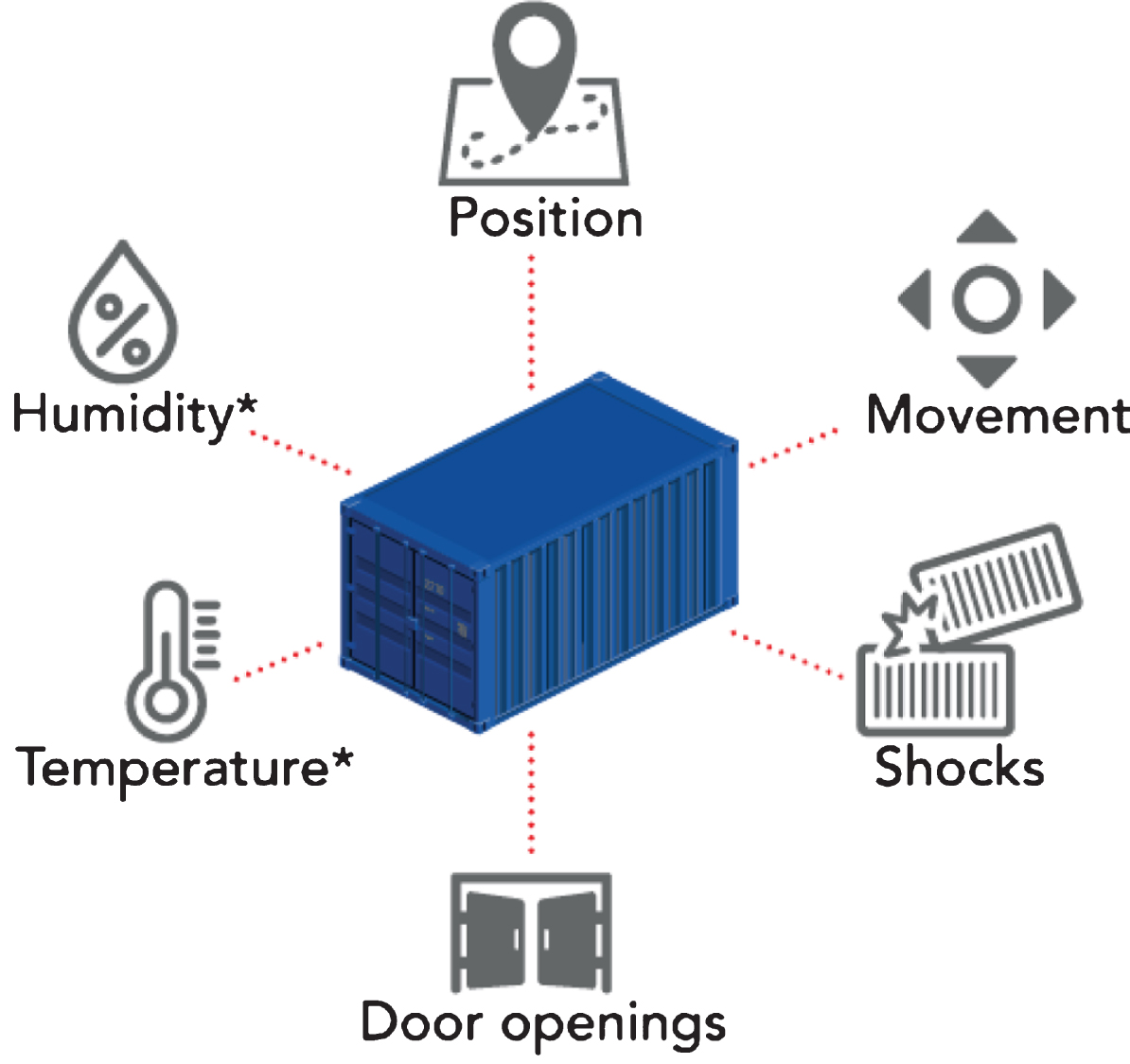
Real-time data and notification provided by smart container [13].
At the same time, these containers, which are also defined as smart parts in a mixed integrated logistics system, allow access to process information [15]. In an integrated logistics system, the central server uses software and within the scope of the authority levels and security definitions, it provides and transfers this information to its connected users online. Data and information obtained from the container and its surroundings can be monitored instantly via digital maps [10].
Information exchange between two containers can be provided when necessary [16]. Especially in food, explosives, chemical substances, pharmaceuticals, medical devices, and material transport, sensors are used in the container. When necessary, the generated reports and alarms are transmitted to the relevant point or person anywhere in the world [17].
By using data obtained from SC it can be possible to achieve higher quality management of cargo with shock tracing data, establish a cargo security policy by using door opening notifications, monitor cargo security, determine the lead time and conduct root cause analysis with a comprehensive report, improve inventory management, optimize cargo quality and ease financial management [13, 18].
The information about the product could be kept and could be updated with the use of smart containers. Real-time information about the product could be obtained and route change could be done. When necessary, temperature, humidity, and pressure adjustments could be possible and product information could be changed.
In addition to promising future properties, containers have some features that need to be improved. Reducing initial costs allows for greater use. The appropriate technological infrastructure needs to be integrated into the supply network and new regulations should be made in the universal container transport literature [8].
When the containers get smarter, the characteristics they should have and the functions expected from them increase. In this case, it is difficult to collect all properties in one container and it will be needed to prioritize the properties expected to be in one container. This can be determined by a multi-criteria decision making (MCDM) methodology.
It is not easy to get crisp data in real-life problems, especially on newly studied issues. Decision makers should also consider uncertainties in this case. The fuzzy set theory developed by Zadeh [19], is very useful in addressing this need. In recent years, this theory has been expanded with new types [20]. Neutrosophic set is one of these fuzzy sets and uses indeterminacy membership firstly. A neutrosophic set uses the parameters “truthiness”, “falsity” and “indeterminacy”. The parameter of indeterminacy provides experts to expose their judgments more comprehensively.
The originality of this study is that the neutrosophic TOPSIS method was used for the first time in the smart container MCDM problem. In the literature this work is a pioneering study of smart container for Industry 4.0 applications.
The rest of the paper is presented as follows: Literature review is given in section 2, and then the Neutrosophic TOPSIS method’s steps are presented in section 3. Later an application is given in section 4. In section 5, sensitivity analyses are presented and conclusions are presented in the last section.
Latest developments in Radio Frequency Identification (RFID), Sensor Networks, Global Positioning System (GPS), Wireless Technologies and studies on cyber-physical systems, Internet of Things (IoT) and intelligent products propose smart systems and objects [8].
The literature on the smart container is focused on this section and is not as broad as smart systems and objects. Kodwani et al. [21] proposed an IoT based system that is capable of decreasing human efforts for filling the containers. Makarem and Haraty [22] proposed an agent-based methodology to maximize single container usage. The loading system is smarter than a container here. Kim et al. [23] proposed a system using Wireless Sensor Networks and RFID to improve the security between neighbor containers by using ad-hoc networks. Ruckebusch et al. [24] developed a prototype solution for monitoring and tracking shipping the smart containers. Wang et al. [25] developed a sim-heuristic-based solution algorithm for the scheduling and reversible lanes allocation problem at the smart container terminal gate.
Meyer et al. [26] introduced three levels of intelligence of smart containers in an SCMS (Fig. 2). Embedded systems can record some information in the container (e.g. temperature, humidity) in the first class intelligence. The second class, the appropriate and sufficient sensors are available to detect the abnormal condition inside and out of the container. Container sends the alarm message in an abnormal state and subsequent processes are executed by SCMS. The third intelligence class, decision making is carried out partially or completely by the application/system in the smart container, the SCMS infrastructure is used to import the required services.
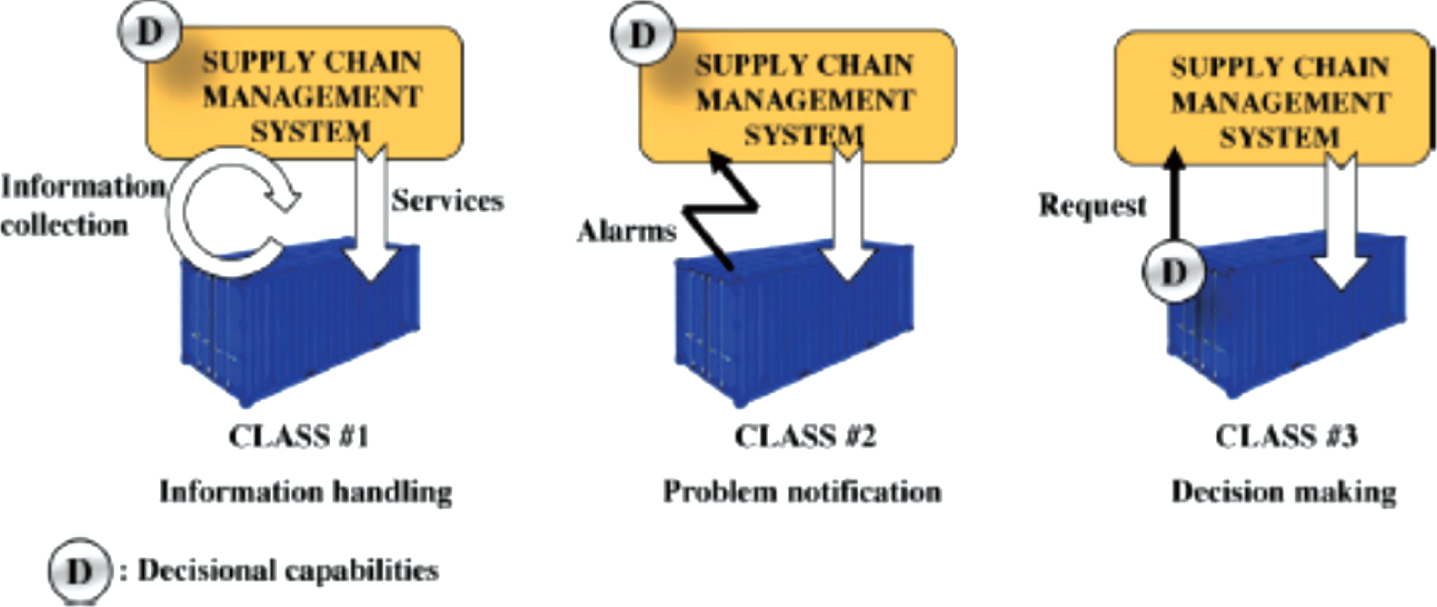
Three levels of intelligence of smart containers in an SCMS [26].
Jedermann et al. [27] studied on intelligence level that could be implemented on container or sensor for food logistics. Xu et al. [28] presented a monitoring system using ZigBee based on ad-hoc network for smart containers with the aim of energy consume minimization and efficiency improvements. Dittmer et al. [29] offered the Smart Container Project to monitor the products that could be damaged. The environmental data is collected and the life span of the products is monitored. Information can be sent to SCMS using the internet with different communication tools. Sallez et al. [30] focused on the informational context and associated activeness of smart containers. They also highlighted the constraint of actual solutions for completing the informational requirements.
Jing et al. [31] proposed a survey study on the standardization of smart containers. They presented the functions desired to be found in smart containers as follows: Container Automatic Identification, Ensuring Security, Track and Trace, Information Services for Different Parties, Recording Environmental Information and Intelligent Operation Management. The expected technical solutions from smart containers are presented as follows: Radio Frequency Identification, Sensor Monitoring Technology, Positioning Technology, Wireless Communication Technology, and Network Information Technology.
Smart containers that have recently begun to be used in the world are likely to find a global usage area over time. From this point of view, the preferences of users for smart containers are a guide for academicians and manufacturers. When the literature is examined, it is seen that there is not much of study in this context. Therefore a Multi Criteria Decision Making study needs to be studied on the selection of smart containers by its users and on the selection criteria.
On the other hand, neutrosophic TOPSIS related studies are also rare in the literature; some of them are as follows; Neutrosophic TOPSIS method recently developed by Biswas et al. [32] to solve multi attribute group decision making problem. Elhassouny and Smarandache [33] compared classical TOPSIS and neutrosophic TOPSIS results. Dung et al. [34] proposed TOPSIS approach using interval neutrosophic sets for personnel selection problem. Basset et al. [35] proposed neutrosophic TOPSIS method to evaluate Smart Medical Device Selection. Biswas et al. [36] extended TOPSIS strategy to solve multi-attribute group decision making problems in single valued neutrosophic set.
This study enables experts to evaluate smart container using neutrosophic TOPSIS for the first time in the literature.
In this section, TOPSIS approach under simplified neutrosophic environment is presented step by step developed by Biswas et al. [32].
Consider a multi-attribute decision-making problem with m alternatives and n attributes. Let A = {A1, A2, …, A
m
} be a discrete set of alternatives, and C = {C1, C2, …, C
n
} be a set of alternatives. The rating of each alternative with respect to each attribute, which describes the performance of alternative A1 against attribute C
j
, is expressed as single valued neutrosophic numbers (SVNNs). Let W = {w1, w2, …, w
m
} be the weight vector assigned for the attributes by experts. The neutrosophic multi-attribute decision-making problem can be represented as follows:
Let the group of p experts evaluate criteria according to attributes. Since these experts have different experiences, knowledge, and background, the importance of each expert may be different.
Let E
k
=〈 T
k
, I
k
, F
k
〉 be a neutrosophic number is used for the rating of the kth expert. Then, in order to get the weight of the kth expert, we use the equation as follows:
Let
Therefore, the aggregated neutrosophic multi-attribute decision-making problem can be represented as follows:
Where, d ij =〈 T ij , I ij , F ij 〉 is the aggregated element of neutrosophic decision matrix D for i = 1, 2, …, m and j = 1, 2, …, n.
In this step, every expert can assign different weights to attributes and then their evaluations are aggregated into group decisions. Let
Where, w j =〈 T j , I j , F j 〉 for j = 1, 2, …, n.
In this step, the weights of attribute and aggregated neutrosophic decision matrix are combined by using Equations (8) and (9) as follows;
Here,
Let
neutrosophic positive ideal solution (RNPIS) and
Where,
And
Where,
The normalized Euclidean distance measure of each alternative
Then, the normalized Euclidean distance measure of each alternative
The relative closes coefficient of each alternative is defined as follows:
Where,
Alternatives are ranked according to the relative closeness coefficient values. The larger values of
The criteria for the evaluation are based on literature review and the products of the sector manufacturers [8, 31]. Neutrosophic TOPSIS method, which was clarified in Section 3, is used as an evaluation method during the evaluation phase.
In application section, three smart containers alternatives (A1, A2, A3) are evaluated by three logistics experts (E1, E2, E3), with seven different criteria which contain benefit and cost. Benefit criteria are as follows; Temperature range (C1), Dimensions /Volume (C2), Data Logging (C3), IT infrastructure (C4), Safety and Security (C5). Cost criteria are as follows; Cost (C6) and Weight (C7). Brief descriptions of the criteria are given below.
The smart container evaluation problem is solved by Neutrosophic TOPSIS method [32] with the following steps;
Experts have different importance weights in evaluation committee due to their knowledge, background and experiment about smart container evaluation. First expert has 15 years experience, second expert has 12 years experience and the last expert has 9 years experience in logistics sector.
Different importance weights are assigned by using Table 1 and the importance of experts with SVNNs are in Table 2. The importance weight of experts is calculated by using Equation (3). For instance first expert’s importance weight is calculated as follows;
Linguistic terms for rating of criteria and experts
Linguistic terms for rating of criteria and experts
Importance of experts with SVNNs
Similarly, other importance weights of experts are calculated as follows; ψ2 = 0.360 and ψ2 = 0.242.
In this step Table 3 is used to evaluate alternatives according to criteria. Experts’ evaluations are in Table 4, and then aggregated values are calculated by using Equation (4) in Table 5. For an example, aggregated value of experts for A1 according to the criteria C1 is calculated as follows;
Linguistic terms for rating of alternatives by experts
Evaluation of alternatives and criteria weights
Aggregated neutrosophic decision matrix
After calculation of the aggregated decision matrix, aggregated weighted neutrosophic decision matrix is calculated by using Equation (8) shown in Table 6. For an example, the element of aggregated weighted decision matrix for the alternative A1 according to the criteria C1 is calculated by the following;
Aggregated weighted neutrosophic decision matrix
The RNPIS can be calculated from the aggregated weighted decision matrix by using Equation (10)
The RNNIS can be calculated from the aggregated weighted decision matrix by using Equation (14)
The normalized Euclidean distance measure of each alternative from the RNPIS and RNNIS are calculated by using Equations (18) and (19). Table 7 shows distances of each alternative from the RNPIS and RNNIS.
Distance of each alternative from the RNPIS and RNNIS
The relative closes coefficient of each alternative A i is calculated by using Equation (20). The results are shown in Table 8.
The relative closes coefficient results
Alternatives are ranked according to the relative closeness coefficient values in descending order as follows;
In this section a sensitive analysis is performed. The lowest weight in Table 1 is assigned to criteria weights respectively and is analyzed how much these weights influence the value of relative closeness coefficient. Figure 3 shows the results of sensitive analysis.
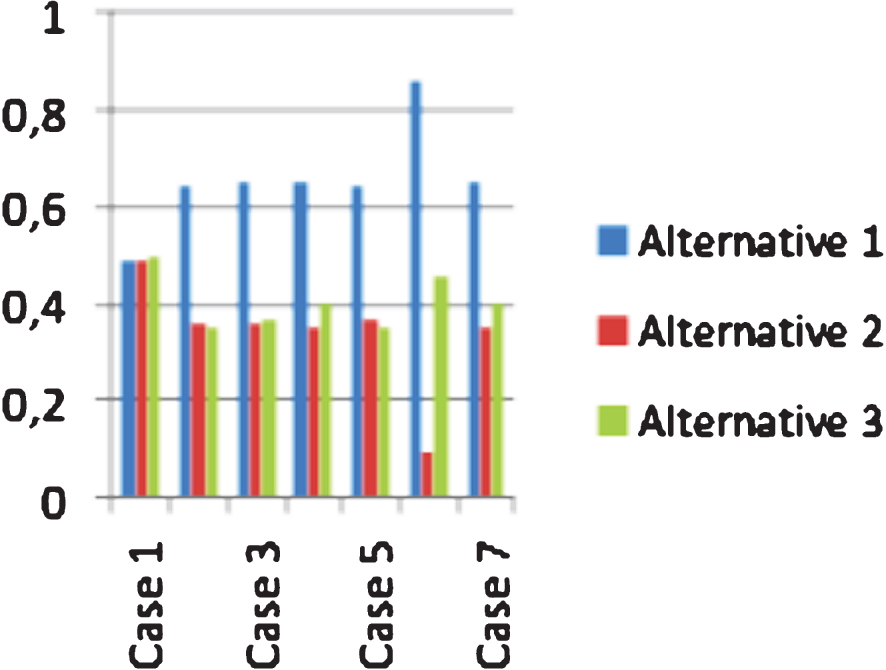
Sensitive analysis results.
As seen in Fig. 3, Alternative 1 has the highest value in many cases. But, when the importance of temperature range is assigned to lowest value, Alternative 3 becomes the first alternative. In this case we can say temperature range has big impact in evaluating smart containers. In case 6, when we assign the lowest value to cost importance, we observe Alternative 1 has big difference with other alternative. We can say that the cost criterion has a quite big impact on evaluating smart containers. As seen in other cases, Alternative 1 is always first alternative. As a result, “temperature range” which is benefit criterion and “cost” which is cost criterion are crucial criteria in smart containers evaluation.
Another sensitivity analysis is realized to observe how much experts’ weights influence the value of relative closeness coefficient. We realize three different cases, and in first case we assigned the experts’ weights as follows: VI, VUI and VUI, respectively. The ranking of alternatives are A1 > A2 > A3. Then we assigned the experts’ weights as follows, VUI, VI and VUI, respectively and ranking of alternatives are A1 > A3 > A2.In the third case, we assigned the experts’ weights as follows,VUI, VUI and VI, respectively and ranking of alternatives are A1 > A3 > A2 In this point, we can say that, decreasing second and third experts’ weights influence the the value of relative closeness coefficient and change the ranking of alternatives. Figure 4 shows the results of second part of sensitive analysis.
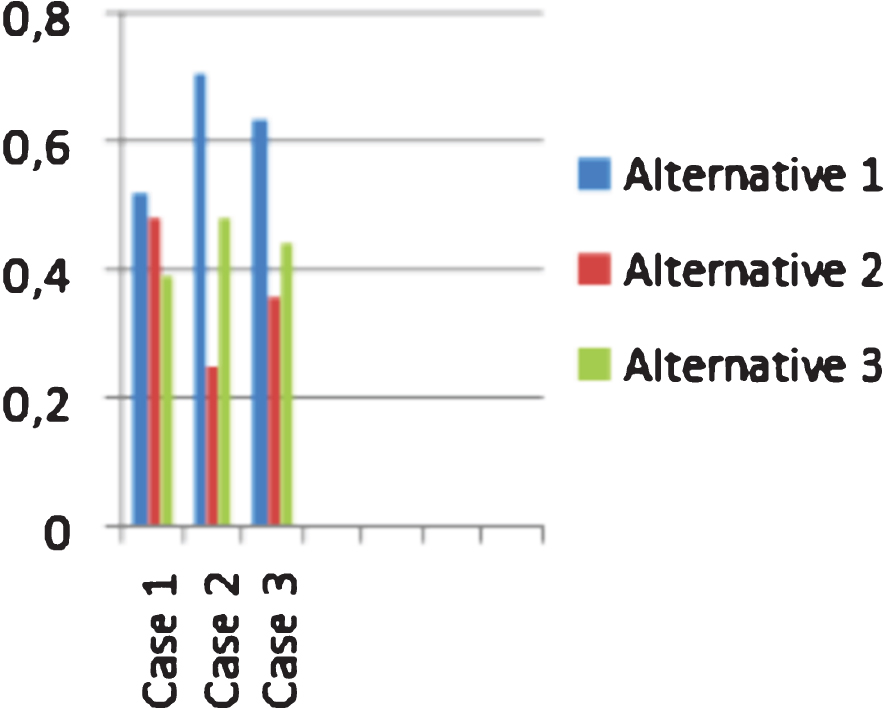
Sensitive analysis results.
Developments in information technologies and increasing use of the internet accelerate the Industry 4.0 process. In this context, logistics applications in SCMS are getting smarter like many other applications. Containers, which are important elements of logistics, are also getting smarter and thus improve logistics practices.
The formation of smart containers is still ongoing, and this formation is directed by information technologies and the demands of the users. Users’ preferences also determine the future characteristics of smart containers that continue to evolve. In this context, the determination of smart containers that will be preferred in logistics applications appears to be a multi criteria decision making problem.
Evaluation smart containers contain different conflicting criteria. Because of smart containers evaluation problem is considered in MCDM problem, there is need for capturing experts’ judgements via linguistic variables. In this paper, a recently developed neutrosophic set, which is extension of fuzzy set, is used to capture experts’ opinions.
In the evaluation process, linguistic terms are established for rating of criteria, alternatives and experts. Then each expert evaluates alternatives according to seven different criteria. In the next step, a combined decision matrix is established by using neutrosophic aggregation operator. After that, Euclidian distance measures are calculated from positive and negative ideal solutions. Finally, relative closeness coefficient of each alternative is calculated, and alternatives are ranked in descending order according to their relative closeness coefficient value. In order to show the robustness of model, sensitive analysis is performed. In sensitive analysis section, the influence of criteria weights to the final results is observed.
In future, the smart evolution problem can be solved by different extension of fuzzy set such as intuitionistic fuzzy TOPSIS, Pythagorean fuzzy TOPSIS, hesitant fuzzy TOPSIS, etc.