







Abstract
With the development of science and technology, as well as the improvement of living standards, the calculation of social benefit evaluation has been considered as one of the key points for Chinese film and TV enterprises to achieve a sustainable development in the future. The exploration of seeking improvement paths through actively responding to changes in consumer demands and improving social benefits, as well as applying calculation and analysis of evaluation weights, has attracted widespread attention from the academic community. Based on the fuzzy comprehensive evaluation method, this paper applied the concept of fuzzy computing, and conducted a weighted analysis of the social benefits of Chinese film and TV enterprises through questionnaire and analysis of large sample survey data. Accordingly, it proposed the countermeasures for Chinese film and TV enterprises to achieve innovative development in the future.
Introduction
The rapid development of science and technology has altered people’s lives. New technologies such as Internet, new media, cloud computing and big data have profoundly changed the social development environment and people’s consumption demand. The highly creative Chinese cultural industry has ushered in a golden development era full of opportunities and is now in a historic process from weak to strong, from small to large, and from single development to cross-border prosperity. Integrating new ideas and technologies, the cultural industry has created new cultural technologies, new formats and new models, thus bringing about rich social benefits. As a typical representative of cultural operators, film and television enterprises are showing a thriving momentum of development. As experts have emphasized, compared with others, film and television enterprises are inextricably linked with consumer demand [6, 14]. Their works are often known for their cultural and entertainment attributes [22], which make them able to represent the cultural and creative industries to some extent [12].
Background and practical significance
China’s opening up to the outside world is gradually accelerating, and film and television enterprises are facing new opportunities and challenges. In order to promote the rapid development of the industry, the Chinese government has continuously increased its support for local enterprises, and has further lowered the threshold for foreign film and television enterprises to enter and exit, gradually eliminated the barriers for entities in the industry to improve the utilization of foreign investment. Therefore, more foreign-funded enterprises are seizing the business opportunities to invest in China, which invisibly brings enormous challenges to Chinese local operators. At the same time, foreign culture is further integrated into the consumer market of China, which have made it urgent to improve the social benefits of local film and television enterprises. In order to seize the opportunities and meet the challenges, Chinese film and television enterprises must be pushed onto the road of innovation and development.
In order to better grasp the complex innovation process, characteristics, mode, and efficiency of the social benefit promotion of film and television enterprises, it is necessary and urgent to establish a scientific evaluation system for them. Although the performance evaluation system of innovation social benefits of film and television enterprises can draw lessons from the achievements of general industrial enterprises, due to the uniqueness of cultural products of film and television enterprises, the dynamic characteristics of consumer demand should also be taken into account.
The cultural products and creative ideas of film and television enterprises are priceless, and also binding because of ideological characteristics. The social benefits of film and television enterprises are their core asset, and cultural creativity is the source of their value. However, these intangible assets cannot be fully reflected in accounting measurement [3], which is difficult to identify when evaluating their innovation activities. Therefore, the quantified analysis of the social benefits their innovation is worthy of in-depth research and discussion because of its complexity and uniqueness.
According to the general defination, performance evaluation is a process of making objective, fair, accurate, and comprehensive judgement of the performance of the object being evaluated in a certain period of time based on unified evaluation indicators and standards, and in line with certain procedures, through quantitative or qualitative comparative analyses [2, 15]. Social benefit assessment is an important part of innovation performance evaluation, and the promotion of social benefits is the primary task for the development of film and television enterprises in the new era. Therefore, such analyses serve as the judgment of the film industry’s innovation process to better meet the needs of consumers. With the improvement of consumer demand, the social benefit evaluation of innovation of those enterprises is constantly gaining importance. At the practical level, scientific and effective evaluation of social benefits can not only point out the way for their innovation and development, but also help deepen the supply-side reform of the industry. Strengthening the evaluation research in this regard can further promote the scientific and standardized innovation management of film and television enterprises, which has considerable urgency and practical necessity.
First, the research on the evaluation of social benefits of innovation in film and television enterprises is an inevitable requirement for fully implementing the scientific development concepts and promoting the sustainable development of the industry in China. Establishing a scientific and complete evaluation system can create positive influence to national management and cultural publicity on the basis of maintaining steady economic development for the industry and the entities in it in China.
Second, the research is conducive to promoting the scientific, standardized and refined innovation process of film and television enterprises, comprehensively deepening the reform of the administrative management system, promoting the transformation towards scientific development, optimizing resource allocation, and forming standardized management mechanisms.
Third, the research is conducive to solving the problems related to innovation and development in various fields of the cultural industry, in which enhancing social benefits is an important issue commonly met in the new era, and it is also the key to determine whether the industrial development environment enables the enterprises to adapt. The selection of evaluation elements will provide a methodological reference for the innovation and development of cultural industries.
Theoretical framework and indicator selection
Dynamic change and response of consumer demand
Marketing is the lifeline of enterprise innovation and development. At the same time, both 4P and 4C theories of marketing essentially focus on consumer demand [5, 16]. Therefore, enterprise innovation and development is bound to have a close relationship with consumer demand. The demand does not stay unchanged, especially in certain consumer goods markets (such as film and television), showing great changes in different spaces and times. It is generally believed by scholars that changes in consumer demand can be divided into three stages: quantitative consumption, qualitative consumption and perceptual consumption [10]. With the advent of experience economy era, consumers tend to pay more attention to the acquisition of “good experience” [1]. In the process, a certain amount of costs is created. With the improvement of science and technology and consumption levels, the need for “good experience” are increasing, which is closely related to industry characteristics and scientific and technological advancements. Demands are an important source of innovation, and the process in which companies apply new technologies to meet them can generate innovation. Consumer demands are a cyclic growth process of production, satisfaction and regeneration [4], so consumer demands can often directly reflect the innovation benefits of enterprises. Therefore, in this study, it is proposed to apply the consumer demand dimension to evaluate the innovation benefits of film and television enterprises.
The characteristics of social benefit evaluation indicators of enterprise innovation
In the research on the evaluation of social benefits of enterprise innovation, combining with the influence of social factors on the strategic goals of enterprises, Yin Jianhai and Yang Jianhua proposed the secondary indicators including environmental protection [7], benefits to the mankind and other factors that can be used as indicators of social benefits, and that the raw material and energy recycling rate, the product recovery rate and the reduction of energy consumption per 10,000 yuan of output value can be used as their tertiary indicators. Li Xingkuan and other scholars put forward three social benefit indicators in the research process [18], namely, the environmental protection qualification level of new products, the emission reduction rate of new technologies, and the energy consumption reduction rate per 10,000 yuan of output value. Zhao Li considered that driving the development of related technologies or products in the society [11], improving the environment and enhancing environmental protection are the key factors to measure the social benefits of enterprise innovation. Shen Xilian believed that from a macro perspective, social benefits can be measured by such indicators as people’s living standards [19], improvement of quality of life, timely supply of public goods, public security, people’s living and working conditions, and social harmony. At the same time, the second dimension of cultural benefits is divided into three aspects: social performance, cultural performance and ecological performance, which expands the scope of measuring social benefits and plays an enlightening role for future research. Wei Jingzhu and Liang Lingling designed the three-level indicators: corporate image improvement, government environmental policy support [9], philanthropy participation, the ratio of environmental protection investment to total output value, and accident rate of environmental pollution in the design of innovation performance evaluation indicators. Wang Xi formulated the middle-level indicators [17], policy environment indicators and cultural indicators of social benefit characteristics in enterprise innovation performance evaluation, among which the specific factors include policy incentive for innovation formulated by governments at all levels, logistics infrastructure, number of service innovation proposals and other social benefit factors. Zhang Pei proposed that residents’ perception can be used as a dimension as well [13], and his research further validates the feasibility of applying consumer demands as an evaluation indicator of social benefit. Liu Jianling believed that the social contribution should be assessed mainly by the social benefit evaluation in this process [8]. At the same time, he also put forward that customer service ability can also be added to the indicator spectrum.
In summary, with the deepening of research in this field, there is a popular belief among scholars that social benefits should be adopted as an indicator to measure the contribution of enterprises to the society, and have begun to stress the connection between consumer demands and social benefits. Thus it is clear that some scholars have directly understood it as external indirect economic benefits. Therefore, there are two points to be raised about general social benefits: one is the characteristics of consumer demand; the other is that most indicators will reflect certain characteristics of economic benefits factors [20, 21]. Therefore, in selecting the indicators of innovation in film and television enterprises, the two will be fully considered, and the breakthrough indicators for the first characteristic will be sought in this study.
Selection of evaluation indicators
In this study, the dynamic response of consumer demands and the characteristics of social benefit evaluation indicators of enterprise innovation are analyzed comprehensively based on the following criteria: (1) Conforming to the dynamic response of consumer demands; (2) Relating to social benefits generated by innovation activities of film and television enterprises; (3) Concise and easy-to-understand; (4) Clear definition; (5) Relating to innovation behavior. On this basis, a total of 24 indicators were selected, namely, the degrees of demand for film and television images, pictures, audio effect, art, sound, special effect, light technology, projection, digital technology, and printing technology, situation of film and television market, cultural enrichments for consumers, changes in the their values, growth rates of output value of the cultural industry, value-added services of film and television products, benefits concerning the cultural improvement for the society, the cultural values, cultural quality, artistic level, satisfaction level of the society, and market share of film and television products, research and development needs of movie and television derivatives, functions for promoting positive spirits and contribution rate for competition.
Research hypothesis, methods and sample descriptions
Research hypothesis
In the analysis, based on the dynamic response of consumer demands and the characteristics of the demands, market and cultural transmission, it is assumed that the social benefit evaluation indicators can be divided into three groups: demand benefit variables, market creation ability variables and cultural dissemination benefit variables.
1. Demand benefit variables. This mostly manifests as the demands for film and television products and services, covering the traditional need for visual, auditory and artistic products, the individualized demand derived from scientific development, and the market demand caused by regional, temporal and environmental factors, of which both the traditional demand and individualized demand belong to individual demand, while the market demand to the common demand of consumers. The three together reflect the dynamic characteristics of consumer demand.
2. Market creation ability variables. It generally refers to the ability of enterprises (without existing markets) to build new markets by attracting consumers through certain methods and means in the process of developing new products and services after discovering the potential needs of customers. In film and television enterprises, the creation of the market is very important to the promotion of social benefits, which is often regarded by scholars as the inexhaustible momentum of film and television innovation activities.
3. Cultural dissemination benefit variables. This concept generally refers to the social benefit produced by the interaction of culture among regions and groups. Because of the unique characteristics of film and television products and services, their cultural dissemination benefits also accounts for a high proportion in social benefits.
Research methods
In this study, factor analysis and network analytic network process (ANP) are used to evaluate the innovation social benefits of Chinese film and television enterprises comprehensively and systematically as follows:
1. Factor analysis. By constructing the theoretical framework, using SPSS23.0 and AMOS and methods of descriptive statistical analysis, exploratory factor analysis and confirmatory factor analysis, the indicators applicable to the evaluation are screened and verified.
2. Analytic network process. The relative importance of the evaluation indicators of social benefits is determined by the ANP method. The importance values and weights of the indicators are determined by the 1–9 scale method so as to develop a set of applicable evaluation scale.
Sample description
Based on descriptive statistics, exploratory factor analysis and confirmatory factor analysis, a questionnaire survey was formulated and conducted in a time period of one month. 656 copies were collected and 626 were screened out. The validity rate was 95.42%. The questionnaires were randomly and evenly divided into two parts both consisting of 313 copies to ensure the validity and randomness of sample selection with one part for questionnaires for exploratory factor analysis and and the other confirmatory factor analysis. The factors of the sample were shown in Table 1.
Demographic variables for questionnaires
Demographic variables for questionnaires
Exploratory factor analysis
It is known that 24 measurement items are included in the social benefit indicators of innovation in film and television enterprises. Firstly, the KMO value and Bartlett spherical test of 313 effective samples were carried out. The results showed that the KMO value reached 0.913, the Bartlett spherical test value reached 3,845.216, and the significance was less than 0.001. The subsequent reliability analysis produced results that showed that the correlation coefficients of the single item to the total item in all items were greater than 0.5. Finally, a consistency analysis was performed gave an Alpha value of 0.924. In summary, the reliability of the scale is very good, in line with the exploratory factor analysis standard.
Based on the principles of project analysis commonly recognized by scholars, the screening of items was carried out. The analysis principles are as follows: (1) the common factor load should be greater than 0.50; (2) only one common factor load can exceed 0.50; (3) the common factor load should have a large difference.
It is concluded based on these principles (as shown in Table 2), factor analysis should be operated as follows: constructing covariance matrix, extracting factors by principal component analysis, rotating them by maximum variance method, and converging after 6 rotations. The economic benefit indicator showed a clear 5-factor structure. The total variance interpretation rate reached 63.756%. In terms of items screening, S14 was deleted since its load in the common factor was less than 0.50, and the items S7, S11, S13, S19, S20 were deleted since 2 or more of them have an small difference in load in the common factor.
Results of exploratory factor analysis of innovation and social benefit evaluation scale for film and television enterprises (N = 313)
Results of exploratory factor analysis of innovation and social benefit evaluation scale for film and television enterprises (N = 313)
In view of the definitions and significance of the above-mentioned items, and combining with the references and the particularity of innovation of Chinese film and television enterprises and the classification criteria of social benefit indicators of innovation (specifically, the factor is named by the consumer’s differential demand for film and television products and the market characteristics of film and television enterprises.), the above 5 factors are determined.
Factor 1 is named as traditional demand benefit. The variance contribution rate was 17.030%, and it consisted of 6 items: S1, S2, S3, S4, S5 and S6.
Factor 2 is named as cultural transmission benefit. The variance contribution rate was 14.091%, and it consisted of 4 items: S16, S17, S18 and S23.
Factor 3 is named as market demand benefit. The variance contribution rate was 11.991%, and it consisted of 4 items: S15, S21, S22 and S24.
Factor 4 is named as individualized demand benefit. The variance contribution rate was 11.113%, and it consisted of 3 items: S8, S9 and S10.
Factor 5 is named as market creation ability. The variance contribution rate was 9.531%, and it consisted of 2 items: S12 and S13.
The 5-factor structure that forms the evaluation indicators shows that the five categories are basically consistent with the demand benefit variables, the market creation ability variables and the cultural transmission benefit variables in the research hypothesis (among them, the demand benefit variables are divided into three parts: traditional demand benefit, market demand benefit and individualized demand benefit in the exploratory factor analysis).
Because it is found in the exploratory factor analysis that the evaluation on social benefits of innovation in film and television enterprises is composed of 5 factors, the confirmatory factor analysis is carried out accordingly (the analysis results are shown in Fig. 1 and Table 3). Both the primary factor load and the secondary load factor are found to be significant.
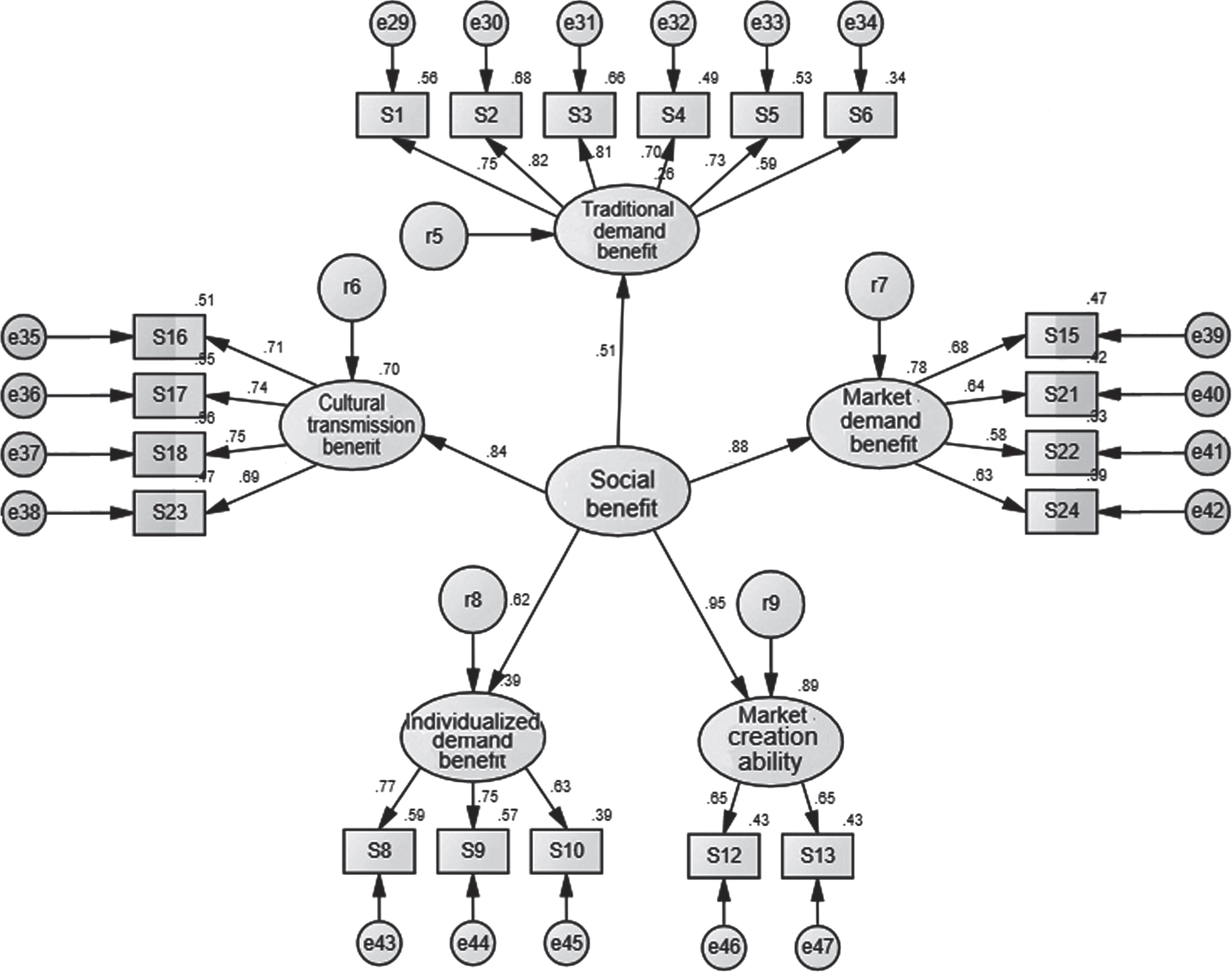
Confirmatory measurement model of social benefit indicator system.
Factor load coefficient of measurement model of innovation and social benefit evaluation indicator for film and television enterprises (N = 313)
Table 4 shows that a desirable level of overall fitness of the measurement model of innovation social benefit indicator system, where, x2/df is 3.267 (between 3 and 5), which is within the acceptable range of the test value. All indicators of CFI, NNFI, IFI, NFI, GFI and AGFI are greater than 0. 8, which indicates a good fitting performance; RFI is close to 0.8, which shows a middle level of fitness; RMSEA and RMR are less than 0.1 and ECVI value is smaller, showing a good fitness. Therefore, it is judged through the confirmatory factor analysis on the verification model of innovation that the social benefit indicators has a high degree of fitness, and all the parameters are effective.
Overall fitness of the indicator system of social benefit of innovation in film and television enterprises (N = 313)
In summary, the innovation social benefit scale for film and television enterprises based on the dynamic response of consumer demand is a five-dimensional model: traditional demand benefit, cultural transmission benefit, market demand benefit, individualized demand benefit and market creation ability, among which traditional demand benefit, market demand benefit, and individualized demand benefit are all demand benefit variables, so the conclusion can be drawn that the research results are basically consistent with the research hypotheses, and the hypotheses are valid.
In order to further improve the evaluation indicator system of social benefit of innovation in Chinese film and television enterprises, and better evaluate their innovation activities, Super Decisions is used to analyze the weights of the indicator system, and the ANP is adopted to determine the weights of innovation performance evaluation indicator system of Chinese film and television enterprises.
A structural model is drawn on the basis of the established indicator system, as shown in Fig. 2. The model consists of two levels:
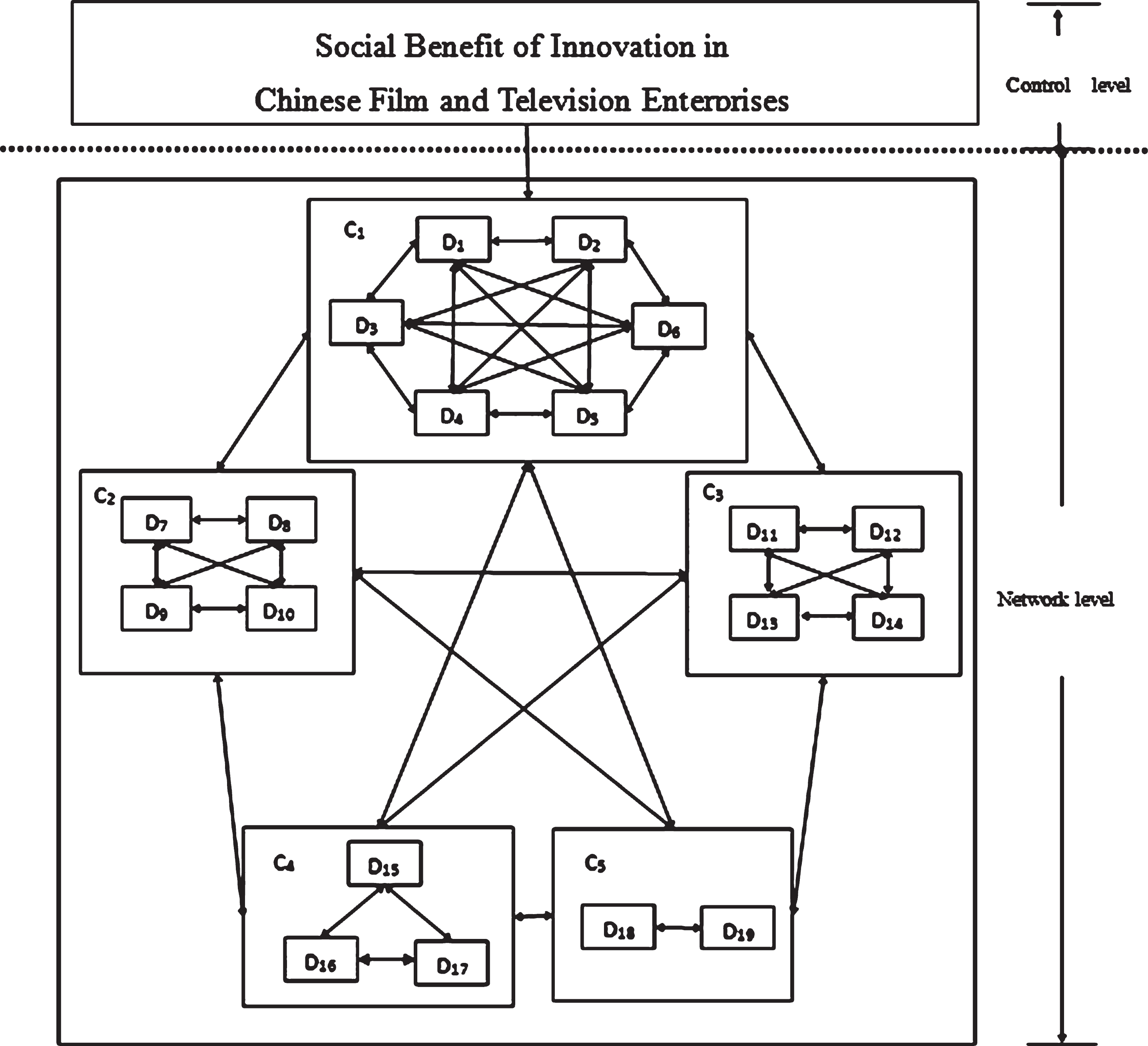
Network level structure model for evaluation indicator system of social benefit of innovation in Chinese film and television enterprises.
Control level: social benefit of innovation in Chinese film and television enterprises
Network level: Traditional demand benefit (C1), cultural transmission benefit (C2), market demand benefit (C3), individualized demand benefit (C4), market creation ability (C5), the degree of demand for film and television images (D1), the degree of demand for film and television pictures (D2), the degree of demand for film and television audio effect (D3), the degree of demand for film and television art (D4), the degree of demand for film and television sound (D5), the degree of demand for film and television special effect technique (D6), benefits of the cultural improvement (D7), the cultural values of film and television products (D8), cultural quality of film and television products (D9), positive energy dissemination effect (D10), value-added services of film and television products (D11), market share of film and television products (D12), research and development needs of movie and television derivatives (D13), contribution rate of film and television market competition (D14), the degree of demand for film and television projection technique (D15), the degree of demand for film and television digital technology (D16), the degree of demand for film and television work printing process (D17), cultural quality improvement of films and television consumers (D18), change in the values of film and television consumers (D19).
In this study, the Analytic Network Process (ANP) was used based on the above structure, and the one-time test was adopted to calculate and form a complete weight system for the evaluation indicators, as shown in Table 5.
Weight system of social benefit evaluation indicators of innovation in Chinese film and television enterprises
Social benefit of innovation in film and television enterprises based on dynamic response of consumer demand is a five-dimensional structure
Although social benefits have been regarded by most scholars as an important manifestation of corporate innovation, the specific contents and components of social benefits in film and television enterprise innovation have not been widely known. In this study, based on the dynamic response characteristics of consumer demand, an evaluation was carried out on the basis of literature analysis, and 24 impact indicators were selected. Then, combined with the quantitative analysis, the questionnaire survey for measuring the social benefit was carried out. The final results show that the scale of the social benefit based on dynamic response of consumer demand is a five-dimensional model: traditional demand benefit, cultural dissemination benefit, market demand benefit, individualized demand benefit and market creation ability.
Focusing on enhancing the social benefits of innovation in film and television enterprises can help enterprises them adapt to the “new normal” of China’s economic development
In the “new normal” era of China’s economic development, industrial consumption demand has gradually become the main theme, and innovation-driven development concept has been made the key. In this regard, the film and television industry in line with the concept of “new normal” has become an important area of China’s economic development. In this context, how to better respond to changing consumer needs, coordinate film and television resources among regions, change the mode of growth of film and television enterprises, and achieve sustainable development of film and television enterprises, which calls for more attention paid to the coordinated development of social benefits. According to the exploration and conclusion of this study, enhancing the social benefits of innovation in film and television enterprises can help enterprises adapt to the “new normal” of China’s economic development, which is reflected in the following two aspects:
(1) Focusing on the “five-dimensional” coordinated development of film and television enterprises to adapt to the “new normal”. The results show that the dimensions of the social benefits are significantly correlated. According to the weights, the top three are: the benefit of spiritual creation construction, the change in the values of film and television consumers, and the cultural quality of film and television products. Therefore, the promotion of the social benefits of innovation in film and television enterprises requires joint efforts from various aspects, including actively promoting the cultural improvement of the society, grasping the changes in consumer values, and concentrating on cultivating the cultural quality of film and television products, in order to give better play to the benefits of film and television cultural dissemination.
(2) Seizing the opportunity to improve the social benefits to adapt to the “new normal”. The results show that the weight scores of traditional demand and individualized demand are low, which indicates that the individual demand of consumers is no longer the main problem faced by film and television enterprises at this stage, and the score of cultural dissemination benefit is higher, which suggests that the emphasis of market cultural dissemination will become the core of social benefit promotion in the new era. Therefore, in the “new normal” context, on the one hand, enterprises should further understand the common demand of market culture and improve their own business model; on the other hand, they should actively correspond to China’s cultural building and become “guides” for films and television consumers.
Consumer dynamic response, as the core performance of improving the social benefits, has a significant positive impact on the sustainable innovation and development of film and television enterprises.
In this study, the positive effects of market demand, traditional demand, individualized demand, cultural transmission benefit and market creation ability on the social benefit of innovation in film and television enterprises were explored and verified. It is thus concluded that consumer dynamic response has a significant positive impact on the sustainable innovation of film and television companies. Therefore, future studies can further explore the role of the dynamic response of consumers in the promotion of social benefits of innovation in film and television enterprises. Film and television management authorities or enterprises can apply the scale developed in this study to the evaluation, so as to analyze the weak links and achievements in the process, and based on this, strengthen the innovation and development of the enterprises and enhance their performance.
The theoretical contributions of this article are as follows: Through literature reviews, it is known that there is still a lack of micro-discussion on the research on innovation in film and television enterprise at home and abroad, and the research and understanding of social benefit improvement needs to be strengthened. In this study, the social benefits of innovation in film and television enterprises are comprehensively evaluated, which not only helps to analyze the social benefits in detail, but also further aids the understanding and exploration of the structure of the social benefits from the perspectives of consumers and managers. Finally, based on sample data, the dimensions of the social benefits have been tested by empirical research, and a set of scales with good reliability and validity has been developed, which provides a reliable measurement tool for follow-up theoretical and empirical research, and enriches the innovation theory of film and television enterprises to a certain extent.