






Abstract
This paper develops a latest mathematical model to derive the membership function of fuzzy retrial queue with single server queue model FM1, FM2/FM1, FM2/1 with priority and unequal service rates. The vital aim of this paper is to combine the parametric non linear programming technique and Yager’s ranking method. Using α - cut approach and Zadeh’s principle the fuzzy queues are changed into crisp queues in this paper. The membership function of the system characteristics is derived for different values of α. The numerical example is given to check the validity of the model.
Introduction
The retrial queues have the characteristic feature that arriving call who discovers all servers occupied join the retrial group to attempt for their requests again. Retrial queues are extensively used in many problems in computer, telephone switching system and communication systems. Many authors have studied on the retrial queue with priority and single server. Choi and Park [8] studied an M1, M2/G/1 retrial queue with two types of calls, Type I calls in priority queue and Type II calls in retrial group. Falin, Artalejo and Martin [10] extended Choi and Park [8] to a model where two types of calls have different service times. The retrial queues with priority are useful for evaluation of performance in production, manufacturing systems, inventory control, computer and telecommunication systems.
The general retrial queues with single server and priority with two types of calls are described as follows. In the event that a call upon the arrival finds the server free, he instantly gets the service and leaves the system after service. At the point when Type I customers find the server occupied, he enters the priority queue and waits until the server is free and then gets service. In the event that Type II customers finds the server busy upon the arrival he enters the retrial queue keeping in mind the end goal to receive the service again after a random amount of time. Type II customers are served just when there is no Type I customers in the system. In this manner Type I customers are considered to have non preemptive priority over the Type II customers.
Because of few factors, parameters in the non preemptive priority queues might be fuzzy. In the literature, arrival times and service times are necessary to follow probability distributions. However, in some real-world applications, the parameter distributions are characterized subjectively. Hence fuzzy queues are more practical and useful when compared to the commonly used crisp queues (see Zadeh [27] and Li and Lee [20]. Hence the retrial queues with priority and fuzzy have a extensive range of applications. Bellman and Zadeh [1] presented the idea of fuzziness where inexact information could be solved by decision making problems. The researchers like Li and Lee [20], Buckley [2], Negi and Lee [22], Kaufmann [17], Kao et al. [16], Chen [3] has examined fuzzy queues by Zadeh’s extension principle. The analytical results of fuzzy queues (denoted M/F/1/∞ and FM/FM/1/∞ are studied by Li and Lee [20] where F denotes fuzzy time and FM denotes fuzzified exponential distributions) using Zadeh’s extension principle.
Parametric linear programming approach to derive the membership functions of the system in fuzzy queues has been studied by Kao et al. [16]. F. Choobinesh [5] discussed on different methods for ordering fuzzy numbers. R. Jain [14] made a study on Decision Making in fuzzy variables. L.A. Zadeh [27] has presented the idea of fuzzy probabilities. Buckley [2] studies multi-server queues with finite and infinite capacity queuing models where arrivals and departures follow possibilistic pattern. Chen [3] suggests a strategy of parametric programming in order to derive membership functions of the fuzzy queues. Further, the conversion of fuzzy queues to crisp queues has also been widely discussed in works and many methods and approaches have been used. M.J. Pardo and David de la Fuente [24] optimized a fuzzy priority discipline queuing model. B. Palpandi, and G. Geetharamani [23] computed performance measures of fuzzy non-preemptive priority queues by Robust ranking technique. W. Ritha and L. Robert [25] have analysed priority queuing discipline using fuzzy set theory. Many earlier researches on fuzzy queueing models have shown attention on simple queues with one or two fuzzy variables. In this paper, we discuss an approach that derives system characteristics for retrial queues with priority fuzzy parameters. Using α- cuts and Zadeh’s extension principle, we change the fuzzy queues to a family of crisp queues. The family of crisp queues is derived for different values of α and are solved using parametric nonlinear programming (NLP). The NLP solution wholly and effectively gives the membership functions of the system characteristics, the expected number of jobs and the expected waiting time in the queue.
This paper is structured as follows. Section 2 presents the system characteristics of single server retrial fuzzy queueing models with priority. In Section 3, a mathematical programming approach is developed to derive the membership functions of these system characteristics. In Section 4, realistic numerical examples are solved to exhibit the validity of the given approach. In Section 5, results and discussions are done. Conclusions are given in Section 6.
Retrial queue with priority
M1, M2/M1, M2/1 queues
Consider a single server retrial queuing system in which Type I and Type II customers arrive according to poisson process with rate λ1 and λ2 respectively. The unequal service time is exponentially distributed with μ1, μ2 respectively. Type I can be identified as high priority customer. On the other hand, low priority customers who finds the server busy upon arrivals leaves the system and enters the retrial group for the service again after a random exponentially amount of time. The retrial times are assumed to be independent and exponentially distributed with parameter θ.
From the results in Falin, Artalejo and Martin [10] we can obtain the system characteristics in terms of the system parameters.
Mean number of Type I customers in the priority queue is given by
Mean number of Type II customers in the retrial queue is given by
FM1, FM2/FM1, FM2/1 queues
The retrial queueing model with priority when extended with fuzzy parameters has a wider range of application. Let the arrival rate of high priority customers, the arrival rate of low priority customers, service rate of high priority customers, service rate of low priority customers and retrial rate are approximately known and are represented by the fuzzy numbers,
Where X1, X2, Y1, Y2, V are the crisp universal sets of the arrival rate of high priority, low priority, service rate of high priority, low priority and retrial rate respectively.
Let p (x1, x2, y1, y2, v) denote the system characteristic of interest. Since
Assume that the system characteristic of interest is the expected number of customers in the high priority and low priority queue.
The membership function for the expected number of customers in priority queue is
The membership function for the expected number of customers in retrial queue is
The membership function is not expressed in the standard form, making it very difficult to imagine its shape. In this paper we approach the representation problem using a mathematical programming technique. Parametric NLPs are developed to find the α -cuts of
Parametric nonlinear programming
To express the membership function in an understandable form we implement Zadeh’s approach which deals on α–cuts of
Definitions for the α-cuts of
The constant arrival rates and service rates are given as intervals when the membership functions are no less than a given possibility level for α The bounds of these intervals can be described as functions of α and can be obtained as
We can use the α cuts of Lq1 and Lq2 to construct its membership function since the membership function is parametrized by α
Using Zadeh’s extension principle,
Case 1:
Case 2:
Case 3:
Case 4:
This can be solved using parametric NLP techniques. The NLP to find the lower and upper bounds of the αcuts of
For case 1 are
For case 2 are
For case 3 are
For case 4 are
From the definitions of
The α - cuts form a nested structure with respect to α (see Kaufmann [17] and Zimmermann [28]). Given 0 < α2 < α1 ≤ 1, we have
To find the membership function
At least one of x1 and y1 must hit the boundaries of their α -cuts to satisfy
This model is a set of mathematical programs with boundary constraints is a special case of parametric NLPs (see [11]) where how the optimal solution change with
Yet again, by applying the results of Kaufmann [17] and Zimmermann [28] and convexity properties to
0 < α2 < α1 ≤ 1. In other words,
Similarly the lower bound
If both
Similarly If both
In general, the values of
Similarly the membership function of the expected number of customers in retrial queue can be derived.
The values preserve completely all the fuzziness of the arrival and service rate because the system characteristics are described by the membership function. However if we need a single crisp value for a system characteristic rather than a fuzzy set, the fuzzy values are defuzzified using Yager’s ranking index method which is given as
Where
Numerical example
Mostly retrial queues are dealt with one kind of call. Though there are some realistic models which deal with more than a few types of calls. Let us consider an example of telephone switching system (Falin et al. [10]). In recent telephone exchanges, subscriber lines are generally linked to the subscriber line modules. These modules deal both incoming and outgoing calls. A fundamental contrast between these two kinds of calls is in the way that on account of blocking due to all channels busy in the module, outgoing calls can be queued, while incoming calls get busy signal and retried so as to begin the connection. When the channel is free, an active call, if exhibit, occupies the channel quickly. Hence incoming calls may not be connected provided that there are outgoing calls waiting. This shows that there is non-preemptive priorty of outgoing calls over incoming calls.
The fuzzy expected number of customers in priority queue
Let the arrival, service rates and retrial ratesare triangular fuzzy numbers given by
The α–cuts of
With the help of MATLAB 8.6, the inverse functions of
Where L (z) = (48 * x + 27)/(4 * (x - 1)) + (6(1/2)* ((r))/(12 * ((q)/(x - 1) 3) (1/6)) + (6(1/2) * ((3 * (28037992 * x + 40302864 * x2 + 26838656 * x3 - 28672 * x4 - 228965) * ((675840 * x)/(x - 1)-(2184192 * x)/(x - 1) 2 + (61965 * x)/(x - 1) 3-(2125764 * x)/(x - 1) 4 - 14424/(x - 1) -161352/(x - 1) 2 - 977589/(2 * (x - 1) 3) -4782969/(16 * (x - 1) 4) + (16148 * x + 328 * x2 + 399) 2/(16 * (x - 1) 4) - (3373056 * x2)/(x - 1) 2 + (4854816 * x2)/(x - 1) 3 - (5668704 * x2)/(x - 1) 4 + (5688576*x3)/(x - 1) 3 - (6718464 * x3)/(x - 1) 4 - (2985984 * x4)/(x - 1) 4 + ((q)/(x - 1) 3) (2/3) + (((q)/(x - 1) 3) (1/3) * (16148 * x + 328 * x2 + 399))/(2 * (x - 1) 2)) (1/2))/(16 * (x - 1) 4) - ((q)/(x - 1) 3) (2/3) * ((r) - ((16148 * x + 328 * x2 + 399) 2 * ((675840 * x)/(x - 1) - (2184192 * x)/(x - 1) 2 + (61965 * x)/(x - 1) 3 - (2125764 * x)/(x - 1) 4 - 14424/(x - 1) -161352/(x - 1) 2 - 977589/(2 * (x - 1) 3) -4782969/(16 * (x - 1) 4) + (16148 * x + 328 * x2 + 399) 2/(16 * (x - 1) 4) - (3373056 * x2)/(x - 1) 2 + (4854816 * x2)/(x - 1) 3 - (5668704*x2)/(x - 1) 4 + (5688576 * x3)/(x - 1) 3 - (6718464 * x3)/(x - 1) 4 - (2985984 * x4)/(x - 1) 4+ ((q)/(x - 1) 3) (2/3) + (((q)/(x - 1) 3) (1/3) * (16148*x + 328 * x2 + 399))/(2 * (x - 1) 2)) (1/2))/(16 * (x - 1) 4) + (9 * 6(1/2) * ((q)/(x - 1) 3) (1/2) * (71322*x + 69652 * x2 - 192 * x3 - 157))/(2 * (x - 1) 3)+ (((q)/(x - 1) 3) (1/3) * (16148 * x + 328 * x2 + 399)* ((675840* x)/(x - 1) - (2184192 * x)/(x - 1) 2 +(61965 * x)/(x - 1) 3 - (2125764 * x)/(x - 1) 4 - 14424/(x - 1) -161352/(x - 1) 2 - 977589/(2 * (x - 1) 3) -4782969/(16 * (x - 1) 4) + (16148 * x + 328 * x2 + 399) 2/(16 * (x - 1) 4) - (3373056 * x2)/(x - 1) 2 + (4854816 * x2)/(x - 1) 3 - (5668704*x2)/(x - 1) 4 + (5688576 * x3)/(x - 1) 3 - (6718464 * x3)/(x - 1) 4 - (2985984 * x4)/(x - 1) 4+ ((q)/(x - 1) 3) (2/3) + (((q)/(x - 1) 3) (1/3) * (16148*x + 328 * x2 + 399))/(2 * (x - 1) 2)) (1/2))/(x - 1) 2) (1/2))/(12 * ((q)/(x - 1) 3) (1/6) * ((675840 * x)/(x - 1) - (2184192 * x)/(x - 1) 2 + (61965 * x)/(x - 1) 3 - (2125764 * x)/(x - 1) 4 - 14424/(x - 1)-161352/(x - 1) 2 - 977589/(2* (x - 1) 3) -4782969/(16 * (x - 1) 4) + (16148 * x + 328 * x2 +399) 2/(16 * (x - 1) 4) - (3373056 * x2)/(x - 1) 2 + (4854816 * x2)/(x - 1) 3 - (5668704 * x2)/(x - 1) 4+(5688576 * x3)/(x - 1) 3 - (6718464 * x3)/(x - 1) 4 - (2985984 * x4)/(x - 1) 4 + ((q)/(x - 1) 3) (2/3)+ (((q)/(x - 1) 3) (1/3) * (16148 * x + 328 * x2 + 399))/(2 * (x - 1) 2)) (1/4))
R (z) = (6(1/2) * ((3 * (28037992 * x + 40302864*x2 + 26838656 * x3 - 28672 * x4 - 228965) * ((254016 * x)/(x - 1) - (2144400 * x)/(x - 1) 2 - (1385475 * x)/(x - 1) 3 - (3858750 * x)/(x - 1) 4-116280/(x - 1) -734160/(x - 1) 2 - 3009825/(2 *(x - 1) 3) -13505625/(16 * (x - 1) 4) + (16148 * x + 328 * x2 + 399) 2/(16 * (x - 1) 4) - (1491840 * x2)/(x - 1) 2 + (2730000 * x2)/(x - 1) 3 - (6615000*x2)/(x - 1) 4 + (2683200 * x3)/(x - 1) 3 - (5040000 * x3)/(x - 1) 4 - (1440000 * x4)/(x - 1) 4+ ((q)/(x - 1) 3) (2/3) + (((q)/(x - 1) 3) (1/3) * (16148*x+ 328 * x2 + 399))/(2 * (x - 1) 2)) (1/2))/(16 * (x - 1) 4) - ((q)/(x - 1) 3) (2/3) * ((r - ((16148 * x +328 * x2 + 399) 2 * ((254016 * x)/(x - 1) - (2144400 * x)/(x - 1) 2 - (1385475 * x)/(x - 1) 3-(3858750 * x)/(x - 1) 4 - 116280/(x - 1) - 734160/(x - 1) 2 - 3009825/(2 * (x - 1) 3) -13505625/(16 * (x - 1) 4) + (16148 * x + 328 * x2 + 399) 2/(16 * (x - 1) 4) - (1491840 * x2)/(x - 1) 2 + (2730000 * x2)/(x - 1) 3 - (6615000 * x2)/(x - 1) 4 + (2683200 * x3)/(x - 1) 3 - (5040000 * x3)/(x - 1) 4 - (1440000* x4)/(x - 1) 4 + ((q)/(x - 1) 3) (2/3) + (((q)/(x - 1) 3) (1/3) * (16148 * x + 328 *x2+ 399))/(2 * (x - 1) 2)) (1/2))/(16 * (x - 1) 4) + (9 *6(1/2)* ((q)/(x - 1) 3) (1/2) * (71322 * x + 69652 *x2 - 192 * x3 - 157))/(2 * (x - 1) 3) + (((q)/(x - 1) 3) (1/3) * (16148 * x + 328 * x2 + 399) * ((254016*x)/(x - 1) - (2144400* x)/(x - 1) 2 - (1385475 *x)/(x - 1) 3 - (3858750 * x)/(x - 1) 4 - 116280/(x-1) -734160/(x - 1) 2 - 3009825/(2 * (x - 1) 3) -13505625/(16 * (x - 1) 4) + (16148 * x + 328 * x2+399) 2/(16 * (x - 1) 4) - (1491840 * x2)/3 - (5040000 * x3)/(x - 1) 4 - (1440000 * x4)/(x - 1) 4+ ((q)/(x - 1) 3) (2/3)+ (((1477201770 * x - 12 *3(1/2) * ((p) (1/2) - 1656476100 * x2 + 1331000 * x3+36* 3(1/2) * x * ((p) (1/2) - 36 * 3(1/2) * x2 *((p) (1/2) + 12 * 3(1/2) * x3 * ((p) (1/2) - 12228921)/(x - 1) 3) (1/3)* (16148 * x + 328 * x2 + 399))/(2 *(x - 1) 2)) (1/2))/(x - 1) 2) (1/2))/(12 * ((q)/(x - 1) 3) (1/6) * ((254016 * x)/(x - 1) - (2144400 * x)/(x - 1) 2 - (1385475 * x)/(x - 1) 3 - (3858750 * x)/(x - 1) 4 - 116280/(x - 1) -734160/(x - 1) 2 - 3009825/(2 * (x - 1) 3) -13505625/(16 * (x - 1) 4)+(16148 * x + 328 * x2 + 399) 2/(16 * (x - 1) 4)-(1491840 * x2)/(x - 1) 2 + (2730000 * x2)/(x - 1) 3 -(6615000 * x2)/(x - 1) 4 + (2683200 * x3)/(x - 1) 3-(5040000 * x3)/(x - 1) 4 - (1440000 * x4)/(x - 1) 4+ ((q)/(x - 1) 3) (2/3) + (((q)/(x - 1) 3) (1/3) * (16148*x + 328 * x2 + 399))/(2 * (x - 1) 2)) (1/4)) - (6(1/2)* ((8074 * x * ((q)/(x - 1) 3) (1/3) - 4345980 * x - 2*x * ((q)/(x - 1) 3) (2/3) + (399 * ((q)/(x - 1) 3) (1/3))/2 + ((q)/(x - 1) 3) (2/3) + 12100 * x2 + 164 * x2 * ((q)/(x - 1) 3) (1/3) + x2 * ((1477201770 * x - 12 * 3(1/2)* ((p) (1/2) - 1656476100 * x2 + 1331000 * x3 + 36 *3(1/2) * x * ((p) (1/2) - 36 * 3(1/2) * x2 * ((764189866500 * x - 1791293889482575 * x2 + 178721374968255750 * x3 + 4773621235275000 * x4 - 5788552275000 * x5 + 3865907200)/(x - 1) 6) (1/2) + 12 * 3(1/2) * x3 * ((p) (1/2) - 12228921)/(x - 1) 3) (2/3) + 52881)/(x - 1) 2) (1/2))/(12 * ((q)/(x - 1) 3) (1/6)) - (40 * x + 35)/(4 * (x - 1))
Where p = (764189866500 * x - 1791293889482575 * x2 + 178721374968255750 * x3 + 4773621235275000 * x4 - 5788552275000 * x5 + 3865907200)/(x - 1) 6q = 1477201770 * x - 12 * 3(1/2) * (p) (1/2) - 1656476100 * x2 + 1331000 * x3 + 36 * 3(1/2) * x * (p) (1/2) - 36 * 31/2 * x2 * (p) (1/2) + 12 * 3(1/2) * x3 * (p) (1/2) - 12228921r = (8074 * x * ((q)/(x - 1) 3) (1/3) - 4345980 * x - 2 * x * ((q)/(x - 1) 3) (2/3) + (399 * ((q)/(x - 1) 3) (1/3))/2 + ((q)/(x - 1) 3) (2/3) + 12100 * x2 + 164 * x2 * ((q)/(x - 1) 3) (1/3) + x2 * ((q)/(x - 1) 3) (2/3) + 52881)/(x - 1) 2) (1/2)
The overall shape turns out as expected. The membership functions L (z) and R (z) have complex values with their imaginary parts approaching zero when
Crisp intervals for fuzzy expected number of customers in priority queue at different possiblistic α- levels are presented in Table 1. The support of

The membership function for fuzzy expected number of customers in priority queue.
The α–cuts of arrival and service rates and fuzzy expected number of customers in priority queue
The α- cuts of
With the help of MATLAB 8.6, the inverse functions of
Where L (z) = root (8 * x * z6 - 8 * z6 - 474 * x * z5 - 378 * z5 + 11303 * x * z4 - 6992 * z4 - 133014 * x * z3 - 63881 * z3 + 725424 * x * z2 - 300290 * z2 - 2742912 * x * z - 685971 * z + 3548160 * x - 593980, z, 1)
R (z) = root (8 * x * z6 - 8 * z6 - 474 * x * z5 - 378 * z5 + 11303 * x * z4 - 6992 * z4 - 133014 * x * z3 - 63881 * z3 + 847076 * x * z2 - 300290 * z2 - 2742912 * x * z - 685971 * z + 3548160 * x - 593980, z, 1)
The overall shape turns out as expected. The membership functions L (z) and R (z) have complex values with their imaginary parts approaching zero when
Crisp intervals for fuzzy expected number of customers in retrial queue at different possiblistic α- levels are presented in Table 2. The support of
The α- cuts of arrival and service rates and fuzzy queue length of retrial customers
The α- cuts of arrival and service rates and fuzzy queue length of retrial customers
Since the performance measures are described by the membership function, the values conserve completely all of fuzziness of arrival rate, service rate and retrial rate If we prefer a suitable single crisp value for the system characteristics, we defuzzify the fuzzy values using Yager’s ranking index method. The system characteristics are calculated by
Based on the example the suitable number of customers in priority queue is
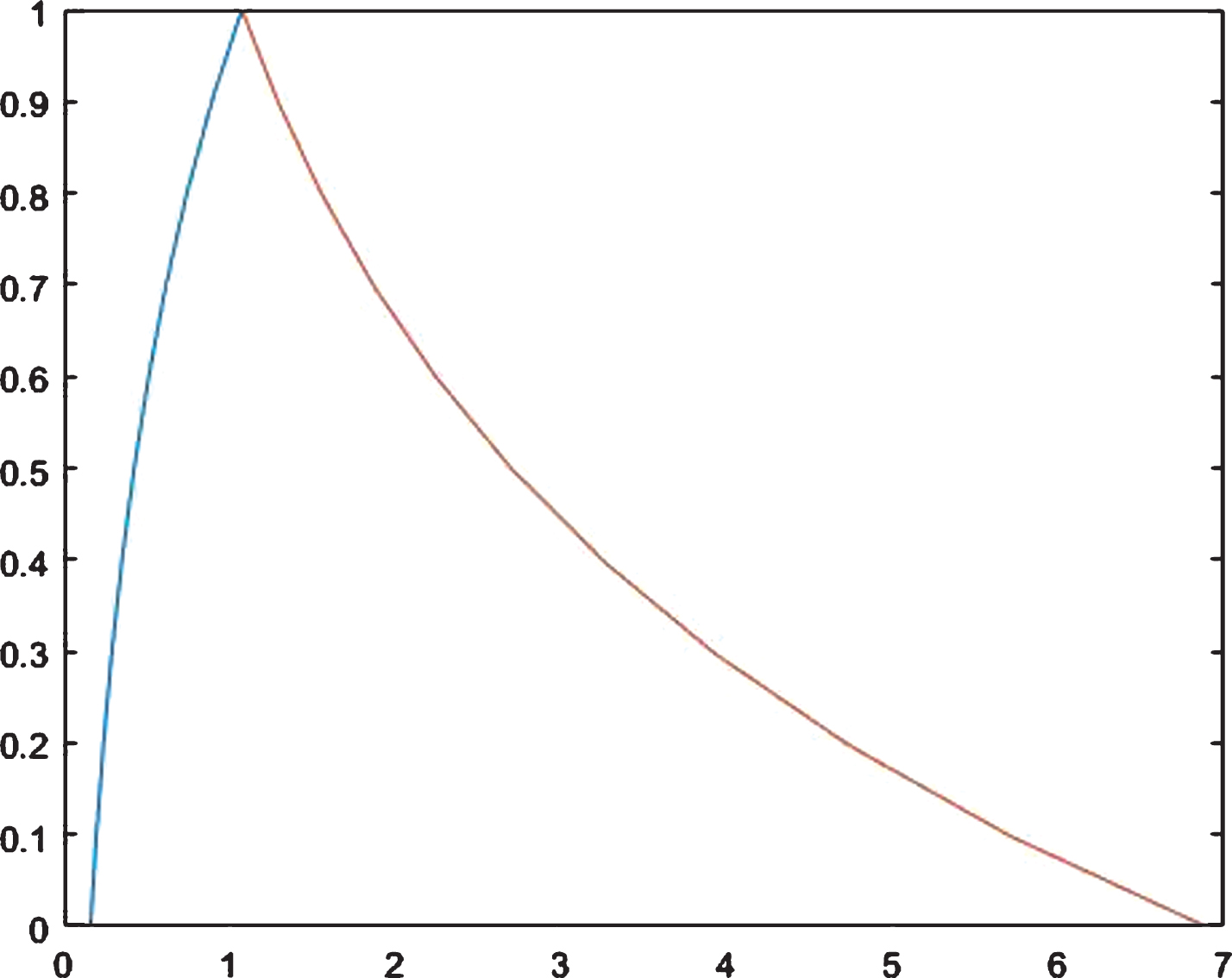
The membership functions for fuzzy expected no of retrial customers in the queue.
The suitable number of customers in retrial queue is
This paper applies the concepts of α -cuts and Zadeh’s extension principle to retrial queue with single server queue model with priority and unequal service rates and constructs membership functions of the fuzzy expected number of customers in high priority queue and fuzzy expected number of customers in low priority queue using paired NLP models. Using the proposed approach, α-cuts of the membership functions are set up and their interval limits inverted to attain explicit closed-form expressions for the system characteristics. The system characteristics of interest can be specified and numerical experiments can be performed when the membership function intervals cannot be inverted, to examine the corresponding a -cuts and then use this information to improve system processes. Since the system characteristics are given by the membership functions, the fuzzy queues with priority are represented more precisely and the results are more useful.