





Abstract
Quantitative methods for determining the quality of scientific publications evolved gradually from popularity methods to prestige methods. However, existing methods have some drawbacks, such as inability to account for important factors and mutual reinforcement between different entities, and limitation of using novel information techniques like artificial intelligence (AI) methods. This study proposes an intelligent time-aware mutual reinforcement ranking (TAMRR) model that accounts for mutual reinforcement, and temporal factors, such as the time of citation, to measure the prestige of scientific papers. The method also considers the distribution of the co-authors’ contributions, which indicates the credit allocation of citations. Moreover, mutual reinforcement which indicates interactive impact between different entities by means of the extension of an AI algorithm, i.e., Hyperlink-Induced Topics Search (HITS) algorithm, is adopted to further explore the interactions of papers, journals and authors. Another AI algorithm, i.e., PageRank, is also enhanced to measure the prestige of papers, journals, and authors in citation networks, which are then used as the inputs to the modified HITS. Experiments on temporal factors and heterogeneous networks reveal that these factors are likely to be informative in prestige measurements. Analysis of correlations suggests that our proposed intelligent ranking method is reasonable. This study offers an intelligent method for researchers, authors, and entrepreneurs to quantify the importance of scientific papers and the conclusions are likely to be of importance for researchers in both the academic and enterprise domains.
Keywords
Introduction
With the continuing explosion of information and development of artificial intelligence (AI) techniques, intelligent methods for efficient information retrieval are becoming increasingly important. Zhang et al. argued that acquiring accurate, timely, rapid, and comprehensive information from the large-scale and fast-growing literature is difficult but urgent in the big data era [21]. Journals, papers, and authors are three basic categories in bibliometric research, and prestige-measuring methods adopted in respective entities can be versatile to some extent. Accordingly, we cannot deny the mutual interaction between journals, papers, and authors in prestige-measuring methods. Consequently, in the present study we mainly focus on using AI approaches to paper ranking, which would account for different factors that may affect the objects’ prestige. Similar methods can be used to identify the prestige of other entities, such as journals and authors.
Although, some altmetric analysis in bibliometric is arisen these days [37], measuring the prestige and popularity of scientific publications based on citation network is still a mainstream. Two classes of such methods exist. One is the popularity method which is based on the number of citations and its extensions such as the h-index [19], the h2 index [26], the g-index [22], the c-index [23]; this approach is still used by many researchers. In such circumstances, every citation can be considered to be a vote, and the more citations a paper receives, the more popular it is [33]. Another class is recognized as prestige method using a variety of algorithms to rank journals, papers, and authors, based on the measurement of prestige. An AI algorithm, PageRank [36] which was initially developed for internet search engine, have been widely used for ranking web pages, literature, journals, authors, and research trends. Another similar algorithm, Hyperlink-Induced Topics Search (HITS) [20], has also been used to measure scientific prestige. However, traditional methods based on homogeneous networks cannot account for relations between different scientific entities; to this end, methods that assume heterogeneous networks have been proposed recently, such as the P-Rank [14], and the Mutual-Rank [39]. By exploring the aforementioned two patterns, it is known that measuring the scientific prestige is such a gradually evolving process that there is no gold standard to eliminate all the problems [25].
It is also found that traditional PageRank assigns equivalent importance to every node, leading to a noticeable bias. Citations of an identical entity undoubtedly have complex temporal distribution, so time factor must be taken into consideration to reduce the bias [7, 9]. In addition, if a paper is cited by prestigious papers, it tends to become prestigious in practice. Similarly, if a paper is published by a high-prestige author in a prestigious venue, the paper is more likely to be recognized by the readers. Moreover, heterogeneous networks can affect the prestige of different entities and call for consideration of the interactions between them [10, 39].
In this study, we integrate the journals, papers, and authors to establish heterogeneous networks that are referred to journal-paper networks, author-paper networks, and journal-author networks, and the time-aware factor that accounts for the timeinterval between first cited and published time of the paper is further explored and used to distribute the prestige across different cited papers. Citation number of journals is used as a weight for prestige measurements. The distribution of the co-authors’ contributions are modeled as weights on the edges of the author citation network, reflecting the fact that an author could gain prestige according to their contribution. In addition, HITS is extended to account for the mutual reinforcement, which indicates interrelationship between different entities, after the integration with the outputs of various weighted PageRank algorithms. Some principal accomplishments are as follows. (1) The “time-aware” modifications for papers based on the homogeneous network, takes into account the time factors of cited time, allowing to further identify whether this factor affects the prestige ranking of papers. Citation number of journals is considered to measure their prestige indicating that each edge between cited and citing journals is weighted by the number of citations. Different contributions of co-authors are used to distribute the citation credit to authors in the author citation network. Various weighted PageRank algorithms are applied to measure the prestige of papers, journals, and authors in the homogeneous network. (2) The results of the weighted PageRank algorithm, obtained in (1), are used as the inputs to the mutual reinforcement iteration process, i.e., the modified HITS algorithm, until the search converges. In this way, papers can be ranked by taking into consideration both inter-network and intra-network effects. (3) Compared with the existing paper ranking methods, such as Citation Counts, standard PageRank, HITS, P-rank [14], and MutualRank [39], the feasibility and the efficiency of the proposed time-aware mutual reinforcement ranking (TAMRR) model are evaluated. In addition, analysis of correlations is performed to further validate our proposed model.
The remainder of this paper is organized as follows. Section 2 provides an overview of related work, where a variety of approaches to paper-ranking are reviewed in both the homogeneous network and heterogeneous network. In Section 3, our proposed model is described in detail, and its integration of two AI algorithms, i.e., weighted PageRank algorithm and modified HITS algorithm are elaborated. Section 4 describes data collection and experimental processes, while the experimental results are evaluated and discussed in Section 5. Conclusions and future research plans are listed in Section 6.
Related work
The ever-increasing amount of information generated by the modern society motivates to develop intelligent methods for more efficient extraction of relevant information. Different scientific disciplines are generating vast amounts of information. Thus, some AI techniques are needed for gauging the importance of a certain publication in a certain academic field.
Intelligent prestige methods in homogeneous network
Various methods have been proposed for determining the prestige of publications, not only considering the number of citations but also the prestige structure of citations. After Brin & Page [19] who firstly proposed the PageRank algorithm to rank the prestige of web pages, which has since been used for literature analysis by Chen et al. [31] and Ma et al. [29], many variations have been proposed to modify or extend the standard PageRank algorithm to address more complicated scenarios. Su et al. [6] proposed the PrestigeRank algorithm by taking into consideration the missing data; Yan [12] proposed a topic-based PageRank approach to identify the prestige of papers, journals, and authors at the topic level.
With the further exploration in prestige methods, some considerable time-aware factors have been increasingly recognized owing to the observation that recently published papers may receive somewhat less citations. Walker et al. [19] proposed the CiteRank algorithm, which is similar to the PageRank algorithm, by distributing random surfers exponentially according to age, to reduce the time bias toward recently published papers. Singh et al. [4] also proposed a similar modified version of the time-aware PageRank algorithm.
All these methods recognized that publications are independent from other entities. However, heterogeneous factors have been increasingly noticed by researchers.
Intelligent prestige methods in heterogeneous network
As is commonly recognized, papers are not isolated from journals and authors. The concept of mutual reinforcement has been proposed and used in extensive fields, such as authority ranking [42], academic performance prediction and library book recommendation [8], sustainability and innovation in development [35], indicating interactive impact of several interrelated entities. Some researchers have attempted to explore mutual reinforcement of papers, journals, and authors in bibliometrics. Yu et al. [34] noticed that citations may really make a difference for the paper’s prestige, and proposed the Timed PageRank algorithm, and they further investigated the prestige of papers published in different venues by different authors. FutureRank [18] used the authorship network and the publication time of an article to predict future citations, with the premise that the higher the prestige of an actor is, the more citations it will receive in the future. Yan & Ding [13] proposed weighted PageRank, which takes into account the citing journals and citations time interval. This method assumes that if a publication is published in a higher-prestige venue, this publication will be more prestigious. Qiao et al. [17] took into account the prestige of journals and the correlation between two papers to measure the prestige of publications owing to the fact that correlated actors interact more compared with interdependent ones. All these researches suggest that the prestige of authors and the publication venue significantly affects the paper’s prestige. To further explain this interaction between papers, journals, and authors, an AI algorithm, HITS, was adopted to identify the mutual reinforcement process, in which the authority value and hub value are computed to measure the quality of a target web page.
Zhou et al. [11] established a co-ranking framework in a heterogeneous network of authors and documents. Yan et al. [14] proposed a new informetric indicator, P-Rank, for measuring prestige in heterogeneous scholarly networks with different weights assigned to the citing papers, citing journals, and citing authors. Jiang et al. [39] proposed a new graph-based ranking algorithm, MutualRank, to mutually reinforce the interaction between papers, researchers, and venues, to achieve more synthetic, accurate, and less biased ranking results. Yu et al. [10] presented a multiple-link mutually reinforced journal-ranking (MLMRJR) method, which not only considered prestige on the intra-network level, but also the mutual reinforcement on the inter-network level, based on the PageRank and HITS algorithms. Ayala-Gómez et al. [15] also used a novel rank model based on knowledge graph to recommend citations for scientific publications. In this sense, publications, journals, and author are coined and reinforce the prestige of each other.
Although our proposed TAMRR model also used the rank model to measure the value of a publication, we have combined two AI algorithms, i.e., modified PageRank and extended HITS, to deal with the recommendation of publications in a more intelligent way. In addition, the proposed TAMRR model differs from the current prestige measurement. We consider the citation time interval to differentiate the weight according to the cited paper. Further, the contributions distribution of co-authors of a given paper is considered in this study, indicating that an author inherits prestige from citing authors according to their contributions. TAMRR model differentiates the edge weights of authors based on the distribution of their contributions. More details are provided in whatfollows.
Method
In this study, we apply AI and computer science methods to measure the prestige of scientific publication. The method accounts for the time factors of papers by assigning a time-aware weight to every cited node rather than assuming them to be equal; the journals’ edges are weighted by their citation counts; and the contribution distribution of authors in a paper is further considered while measuring the authors’ prestige. We assume that the following factors may affect the corresponding entity in some way. In a paper citation network, if a paper is cited by any other papers immediately, it means that the paper has immediately attracted the attention of the readership and thus is more likely to be prestigious. Nevertheless, there is a specific phenomenon called the “sleeping beauty” [2, 3], in which a published paper is cited relatively infrequently until a “prince” awakes the “beauty”, following which the number of citations increases in explosive manner [1]. Here, for the sake of simplicity, the “sleeping beauty” phenomenon is not taken into account owing to its scarce manifestation. The journal citation network differs from the paper citation network in which a journal can cite the same journal more than once, and the more times a paper is cited, the more prestige will be inherited. In the author citation network, a paper may have more than one author and the distribution of credit across authors should be in line with their contributions to the paper; similar to the journal citation network, the citation count of authors is further considered.
In addition, to address the disadvantages of the homogeneous network paradigm, two AI algorithms, weighted PageRank algorithm and the modified HITS algorithm, were combined to mutually reinforce these processes inheriting the prestige from journals and authors. The basic principles in this paper are as follows. First, if a paper is cited by a more prestigious one, then this paper tends to be more prestigious, and so it is in the other two citation networks. That is, if cited by a higher-prestige journal, this journal will be facilitated with higher prestige; if cited by a more prestigious author in a certain field, the cited author is considered to be more prestigious compared with what is cited by less prestigious ones. In addition, since journals, papers, and authors are considered to be interdependent entities, the prestige of any one out of the three will affect the other two. In this study, we focus on paper ranking for representation; thus, we deem that if a paper is published in a more prestigious venue and written by authors with higher prestige, it tends to be more prestigious, similar to the assumption for authors and journals.
To further express these ideas, the TAMRR model is constructed and explained in the following sub-sections. We define the time-aware factors and contributions, and explain the approach by considering the intra-network and inter-network.
Intra-network
To intuitively express the relationships, we built three types of networks for different entities: 1) the paper citation network, 2) the journal citation network, and 3) the author citation network.
Paper citation network
Let PCN = (P, E P ) be a directed, paper citation network, and P ={ P1, P2,. . . , P N P } represents a set of papers, E P ⊆ P × P be a set of edges between papers and their citations, the exact expression of E P is as follows:
Let JCN = (J, E J , T J ) be a directed, edge-weighted journal citation network, and J ={ J1, J2,. . . , J N J } represents a set of journals, E J ⊆ J × J be a set of edges between journals and their citations, which can be expressed as follows:
Since a journal can be cited by the same journal more than once, the number of citations can be considered as the weight of an edge. Thus, edge-weighted PageRank for journal ranking can be written as follows [10]:
Let ACN = (A, E A , T A ) be a directed, edge-weighted network of author citations, let A ={ A1, A2,. . . , A N A } be a set of authors, E A ⊆ A × A be a set of edges between authors and their citations, which can be formulated as follows:
For a given author, the contribution distribution weight is given as:
In conclusion, different weighted PageRank algorithms can be used for measuring the respective prestige of papers, journals, and authors in the homogenous network. The application of the modified HITS algorithm, which is aimed at inheriting the impact of three entities in the heterogeneous network, will be described in what follows.
Besides the aforementioned three directed intra-networks, three undirected networks were constructed to express their interrelationship, that is, the paper-journal network (PJ or JP), the paper-author network (PA or AP), and the author-journal network (AJ or JA). These three networks can be coupled to their corresponding intra-networks.
Let the paper-journal network (PJ or JP) incorporate the paper citation network and the journal citation network, let PJN PJ = PJN JP = (P ∪ J, E PJ ) be an undirected, unweighted paper-journal graph, let P ∪ J be a series of vertices and E PJ ⊆ P × J denote the edges between papers and journals. For example, there are two edges (P i , J k ) and (J k , P i ) between them, (P i , J k ) , (J k , P i ) ∈ E JP . Then, the adjacency matrix PJ (P i , J k ) or JP (J k , P i ) can be expressed as:
Finally, let the journal-author network (AJ or JA) integrate the journal citation network and author citation network, JAN JA = JAN AJ = (J ∪ A, E JA ), let J ∪ A be a set of vertices and E JA ⊆ J × A represent a series of edges connecting the journals and authors. For example, the two edges (J k , A j ) , (A j , J k ) ∈ E JA connect A j and J k . Then, the adjacency matrix JA (J k , A j ) or AJ (A j , J k ) can be expressed as:
As we argued above, the prestige of a paper is determined not only by the paper citation network, but also by the other two inter-networks: the paper-journal network and the paper-author network. The same holds for journals and authors. Therefore, mutual reinforcement is a key point in measuring scientific prestige which combines the interactive impact of papers, journals, and authors. According to our aforementioned works, we have constructed three adjacency matrices P, J, and A from the intra-network indicating the citation relations of papers, journals and authors, P is an N
P
× N
P
matrices, J is an N
J
× N
J
matrices, A is an N
A
× N
A
matrices and six adjacency matrices PJ, JP, PA, AP, AJ, and JA from the inter-network.
Our proposed model is based on the model of [41]. There are three significant measurements in our proposed model: 1) PRP, the prestige of papers; 2) PRJ, the prestige of journals; and 3) PRA, the prestige of authors. Taking the initial vectors PRP, PRJ, and PRA as input, these vectors are constantly and iteratively updated until convergence, as follows: For each PRP at iteration t, denoted as Similarly, each PRJ at iterationt, denoted as The value PRA at iteration t is distributed among three parts in the same way and reinforces the values of PRP, PRJ, and PRA at iteration t + 1, respectively. For the first part,
In summary, both δ and ϑ are parameters representing a portion. The parameter δ indicates the probability of random walkers to jump at the intra-network and the parameter ϑ indicates the probability of walks between inter-networks. Then, the TAMRR model is formulated as follows [10, 39]:
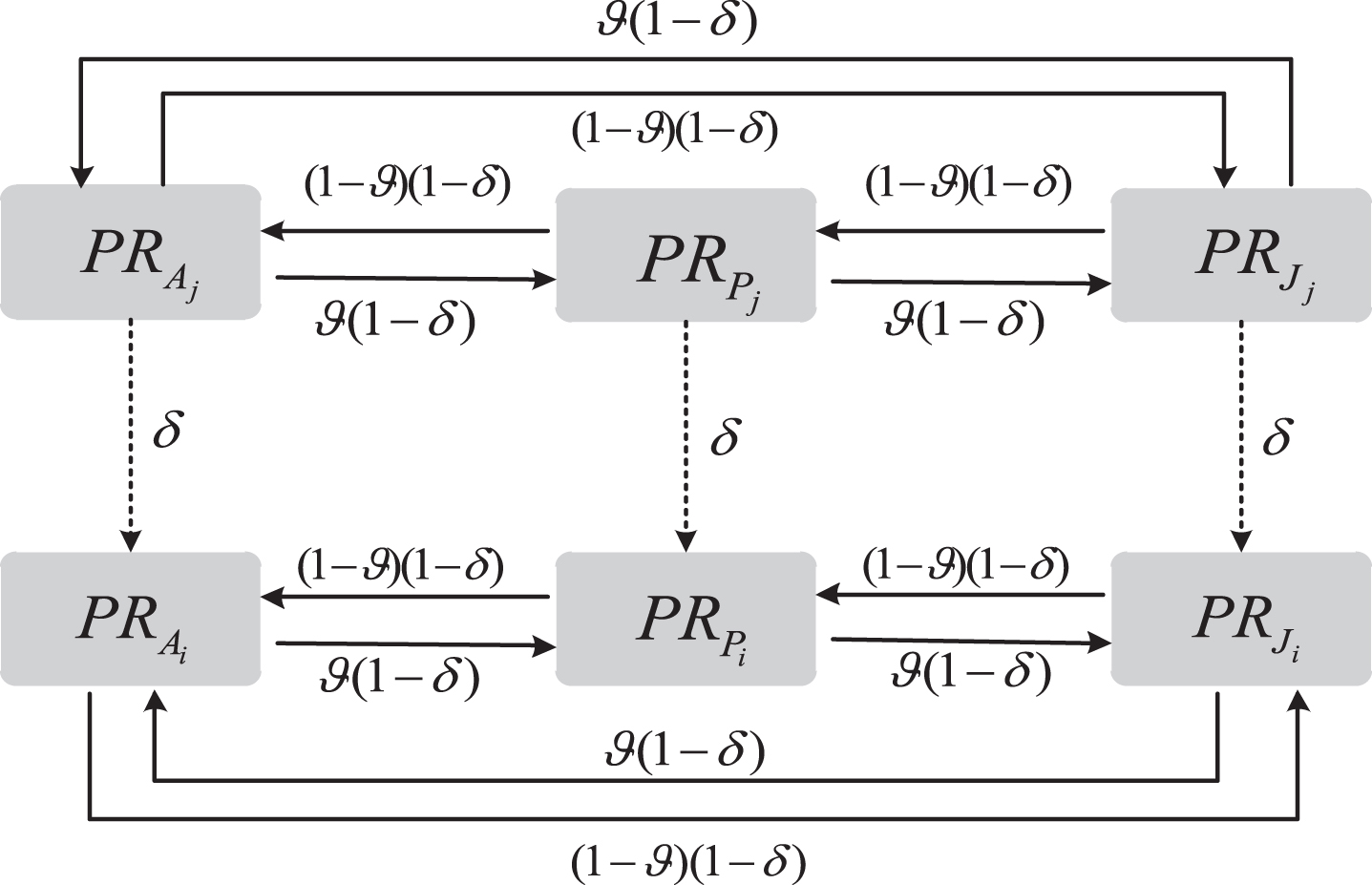
Mutual reinforcement in a heterogeneous network.
To validate the proposed model, practical experiments should be performed on with real data, through which it can be verified that the model is not only theoretically feasible, but also practical.
Data used in this study
For the aforementioned purpose, we extracted publications from the Web of Science database, which has been used widely as a source of data for studies of this type. We extracted and analyzed publication data related to the fields of performance management and performance measurement. Owing to the fact that many studies have been performed in the performance management domain, an efficient method for identifying which publications are prestigious seems to be essential. Unlike other researchers who extracted papers from predefined sets of journals, we decided here to use some keywords to constrain the publication data in our field of interest, similar methods are widely used in bibliometric [16, 38]. Performance management seems to be a multidisciplinary field, with wide outreach to public sectors during the past several years [5]. Bititci et al. [38] used “performance measurement”, “performance management”, “performance indicators”, “management control” and “strategic control” as search strings to identify relevant papers, but the obtained dataset contained publications from a broad range of fields, owing to the multidisciplinary nature of the topic of interest. In the recent work by Cuccurullo et al. [5], the evolution of performance management was tracked based on the keywords “Performance management” and “Performance evaluations” in “Social Science Citation Index, SSCI”, yielding only 1534 publications. In this study, to obtain a more correlative and efficient database, we used “Performance management”, “Performance measurement”, and “Management control” as all subject terms because of the explorative nature of our study, and combined with no time limitation to further explore the comparative prestige of publications and how different factors and different networks affect the prestige of different actors. Moreover, performance management mainly belongs to the humanities and social sciences, so “Social Science Citation Index, SSCI” under “More settings” was checked. The final dataset included 3275 papers published in 658 journals, after canceling all of the isolated nodes by Sci2, with a total of 6330 authors. All of the citation network and bipartite network are extracted by Sci2 with its default set. Some erroneous entries, such as entries corresponding to papers for which the time of the first citation was before the time of publication were dropped while cleaning the data.
Values of parameters
The parameters in this study are α, δ, ϑ, l and d. The parameter α reflects the time factor that is determined by the relationship between the time interval and their citation numbers. According to Fig. 2, α was set to –0.489, based on [9], because the relationship between citation number of papers and their time intervals between published and first cited fits the trend y = e-0.498x. Specifically, for the time interval of 1, i.e., when a paper was cited immediately after it was published for one year, the citation number of this paper tends to be enormous; but for the time interval of 0, the citation number is far less than one year. The potential reason is that most of the papers need time to be cited by others whether it is prestigious or not.
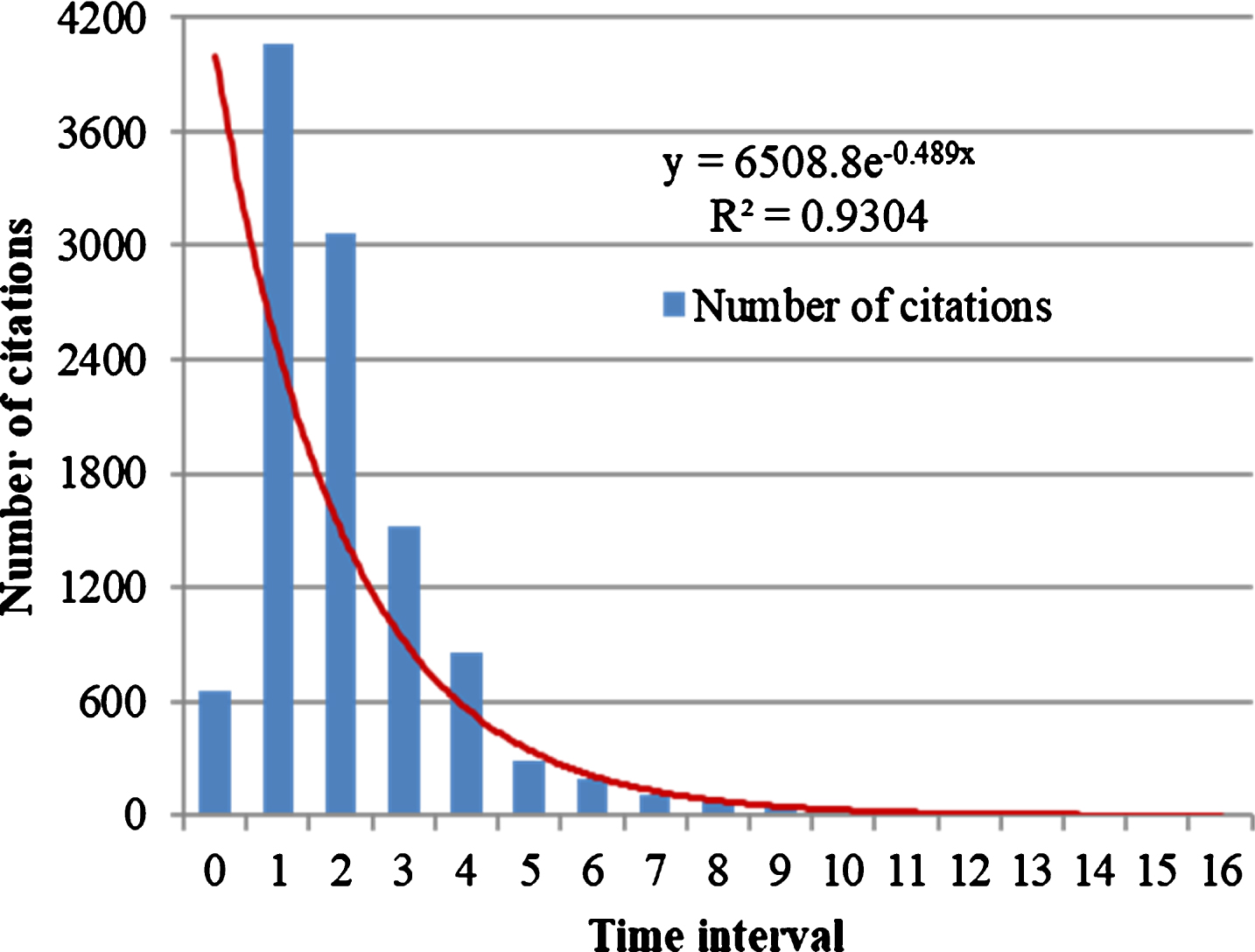
Relationship between time interval and citation number.
In addition, d is the damping factor in PageRank and is usually set to 0.85. Many researchers discussed how different values of d affect the results of PageRank [24, 31, 41], so we will not discuss this issue in detail and will set d to 0.85 in what follows. The parameter δ indicates the probability of random walkers to jump from the intra-network to the inter-network, and the performances of different values of δ are listed in Table 1. Different values of δ may affect the final results of our proposed model but affect slightly. As can be seen, the performance of our proposed model is optimal when δ is set to 0.4, for most evaluation metrics. Citation Count is the baseline that we use when evaluating the effects of parameters, and this metric has been extensively used for ranking papers and some scholars have used it as a baseline metric, such as Nykl et al. [28] Although it seems that 0.4 is the optimal value for our model, the results vary for a range of different rankings. The parameter ϑ represents the probability of random walkers to jump between different inter-networks and it is set to 0.5, which means that their probability stepped in by random walkers is the same.
Performance metrics according to ROC with baseline of Citation Count
For parameter l, it defines different distributions of credits among co-authors. As shown in Fig. 3, the contribution of each co-author is evenly distributed while l = 1,
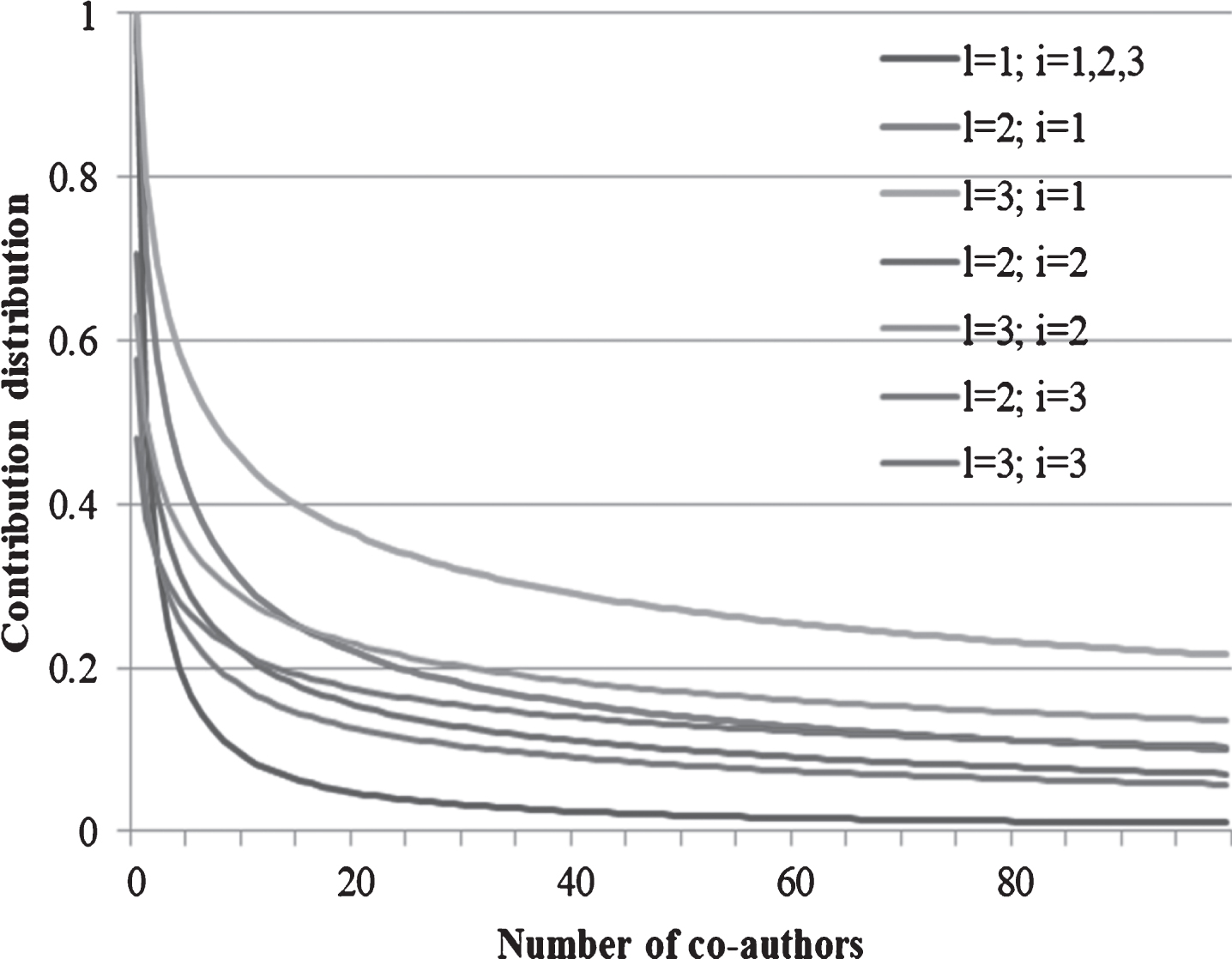
Distribution of contributions of co-authors.
The performed experiments suggest that the method allows to intuitively explore ranking of large publication volumes, and it also allows to analyze the contribution of different factors to prestige. In this section, a detailed analysis from various perspectives is presented, which help to explain and support the proposed model.
Popularity and prestige
It is widely acknowledged that popularity is different from prestige; a popular paper is not necessarily prestigious, and vice versa. Citation count-based indices are commonly used for measuring popularity. Novel methods for prestige measurement are being constantly proposed and evaluated, with state-of-the-art ranking methods becoming increasingly reliable.
Our proposed model considers both the quantity and quality of citations, and adopts the heterogeneous network paradigm in which prestige is deduced from different networks. Publication’s popularity is usually assessed in terms of its number of citations, while our proposed model aims to assess prestige. Compared with purely citation count-based ranking, there are four classes of entities in our approach, which include: 1) high prestige and high popularity entities, 2) high prestige and low popularity entities, 3) low prestige and high popularity entities, and 4) low prestige and low popularity entities. We assume that top 20 papers returned by the Citation Count method are the most popular, while top 20 papers returned by the TAMRR method are highly prestigious. High popularity and high prestige are two relative concepts which vary across different situations. In Table 2, the grey-shaded papers have high prestige and low popularity, which corresponds to being in the top 20 in the set returned by the TAMRR method but being out of the top 20 according to the Citation Count method. These papers are cited by prestigious papers that are written by prestigious authors or published in prestigious journals, so they are more prestigious owing to their citations. Similarly, the grey-shaded papers in Table 3 have low prestige and high popularity, being in the top 20 according to the Citation Count method but out of the top 20 according to our proposed model, because their citations tend to be relatively less prestigious, or because these papers are written by less prestigious authors and published in less prestigious venues. The remaining papers in both two tables have high prestige and high popularity, being in the top 20 of papers returned by both two methods; these papers are characterized by high quality and high number of citations. For these scientific publications, the two methods seem to yield similar results. Low prestige and low popularity papers are not presented in these tables. However, in practice the boundaries between the different categories are not likely to be so clear as to enable comparative evaluation of prestige and popularity according to the Citation Count and TAMRR methods. Prestigemethods are continually raising more concern compared to traditional popularity method currently.
Top 20 papers in TAMRR model and their corresponding ranks in Citation Count method
Top 20 papers in TAMRR model and their corresponding ranks in Citation Count method
Top 20 papers in Citation Count method and their corresponding ranks in TAMRR model
If a certain publication satisfies the following three conditions: 1) it is cited by prestigious publications, 2) it is written by prestigious authors, and 3) it is published in prestigious venues, then the publication under consideration itself will tend to be a prestigious one. Yet how do the time-aware factors, citation count, and distribution of contributions affect scientific prestige via inter-network and intra-network considerations? In the following, we elaborate on this issue.
Weighted PageRank differentiates prestige
In the standard PageRank algorithm, edges between any two publications are considered to be the same. However, in general, a more prestigious paper is more likely to be cited. Table 4 lists the top 20 papers returned by the standard PageRank algorithm (PR Rank). Moreover, the ranks of these 20 papers in the weighted PageRank (WPR Rank) algorithm, considering the time interval from the time of publication to the time of first citation, are used for comparison. Most of the analyzed publications have the same status in both algorithms. Specifically, the ranks of five grey-shaded publications for the weighted PageRank algorithm are much lower than those for the standard PageRank algorithm. This likely occurs because publications are not cited immediately following their publication. For example, the paper Abernethy, 1999, ACCOUNT ORGAN SOC, V24, P189 was published in 1999 but was cited in 2003, with the citation interval of four years.
Ranking of publications using PageRank and weighted PageRank with the time factor
Ranking of publications using PageRank and weighted PageRank with the time factor
Table 5 lists the top 20 authors proposed by the PageRank algorithm, for different weighting conditions. The PR Rank measure is the rank based on the standard PageRank algorithm. Similarly, Count Rank is ranking by the PageRank algorithm weighted by citation counts, while Contribution Rank is ranking that is weighted by the distribution of contributions. First, compared with the standard PageRank algorithm, the ranks of Larcker D F, Banker R D, Bourne M, and Platts K are higher in Count Rank. Taking Bourne M as an example, the total number of citations is 924 in our dataset, and it far exceeds the numbers of citations for Behn R D and Sturman M C, whose ranks are lower in Count Rank but higher in PR Rank. Then, comparing the results of Count Rank and Contribution Rank for both of them, consider the credit distribution of contributions. Therein, the ranks of Eddy D M, Perrin B, Sturman M C and Behn R D increase to some extent, according to their high contributions to the papers. For example, Behn R D was cited 198 times and in all these cases as an independent author. Except these cases, the ranks of authors listed in Table 5 decline inordinately. For example, Srinivasan D is ranked 14 by the Count Rank method but ranked 119 by the Contribution Rank method. This author is the third co-author on all his cited papers, with overall three co-authors, which means that his contributions are smaller compared with the other two co-authors.
Author ranking according to the PageRank algorithm with different weights
The PageRank algorithm is widely used to measure the prestige of journals. However, a certain journal can be cited more than one time by the same journal, which is substantially different from the publication citation network. Thus, the number of citations should be considered when measuring the prestige of a journal. The more times a journal is cited by other journals, the more prestige it inherits from those other journals. Weighted PageRank is a modification of PageRank algorithm weighted by the number of citations, and its output is listed in Table 6. Because the present study is exploratory, we considered only top 20 journals. In general, the results of PR Rank and Weighted Rank were similar, and for some entities the ranks differed slightly. For example, the rank dropped to 41 for the journal Organization Science owing to its relatively small number of citations by prestigious journals, while Journal of Public Administration Research and Theory is ranked ninth considering its number of citations. Owing to the limitations presented by the field of study that we selected to analyze, many citations and references were out of our dataset; thus, our results capture prestige measurements for one given field, without considering potential impacts of other fields.
Ranking of journals using PageRank and PageRank weighted by the number of citations
To increase the effectivity and feasibility of our ranking methods, we considered the effect of heterogeneous network, which reflects the notion that more prestigious publications tend to be written by more prestigious authors and published in more prestigious venues. In Table 7, results are shown for a method in which journals and authors were accounted for while ranking publications. Therein, PR Rank shows the ranking results for the standard PageRank algorithm. Time Rank shows the corresponding ranking results for the time weighted PageRank algorithm. A comparison between the results yielded by PageRank and Time Rank has been elaborated on before. To account for the prestige inheritance from journals and authors, we propose a TAMRR model with mutual reinforcement. The results of ranking are listed in Table 7. Most of the results are similar to those obtained using PR Rank and Time Rank, indicating that the approach is feasible to some extent. Specially, Gunasekaran, 2001, INT J OPER PROD MANAGE, V21, P71 and Beamon, 1999, INT J OPER PROD MANAGE, V19, P275 drop significantly in TAMRR ranking compared with their ranks according to both the PR Rank and Time Rank algorithms. Further analysis reveals that the authors of Gunasekaran, 2001, INT J OPER PROD MANAGE, V21, P71 are ranked 17, 36, and 91, respectively, and the authors of Beamon, 1999, INT J OPER PROD MANAGE, V19, P275 are ranked 53 and 109. Although the published venue International Journal of Operations and Production Management is prestigious, the rankings of these two papers show relatively significant drops. The paper Abernethy, 1999, ACCOUNT ORGAN SOC, V24, P189 is ranked 15 according to the TAMRR ranking method, which is similar to its ranking according to the PR Rank method; however, the paper is ranked 90 by Time Rank. Its publication venue is at the top in our dataset, as shown in Table 6, and its first author is ranked ninth in our dataset. The prestigious publication venue and authors make this publication a prestigious one by TAMRR method. Regarding Ittner, 2001, J ACCOUNT ECON, V32, P349, its sole author is ranked third among all the 6330 authors in our database. Thus, this publication is ranked seventh according to the TAMRR ranking method. In general, the TAMRR model quantifies prestige according to the inherited prestige of journals and authors, indicating that papers written by more prestigious authors and published in more prestigious venues tend to be more prestigious, and vice versa.
Ranking results by different methods with inter-network and intra-network
Ranking results by different methods with inter-network and intra-network
Correlation analysis is among widely used methods for evaluating the relationships between different features or methods. Five widely adopted methods were used to rank the publications in our dataset, and Table 8 shows the results of the Spearman correlation analysis applied to these rankings to explore the relationships between the existing models and our proposed method. Owing to the limitations associated with the selected field of study, not all citations and references were present in our dataset. Thus, our analysis and its results are limited to a certain domain. As shown in Table 8, PageRank-like algorithms are highly correlated with Citation Counts. Bothhomogeneous methods and heterogeneous method internal show a comparative higher correlation such as HITS algorithm and PageRank algorithm, and MutualRank model and TAMRR model. Based on the analysis of correlations, we conclude that the proposed model is feasible and efficient.
Spearman’s coefficients of the relative ranks in various comparative methods
Spearman’s coefficients of the relative ranks in various comparative methods
AI and computer science methods are very useful for measuring the prestige of scientific papers. In particular, recursive PageRank-like methods provide intelligent ways to rank scientific papers according to their prestige rather than their popularity. However, many factors should be considered for ranking; thus, new methods have been proposed to account for time factors [7], sentiment similarity [32] and altmetric factors [37]. This study proposed the TAMRR model to further complement the currently existing PageRank-like methods, in the following aspects. First, our proposed model considers time effects by factoring in the time at which publications are cited by others; the shorter the time interval is, the more remarkable the paper is. Next, the credit allocation of different co-authors based on their contributions is considered. Furthermore, citation counts are used to weight the edges of the journal citation network. Finally, to account for the impact of journals and authors on publications, an AI algorithm, modified HITS algorithm, was used to mutually reinforce the prestige of publications, after the integration with the outputs of different weighted PageRank algorithms.
Based on the results of our experiments, we conclude that: prestige and popularity are two different concepts; thus, a more prestigious publication does not imply higher popularity, and highly popular publications are not necessarily prestigious. There are four principal situations: 1) papers have high prestige and high popularity, 2) papers have high prestige and low popularity, 3) papers have low prestige and high popularity, and 4) papers have low prestige and low popularity. By comparing our weighted PageRank with standard PageRank, it is found that factors such as the time interval, the distribution of contributions, and the number of citations, significantly affect ranking of publications, authors, and journals; in addition, the mutual reinforcement which indicates the interactive impact of authors and journals plays an important role while measuring the prestige of papers in the heterogeneous network. Ranking of publications using AI algorithms is promising for recommendation of publications in a more intelligent way. To increase the efficiency of ranking methods, more effective AI techniques and additional factors should be taken into account. In our future research, we will focus on additional factors such as the age of journals and the growth rate of citations during different time periods. Scenarios that add more information that is likely to influence the prestige of papers, authors, and journals should be explored.
Footnotes
Acknowledgments
This work has been supported by National Social Science Foundation of China (No.17NDJC168YB), National Natural Science Foundation of China (No. 51875503, No.51475410), and Zhejiang Natural Science Foundation of China (No. LY17E050010).