






Abstract
In Mobile Adhoc Network (MANET), obstacles in terrain and nodes mobility are main constrains due which performance degrades. To mitigate these effects, the routing protocol should be mobility and obstacles aware. In this work, we proposed a novel Obstacle and Mobility Aware Routing (OMAR) protocol. In OMAR, for obstacles avoidance, DeCasteljau Algorithm based on Bezier curve is been used. And to reduce effects of mobility and energy shortage of a node, an Energy based Mobility Index (EMI) routing scheme is been developed. The path possesses high EMI is selected as route. The performance of proposed Mobility and Obstacle Aware Routing protocol is evaluated using NS2 simulator. Simulation results show that the proposed algorithm reduces energy consumption, overhead, delay and increases data delivery in the network.
Introduction
One of the most important issue in the current MANET technology is the mobility of the nodes which reduces the performance [1]. To enhance the performance of MANET further, a number of routing protocols are proposed [2–4].However mobility issue are not addressed effectively. Again authors have assumed plain terrain for simulation and have not considered terrain with obstacles. Hence, in this work, we have proposed a Mobility and Obstacle Aware Routing algorithm that reduces effects of mobility and incorporate the presence of irregular shape obstacles in terrain.
In this paper significant contribution are listed below. To avoid obstacles, DeCasteljau Algorithm based on Bezier curve is used. In this work, we have used the ‘trace of Bezier curve’ as a reference to find the Guiding Node_list(This list contains the nodes close to the Bezier trace),which will guide data to destination avoiding fixed immobile obstacles. An Energy based Mobility Index (EMI) routing scheme is developed to reduce the effects of mobility and energy shortage in node. Nodes with high EMI are selected for constructing path to avoid obstacles. The algorithm increases stability of the path.
Related works
There are a number of mobility models and routing protocols available in the literature for efficient routing in MANETs. The section summaries the related works already proposed by different authors on Mobility models in plain terrain and obstacle terrain.
In [5], authors have proposed an Environment-Aware Mobility model. The node connectivity is broken if any obstacles are found in the network. In this work, Hotspot model and Route model are used to observe the node mobility in a specific environment. It nice combination of available mobility model with terrain environment. However, here no mobility aware routing is proposed to reduce mobility effect.
The paper [6] initially proposes a unique Semi-Markov smooth mobility model to copy the behavior of the airliners within the sky. Probability density function of the relative speed of two nodes is obtained depending on the mobility model. Here motion consist of three moving phase i.e Speed Up phase, Middle Smooth phase and Slow Down phase. Then the expectation of the link lifetime is obtained. However, the routing protocol is developed neglecting the presence of obstacles on the route.
In [7] authors have addressed Link availability-Based Routing Protocol (LBRP) that considers dynamic topology and repeated failure link. In this scheme, the nodes are moved based on random mobility Model and it accurately guesses the availability of link throughout within a limited period of time. This protocol takes into account regular topology change and related link failure during design. However, the protocol has not incorporated the presence of obstacles on the route.
DSR Protocol was proposed in paper [8] and as per the author DSR protocol search a route when a source node wants to send packet to a destination. There are mainly two activities present in DSR i.e. route discovery phase and route maintenance phase. In DSR source routing technique is used. Here the complete route address is stored in the route cache of a node. And this complete address guides data to the destination. Route error occurs when route breaks and that initiate the route maintenance process. So that expired routes are removed from route cache and a new route discovery is started.
The paper [9] addresses a Mobility prediction method used for improving the network stability and link connection interruptions. In this approach, genetic algorithmic rule is employed to form a history primarily based mobility prediction. However, the method has not incorporated awareness of obstacles.
In [10] authors have proposed a adaptive learning an automation mobility prediction method that predicts the future mobility based on history of node mobility in plain terrain. However, authors have not addressed any obstacle aware scheme. The paper [11] proposes Residual Link Lifetime (RLL) protocol which represents the dependence between neighboring links and the joint probability distribution of two adjacent links. However but it has not considered the presence obstacle in real terrain. In [12] authors have discussed mobility prediction methodology that estimates the soundness of paths therefore helps to boost routing by reducing the overhead and therefore the range of connection interruptions. However, the paper has not considered the presence of obstacles in terrain. The paper [13] proposes a multipath routing scheme which adapts variation of dynamic network situations that improves the network efficiency. It also does not consider obstacles in terrain.
In [14], authors have proposed a dynamic and autonomic detection of obstacles technique applying the enhanced cartography optimized link state routing. This method accurately specifies the obstacle space with high coverage and efficient exactness ratios. It renders an adequate precision ratio sufficient to efficiently avoid link burst links induced by the blocking obstacle. However the technique does not include any mobility aware method.
Authors in [15] have discussed a Link-state QoS routing protocol to determine stable paths among all nodes in a MANET. The node stability function is used for selecting the route from source to destination based on node mobility degree. However, it lacks the obstacle awareness of path in the network.
The paper [16] focuses the significance of the physical layer and its effect on performance in MANET. This was proved by simulating numerous MANET environment using Network Simulator-2 (NS-2) with increased capability by adding propagation loss models like modified Two-Ray Ground model, ITU Line of Sight Non line of Sight model combined path loss and shadowing model.However, the authors have not proposed any obstacle avoidance method. In [17] authors have proposed an obstacle-avoiding Connectivity Restoration strategy which utilizes mobility technique for avoiding any curved obstacle. However, authors have not addressed any mobility scheme. The paper [18], addresses a practical Mobility model with different shape obstacle limitation based on Bezier curves (RMBC) that characterizes realistic motion and computes smooth route among the obstacles. However, the authors have not provided any mobility prediction in the network. The path planning techniques [19] using Ant Colony Optimization (ACO) method to discover optimal path in the network environment. In this scheme, Rational Bezier curves helps to detect the obstacles. However, it lacks the mobility awareness.
In [20], authors have given a sound and reliable route choice technique supported the nodes’ mobility in mobile ad hoc networks. In this approach, a path is selected for information routing depending on a node’s speed, direction and pause time. However, authors in this work have considered plain terrain and moreover they have not considered residual energy available in any node.
Obstacle and mobility awareness routing protocol in MANET (OMAR)
Obstacle aware routing
In the proposed work MOAR, for routing in presence of obstacles, DeCasteljau Algorithm is used based on Bezier curve concept [18]. In this scheme, a Realistic Mobility model based on DeCasteljau Algorithm is used that incorporates node movement with collision-free and obstacles.
To avoid the obstacles we create a Guiding Node_list including nodes which are close to Bezier curve path trace. Bezier curve path passes through several nodes that constitutes a complete route to destination avoiding obstacles.
Energy based mobility aware optimal routing
In Energy based Mobility aware optimal routing we have used the concept of mobility prediction and the residual energy of a node before selecting for a final path. First an Energy based mobility_index(EMI) scheme is developed. An EMI index point is calculated for each node in the Guiding Node_list. Development of Energy based mobility_index (EMI) scheme is discussed asbelow.
Here a parameter called Energy based mobility_index(EMI) for each mobile nodes in ‘Guiding node list’ is proposed. The Energy based mobility_index is the determined depending on points assigned to pause time, direction, speed, and residual energy in specified range. The Table 1 shows various ranges of pause time, speed, direction and residual energy and their corresponding index points. It is calculated relating to its neighbor nodes available in the Guiding node_list. A Guiding list node having high EMI_index indicates it has high pause time, low velocity, suitable direction and high residual energy. A minimum threshold value of Energy based mobility_index i.e. EMITH is fixed for Guiding node_list. If EMI of a node is bigger than or up to the threshold value EMITH, then it’ll be chosen as an intermediate node the route to bypass the obstacles. Otherwise, the node will not be chosen for route formation.
Lookup index table for assigning points
Lookup index table for assigning points
An Energy based mobility_index measuring model for a node in Guiding node_list is developed. In this work free-space propagation model is incorporated [19]. Hence, the link time duration for which two nodes will stay connected is calculated for a given direction, transmission range, speed and residual energy.
Assume EMI(a,b,t) be the Energy based mobility_index of a node ‘b’ with respect to another neighboring node ‘a’, present in ‘Guiding node_list’ at any instant of time t, EMI s (b, t) is the Energy based mobility_index of node ‘b’ calculated by the node ‘a’ that is neighbor to node ‘b’ and EMI O (b, t) be the EMI of node ‘b’ determined by the common neighbors of nodes ‘a’ and ‘b’. Neighbor nodes are identified by reciprocating modified hello signal at regular interval in the network. A neighbor node n is decided as a common neighbor for nodes ‘a’ and ‘b’ when, the hello signals they reciprocate carry the details of node ‘n’.
Let us assume two weights of EMI
s
(b, t) and EMI
O
(b, t) as ‘α’ and ‘β’. Hence, EMI (a, b, t) shown in Equation (1) [18].
Where [{EMI (a, b, t) EMI s (b, t) {0, 1} and α, β, {0, 1} α + β = 1]
Energy based mobility_index of node ‘b’ with respect to a node ‘a’ obeys the rule i.e. EMI (a, b, t) ≠ EMI (b, a, t)
Nodes in Guiding node_list, move randomly in the area within allowed distance from Bezier trace and pause for a random span of time. After each pause node change it direction with an angle θ (0 ≤ θ ≤ 2π), here angle θ is measured with reference to the shortest distance between ‘a’ and ‘b’. Always there is a chance of node ‘b’ that move away from the transmission range of node ‘a’ or residual energy of node ‘b’ falls below minimum threshold value. So, the link time duration between two neighboring nodes depends on coverage area, mobility and residual energy of these nodes. The link time duration is also called as link expiration time [22]. Assume total time needed to do q number of observations is T. Hence T is written as shown inEquation (2) [20].
Where
Here, t
z
(1 ≤ z ≤ h) t
z
is the zth time duration of halt state and t
l
(1 ≤ l ≤ m) is the lth time duration of motion state. So, total halt time is T
h
and the total motion time is T
m
obtained during h and m observations respectively. Assume {x
q
(t
l
) , y
a
(t
l
)} be the starting coordinate for ath node in first observation. Let
Where,
The average angle θ (T
m
) (0 ≤ θ (T
m
) ≤2π) for T
m
is computed by the Equation (5) given below [18].
The average residual energy E (T
m
) (E
TH
≤ E (T
m
) ≤ E
T
) for T
m
is computed by Equation (6) given below
We know EMI of node depends on its moving angle, speed, pause time and residual energy. So, we propose an index-value-based EMI computation method. In the index value based method, each node earns an index value based on its halt time T
h
(Tmin ≤ T
h
≤ Tmax), direction θ (a, t
l
) (0 ≤ θ (a, t
l
) ≤2π), speed v (a, t
l
) (Vmin ≤ v (a, t
l
) ≤ Vmax) and E (a, t
l
) E (E
TH
≤ E (T
m
) ≤ E
T
) E (a, t
l
). Let
The average EMI
a
′ of node ‘a’ for l observation is computed as expressed in Equation (8) [18].
Similarly at zth observation, the average Energy based mobility_index,
Where
Hence, for the duration T, the average Energy based mobility_index, EMI
a
(0 ≤ EMI ≤ 1) is computed by the Equation (10) given below [18].
As we know the stability of any path depends on mobility and residual energy of the node present in the route. Thus, it is required to take node’s direction, speed and residual energy in consideration while selecting a route. Assume arbitrarily two neighboring nodes a and b. Node a is having a speed of v (a, t
l
), angle θ (a, t
l
) with residual energy E (a, t
l
), at the lth instant of time. Let {x (a, t
l
) , y (a, t
l
)} be the coordinate of node a and {x (a, t
l
) , y (a, t
l
)} be coordinate of nodes b. Hence, at the lth instant the relative speed v (a, b, t
l
) between a and b is expressed by Equation (11) [20].
Relative velocity can be measured when both nodes are in the coverage area of each other. Assume θ (a, b, t
l
) = |θ (a, t
l
) - θ (b, t
l
) | is the relative angle on lth observation. Let E (a, b, t
l
) = |E (a, t
l
) - E (b, t
l
) | is the relative residual energy on lth observation hence, the earned EMI value among a and b for relative angle and relative velocity is calculated as shown in Equation (12).
Here
We can also determine the relative mobility of any two nodes a and b present in Guiding Node_list. Figure 1 indicates that the starting points of nodes a and b are A1 and B1. Assume
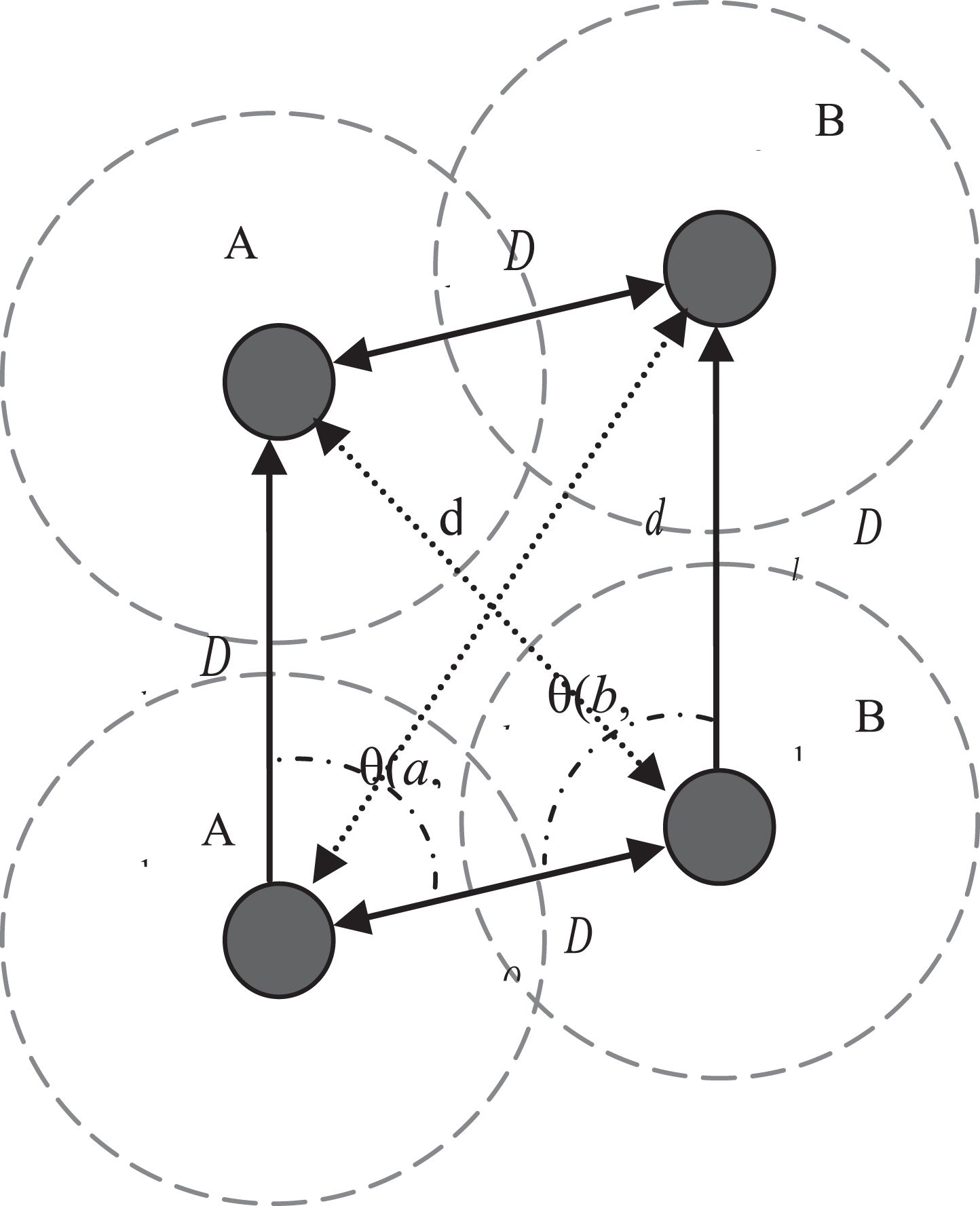
Distance among nodes a and b in instant of time.
Where
Alternatively d1 and d2 are also computed without knowing the relative angles as follows:
So when relative earned index value of pause time, velocity, relative angle and residual energy of two neighboring nodes are obtained we can determine Energy based mobility_index and average relative acquired points, i.e. Energy based mobility_index using Equations (12) and (15), respectively.
Hence, EMI
ab
is calculated by node a for node b, is written in Equation (17) as below [18].
The value of EMI
O
(b, t) is Energy based mobility_index for node b, calculated by the common neighboring of the nodes b and a. At initial time slot EMI
O
(b, t) =0. This assumption is done because node b just enters transmission range of node a and also neighbors of a. If there are n numbers of common neighbors,
In this way EMI of all the nodes available in Guiding Node list are calculated. Then some alternative route bypassing obstacles are formed taking connected nodes from Guiding Node_list Formation of alternative routes using Guiding Node_list along Bezier trace is shown in the Fig. 2.
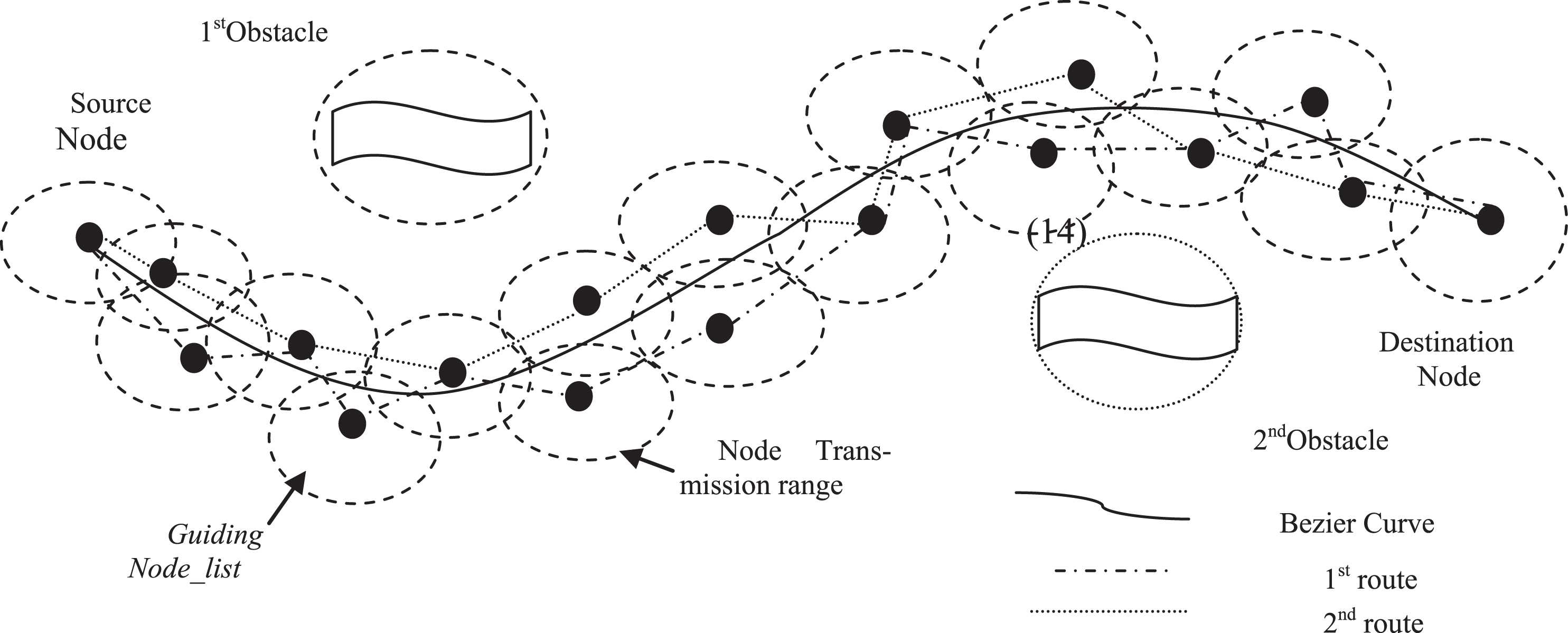
Formation of alternative routes using Guiding Node_list of nodes along Bezier trace.
Now EMI O of all nodes present in a route are calculated. If EMI O of a node is found below EMI TH ,then the route is removed from list. If all the nodes of a route posses EMI° ≥ EMI TH then, its total EMI T is calculated. Then route that posses maximum EMI T is selected for data transmission
The simulation of the proposed Obstacle Aware Model is validated using the network simulator NS2. The most important advantage of using NS2 is the simple scalability factor using the front end Object Oriented Tool Command Language (OTCL) when compared to the back end C++ programming. The performance of the proposed OMAR considering parameters such as Packet Received Ratio, Average Delay, Control Overhead and Energy Consumption are analysed and compared with the existing AODV protocol in both plain terrain with obstacle without having avoidance model (AODV-OT). The parameters values for which simulation has been done are depicted in Table 2 [21]. Here, for each parameter five seeds of simulations are done and the average is taken to plot the graph.
Simulation Parameters
Simulation Parameters
In this case, Mobility of nodes is varied varying speed(m/s) while pause time is fixed at 100 sec with ten sources and performance of OMAR is analysed and compared with AODV and AODV-OT.
Simulation outcomes are listed in Table 3. Figure 4(a) shows that the PDR (%) of AODV is 95.02% at speed ‘5 m/s’ and decreases slowly to 95.01% at a speed 30 m/s. This is because at speed ‘5 m/s’, the mobility is low, so link break is less making PDR (%) high. PDR of AODV-OT is less than AODV and is 84.49%. This is because of more link breakage in presence of obstacles in realistic terrain. Same trend is observed for all other speeds. PDR of OMAR is more than AODV and is 96.56%. This is because of reduction of link breakages due to implementation of mobility aware optimal routing path. The Packet Delivery Ratio of OMAR is increased by 1.15% in comparison to AODV.
Simulation results with varying mobility
Simulation results with varying mobility
Simulation results with varying traffic
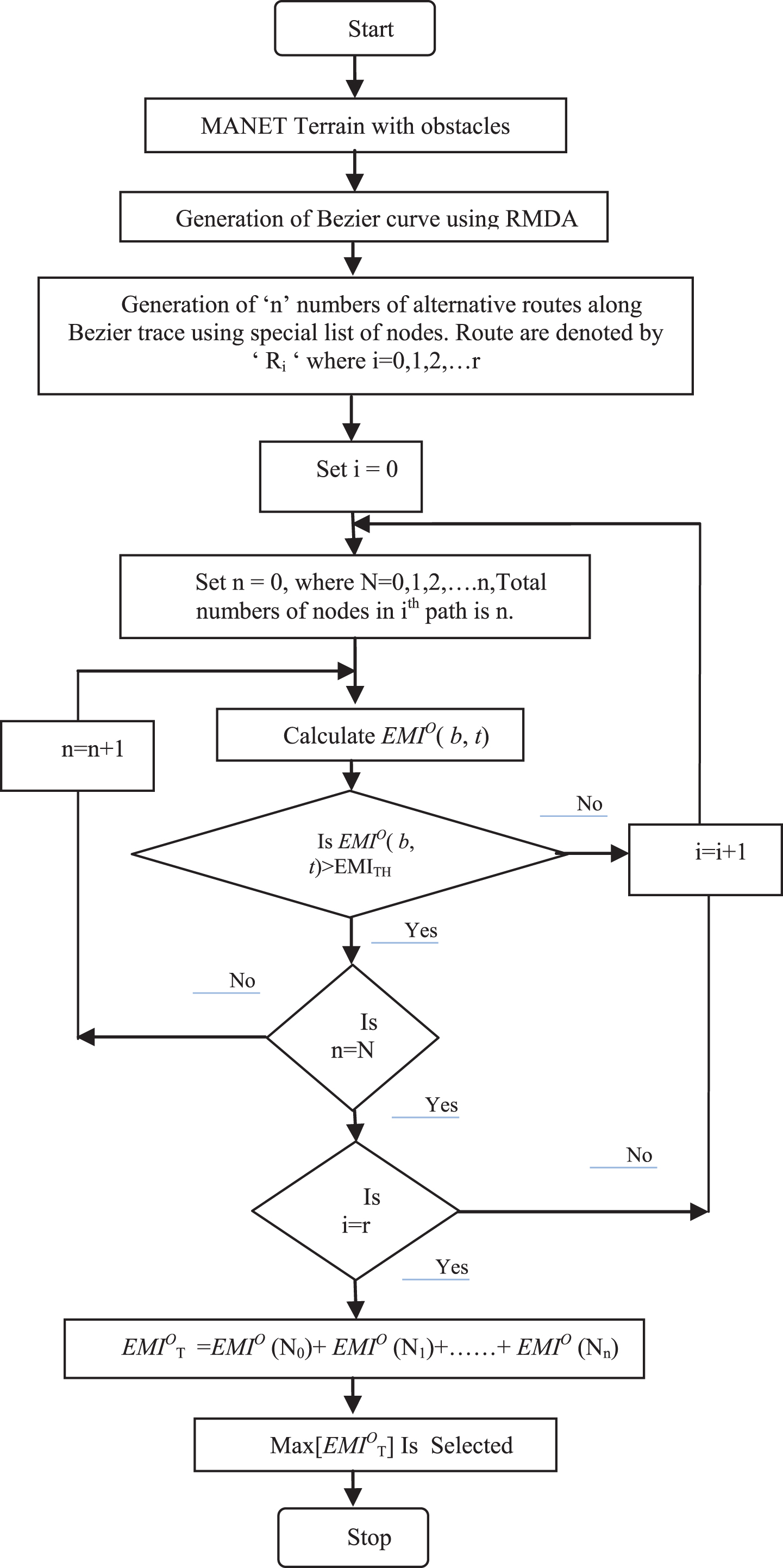
shows the flow chart of OMAR routing.
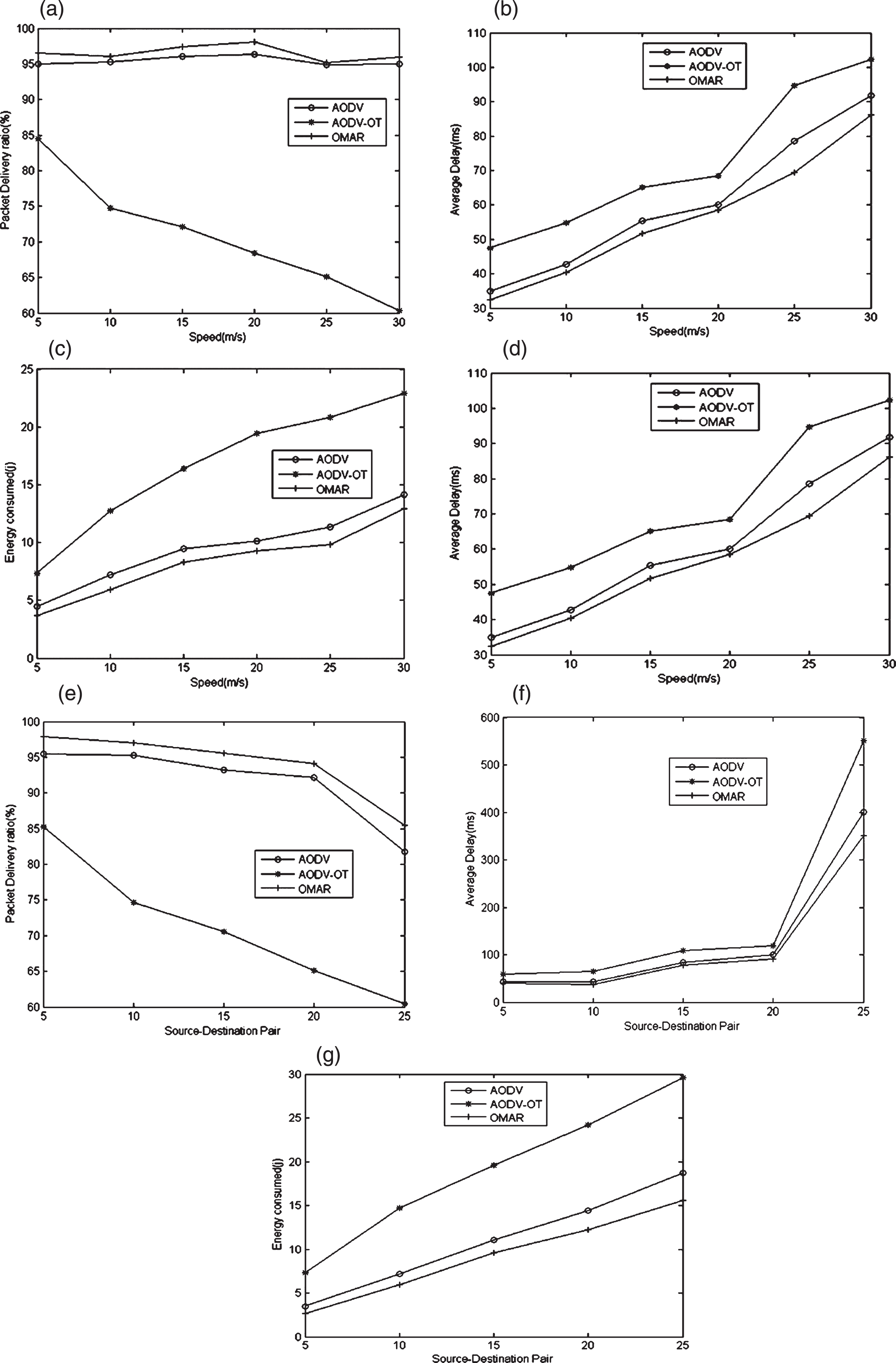
(a) PDR for 50 nodes with 10 sources, (b) Avg Delay 50 nodes with 10 sources, (c) EC for 50 nodes with 10 sources, (d) Routing Overhead for 50 nodes with 10 sources, (e) PDR for 50 nodes with Speed 10 m/s, (f) Avg. Delay for 50 with Speed 10 m/s, (h) Control Overhead for 50 nodes with Speed 10 m/s.
Figure 4(b) shows the variation of Average Delay with respect to speed. Here ‘Average Delay’ is 34.9 ms for AODV at a speed of ‘5 m/s’, it increases as speed increases (Mobility increases) because link breakage also increases. ‘Average Delay’ of AODV-OT is 47.49 ms at a speed of ‘5 m/s’. The increase in delay is due to increase in link break because of presence of obstacles. ‘Average Delay’ of OMAR is 32.34 ms at at speed ‘5 m/s’which is less than AODV. The Average Delay of OMAR is decreased by 6.9 % than AODV Fig. 4(c) signifies the average Energy Consumed in AODV at the speed ‘5 m/s’is 4.48 Joules. Average Energy Consumed in AODV-OT at the speed ‘5 m/s’ is 7.34 Joules.
The increase in energy consumption is due to presence of obstacles which causes repeated link breaks and due to that again route search process is initiated making more energy consumption increases.
In case of OMAR average energy consumption at the speed ‘5 m/s’is 3.65 Joules. The average Energy Consumption of OMAR is decreased by 2.04% than AODV.
Figure 4(d) shows that the normalised Routing Overhead of AODV at the speed ‘5 m/s’is 0.45. Routing Overhead of AODV-OT at the speed ‘5 m/s’is 1.15. The increase in Routing Overhead is due to the presence of obstacles. In case of OMAR Routing Overhead at the speed of ‘5 m/s’is 0.41. The Routing Overhead of OMAR is decreased by 8.86% than AODV. Here in varying mobility scenario the performance of OMAR is better than AODV in plain terrain. This is because of use of Energy based mobility aware routing algorithm.
In this case, source-destination pair is varied, pause time is fixed at 100 sec and speed is at 10 m/s. Simulation carried for MANET with 50 nodes. Here performance of OMAR is analysed and compared with AODV and AODV-OT.
Figure 4(e) indicates the variation of PDR% at different network traffic i.e. Source-Destination Pair (SD Pair). It is observed from Fig. 4(e) that the PDR (%) of AODV is 94.49 for five SD Pairs and decrease slowly to 81.75 for twenty five SD Pairs. The decrease of PDR (%) is due to increase of network traffic (Increase of SD Pair). As network traffic increases network congestion also increases and hence PDR (%) decreases. PDR of AODV-OT is less than AODV and is 85.29%.This is because of more link break in presence of obstacles in realistic terrain.
Same trend is observed for all SD Pairs. PDR of OMAR is more than AODV and is 96.91%.This is because of reduction of link breakage due to implementation of mobility aware optimal routing path. Here the effect of presence of obstacles is overcome by using DeCasteljau Algorithm based on Bezier curve. The Packet Delivery Ratio of OMAR is increased by 2.7 % in comparison to AODV for different cases of network traffic.
It is observed from Fig. 4(f) that the Average Delay of AODV is 43.02 ms for five SD Pairs and increases slowly to 400.2 ms for twenty five SD Pairs. The increase of PDR (%) is due to increase of network traffic because it is known that as network traffic increases network congestion also increases and hence PDR (%) decreases. Average Delay of AODV-OT is more than AODV and is 59.49 ms. This is because of more link breakage in presence of obstacles in realistic terrain. Same trend is observed for all SD Pairs.
Average Delay of OMAR is less than AODV and is 39.70 ms. The Average Delay of OMAR is decreased.
by 10.9 % in comparison to AODV for different cases of network traffic
It is observed from Fig. 4(g) that the average Energy consumed of AODV is 3.49 joules for five SD Pairs and increases slowly to 18.75 joules for twenty five SD Pairs. The increase of Energy consumption is due to increase of network traffic because it is known that as network traffic increases network congestion also increases, more link breaks and hence Energy consumption increases. Average Energy consumption of AODV-OT is more than AODV and is 7.34 joules. This is because of frequent link breaks in presence of obstacles in realistic terrain. Same trend is observed for all SD Pairs. Average Energy consumption of OMAR is less than AODV and is 2.65 joules. The Average Energy consumption of OMAR is decreased by 16.3 % in comparison to AODV for all cases of network traffic.
The performance of OMAR is better than AODV in plane terrain, this is because of effect of presence of obstacle is avoided by using the OMAR algorithm. The mobility effect and chance of dropping of a node due to shortage of energy is compensated by using Energy based mobility aware routing.
Conclusion
The proposed Obstacle and Mobility Aware Optimal Routing (OMAR) for MANET performs satisfactorily in presence of obstacles in a MANET terrain thereby improving the performance of the MANET. The performances of AODV and AODV-OT are compared with the proposed Obstacle and Mobility Aware Optimal Routing (OMAR) in obstacle environment. It is concluded from the simulation that the OMAR yields good enhancement in Packet Received Ratio, Average Delay, Energy Consumption and Control Overhead metrics in varying mobility and traffic scenario.