There are mainly two classes of approaches in the studies of Formal Concept Analysis (FCA), i.e. the constructive and axiomatic approaches. In axiomatic approach, operators are interpreted by using operations in mathematical systems instead of operations in a formal context. Seeking for minimal axioms to characterize the concept generation operators is an important issue in the research of the axiomatic approach. In this paper, axiomatic characterizations of set-theoretic operators are investigated. We construct an adjoint generalized (dual) concept systems in which the pair of classical concept generation operators are represented by one set-theoretic operator, and the other operator can be obtained from the former. Compared with the previous methods, the proposed generalized (dual) concept systems have fewer axioms and is easy to verify. Some properties of adjoint generalized (dual) concept systems are examined.
The theory of formal concept analysis (FCA), originally proposed by Wille [4, 43] in 1982, is a model for the study of formal concepts and conceptual hierarchies. In the last two decades, it has been studied from various perspectives, such as its mathematical foundations [1, 41], the generalizations of formal concepts [17, 53], relationship with other theories [2, 52], knowledge reduction and rule acquisition [12, 47]. Currently, FCA has been successfully applied to information retrieval, knowledge discovery, data mining, machine learning, software engineering and other disciplines [3, 26].
FCA is formulated on the basis of a formal context represented by a binary relation between a pair of sets. The formal concept is constructed from a formal context by using a pair of set-theoretic operators, and all the formal concepts combined with a partial order form a concept lattice (CL). In the above process, formal contexts and binary relations are primitive notions, which is referred to the constructive approach. From this perspective, the pair of set-theoretic operators that generate all concepts are defined on a formal context. In the constructive approach, the physical meaning of set-theoretic operators is associated with the binary relations R. Most of the research on FCA is carried out along this line.
In contrast, the axiomatic approach focuses on the algebraic properties of set-theoretic operators. The axiomatic approach regards the pair of set-theoretic operators as primitive notions, in which a set of axioms is used to characterize the pair of set-theoretic operators that are the same as the ones produced by using the constructive approach. In axiomatic approach, operators are interpreted by using operations in mathematical systems instead of operations in a specific formal context.
The axiomatic approach of FCA was proposed from the viewpoint of algebra, and the idea was inspired by rough set theory (RS) [28]. Many authors explored and developed the axiomatic approach in the study of RS theory [40, 58]. In recent years, the axiomatic approach of fuzzy RS has been a research hotspot [18, 44– 46]. Zhang et al. [54] first proposed the axiomatic approach in the study of FCA, in which set-theoretic operators are primitive notions. In their approach, a set of axioms is used to characterize the pair of set-theoretic operators and the formal context can be obtained from the pair of set-theoretic operators.
Recently, there has been an increasing interest in the axiomatic approach of CL, and several axiomatic methods related to FCA have been proposed [5, 30]. Among which, Ma and Zhang [21] presented axiomatic characterizations of dual concept lattices. An important contribution of the authors is that they characterized a pair of dual concept lattices by using different sets of axioms. Rodrĺłguez-Lorenzo et al. [31] proposed a complete axiomatic system for conditional attribute implications in triadic concept analysis. In another interesting work, Li et al. applied the axiomatic approach of concept systems to concept learning and cognitive computing on the basis of isotone Galois connection [7, 57].
Along the line of Ma and Zhang’s study on the axiomatic approach of CL [21], this paper focuses on axiomatic characterizations of generalized (dual) concept systems. In the paper, we propose an adjoint generalized (dual) concept system with two axioms, that is, we use fewer axioms to construct a generalized (dual) concept system. The rest of this paper is organized as follows. We review some basic notions of formal concepts and concept lattices in Section 2. In Section 3, we construct a kind of adjoint generalized concept system and discuss its properties. Section 4 proposes an adjoint generalized dual concept system and discuss its properties. Section 5 concludes the paper and outlines the future work.
Preliminaries
In this section we briefly recall some relevant notions needed for our purposes (please refer to [4, 21] for further details).
A formal context is a triplet , where U is a non-empty finite set of objects, A is a non-empty finite set of attributes and I is a relation between U and A. Where, (x, a) ∈ I means that object x has attribute a or the attribute a is possessed by object x. For any X ⊆ U, B ⊆ A, the pair of set-theoretic operators * and ★ are defined by
Let (U, A, I) be a formal context, the operators ∗ and ★ satisfy the followings properties (see [4]): for all X1, X2, X ⊆ U and B1, B2, B ⊆ A,
A pair (X, B) of two sets X ⊆ U and B ⊆ A is called a formal concept if X = B★ and B = X∗. Where, X and B are called the extent and the intent of the concept. The set of all concepts of (U, A, I) is denoted by , that is,
Under partial order ≤ defined by
for , forms a CL with meet and join given by:
For any X ⊆ U and B ⊆ A, the other pair of set-theoretic operators △ and ▽ are defined as
where, ∼ denotes the complement of a set.
Let (U, A, I) be a formal context, the operators △ and ▽ satisfy the followings properties (see [21, 51]): for all X1, X2, X ⊆ U, B1, B2, B ⊆ A,
A pair (X, B) of two sets X ⊆ U and B ⊆ A is called a dual formal concept if X = B▽ and B = X△. X and B act as the extent and the intent of the dual concept, respectively. We denote the set of all dual concepts of (U, A, I) by . The partial order ≤ is given by
for .
forms a CL with meet and join defined by:
Axiomatic characterizations of adjoint generalized concept systems
In this section, we first propose an adjoint generalized concept system (AGCS), then discuss its axiomatic characterizations and properties. Where, the term “adjoint" means that the pair of operators generating generalized concept system is adjoint.
Definition 1. Let and be a pair of set-theoretic operators between power sets and . The sextuple is called an AGCS, if the operators L and H satisfy the following axioms: for all , ,
(AL) L (X ∪ Y) = L (X) ∩ L (Y),
(AH)
From the above definition, we know that , ∪, ∩) is a set algebra and adjoint generalized concept system is an algebra system.
The pair of set-theoretic operators in an AGCS satisfy the following fundamental properties.
Proposition 1.Let be an AGCS. Then the following conclusions hold for all , ,
(1) X1 ⊆ X2 ⇒ L (X2) ⊆ L (X1);
(2) B1 ⊆ B2 ⇒ H (B2) ⊆ H (B1);
(3) L (X1) ∪ L (X2) ⊆ L (X1 ∩ X2);
(4) H (B1) ∪ H (B2) ⊆ H (B1 ∩ B2).
Proof. It can be easily derived from axioms (AL) and (AH). □
Now we review some well known facts between Galois connection and complete lattice.
Definition 2. [4] Let φ : P → Q and φ : Q → P be mappings between ordered sets (P, ≤) and (Q, ≤). A pair (φ, φ) of mappings is called a Galois connection between the ordered sets if
(i) p1 ≤ p2 ⇒ φ (p1) ≥ φ (p2),
(ii) q1 ≤ q2 ⇒ φ (q1) ≥ φ (q2),
(iii) p ≤ φφ (p) and q ≤ φφ (q).
The two mapings then are called dually adjoint to each other.
Note that above conditions (i), (ii) and (iii) are equivalent to the following one:
Theorem 1.The pair (L, H) of set-theoretic operators defined in Definition 1 forms a Galois connection between and .
Proof. Assume that , and X1 ⊆ X2. According to (AL), we have
which implies Definition 2 (i). Similarly, we can prove Definition 2 (ii).
For any , we have
By the similar proof we have H (L (X)) ⊇ X.
From above assertions, we conclude that Definition 2 (iii) holds. Hence, (L, H) is a Galois connection between and . □
In the following, for the sake of simplicity, we denote H (L (X)) and L (H (B)) as H ∘ L (X) and L ∘ H (B) respectively.
Proposition 2.Let be an AGCS, and . Then L ∘ H ∘ L (X) = L (X), H ∘ L ∘ H (B) = H (B).
Proof. By Equation (7), we have L ∘ H (B) ⊇ B. It follows from Proposition 1 (2) that
On the other hand, from Equation (8) it is easy to show that
Therefore, H ∘ L ∘ H (B) = H (B). By the similar proof we obtain L ∘ H ∘ L (X) = L (X). □
Proposition 3.Letφ : P → Q, φ1 : Q → P and φ2 : Q → P be mappings between ordered sets (P, ≤) and (Q, ≤). If pairs (φ, φ1) and (φ, φ2) are Galois connections between the ordered sets, then φ1 = φ2.
Proof. For any p ∈ P, q ∈ Q, by Equation (5) we have
Hence
Suppose φ1 ≠ φ2. Then there exists q1 ∈ Q such that φ1 (q1) > φ2 (q1) or φ1 (q1) < φ2 (q1). We denote φ1 (q1) = p1. If φ1 (q1) > φ2 (q1), then we have φ1 (q1) = p1 > φ2 (q1), which contradicts Equation (9). By the similar proof, we obtain that φ1 (q1) < φ2 (q1) contradicts Equation (9). Therefore, φ1 = φ2. □
By Proposition 3, it can be easily seen that a mapping’s dually adjoint is unique. That is, if a mapping is given, then its dually adjoint is also determined.
Recall that Ma and Zhang’s definition of generalized concept system (GCS) is defined as follows [21].
Definition 3. [21] Let and be a pair of set-theoretic operators between power sets and . The sextuple is called a GCS, if the operators L and H satisfy the following axioms: for all , ,
(L) L (X ∪ Y) = L (X) ∩ L (Y),
(H) H (B ∪ C) = H (B) ∩ H (C),
(LH) X ⊆ H (L (X)) and B ⊆ L (H (B)).
Note that operators L and H in Definition 3 are defined independently, however, operator H in Definition 1 are defined by operator L. On the other hand, axiom (LH) in Definition 3 is difficult to verify. Comparing with a GCS, an AGCS has fewer axioms and is easy to verify.
Theorem 2.Let and be a pair of set-theoretic operators between power sets and . Then the sextuple is an AGCS iff is a GCS.
Proof. (⇒) It is evident that (L) holds. Here, we are to prove (H). For any , we have
from which (H) follows. (LH) follows immediately from Equations (7) and (8). Hence, , ∪, ∩ , L, H) is a GCS.
(⇐) By Definition 2 and using (L),(H) and (LH), we can easily conclude that the pair (L, H) of operators forms a Galois connection between and . We define the mapping by
From Theorem 2, it is easy to check that the pair (L, H1) of operators also forms a Galois connection. By Proposition 3, we conclude that H = H1. Combining the fact and (L), we immediately conclude that is an AGCS. □
Remark. The above theorem shows that an AGCS is equivalent to a GCS. The proposed AGCS deleted two of three axiomatic characterizations but added another condition. That is to say, the new axiomatic system is constructed by two axiomatic characterizations. An AGCS can be regarded as a specific explanation and implementation of a GCS in the viewpoint of the adjoint operators.
Theorem 3.Let and be two set-theoretic operators. Then there exists a 0-1 binary relation I ⊆ U × A such that (U, A, I) is a formal context, and the operators defined by Equations (1) and (2) satisfy L (X) = X∗ and H (B) = B★ () iff the operators L and H satisfy axioms (AL) and (AH).
Proof. (⇒) Easy, it is omitted.
(⇐) Putting I = {(x, a) | a ∈ L ({x})} (x ∈ U, a ∈ A), then we obtain a formal context (U, A, I). For any , by Equation (1) we have
For any , using Equation (2) and the proof of Theorem 1 we have
we have completed the proof of the theorem. □
By Theorem 3, we can obtain a formal context from an AGCS, and vice versa.
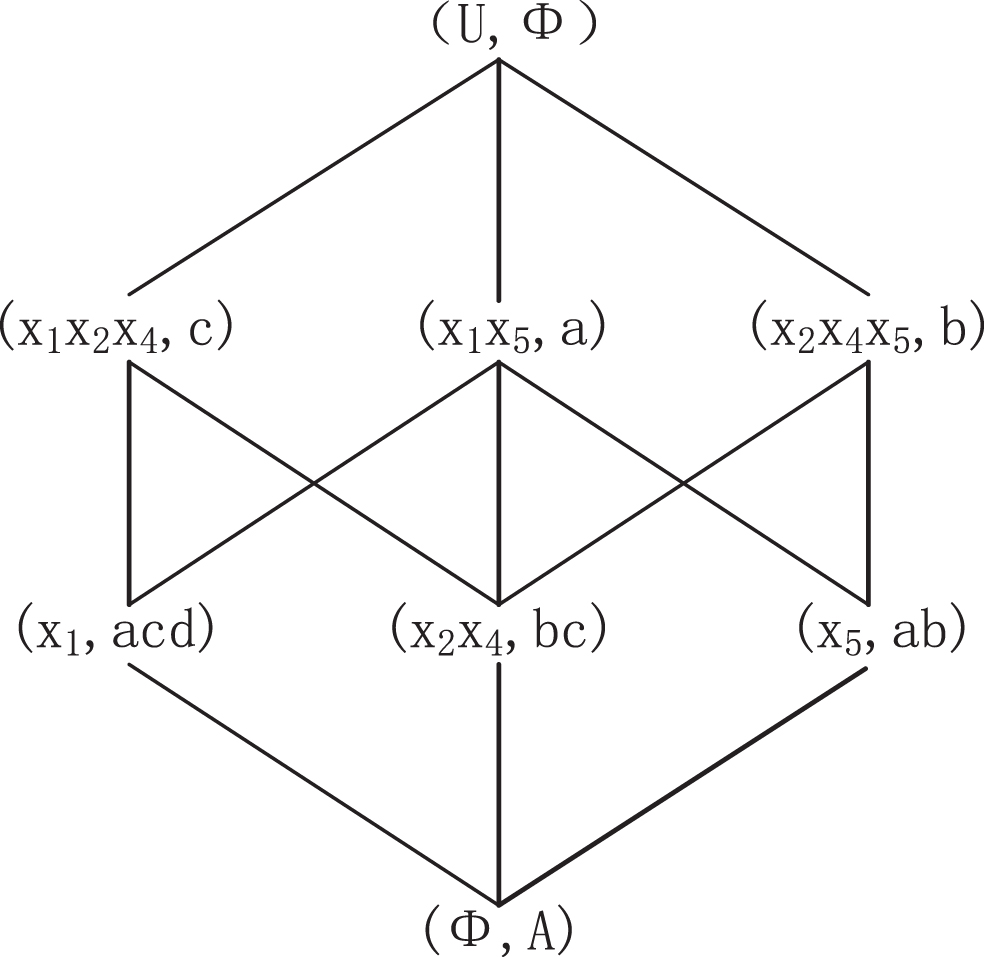
Example 1. For U = {x1, x2, x3, x4, x5}, A = {a, b, c, d}, X ⊆ U and B ⊆ A, define the operators and as follows:
The formal context (U, A, I)
I
a
b
c
d
x1
1
0
1
1
x2
0
1
1
0
x3
1
0
0
1
x4
0
1
1
0
x5
1
1
0
0
It can be checked that is an AGCS. For x ∈ U and a ∈ A, we define I = {(x, a) |x ∈ L ({a})}. Then (U, A, I) is a formal context and is showed in Table 1. Figure 1 depicts the Hasse diagram of lattice .
.
From Example 1, we can obtain a concept lattice from an AGCS. Therefore, the knowledge hidden in the an AGCS can be mined and presented.
Axiomatic characterizations of adjoint generalized dual concept systems
In this section, we first propose an adjoint generalized dual concept system (AGDCS), then present its axiomatic characterizations and properties.
Definition 4. Let and be a pair of set-theoretic operators between power sets and . The sextuple is called an AGDCS, if the operators Ld and Hd satisfy the following axioms: for all , ,
(ALd) Ld (X ∩ Y) = Ld (X) ∪ Ld (Y),
(AHd) .
From Definition 4, we know that is a set algebra and adjoint generalized dual concept system is an algebra system.
The pair of set-theoretic operators in an AGDCS satisfy the following fundamental properties.
Proposition 4.Let be an AGDCS. Then the following conclusions hold for all , ,
(1) X1 ⊆ X2 ⇒ Ld (X2) ⊆ Ld (X1);
(2) B1 ⊆ B2 ⇒ Hd (B2) ⊆ Hd (B1);
(3) Ld (X1) ∩ Ld (X2) ⊆ Ld (X1 ∪ X2);
(4) Hd (B1) ∩ Hd (B2) ⊆ Hd (B1 ∩ B2).
Proof. It can be easily derived from axioms (ALd) and (AHd).
Definition 5. Let φ : P → Q and φ : Q → P be mappings between ordered sets (P, ≤) and (Q, ≤). A pair (φ, φ) of mappings is called a dual Galois connection between the ordered sets if
(i) p1 ≤ p2 ⇒ φ (p1) ≥ φ (p2),
(ii) q1 ≤ q2 ⇒ φ (q1) ≥ φ (q2),
(iii) p ≥ φφ (p) and q ≥ φφ (q).
Proposition 5.Let φ : P → Q and φ : Q → P be mappings between ordered sets (P, ≤) and (Q, ≤). A pair (φ, φ) of mappings is a dual Galois connection iff
Proof. (⇒) Suppose p ≥ φ (q). From Definition 5 (i), we have φ (p) ≤ φφ (q), and by Definition 5 (iii) we have φ (p) ≤ q. Thus, p ≥ φ (q) ⇒ φ (p) ≤ q. Conversely, from φ (p) ≤ q we can obtain p ≥ φ (q) symmetrically.
(⇐) Since φ (p) ≤ φ (p) and φ (q) ≤ φ (q), by Equation (10) they follow that p ≥ φφ (p) and q ≥ φφ (q). Thus, we have proved Definition 5 (iii). Suppose p1 ≤ p2 and q1 ≤ q2. By employing Definition 5 (iii), we have p2 ≥ φφ (p1), by Equation (10) it follows that φ (p1) ≥ φ (p2). By the similar proof, we obtain φ (q1) ≥ φ (q2). □
Proposition 5 states that conditions (i), (ii) and (iii) in Definition 5 are equivalent to Equation (10).
Theorem 4.The pair (Ld, Hd) of set-theoretic operators defined in Definition 4 forms a dual Galois connection between and .
Proof. Assume that , and X1 ⊆ X2. According to Definition 4, we have
which implies Definition 5 (i). By the similar proof, we obtain Definition 5 (ii).
For any , we have
On the other hand, for any , it follows that
From Equations (11) and (12), we conclude that Definition 5 (iii) holds. Therefore, (Ld, Hd) is a dual Galois connection between and . □
Proposition 6.Let be an AGCS, and . Then Ld ∘ Hd ∘ Ld (X) = Ld (X), Hd ∘ Ld ∘ Hd (B) = Hd (B).
Proof. It is similar to the proof of Proposition 2. □
Proposition 7. Let φd : P → Q, φ1d : Q → P and φ2d : Q → P be mappings between ordered sets (P, ≤) and (Q, ≤). If pairs (φd, φ1d) and (φd, φ2d) are dual Galois connections between the ordered sets, then φ1d = φ2d.
Proof. It is similar to the proof of Proposition 3. □
By Proposition 7, it can be easily seen that a mapping’s dually adjoint is uniquely determined.
Recall that the definition of generalized dual concept system is defined as follows [21].
Definition 6. Let and be a pair of set-theoretic operators between power sets and . The sextuple is called a GDCS, if the operators Ld and Hd satisfy the following axioms: for all , ,
(Ld) Ld (X ∩ Y) = Ld (X) ∪ Ld (Y),
(Hd) Hd (B ∩ C) = Hd (B) ∪ Hd (C),
(LdHd) X ⊇ Hd (Ld (X)) and B ⊇ Ld (Hd (B)).
Theorem 5.Let and be a pair of set-theoretic operators between power sets and . Then the sextuple is an AGDCS iff is a GDCS.
Proof. (⇒) It is evident that (Ld) holds. Here, we are to prove (Hd). For any , we have
from which (Hd) follows. (LdHd) follows immediately from Equations (11) and (12). Therefore,
is a GDCS.
(⇐) By Definition 5 and using (Ld),(Hd) and (LdHd), we can easily conclude that the pair (Ld, Hd) of operators forms a dual Galois connection between and . Define the mapping by
From Theorem 4, it is easy to check that the pair of operators (Ld, H1d) also forms a dual Galois connection. By Proposition 7, we conclude that Hd = H1d. Using above assertion and (AL), we immediately conclude that is an AGDCS. □
Remark. The above theorem shows that an AGDCS is equivalent to a GDCS. An AGDCS can be regarded as a specific explanation and implementation of a GDCS in the viewpoint of the adjoint operators.
Theorem 6.Let and be two set-theoretic operators. Then there exists a 0-1 binary relation I ⊆ U × A such that (U, A, I) is a formal context, and the operators defined by Equations (3) and (4) satisfy Ld (X) = X△ and Hd (B) = B▽ () iff the operators Ld and Hd satisfy axioms (ALd) and (AHd).
Proof. (⇒) It follows immediately.
(⇐) Putting I = {(x, a) | a ∉ Ld ({x} ∼)} (x ∈ U, a ∈ A). We are going to prove that
For any x ∈ U and a ∈ A, we obtain from Equations (3), (4) and the proof of Theorem 4 that
Similarly, we can verify that
Thus, we have
from which we conclude that
For any , using Equation (4) and the proof of Theorem 4 we have
The proof that X△ = Ld (X) is similar. □
From Theorem 6, we can obtain a formal context from an AGDCS, and vice versa.
Example 2. Let U = {x1, x2, x3, x4, x5} and A = {a, b, c, d}. The operators and are defined as follows: for all Xi ⊆ U, B ⊆ A,
It is easy to verify that is an AGDCS. For x ∈ U and a ∈ A, we define I = {(x, a) | a ∉ Ld ({x} ∼)}. Then (U, A, I) is a formal context (represented by Table 2, Ld (X) = X△ and Hd (B) = B▽.
Formal context (U, A, I)
I
a
b
c
d
e
x1
1
0
1
1
1
x2
0
1
0
0
1
x3
1
0
1
1
0
x4
0
1
0
0
1
x5
1
0
1
1
1
Corollary 1.Let and be a pair of set-theoretic operators between power sets and . The sextuple is an AGCS if and only if for all , :
(1) (L (X ∩ Y) ∼) ∼ = (L (X∼)) ∼ ∪ (L (Y∼)) ∼,
(2) .
Proof. (⇒) By (AL), we have
(⇐) For any , by the assumption we have
which implies that L (X ∪ Y) = L (X) ∩ L (Y). It follows from Definition 1 that , ∩, L, H) is an AGCS. □
Corollary 2.Let and be a pair of set-theoretic operators between power sets and . The sextuple is an AGDCS if and only if for all , :
Proof. (⇒) For any , by (ALd) we have
which implies that L (X ∪ Y) = L (X) ∩ L (Y).
(⇐) For any , by the assumption we have
It follows from Definition 4 that
is an AGDCS. □
Corollaries 1 and 2 show the relationship between an AGCS and an AGDCS.
Conclusion
There are mainly two approaches in the study of concept lattices, i.e., the constructive and axiomatic approaches. Many researchers investigated the constructive approach in the development of FCA. Comparing with the constructive approach, less effort has been made to the axiomatic approach in the study of FCA. Axiomatic characterizations of set-theoretic operators are important in the study of concept lattice. The axiomatic approach focuses on the algebraic properties of set-theoretic operators without being restricted to any explicitly formal contexts. In the paper, axiomatic characterizations of set-theoretic operators are investigated. In this approach, a set of properties is used to characterize the pair of set-theoretic operators that are the same as the ones produced by using the constructive approach. We construct an adjoint generalized (dual) concept systems by using a pair of adjoint operators, and the pair of concept generation operators can be represented by one set-theoretic operator. Compared with the previous methods, the proposed adjoint generalized (dual) concept systems have fewer axioms and is easy to verify. The research results may improve our understanding of CL’s algebraic properties. Note that the axiomatic approach of generalized (dual) concept systems discussed in this paper are based on antitone Galois connection. The axiomatic approach of generalized (dual) concept systems generated from isotone Galois connection is a problem worthy of further research. Knowledge reduction and rules acquisition in adjoint generalized (dual) concept systems should be further studied also.
Footnotes
Acknowledgement
This work was supported by the grants from the National Natural Science Foundation of China (Nos. 61673396, 61573321, 61572082), Shandong Provincial Natural Science Foundation (No. ZR2015FM022), the Fundamental Research Funds for the Central Universities under Grant (No. 16CX02008A, 18CX02133A) and National Social Science Foundation of China (No.14XXW004).
References
1.
ButkaP. and PócsJ., Generalization of one-sided concept lattices, Computing and Informatics32 (2013), 355–370.
2.
ChenJ.k., LiJ.J., LinY.J., LinG.P. and MaZ.M., Relations of reduction between covering generalized rough sets and concept lattices, Information Sciences304 (2015), 16–27.
3.
FormicaA., Semantic Web search based on rough sets and Fuzzy Formal Concept Analysis, Knowledge-Based Systems26 (2012), 40–47.
GongF.M., ShaoM.W. and QiuG.F., Concept granular computing systems and their approximation operators, International Journal of Machine Learning and Cybernetics8(2) (2017), 627–640.
6.
HashemT., AhmedC.F., SamiullahM., et al., Assessing semantic annotation activities with formal concept analysis, Expert Systems with Applications41 (2014), 2914–2938.
7.
HuangC.C., LiJ.H., MeiC.L. and WuW.Z., Three-way concept learning based on cognitive operators: An information fusion viewpoint, International Journal of Approximation Reasoning83 (2017), 218–242.
8.
KangX.P., LiD.Y., WangS.G. and QuK.S., Formal concept analysis based on fuzzy granularity base for different granulations, Fuzzy Sets and Systems203 (2012), 33–48.
9.
KaytoueM., KuznetsovS.O., NapoliA. and DuplessisS., Mining gene expression data with pattern structures in formal concept analysis, Information Sciences181 (2011), 1989–2001.
10.
KumarC.A. and SrinivasS., Concept lattice reduction using fuzzy K-means clustering, Expert Systems with Applications37 (2010), 2696–2704.
11.
KumarC.A., Fuzzy clustering-based formal concept analysis for association rules mining, Applied Artificial Intelligence26(3) (2012), 274–301.
12.
LiJ.H., MeiC.L., KumarC.A. and ZhangX., On rule acquisition in decision formal contexts, International Journal of Machine Learning and Cybernetics4(6) (2013), 721–731.
13.
LiJ.H., MeiC.L., XuW.H. and QianY.H., Concept learning via granular computing: A cognitive viewpoint, Information Sciences298 (2015), 447–467.
14.
LiJ.H., RenY., MeiC.L., QianY.H. and YangX.B., A comparative study of multigranulation rough sets and concept lattices via rule acquisition, Knowledge-Based Systems91 (2016), 152–164.
15.
LiJ.H., KumarC.A., MeiC.L. and WangX.Z., Comparison of reduction in formal decision contexts, International Journal of Approximate Reasoning80 (2017), 100–122.
16.
LiK.W., ShaoM.W. and WuW.Z., A data reduction method in formal fuzzy contexts, International Journal of Machine Learning and Cybernetics8(4) (2017), 1145–1155.
17.
LiM.Z. and WangG.Y., Approximate concept construction with three-way decisions and attribute reduction in incomplete contexts, Knowledge-Based Systems91 (2016), 165–178.
18.
LiuG.L., Axiomatic systems for rough sets and fuzzy rough sets, International Journal of Approximate Reasoning48 (2008), 857–867.
19.
LiuG.L., Using one axiom to characterize rough set and fuzzy rough set approximations, Information Sciences223 (2013), 285–296.
20.
MaJ.M., ZhangW.X., LeungY. and SongX.X., Granular computing and dual Galois connection, Information Sciences177(23) (2007), 5365–537.
21.
MaJ.M. and ZhangW.X., Axiomatic characterizations of dual concept lattices, International Journal of Approximate Reasoning54 (2013), 690–697.
22.
MaJ.M., CaiM.J. and ZouC.J., Concept acquisition approach of object-oriented concept lattices, International Journal of Machine Learning and Cybernetics8(1) (2017), 3–20.
23.
MedinaJ. and Ojeda-AciegoM., Multi-adjoint t-concept lattices, Information Sciences180 (2010), 712–725.
24.
MedinaJ. and Ojeda-AciegoM., Dual multi-adjoint concept lattices, Information Sciences225 (2013), 47–54.
25.
MiJ.S. and ZhangW.X., An axiomatic characterization of a fuzzy generalization of rough sets, Information Sciences160 (2004), 235–249.
26.
NiuJ.J., HuangC.C., LiJ.H. and FanM., Parallel computing techniques for concept-cognitive learning based on granular computing, International Journal of Machine Learning and Cybernetics9(11) (2018), 1785–1805.
27.
MorsiN.N. and YakoutM.M., Axiomatics for fuzzy rough sets, Fuzzy Sets and Systems 100 (1998), 327–342.
28.
PawlakZ., Rough sets, International Journal of Computer and Information Science11 (1982), 341–356.
29.
QiJ.J., QianT. and WeiL., The connections between three-way and classical concept lattices, Knowledge-Based Systems91 (2016), 143–151.
30.
QiuG.F., MaJ.M., YangH.Z. and ZhangW.X., A mathematical model for concept granular computing systems, Science China (Information Sciences)53(7) (2010), 1397–1408.
31.
Rodriguez-LorenzoE., CorderoP., EncisoM., MissaouiR. and MoraA., An axiomatic system for conditional attribute implications in triadic concept analysis, International Journal of Intelligent Systems32(8) (2017), 760–777.
32.
ShaoM.W., LiuM. and ZhangW.X., Set approximations in fuzzy formal concept analysis, Fuzzy Set and Systems158 (2007), 2627–2640.
33.
ShaoM.W., LeungY., WangX.Z. and WuW.Z., Granular Reducts of Formal Fuzzy Contexts, Knowledge-Based Systems114(15) (2016), 156–166.
34.
ShaoM.W. and LiK.W., Attribute reduction in generalized onesided formal contexts, Information Sciences378 (2017), 317–327.
35.
ShaoM.W., GuoL. and WangC.Z., Connections between twouniverse rough sets and formal concepts, International Journal of Machine Learning and Cybernetics9(11) (2018), 1869–1877.
36.
ShivhareR. and Aswani KumarCh., Three-way conceptual approach for cognitive memory functionalities, International Journal of Machine Learning and Cybernetics8(1) (2017), 21–34.
37.
SinghP.K. and KumarC.A., Bipolar fuzzy graph representation of concept lattice, Information Sciences288 (2014), 437–448.
38.
SheY.H. and WangG.J., An axiomatic approach of fuzzy rough sets based on residuated lattices, Computers & Mathematics with Applications58(1) (2009), 189–201.
39.
TanA.H., liJ.J. and LinG.P., Connections between covering-based rough sets and concept lattices, International Journal of Approximate Reasoning56 (2015), 43–58.
40.
ThieleH., On axiomatic characterisation of crisp approximation operators, Information Sciences129 (2000), 221–226.
41.
WangL.D. and LiuX.D., Concept analysis via rough set and AFS algebra, Information Sciences178 (2008), 4125–4137.
42.
WeiL. and QiJ.J., Relation between concept lattice reduction and rough set reduction, Knowledge-Based Systems23 (2010), 934–938.
43.
WilleR., Restructuring lattice theory: An approach based on hierarchies of concepts, in: I. Rival (Ed.), Ordered Sets, Reidel, Dordrecht-Boston, 1982, pp. 445–470.
44.
WuW.Z., MiJ.S. and ZhangW.X., Generalized fuzzy rough sets, Information Sciences151 (2003), 263–282.
45.
WuW.Z. and ZhangW.X., Constructive and axiomatic approaches of fuzzy approximation operators, Information Sciences159 (2004), 233–254.
46.
WuW.Z., LiT.J. and GuS.M., Using one axiom to characterize fuzzy rough approximation operators determined by a fuzzy implication operator, Fundamenta Informaticae142 (2015), 87–104.
47.
WuW.Z., LeungY. and MiJ.S., Granular computing and knowledge reduction in formal contexts, IEEE Transactions Knowledge and Data Engineering21(10) (2009), 1461–1474.
48.
YangX.P. and LiT.J., The minimization of axiom sets characterizing generalized approximation operators, Information Sciences176 (2006), 887–899.
49.
YangX.P., Minimization of axiom sets on fuzzy approximation operators, Information Sciences177 (2007), 3840–3854.
50.
YaoY.Y., Two views of the theory of rough sets in finite universes, International Journal of Approximate Reasoning15 (1996), 291–317.
51.
YaoY.Y., Constructive and algebraic methods of the theory of rough sets, Journal of Information Sciences109 (1998), 21–47.
52.
YaoY.Y., A comparative study of formal concept analysis and rough set theory in data analysis, 4th International Conference on Rough Sets and Current Trends in Computing, LNCS, vol. 3066, Springer, Beilin, 2004, pp. 59–68.
53.
YaoY.Y., Interval sets and three-way concept analysis in incomplete contexts, International Journal of Machine Learning and Cybernetics8(1) (2017), 3–20.
54.
ZhangW.X., YangH.Z., MaJ.M. and QiuG.F., Concept granular computing based on lattice theoretic setting, Studies in Computational Intelligence182 (2009), 67–94.
55.
ZhangY.L., LiJ.J. and WuW.Z., On axiomatic characterizations of three pairs of covering based approximation operators, Information Sciences180 (2010), 274–287.
56.
ZhangY.L. and LuoM.K., On minimization of axiom sets characterizing covering-based approximation operators, Information Sciences181 (2011), 3032–3042.
57.
ZhaoY.X., LiJ.H., LiuW.Q. and XuW.H., Cognitive concept learning from incomplete information, International Journal of Machine Learning and Cybernetics8(1) (2017), 3–20.
58.
ZhuW. and WangF.Y., Reduction and axiomization of covering generalized rough sets, Information Sciences152 (2003), 217–230.